
Market Overview
| Study Period | 2021 - 2032 |
|---|---|
| Forecast Data Period | 2027 - 2032 |
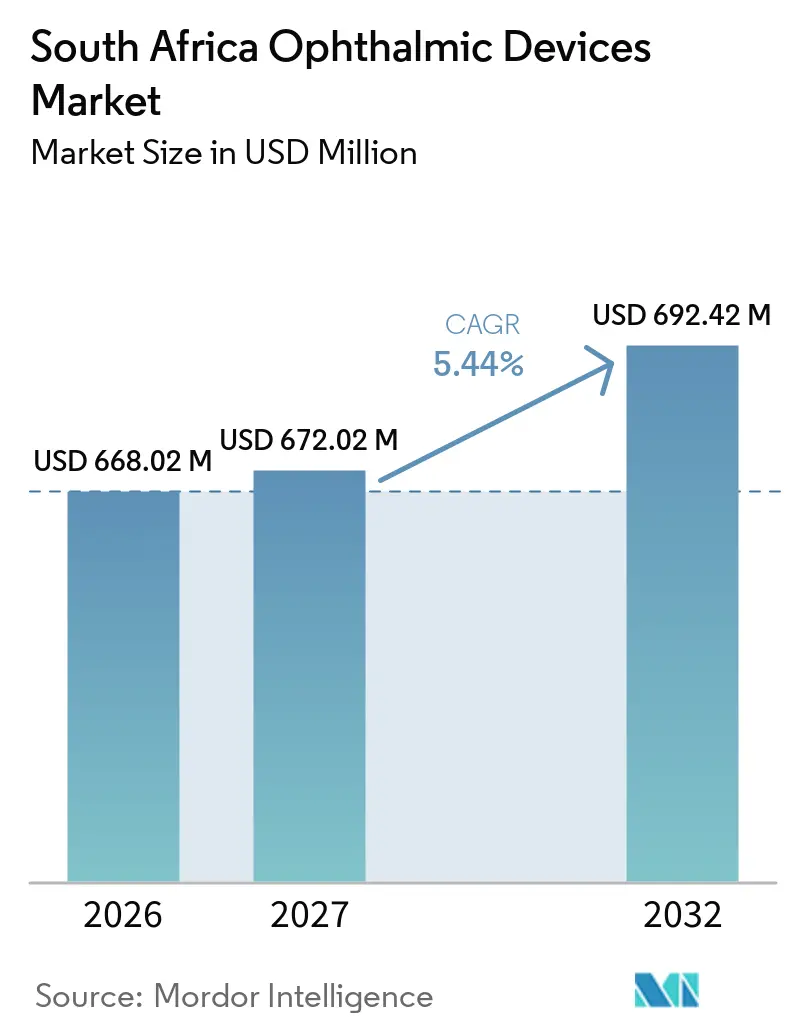
| Base Year Market Size (2026) | USD 668.02 Million |
| Market Size (2027) | USD 672.02 Million |
| Market Size (2032) | USD 692.42 Million |
| Growth Rate (2027 - 2032) | 5.44 % |
| Market Concentration | Medium |
Major Players *Disclaimer: Major Players sorted in no particular order Image © Mordor Intelligence. Reuse requires attribution under CC BY 4.0. | |
South Africa Ophthalmic Devices Market Analysis by Mordor Intelligence
The South Africa ophthalmic devices market size is expected to grow from USD 668.02 million in 2026 to USD 672.02 million in 2027, and is forecasted to reach USD 692.42 million by 2032 at 5.44% CAGR over 2027-2032. Demand is expanding as rising cataract surgery volumes, growing diabetic retinopathy screening programs, and wider medical-scheme reimbursement converge with technology upgrades in both public and private settings. Multinational manufacturers have responded by establishing local assembly hubs to offset rand volatility, while public-sector tenders increasingly specify whole-of-life service contracts that bundle devices with training and maintenance. Early adoption of AI-assisted diagnostics in urban hospitals is demonstrating workflow gains that, in turn, spur purchases of high-resolution OCT and fundus imaging systems. Simultaneously, the proliferation of optical retail chains in townships is broadening the entry-level pool of patients who later transition to surgical care.
Key Report Takeaways
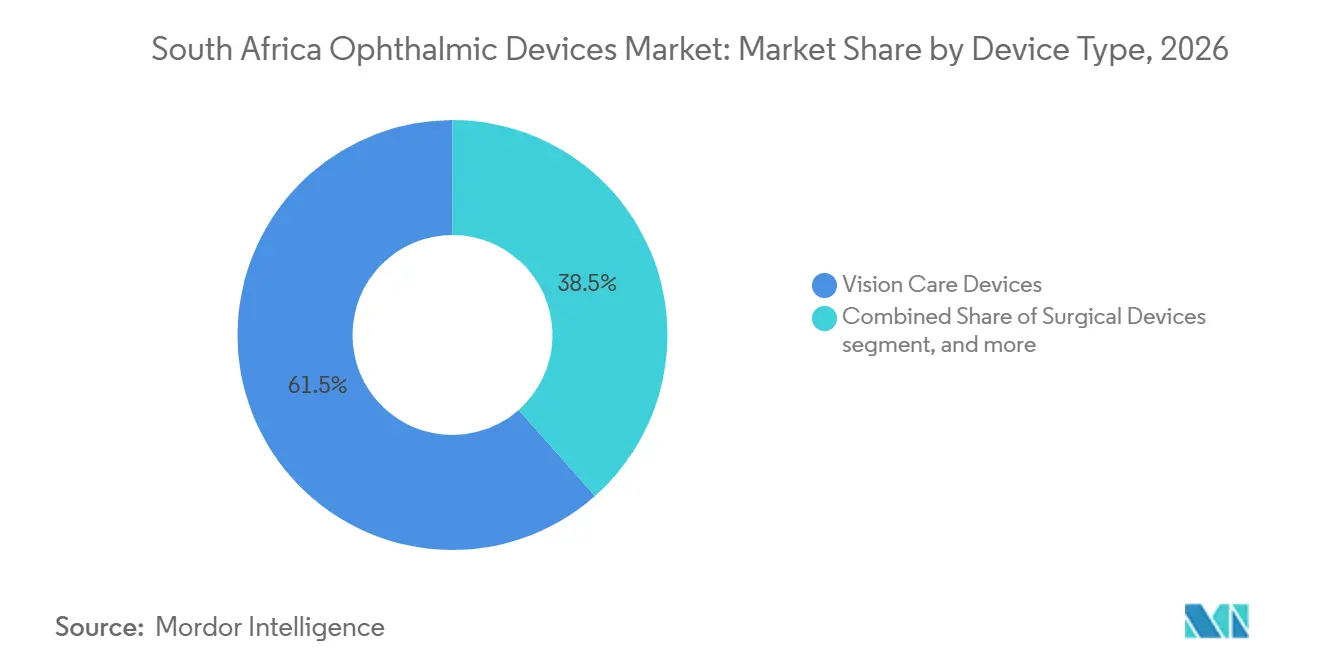
- By device type, vision care products held 61.52% of the South Africa ophthalmic devices market share in 2026, while diagnostic and monitoring devices are forecast to expand at a 7.54% CAGR to 2032.
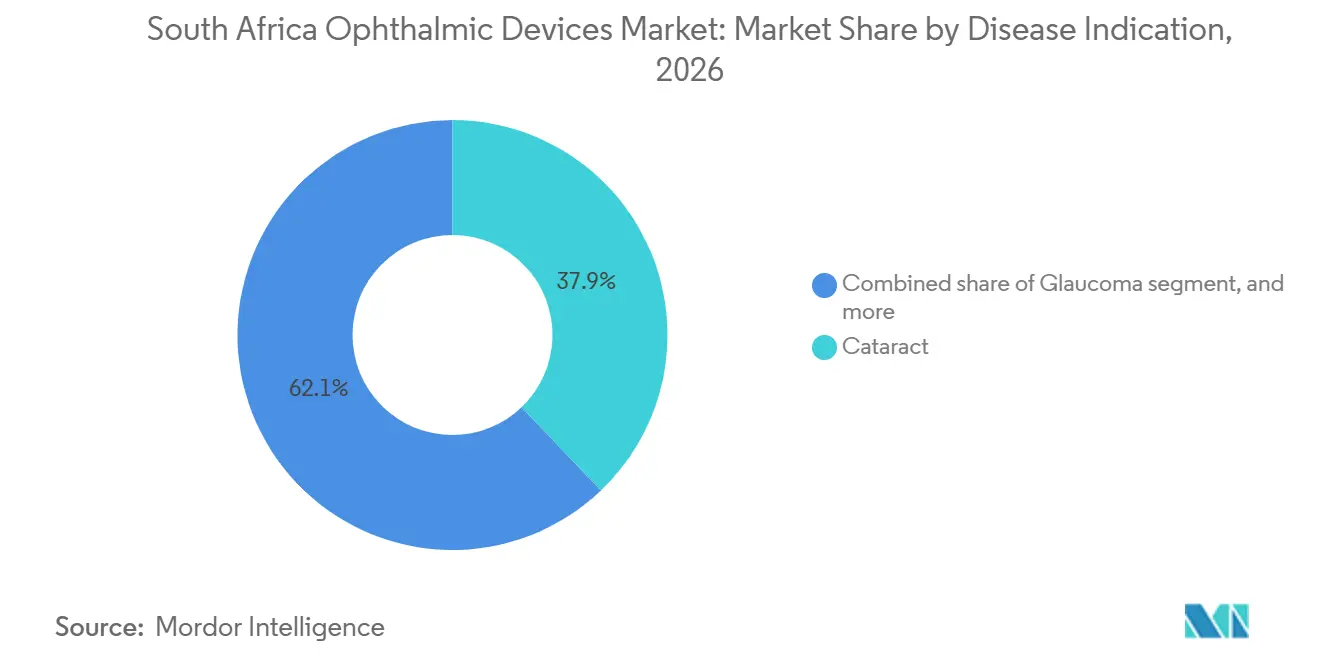
- By disease indication, cataract products dominated with 37.86% share of the South Africa ophthalmic devices market size in 2026; diabetic-retinopathy devices are poised to grow at a 6.78% CAGR through 2032.
- By end-user, hospitals accounted for 42.09% revenue share of the South Africa ophthalmic devices market in 2026; ambulatory surgery centers (ASCs) record the highest projected CAGR at 6.62% over 2027-2032.
Note: Market numbers in this report are based on Mordor Intelligence's proprietary estimation framework, which combines nine months of actuals with Q4 projections for base year 2026.
South Africa Ophthalmic Devices Market Trends and Insights
Drivers Impact Analysis*
| Driver | % Impact on CAGR Forecast | Geographic Relevance | Impact Timeline |
|---|---|---|---|
| Rising incidence of diabetic retinopathy amid South Africa’s growing diabetes prevalence | +0.40 | Limpopo and major urban provinces | Long term (≥ 4 years) |
| Government Vision 2030 Eye-Health Programme boosts surgical volume in public sector | +0.30 | National public hospitals | Medium term (2-4 years) |
| Rapid adoption of femto cataract and SMILE lasers in private hospitals | +0.35 | Gauteng & Western Cape | Short term (≤ 2 years) |
| Expansion of medical-scheme coverage for intraocular lenses & premium diagnostics | +0.25 | Major urban centers | Medium term (2-4 years) |
| Growth of vision-care retail chains in urban townships increasing device demand | +0.15 | Johannesburg, Cape Town, Durban townships | Short term (≤ 2 years) |
| Source: Mordor Intelligence | |||
Escalating Diabetic Retinopathy Prevalence
South Africa’s 35.3% diabetic-retinopathy prevalence among diabetes patients in Limpopo is driving unprecedented orders for high-resolution OCT scanners and mydriatic fundus cameras, with total demand forecast to rise 40% by 2027. Hospitals are increasingly adopting teleophthalmology models in which technicians capture retinal images in rural clinics and ophthalmologists interpret them remotely, cutting referral delays by up to 60%. Equipment vendors now structure contracts as service-based subscriptions that spread costs across multiyear screening quotas, reducing upfront capital outlays. The resulting procurement flexibility is accelerating uptake among provincial health departments that previously delayed purchases over budget-cycle constraints. Suppliers that integrate AI grading algorithms into imaging platforms report 25% faster reading times, freeing scarce ophthalmologists for surgical duties.
Government Vision 2030 Eye-Health Programme
The Vision 2030 Eye-Health Programme targets a 30% increase in effective cataract-surgery coverage (eCSC) and has already lifted public-hospital cataract volumes 15% year-on-year in 2024[1]. Tender documents increasingly bundle phaco machines, microscopes, and consumables with surgeon-training modules, ensuring continuous device utilization after installation. Manufacturers offering modular surgical kits suited to district-hospital theatres are winning bids in Limpopo and Eastern Cape, where less than 47% of facilities previously had adequate eye-care infrastructure. As the programme expands, suppliers anticipate multiyear delivery pipelines for intraocular lenses, phacoemulsification handpieces, and low-cost slit lamps that can withstand intermittent power.
Rapid Uptake of Femto Cataract and SMILE Lasers
Private hospitals in Gauteng and Western Cape installed 35% more femtosecond laser platforms in 2024, propelling the segment toward double-digit growth[2]. Pay-per-procedure financing is proving pivotal for independent clinics that previously could not justify USD 1 million capital purchases. Patient demand is buoyed by reduced surgical energy and faster visual recovery, leading insurers to classify FLACS as a reimbursable upgrade rather than a purely elective procedure. Clinics that market combined femto cataract and SMILE refractive packages report 18% higher conversion rates among myopic patients aged 25-40, broadening the surgical funnel for premium intraocular lenses.
Expansion of Medical-Scheme Coverage
Eye-care benefits accounted for 3.1% of total scheme payouts in 2024, and new 2025 gap-cover products now reimburse premium multifocal IOLs up to ZAR 213,000 per annum. Closed schemes, which spend more per beneficiary than open schemes, negotiate volume-based discounts that shorten payback periods on diagnostic devices for network hospitals. Device manufacturers now tailor segmented product lines—economy, standard, and premium—to match the tiered benefits structure. As copayments for ophthalmology fall below optometry services, more patients bypass routine spectacles and elect for definitive surgical correction, expanding the total addressable base for surgical platforms and consumables.
Restraints Impact Analysis*
| Restraints Impact Analysis | (~) % Impact on CAGR Forecast | Geographic Relevance | Impact Timeline |
|---|---|---|---|
| Limited ophthalmologist density outside Gauteng & Western Cape restricts device uptake | −0.80 | Rural provinces | Long term (≥ 4 years) |
| High import duties and rand volatility inflating capital-equipment costs | −0.70 | National | Short term (≤ 2 years) |
| Delayed reimbursement approvals for new ophthalmic technologies by Council for Medical Schemes | −0.50 | Private-sector providers | Medium term (2-4 years) |
| Counterfeit low-cost lenses in informal markets undermining premium brand sales | −0.20 | Informal urban markets | Short term (≤ 2 years) |
| Source: Mordor Intelligence | |||
Limited Ophthalmologist Density Outside Gauteng & Western Cape
More than 90% of optometrists serve fewer than 16% of the population, and 85% of ophthalmologists practice in the private sector, leaving vast rural districts without specialist coverage[3]. This imbalance lowers device-penetration potential by up to 80% in provinces such as Northern Cape and North West. To bridge the gap, manufacturers are developing automated autorefractors and simplified slit-lamp cameras that nurses can operate after short courses, yet uptake remains constrained by limited maintenance capacity. The hub-and-spoke teleophthalmology model alleviates workflow bottlenecks but depends on reliable broadband, which only reaches 42% of rural clinics. Consequently, suppliers must bundle solar power kits and remote diagnostics to keep devices operational.
High Import Duties and Rand Volatility
Over 70% of ophthalmic devices are imported, and the rand’s swings have widened price quotations by as much as 15% within a single tender cycle. Smaller practices defer upgrades when exchange-rate spikes lift loan repayments, prolonging replacement cycles. Multinationals such as Alcon have responded by assembling intraocular lens packs locally, trimming landed costs by 12% and cushioning public-sector budgets. Regional component sourcing is also gaining traction; one leading microscope maker expects to shift 30% of its precision-metal parts to a Durban supplier by 2027. These localization moves gradually dampen price volatility but require technology-transfer agreements and regulatory approvals that lengthen time-to-market for new models.
*Our forecasts treat driver/restraint impacts as directional, not additive. The impact forecasts reflect baseline growth, mix effects, and variable interactions.
Segment Analysis
By Device Type: Vision Care Leads, Diagnostics Accelerate
The vision-care category generated 61.52% of the South Africa ophthalmic devices market in 2026, reflecting the country’s high burden of uncorrected refractive errors and the role of spectacles as the most accessible entry point to eye health. Steady retail-chain expansion into townships is broadening consumer reach, while online lens-replacement platforms lift repeat-purchase frequency. Premium daily-wear contact lenses now account for 17% of retail turnover, signaling an upgrade cycle that boosts unit margins.
The diagnostic-and-monitoring segment, forecast to compound at 7.54% through 2032, is the fastest-growing contributor to the South Africa ophthalmic devices market. OCT scanners already represent more than 24% of diagnostic sales, buoyed by diabetic-retinopathy screening mandates. Suppliers increasingly bundle AI detection software that classifies pathology with 97.3% accuracy, enabling non-ophthalmologists to triage cases quickly. Over the forecast window, a more connected public-sector procurement model will force vendors to ensure compatibility with national health-information exchanges, cementing software as a decisive tender criterion.
Surgical devices comprise a smaller but rapidly evolving slice of the South Africa ophthalmic devices market. Femto-laser platforms, MIGS implants, and hand-held phaco tips collectively anchor a high-value niche fueled by Vision 2030 cataract targets and private-sector demand for premium vision-correction options. The OMNI Surgical System, for instance, offers combined canaloplasty and trabeculotomy in a single device, reducing postoperative medication reliance and shortening national hospitalization stays. Device makers that supply both conventional and micro-invasive solutions occupy a strategic position as surgeons transition to next-generation techniques.

By Disease Indication: Cataract Dominance, Diabetic Retinopathy Momentum
Cataract products commanded 37.86% of the South Africa ophthalmic devices market share in 2026, driven by robust surgical protocols and growing government emphasis on clearing backlogs. Public-sector tender volumes surged following the 15% increase in cataract surgeries in 2024, prompting phaco-probe manufacturers to scale regional inventory hubs to prevent stock-outs.
Devices targeting diabetic retinopathy register the fastest forecast expansion at a 6.78% CAGR, powered by epidemiological pressure from rising diabetes prevalence and the national commitment to tele-enabled retinal screening. Fundus cameras designed for battery operation now penetrate mobile clinics that serve mining communities, while cloud-hosted AI graders cut reporting turnaround to under 24 hours.
The glaucoma device segment, including MIGS implants and long-acting drug-delivery stents, retains meaningful scale because chronic intraocular-pressure management demands lifelong follow-up. New micro-shunt designs that integrate with electronic health-record systems illustrate how surgical hardware and data capture are converging into a holistic disease-management proposition. Broader adoption hinges on training; workshops led by visiting glaucoma surgeons from Gauteng have doubled MIGS procedural volumes in Eastern Cape since 2023.
By End-User: Hospitals Continue to Lead, ASCs Gain Speed
Hospitals accounted for 42.09% of South Africa ophthalmic devices market revenue in 2026, thanks to comprehensive service portfolios and established referral chains who.int. Public facilities, energized by Vision 2030 funding, are refreshing aging microscopes and slit lamps after more than a decade of deferred maintenance. Private hospitals differentiate on premium technology, advertising Zeiss-based 3-D heads-up visualization and LenSx-enabled cataract suites to attract insured patients.
Ambulatory surgery centers, projected to grow at 6.62% CAGR, offer lower overheads and rapid case throughput, making them attractive partners for pay-per-click femto-laser vendors. Moreover, several ophthalmologist cooperatives have converted vacant retail space into procedure-ready outposts that perform up to 25 cataract cases daily. This model trims facility fees up to 30% below hospital tariffs, allowing schemes to authorize surgeries that would otherwise exceed benefit limits.
Specialty ophthalmic clinics in urban nodes remain innovation testbeds, often piloting AI-enabled keratometry and wavefront-guided LASIK platforms before wider diffusion. Their active social-media outreach builds consumer awareness that ultimately feeds both ASC and hospital pipelines, reinforcing the integrated-care loop that public planners envision for national eye health.
Geography Analysis
Gauteng and Western Cape provinces contributed roughly 64.58% of South Africa ophthalmic devices market revenue in 2026, an outsized share relative to their 30% population weight. This concentration reflects higher disposable incomes, dense medical-scheme penetration, and the clustering of more than 70% of active ophthalmologists in Johannesburg, Pretoria, and Cape Town. Device vendors frequently pilot new technologies in these hubs before scaling to secondary cities because proven utilization statistics streamline reimbursement negotiations.
KwaZulu-Natal and Eastern Cape are emerging focal points as provincial health departments direct Vision 2030 funds to neglected districts. Eastern Cape adults aged 35 + exhibit visual-impairment prevalence of 51% and blindness of 6.6%, chiefly from uncorrected refractive error (38%) and cataract (20%). Targeted mobile-surgery caravans, equipped with compact phaco machines and solar-charged microscopes, now host weekly outreach camps that collectively perform 1,200 cataract extractions per quarter—unlocking incremental consumables demand.
Limpopo, Northern Cape, and North West provinces illustrate the gap-closing potential—and challenges—of public investment. Fewer than 47% of Limpopo facilities possessed adequate eye-care resources in late-2024, prompting an equipment-procurement drive that prioritizes rugged slit lamps, autorefractors, and paediatric vision-screening kits. However, supply-chain hurdles—long road distances, limited cold-chain capacity for certain imaging sensors, and intermittent electricity—require vendors to redesign packaging and include off-grid power solutions. Manufacturers that address these logistical realities are gaining early-mover advantage as provincial tenders increasingly weigh lifecycle support over sticker price.
Urban townships adjoining Johannesburg, Cape Town, and Durban represent the fastest-growing vision-care retail segment. Chains that blend optometry, basic ophthalmic diagnostics, and micro-loan financing enable first-time spectacle wearers to upgrade to contact lenses within a single credit cycle. These outlets also feed referral pipelines to nearby ASCs for laser-vision-correction consultations, subtly shifting surgical volumes away from big hospitals. Teleophthalmology rollouts are further equalizing specialist access: township clinics equipped with cloud-connected fundus cameras now forward images to academic hospitals, reducing unnecessary travel and concentrating surgical referrals on cases that truly need tertiary care.
Regulatory Landscape
Ophthalmic devices in South Africa are regulated by the South African Health Products Regulatory Authority (SAHPRA) under the Medicines and Related Substances Act (Act 101 of 1965) and the Regulations Relating to Medical Devices and In Vitro Diagnostic Medical Devices (Government Gazette No. 40480). SAHPRA uses a risk-based classification framework (Classes A to D), which affects conformity assessment requirements, dossier depth, and post-market obligations. For higher-risk ophthalmic implants and surgical devices, applicants also need appropriate establishment licensing to manufacture, import, export, or distribute.
For borderline and combination products, where device-drug characteristics intersect, SAHPRA determination depends on the primary mode of action (PMOA), which dictates whether the submission route follows medical device or medicine requirements. The regulatory environment also ties pathway choice to supply strategy: SAHPRA issued a local manufacturing policy (signed June 2025) that supports domestic manufacturing and includes a priority-review mechanism for qualifying locally manufactured health products, shaping go-to-market decisions for firms planning local assembly or packaging of ophthalmic consumables and implant kits.
Competitive Landscape
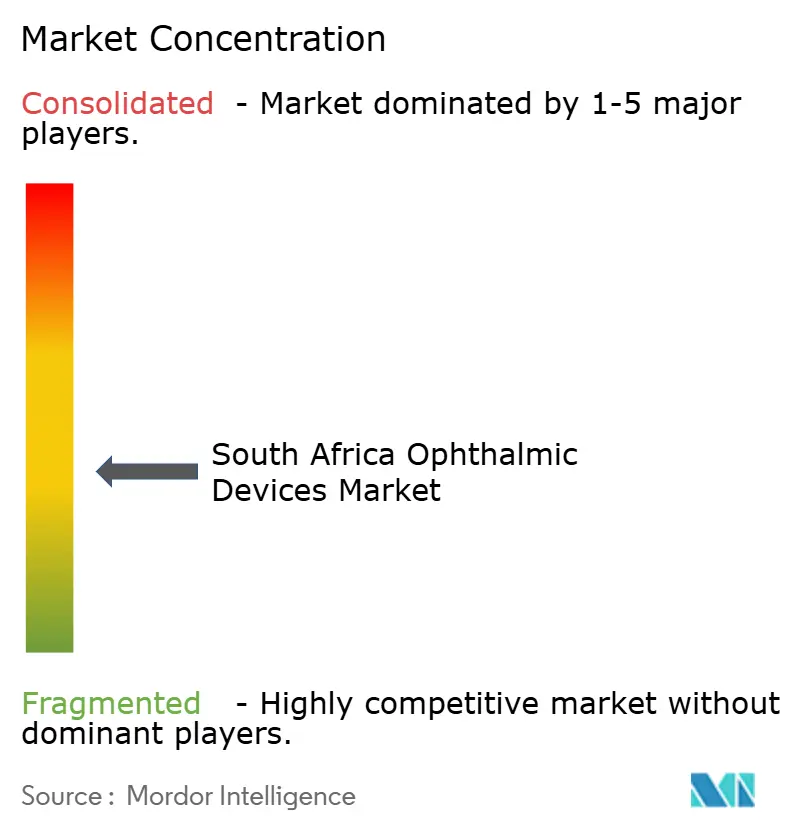
The South Africa ophthalmic devices market remains moderately fragmented, yet the premium tier shows rising concentration around a handful of global players. Alcon, Johnson & Johnson Vision Care, and Carl Zeiss Meditec together controlled 47% of premium intraocular lens revenue in 2024, a lead they reinforce through surgeon-education programs and multimodal service bundles. Local subsidiaries invest in technical-support teams that provide same-day loaner equipment during repairs, a critical differentiator in high-volume cataract centers where downtime erodes profitability.
Regional challengers focus on cost-optimized diagnostic devices and generic consumables. A Durban-based manufacturer recently introduced a single-use phaco tip priced 22% below imported equivalents, capturing share in cash-paying segments. Although counterfeit lenses circulate in informal markets, their impact skews toward low-income spectacles rather than surgical categories; nonetheless, premium brands enforce hologram authentication and QR-code verification to preserve consumer trust.
Strategic partnerships are proliferating as manufacturers seek reimbursement traction. One leading OCT vendor secured a framework agreement with a closed medical scheme covering 280,000 lives to install devices at 14 network hospitals, funded through a per-screen fee payable from savings on late-stage retinopathy complications. Simultaneously, data-analytics alliances position device makers as population-health collaborators: Zeiss integrates anonymized imaging datasets with an academic-AI lab in Pretoria to refine glaucoma-progression algorithms, strengthening its claim in future tenders that emphasize data-science capabilities.
Despite rand volatility, multinationals view localized production as a hedge; Alcon’s assembly line for Clareon IOLs in Cape Town slashed lead times to two weeks and cut landed costs 12%, prompting Johnson & Johnson to scout Bloemfontein for a potential contact-lens blister-pack plant. Such moves signal a strategic shift from pure import dependency toward hybrid supply chains that cushion currency swings while supporting regional export ambitions into Botswana, Namibia, and Zimbabwe.
South Africa Ophthalmic Devices Industry Leaders
-
Alcon Inc.
-
Carl Zeiss Meditec AG
-
Johnson & Johnson Vision Care Inc.
-
Bausch + Lomb (Bausch Health)
-
Hoya Corporation
- *Disclaimer: Major Players sorted in no particular order
Market Opportunities and Future Outlook
Localization and supply assurance is a practical white-space for high-volume cataract and refractive-care workflows, given the market reliance on imports and procurement sensitivity to currency swings. The June 2025 SAHPRA local manufacturing policy, which includes priority review for qualifying locally manufactured health products, offers a clear lever for manufacturers looking to expand domestic assembly and packaging of ophthalmic consumables and implant kits. This aligns with localization already occurring in intraocular lens pack assembly, which can improve tender responsiveness. It also fits with public-sector whole-of-life tenders that bundle devices with training and maintenance, where suppliers with local technical service coverage and faster replenishment cycles have an edge.
Teleophthalmology-ready diagnostics are another focused opportunity area as screening programs expand and specialist scarcity shifts value toward rugged imaging hardware and workflow software. Demand pull is visible in diabetic-retinopathy screening adoption and AI-assisted image interpretation in urban hospitals, which supports higher utilization of OCT and fundus imaging and can underpin service-based contracting that spreads capital costs. On the capability side, South Africa has identifiable ecosystem actors (DTIC, DSI, CSIR, SAMRC alongside SAHPRA) that can support localization and innovation efforts, while SAHPRA's risk-based classification and establishment licensing requirements make regulatory affairs execution a differentiator for vendors expanding higher-risk portfolios for surgery and implants.
Recent Industry Developments
- January 2026: No material, verifiable 2026 company-level event meeting the stated criteria was identified in the provided evidence for South Africa ophthalmic devices (April to July 2026 items were not found in the in-scope sources). This points to a market that is drawing more on earlier localization, distribution, and provider-network actions than on newly publicized capacity additions in 2026.
- May 2025: Oculate became the exclusive distributor for Sterimedix in South Africa, widening access to single-use ophthalmic cannulas and handpieces. The change improves local channel coverage for consumables used in cataract and vitreoretinal workflows, where infection control and standardization are procurement priorities.
- December 2024: Johnson & Johnson Vision Care signed a framework agreement with Mediclinic Southern Africa to deploy TECNIS Synergy multifocal IOLs across 22 hospitals. By anchoring rollout in a major private hospital network, the agreement increases installed-base visibility for premium IOLs and reinforces bundled contracting dynamics linked to surgeon training and standardized outcomes.
Research Methodology Framework and Report Scope
Market Definition and Coverage
This market covers the value of ophthalmic devices sold and used in South Africa to diagnose, monitor, correct, or surgically treat eye conditions across care settings.
Scope exclusions: We exclude pharmaceuticals and injectable drugs, and we also exclude pure services revenue from eye exams or surgical procedures.
Segmentation Overview
- By Device Type
- Diagnostic & Monitoring Devices
- OCT Scanners
- Fundus & Retinal Cameras
- Autorefractors & Keratometers
- Corneal Topography Systems
- Ultrasound Imaging Systems
- Perimeters & Tonometers
- Other Diagnostic & Monitoring Devices
- Surgical Devices
- Cataract Surgical Devices
- Vitreoretinal Surgical Devices
- Refreactive Surgical Devices
- Glaucoma Surgical Devices
- Other Surgical Devices
- Vision Care Devices
- Spectacles Frames & Lenses
- Contact Lenses
- Diagnostic & Monitoring Devices
- By Disease Indication
- Cataract
- Glaucoma
- Diabetic Retinopathy
- Other Disease Indications
- By End-user
- Hospitals
- Specialty Ophthalmic Clinics
- Ambulatory Surgery Centers (ASCs)
- Other End-users
Data Sources, Market Sizing, and Validation
Desk Research
Desk research starts with building a clean demand and supply context for South Africa eye care, so later assumptions do not float without support. We typically pull published health indicators and disease burden signals from sources such as the World Health Organization, the World Bank, and official South Africa health statistics portals, which help anchor the patient pool and system capacity.
To understand device flow and pricing pressure points, we also review trade and customs-facing material, including South Africa Revenue Service trade releases where available, and UN Comtrade style import and export series for relevant device categories. We support these inputs with manufacturer and distributor public disclosures such as annual reports, investor presentations, and product catalogs, plus reputable news coverage and tender announcements for larger public and private buys. Where needed, a paid subscription is used for company financials and news screening, and a patent database is used to track technology direction. The sources mentioned above are illustrative and not exhaustive.
Primary Interviews and Surveys
Primary work is used to test what published sources cannot tell us clearly, especially local pricing movement, procedure mix, channel margins, and replacement cycles for diagnostic and surgical equipment. We speak with a spread of respondents across importers and distributors, private eye clinics, hospital procurement teams, and clinicians, and then we re-check differences across major provinces and urban centers before finalizing the model assumptions.
Distribution of primary research fieldwork respondents
| Company type | Respondent position |
|---|---|
| Top tier: 25% | CXOs: 12% |
| Mid tier: 60% | Functional/Unit leaders: 30% |
| Smaller Players: 15% | Managers: 58% |
Market-Sizing & Forecasting
Sizing is built using a top-down and bottom-up combination, where we start from the most defensible demand pool and then use selective supplier and channel checks to keep totals realistic. For South Africa ophthalmic devices, the top-down build is typically tied to procedure and patient flow logic, where cataract and refractive correction activity, glaucoma monitoring needs, and diabetic retinopathy screening coverage are translated into device demand by care setting.
Several market fingerprints are used as inputs, such as the installed base and replacement cycle for diagnostic equipment, annual surgical procedure volumes (especially cataract), import dependence for key device categories, average selling price bands by channel, and utilization differences between public hospitals and private clinics. When some of these inputs are not available at the right granularity, we fill gaps with bounded assumptions that are reviewed in interviews and then stress-tested against trade direction and procurement signals.
For forecasting, scenario analysis is used so the outlook can reflect realistic paths for procedure recovery, budget releases, and price movement under currency shifts. Growth rates by device group are first estimated, then adjusted after expert feedback on adoption timing, tender cadence, and clinic expansion plans so the final curve matches what buyers and suppliers are seeing on the ground.
Data Validation & Update Cycle
Validation is done in layers so one dataset does not drive the whole outcome. We compare outputs against independent signals such as import direction, installed base logic, procedure volumes, and pricing movement, and then investigate any jumps that do not match what interviews indicate.
Before sign-off, the model and assumptions go through multi-step internal review, with specific re-contact triggers when a major variance appears by device group or when a price band shifts more than expected. Reports are refreshed each year, and interim updates are made when there are material events such as policy changes, large tenders, or sudden currency moves. Right before delivery, an analyst performs a final pass so clients receive the most current view available at that time.
Mordor Intelligence's South Africa Ophthalmic Devices Market Size Compared Against Other Published Estimates
Published values for this market can vary widely because sources do not always count the same device basket and they also pick different base years and pricing references. Some estimates place more weight on import totals, while others lean on modeled patient numbers, and the mix chosen can move the final value by a meaningful margin.
In South Africa, the biggest differences usually come from whether vision care devices are included alongside diagnostic and surgical devices, how private-sector procedure volumes are treated when public-sector capacity is constrained, and what is assumed for price progression under currency changes. The 2025 value shown here includes vision care devices together with diagnostic and surgical categories, with procedure-linked demand checks and updated price bands carried into the base year, which explains the gap with narrower scopes and older base years for Mordor Intelligence.
Benchmark comparison
| Source | Market Size | Gaps in Research Methodology |
|---|---|---|
| Mordor Intelligence | USD 650.00 M (2025) | |
| Regional Consultancy A | USD 227.64 M (2023) | Uses an earlier base year and a narrower device split centered on surgical and diagnostic devices, which can miss vision care device spending and later-cycle purchasing seen in more recent years. |
| Trade Journal B | USD 64.80 M (2024) | Tracks only ophthalmic diagnostic devices and excludes surgical and vision care device spending, so it represents a sub-segment rather than the full ophthalmic devices market. |
Taken together, the spread is mainly about scope and timing rather than simple math differences. By keeping the device basket consistent and then cross-checking totals against procedure demand, trade direction, and interview-led pricing reality checks, the final number stays transparent and repeatable for planning.
Key Questions Answered in the Report
What is the current value of the South Africa ophthalmic devices market?
The South Africa ophthalmic devices market is valued at USD 685.36 million in 2026 and is expected to reach USD 692.42 million by 2032.
Which segment is growing fastest in the South Africa ophthalmic devices market?
Diagnostic and monitoring devices are growing fastest, with a projected 7.54% CAGR over 2027-2032.
How is the Vision 2030 Eye-Health Programme influencing device demand?
The programme targets a 30% rise in effective cataract-surgery coverage, driving higher procurement of surgical devices and intraocular lenses.
Why are ambulatory surgery centers gaining momentum?
ASCs offer cost-efficient, high-volume procedures and are projected to grow at 6.62% CAGR over 2027-2032, supported by pay-per-procedure financing for femto-laser platforms.
What challenges limit wider adoption of ophthalmic devices in rural South Africa?
Key constraints include an 80% lower specialist coverage in rural areas and price volatility from import duties and currency fluctuations.