
Spain HVAC Market Size and Share
| Study Period | 2019 - 2030 |
| Forecast Data Period | 2025 - 2030 |
| Historical Data Period | 2019 - 2023 |
| Market Size (2025) | USD 3.46 Billion |
| Market Size (2030) | USD 4.53 Billion |
| CAGR (2025 - 2030) | 5.60% |
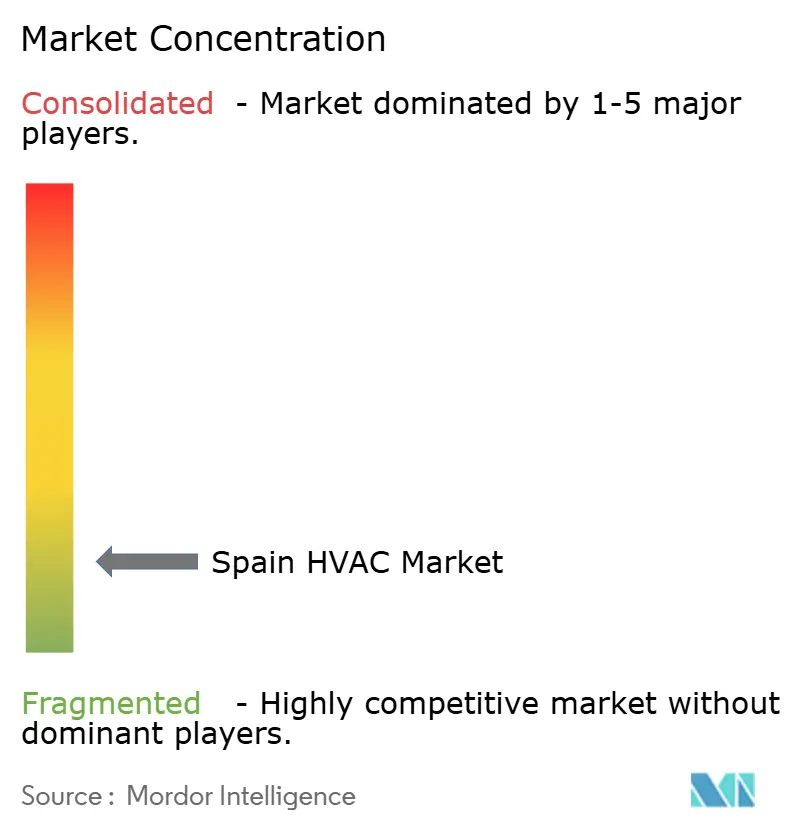
| Market Concentration | Low |
Major Players *Disclaimer: Major Players sorted in no particular order |
Spain HVAC Market Analysis by Mordor Intelligence
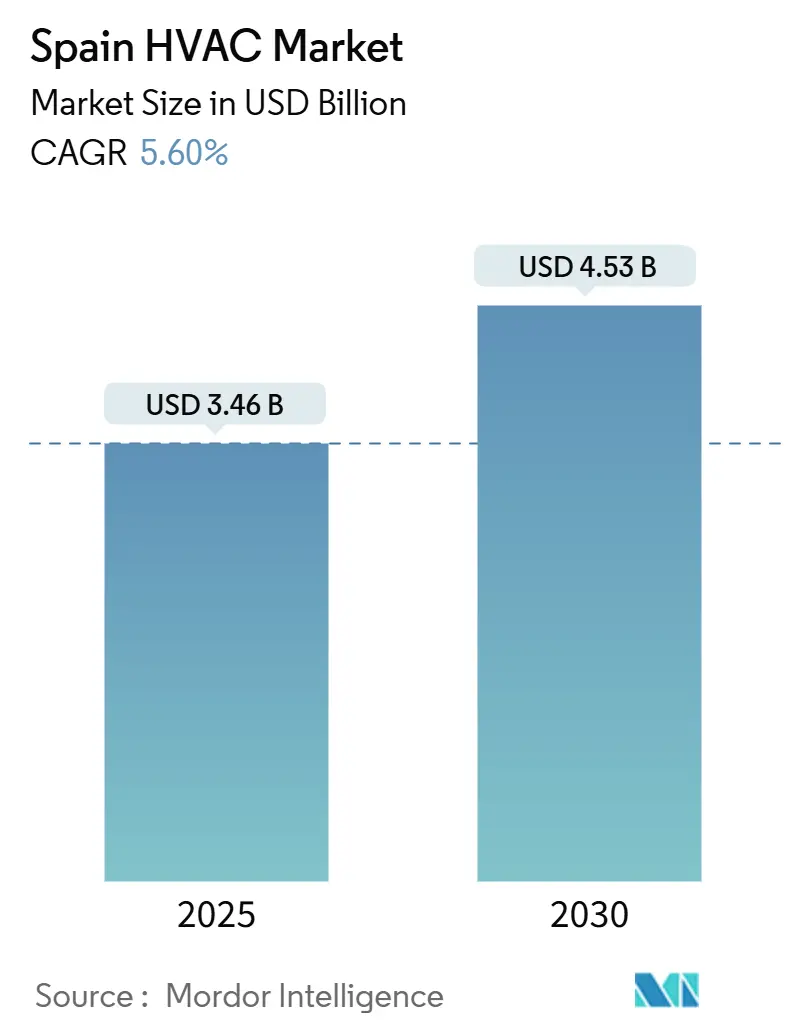
The Spain HVAC Market size is estimated at USD 3.46 billion in 2025, and is expected to reach USD 4.53 billion by 2030, at a CAGR of 5.60% during the forecast period (2025-2030).
- The growth for HVAC (heating, ventilation, and air conditioning equipment) is mainly driven in the country by the new infrastructure projects, and energy efficiency initiatives by the Government. Driven by government-mandated green building initiatives and heightened environmental concerns, the construction industry is increasingly prioritizing sustainability and high energy efficiency. These initiatives enforce strict HVAC (heating, ventilation, and air conditioning equipment) standards in new buildings, creating a burgeoning market for environmentally friendly solutions.
- Spain aims for a decarbonized energy system by 2050. To achieve this, the country must swiftly adopt eco-friendly technologies for space and water heating. This push for climate-neutral heating and cooling technologies will necessitate policy changes. These include reforming the grant system to support a broader array of heat pumps, such as hot water and air-to-air variants; assessing the potential of reversible air-to-air heat pumps as complete substitutes for gas heating; and possibly establishing new obligations or enhancing current ones on energy suppliers to expedite the rollout of heat pumps.
- Spain's electricity is among the highest in Europe, prompting both residential and commercial consumers to transition to high-efficiency HVAC systems that promise reduced operational costs over time. With long-term savings and available subsidies in play, energy-efficient HVAC systems emerge as a sound investment, especially in the commercial and manufacturing sectors. As part of its initiative to curb energy consumption, the Government unveiled new regulations on air conditioning units. These measures aim to slash Spain’s gas consumption by 7%, aligning with Spain’s commitment to the recent EU energy pact, which targets a 15% reduction in gas usage.
- To achieve certification as sustainable and green building units, extensive and mega projects may soon be required to implement appliances powered by renewable sources. This shift could significantly boost the adoption of HVAC systems in both residential and large commercial spaces. In February 2025, Spain took the lead in this endeavor, tapping into the airflow produced by HVAC systems. This innovative technology, already trialed with success at a data center in Colombia, showcases its real-world viability. The Colombian data center utilized Liebert HPC-M coolers, featuring eight EC-FAN fans operating at 480V and 900 rpm, generating a steady vertical airflow essential for cooling its IT equipment.
- With proper maintenance, HVAC systems typically last around 13 years. This maintenance involves regular cleaning to eliminate sediment and dust from the filters, preventing potential damage and system failure. Furthermore, components in HVAC units, like filters, motors, refrigerants, and coolants, often require frequent replacement or repair due to their limited lifespan. While energy-efficient HVAC systems promise long-term savings, their steep initial costs can overshadow these benefits in the short run. Consequently, the significant upfront and maintenance expenses associated with HVAC systems are poised to hinder the growth of the HVAC equipment market.
- Spain's HVAC industry, heavily reliant on imports, grapples with challenges stemming from macroeconomic factors. Rising costs for refrigerants, semiconductors, and HVAC units have led to increased prices for end users, dampening their purchasing enthusiasm. Furthermore, Spain has faced significant energy price fluctuations, fallout from the European energy crisis ignited by geopolitical tensions. These surging electricity prices elevate the operational costs of HVAC systems, deterring both residential and commercial clients from investing in or upgrading their systems.
Spain HVAC Market Trends and Insights
Residential Sector is Expected to Hold a Largest Market Share
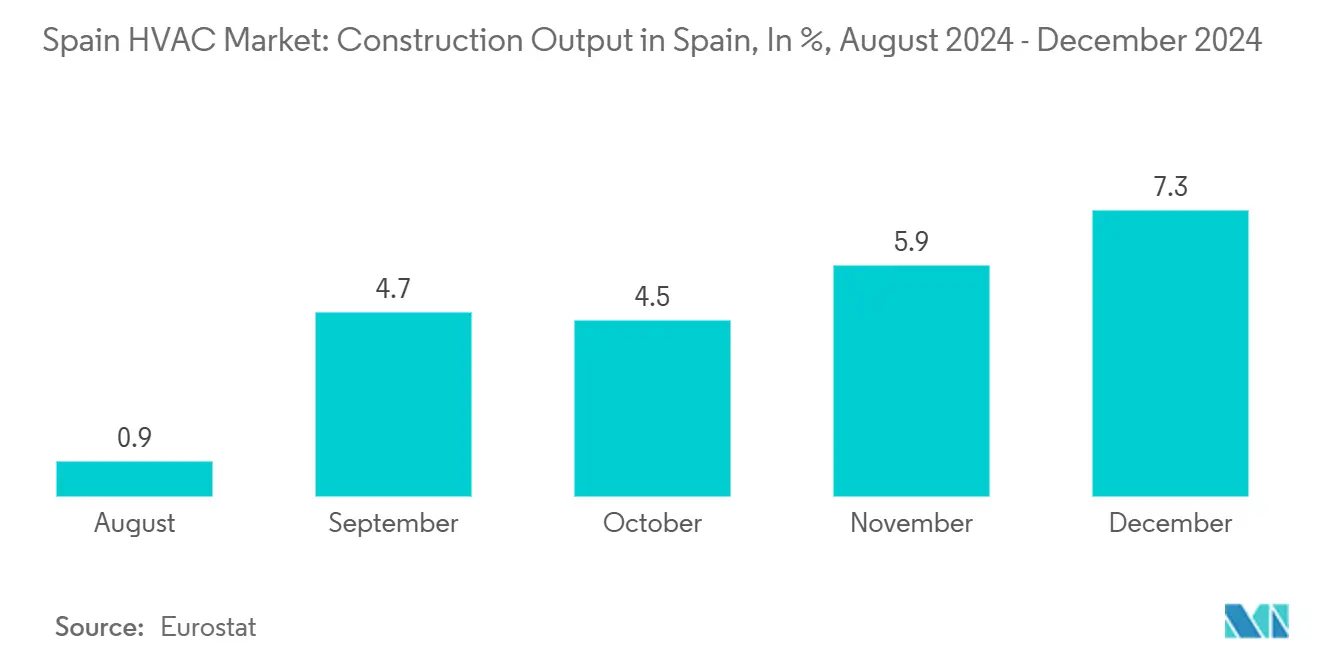
- The demand for heating, ventilation, and air conditioning (HVAC) systems in the residential sector is surging, driven by a rise in luxury residential projects in Spain. Stricter government regulations on energy emissions from these buildings have further boosted the adoption of HVAC systems. To align with these emission standards, numerous market players are actively investing in advanced product launches and residential HVAC subscription services. Additionally, a significant uptick in energy consumption within Spanish homes has spurred the adoption of energy retrofit systems, enhancing building efficiency and driving the HVAC equipment market. According to Eurostat, in December 2024, Spain's construction output surged to 7.3%, up from 5.9% in November 2024.
- Spain is championing a transition from conventional gas and oil boilers to renewable energy systems in its residential sector. This shift is propelling a surge in demand for air-to-air and air-to-water heat pumps alongside hybrid HVAC solutions, all of which resonate with the nation's energy efficiency and decarbonization objectives. Data from the Spanish Ministry for the Ecological Transition highlights that the building sector accounts for roughly 8% of Spain's greenhouse gas emissions.
- While Spain boasts 162 municipalities with populations exceeding 45,000, only one has devised a comprehensive plan addressing both heating and cooling. Spain aims to eliminate gas boilers from public buildings by 2025 and targets a replacement rate of 500,000 dwellings annually in the residential sector. The strategy emphasizes the installation of individual heat pumps capable of summer cooling, centralized heating systems, and expansive district heating and cooling networks.
- In Spain, rising air pollution and rapid urbanization have fueled the demand for heating, ventilation, and air conditioning (HVAC) systems in residential buildings. This surge in demand is further bolstered by the government's heightened budgetary support for sustainable community development, promoting the adoption of energy-efficient HVAC systems. According to the MITMA (Ministry of Transport, Mobility, and Urban Agenda), Spanish households can obtain a grant of up to EUR 3,000 (USD 3,388) for installing an air source heat pump. This subsidy, which amounts to 40% of the installation cost, is part of a scheme set to run until 2026.


Heating Equipment is Expected to Witness a Significant Growth
- The demand for heating equipment, particularly heat pumps, is being propelled by several key factors in Spain. These include the Spanish government's push for renewable heating through building regulations, heightened concerns about air quality, and financial backing from the government. Recognizing the significance of heating as a primary energy consumer in buildings, the Spanish government has been actively promoting renewable heating through its building regulations. As many individuals construct new buildings adhering to these regulations, there's a noticeable inclination towards installing heating devices, with heat pumps being a preferred choice.
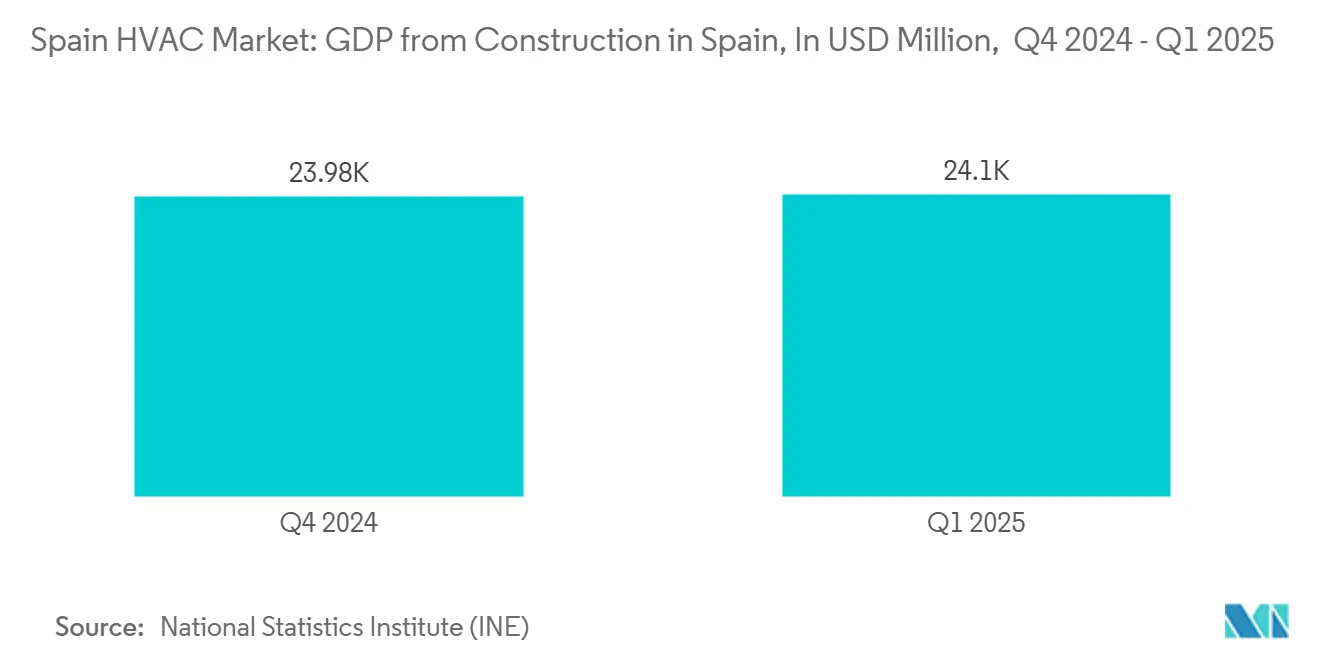
- According to the INE (National Statistics Institute), in Q1 2025, Spain's construction GDP rose to EUR 21,340 million (USD 24,096 million), up from EUR 21,190 million (USD 23,983 million) in Q4 2024.
- Spain views heat pumps as a crucial clean energy solution, emphasizing the need for their rapid proliferation in the coming decades to achieve national energy and climate objectives. Depending on their setup, heat pumps can provide heating for spaces and water, as well as cooling. While every region in Spain mandates domestic hot water, the requirements for space heating and cooling differ markedly across locations. For instance, northern areas and high-altitude regions of Spain exhibit a pronounced demand for space heating, whereas other locales grapple with a substantial need for cooling.
- Heat pumps, known for their low carbon footprint and cost-effectiveness, offer efficient solutions for heating, cooling, and hot water needs. In Spain, however, air-to-air reversible heat pumps find limited application in heating. Typically, smaller air-to-air heat pumps serve primarily for summer refrigeration, with occasional winter heating use. Spain is witnessing a growing adoption of renewable energy sources, with air-to-air heat pumps playing a pivotal role. Notably, in the realm of cooling, heat pumps stand out as the only renewable energy source being utilized.
- As the world increasingly prioritizes efficiency and environmental stewardship, Spain is turning to aerothermal energy as an advanced, sustainable solution for home heating and cooling. In April 2025, Iberdrola España unveiled ATuAire, a dedicated unit for aerothermal heat pump solutions. This initiative targets the electrification of heating and hot water systems in Spain's residential, commercial, and industrial sectors. Iberdrola emphasized that this launch underscores its dedication to curbing fossil fuel dependence and hastening the decarbonization of energy use in buildings, aligning with European Union directives. Notably, heat constitutes 41% of Spain's final energy consumption. Current EU mandates stipulate that all new buildings must achieve zero emissions by 2030, a standard that will extend to existing structures by 2050.

Competitive Landscape
In Spain's HVAC market, a mix of specialized players and regional conglomerates operates across diverse segments. While certain high-value segments see dominance from large multinational corporations, a host of regional and niche players intensify the competition, underscoring the market's diversity. This competition thrives on the myriad applications of HVAC equipment, enabling both small and large entities to flourish.
Prominent players in Spain's HVAC landscape include Johnson Controls International PLC, Carrier Corporation, Robert Bosch GmbH, Daikin Industries, Ltd., and Trane Inc., among others. These companies, bolstered by strong brand recognition and expansive regional operations, hold a substantial market share. Their competitive advantages lie in innovation, a diverse solutions portfolio, and a solid distribution network. To further their market presence and sustain their competitive edge, these industry leaders actively engage in strategic acquisitions and partnerships.
Success in Spain's HVAC market hinges on prioritizing innovation, particularly in heating, ventilation, and air conditioning equipment. As industries seek cutting-edge solutions, HVAC equipment is set to become a pivotal differentiator. Expanding service offerings and enhancing customer support will be crucial for fostering enduring relationships and securing repeat business. Firms that invest in emerging markets and tailor products to regional needs are poised to gain a competitive advantage in this fragmented arena.
Spain HVAC Industry Leaders
Johnson Controls International PLC
Carrier Corporation
Robert Bosch GmbH
Daikin Industries, Ltd.
Trane Inc.
- *Disclaimer: Major Players sorted in no particular order

Recent Industry Developments
- February 2025: Panasonic Corporation announced a sponsorship agreement with FC Barcelona, positioning itself as the primary Heating, Ventilation, and Air Conditioning (HVAC) provider for the club's revamped Camp Nou stadium complex. Under the four-season sponsorship, running until June 2028, Panasonic's Heating & Cooling Solutions will implement eco-friendly HVAC solutions at the refurbished Camp Nou. These include air purification through nanoe X technology and state-of-the-art heat pump systems. Furthermore, Panasonic's HVAC equipment will be deployed in critical technical zones, encompassing server and broadcasting rooms.
- August 2024: Daikin Applied introduced its latest self-contained HVAC system, the SWP J-Vintage. This cost-effective and efficient unit is enhanced with the environmentally friendly R-32 refrigerant, known for its low global warming potential (GWP). Designed for floor-by-floor applications, the SWP J-Vintage boasts features that empower customers to shrink their carbon footprint without compromising on performance or incurring high costs. The introduction of the SWP J-Vintage underscores Daikin's commitment to decarbonizing commercial buildings. By harnessing advanced technologies and eco-friendly refrigerants, Daikin aligns with its overarching mission: to forge a resilient and sustainable future.


Spain HVAC Market Report Scope
HVAC is a comprehensive system designed to create and maintain comfortable indoor environmental conditions in residential, commercial, and industrial spaces. Heating is the first component, which involves warming interior spaces during cold weather through various methods such as furnaces, heat pumps, and radiant heating systems. These technologies convert energy into heat, distributing warmth evenly throughout a building to ensure occupant comfort and prevent temperature-related issues.
Ventilation represents the critical process of exchanging indoor and outdoor air, ensuring proper air circulation, removing pollutants, controlling humidity, and maintaining air quality. This aspect of HVAC involves mechanical and natural ventilation techniques that introduce fresh air, filter contaminants, and regulate oxygen levels. Proper ventilation is essential for preventing the buildup of harmful gases, reducing moisture-related problems, and creating a healthy indoor environment.
Air Conditioning focuses on cooling and dehumidifying interior spaces during warm weather. Modern air conditioning systems use refrigeration cycles to remove heat and moisture from the air, creating a comfortable and controlled climate. These systems range from central air conditioning units to ductless mini-splits, providing precise temperature management and improving overall indoor comfort. The integration of these three components- heating, ventilation, and air conditioning- creates a sophisticated environmental control system that adapts to changing weather conditions and occupant needs.
The study tracks the revenue accrued through the sale of HVAC product types by various players in Spain. The study also tracks the key market parameters, underlying growth influencers, and major vendors operating in the industry, which supports the market estimations and growth rates over the forecast period. The study further analyses the overall impact of macroeconomic factors on the market. The report's scope encompasses market sizing and forecasts for the various market segments.
The Spain HVAC Market is Segmented by product type (heating equipment [heat pumps (air source, ground source), furnaces (gas, electric, oil), boilers (condensing, non-condensing), unit heaters, and others (radiators & baseboard heaters, solar water heating systems)], ventilation equipment [air handling units (AHUs), energy recovery ventilators (ERVs)/heat recovery, ventilators (HRVs), exhaust and supply fans, dehumidifiers/humidifiers], air conditioning equipment [unitary air conditioners, variable refrigerant flow (VRF) systems, chillers (air-cooled, water-cooled), fan coil units (FCUs), and others (window and portable air conditioners)]) and end-user industry (residential, commercial, and industrial). The market sizes and forecasts are provided in terms of value (USD) for all the above segments.
| Heating Equipment | Heat Pumps (Air Source, Ground Source) | |
| Furnaces (Gas, Electric, Oil) | ||
| Boilers (Condensing, Non-condensing) | ||
| Unit Heaters | ||
| Others (Radiators & Baseboard Heaters, Solar Water Heating Systems) | ||
| Ventilation Equipment | Air Handling Units (AHUs) | |
| Energy Recovery Ventilators (ERVs)/Heat Recovery Ventilators (HRVs) | ||
| Exhaust and Supply Fans | ||
| Dehumidifiers/Humidifiers | ||
| Air Conditioning Equipment | Unitary Air Conditioners | Split Air Conditioners |
| Packaged Terminal ACs (PTACs) | ||
| Rooftop Packaged Units (RTUs) | ||
| Variable Refrigerant Flow (VRF) Systems | ||
| Chillers (Air-Cooled, Water-Cooled) | ||
| Fan Coil Units (FCUs) | ||
| Others (Window and Portable Air Conditioners) | ||
| Residential |
| Commercial |
| Industrial |
| By Product Type | Heating Equipment | Heat Pumps (Air Source, Ground Source) | |
| Furnaces (Gas, Electric, Oil) | |||
| Boilers (Condensing, Non-condensing) | |||
| Unit Heaters | |||
| Others (Radiators & Baseboard Heaters, Solar Water Heating Systems) | |||
| Ventilation Equipment | Air Handling Units (AHUs) | ||
| Energy Recovery Ventilators (ERVs)/Heat Recovery Ventilators (HRVs) | |||
| Exhaust and Supply Fans | |||
| Dehumidifiers/Humidifiers | |||
| Air Conditioning Equipment | Unitary Air Conditioners | Split Air Conditioners | |
| Packaged Terminal ACs (PTACs) | |||
| Rooftop Packaged Units (RTUs) | |||
| Variable Refrigerant Flow (VRF) Systems | |||
| Chillers (Air-Cooled, Water-Cooled) | |||
| Fan Coil Units (FCUs) | |||
| Others (Window and Portable Air Conditioners) | |||
| By End-user Industry | Residential | ||
| Commercial | |||
| Industrial | |||


Key Questions Answered in the Report
How big is the Spain HVAC Market?
The Spain HVAC Market size is expected to reach USD 3.46 billion in 2025 and grow at a CAGR of 5.60% to reach USD 4.53 billion by 2030.
What is the current Spain HVAC Market size?
In 2025, the Spain HVAC Market size is expected to reach USD 3.46 billion.
Who are the key players in Spain HVAC Market?
Johnson Controls International PLC, Carrier Corporation, Robert Bosch GmbH, Daikin Industries, Ltd. and Trane Inc. are the major companies operating in the Spain HVAC Market.
What years does this Spain HVAC Market cover, and what was the market size in 2024?
In 2024, the Spain HVAC Market size was estimated at USD 3.27 billion. The report covers the Spain HVAC Market historical market size for years: 2019, 2020, 2021, 2022, 2023 and 2024. The report also forecasts the Spain HVAC Market size for years: 2025, 2026, 2027, 2028, 2029 and 2030.
Page last updated on:
Spain HVAC Market Report
Statistics for the 2025 Spain HVAC market share, size and revenue growth rate, created by Mordor Intelligence™ Industry Reports. Spain HVAC analysis includes a market forecast outlook for 2025 to 2030 and historical overview. Get a sample of this industry analysis as a free report PDF download.


 Your data is secure and never sold or shared.


