
Brazil HVAC Market Size and Share
| Study Period | 2019 - 2030 |
| Forecast Data Period | 2025 - 2030 |
| Historical Data Period | 2019 - 2023 |
| Market Size (2025) | USD 6.19 Billion |
| Market Size (2030) | USD 8.07 Billion |
| CAGR (2025 - 2030) | 5.50% |
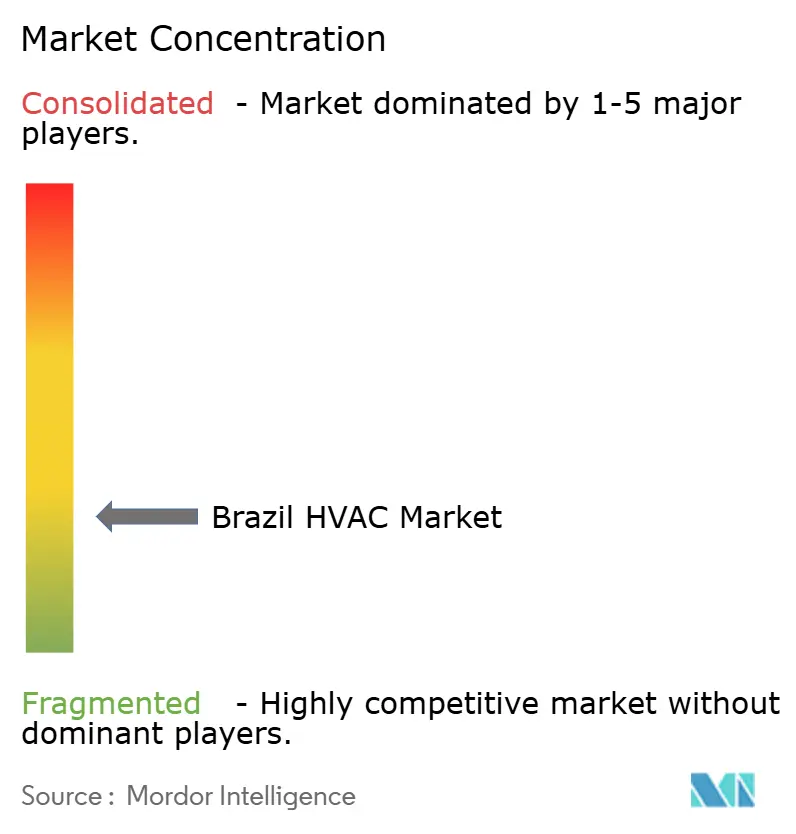
| Market Concentration | Low |
Major Players *Disclaimer: Major Players sorted in no particular order |
Brazil HVAC Market Analysis by Mordor Intelligence
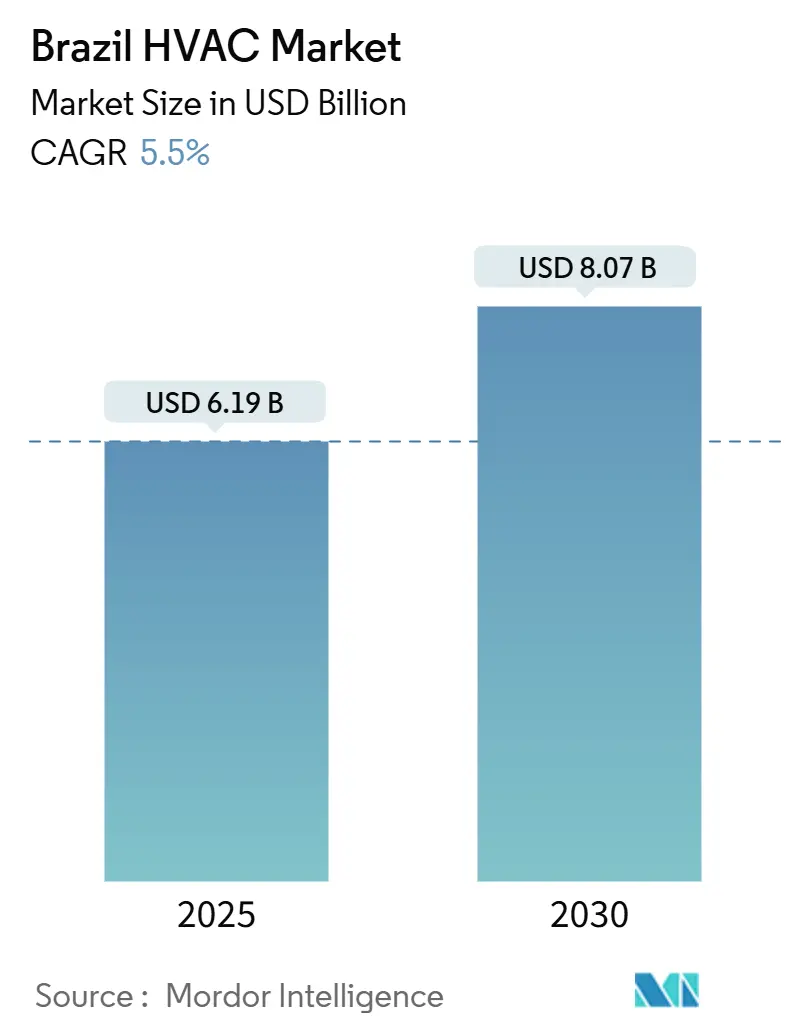
The Brazil HVAC Market size is estimated at USD 6.19 billion in 2025, and is expected to reach USD 8.07 billion by 2030, at a CAGR of 5.5% during the forecast period (2025-2030).
- Brazil's HVAC market is projected to grow steadily during the forecast period, driven by factors such as energy efficiency mandates, rapid urbanization, and technological advancements. The Brazilian Energy Efficiency Labeling Program (Programa Brasileiro de Etiquetagem, PBE) plays a key role in promoting energy-efficient household products, including HVAC systems. This program enables consumers to select energy-efficient options, minimize energy consumption, and reduce their energy bills.
- The Plano Decenal de Expansão de Energia (PDE) 2034, developed by Brazil's Ministry of Mines and Energy in strategic partnership with the Energy Research Company (EPE), is a comprehensive plan focusing on energy efficiency and renewable energy development. It aims to achieve a 7% reduction in Brazil's energy consumption by 2034 through improvements in energy efficiency. Such government initiatives are anticipated to create ample growth opportunities for HVAC retrofits and upgrades.
- Brazil provides energy-saving incentives for both new constructions and building renovations. These include financing programs from the Banco Nacional de Desenvolvimento Econômico e Social (BNDES), a state-owned financial institution that supports the federal government’s credit and development policies.
- Renovation and retrofitting activities are transforming well-known developments in Brazil. São Paulo, the largest city in the country, is experiencing a rise in investments focused on upgrading its old and unused buildings. To revitalize its historic downtown, the São Paulo government has implemented several initiatives over the years to support such projects in the central area. These measures include tax exemptions, public funding, and various other incentives.
- Installing an HVAC system is expensive due to the high costs of ductwork, which is labor-intensive. The process involves setting up indoor and outdoor units and connecting ducts throughout the home. Additionally, regular maintenance, such as duct cleaning and air filter replacements, increases operational costs. These financial challenges may delay or prevent adoption among SMEs and residential consumers with limited budgets.
- Macroeconomic factors, such as strong economic growth and rapid industrialization, are expected to drive the HVAC market in Brazil. In 2024, Brazil's economy performed better than anticipated: Real GDP increased by 3.4%, primarily due to robust domestic demand. Higher consumer spending and capital formation played a significant role in offsetting the slowdown in government spending and exports, ensuring continued economic growth.
Brazil HVAC Market Trends and Insights
Construction Sector Growth to Propel the Market Growth
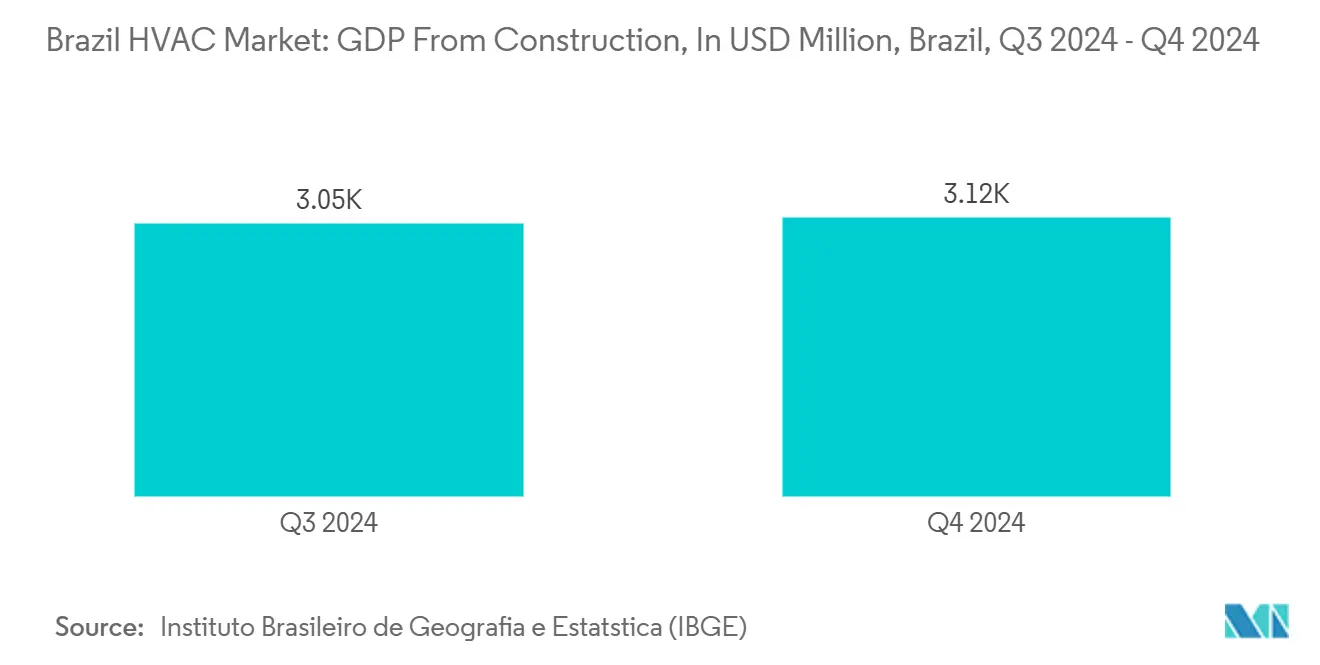
- The construction industry in Brazil serves as a cornerstone of the country’s economic growth, encompassing industrial, residential, and commercial projects. This dynamic market contributes significantly to GDP and employment, offering immense opportunities for stakeholders. According to the Instituto Brasileiro de Geografia e Estatística (IBGE), GDP from construction in Brazil increased to BRL 17,364.5 million (USD 3,122.1 million) in Q4 2024 from 17,245.67 BRL million (USD 3,048.0 million) in Q3 2024. The expansion of the construction sector is expected to drive Brazil's HVAC market growth during the forecast period.
- Government programs, such as Minha Casa Minha Vida (MCMV), continue to drive the growth of the HVAC industry. The MCMV program has significantly contributed to addressing Brazil's housing deficit by delivering more than 4.5 million affordable housing units to the population, improving access to housing, and supporting economic development.
- In July 2024, Brazil's population reached an estimated 212.6 million people, as reported by the Brazilian Institute of Geography and Instituto Brasileiro de Geografia e Estatística/IBGE. The country has 15 cities with populations over 1 million, collectively housing 42.7 million people, which accounts for 20.1% of the total population of Brazil. São Paulo is the largest city, with 11.9 million residents, followed by Rio de Janeiro with 6.7 million, and Brasília with 3 million.
- Rapid urbanization and population growth are driving significant residential construction projects in major cities such as São Paulo, Rio de Janeiro, and Brasilia. Additionally, the rise in middle-class incomes is increasing the demand for energy-efficient HVAC systems in newly built homes and apartments. Brazil's welfare state has grown considerably in the last few years. In 2024, federal and state transfers provided social benefits amounting to at least USD 650 million annually. This development reduced the proportion of lower-income classes D and E from 50.4% to 49.9%, highlighting an improvement in the economic conditions of Brazilian households.
Air Conditioning Equipment is Anticipated to Witness a Significant Growth
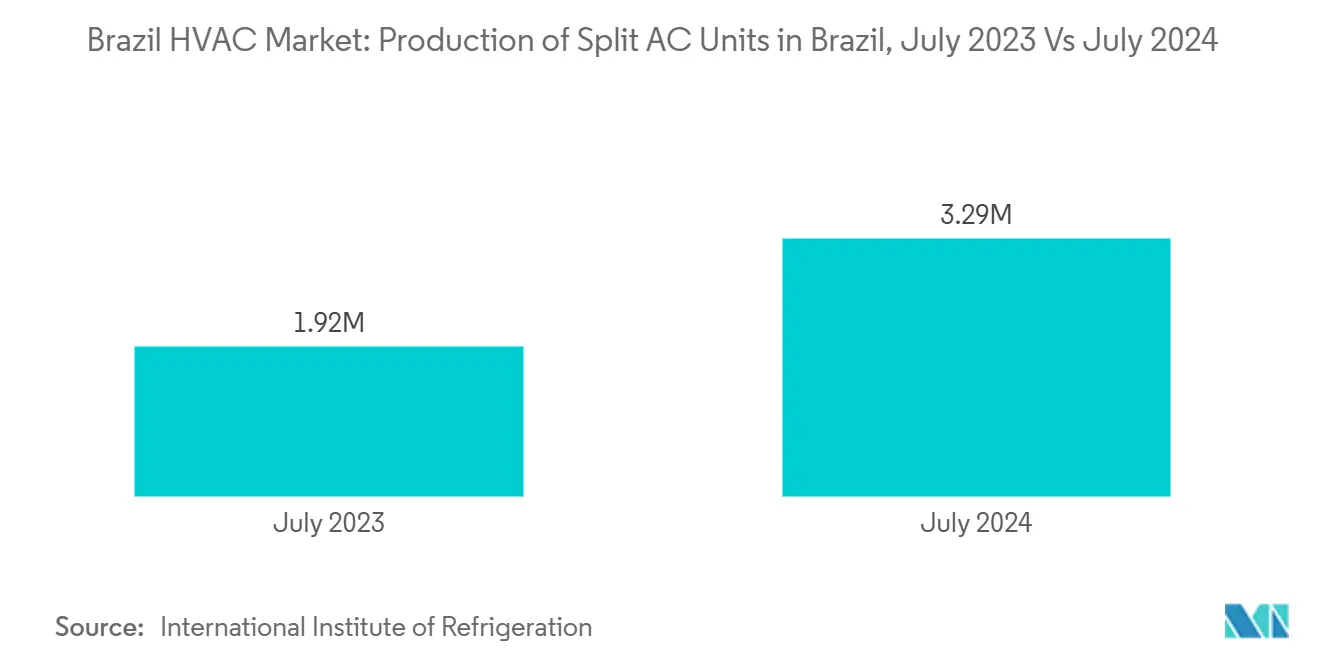
- Brazil is one of the top ten global consumers of air-conditioning units. According to the International Institute of Refrigeration, production of split AC units grew significantly by 71.3% in the first half of 2024. The number of units produced increased from 1,922,331 in July 2023 to 3,294,408 in July 2024, highlighting a strong recovery in demand for split ACs.
- In Brazil, air conditioners are significant contributors to residential electricity consumption. The increasing frequency of heat waves has led to a rise in air conditioner sales, which, in turn, has caused a long-term increase in household energy usage. In April 2025, the Brazilian Ministry of Mines and Energy established new standards to encourage the widespread adoption of high-efficiency inverter air conditioners in the market.
- Brazil is emerging as a key destination for data centers, with billions of dollars in investments anticipated in the coming years. The rapid expansion of data centers in the country is supported by factors such as Brazil’s favorable economic conditions, strategic geographical location, and a relatively stable regulatory framework. Furthermore, growth limitations in larger markets like the U.S. and Europe are driving the development of Brazil's data center market. Since data centers require extensive cooling infrastructure, the demand for commercial AC systems is also expected to rise in the country.
- Brazil is working to improve air quality management due to its negative effects on health, the environment, and the economy. After COVID, there is more focus on indoor air quality and thermal comfort in homes, offices, and public spaces. All these factors are expected to increase the demand for air conditioning equipment in Brazil.
Competitive Landscape
In Brazil's HVAC market, a mix of regional conglomerates and specialized players operates across diverse segments. While a handful of large multinational corporations dominate certain lucrative segments, a multitude of regional and niche players intensifies the competition, resulting in a rich tapestry of market diversity. This fragmentation stems from the versatile applications of HVAC systems, creating an environment where both large and small enterprises can flourish.
Prominent players in Brazil's HVAC landscape include Daikin Industries, Ltd., Carrier Corporation, Johnson Controls International plc, Mitsubishi Electric Corporation, and LG Electronics. These industry giants boast robust brand recognition and a vast global footprint, allowing them to secure a substantial market share. Their prowess is evident in their commitment to innovation, a diverse portfolio of solutions, and a formidable distribution network. To further bolster their market presence, these leaders frequently pursue strategic acquisitions and forge partnerships.
In Brazil's HVAC arena, companies that champion innovation are more likely to thrive. As industries increasingly demand cutting-edge solutions, energy-efficient HVAC systems have emerged as a pivotal differentiator. Additionally, expanding service offerings and enhancing customer support are crucial for cultivating enduring relationships and ensuring repeat patronage. Firms that venture into emerging markets and customize their products to resonate with regional preferences carve out a competitive advantage in this fragmented market.
Brazil HVAC Industry Leaders
-
Daikin Industries, Ltd.
-
Carrier Corporation
-
Johnson Controls International plc
-
Mitsubishi Electric Corporation
-
LG Electronics Ltd.
- *Disclaimer: Major Players sorted in no particular order
Recent Industry Developments
- April 2025: TCL, an electronics manufacturer, has introduced its latest air conditioner, the Fresh-in 3.0, which offers improved usability and better air quality. The key feature is its independent voice command system, allowing users to operate the device without needing an internet connection or virtual assistants. Scheduled for release in Brazil by the third quarter of 2025, the air conditioner will be available in 9,000 and 12,000 BTU models.
- June 2024: Hisense, a Chinese electronics producer, announced start of production of air conditioning units in Brazil in partnership with the local factories. In addition to local manufacturing, it will also enter the Brazilian market with the import of white goods for household appliances.
Brazil HVAC Market Report Scope
HVAC is a comprehensive system designed to create and maintain comfortable indoor environmental conditions in residential, commercial, and industrial spaces. Heating is the first component, which involves warming interior spaces during cold weather through various methods such as furnaces, heat pumps, and radiant heating systems. These technologies convert energy into heat, distributing warmth evenly throughout a building to ensure occupant comfort and prevent temperature-related issues.
Ventilation represents the critical process of exchanging indoor and outdoor air, ensuring proper air circulation, removing pollutants, controlling humidity, and maintaining air quality. This aspect of HVAC involves mechanical and natural ventilation techniques that introduce fresh air, filter contaminants, and regulate oxygen levels. Proper ventilation is essential for preventing the buildup of harmful gases, reducing moisture-related problems, and creating a healthy indoor environment.
Air Conditioning focuses on cooling and dehumidifying interior spaces during warm weather. Modern air conditioning systems use refrigeration cycles to remove heat and moisture from the air, creating a comfortable and controlled climate. These systems range from central air conditioning units to ductless mini-splits, providing precise temperature management and improving overall indoor comfort. The integration of these three components- heating, ventilation, and air conditioning- creates a sophisticated environmental control system that adapts to changing weather conditions and occupant needs.
The study tracks the revenue accrued through the sale of HVAC product types by various players in Brazil. The study also tracks the key market parameters, underlying growth influencers, and major vendors operating in the industry, which supports the market estimations and growth rates over the forecast period. The study further analyses the overall impact of macroeconomic factors on the market. The report's scope encompasses market sizing and forecasts for the various market segments.
The Brazil HVAC Market is Segmented by product type (heating equipment [heat pumps (air source, ground source), furnaces (gas, electric, oil), boilers (condensing, non-condensing), unit heaters, and others (radiators & baseboard heaters, solar water heating systems)], ventilation equipment [air handling units (AHUs), energy recovery ventilators (ERVs)/heat recovery, ventilators (HRVs), exhaust and supply fans, dehumidifiers/humidifiers], air conditioning equipment [unitary air conditioners, variable refrigerant flow (VRF) systems, chillers (air-cooled, water-cooled), fan coil units (FCUs), and others (window and portable air conditioners)]) and end-user industry (residential, commercial, and industrial). The market sizes and forecasts are provided in terms of value (USD) for all the above segments.
| Heating Equipment | Heat Pumps (Air Source, Ground Source) | |
| Furnaces (Gas, Electric, Oil) | ||
| Boilers (Condensing, Non-condensing) | ||
| Unit Heaters | ||
| Others (Radiators & Baseboard Heaters, Solar Water Heating Systems) | ||
| Ventilation Equipment | Air Handling Units (AHUs) | |
| Energy Recovery Ventilators (ERVs) / Heat Recovery Ventilators (HRVs) | ||
| Exhaust and Supply Fans | ||
| Dehumidifiers / Humidifiers | ||
| Air Conditioning Equipment | Unitary Air Conditioners | Split Air Conditioners |
| Packaged Terminal ACs (PTACs) | ||
| Rooftop Packaged Units (RTUs) | ||
| Variable Refrigerant Flow (VRF) Systems | ||
| Chillers (Air-Cooled, Water-Cooled) | ||
| Fan Coil Units (FCUs) | ||
| Others (Window and Portable Air Conditioners) | ||
| Residential |
| Commercial |
| Industrial |
| By Product Type | Heating Equipment | Heat Pumps (Air Source, Ground Source) | |
| Furnaces (Gas, Electric, Oil) | |||
| Boilers (Condensing, Non-condensing) | |||
| Unit Heaters | |||
| Others (Radiators & Baseboard Heaters, Solar Water Heating Systems) | |||
| Ventilation Equipment | Air Handling Units (AHUs) | ||
| Energy Recovery Ventilators (ERVs) / Heat Recovery Ventilators (HRVs) | |||
| Exhaust and Supply Fans | |||
| Dehumidifiers / Humidifiers | |||
| Air Conditioning Equipment | Unitary Air Conditioners | Split Air Conditioners | |
| Packaged Terminal ACs (PTACs) | |||
| Rooftop Packaged Units (RTUs) | |||
| Variable Refrigerant Flow (VRF) Systems | |||
| Chillers (Air-Cooled, Water-Cooled) | |||
| Fan Coil Units (FCUs) | |||
| Others (Window and Portable Air Conditioners) | |||
| By End-user Industry | Residential | ||
| Commercial | |||
| Industrial | |||
Key Questions Answered in the Report
How big is the Brazil HVAC Market?
The Brazil HVAC Market size is expected to reach USD 6.19 billion in 2025 and grow at a CAGR of 5.5% to reach USD 8.07 billion by 2030.
What is the current Brazil HVAC Market size?
In 2025, the Brazil HVAC Market size is expected to reach USD 6.19 billion.
Who are the key players in Brazil HVAC Market?
Daikin Industries, Ltd., Carrier Corporation, Johnson Controls International plc, Mitsubishi Electric Corporation and LG Electronics Ltd. are the major companies operating in the Brazil HVAC Market.
What years does this Brazil HVAC Market cover, and what was the market size in 2024?
In 2024, the Brazil HVAC Market size was estimated at USD 5.85 billion. The report covers the Brazil HVAC Market historical market size for years: 2019, 2020, 2021, 2022, 2023 and 2024. The report also forecasts the Brazil HVAC Market size for years: 2025, 2026, 2027, 2028, 2029 and 2030.
Brazil HVAC Market Report
Statistics for the 2025 Brazil HVAC market share, size and revenue growth rate, created by Mordor Intelligence™ Industry Reports. Brazil HVAC analysis includes a market forecast outlook for 2025 to 2030 and historical overview. Get a sample of this industry analysis as a free report PDF download.