
Market Overview
| Study Period | 2021 - 2031 |
|---|---|
| Forecast Data Period | 2026 - 2031 |
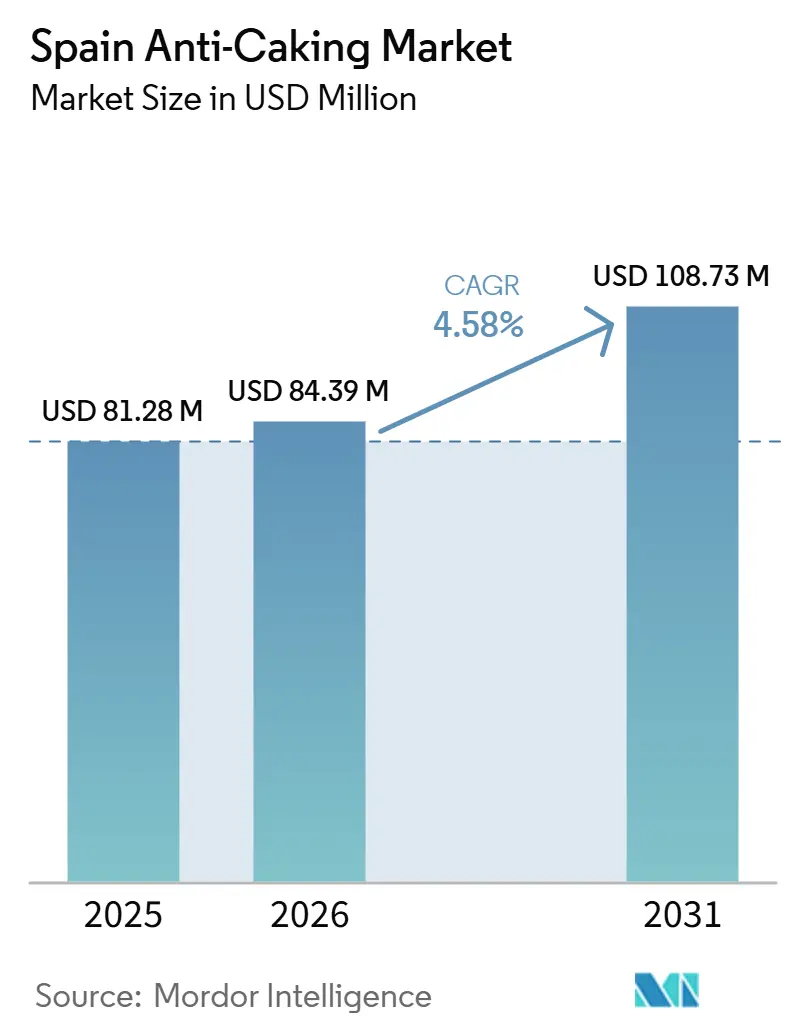
| Base Year Market Size (2025) | USD 81.28 Million |
| Market Size (2026) | USD 84.39 Million |
| Market Size (2031) | USD 108.73 Million |
| Growth Rate (2026 - 2031) | 4.58 % |
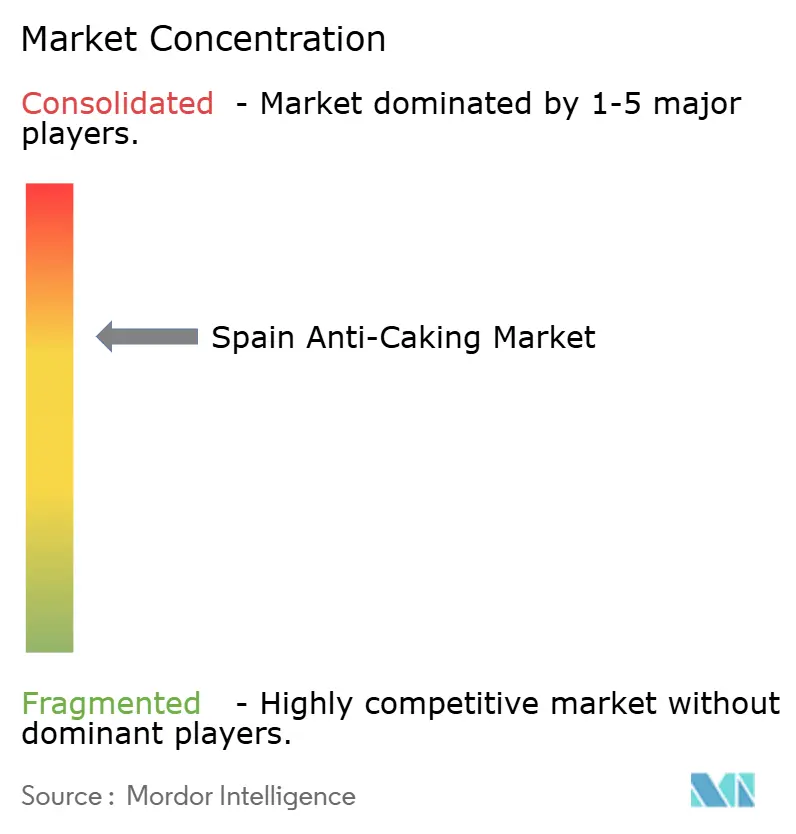
| Market Concentration | Medium |
Major Players *Disclaimer: Major Players sorted in no particular order Image © Mordor Intelligence. Reuse requires attribution under CC BY 4.0. | |
Spain Anti-Caking Market Analysis by Mordor Intelligence
The Spain Anti-Caking Market size is estimated at USD 84.39 million in 2026 and is forecast to reach USD 108.73 million by 2031, growing at a CAGR of 4.58% during 2026-2031. The Spain Anti-Caking Market is supported by a large domestic food manufacturing base, which remained Spain’s largest industrial branch in 2024. Food processors require stable powder flow in seasoning, bakery mixes, dairy ingredients, and beverage formulations. Climate conditions also raise the importance of moisture management during storage and transport, particularly along coastal supply routes. Suppliers are responding with mineral-based materials, formulation support, and regulatory documentation that reduce switching risk for buyers. Competitive positions depend on reliable local supply, food-grade compliance, and the ability to serve both established food uses and newer personal care applications.
Key Report Takeaways
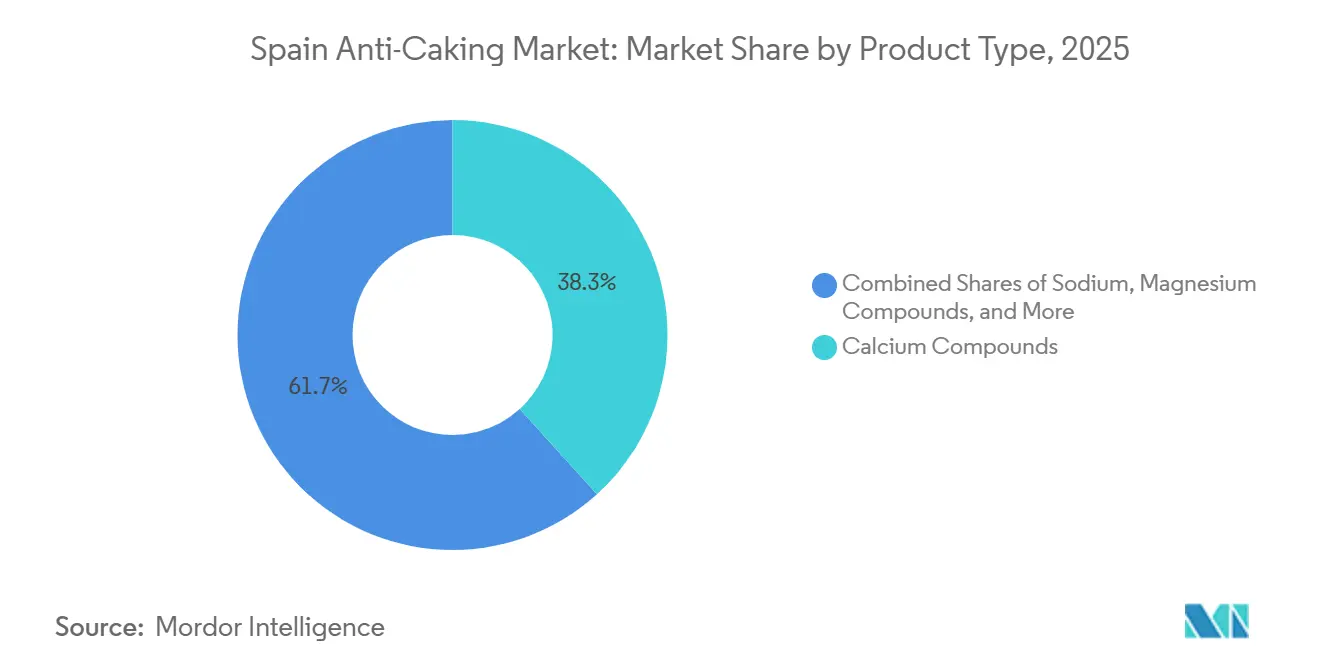
- By type, Calcium Compounds held 38.27% of the Spain Anti-Caking Market in 2025, while Sodium Compounds are forecast to grow at a 5.68% CAGR through 2031.
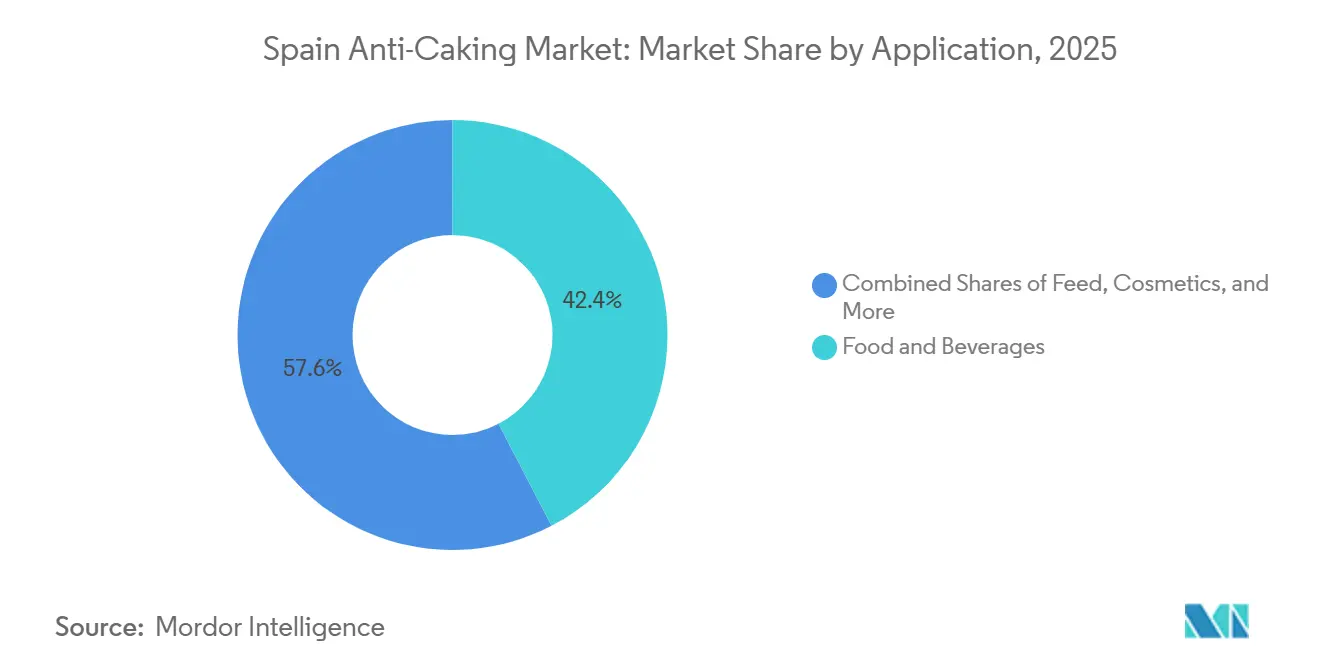
- By application, Food and Beverage held 42.38% of the Spain Anti-Caking Market in 2025, while Cosmetics and Personal Care is forecast to grow at a 6.02% CAGR through 2031.
Note: Market size and forecast figures in this report are generated using Mordor Intelligence’s proprietary estimation framework, updated with the latest available data and insights as of January 2026.
Spain Anti-Caking Market Trends and Insights
Drivers Impact Analysis*
| Driver | (~) % Impact on CAGR Forecasts | Geographic Relevance | Impact Timeline |
|---|---|---|---|
| Growth of the Processed Food Industry | +1.1% | National, with concentration in Catalonia, Andalusia, and Castilla y León food processing belts | Medium term (2–4 years) |
| Strong Bakery and Confectionery Production | +0.8% | National, with early gains in Aguilar de Campoo, Barcelona, and Valencia production clusters | Short term (≤ 2 years) |
| Humidity-Resilient Formulations for Mediterranean Supply Chains | +0.4% | Mediterranean coast, spill-over to Andalusia and Murcia | Short to medium term (≤ 3 years) |
| Rising Demand for Clean-Label Formulations | +0.6% | National, with premium-market concentration in Madrid and Barcelona retail corridors | Medium term (2–4 years) |
| Increasing Automation in Food Processing Facilities, Requiring Free-Flowing Ingredients | +0.5% | National, with early gains in Catalonia and Basque Country high-automation plants | Long term (≥ 4 years) |
| Rising Applications of Anti-Caking Agents in Cosmetics and Personal Care | +0.7% | National, with cosmetics export hubs in Barcelona and the Balearic Islands | Medium term (2–4 years) |
| Source: Mordor Intelligence | |||
Growth of Processed Food, Bakery, and Confectionery Production
Spain’s food and beverage manufacturing sector recorded 1.7% real production growth in 2025. The sector generated EUR 137,188 million in real production value and benefited from domestic consumption and export demand. It employed 559,700 people and represented 23.8% of national manufacturing activity. This scale creates recurring demand for free-flow agents used in powdered seasonings, dairy ingredients, beverage blends, and bakery mixes. The United States Department of Agriculture expects Spanish demand for food ingredients to continue increasing in 2026[1]Source: U.S. Department of Agriculture Foreign Agricultural Service, “Spain Food Processing Ingredients Annual,” USDA Foreign Agricultural Service, fas.usda.gov.. The Spanish Anti-Caking Market therefore benefits when larger processors standardize ingredient specifications and require more consistent quality documentation. Spanish confectionery turnover reached EUR 8,110 million in 2025, rising 4.5%, while exports reached EUR 2,658 million. Industrial bakery and pastry revenue reached EUR 6,150 million in the same year. These sectors use calcium-based products in baking powder, powdered sugar, cake mixes, and seasoning systems. Longer export routes extend storage and transit periods for powder ingredients. That requirement favors agents that maintain flow during handling and transport. The Spain Anti-Caking Market gains from this need because bakery producers cannot easily substitute lower-performing compounds without affecting processing consistency.
Humidity-Resilient Formulations and Processing Automation
Mediterranean humidity and inland temperature changes can affect the behavior of powder ingredients during warehousing and distribution. Food manufacturers therefore need materials that limit clumping before dosing, blending, and packing. Calcium and magnesium compounds are important where moisture resistance and mineral-origin credentials are both required. The Mediterranean coast, Murcia, and Andalusia combine agricultural production with logistics activity, increasing exposure to storage conditions. Automated lines also require powders with more predictable flow than manual batch operations. The Spain Anti-Caking Market has an opportunity to serve these needs through application testing, storage guidance, and materials matched to local operating conditions. Spanish food processors are increasing their use of automation and digital systems in production operations. Automated dosing equipment depends on consistent bulk density, particle movement, and moisture control. Small variations in powder behavior can interrupt production or reduce batch accuracy. This makes free-flow performance a functional requirement rather than an optional additive benefit. Suppliers with technical support can work with processors during equipment upgrades and product reformulation. The Spain Anti-Caking Market can therefore gain from the modernization of food plants even when underlying food volumes grow gradually.
Rising Demand for Clean-Label Formulations
Shorter ingredient lists are changing how food producers select functional additives. Buyers increasingly look for mineral-origin or naturally derived materials that can fit clean-label product positioning. This preference supports the use of calcium carbonate, calcium silicate, and natural clay minerals in appropriate formulations. It also increases scrutiny of product specifications, traceability, and permitted use conditions. Spain’s bioingredients network has prioritized the conversion of agri-industrial by-products into higher-value functional ingredients in its 2025-2027 agenda. The Spain Anti-Caking Market is affected because suppliers need to explain both performance and ingredient-origin credentials to formulation teams. Clean-label demand does not remove the technical need for flow control in dry products. Instead, it shifts purchasing toward compounds that meet both functional and labeling requirements. Natural mineral suppliers can benefit when they provide clear regulatory files and application evidence. Synthetic silica and aluminosilicate products may face greater review in some new product briefs. Tolsa’s Spanish mineral extraction base gives it a relevant position in this transition. The Spain Anti-Caking Market is likely to reward suppliers that can support reformulation without compromising shelf life, blending performance, or consumer-facing claims.
Rising Applications in Cosmetics and Personal Care
Spain’s personal care manufacturers are increasing their attention to powder formats and formulation performance. Dry shampoos, face powders, body powders, and color cosmetics need reliable flow during production and use. Anti-caking agents help prevent aggregation in these products, especially where storage conditions include humidity. Cosmetics and Personal Care is the fastest-growing application in the Spain Anti-Caking Market because powder formats require both sensory quality and process stability. Mineral alternatives also align with the move away from some conventional powder ingredients. Suppliers must demonstrate compatibility with cosmetic matrices and provide documentation suitable for personal care customers. Personal care manufacturers are also seeking partners that can support product development instead of only supplying a standard mineral. Formulation teams evaluate absorption, color, particle behavior, and sensory properties together. This creates a higher service requirement than many established food applications. Suppliers that provide technical co-development can become more difficult to replace. The category requires suppliers to explain how their ingredients perform in specialized powder formulations. The Spain Anti-Caking Market has room for suppliers that connect mineral performance with the product claims sought by local cosmetics brands.
Restraints Impact Analysis*
| Restraint | (~) % Impact on CAGR Forecasts | Geographic Relevance | Impact Timeline |
|---|---|---|---|
| Stringent EU Food Additive Regulations | -0.8% | National (EU member state; full compliance with EC No 1333/2008) | Medium term (2–4 years) |
| Availability of Alternative Processing Technologies | -0.5% | National, with technology-intensive processors in Catalonia and Basque Country most exposed | Long term (≥ 4 years) |
| Volatility in Raw Material Prices | -0.6% | National, with import-dependent producers in Tarragona and Valencia industrial zones most sensitive | Short to medium term (≤ 3 years) |
| Complex Reformulation Requirements | -0.4% | National, with premium-food and nutraceutical segments in Madrid and Barcelona most affected | Medium term (2–4 years) |
| Source: Mordor Intelligence | |||
EU Food Additive Regulation and Reformulation Requirements
Spain applies Regulation (EC) No 1333/2008, which sets permitted food additives and conditions of use across the European Union. The framework requires processors, importers, and manufacturers to maintain compliant ingredient documentation. The European Commission reported that 244 additives had been assessed under the re-evaluation program by February 2026. It also reported that 71 substances remained pending assessment[2]Source: European Commission, “Re-Evaluation of Food Additives,” European Commission Food Safety, food.ec.europa.eu.. This ongoing review can delay purchasing decisions where buyers expect future specification changes. The Spain Anti-Caking Market is more resilient where suppliers offer already-reviewed mineral materials supported by complete technical dossiers. EFSA’s 2024 opinion on silicon dioxide, E551, found no safety concern across population groups under the evaluated conditions of use. The opinion recommended lower maximum limits for lead, mercury, and arsenic. Manufacturers may need to update specifications, supplier qualification systems, and quality assurance records. Reformulation can require plant trials because a replacement agent may change moisture response or powder movement.
Alternative Processing Technologies and Raw Material Volatility
Some processors can reduce caking risk through packaging, humidity control, modified handling, or equipment changes. These approaches can limit additive use in selected applications, although they do not remove the need for free-flow performance in every powder product. Raw material costs also depend on energy, extraction, transport, and global chemical supply conditions. Solvay is investing more than EUR 200 million in biomass cogeneration at its Torrelavega soda ash and bicarbonate plant. The project is designed to replace 70% of coal use by 2027. The Spain Anti-Caking Market faces cost pressure when these inputs fluctuate faster than suppliers can update customer contracts. Spain relies on supply routes that include North African minerals and Central European chemicals. Disruption along these routes can affect delivered costs even when domestic demand remains stable. Import-dependent users in Tarragona and Valencia are particularly sensitive to logistics changes. Producers can respond through local inventory, broader sourcing, and longer-term supply agreements. Alternative processing technologies may be most relevant in high-value applications where equipment investment is economically justified. The Spain Anti-Caking Market remains dependent on additives in many food and feed uses because the materials support routine handling at scale.
*Our forecasts treat driver/restraint impacts as directional, not additive. The impact forecasts reflect baseline growth, mix effects, and variable interactions.
Segment Analysis
By Type: Calcium Compounds Lead While Sodium Compounds Gain Ground
Calcium Compounds held 38.27% of Spain Anti-Caking Market share in 2025. Their position reflects broad acceptance across food categories and cost competitiveness against some synthetic silica products. Calcium silicate and calcium carbonate are used in table salt, baking powders, powdered seasonings, and dairy mixes. These materials are familiar to food processors and can fit established manufacturing practices. Their performance is especially relevant in products exposed to storage and transport moisture. The Spain Anti-Caking Market size for Calcium Compounds is supported by high-volume bakery and confectionery activity. Suppliers also benefit from a clear fit with clean-label and mineral-origin product discussions. Regulatory familiarity lowers the burden of supplier qualification for many applications. This gives calcium products a durable place in the type mix even as specialty materials grow. It also supports demand from processors that prioritize predictable cost and availability.
Sodium Compounds are forecast to expand at a 5.68% CAGR through 2031. Their growth is tied to flexibility across food reformulation and personal care powder production. Sodium aluminosilicate can be selected where formulators need specific flow, absorption, or texture characteristics. The category benefits from the continued use of silica-based functional materials in dry products. EFSA confirmed the safety of silicon dioxide, E551, under its evaluated conditions of use in 2024. That finding provides useful regulatory context for manufacturers assessing free-flow systems. Magnesium Compounds and other types address narrower needs in animal feed and sports nutrition. Tolsa’s EXAL range uses Spanish sepiolite clay as a flow aid and carrier in feed production. These smaller categories can expand when customers require absorption capacity, inert behavior, or natural mineral credentials.



By Application: Food and Beverage Remains the Volume Base While Cosmetics Grows Faster
Food and Beverage accounted for 42.38% of Spain Anti-Caking Market share in 2025. The application includes bakery products, dairy products, soups and sauces, beverages, and other dry food products. Powdered baking mixes, instant soups, seasonings, and dairy ingredients depend on stable movement during production. Industrial bakery is an important customer because small changes in powder behavior can affect large production runs. Spain has an established industrial bakery and pastry base that uses several powdered ingredients. Export activity extends the time that ingredient systems remain in storage and transit. The Spain Anti-Caking Market size for Food and Beverage is also linked to consistent food ingredient demand. Producers need materials that keep products free-flowing while meeting food safety and labeling requirements. This application will remain the central volume source because it spans many everyday food categories.
Cosmetics and Personal Care is projected to grow at a 6.02% CAGR through 2031. The category uses anti-caking materials in face powders, dry shampoos, and talc-free body products. Formulators consider flow behavior alongside texture, absorption, color, and product appearance. Mineral-origin alternatives are gaining attention as clean-beauty product development expands. Feed remains a meaningful secondary application because Spain produced 30.8 million tonnes of compound animal feed in 2025. Free-flow agents support premix handling and consistent feed manufacture. FEFAC projected a 3% decline in Spanish cattle feed production, which may limit near-term growth in selected feed uses[3]Source: European Feed Manufacturers’ Federation, “Feed and Food Report 2025,” FEFAC, fefac.eu.. Other applications provide a route for suppliers to diversify beyond food. The Spain Anti-Caking Industry is therefore balancing stable food demand with faster growth in cosmetics and targeted feed opportunities.
Geography Analysis
Catalonia is a leading demand center because it has a dense base of food processors, ingredient distributors, and cosmetics manufacturers. Barcelona also hosts the Alimentaria FoodTech ecosystem, which brings together food processing and ingredient companies. Brenntag and IMCD support supply to bakery, dairy, and beverage customers across Barcelona and the Ebro Valley. The Spain Anti-Caking Market is also supported in Andalusia, Spain’s largest agricultural region. Olive oil, dairy, processed meat, and seasoning production create repeated demand for dry ingredient handling. Spain was the third-largest destination for U.S. agricultural ingredient exports in the European Union in 2026. This connection places Andalusian processors within international ingredient supply chains.
Northern Spain, especially Cantabria and the Basque Country, has important chemical manufacturing assets. Solvay’s Torrelavega site produces soda ash and sodium bicarbonate, relevant upstream materials for sodium compound production. The company’s biomass project supports the continued role of domestic production through 2027. BASF’s Tarragona production center remains a major southern European facility for the company. BASF confirmed EUR 54 million of investment in Spain for 2026, with more than half directed to Tarragona. Castilla y León is a growing secondary food manufacturing area. Galletas Gullón submitted a EUR 196.3 million investment plan for 2026-2030, including a new factory and automated logistics platform.
The Mediterranean corridor includes Valencia, Murcia, and Andalusia. Its horticultural exports and food logistics networks create demand for flow control in granular and powdered products. The region’s agri-food trade balance exceeded EUR 19 billion. The Spain Anti-Caking Market benefits where automated dosing systems require tighter powder-flow tolerances. Coastal humidity also makes formulation performance an operational issue for suppliers and buyers. These regional differences mean that a national sales approach must still address local climate, application, and supply conditions.
Competitive Landscape
The Spain Anti-Caking Market is moderately concentrated, with multinational chemical suppliers and Spanish mineral specialists serving different customer needs. BASF, Evonik, Solvay, and Cabot Corporation compete through product breadth and technical support. Their offerings are relevant in food-grade silica and precipitated silica applications. Tolsa has a differentiated domestic position through Spanish sepiolite extraction and international distribution. Distribution companies such as Brenntag, IMCD, Azelis, and Univar compete through logistics, local availability, and formulation assistance. Their role is important for manufacturers that do not maintain a direct Spanish commercial organization. The Spain Anti-Caking Market favors suppliers that can combine dependable delivery with application-specific documentation. This structure gives customers several purchasing options but does not eliminate qualification barriers. Food and cosmetic customers usually require evidence that a material works within a particular formulation.
PPG positions its FLO-GARD precipitated silica range for bulk food and feed applications. In 2024, PPG published research showing carrying capacities above 66% by weight for its silica products, compared with 3.75% for maltodextrin. This example shows how technical performance data can influence customer discussions. Evonik has communicated the regulatory relevance of EFSA’s E551 opinion for silica products. Tolsa renewed UNE 22470 and UNE 22480 Certified Sustainable Mining credentials in Spain and Senegal during 2025. These actions strengthen its position with buyers that assess sourcing and environmental documentation. Suppliers are also seeking opportunities in natural cosmetics and functional foods. That area requires clean-label support, climate-resilient performance, and compliance records.
BASF is continuing investment in its Spanish chemical footprint, with Tarragona receiving a large share of its 2026 investment budget. Solvay’s Torrelavega biomass project is intended to lower emissions while retaining sodium compound capacity. Tolsa introduced EXAL for animal feed production in July 2026. These moves demonstrate competition through capacity investment, production efficiency, and tailored mineral products.
Spain Anti-Caking Industry Leaders
BASF SE
Evonik Industries
Cargill Inc.
Brenntag AG
Solvay SA
- *Disclaimer: Major Players sorted in no particular order

Recent Industry Developments
- July 2026: Tolsa S.A. launched EXAL, a sepiolite-based anti-caking and carrier additive for animal feed production. The product was positioned as an alternative to synthetic flow aids and supports Tolsa’s feed premix and supplement offering.
- March 2025: BASF announced plans to establish a 25-hectare state-of-the-art R&D and Innovation (R&D&I) center in El Ejido, Almería, Spain. Construction is scheduled to begin in early 2026, with the facility expected to become fully operational by early 2028.


Spain Anti-Caking Market Report Scope
The Spain Anti-Caking Market is segmented by type and application. By type, the market is segmented into calcium compounds, sodium compounds, magnesium compounds, others. By application, the market is segmented into food and beverage, cosmetic and personal care, feed, and other applications.
By Type
| Calcium Compounds |
| Sodium Compounds |
| Magnesium Compounds |
| Other Types |
By Application
| Food and Beverage | Bakery Products |
| Dairy Products | |
| Soups and Sauces | |
| Beverages | |
| Others | |
| Cosmetic and Personal Care | |
| Feed | |
| Other Applications |
| By Type | Calcium Compounds | |
| Sodium Compounds | ||
| Magnesium Compounds | ||
| Other Types | ||
| By Application | Food and Beverage | Bakery Products |
| Dairy Products | ||
| Soups and Sauces | ||
| Beverages | ||
| Others | ||
| Cosmetic and Personal Care | ||
| Feed | ||
| Other Applications | ||


Key Questions Answered in the Report
What is the 2026 value of Spain’s anti-caking sector?
The Spain Anti-Caking Market is valued at USD 84.39 million in 2026 and is forecast to reach USD 108.73 million by 2031.
What is the forecast growth rate through 2031?
The sector is forecast to expand at a 4.58% CAGR between 2026 and 2031.
Which anti-caking type has the largest position in Spain?
Calcium Compounds held 38.27% in 2025, supported by established food and bakery uses.
Which application is growing fastest in Spain?
Cosmetics and Personal Care is forecast to grow at a 6.02% CAGR through 2031.
Page last updated on:


 Your data is secure and never sold or shared.


