
Spacecraft Market Size and Share
Market Overview
| Study Period | 2019 - 2031 |
|---|---|
| Market Size (2026) | USD 49.62 Billion |
| Market Size (2031) | USD 78.73 Billion |
| Growth Rate (2026 - 2031) | 9.67 % |
| Fastest Growing Market | Asia Pacific |
| Largest Market | North America |
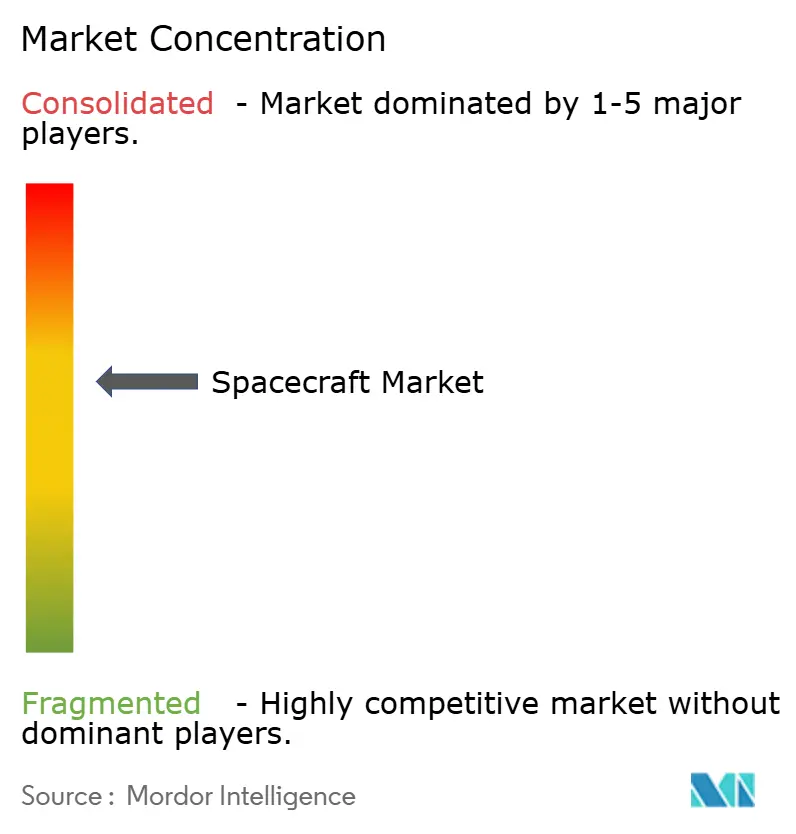
| Market Concentration | Medium |
Major Players *Disclaimer: Major Players sorted in no particular order Image © Mordor Intelligence. Reuse requires attribution under CC BY 4.0. | |
Spacecraft Market Analysis by Mordor Intelligence
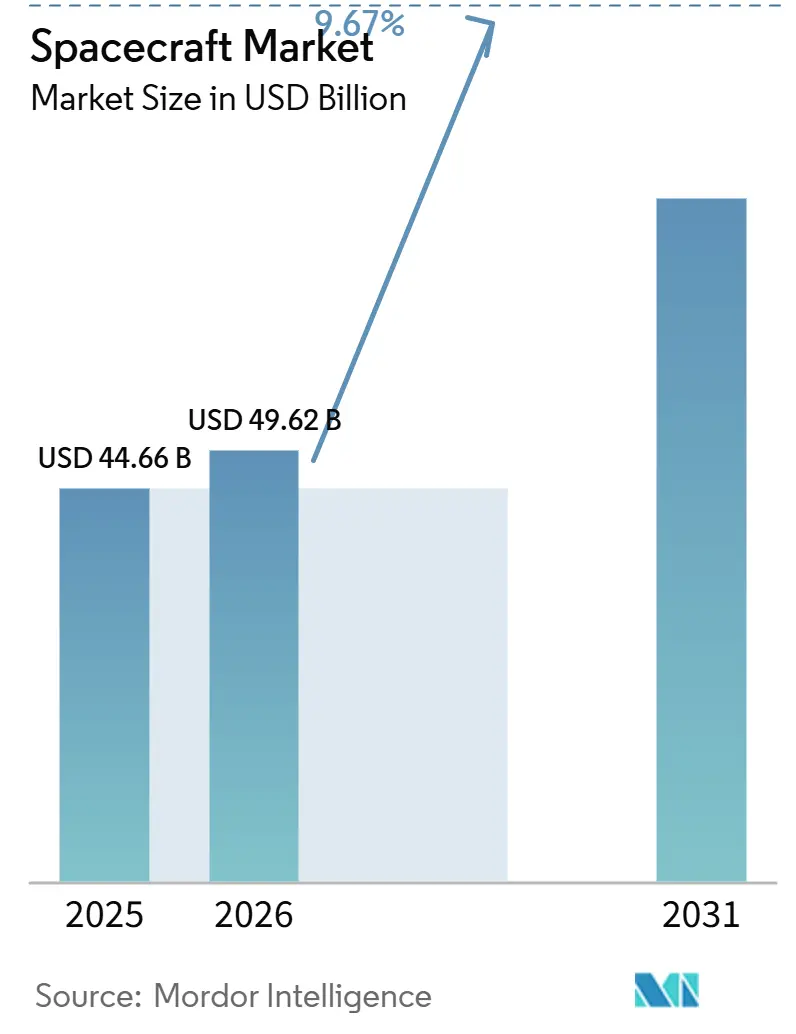
The spacecraft market size is expected to grow from USD 44.66 billion in 2025 to USD 49.62 billion in 2026 and is forecast to reach USD 78.73 billion by 2031 at a 9.67% CAGR over 2026-2031. Growth reflects a decisive pivot from fully government-funded missions to hybrid procurement models that blend defense, civil, and commercial demand. Nations are proliferating small satellites to build resilient intelligence networks, private operators are fielding broadband mega-constellations at automotive-style production rates, and lunar logistics programs are opening recurring cargo opportunities. Tightening de-orbit rules, additive manufacturing breakthroughs, and rising reliance on commercial-off-the-shelf (COTS) electronics are further compressing development cycles and cost curves. Meanwhile, launch-site congestion and space debris mitigation costs temper the expansion, but do not blunt the long-term trajectory of the spacecraft market.
Key Report Takeaways
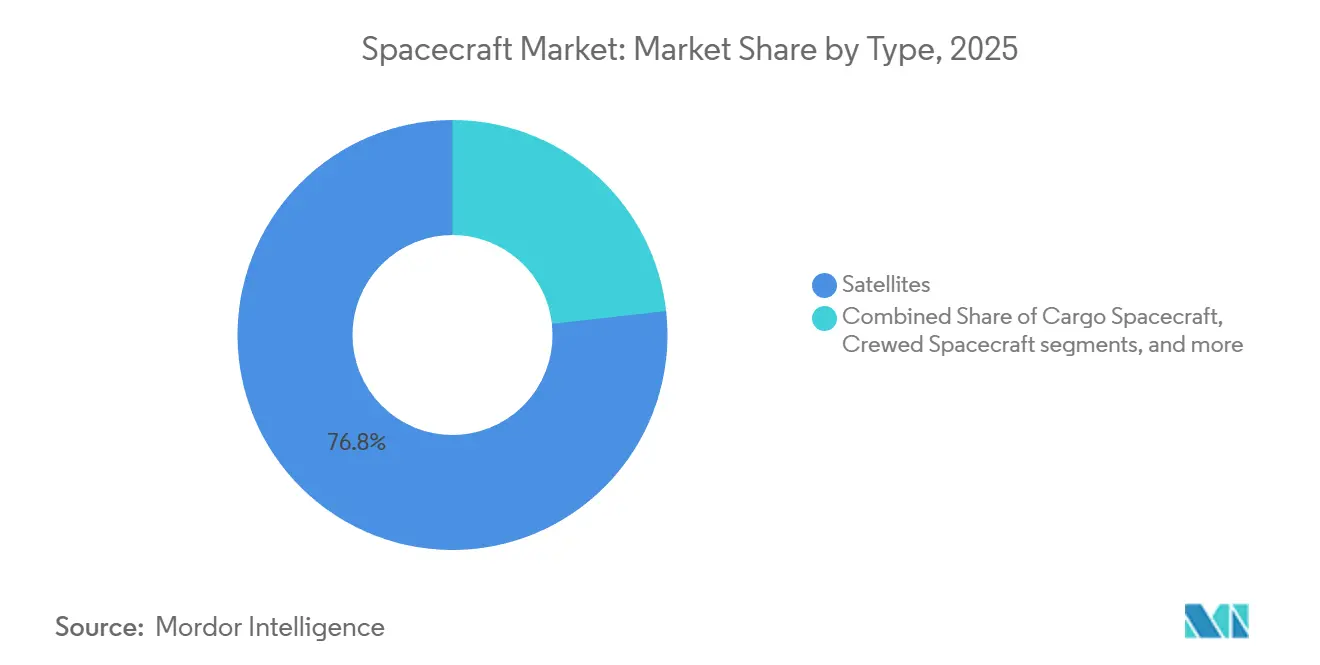
- By type, satellites accounted for 76.78% of the 2025 revenue. In contrast, cargo vehicles are forecast to grow at a 10.12% CAGR through 2031 as NASA’s Commercial Lunar Payload Services and private space-station resupply schedules ramp up.
- By application, communication held a 42.24% share of the spacecraft market size in 2025, while technology-demonstration missions are projected to grow at a 10.32% CAGR through 2031, driven by in-orbit servicing and debris-removal pilots.
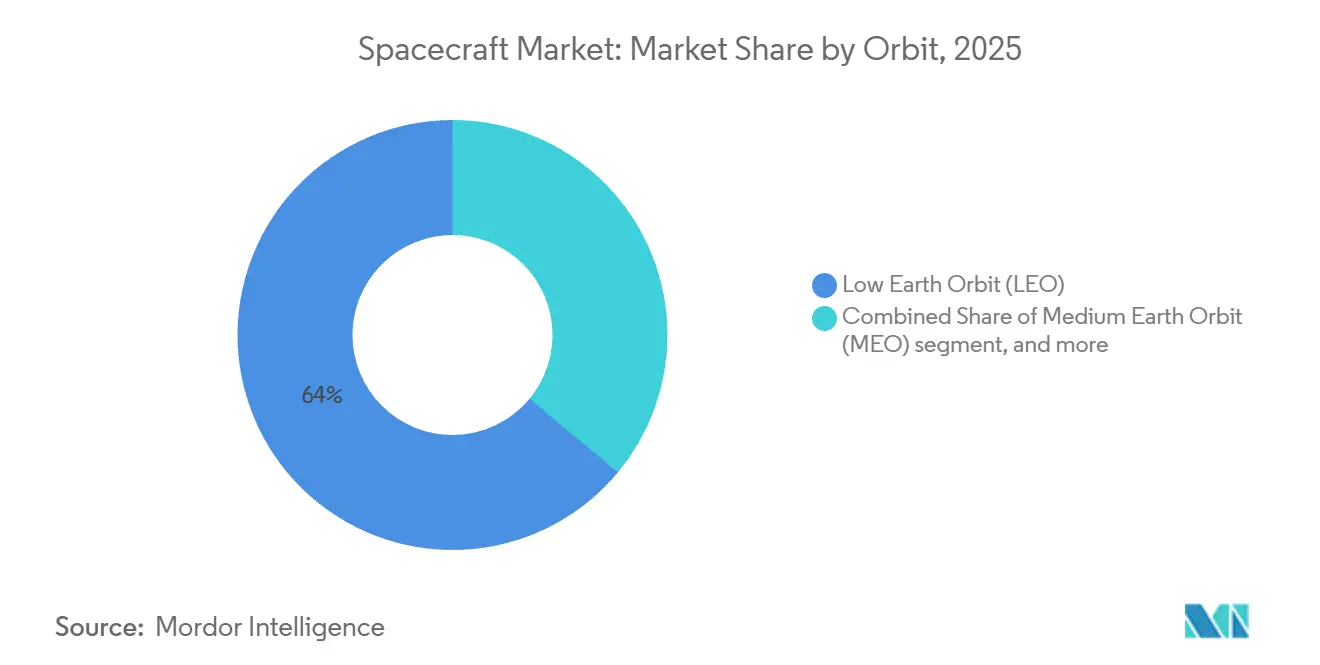
- By orbit, Low Earth Orbit (LEO) accounted for 63.97% of 2025 deployments, but the “Others” category (beyond GEO, cislunar, highly elliptical, and interplanetary) is forecast to grow at a 10.75% CAGR to 2031, supported by Artemis Gateway modules and Mars sample-return probes.
- By subsystem, payloads commanded 31.54% of the 2025 value. Yet, propulsion is projected to grow at a 10.44% CAGR as electric systems become standard for both LEO raising and mandated five-year de-orbit compliance.
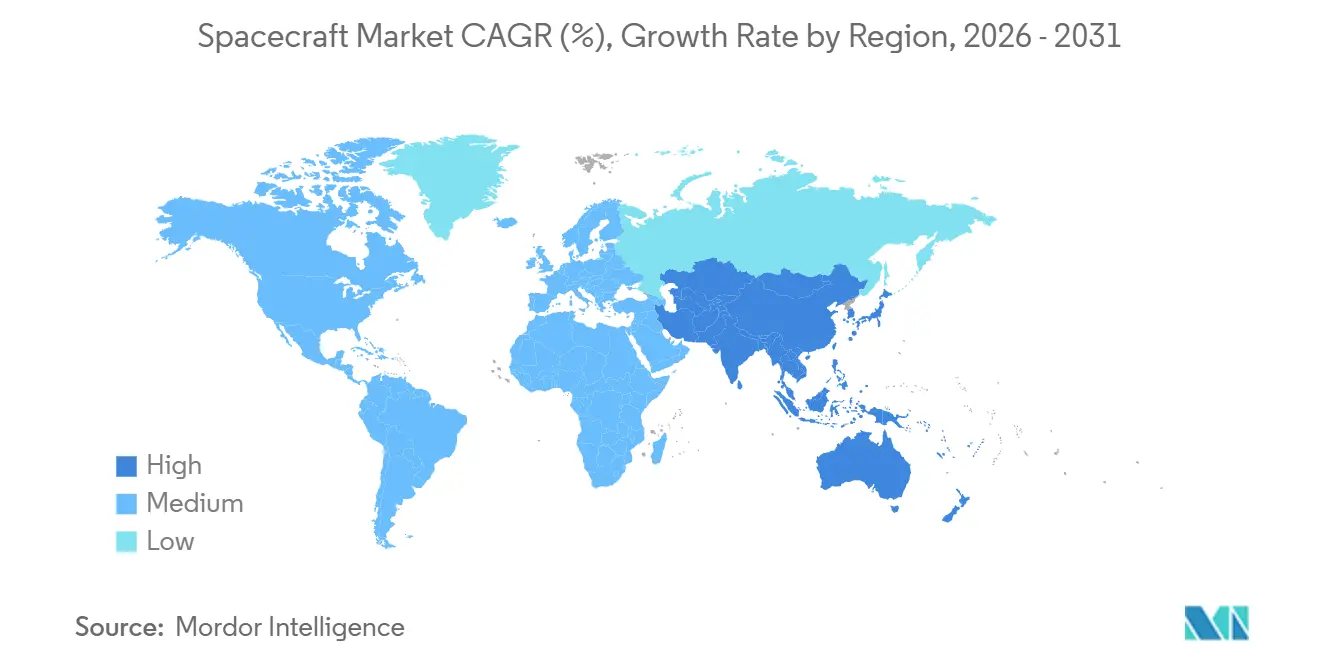
- By geography, North America led with 47.89% of 2025 revenue, anchored by USD 2.7 billion in Orion capsule orders and USD 3.19 billion in Space Launch System boosters, while Asia-Pacific is forecast to grow at an 11.25% CAGR through 2031 on the back of Chinese, Indian, and Japanese deep-space programs.
Note: Market size and forecast figures in this report are generated using Mordor Intelligence’s proprietary estimation framework, updated with the latest available data and insights as of January 2026.
Market Trends and Insights
Drivers Impact Analysis of Spacecraft Market*
| Driver | (~) % Impact on CAGR Forecast | Geographic Relevance | Impact Timeline |
|---|---|---|---|
| Adoption of commercial-off-the-shelf electronics is accelerating spacecraft development | +1.8% | Global, early in North America and Europe | Medium term (2-4 years) |
| Growth of broadband satellite constellations is increasing spacecraft manufacturing demand | +2.4% | Global, concentrated in North America, Europe, Asia-Pacific | Short term (≤2 years) |
| Government lunar and Mars exploration programs are driving advanced spacecraft procurement | +1.6% | North America, Europe, Asia-Pacific | Long term (≥4 years) |
| Rising defense ISR requirements are expanding small satellite deployments | +1.5% | North America, Europe, Middle East, Asia-Pacific | Medium term (2-4 years) |
| In-orbit servicing and life-extension concepts are creating new spacecraft demand | +1.2% | Global, early in North America and Europe | Long term (≥4 years) |
| Additive manufacturing is enabling scalable and cost-efficient spacecraft production | +1.4% | North America, Europe, spillover to Asia-Pacific | Medium term (2-4 years) |
| Source: Mordor Intelligence | |||
Adoption of Commercial-Off-the-Shelf Electronics is Accelerating Spacecraft Development
COTS components shorten design cycles and lower unit costs by replacing long-lead, radiation-hardened parts with high-volume automotive or consumer chips, safeguarded through software error correction and redundancy. The Aerospace Corporation’s 2024 guidelines confirm that COTS processors now power guidance computers in small satellites flying below 600 km for up to five years.[1] ESA echoed the trend by green-lighting commercial microcontrollers for non-critical subsystems, enabling primes to source from Infineon and Texas Instruments rather than waiting 18 months for space-qualified equivalents. The US Space Development Agency’s Tranche 1 transport layer specifies COTS-heavy designs to hit 90-day replenishment goals. The DoD’s 2025 acquisition policy revision further encourages the adoption of COTS for missions with manageable risk. Together, these moves accelerate procurement while introducing supply chain exposure to commercial fabs.
Growth of Broadband Satellite Constellations is Increasing Spacecraft Manufacturing Demand
Mega-constellations require assembly line production. SpaceX’s Redmond plant builds six Starlink spacecraft daily, holding per-unit cost under USD 1 million and resetting pricing expectations. Europe’s IRIS² contract allocates EUR 10.6 billion (USD 12.39 billion) to 290 satellites, justifying investments in automated testing and pushing the first launches to 2028. Amazon’s Project Kuiper received approval for 3,236 satellites and booked 83 launches through 2029, triggering a production ramp in 2025-2026. OneWeb, majority-owned by Eutelsat, is planning a higher-capacity second generation that will reopen its supply chain. This flood of orders institutionalizes mass‐manufacturing practices across the spacecraft market.
Government Lunar and Mars Exploration Programs Are Driving Advanced Spacecraft Procurement
Deep space missions command premium platforms. In 2025, NASA ordered three Orion capsules, extending production into the early 2030s. Commercial Lunar Payload Services has already issued USD 800 million across fourteen task orders, guaranteeing two to three payload flights per year through 2028. Japan’s Martian Moons eXploration probe will showcase ion propulsion and autonomous rendezvous on its 2026-2029 mission. India’s Chandrayaan-4 sample-return mission, approved at over USD 100 million, further diversifies demand. These programs anchor high-value demand well beyond 2030.
Rising Defense ISR Requirements Are Expanding Small-Satellite Deployments
Military agencies are moving from exquisite, single-point-failure satellites to proliferated constellations. The US National Reconnaissance Office issued contracts in 2024 for low-cost electro-optical and SAR assets, each valued at less than USD 50 million, with launch cadences exceeding 10 per year. The UK earmarked GBP 968 million (USD 1.30 billion) for the Oberon and ISTARI constellations to secure sovereign ISR by 2027. Meanwhile, DARPA’s Blackjack program demonstrated autonomous tasking across six spacecraft, serving as a template for the Space Development Agency’s Tranche 2 network. Small-satellite production lines, therefore, scale not only for telecom but also for defense surveillance, reinforcing the expansion of the spacecraft market.
Restraints Impact Analysis of Spacecraft Market*
| Restraint | (~) % Impact on CAGR Forecast | Geographic Relevance | Impact Timeline |
|---|---|---|---|
| Launch-site capacity constraints and launch manifest congestion are delaying deployments | -0.9% | Global, acute in North America | Short term (≤2 years) |
| Increasing space debris and collision risks are complicating mission planning | -0.7% | Global, focused in LEO | Medium term (2-4 years) |
| Export control regulations are restricting international spacecraft collaboration | -0.5% | Global, affecting US-EU and US-Asia | Long term (≥4 years) |
| Shortages of radiation-hardened components are constraining spacecraft production | -0.6% | Global, high in North America and Europe | Medium term (2-4 years) |
| Source: Mordor Intelligence | |||
Launch-Site Capacity Constraints and Manifest Congestion Are Delaying Deployments
Cape Canaveral and Kennedy Space Center hosted more than 50 launches in 2024, stretching range safety staffing and causing multi-week slips when anomalies struck.[2] Vandenberg completed upgrades for 50 flights per year, yet SpaceX has requested over 40 slots alone. Blue Origin’s New Glenn debut moved to 2025, partly due to pad availability conflicts. Such saturation cascades to spacecraft builders, extending delivery timelines and adding cost buffers.
Increasing Space Debris and Collision Risks Are Complicating Mission Planning
The 18th Space Defense Squadron tracks 47,000 objects larger than 10 cm, a 15% increase since 2022. Starlink alone executed 50,000 avoidance maneuvers in the first six months of 2024, burning propellant and shortening the design life. FCC de-orbit mandates compel operators to reserve fuel, reducing payload mass. ESA’s Zero Debris Charter will require controlled re-entries by 2030. Insurance premiums have increased by 20-30%, thereby elevating operating costs.
*Our forecasts treat driver/restraint impacts as directional, not additive. The impact forecasts reflect baseline growth, mix effects, and variable interactions.
Spacecraft Market Segment Analysis
By Type:
Satellites Dominate, Cargo Spacecraft AccelerateSatellites generated 76.78% of the 2025 revenue for the spacecraft market, confirming their centrality to communication, navigation, and Earth observation missions. In contrast, cargo spacecraft are forecast to post a 10.12% CAGR, making them the fastest-growing segment of the spacecraft market. NASA’s Commercial Lunar Payload Services has already allocated USD 800 million, securing two to three cislunar cargo flights per year and cementing demand for uncrewed logistics craft. Sierra Space’s Dream Chaser, with a 5,500 kg capacity and runway landing, is set for a late-2024 ISS debut and differentiates through gentle re-entry profiles.[3]
Cargo growth dovetails with planned commercial stations, where Axiom modules and Orbital Reef concepts need routine supply. Crewed spacecraft remain niche but lucrative; SpaceX’s Dragon capsules dominate current rotations, while Boeing’s Starliner clears final certification for operational flights in 2026. Deep-space probes, although low-volume, deliver high contracting value and drive subsystem innovations, such as deep-space optical links and autonomous navigation. Collectively, the expanding mix sustains a broad production base and underpins the spacecraft market.

By Application:
Communication Leads, Technology Demonstration SurgesCommunication retained a 42.24% share of the spacecraft market size for 2025, reflecting the relentless demand for broadband capacity and secure defense links. Technology demonstration missions, however, are forecast to grow at a 10.32% CAGR through 2031 as operators validate life-extension, debris-removal, and on-orbit assembly concepts. In-orbit servicing successes, such as MEV dockings and forthcoming Astroscale operations, signal a commercial tipping point.
The growth of the Earth observation segment is powered by sub-meter synthetic aperture radar constellations that fulfill defense and agritech analytics. Navigation missions maintain a steady cadence with GPS III and Galileo replenishments, ensuring batch orders are fulfilled every two to three years. Science missions, such as the Europa Clipper, which exceeds USD 5 billion, act as technology pathfinders and maintain institutional knowledge at prime contractors.
By Orbit:
Low Earth Orbit Dominates, Cislunar Trajectories EmergeLow Earth Orbit (LEO) secured 63.97% of 2025 spacecraft deployments, primarily due to the proliferation of Starlink, OneWeb, and defense architectures. Starlink’s more than 7,500 operational satellites span 340-614 km shells, minimizing latency and aligning with FCC five-year disposal rules. Medium Earth Orbit (MEO) serves as the navigation backbone for systems such as GPS III and BeiDou. Geostationary (GEO) remains the realm of weather and high-throughput telecom but increasingly relies on electric propulsion for orbit raising. The Others category, including cislunar and interplanetary paths, is projected to grow at a 10.75% CAGR through 2031 as Artemis Gateway modules and sample-return probes enter serial production.
Cislunar traffic introduces new challenges in radiation shielding, navigation autonomy, and long-duration power systems, encouraging investment in advanced subsystems. Highly elliptical and interplanetary orbits likewise demand higher-specific-impulse propulsion. As these missions mature, they catalyze supplier specialization and broaden the spacecraft market share for niche hardware.
By Subsystem:
Payloads Command Premium, Propulsion Grows FastestPayloads accounted for 31.54% of the 2025 value, driven by the premium pricing of SAR and optical inter-satellite link packages. Propulsion is forecast to lead growth at a 10.44% CAGR, with Aerojet Rocketdyne’s XR-100 Hall thruster offering 4,000 seconds specific impulse and 40% propellant savings for GEO transfer. Busek’s BIT-7 ion thruster underpins multiple small-sat platforms, proving low-mass precision orbit control.
Power, communication, thermal control, and guidance subsystems are all trending toward modular, software-defined architectures. Spectrolab’s 32%-efficient triple-junction cells increase available power density, while NASA’s Laser Communications Relay achieved 1.2 Gbps downlink speeds from the ISS, indicating the potential for optical mainline adoption. Such subsystem evolution reinforces competitive differentiation across the spacecraft market.
Geography Analysis
North America Spacecraft Market
North America contributed 47.89% of 2025 revenue, buoyed by Orion capsule orders and SpaceX’s 148 launches in 2024 that soak up Cape and Vandenberg capacity. The National Reconnaissance Office’s sub-USD 50 million small-sat awards further embed proliferated architectures. Canada’s Telesat Lightspeed constellation targets a 2026 service launch, cementing regional broadband competition.[4]
APAC Spacecraft Market
Asia-Pacific is forecast to witness the highest growth at an 11.25% CAGR to 2031. China executed 67 orbital launches in 2024, showcasing reusable boosters such as Landspace’s Zhuque-3 and expanding the commercial payload share. India’s NewSpace India Limited (NSIL) booked twelve small-sat launches and is maturing a reusable launch demonstrator to halve per-kilogram prices. Japan’s Martian Moons eXploration probe remains on track for 2026, emphasizing deep-space ambition: South Korea’s Nuri rocket and Taiwan’s maiden Triton weather satellite signal broader regional participation.
EMEA Spacecraft Market
Europe advances strategic autonomy with the IRIS² sovereign broadband program and the asteroid-defense Hera mission. OHB SE continues to carve out a 500 kg-class niche, while the UK invests in the Oberon and ISTARI ISR constellations. Sanctions constrain Russia to 19 launches in 2024, but domestic GEO and Progress logistics remain steady. The Middle East and Africa are gaining momentum through the UAE’s MBZ-SAT and Saudi Vision 2030 initiatives, signaling growing demand for high-resolution imaging and secure links.
Regulatory Landscape
Spacecraft programs operate under a tightening set of safety, sustainability, and market-access rules that increasingly shape platform design and procurement. In the United States, the Office of Space Commerce released a proposed Space Commerce Certification process in March 2026 to consolidate interagency reviews for commercial space missions, reflecting an effort to create a clearer authorization pathway alongside existing licensing regimes.
Cost and compliance burdens are also shifting through funding and trade actions. In April 2026, the FAA published a notice establishing commercial space launch and reentry licensing user fees mandated by the One Big Beautiful Bill Act (Pub. L. 119-21, signed July 4, 2025), adding administrative costs as launch tempos rise. In Europe, the European Commission proposed an EU Space Act in June 2025 to harmonize space rules and include collision-avoidance and cybersecurity requirements, complemented by a 2026 Council proposal that strengthens oversight for Union and third-country operators providing services into the EU. Multilateral soft-law guidance continues to evolve through UN Office for Outer Space Affairs instruments updated in March 2026, reinforcing debris mitigation and responsible operations expectations that flow down to spacecraft disposal planning and on-orbit operations.
Value Chain Analysis
The spacecraft value chain runs from mission definition and procurement (civil agencies, defense organizations, and commercial operators) through architecture and design, component supply (electronics, propulsion, power, structures, optics, and communications), subsystem integration, final assembly, environmental testing, and delivery to launch site processing. Prime integrators such as Airbus, Thales Alenia Space, Lockheed Martin, and Northrop Grumman coordinate multi-tier supply networks, while constellation-scale manufacturing increases reliance on standardized satellite buses, automated testing, and COTS electronics. Spaceport-side activities, including payload integration and spacecraft processing, are also becoming a more visible throughput constraint as manifest density at major ranges tightens.
Supply risk clusters in a narrow set of specialized parts and high-assurance manufacturing steps. 2026 industrial base reporting highlighted bottlenecks across components such as optical inter-satellite links, radiation-tolerant electronics, connectors, valves, and integrated circuits, which can stretch lead times and force design substitutions. At the same time, the supplier base is widening through cross-industry partnerships and long-term material agreements: Syensqo signed a long-term supply agreement with Avio in April 2026 covering space materials for Vega-C and LEO missions, and Spire Global announced cooperation with Schaeffler in May 2026 to scale satellite production in Germany, showing how primes and mid-tier manufacturers are diversifying sourcing and industrial capacity to support higher-rate production.
Competitive Landscape
Prime contractors show moderate consolidation, with Space Exploration Technologies Corp., Lockheed Martin Corporation, Airbus SE, and China Aerospace Science and Technology Corporation vertically integrating propulsion, avionics, and final assembly lines. NASA’s dual awards to Starship and Blue Origin for lunar landers demonstrate intent to keep at least two providers in every critical lane. SpaceX’s cradle-to-orbit model captures margin across the launch, satellite, and ground-station domains, intensifying price competition.
Mid-tier entrants, such as Rocket Lab, Relativity Space, and Sierra Space, differentiate themselves through additive manufacturing, rapid cadence micro-launches, and winged re-entry cargo capabilities. Electric propulsion specialists (Aerojet Rocketdyne, Busek), optical-link innovators, and deployable solar-array suppliers fragment the subsystem layer, encouraging niche excellence. Patent filings in autonomous rendezvous, mesh networking, and deployable structures climbed 30% from 2022 to 2025, signaling sustained innovation.
White-space growth pivots on in-orbit servicing, debris removal, and cislunar trucking. Astroscale’s ELSA-M targets FCC-mandated disposal burdens; Orbit Fab’s hydrazine depots extend GEO satellite life; and Intuitive Machines pitches lunar cargo flights. These emergent verticals should widen participation and gradually lower the spacecraft market concentration score.
Spacecraft Industry Leaders
-
The Boeing Company
-
Lockheed Martin Corporation
-
China Aerospace Science and Technology Corporation
-
Space Exploration Technologies Corp.
-
Airbus SE
- *Disclaimer: Major Players sorted in no particular order
Spacecraft Market Companies Covered in this Report
- Airbus SE
- The Boeing Company
- Lockheed Martin Corporation
- Northrop Grumman Corporation
- Space Exploration Technologies Corp.
- Thales Group
- Blue Origin Enterprises, L.P.
- Sierra Space Corporation
- Rocket Lab Limited
- Israel Aerospace Industries Ltd.
- OHB SE
- Mitsubishi Electric Corporation
- Axiom Space, Inc.
- Surrey Satellite Technology Ltd.
- Indian Space Research Organisation
- China Aerospace Science and Technology Corporation
- Planet Labs PBC
Market Opportunities and Future Outlook
White space is emerging around industrial-scale spacecraft throughput, in both factory output and spaceport processing capacity. NASA-backed infrastructure initiatives provide concrete signals of near-term demand for shared processing and logistics: in April 2026, All Points Logistics signed an exclusive agreement with NASA to lease 64 acres at Kennedy Space Center for a multi-user spacecraft processing and logistics complex, including a 275,000-square-foot Spacecraft Processing Center and a 266,000-square-foot Spaceport Logistics Center. This multi-tenant approach expands integration and test slots for satellite operators, lunar missions, and responsive defense payloads, while lowering the barrier for entrants that cannot justify dedicated facilities.
Manufacturing footprint expansion and sovereign constellation initiatives are also creating opportunity in modular buses, avionics, and high-cadence testing. Firefly Aerospace expanded its Cedar Park, Texas campus in May 2026 by adding 144,000 square feet for spacecraft assembly, testing, and avionics manufacturing to support multi-vehicle lunar lander and orbital transfer vehicle production lines, reinforcing the shift toward vertically integrated, multi-program output. In Asia-Pacific, Hanwha Aerospace announced a 55 trillion won investment plan in July 2026 spanning launch vehicle development and testing infrastructure, while Hanwha Systems outlined plans for a 64-satellite very-low-Earth-orbit SAR constellation and a space AI data center, highlighting demand for ISR-class payload integration, power and thermal solutions for low-altitude drag environments, and secure data-handling architectures. Alongside these capacity moves, policy roadmaps from bodies such as the Aerospace Industries Association and NASA-identified civil space capability shortfalls keep emphasis on resilient communications, ISR, and long-duration exploration-enabling subsystems, supporting sustained procurement of both constellation satellites and higher-value exploration spacecraft.
Recent Industry Developments in Spacecraft Market
- June 2026: Boeing was awarded a U.S. Space Force contract to design, develop, produce, and test two next-generation Mobile User Objective System MUOS satellites based on the 702MP spacecraft platform. The award supports military SATCOM modernization and secures production and subsystem sourcing for a mission set that prioritizes assured communications.
- April 2025: SpaceX received a USD 5.9 billion firm-fixed-price, indefinite-delivery requirements contract from the U.S. Space Force under National Security Space Launch (NSSL) Phase 3 Lane 2, running through April 2033. The structure ties national security access to space with multi-year ordering discipline, influencing spacecraft integration schedules, mission assurance requirements, and launch-vehicle-to-spacecraft interface standardization.
- June 2024: SpaceX was awarded an indefinite-delivery NSSL Phase 3 Lane 1 launch services contract (FA8811-24-D-B003) with an ordering period through June 2029. The award formalized a five-year pathway for smaller national security missions, shaping how spacecraft builders plan production slots, test flow, and delivery timing for more frequent, diversified launch opportunities.
Spacecraft Market Report Scope and Research Methodology
Market Definition and Coverage
For this study, the spacecraft market is defined as the value generated from designing and manufacturing complete spacecraft platforms and their major on-board systems that operate beyond Earth's atmosphere for commercial, civil, and defense missions.
Scope exclusions: We exclude launch services, ground stations, satellite connectivity service revenue, and downstream data or analytics services that sit outside spacecraft manufacturing.
Segments Covered in This Report
- By Type
- Satellites
- Cargo Spacecraft
- Crewed Spacecraft
- Deep-Space Probes
- By Application
- Communication
- Earth Observation
- Navigation and Mapping
- Science and Exploration
- Technology Demonstration
- By Orbit
- Low Earth Orbit (LEO)
- Medium Earth Orbit (MEO)
- Geostationary Orbit (GEO)
- Others
- By Subsystem
- Propulsion Systems
- Power Systems
- Communication Systems
- Thermal Control Systems
- Guidance and Navigation Systems
- Payloads
- By Geography
- North America
- United States
- Canada
- Mexico
- Europe
- United Kingdom
- France
- Germany
- Russia
- Rest of Europe
- Asia-Pacific
- China
- India
- Japan
- South Korea
- Rest of Asia-Pacific
- South America
- Brazil
- Rest of South America
- Middle East and Africa
- Middle East
- United Arab Emirates
- Saudi Arabia
- Rest of Middle East
- Africa
- South Africa
- Rest of Africa
- Middle East
- North America
Data Sources, Market Sizing, and Validation
Desk Research
Desk research was used to set up the market structure and to lock in demand signals that can be checked in public sources. We relied on space agency budget documents and procurement releases, United Nations space object registries, ITU satellite network filings, and government defense planning documents where available. Peer-reviewed aerospace journals and conference proceedings were also reviewed to understand technology maturity and likely adoption timelines for key subsystems.
Alongside this, we reviewed company annual reports, investor presentations, and credible press coverage to capture program announcements, delivery timelines, and order backlogs at a high level. Patent database screening helped us spot where activity was rising for propulsion, power, and payload-related designs, which then informed assumptions on capability and cost direction. We also used paid subscriptions limited to company financials and intelligence, news and financials, and aerospace and aviation databases containing aircraft-level and engine-level market and technical details that can be adapted for space platforms. The desk sources listed above are illustrative only, and many other public and paid references were used for data collection, cross-checks, and clarification.
Primary Interviews and Surveys
Primary work focused on validating what was counted as a spacecraft sale versus adjacent revenue, and then confirming how unit volumes and pricing are moving by orbit class and mission type. We spoke with a mix of program managers, procurement and supply chain leaders, subsystem specialists, and integrator-side commercial teams across the Americas, EMEA, and APAC, so regional production realities and demand pacing could be checked consistently.
Distribution of primary research fieldwork respondents
| Company type | Respondent position | Region |
|---|---|---|
| Top tier: 37% | CXOs: 15% | APAC: 48% |
| Mid tier: 47% | Functional/Unit leaders: 38% | EMEA: 33% |
| Smaller Players: 16% | Managers: 47% | Americas: 19% |
Market-Sizing & Forecasting
Sizing starts with a top-down build where publicly visible spacecraft programs and constellation plans are translated into a demand pool by orbit and mission category, then extended using replacement cycles and expected deployment cadences. Once that structure is in place, the totals are corroborated with selective bottom-up approximations, where sampled platform ASPs are multiplied by expected unit deliveries and then checked against supplier-side signals and channel feedback.
Key model inputs include funded mission counts, constellation deployment schedules, average spacecraft mass class mix by orbit, subsystem content shifts (propulsion, power, thermal, and payload intensity), and inflation-driven input cost pressure that typically moves platform pricing over time. Where programs are not fully transparent, gaps are handled using proxy indicators such as budget line items, contract award timing, and historical delivery patterns for similar missions, which are then reviewed in follow-up discussions.
For forecasting, we mainly use scenario analysis because build rates can change quickly when budgets, launch availability, and de-orbit compliance timelines move at the same time. Assumptions on unit deliveries and ASP progression are aligned to expert consensus, and we keep a base case plus an upside and downside so clients can see what drives the spread.
Data Validation & Update Cycle
Validation is done through several checks so the final number stays tied to observable market signals. We compare model outputs against independent metrics such as spacecraft registrations, visible launch manifest activity, and publicly reported procurement spending, and then investigate large variances by revisiting the underlying assumptions.
Before sign-off, the work is reviewed in steps, where one analyst checks the model math and another checks whether scope rules were applied consistently across regions and mission types. If a major program slips, a budget is revised, or pricing moves sharply, interviews are revisited to confirm what changed and whether it affects the sizing. Reports are refreshed annually, with interim updates for material events, and a final pre-delivery review is done so clients receive the latest updated view.
Mordor Intelligence's Spacecraft Market Size Compared With Other Published Estimates
Published spacecraft market values can look far apart because the term spacecraft is not always used in the same way, and some sources blend manufacturing revenue with launch, operations, or satellite connectivity services. Differences also show up when one study emphasizes a near-term procurement cycle and another assumes a longer build-out of constellations and exploration missions.
In our checks, the biggest gap drivers were whether satellites are counted only as hardware platforms or if downstream service revenue is blended in, how deep-space and crewed programs are treated in the same total, and which year is used for currency conversion and inflation adjustments. The spread is also affected by refresh cadence, since a single slip in a flagship constellation schedule can shift the current-year total materially, which is why funded mission pacing and contract award timing are rechecked close to publication at Mordor Intelligence.
Benchmark comparison
| Source | Market Size | Gaps in Research Methodology |
|---|---|---|
| Mordor Intelligence | USD 49.62 B (2026) | |
| Global Consultancy A | USD 7.15 B (2026) | This estimate appears to use a narrower revenue frame that can resemble factory-gate sales only and may undercount larger platform programs or bundled on-board subsystem value, which keeps the total lower. |
| Industry Research Group B | USD 7.29 B (2025) | This figure uses a different base year and typically applies a simpler orbit and mission mix treatment, which can reduce the uplift from large constellation procurement cycles and exploration program timing. |
The table shows that scope and timing choices explain most of the difference, rather than a single calculation step. When the counting rule is tied to funded missions, expected unit deliveries, and a consistent ASP logic by orbit and mission type, the market total becomes easier to trace and repeat over time for planning.
Key Questions Answered in the Report
How large is the spacecraft market in 2026?
The spacecraft market size reached USD 49.62 billion in 2026 and is forecasted to climb to USD 78.73 billion by 2031.
What CAGR is projected for spacecraft sales through 2031?
The spacecraft market is expected to expand at a 9.67% CAGR over the 2026-2031 period.
Which spacecraft type shows the fastest growth?
Cargo vehicles lead with a projected 10.12% CAGR as lunar and commercial-station logistics missions multiply.
Which region is growing fastest in spacecraft demand?
Asia-Pacific is the fastest, advancing at an 11.25% CAGR through 2031 on the back of Chinese, Indian, and Japanese programs.
What is the biggest restraint facing new spacecraft programs?
Launch-site congestion and rising space-debris risks are causing schedule delays and higher insurance costs affecting the market growth.
Which subsystem is forecast to grow the most?
Propulsion leads subsystem growth at a 10.44% CAGR, driven by orbit-raising efficiency and de-orbit mandates.