
Southeast Asia Telematics Market Size and Share
Market Overview
| Study Period | 2020 - 2031 |
|---|---|
| Forecast Data Period | 2026 - 2031 |
| Base Year Market Size (2025) | USD 2.25 Billion |
| Market Size (2026) | USD 2.51 Billion |
| Market Size (2031) | USD 4.35 Billion |
| Growth Rate (2026 - 2031) | 11.62 % |
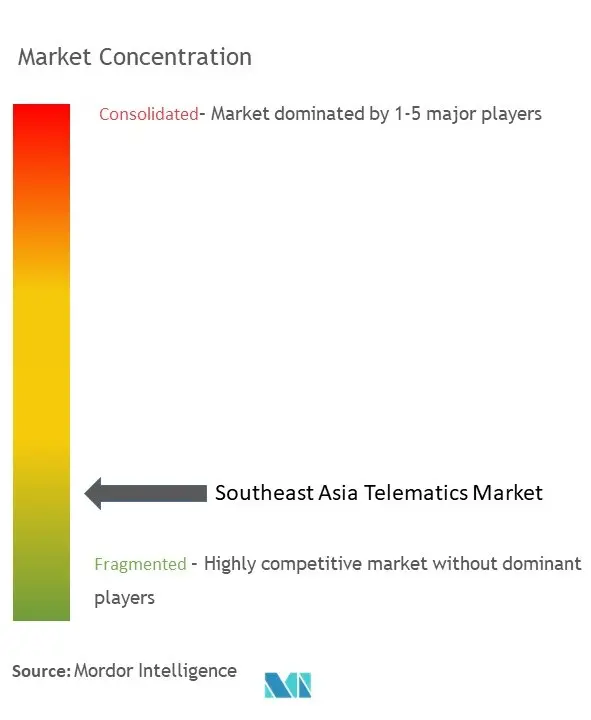
| Market Concentration | Low |
Major Players *Disclaimer: Major Players sorted in no particular order Image © Mordor Intelligence. Reuse requires attribution under CC BY 4.0. | |
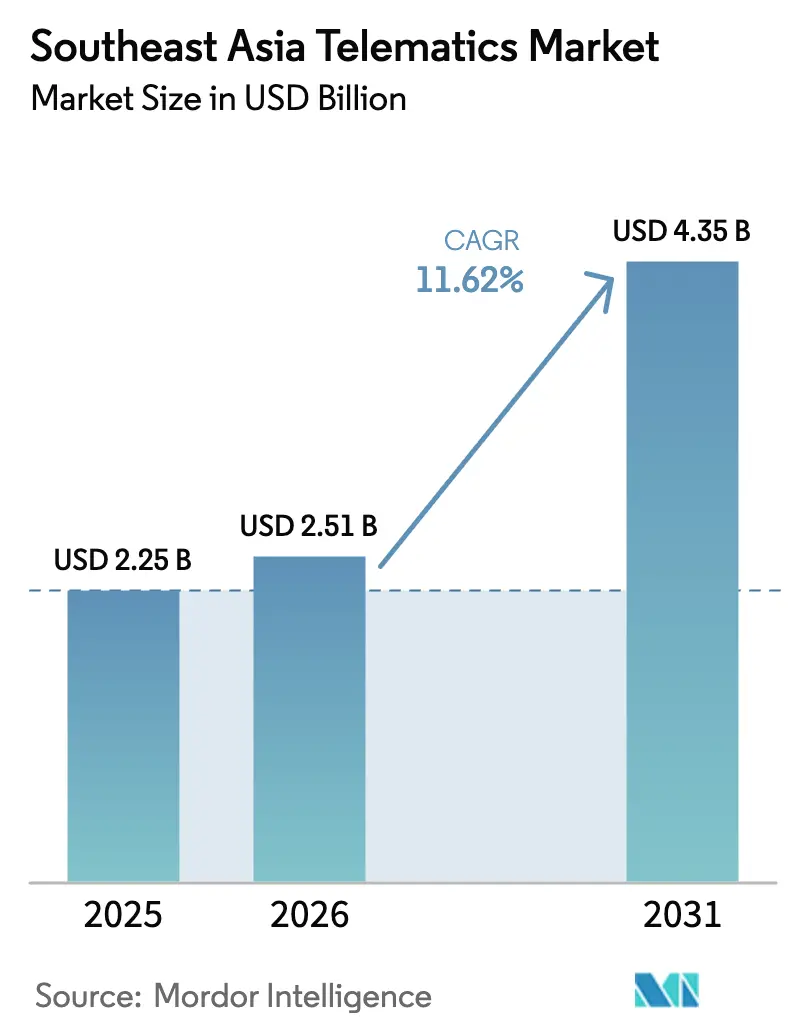
Southeast Asia Telematics Market Analysis by Mordor Intelligence
The Southeast Asia telematics market size was valued at USD 2.25 billion in 2025 and estimated to grow from USD 2.51 billion in 2026 to reach USD 4.35 billion by 2031, at a CAGR of 11.62% during the forecast period (2026-2031). Product demand is pulling ahead of earlier projections as regulators tighten fuel-economy and emissions rules, e-commerce drives record parcel volumes, and 4G/5G coverage reaches secondary cities. Thailand’s 30@30 policy for electric-vehicle production, Indonesia’s target of 1 million EVs by 2035, and the ASEAN Fuel Economy Roadmap’s 26% fleet-wide fuel-savings mandate together set a compelling compliance timetable that makes telematics a non-negotiable fleet investment. The region’s telecom operators are rolling out low-latency 5G, unlocking predictive maintenance, V2X applications, and advanced driver-assistance add-ons. Multinational and local suppliers continue to enter the market despite hardware-cost inflation, resulting in a fragmented but fast-maturing competitive field.
Key Report Takeaways
- By vehicle type, Light Commercial Vehicles led with 36.92% revenue share in 2025; Two-Wheelers are forecast to expand at a 12.05% CAGR through 2031.
- By solution, Fleet and Vehicle Management held 41.55% revenue share in 2025, while Telematics Insurance is projected to grow at 13.14% CAGR to 2031.
- By end-user industry, Transport and Logistics captured 27.24% revenue share in 2025, whereas E-commerce Last-Mile delivery is advancing at a 12.42% CAGR through 2031.
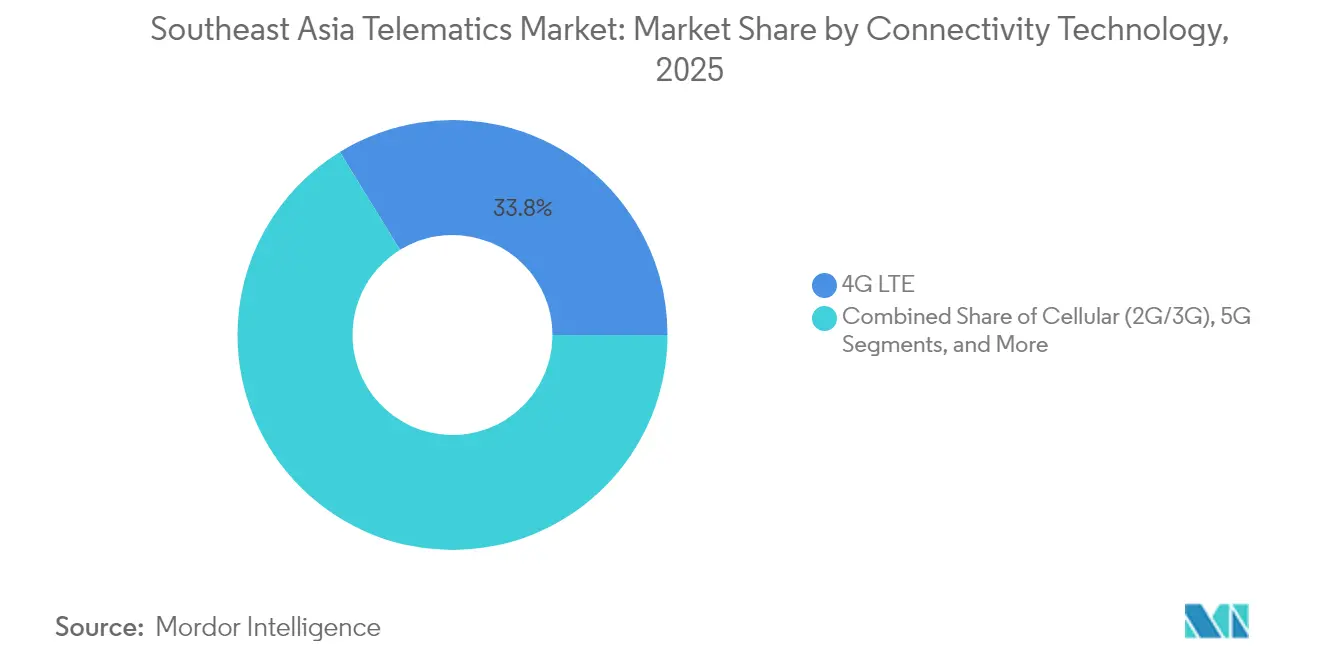
- By connectivity technology, 4G LTE dominated with 33.78% revenue share in 2025; 5G is set to rise at a 13.47% CAGR through 2031.
- By country, Thailand commanded 22.48% revenue share in 2025, while Vietnam is forecast to register the fastest 12.74% CAGR from 2026 to 2031.
Note: Market size and forecast figures in this report are generated using Mordor Intelligence’s proprietary estimation framework, updated with the latest available data and insights as of 2026.
Market Trends and Insights
Drivers Impact Analysis of Southeast Asia Telematics Market*
| Driver | (~) % Impact on CAGR Forecast | Geographic Relevance | Impact Timeline |
|---|---|---|---|
| Four-tier safety and emissions mandates drive adoption | + 2.8% | Global, strongest in Thailand and Indonesia | Medium term (2-4 years) |
| E-commerce last-mile boom fuels LCV telematics | + 3.2% | ASEAN core, spill-over to Philippines | Short term (≤ 2 years) |
| 4G/5G rollout enables real-time data services | + 2.1% | Singapore and Malaysia leading, regional expansion | Long term (≥ 4 years) |
| Fleet cost-reduction amid diesel volatility and carbon tax | + 1.9% | Thailand, Indonesia, Malaysia | Medium term (2-4 years) |
| Mileage-based road-tax pilots (Indonesia) | + 1.2% | National, with early gains in Jakarta, Surabaya | Long term (≥ 4 years) |
| Vietnam PAYD insurance-telco alliances | + 0.8% | National, expanding to regional markets | Medium term (2-4 years) |
| Source: Mordor Intelligence | |||
Four-tier Safety and Emissions Mandates Drive Adoption
Governments across Southeast Asia are layering fuel-economy targets, CO₂-based taxes, local-content rules, and zero-emission commitments, turning telematics from an efficiency option into a regulatory requirement. The ASEAN Fuel Economy Roadmap insists on a 26% reduction in average fleet fuel consumption by 2025, obliging operators to monitor vehicle usage in real time.[1]ASEAN Secretariat, “ASEAN Fuel Economy Roadmap for the Transport Sector,” asean.orgThailand’s excise system rewards CO₂ cuts, while Indonesia’s local-content thresholds steer buyers toward domestically integrated telematics modules. Emerging hydrogen and biofuel pilots under the Asia Zero Emission Community also require granular operating data for compliance, further embedding telematics in fleet workflows. As a result, adoption no longer hinges on ROI alone; fleets must connect or face non-compliance penalties, sustaining double-digit growth for the Southeast Asia telematics market.
E-commerce Last-mile Boom Fuels LCV Telematics
Online retail platforms continue to set delivery-speed benchmarks that require point-to-point visibility from warehouse to doorstep. Grab’s super-app services in 800+ cities rely on connected LCV and two-wheeler fleets to hit sub-one-hour delivery windows. Malaysia’s digital economy already contributed 22.6% of GDP in 2020 and is expanding 8.5% per year, pressuring logistics providers to upgrade tracking systems.[2]Huawei, “Malaysia’s Digital Economy Progress Update 2024,” huawei.comVietnam’s electric two-wheelers crossed 9% market share in 2024, adding battery-health and range-management datasets to fleet dashboards. These dynamics underpin sustained demand for real-time routing, driver-behavior scoring, and charge-cycle analytics, all of which expand the Southeast Asia telematics market.
4G/5G Rollout Enables Real-time Data Services
Singapore’s Tuas Port went live with 5G slices for mission-critical crane and AGV operations, showcasing how low-latency networks elevate telematics from reactive tracking to predictive orchestration.[3]Singtel, “Singtel, Ericsson Collaborate to Deploy 5G at Tuas Port,” singtel.comThe ASEAN Digital Masterplan calls for regional 5G coverage of at least 35% of the population by 2025, with spectrum-sharing frameworks accelerating rollouts. Malaysia’s ambition to become the ASEAN Digital Capital is pulling forward 5G timelines, giving fleets access to V2X services and over-the-air OTA updates. As coverage grows, edge-analytics and AI-based maintenance models will unlock new revenue streams, broadening the addressable base for the Southeast Asia telematics market.
Fleet Cost-reduction Amid Diesel Volatility and Carbon Tax
Fuel makes up more than 30% of many fleet budgets, and diesel price swings now combine with early-stage carbon taxes to squeeze margins. Thailand links its fuel-economy rules to excise rebates that favor connected vehicles able to demonstrate lower CO₂ per kilometer. The International Transport Forum shows declining fuel-tax proceeds as EV adoption rises, pushing governments toward distance-based tolling that depends on telematics odometer feeds.[4]International Transport Forum, “Distance-based Road-Charging Study,” internationaltransportforum.orgIndonesia’s biofuel mandates similarly compel operators to log blend ratios and route data to claim fiscal incentives. These economic levers make connected dashboards central to cost control, lifting penetration rates across segments.
Restraints Impact Analysis of Southeast Asia Telematics Market*
| Restraint | (~) % Impact on CAGR Forecast | Geographic Relevance | Impact Timeline |
|---|---|---|---|
| High upfront hardware and integration cost | -1.8% | Regional, acute in smaller markets | Short term (≤ 2 years) |
| Patchy cross-border network roaming | -1.2% | Cross-border corridors, rural areas | Medium term (2-4 years) |
| Data-sovereignty bottlenecks on telemetry export | -0.9% | Vietnam, Indonesia, Thailand | Long term (≥ 4 years) |
| Shortage of certified installers outside tier-1 cities | -0.7% | Rural and secondary urban areas | Medium term (2-4 years) |
| Source: Mordor Intelligence | |||
High Upfront Hardware and Integration Cost
Global chip shortages linger, with automotive semiconductor lead times stretching to 50 weeks, inflating device prices and limiting SKU availability. Fleet operators face a widening cost-of-capital gap: larger firms lock multi-year supply contracts, while SMEs postpone deployments or opt for stripped-down feature sets. Production shortfalls hit 8.2 million vehicles in 2021 and still ripple through 2025 order books, keeping average hardware ASPs elevated and dampening the Southeast Asia telematics market’s near-term growth trajectory.
Data-sovereignty Bottlenecks on Telemetry Export
Vietnam’s personal-data decree forces foreign providers to process and store information domestically, adding data-center CapEx and operational overheads. Indonesia and Thailand impose sector-specific localization clauses that require complex onboarding workflows for cross-border fleets. The resulting patchwork erodes scale efficiencies, obliges country-specific device SKUs, and raises compliance risk, weighing on market expansion despite surging demand.
*Our forecasts treat driver/restraint impacts as directional, not additive. The impact forecasts reflect baseline growth, mix effects, and variable interactions.
Southeast Asia Telematics Market Segment Analysis
By Vehicle Type:
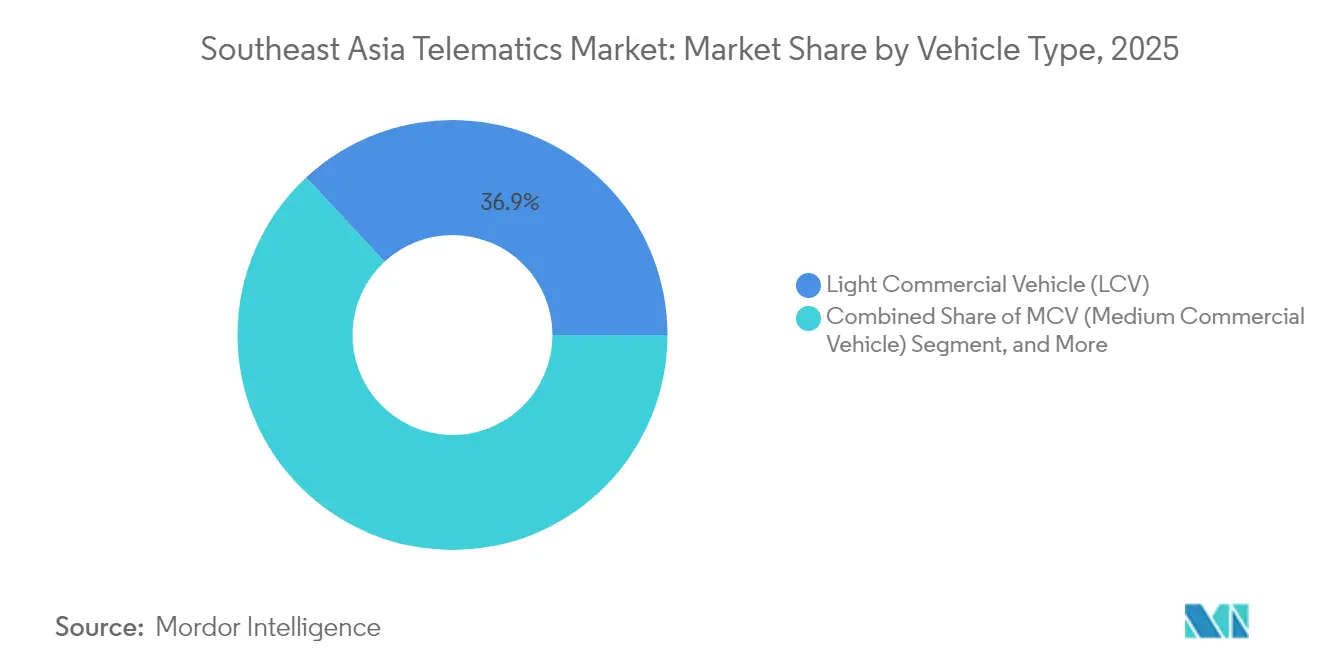
Commercial Fleets Drive ElectrificationLight Commercial Vehicles commanded 36.92% of the Southeast Asia telematics market size in 2025, anchored in parcel and grocery delivery runs that demand granular route analytics. Operators deploy camera-based driver scoring, cold-chain temperature probes, and ePOD integrations to hit tight service-level agreements. Two-Wheelers are registering the fastest 12.05% CAGR to 2031 as Vietnam and Indonesia electrify ride-hailing and courier fleets, adding battery state-of-charge alerts and swap-station mapping features.
Zapp’s micro-factory in Thailand can build 21,500 electric motorcycles per year, each shipping with CAN-bus ports for real-time power-train data. For Medium Commercial Vehicles in mining and construction, uptime dashboards and geofencing ensure equipment-site compliance. Passenger Cars round out demand as insurers bundle connected-policy discounts and ride-sharing platforms fit aftermarket OBD dongles. Collectively these dynamics reinforce the Southeast Asia telematics industry’s multi-segment nature, keeping solution providers agile across payload classes.



By Solution:
Insurance Innovation Accelerates GrowthFleet and Vehicle Management accounted for 41.55% of the Southeast Asia telematics market size in 2025, offering core GPS tracking, maintenance scheduling, and driver alerts. Adoption is nearly universal among long-haul and regional haul operators seeking 3%–5% fuel-burn cuts per vehicle. Telematics Insurance, growing at 13.14% CAGR, is redefining risk pricing by aligning premiums with behavioral scores and mileage, a shift highlighted by NTUC Income’s pay-as-you-drive launch with Carro. MS&AD’s 1.85 million connected policies expand the actuarial dataset, enabling AI to benchmark risk corridors. These use cases underscore how analytics extensions not hardware alone differentiate vendors in the Southeast Asia telematics industry.
Location-Based Services tie into mapping and dispatch platforms, while Predictive Maintenance gains momentum through edge-AI fault detection. Vendors that pull usage, vibration, and fluid-temperature data into cloud ML models reduce unplanned downtime and enhance residual-value calculations. Competitive advantage now lies in API openness, over-the-air feature upgrades, and integration speed with third-party TMS or ERP suites.
By End-user Industry:
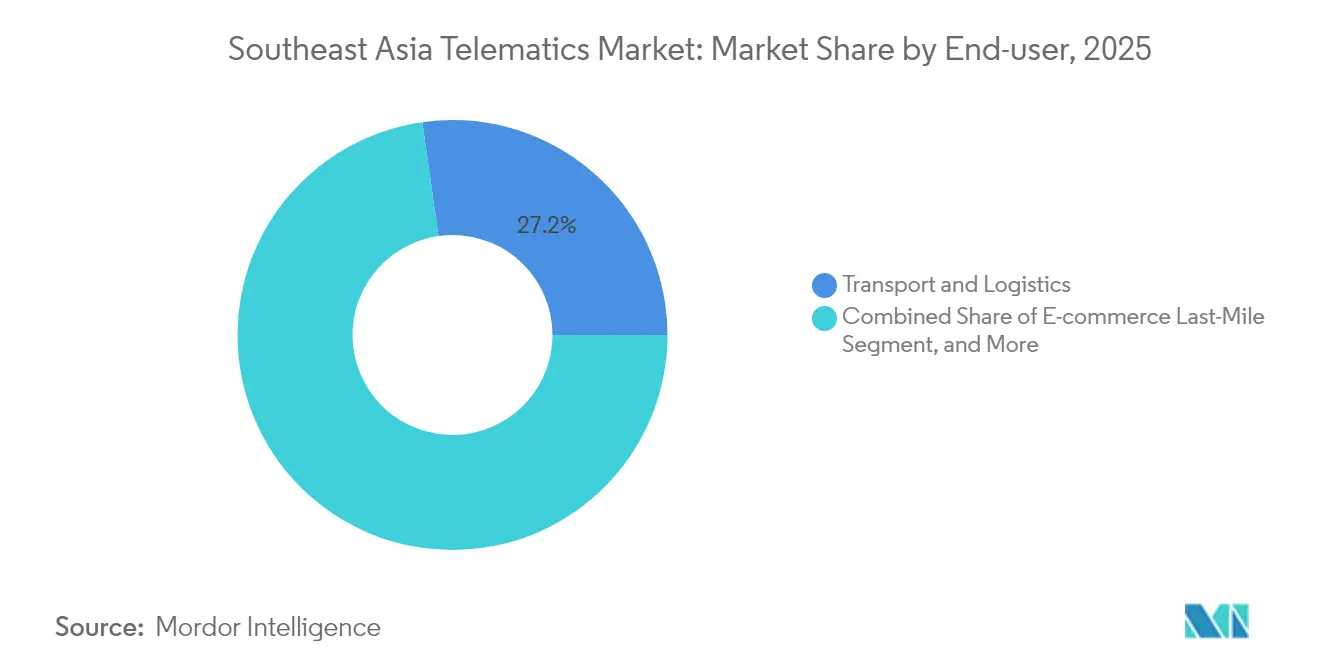
E-commerce Reshapes LogisticsTransport and Logistics contributed 27.24% of the Southeast Asia telematics market size in 2025, spanning trucking, public transit, and bulk commodity haulage. Route-planning engines cut empty miles, while driver coaching reduces harsh-braking events by 15%–20%. E-commerce Last-Mile operations, expanding at a 12.42% CAGR, overlay parcel-level ETA push notifications and dock-door sequencing to trim dwell time. Grab’s multi-modal network exemplifies these blended use cases, requiring unified dashboards across taxis, bikes, and delivery vans.
Public Transportation agencies deploy CCTV-enabled telematics for real-time passenger counts and accident forensics. Construction and Mining rely on RFID zone alerts to prevent blind-spot collisions, whereas Oil and Gas fleets use sensor-verified journey-management plans to satisfy hazardous-goods regulations. Each vertical adds proprietary data layers, making configurable rule engines a must-have for vendors scaling within the Southeast Asia telematics industry.
By Connectivity Technology:
5G Transformation Accelerates4G LTE represented 33.78% of the Southeast Asia telematics market size in 2025, giving fleets ubiquitous SIM coverage at sustainable data tariffs. Yet 5G, advancing at a 13.47% CAGR, is set to handle machine-vision uploads, over-the-air firmware packages, and V2X safety pings. Ericsson’s research shows software-defined vehicles generate 30 times more data than traditional telematics boxes, necessitating dedicated network slices and edge-compute gateways.
Legacy 2G/3G sunsets push operators in rural corridors to adopt multibearer modems that fall back to NB-IoT or satellite, especially for cross-border long-haul into Laos or Myanmar. Satellite links remain indispensable for forestry, mining, and maritime use cases, though price-per-megabyte keeps them niche. The winners are chipset suppliers and platform vendors that abstract these heterogeneous pipes behind a unified device-management stack and predictive-billing engine.
Geography Analysis
Thailand Telematics Market
Thailand’s 22.48% revenue lead stems from its deep automotive supply chain and supportive CO₂-linked excise structure that rewards connected fleets. Its 30@30 target to produce 30% EVs by 2030 layers on battery-health monitoring requirements, giving telematics extra pull across OEM assembly lines and retrofits alike. The installed base surged from 6 million passenger and LCV units in 2000 to nearly 19 million in 2022, broadening retrofit opportunities at dealerships and service centers.
ASEAN Telematics Market
Indonesia ranks second on volume, leveraging a domestic fleet exceeding 23 million vehicles and a production goal of 1 million EVs by 2035 that necessitates local telematics modules for content-rule compliance. An Omnibus Law easing foreign-investment caps spurs joint ventures, while mileage-based road-tax pilots in Jakarta and Surabaya validate usage-based charging models reliant on OBD mileage feeds. Malaysia and Singapore punch above fleet size, thanks to advanced 5G coverage and digital-economy incentives such as Malaysia’s Digital Nasional Berhad wholesale model that lowers connectivity barriers.
Vietnam and the Philippines Telematics Market
Vietnam posts the fastest 12.74% CAGR from 2026 to 2031 as the government positions ICT as a growth pillar, helping the country leap from rudimentary copper networks in 1986 to fiber and 5G backbones today. Electric two-wheelers hit 250,000 sales in 2024, growing the addressable pool for battery-state dashboards and pay-as-you-charge subscriptions iea.org. Data-localization rules complicate cross-border dashboards, yet they also tilt enterprise buyers toward domestic providers, accelerating a home-grown ecosystem. The Philippines plus smaller ASEAN markets continue to record double-digit growth but await clearer regulatory alignment before large-scale telematics rollouts reach rural routes.
Regulatory Landscape
Southeast Asia's telematics market is shaped by transport-safety oversight, telecom certification, and data governance rules across the region. Malaysia's Ministry of Transport leads a phased commercial-vehicle telematics initiative scheduled for 2026-2028, with data integration involving the Road Transport Department (JPJ), Royal Malaysia Police (PDRM), and the Malaysian Institute of Road Safety Research (MIROS), which points to more centralized compliance workflows.
Across core markets, regulators require certified devices, approved installers, and lawful handling of telemetry data. Thailand's Department of Land Transport (DLT) mandates certified GPS and fleet-management solutions for commercial logistics operators, while Vietnam's Ministry of Information and Communications is drafting technical specifications linked to connected vehicle data localization. In parallel, type-approval and wireless certification requirements, including 5G/V2X, add gating steps for device makers and platform providers operating across multiple ASEAN countries, with UNECE R144 emergency-call certification converging across Indonesia, Thailand, and Vietnam to support unified fleet-platform roadmaps.
Competitive Landscape
The Southeast Asia telematics market remains moderately fragmented: no single vendor exceeds a 10% revenue share region-wide, and at least 25 local system integrators compete with global brands on cost and localization. Cross-border players form alliances with telecom operators to gain SIM bulk rates and on-the-ground installer networks; CelcomDigi’s i-Fleet is a case in point for Malaysia. Hardware vendors differentiate on AI accelerators and multi-GNSS chipsets, while platform specialists emphasize open APIs that plug into TMS and ERP suites in less than two weeks.
Technology maturity, not device price alone, is becoming the decisive factor. Proof points include AROBS Transilvania’s TachoAnalytics, which automates driver-hour compliance across EU and ASEAN tachograph standards and is now ported into Thai and Indonesian time-zone rules. Predictive-maintenance patents that integrate tire pressure, humidity, and shock data give early-warning windows of 1,000–1,500 km before component failure [google.com/patents/US202400].
Strategic moves in 2024-2025 reveal three patterns:
- Telecom–telematics partnerships (e.g., Singtel–Ericsson, CelcomDigi–iFleet) accelerate 5G monetization while lowering customer-acquisition costs.
- Insurer alliances (NTUC–Carro, MS&AD data-driven underwriting) open new premium pools.
- Hardware start-ups place micro-factories (Zapp in Thailand) near OEM clusters, shortening supply chains and qualifying for local-content incentives. Together these actions sustain innovation velocity and keep the Southeast Asia telematics market highly dynamic.
Southeast Asia Telematics Industry Leaders
Foxlogger
Onelink Technology
Foxlogger
DTC Enterprise
Tramigo Singapore
- *Disclaimer: Major Players sorted in no particular order
Southeast Asia Telematics Market Companies Covered in this Report
- DTC Enterprise
- GPSiam
- Forth Tracking System
- Thai GPS Tracker
- Guarantee GPS
- Onelink Technology
- Thai Global Technologies
- East Innovation (EyeFleet)
- Xsense Information Service
- PT Navindo Technologies
- Foxlogger
- Maxxfleet
- IntelliTrac
- TransTrack
- UTrack
- Gigabyte Indonesia
- i-Tracking (S) Pte Ltd
- Tramigo Singapore
- Evo Systems SDN BHD
- Omnicomm Vietnam
- i-Fleet (CelcomDigi)
- EUPFIN Technology
- FindMyCar Philippines
- Manila GPS Trackers
- SkyFy Technology
- Vectras Inc.
- Teltonika Asia
- Explosoft International
- Get Prepared SDN BHD

Market Opportunities and Future Outlook
Regulatory-led instrumentation of fleets is creating near-term whitespace for compliant device bundles and managed services. Malaysia's phased telematics rollout (2026-2028) and the Q1 2026 dashcam mandate for buses, lorries, and public transport vehicles create procurement triggers for video telematics, installation services, and cloud evidence management, particularly for operators that need fleet-wide standardization and auditable data retention.
Cross-border scaling is still constrained by localization and certification fragmentation, but those frictions also support country-specific deployment stacks and local partnership models. Vietnam's data localization direction and Thailand's radio-equipment certification processes, including pathways for 5G-ready devices, favor vendors with in-country hosting, local SIM and installer networks, and modular architectures that can be re-certified per market. Convergence efforts around UNECE R144 aligned emergency-call certification across Indonesia, Thailand, and Vietnam also support unified platforms for eCall, vehicle health, and driver-behavior monitoring in mixed fleets (LCVs, buses, and two-wheelers).
Recent Industry Developments in Southeast Asia Telematics Market
- March 2026: The company announced a strategic focus on providing comprehensive logistics solutions, including plans to expand its customer base into the electric vehicle (EV) taxi market within 2026. This broadens the telematics-enabled fleet services in SEA and positions the company to collaborate with OEMs and mobility partners for EV adoption in the region.
- March 2026: The company announced a strategic focus on providing comprehensive logistics solutions, including plans to expand its customer base into the electric vehicle (EV) taxi market within 2026. This strengthens DTCENT's device-to-cloud telematics footprint and creates a broader service-network reach for fleet and retail applications across SEA.
- January 2026: The company launched DTC Smart Shop Solutions, an IoT system for centralized digital management, including smart digital signage, security monitoring, and remote energy management. The offering aligns IoT and telematics capabilities with fleet and retail infrastructure in SEA, expanding the company's digital management footprint.


Southeast Asia Telematics Market Report Scope and Research Methodology
Market Definition and Coverage
For this study, the market covers revenues earned from telematics hardware, software platforms, and related services that enable connected vehicle and fleet functions across Southeast Asia, including tracking, safety, diagnostics, and compliance use cases.
Scope exclusions: We exclude general in-vehicle infotainment and consumer smartphone navigation apps when they are not sold as telematics solutions tied to vehicles or fleets.
Segments Covered in This Report
- By Vehicle Type
- Light Commercial Vehicle (LCV)
- Medium Commercial Vehicle (MCV)
- Passenger Cars
- Others
- By Solution
- Fleet/Vehicle Management
- Location-Based Services
- Telematics Insurance
- Predictive Maintenance
- Others
- By End-user Industry
- Transport and Logistics
- E-commerce Last-Mile
- Public Transportation
- Construction and Mining
- Oil and Gas
- Others
- By Connectivity Technology
- Cellular (2G/3G)
- 4G LTE
- 5G
- Satellite
- Others
- By Country
- Thailand
- Indonesia
- Malaysia
- Singapore
- Vietnam
- Rest of Southeast Asia
Data Sources, Market Sizing, and Validation
Desk Research
Desk work starts with building a clean demand and supply picture for each country, and then aligning it to how telematics is actually deployed in fleets and connected vehicles. We referenced public and official sources such as national transport agencies and road safety departments in the region, telecom regulators and spectrum release notes, national statistics offices for vehicle stock and freight activity, and customs or trade statistics that help with hardware flow signals. To avoid overcounting, we also used company filings, investor presentations, reputable press coverage, and association publications that describe adoption, regulation timelines, and typical commercial terms.
For cross-checks that need consistent time series, we selectively used paid subscriptions focused on company financials and intelligence, news and financials, patent databases, and shipment-level import or export records where available for relevant device categories. These inputs mainly help confirm directionality and ranges, and then the final numbers are filtered through interview feedback and country-level plausibility checks. The desk research sources mentioned above are illustrative, and many other sources were also used for data collection, validation, and clarification.
Primary Interviews and Surveys
Primary work was used to sanity-check adoption, pricing, and packaging differences across countries, since telematics is sold in mixed bundles (device plus platform plus service) and customer maturity is uneven. We spoke with stakeholders across solution providers, telecom-linked channels, system integrators, fleet operators, and end users in logistics, passenger transport, and industrial fleets, which helped convert desk assumptions into realistic penetration and ARPU bands. Coverage was balanced across key Southeast Asian markets so the model does not lean too heavily on any single high-income country signal.
Distribution of primary research fieldwork respondents
| Company type | Respondent position |
|---|---|
| Top tier: 34% | CXOs: 12% |
| Mid tier: 52% | Functional/Unit leaders: 33% |
| Smaller Players: 14% | Managers: 55% |
Market-Sizing & Forecasting
Sizing was built using top-down demand pool reconstruction, where commercial vehicle parc, active fleet share, and telematics penetration by use case were applied country by country, followed by an ARPU build that reflects typical subscription and service attachment. Once the totals were formed, they were checked with selective bottom-up approximations, such as sampled pricing by channel, solution mix splits, and revenue reasonableness checks against supplier disclosures that are publicly visible.
Several market-specific inputs were used to keep the model grounded, including commercial vehicle population and annual additions, cross-border freight and last-mile delivery intensity, cellular coverage and network upgrade timelines that influence connectivity choice, regulatory or quasi-mandate triggers in transport, and typical contract duration and churn patterns shared by interviewees. Where country data was thin, gaps were handled by using proxy indicators like fleet density, logistics GDP exposure, and telecom readiness, and then scaled back through expert feedback so estimates stay realistic.
Data Validation & Update Cycle
Outputs were validated by comparing country totals against independent signals, such as vehicle parc logic, observed adoption narratives in major fleet end uses, and pricing bands that match what buyers report paying. Any unusual spikes or country shares triggered a second-pass review, and assumptions were revisited through follow-up outreach when variance was not explained by policy changes, macro shifts, or connectivity rollouts.
Each model goes through multi-step analyst reviews before sign-off, with checks for unit consistency, currency treatment, and double counting across hardware, platform, and services. Reports are refreshed annually, and interim updates are made when material events happen, such as regulation changes, major connectivity expansions, or sharp inflation in device costs. Before delivery, a final review pass is completed so clients receive the latest updated view.
Mordor Intelligence's Southeast Asia Telematics Market Size Compared With Other Published Estimates
It is common to see different market sizes for telematics because each publisher draws the line in a different place, and then applies a different price logic and adoption curve to that line. The biggest swings usually come from whether consumer connected-car services are mixed with fleet solutions, whether hardware and subscriptions are both counted, and how countries outside the core ASEAN-6 are treated.
Some published figures lean toward a broader connected vehicle stack that can include infotainment, in-car connectivity plans, or adjacent software services that are not always paid as telematics. Those items are kept outside the total, and Mordor Intelligence counts telematics only when it is sold as a vehicle or fleet solution and then refreshed using country penetration and ARPU checks as subscription bundles change.
Benchmark comparison
| Source | Market Size | Gaps in Research Methodology |
|---|---|---|
| Mordor Intelligence | USD 2.25 B (2025) | |
| Trade Journal A | USD 1.44 B (2025) | Often centers on smart fleet management revenue only, which can exclude passenger vehicle telematics and leave out portions of hardware revenue when services are the main counted item. |
| Industry Source B | USD 5.56 B (2025) | Typically reflects OEM telematics projections with aggressive fitment assumptions and can mix factory-installed connectivity value with telematics, which expands totals versus subscription-led fleet deployments. |
Across the three numbers, the spread mainly comes down to what is included, plus how pricing is applied to devices and subscriptions across countries. Narrowing to fleet management alone reduces the addressable pool, and expanding into OEM connectivity and adjacent services pushes the total up quickly. Using consistent country checks and repeatable ARPU logic keeps the estimate traceable to clear variables and practical validation steps.


Key Questions Answered in the Report
What is the current value of the Southeast Asia vehicle telematics market?
The market stands at USD 2.51 billion in 2026 and is projected to reach USD 4.35 billion by 2031.
Which vehicle segment accounts for the largest share?
Light Commercial Vehicles hold the lead with 36.92% of 2025 revenue, reflecting last-mile delivery growth.
How fast is telematics insurance growing in the region?
Telematics Insurance is set to expand at a 13.14% CAGR through 2031, driven by pay-as-you-drive models.
Why is Vietnam the fastest-growing geography?
Robust ICT investment, 250,000 electric two-wheeler sales in 2024, and supportive digital policies push Vietnam to a 12.74% CAGR.
Page last updated on:





