
Southeast Asia HCM Software Market Size and Share
Market Overview
| Study Period | 2020 - 2031 |
|---|---|
| Forecast Data Period | 2026 - 2031 |
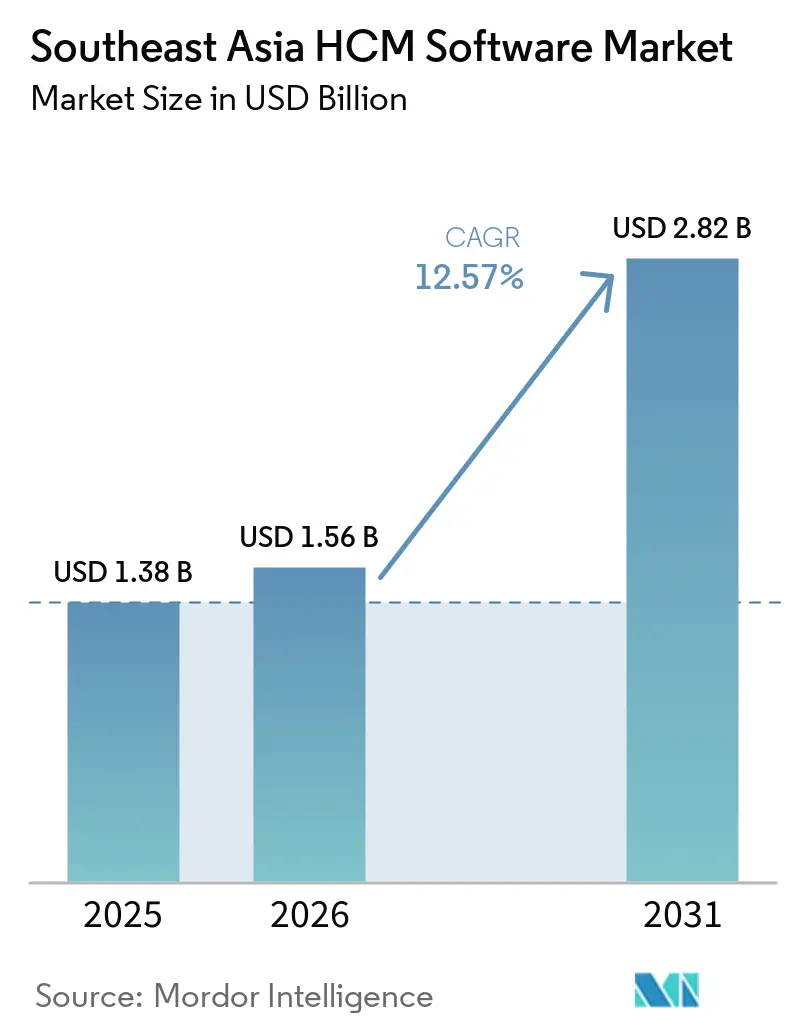
| Base Year Market Size (2025) | USD 1.38 Billion |
| Market Size (2026) | USD 1.56 Billion |
| Market Size (2031) | USD 2.82 Billion |
| Growth Rate (2026 - 2031) | 12.57 % |
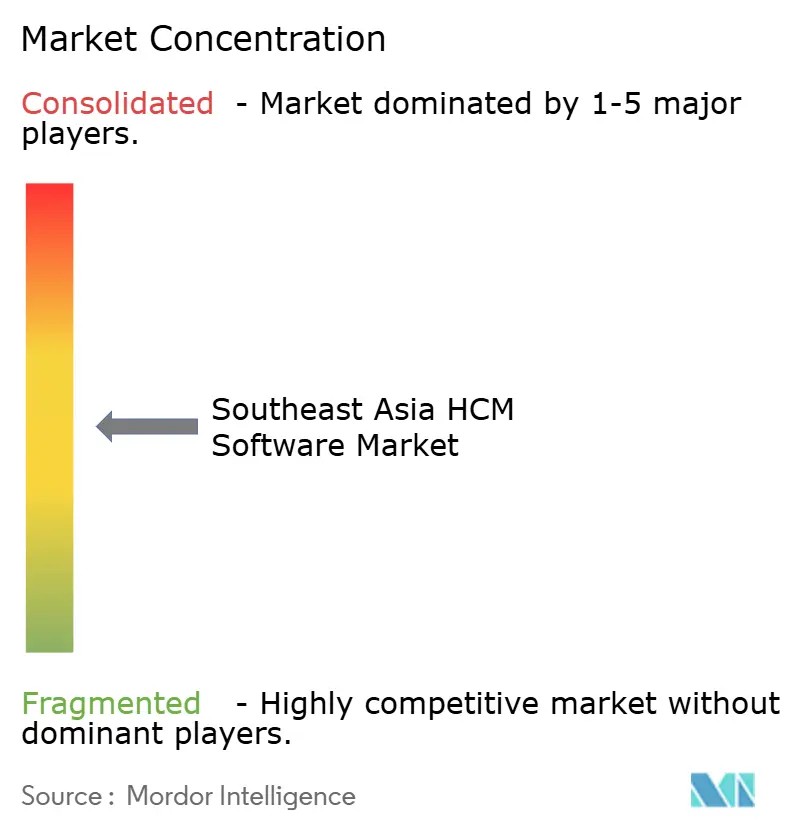
| Market Concentration | Medium |
Major Players *Disclaimer: Major Players sorted in no particular order Image © Mordor Intelligence. Reuse requires attribution under CC BY 4.0. | |
Southeast Asia HCM Software Market Analysis by Mordor Intelligence
The Southeast Asia HCM Software market size was valued at USD 1.38 billion in 2025 and is estimated to grow from USD 1.56 billion in 2026 to reach USD 2.82 billion by 2031, at a CAGR of 12.57% during the forecast period (2026-2031). Rapid payroll cloudification, sovereign digital-workforce mandates, and super-app convergence are steering buyers toward subscription platforms that unify payroll, talent, and analytics. Enterprises are re-platforming to comply with new data-sovereignty rules, while government up-skilling budgets shorten payback periods for HCM investments. Vendors are deepening localization for statutory payroll engines, forming in-country hosting alliances, and embedding generative AI to automate onboarding and career-path mapping. Competitive intensity is rising as regional specialists secure funding and global incumbents bundle multi-country payroll to defend large-enterprise accounts.
Key Report Takeaways
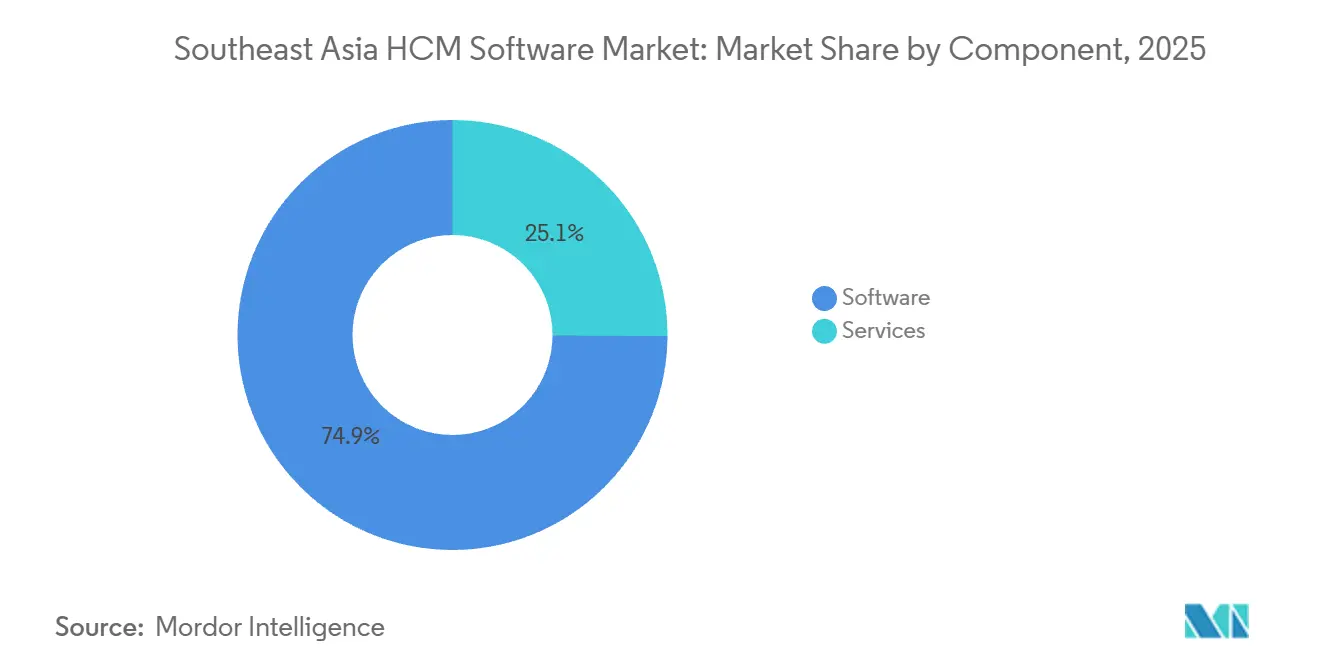
- By component, software accounted for 74.92% of 2025 revenue, yet services are projected to grow at a 13.74% CAGR through 2031.
- By deployment mode, cloud deployment captured 64.41% share in 2025 in the Southeast Asia HCM software market and is forecast to expand at 14.22%, the fastest growth among deployment modes.
- By organization size, large enterprises accounted for 68.16% of 2025 spending, while small and medium enterprises are projected to grow at a 13.98% CAGR.
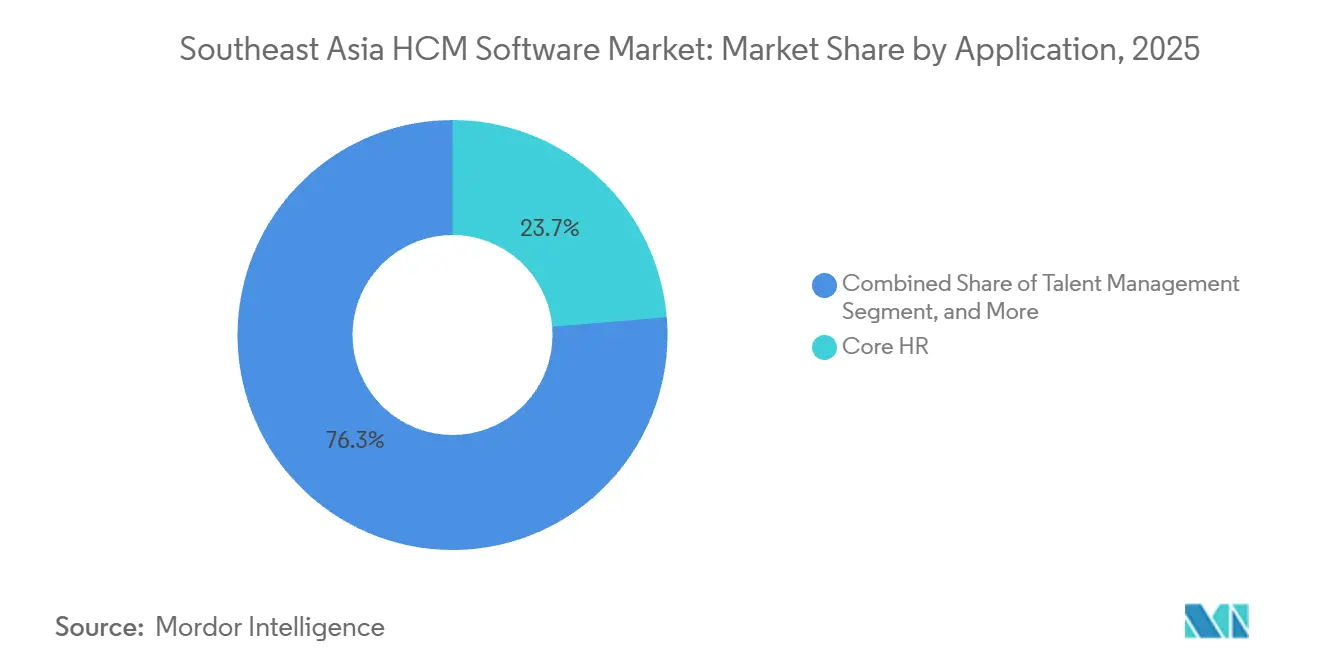
- By application, core human resource management secured 23.68% of 2025 application revenue, while talent management is growing at 14.61%, the highest rate among applications.
- By end-user industry, Information technology and telecommunications led with 27.34% of the 2025 revenue of the Southeast Asia HCM software market, yet the retail and e-commerce segment is expected to accelerate at a 14.08% CAGR to 2031.
- By country, Singapore contributed 23.84% of regional revenue in 2025; Indonesia is anticipated to post the fastest country growth at 14.86% through 2031.
Note: Market size and forecast figures in this report are generated using Mordor Intelligence’s proprietary estimation framework, updated with the latest available data and insights as of January 2026.
Market Trends and Insights
Drivers Impact Analysis of Southeast Asia HCM Software Market*
| Driver | (~) % Impact on CAGR Forecast | Geographic Relevance | Impact Timeline |
|---|---|---|---|
| Accelerated Cloud-First HR Transformation | +3.2% | Indonesia, Thailand, Philippines, Malaysia | Medium term (2-4 years) |
| Government-Led Digital Workforce Initiatives | +2.8% | Singapore, Malaysia, Indonesia, Philippines, Cambodia | Short term (≤ 2 years) |
| Expanding Millennial and Gen Z Workforce | +2.1% | Philippines, Indonesia, Vietnam | Long term (≥ 4 years) |
| Emergence of Regional Super-Apps | +1.6% | Indonesia, Singapore, Malaysia, Thailand, Vietnam | Medium term (2-4 years) |
| AI-Powered Predictive Workforce Analytics | +1.5% | Singapore, Malaysia, Vietnam, Thailand | Short term (≤ 2 years) |
| Cross-Border Freelance Platforms | +1.3% | Indonesia, Philippines, Thailand, Malaysia | Medium term (2-4 years) |
| Source: Mordor Intelligence | |||
Accelerated Cloud-First HR Transformation
Chief financial officers in Indonesia, Thailand, and the Philippines are replacing legacy on-premises systems to curb rising labor-cost inflation, citing 39% information-technology savings after migrating to Oracle Fusion Cloud HCM. Mobile-first behavior underpins this pivot, with 85% of staff in frontline industries accessing HR apps solely on smartphones. Public-sector exemplars, such as Indonesia’s Ministry of Finance, cut personnel-transaction processing time by 43.7% after rolling out the Satu Kemenkeu platform, raising private-sector expectations.[1]
Government-Led Digital Workforce Initiatives
Malaysia’s Human Resource Development Corporation subsidized USD 225 million of enterprise training in 2025, and 40% of claims covered HCM software fees.[2] The Philippines-Singapore Digital Economy Agreement mutualizes electronic payroll records, reducing friction in shared services for multinationals. Cambodia standardized payroll for 284,484 civil servants through a World Bank-backed HRMIS upgrade, setting procurement precedents.
Expanding Millennial and Gen Z Workforce Demographics
Generation Z already accounts for 27% of Southeast Asian employees and rejects employers that lack mobile-native learning tools. Workday's 2025 multigenerational workforce report found that 68% of Generation Z employees in Asia-Pacific prioritize learning-and-development opportunities over base salary when evaluating employers, a preference that is driving demand for integrated learning-management modules within HCM suites. Malaysian bank CIMB invested USD 22.5 million in 2025 to embed micro-learning within its HCM suite, curbing attrition above 20%.
Emergence of Regional Super-Apps Integrating HR Functions
Gojek processes bi-weekly payments for more than 2 million drivers via its in-house payroll module, illustrating how super-apps now deliver core HCM capabilities at scale. Indonesia’s Gadjian links payroll to fintech wallets, letting employees tap earned-wage advances directly from the HR interface. Vendors are opening APIs to safeguard visibility into gig workers who already comprise 30% of the informal labor pool.
Restraints Impact Analysis of Southeast Asia HCM Software Market*
| Restraint | (~) % Impact on CAGR Forecast | Geographic Relevance | Impact Timeline |
|---|---|---|---|
| Fragmented Statutory Compliance Across ASEAN | -2.4% | Indonesia, Philippines, Thailand, Vietnam, Malaysia, Myanmar | Long term (≥ 4 years) |
| Limited HR Tech Budgets in Micro-SMEs | -1.8% | Indonesia, Philippines, Vietnam, Myanmar, Cambodia | Medium term (2-4 years) |
| Data Residency and Sovereignty Concerns | -1.2% | Indonesia, Vietnam, Thailand, Malaysia | Short term (≤ 2 years) |
| Shortage of HR IT Integration Talent | -0.9% | Philippines, Indonesia, Vietnam, Thailand | Medium term (2-4 years) |
| Source: Mordor Intelligence | |||
Fragmented Statutory Compliance Across ASEAN
Separate payroll formulas for Singapore CPF, Malaysia EPF, and Indonesia BPJS oblige vendors to maintain multiple calculation engines, inflating product costs and stalling feature parity. The Philippines adds further complexity with Social Security System, PhilHealth, and Pag-IBIG Fund contributions that vary by income bracket and employment type, while Thailand's Social Security Fund and Vietnam's social insurance, health insurance, and unemployment insurance schemes impose additional localization requirements. Divergent data-privacy regimes further complicate cross-border platform rollouts, forcing smaller providers to defer multi-country support.
Limited HR Tech Budgets in Micro-SMEs
Indonesia's Ministry of Cooperatives and SMEs reported in 2025 that only 18% of registered small and medium enterprises use any form of digital human-resource management, with the majority relying on spreadsheets or paper-based records.[3] Philippine SMEs cite upfront software cost as the primary hurdle to adoption, even when subscriptions are available. Vendors counter by offering pre-configured templates and automated onboarding that slashes go-live time.
*Our forecasts treat driver/restraint impacts as directional, not additive. The impact forecasts reflect baseline growth, mix effects, and variable interactions.
Southeast Asia HCM Software Market Segment Analysis
By Component:
Services Outpace Software on Localization DemandServices revenue is projected to climb at 13.74% from 2026 to 2031, reflecting rising demand for statutory-compliance mapping and change management. In 2025, software still dominated at 74.92%, but many buyers now bundle implementation and managed-services contracts to ensure continuous regulatory updates. Darwinbox’s multi-country payroll launch in the Philippines exemplifies how vendors monetize compliance-as-a-service. Oracle’s Asia-Pacific services revenue jumped 18% in fiscal 2025 on cloud-migration projects.
Adoption of consulting and managed services is strongest among firms expanding across borders, where fragmented rules create switching costs. Large enterprises outsource data migration to accelerate cloud cutovers, while SMEs lean on partners to handle initial configuration. As a result, services capture an incremental share of the Southeast Asia HCM Software market size for each new deployment wave, especially in regulated verticals.
By Deployment Mode:
Cloud Models Consolidate LeadershipCloud captured 64.41% in 2025 and is forecast to grow 14.22% annually, extending its lead as vendors open Jakarta, Ho Chi Minh City, and Kuala Lumpur data centers to satisfy sovereignty rules. On-premises deployments persist in regulated sectors such as defense and government, where data-sovereignty mandates and legacy-system integration requirements favor locally hosted infrastructure, but this segment is contracting as cloud providers establish in-country data centers to satisfy residency rules.
Hybrid models persist for defense and healthcare entities wanting cloud talent modules but on-premises payroll. Singapore’s National Healthcare Group adopted such a hybrid stack in 2024. Improved uptime, zero-maintenance upgrades, and mobile UX propel cloud uptake among SMEs, whereas large enterprises, previously hesitant, now embrace cloud to integrate AI analytics. Consequently, the cloud segment is expected to command more than two-thirds of the Southeast Asia HCM Software market share by 2031.
By Organization Size:
SMEs Close the Spending GapSmall and medium enterprises are forecast to grow at 13.98% during 2026-2031, narrowing the gap with large enterprises, which held 68.16% of market revenue in 2025 but are expanding at a slower pace as their HCM deployments mature. Small and medium enterprises, by contrast, are in the early stages of digitalization, transitioning from spreadsheet-based payroll and paper-based leave management to cloud-native platforms that bundle core human resources, time-and-attendance, and benefits administration functions. Mekari serves over 35,000 Indonesian SMEs, proving an appetite for affordable, payroll-first bundles.
Matching grants from Malaysia’s Digital Economy Corporation cover half of subscription fees, catalyzing take-up among firms with fewer than 200 staff. Mobile-first design, pay-as-you-use pricing, and pre-built statutory engines lower barriers for small and medium-sized enterprises. These dynamics add fresh volume to the Southeast Asia HCM Software market size, even as average deal values remain modest relative to enterprise contracts.
By Application:
Talent Management Becomes the Innovation HotspotTalent management is projected to grow at 14.61% during 2026-2031, the highest application-segment rate, as employers confront skills shortages, high turnover, and the need for skills-based hiring frameworks that align workforce capabilities with strategic priorities. Core human resource management, encompassing employee records, organizational structure, and basic payroll, accounted for 23.68% of application revenue in 2025, underscoring its status as the foundational module in any HCM deployment. Workday’s USD 1.1 billion acquisition of Sana in 2025 injected real-time skills inference into its suite.[4]
Darwinbox’s Super Agent AI automates job description creation and learning path curation. Core HR remains essential, but growth moderates as saturation nears. Workforce management gains from overtime compliance needs in manufacturing, while learning and development accelerates in response to the World Economic Forum forecast that 44% of skills will shift by 2027. The talent boom raises the proportion of the Southeast Asia HCM Software market share allocated to advanced modules.

By End-User Industry:
Retail Races Ahead on Gig-Worker PayrollThe retail and e-commerce sector is projected to post the fastest CAGR of 14.08%, driven by seasonal hiring and the integration of gig workers. Grab and Gojek embed payroll features directly into driver apps, compelling merchants to connect enterprise HCM to super-app APIs. Information technology and telecommunications held 27.34% of market share in 2025, reflecting the sector's early-adopter status, distributed workforce models, and need to manage engineering talent across multiple jurisdictions with varying compensation structures and equity-vesting schedules.
Industrial manufacturing is adopting HCM platforms to manage shift-based production workers, track safety training compliance, and optimize labor costs amid rising minimum wages across Southeast Asia. Healthcare and life sciences end users are deploying HCM systems to manage credentialing, continuing-education requirements, and shift scheduling for clinical staff. Each vertical adds niche requirements, expanding the total demand for Southeast Asia HCM Software.
Geography Analysis
Singapore and Indonesia HCM Software Market
Singapore generated 23.84% of 2025 revenue, sustained by headquarters concentration and stringent data-protection laws that reward enterprise-grade platforms. With 78% of employers already on cloud HR, incremental demand now comes from AI-driven analytics add-ons.[5] Indonesia is forecast to grow at 14.86% during 2026-2031, the highest country-level rate, as the archipelago's 140 million workforce, government-led digitalization initiatives, and rising middle-class consumption create greenfield opportunities for cloud HCM vendors.
Indonesia and Malaysia HCM Software Market
Indonesia represents a greenfield opportunity; its 2024 Personal Data Protection Law spurred hyperscale providers to inaugurate data centers in Jakarta, enabling domestic hosting for the growing pipeline of public-sector and mid-market bids. Malaysia's market is expanding as government digitalization grants, such as the Human Resource Development Corporation's RM 1 billion (USD 225 million) allocation in 2025, subsidize HCM adoption among small and medium enterprises and reduce the payback period for software investments.
ASEAN HCM Software Market
Thailand’s manufacturing clusters are deploying shift-planning modules to offset a 13% increase in the minimum wage. The Philippines’ 1.3 million-strong BPO workforce fuels demand for onboarding automation, supported by DICT-led digital leadership programs. Vietnam, Cambodia, Laos, Myanmar, and Brunei jointly account for a small but rising share as data-center expansion eases sovereignty constraints. Vietnam’s mandate that state-owned firms adopt cloud HR by December 2026 accelerates enterprise pipeline creation. Cambodia’s World Bank project offers a blueprint for donor-funded deployments in frontier markets.
Competitive Landscape
The Southeast Asia HCM software market is moderately consolidated. Global incumbents such as SAP, Oracle, and Workday are competing against regional specialists like Darwinbox, Mekari, and Ramco, which tailor modules to local statutory frameworks and offer pricing structures accessible to mid-market enterprises. SAP, Oracle, and Workday remain entrenched in large enterprises, leveraging ERP adjacency and global payroll alliances. SAP’s 2025 pact with ADP stitches multi-country payroll into SuccessFactors, addressing compliance hurdles for multinationals. Workday’s Vietnam data center adds a sovereignty moat in Indochina.
Regional challengers scale quickly. Darwinbox reached unicorn status after a USD 140 million funding round in March 2025, expanding its coverage to 4 million employees. Mekari commands Indonesian SME mindshare through localized pricing and in-app tax calculators, while Ramco targets aviation and logistics with vertical templates. SunFish HR signs marquee carriers like Thai Airways by offering modular adoption.
Super-apps Grab and Gojek constitute emerging disruptors, embedding payroll settlement and benefits directly into driver ecosystems and siphoning informal-sector workers from traditional HCM funnels. Vendors counter by exposing open APIs and co-marketing deals with fintech wallets. Generative AI is now a hygiene factor. Oracle embedded GPT-5 across its suite in 2025, while UKG clinched a reseller pact with HR Crowd to deepen reach in Australia, New Zealand, and Southeast Asia. Consolidation continues as CloudRock buys SuccessDay to bolster SAP SuccessFactors consulting.
Southeast Asia HCM Software Industry Leaders
-
SAP SE
-
Oracle Corporation
-
Automatic Data Processing Inc.
-
UKG Inc.
-
Workday Inc.
- *Disclaimer: Major Players sorted in no particular order
Southeast Asia HCM Software Market Companies Covered in this Report
- SAP SE
- Oracle Corporation
- Workday Inc.
- Automatic Data Processing Inc.
- UKG Inc.
- Dayforce, Inc.
- Cornerstone OnDemand Inc.
- BambooHR LLC
- Paycom Software Inc.
- Paylocity Holding Corporation
- Zoho Corporation Pvt. Ltd.
- Ramco Systems Limited
- Darwinbox Digital Solutions Pvt. Ltd.
- The Sage Group plc
- Intuit Inc.
- Global Groupware Solutions Limited
- PeopleStrong Technologies Pvt. Ltd.
- HiBob Ltd.
- Rippling People Center Inc.
- Gusto Inc.
- Deel Inc.
- Infor Inc.
- ServiceNow Inc.
- SumTotal Systems LLC
Recent Industry Developments in Southeast Asia HCM Software Market
- March 2026: Workday opened a Vietnam data center to meet sovereignty mandates for state-owned enterprises.
- January 2026: UKG partnered with HR Crowd to accelerate mid-market deployments in Southeast Asia and Oceania.
- January 2026: CloudRock acquired SuccessDay, expanding SAP SuccessFactors implementation capacity in Singapore, Malaysia, and Indonesia.
- January 2026: Deel joined forces with Aspire to merge employer-of-record services with fintech treasury tools for startups.
Southeast Asia HCM Software Market Report Scope
The Southeast Asia Human Capital Management (HCM) Software Market comprises revenues generated from software licenses, SaaS subscriptions, implementation, integration, consulting, support, maintenance, and managed services associated with HCM platforms deployed across Southeast Asian countries.
The Southeast Asia HCM Software Market Report is Segmented by Component (Software, and Services), Deployment Mode (Cloud, On-Premises, and Hybrid), Organization Size (Large Enterprises, and Small and Medium Enterprises), Application (Core HR, Talent Management, Workforce Management, Payroll Management, and Learning and Development), End-User Industry (IT and Telecommunications, BFSI, Industrial Manufacturing, Healthcare and Lifesciences, Retail and E-commerce, Government and Public Sector, and Other End-User Industries), and Geography (Singapore, Malaysia, Indonesia, Thailand, Philippines, and Rest of Southeast Asia). The Market Forecasts are Provided in Terms of Value (USD).
Segmentation Overview
| Software |
| Services |
| Cloud |
| On-Premises |
| Hybrid |
| Large Enterprises |
| Small and Medium Enterprises |
| Core HR |
| Talent Management |
| Workforce Management |
| Payroll Management |
| Learning and Development |
| IT and Telecommunications |
| BFSI |
| Industrial Manufacturing |
| Healthcare and Lifesciences |
| Retail and E-commerce |
| Government and Public Sector |
| Other End-User Industries |
| Singapore |
| Malaysia |
| Indonesia |
| Thailand |
| Philippines |
| Rest of Southeast Asia |
| By Component | Software |
| Services | |
| By Deployment Mode | Cloud |
| On-Premises | |
| Hybrid | |
| By Organization Size | Large Enterprises |
| Small and Medium Enterprises | |
| By Application | Core HR |
| Talent Management | |
| Workforce Management | |
| Payroll Management | |
| Learning and Development | |
| By End-User Industry | IT and Telecommunications |
| BFSI | |
| Industrial Manufacturing | |
| Healthcare and Lifesciences | |
| Retail and E-commerce | |
| Government and Public Sector | |
| Other End-User Industries | |
| By Country | Singapore |
| Malaysia | |
| Indonesia | |
| Thailand | |
| Philippines | |
| Rest of Southeast Asia |
Key Questions Answered in the Report
How fast will Southeast Asia HCM Software spending grow through 2031?
The Southeast Asia HCM Software market is projected to advance at a 12.57% CAGR between 2026 and 2031, according to Mordor Intelligence.
Which deployment model is gaining the most traction?
Cloud deployment already holds 64.41% share and is forecast to expand at 14.22% annually as data-center localization removes sovereignty barriers.
Why are services outpacing software growth?
Enterprises need localized statutory mapping and change-management expertise, pushing services to a 13.74% CAGR, faster than pure software licensing.
What segment shows the highest application growth?
Talent management leads with a projected 14.61% CAGR thanks to AI-driven skills mapping and demand for career-pathing tools.
Which country offers the strongest growth runway?
Indonesia is expected to log a 14.86% CAGR, supported by its USD 350 billion digital masterplan and a 140 million-strong workforce.