
Market Overview
| Study Period | 2019 - 2031 |
|---|---|
| Forecast Data Period | 2026 - 2031 |
| Base Year Market Size (2025) | USD 17.16 Billion |
| Market Size (2026) | USD 18.42 Billion |
| Market Size (2031) | USD 23.02 Billion |
| Growth Rate (2026 - 2031) | 4.56 % |
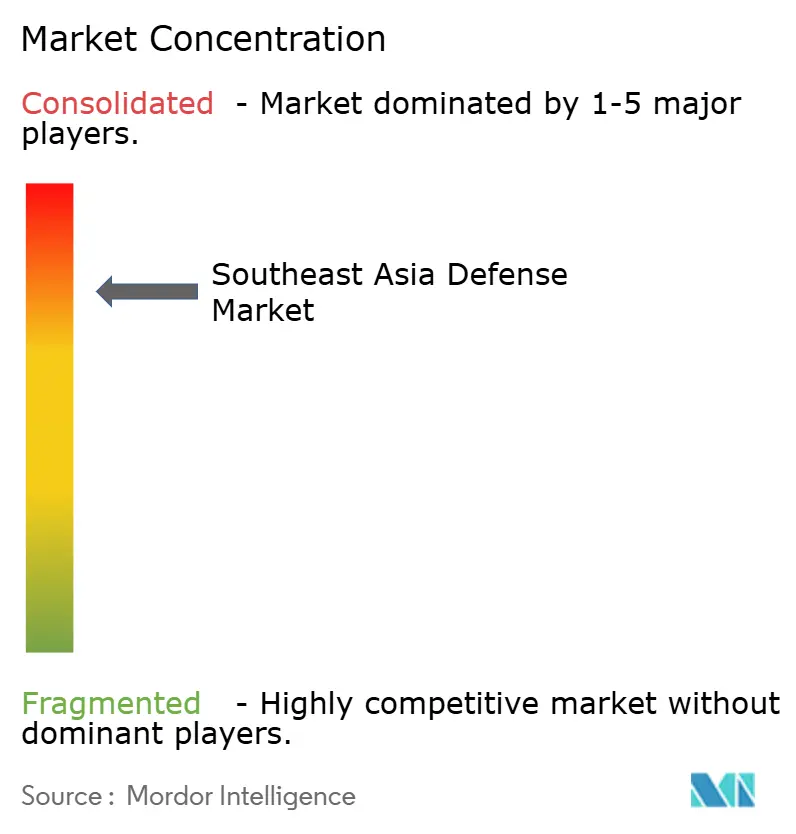
| Market Concentration | High |
Major Players *Disclaimer: Major Players sorted in no particular order Image © Mordor Intelligence. Reuse requires attribution under CC BY 4.0. | |
Southeast Asia Defense Market Analysis by Mordor Intelligence
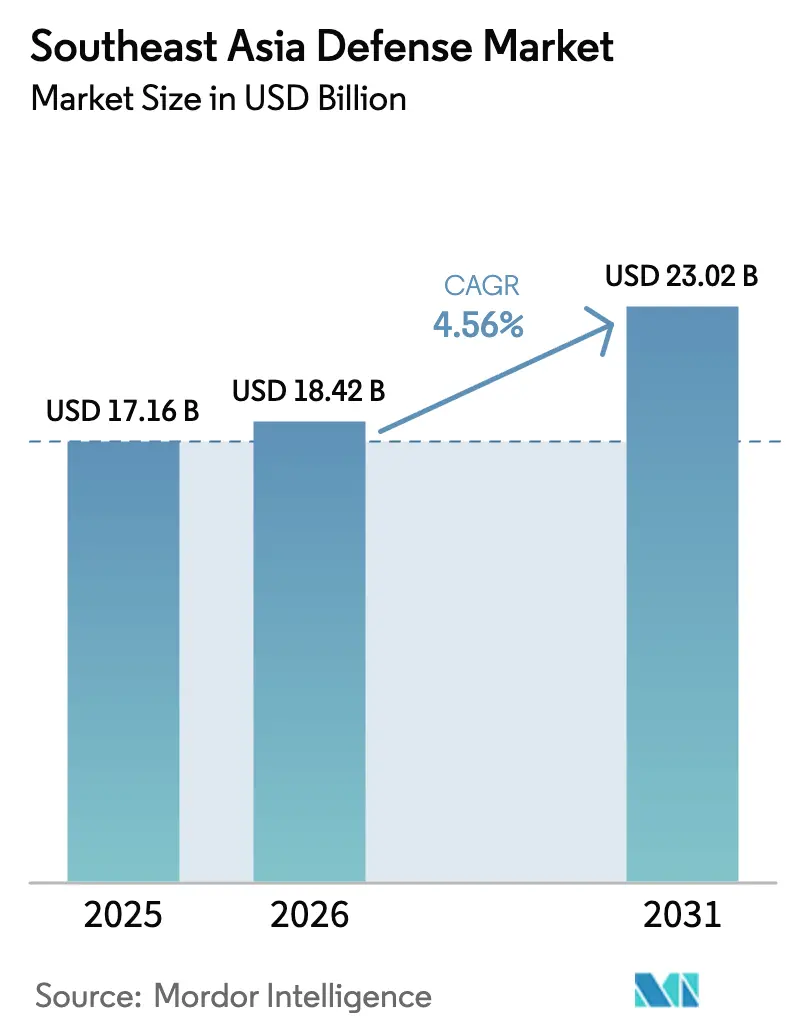
The Southeast Asia defense market size is expected to grow from USD 17.16 billion in 2025 to USD 18.42 billion in 2026 and is forecasted to reach USD 23.02 billion by 2031 at a 4.56% CAGR over 2026-2031. As territorial coercion in the South China Sea collides with budget pressures, pushing capitals toward selective modernization, this growth is expected to continue. Escalating gray-zone incidents, joint procurement initiatives, and widening technology transfer clauses are reshaping acquisition priorities, tilting budgets toward network-centric assets, loitering munitions, and integrated air defense systems. Western primes still dominate headline platform awards, yet South Korean, Israeli, and Turkish suppliers are eroding their lead by promising faster delivery schedules and deeper industrial offsets. At the same time, sovereign-capability mandates are beginning to redirect procurement dollars to local yards and assembly lines, signaling a measured but persistent shift away from dependence on imported systems. Overall, the Southeast Asia defense market is shifting from opportunistic fleet upgrades to long-range force-structure planning that integrates external deterrence with domestic economic multipliers.
Key Report Takeaways
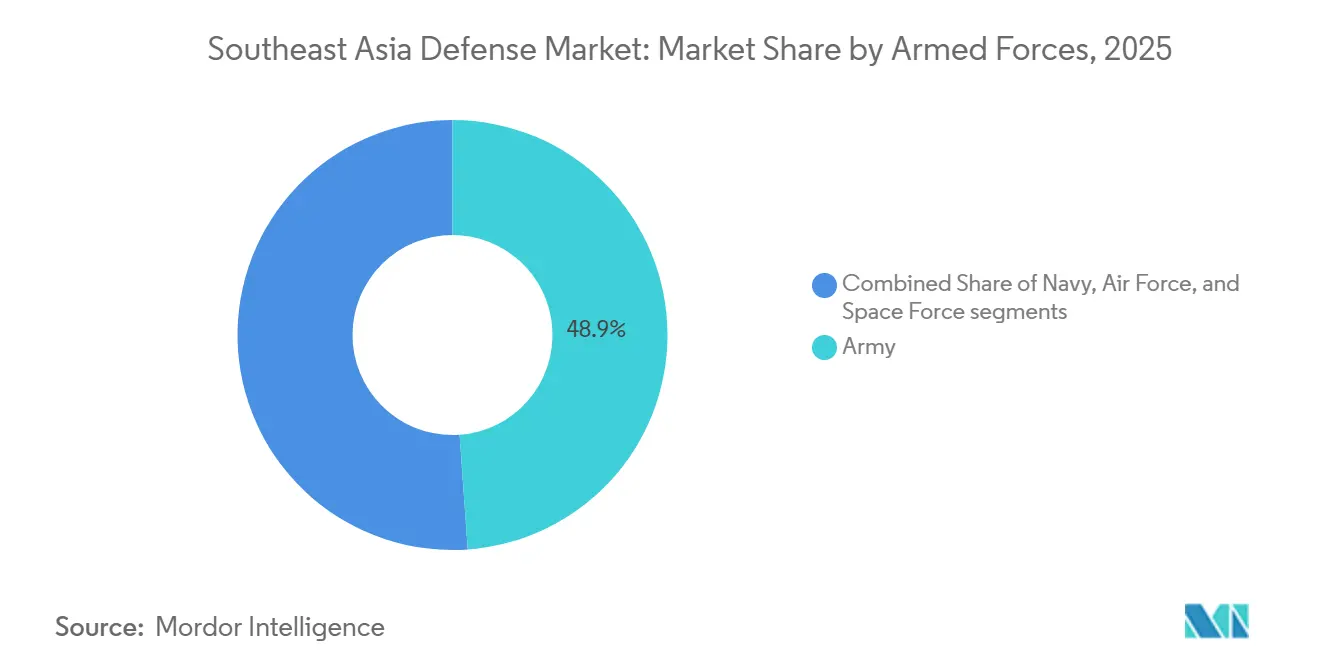
- By armed forces, the army led with 48.87% of the Southeast Asia defense market share in 2025, while the air force is projected to expand at a 5.29% CAGR through 2031.
- By type, vehicles accounted for 42.87% of the Southeast Asia defense market in 2025; unmanned systems are expected to grow the fastest, at a 6.22% CAGR, to 2031.
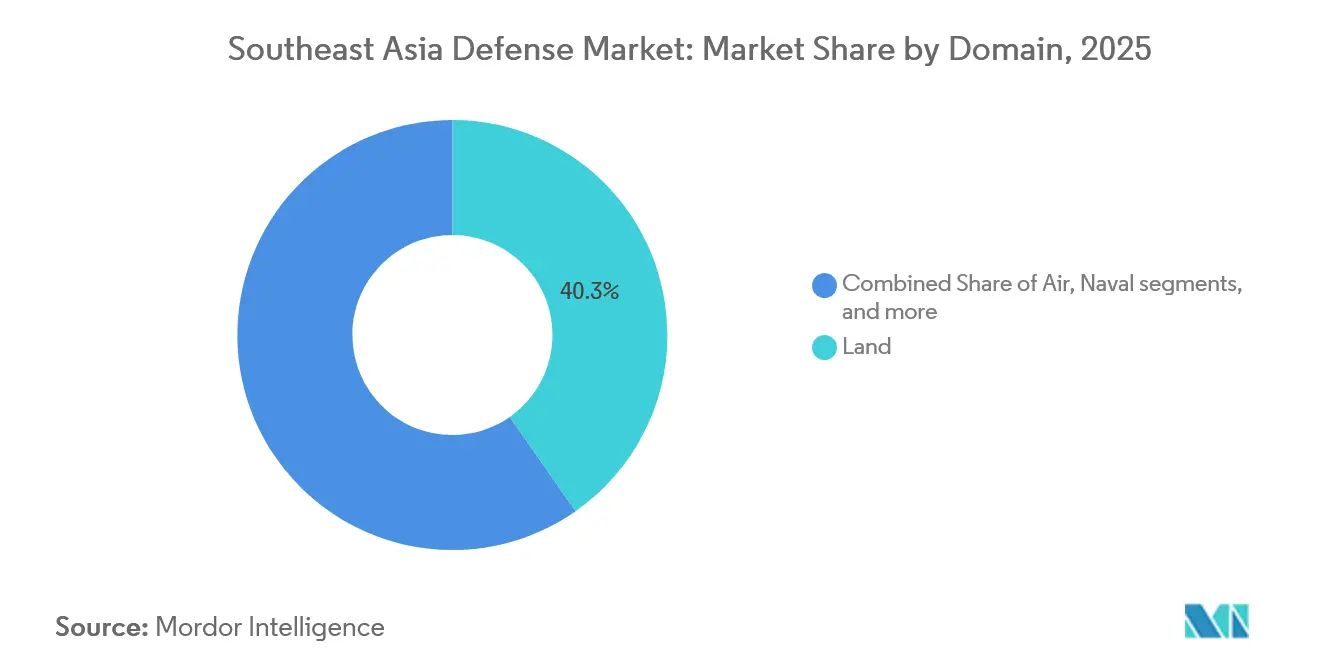
- By domain, the land segment captured 40.29% of spending in 2025, whereas the air domain is set to rise at a 4.95% CAGR, underpinned by multi-role fighter and UAV procurement.
- By procurement nature, foreign procurement still accounted for 53.87% of outlays in 2025, yet indigenous production will accelerate at a 5.12% CAGR through 2031 as technology-transfer clauses expand.
- By geography, Indonesia accounted for 36.78% of regional expenditure in 2025, while the Philippines will register the fastest growth at a 4.87% CAGR over the forecast period.
Note: Market size and forecast figures in this report are generated using Mordor Intelligence’s proprietary estimation framework, updated with the latest available data and insights as of January 2026.
Southeast Asia Defense Market Trends and Insights
Drivers Impact Analysis*
| Driver | (~) % Impact on CAGR Forecast | Geographic Relevance | Impact Timeline |
|---|---|---|---|
| Escalating territorial disputes in the South China Sea | +1.20% | Philippines, Vietnam, Indonesia, Malaysia | Medium term (2-4 years) |
| Modernization of ASEAN defense budgets | +0.90% | Indonesia, Singapore, Thailand, Vietnam | Long term (≥ 4 years) |
| Shift toward network-centric warfare and C4ISR procurement | +0.70% | Singapore, Malaysia, Thailand, Indonesia | Medium term (2-4 years) |
| Rising counterterrorism and maritime security needs | +0.60% | Philippines, Indonesia, Malaysia, Thailand | Short term (≤ 2 years) |
| Incentives for indigenous defense-industrial capabilities | +0.50% | Philippines, Indonesia, Malaysia, Thailand | Long term (≥ 4 years) |
| Regional joint-procurement and interoperability initiatives | +0.30% | ASEAN-wide (notably Singapore, Malaysia, Thailand) | Long term (≥ 4 years) |
| Source: Mordor Intelligence | |||
Escalating Territorial Disputes in the South China Sea
China’s expanded coast-guard patrols have reduced the procurement cycle from a decade to just 18 months as frontline states prioritize missiles, maritime-patrol UAVs, and multi-role fighters that impose cost without escalating to open conflict.[1]Reuters Staff, “Philippines Says China Coast Guard Fired Water Cannon at its Boats,” reuters.com The Philippine Coast Guard recorded 187 Chinese interference episodes in 2024, a 34% increase over 2023, prompting Manila to fast-track the acquisition of BrahMos shore batteries and Hermes 900 UAVs. Vietnam discreetly expanded its Kilo-class submarine inventory, while Indonesia accelerated the delivery of 42 Rafale fighters to patrol the Natuna Sea. Budget reallocations are shifting money away from legacy armor toward ISR, anti-access, and long-range strike capabilities, anchoring the Southeast Asia defense market to those that deter gray-zone incursions. Consequently, procurement dialogue now begins with sensor fusion, precision engagement, and interoperability, relegating traditional platform counts to secondary status.
Modernization of ASEAN Defense Budgets
Defense allocations across ASEAN increased by 7.5% to USD 54.9 billion in 2024, outpacing global growth and signaling a sustained political commitment despite macroeconomic and fiscal headwinds.[2]SIPRI, “Military Expenditure Database 2024,” sipri.org Indonesia alone spends USD 20.3 billion annually under its Minimum Essential Force blueprint, which aims to procure 8 submarines, 12 frigates, and 144 fighters by 2029. Singapore, with the region’s highest per-capita defense bill, is integrating F-35Bs, Aster 30 missiles, and autonomous surface craft into a seamless multi-layer shield. Thailand is repurposing a flat THB 227 billion (USD 6.5 billion) budget toward network-enabled artillery and counter-drone systems. At the same time, the Philippines has enacted a 5% R&D reinvestment clause to prime its budding defense industrial base. These moves underscore how modernization now straddles capability ambition and economic multiplier, hardwiring domestic-industry incentives into every significant order.
Shift Toward Network-Centric Warfare and C4ISR Procurement
Singapore’s Integrated Knowledge-based Command and Control (IKC2) architecture, in service since 2024, compresses the sensor-to-shooter loop to 90 seconds and has become the regional benchmark for joint-force integration.[3]ST Engineering, “Annual Report 2024,” stengg.com Malaysia’s Network Centric Operations Capability mirrors the concept by linking FA-50s, Scorpene submarines, and Kedah-class cutters via Link 16, reducing target engagement cycles to under 4 minutes. Thailand’s USD 340 million Saab contract stitches Gripen E fighters into ground SAM batteries, while Indonesia is investing in a military-only satellite to bridge archipelagic connectivity gaps. Non-traditional suppliers, particularly Israel Aerospace Industries, are capitalizing on this opportunity, displacing older US radar suites with turnkey multi-mission sensors that bundle electronic-attack functions. As a result, C4ISR now commands nearly one-fifth of new-start budgets across the Southeast Asia defense market, and integration readiness is eclipsing unit cost as the decisive award metric.
Rising Counterterrorism and Maritime Security Needs
Despite a pivot toward external defense, terrorism and piracy still siphon resources. The 2024 Jolo bombing propelled Manila to acquire 120 MRAPs and six AW109 helicopters for rapid response in Mindanao. Indonesia logged a 22% uptick in Malacca Strait piracy, triggering orders for eight fast-attack craft with thermal imagers and stabilized guns. Malaysia's Eastern Sabah Security Command now accounts for 18% of the Royal Malaysian Navy's operations budget, maintaining 18 OPVs and a dozen UAVs to interdict Abu Sayyaf militants. Persistent low-intensity threats, therefore, remain a parallel driver that channels funding into ISR, protected lift, and precision fires even as nations reorient toward conventional deterrence.
Restraints Impact Analysis*
| Restraint | (~) % Impact on CAGR Forecast | Geographic Relevance | Impact Timeline |
|---|---|---|---|
| Fiscal pressures constraining defense outlays | -0.80% | Thailand, Malaysia, Philippines | Short term (≤ 2 years) |
| Dependence on foreign technology and related delays | -0.60% | Vietnam, Indonesia, Malaysia, Thailand | Medium term (2-4 years) |
| Supply-chain disruptions affecting critical components | -0.40% | Singapore, Indonesia, Malaysia | Medium term (2-4 years) |
| Procurement paralysis driven by US-China competition | -0.30% | Vietnam, Malaysia, Thailand, Philippines | Short to medium term (≤ 4 years) |
| Source: Mordor Intelligence | |||
Fiscal Pressures Constraining Defense Outlays
Tourism-led revenue softness kept Thailand's 2025 budget flat at THB 227 billion (USD 7.31 billion), forcing the army to postpone a second VT-4 tank tranche and suspend submarine talks with China. Malaysia's MYR 9 billion (USD 2.31 billion) Littoral Combat Ship program is five years late after corruption probes froze payments, leaving only four operational frigates to cover a 4,675 km coastline. The Philippines missed 2025 disbursement targets by 18% as debt service swallowed 9.3% of GDP, stretching BrahMos payments across three fiscal years. Indonesia's plan assumes 5% annual growth, but 2025 allocations rose just 3.2%, nudging frigate and tank projects into the 2027-2029 window. These funding squeezes are trimming near-term procurement appetites and could shave almost 1 percentage point off the Southeast Asia defense market's five-year growth trajectory.
Dependence on Foreign Technology and Related Delays
Semiconductor shortages pushed Singapore’s first Type 218SG submarine commissioning from Q2 2025 to Q4 2026, underscoring how supply-chain fragility can derail even well-funded programs. Indonesia’s Scorpene project demonstrates that the promised 40% local content remains aspirational, as PT PAL lacks the capability to machine pressure hulls, compelling France to ship pre-fabricated modules. Malaysia’s KAI FA-50s were delivered without Link 16 cryptos because US export licenses were delayed by 18 months, and Vietnam’s outreach for F-16s remains in limbo as Washington weighs the optics of replacing Russian hardware. Such bottlenecks magnify schedule risk, inflate sustainment costs, and temper the otherwise solid demand fundamentals underpinning the Southeast Asia defense market.
*Our forecasts treat driver/restraint impacts as directional, not additive. The impact forecasts reflect baseline growth, mix effects, and variable interactions.
Segment Analysis
By Armed Forces: Air Power Gains as Maritime Threats Escalate
The Air Force segment is expected to grow at a 5.29% CAGR, driven by the rapid procurement of multi-role fighters, maritime patrol aircraft, and integrated air defense networks. Singapore’s eight-unit F-35B package, Indonesia’s 42 Rafales, and Malaysia’s FA-50s collectively represent more than USD 8 billion in near-term obligations, a testament to the primacy of the air domain. In contrast, the Army held 48.87% of 2025 spending, but heavy-armor programs are plateauing as capitals favor network-enabled, quick-reaction vehicles such as Strykers and MRAPs. The Navy’s roughly 28% share is protected by submarine and frigate pipelines that now include local workshare provisions.
Growth momentum in the Air Force lineage is anchored in contested-airspace scenarios over the South China Sea, driving demand for AESA radars, beyond-visual-range missiles, and Link 16 connectivity. Thailand is negotiating for six additional Gripen E fighters that can integrate into Saab-led C2 networks, while the Philippines is weighing the Gripen E against the F-16V for a 12-jet requirement with a focus on anti-ship strike capabilities. The Southeast Asia defense market size for Air Force assets is projected to reach USD 9.1 billion by 2031, marking a significant increase that will further shift regional power balances.



By Type: Unmanned Systems Surge on ISR and Loitering-Munition Demand
In 2025, vehicles accounted for 42.87% of the expenditure. However, with slowing armor refresh cycles and a shift toward lighter protected mobility, growth is expected to level off. Unmanned systems, by contrast, will expand at a 6.22% CAGR, becoming the standout gainer inside the Southeast Asia defense market. Twelve Hermes 900s for the Philippines, six Anka-S UAVs for Malaysia, and the upcoming Elang Hitam production run in Indonesia demonstrate how governments are embracing drones to patrol vast maritime zones without risking their crews.
C4ISR and EW allocations now account for 18% of spending and are expected to increase as joint-force data fusion becomes standard practice. Weapons and ammunition hover at 15% but will escalate once the Philippines and Vietnam lock in surface-to-surface missile options. Personnel Training and Protection account for around 8%, yet immersive simulation suites linked to remote-learning nodes could unlock new demand. Space and cyber systems remain embryonic but are increasingly bundled into network-centric bids, ensuring they claim a growing slice of the Southeast Asia defense market over the long run.
By Domain: Air Domain Strengthens, Land Moderates
The land domain captured 40.29% of the 2025 funding, thanks to legacy armor and artillery; however, its share will erode as budgets shift toward air-denial and undersea warfare. High-ticket fighter programs, ISR platforms, and layered SAM networks fuel the Air domain’s projected 4.95% CAGR. Naval allocations, roughly 32% today, will climb marginally on the back of Indonesia’s Scorpene submarines and Malaysia’s catch-up frigate builds.
Space lingers below 2%, a figure likely to double once Indonesia launches its military satellite in 2027, while cyber and electromagnetic investments approach 4% as capitals hedge against electronic warfare threats. The Southeast Asia defense market size tied to the Air domain is expected to eclipse USD 10 billion by 2031, eclipsing Land by mid-decade if current ordering trends persist.
By Procurement Nature: Indigenous Production Accelerates on Sovereignty Mandates
Foreign procurement still accounts for 53.87% of spending, primarily in submarines, fighters, and complex missiles. Yet Indigenous Production is forecast to expand at 5.12% annually as content quotas tighten. Indonesia’s PT Pindad, Malaysia’s Mildef, and Thailand’s Lopburi ammunition plant collectively symbolize a regional determination to anchor value locally. Philippine legislation that channels 5% of every contract into domestic research and development is already seeding new drone and armored-vehicle prototypes.
Sustainment economics amplify the shift: Singapore Technologies Engineering captures a 40% MRO share by offering multi-OEM certification under one roof, reducing turnaround time by 30% compared to shipping airframes back to Europe or the US. As these ecosystems mature, the Southeast Asia defense market is expected to see the foreign-procurement ratio shift toward parity with locally produced content shortly after 2030.
Geography Analysis
Indonesia’s USD 6.8 billion allocation in 2025 confirms its dominance; however, only sustained budget growth of 3-4% will keep pace with its 17,000-island operational theater. Jakarta’s Minimum Essential Force plan earmarks 42 Rafales, 6 Scorpenes, and 8 FREMM frigates; local content requirements are creating a robust tier-2 supplier network that will support everything from pressure-hull assembly to mission-system software. Despite leadership in absolute dollars, delivery timelines, and technology-transfer friction could temper Indonesia’s contribution to the collective Southeast Asia defense market over the next five years.
The Philippines, growing from a smaller base, is racing to field credible deterrence assets before 2030. Contracts awarded since 2024 already top USD 2.1 billion and include BrahMos batteries, Hermes 900 UAVs, and two Hyundai-built frigates. The Revised AFP Modernization Program’s 4.87% CAGR ensures Luzon and Palawan will host new missile regiments, while Clark Air Base prepares for 12 multi-role fighters. If execution matches ambition, Manila will add nearly USD 2 billion to the Southeast Asia defense market size by 2031, outpacing every neighbor on a percentage basis.
Singapore’s military remains the region’s technological vanguard. The initial pair of F-35Bs arrived in 2026, joining Type 218SG submarines, Heron 1 UAVs, and the IKC2 backbone to deliver real-time joint fires. With defense spending protected by bipartisan consensus, Singapore will continue to invest in cyber, space-based ISR, and autonomous surface craft. Although small in dollar terms, its laboratory role means that systems first proven here often migrate to wider ASEAN fleets, indirectly multiplying its impact on the Southeast Asia defense market.
Regulatory Landscape
Defense trade and industrial participation across Southeast Asia is shaped by tighter controls on strategic goods alongside digitized licensing and duty/tax treatments that influence import-dependent programs. In Singapore, the Strategic Goods (Control) Act 2002 is implemented through updated controlled lists, including the Strategic Goods (Control) Order 2025 (effective 1 December 2025), which requires permits for export, transshipment, transit, and brokering of controlled military and dual-use items, supported by catch-all provisions for WMD-related goods.
Indonesia also moved to streamline compliance and transaction speed through digital processes. Ministry of Trade Regulations No. 5 of 2026 and No. 6 of 2026 (effective 1 April 2026) integrated export licensing with the Indonesia National Single Window (INSW). Separately, Indonesia issued Regulation 45/2026 on 24 June 2026 to provide import duty exemptions for weapons, ammunition, and defense/security equipment, including qualifying spare parts and materials for national production. Malaysia continues to use government-linked platforms such as the Portal Industri Pertahanan to coordinate defense-industrial ecosystem engagement among agencies, OEMs, and academic institutions.
Value Chain Analysis
The Southeast Asia defense value chain runs from requirement definition and contracting by defense ministries and services, to foreign OEM design authority and system integration, and then to a growing layer of local prime contractors and Tier-2 suppliers focused on assembly, integration, components, and sustainment. Singapore plays a sustainment and integration hub role, while Indonesia and Malaysia are expanding domestic workshare through offsets and co-production.
Examples include PT Dirgantara Indonesia (PTDI) and Boustead Heavy Industries Corporation Bhd (BHIC) signing a framework agreement in May 2025 for aerospace and defense industrial cooperation, covering MRO and aerostructure supply-chain localization. MILDEF teaming with ASELSAN in May 2025 to integrate subsystems into the Tarantula 4x4 high mobility armoured vehicle further illustrates how local partners support platform assembly and subsystem integration. Downstream, distribution and lifecycle support increasingly shape program economics, especially for aircraft, naval combat systems, and network-centric architectures. Bottlenecks persist around controlled components, cryptography, and specialized manufacturing steps such as submarine pressure-hull fabrication, which keeps select high-complexity modules sourced offshore even when final integration occurs locally.
Competitive Landscape
Western primes, including Lockheed Martin Corporation, Airbus SE, The Boeing Company, Singapore Technologies Engineering Ltd, and Thales Group, continue to win the most visible platform contracts. Still, regional buyers now evaluate offers through the triple lens of delivery speed, financing flexibility, and the depth of technology transfer. US Foreign Military Sales timelines often extend beyond three years, creating opportunities for South Korea’s KAI and Hanwha, as well as Israel Aerospace Industries, to secure orders with delivery cycles of 15 to 24 months. Russian firms are losing ground amid parts shortages driven by sanctions.
Singapore Technologies Engineering Ltd. leverages its proximity and multi-OEM certifications to dominate the maintenance, repair, and overhaul market. Servicing 14 air forces, it captures 40% of the region’s MRO revenue and cements local control over sustainment, often the most significant lifetime cost driver. In the artillery and ammunition sector, Hanwha’s partnership with Indonesia’s PT Pindad is shifting market share away from legacy US providers, underscoring how co-production can trump brand prestige.
Cyber-defense, EW, and space ISR remain white spaces. Elbit Systems’ 2025 radar deal in the Philippines illustrates how bundling electronic-attack capabilities with standard sensors can influence award decisions. Suppliers prepared to deliver integrated kill chains and open-architecture software are best positioned to capture the next wave of growth in the Southeast Asia defense market.
Southeast Asia Defense Industry Leaders
Lockheed Martin Corporation
Airbus SE
The Boeing Company
Singapore Technologies Engineering Ltd.
Thales Group
- *Disclaimer: Major Players sorted in no particular order

Market Opportunities and Future Outlook
Air and maritime deterrence needs are translating into procurement and upgrade pipelines for long-range surveillance, integrated air defense, and precision fires. Singapore provides a clear anchor point through its January 2026 US Foreign Military Sale approval for P-8A maritime patrol and reconnaissance aircraft and MK 54 lightweight torpedoes (USD 2.316 billion), which supports demand for mission systems integration, training, and sustainment services tied to maritime domain awareness. In July 2026, Indonesia signed a contract for the BrahMos cruise missile system from India, and with continued contested-waterway pressures, the deal points to whitespace across coastal defense networks, including targeting systems and stockpiles that can be integrated into C4ISR backbones.
Industrial and sustainment opportunities are widening as aerospace and defense supply chains place more emphasis on secondary manufacturing and MRO hubs alongside major platform acquisitions. In June 2026, Collins Aerospace (RTX) completed a USD 63 million investment to quadruple its MRO facility footprint at Subang Aerotech Park, while component manufacturing expansion commitments were recorded in June 2026 in Clark (Philippines) and Da Nang (Vietnam), supporting structures, avionics support, and parts logistics that programs can draw on. Localization strategies remain uneven, highlighted by Indonesia’s June 2026 shift to direct procurement of KF-21 fighters from South Korea and the termination of a local final assembly plan, which strengthens near-term demand for in-country maintenance capacity and spares availability even when production workshare stays limited.
Recent Industry Developments
- July 2026: Indonesia signed a contract for the BrahMos cruise missile system from India. The move elevates the role of long-range coastal defense and precision-strike capabilities in regional modernization programs, increasing demand for associated targeting, C2 integration, and training packages.
- March 2026: thyssenkrupp Marine Systems (TKMS) and ST Engineering signed an MoU to explore a joint service and maintenance center in Singapore for TKMS submarines. This supports regional readiness by shortening sustainment loops and deepening local technical capability for complex undersea platforms.
- May 2025: Thales was selected, via ST Engineering, to provide the Pathmaster autonomous mine countermeasures system to the Republic of Singapore Navy. The award expands operational use of autonomous and AI-enabled naval systems and strengthens Singapore-based support and integration activity around mission management and sonar payloads.


Research Methodology Framework and Report Scope
Market Definition and Coverage
For this study, the market is defined as defense spending and procurement value across Southeast Asia that translates into demand for military platforms, systems, munitions, and defense-related training and protection across the armed services.
Scope exclusions: Internal security spending that is purely civilian, and non-defense public safety programs, are not counted unless tied to defense procurement budgets.
Segmentation Overview
- By Armed Forces
- Air Force
- Army
- Navy
- Space Force
- By Type
- Personnel Training and Protection
- C4ISR and Electronic Warfare (EW)
- Vehicles
- Weapons and Ammunition
- Unmanned Systems
- Space and Cyber Systems
- By Domain
- Land
- Air
- Naval
- Space
- Cyber and Electromagnetic Spectrum
- By Procurement Nature
- Indigenous Production
- Foreign Procurement
- By Geography
- Indonesia
- Singapore
- Thailand
- Malaysia
- Vietnam
- Philippines
- Rest of Southeast Asia
Data Sources, Market Sizing, and Validation
Desk Research
Desk work started by building a clean picture of the region, the country set, and what each budget line typically covers, because defense definitions can vary by country. We used open sources such as SIPRI military expenditure releases, IISS Military Balance style publications where accessible excerpts exist, World Bank and IMF macro series for GDP and inflation, UN Comtrade for relevant trade flows, and official defense ministry budget documents and parliamentary briefs where available.
From there, the numbers were shaped using public program signals and procurement disclosures from government portals, audit reports, and reputable press, and then cross-checked with company annual reports, investor presentations, and contract award announcements. In parallel, we also referenced paid subscriptions that support company financials and intelligence, defense contract and tender tracking, and defense-related databases for platform and program context. These desk sources are not exhaustive, and many additional public documents were used to collect data, validate assumptions, and clarify unclear points.
Primary Interviews and Surveys
Primary work focused on validating what share of budgets is actually flowing into equipment and modernization versus personnel and operations, and how timelines are shifting in the near term. We spoke with a mix of procurement and maintenance ecosystem participants, defense advisers, and industry executives across key Southeast Asian countries, and inputs were used to confirm procurement cycles, pricing trends, and import versus local production patterns.
Distribution of primary research fieldwork respondents
| Company type | Respondent position |
|---|---|
| Top tier: 26% | CXOs: 12% |
| Mid tier: 57% | Functional/Unit leaders: 37% |
| Smaller Players: 17% | Managers: 51% |
Market-Sizing & Forecasting
The core model uses a top-down build where country defense expenditure trends are reconstructed, and then filtered into the addressable demand pool using procurement intensity and modernization timing by service. To keep it practical, the pool is then allocated across the major capability buckets that are commonly tracked in the region, and totals are converted into USD using consistent currency timing.
Key inputs used to size and shape the market include defense budget levels and growth, procurement share versus personnel and O&M, announced modernization programs and delivery schedules, foreign procurement versus indigenous production split, import patterns for defense-related categories, and inflation and FX movement that impacts reported contract values. Forecasts were developed using scenario analysis, where base, slower, and faster procurement execution paths were tested, and then aligned to expert views on budget priorities and schedule realism. Bottom-up checks were applied selectively, such as sampled program value roll-ups and price times volume checks for munitions and select platforms, with gaps handled through proxy pricing and conservative volume assumptions when public disclosure is limited.
Data Validation & Update Cycle
Estimates were checked through triangulation across budget math, program pipelines, and trade and contract signals so one single input does not drive the outcome. Outliers were flagged when country totals moved in a way that did not match budget releases, FX shifts, or known procurement pauses, and then reviewed again before sign-off.
The report is refreshed annually, and interim updates are triggered when material events occur, such as major budget revisions, contract awards, cancellations, or regional security escalations that change procurement pacing. Before delivery, we do a fresh final pass of key inputs and currency assumptions so the market view reflects the latest available information.
Mordor Intelligence's Southeast Asia Defense Market Estimate Compared With Other Published Estimates
Published market sizes for Southeast Asia defense often do not match because some studies treat the market as total military spending, while others focus only on equipment purchases and related systems. Differences also come from currency timing, whether values are counted at contract award or delivery, and how multi-year programs are annualized.
The benchmark table shows a tighter spread when equipment and systems demand is tied back to service-level capability areas, and in Mordor Intelligence's model the scope includes armed service capabilities such as C4ISR and electronic warfare, unmanned systems, and space and cyber, with procurement split tracked between indigenous production and foreign sourcing.
Benchmark comparison
| Source | Market Size | Gaps in Research Methodology |
|---|---|---|
| Mordor Intelligence | USD 18.42 B (2026) | |
| Industry Association A | USD 41.00 B (2026) | Often closer to total military expenditure reporting, which can include personnel and operating spend that does not translate into procurement value for platforms, systems, and munitions. |
| Regional Consultancy B | USD 15.90 B (2025) | May emphasize equipment procurement only and apply conservative program execution rates, and totals can shift if FX conversion timing and multi-year contract annualization are handled differently. |
Taken together, the differences mainly come down to what is counted as defense market value and how multi-year procurement is converted into annual spend. By keeping the steps traceable to budgets, procurement intensity, and program timing, the sizing stays repeatable and easier to reconcile when new events change buying plans.


Key Questions Answered in the Report
How large is the Southeast Asia defense market in 2026?
The Southeast Asia defense market size stands at USD 18.42 billion in 2026 and is projected to reach USD 23.02 billion by 2031.
Which armed-forces branch is growing the fastest?
The Air Force segment is expected to post the highest CAGR at 5.29% through 2031 on continuing fighter, UAV, and air-defense procurements.
What drives demand for unmanned systems?
Maritime-domain awareness and the need to monitor disputed reefs without risking crews are pushing Unmanned Systems to a 6.22% CAGR.
Why are indigenous-production mandates important?
Clauses that require 35–40% local content shift value-addition to domestic plants, cutting sustainment costs and reducing export-control risk.
Which country will grow spending the quickest?
The Philippines is forecasted to record a 4.87% CAGR through 2031 as its USD 35 billion modernization plan prioritizes external-defense capabilities.
Which suppliers are filling gaps created by long US delivery timelines?
Korea Aerospace Industries, Hanwha Defense, and Israel Aerospace Industries are winning contracts by offering 15- to 24-month delivery windows and flexible financing.
Page last updated on:





