
Market Overview
| Study Period | 2019 - 2031 |
|---|---|
| Forecast Data Period | 2026 - 2031 |
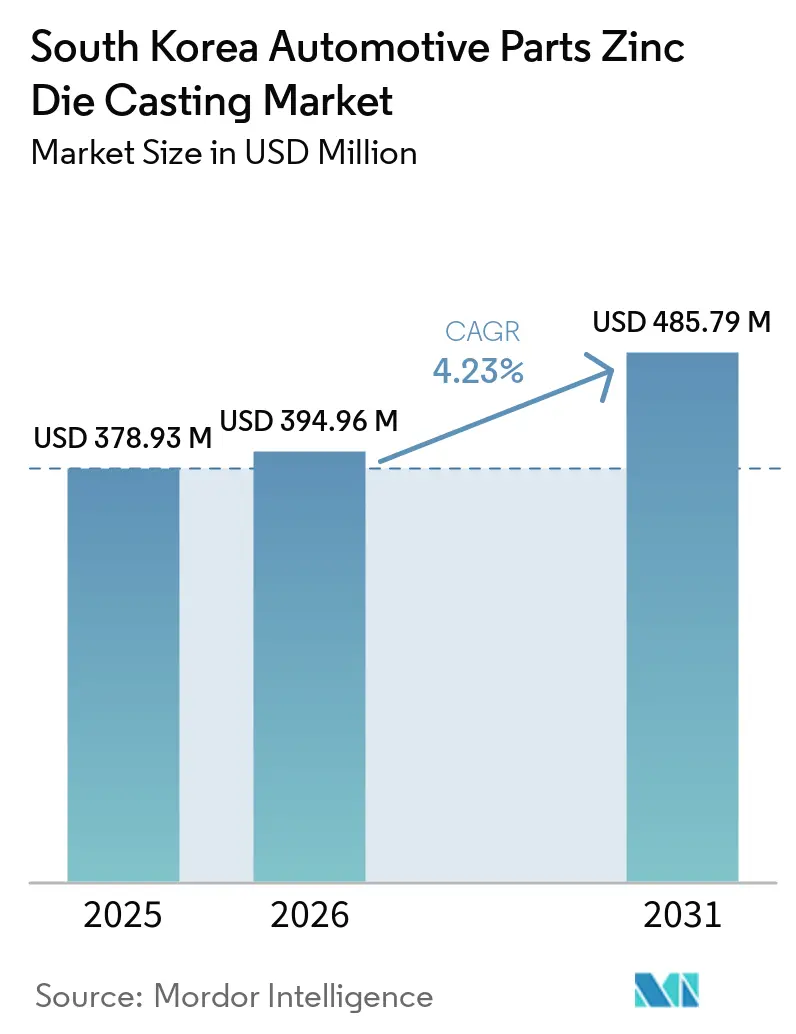
| Base Year Market Size (2025) | USD 378.93 Million |
| Market Size (2026) | USD 394.96 Million |
| Market Size (2031) | USD 485.79 Million |
| Growth Rate (2026 - 2031) | 4.23 % |
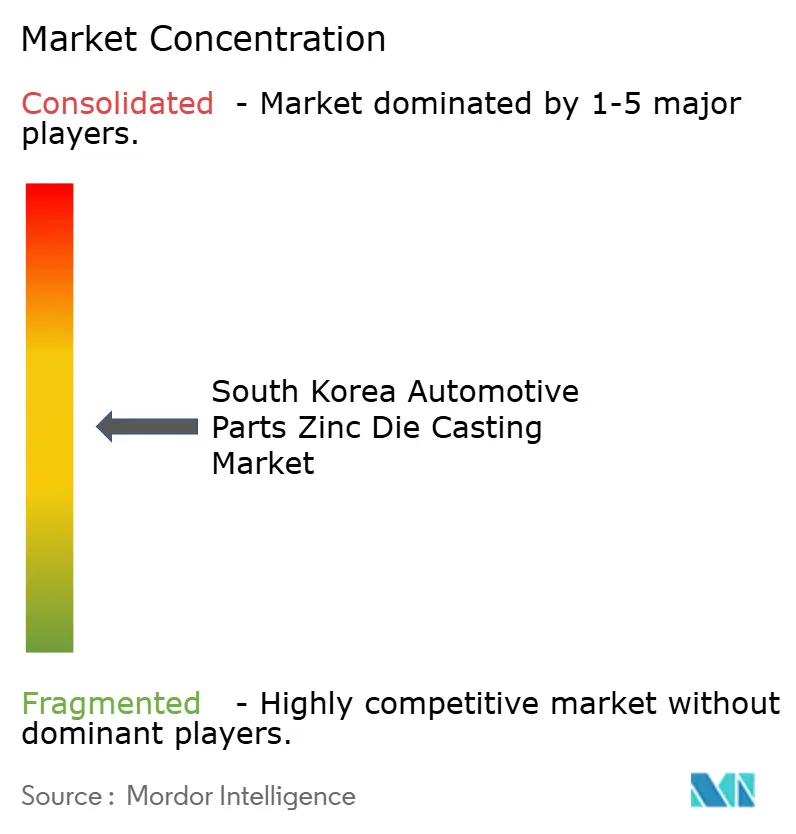
| Market Concentration | Medium |
Major Players
*Disclaimer: Major Players sorted in no particular order Image © Mordor Intelligence. Reuse requires attribution under CC BY 4.0. |
|
South Korea Automotive Parts Zinc Die Casting Market Analysis by Mordor Intelligence
South Korea Automotive Parts Zinc Die Casting Market size in 2026 is estimated at USD 394.96 million, growing from 2025 value of USD 378.93 million with 2031 projections showing USD 485.79 million, growing at 4.23% CAGR over 2026-2031. The market size momentum rests on the rebound of domestic vehicle assembly volumes, steady electrification targets, and ongoing OEM localization programs. Recovery funding for automotive manufacturers, announced in 2024, underpins new capacity additions and keeps order books healthy despite lingering tariff uncertainties. Simultaneously, lightweighting mandates and the migration to higher‐value thermal-management components are shifting alloy choices toward higher-strength formulations. Process-level upgrades, especially smart-factory retrofits in Ulsan, Changwon, and Gyeonggi, are improving yield and mitigating energy-cost headwinds. Competitive intensity remains moderate, with mid-sized die casters adopting real-time process analytics to secure long-term supply agreements with Hyundai Motor Group and other global OEMs.
Key Report Takeaways
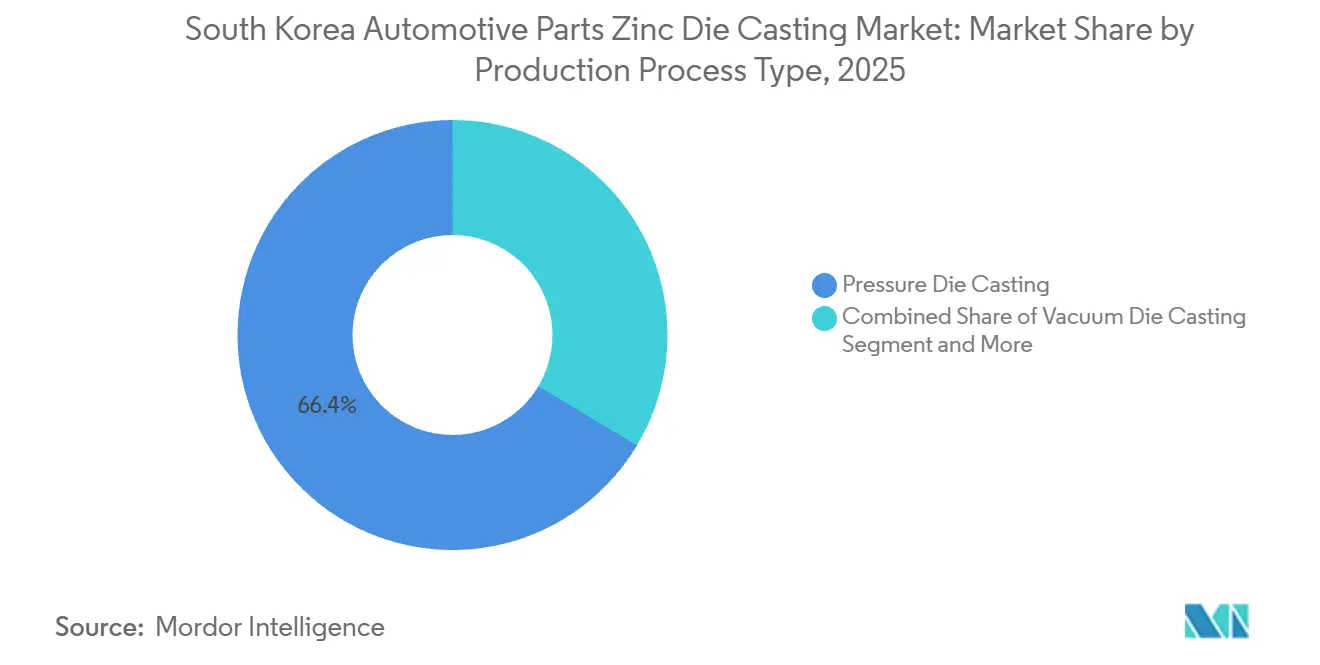
- By production process type, pressure die casting led with 66.42% of the South Korean automotive parts zinc die casting market share in 2025, while semi-solid die casting is projected to advance at a 4.27% CAGR to 2031.
- By alloy type, Zamak 3 accounted for 41.78% of the South Korean automotive parts zinc die casting market share in 2025, whereas ZA alloys record the highest forecast CAGR at 4.36% through 2031.
- By application, body assemblies captured 35.92% of the South Korean automotive parts zinc die casting market share in 2025; electrical and electronics housings posted the strongest growth outlook at a 4.31% CAGR.
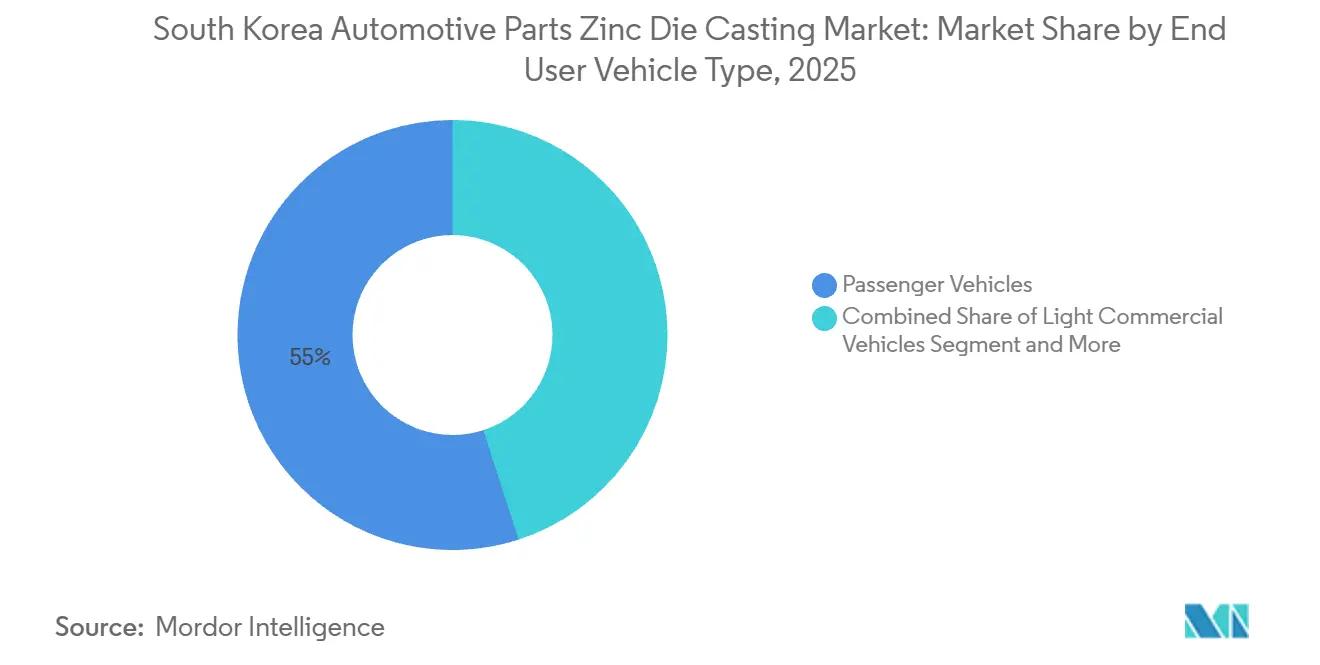
- By end-user vehicle type, passenger vehicles represented 54.98% of the South Korean automotive parts zinc die casting market share in 2025 and are expanding at a 4.29% CAGR to 2031.
- By sales channel, the OEM channel controlled 82.61% of the South Korean automotive parts zinc die casting market share in 2025 and is set to rise at a 4.38% CAGR during the forecast window.
Note: Market size and forecast figures in this report are generated using Mordor Intelligence’s proprietary estimation framework, updated with the latest available data and insights as of 2026.
South Korea Automotive Parts Zinc Die Casting Market Trends and Insights
Drivers Impact Analysis*
| Driver | (~) % Impact on CAGR Forecast | Geographic Relevance | Impact Timeline |
|---|---|---|---|
| Recovery In Domestic Automotive Production Volumes | +1.2% | National, concentrated in Ulsan and Changwon industrial complexes | Short term (≤ 2 years) |
| Rapid EV Adoption | +1.0% | National, with concentration in EV manufacturing hubs | Long term (≥ 4 years) |
| Weight-Reduction Targets | +0.8% | National, with spillover to export markets | Medium term (2-4 years) |
| OEM Localization Push | +0.7% | National, with focus on reducing import dependency | Medium term (2-4 years) |
| Government Incentives | +0.6% | National, focused on industrial complexes in Gyeonggi and South Gyeongsang | Medium term (2-4 years) |
| Korea Zinc Supply-Chain Realignment | +0.4% | National supply chain optimization | Short term (≤ 2 years) |
| Source: Mordor Intelligence | |||
Recovery in Domestic Automotive Production Volumes Post-2024
Annual vehicle assembly at Hyundai’s Ulsan complex has returned to pre-pandemic rhythm, and a KRW 2 trillion EV-dedicated expansion scheduled for 2025 reinforces part procurement visibility[1]“Ulsan Plant Expansion Update,” Hyundai Motor Company, hyundai.com . More than 300 tier-1 and tier-2 suppliers in the region have resumed three-shift operations, boosting order flow for precision zinc castings used in door hinges, wiper systems, and seat frames. A national export surge is further supporting die casters focused on mixed-model platforms, strengthening demand for high-precision components. The volumetric rebound helps spread tooling costs and partially offsets rising energy expenses, preserving margins on high-volume parts. Suppliers are increasingly engaging in co-engineering at the design stage, reducing time-to-market for model-year 2026 vehicle launches and enhancing alignment with OEM specifications.
Rapid EV Adoption Creating New Thermal-Management Parts
The pivot to battery-electric vehicles multiplies zinc casting demand for power-electronics housings, battery-pack frames, and integrated coolant manifolds. Hyundai WIA’s commercial roll-out of a one-piece EV thermal-management module in 2023 validated zinc’s superior thermal conductivity for compact under-hood packaging[2]“Integrated Thermal Management Module,” Hyundai WIA, en.hyundai-wia.com . Unlike combustion-engine radiators, EV modules manage three heat zones: battery, inverter, and e-motor, requiring intricate internal flow paths ideally produced via high-pressure zinc casting. Domestic suppliers exporting to the U.S. and European EV brands benefit from Korea’s advanced EMC testing infrastructure, positioning zinc die casting as a premium solution for thermal and electromagnetic compliance. As EV volumes rise toward the 4.2 million-unit national target by 2030, order frequency for these complex components is expected to grow faster than overall vehicle production, reinforcing demand for specialized zinc-casting capabilities.
Weight-Reduction Targets Driving Thinner-Wall Zinc Castings
Regulatory pressure for carbon-neutral fleets is pushing OEMs to minimize every unnecessary gram. Process controls now maintain wall thickness around 0.5 mm[3]"Die Casting Case Study: Zinc Die Casting in the Automotive Industry," LVMA, lvma-cnc.com. while preserving dimensional stability, achieving up to 20% weight savings compared with 2022 designs. Advanced ZA alloys, with up to 8% aluminum, boost tensile strength to compensate for thinner sections. Investment in conformal-cooling die inserts enhances solidification rates and reduces porosity, giving Korean suppliers a reputation for zero-rework batches. Lightweight compliance premiums negotiated with export OEMs provide an additional revenue stream for mid-sized casters.
Government Incentives for Smart-Factory Upgrades
The Ministry of SMEs and Startups subsidized digital retrofits for 950 companies in 2025, funding investments in sensors, MES integration, and AI-based scrap monitoring systems. Die casting shops leveraging inline thermal cameras report up to 10% scrap reduction alongside modest improvements in cycle time, enhancing overall production efficiency and part quality. The Banwol-Sihwa Smart Green Complex supports participating firms with shared logistics ERP, automated material flows, and green-transport links, reducing operational overhead and energy costs. Beyond efficiency gains, smart-factory accreditation serves as a visible qualification badge in global RFQs, strengthening the export competitiveness of suppliers. These initiatives also encourage broader adoption of data-driven production management, predictive maintenance, and environmentally compliant practices across the Korean die casting sector.
Restraints Impact Analysis*
| Restraint | (~) % Impact on CAGR Forecast | Geographic Relevance | Impact Timeline |
|---|---|---|---|
| High Energy and Processing Costs | -0.9% | National, particularly affecting energy-intensive operations | Short term (≤ 2 years) |
| Zinc-Price Volatility | -0.6% | Global supply chain with national impact | Medium term (2-4 years) |
| Shortage Of Experienced Tool-And-Die Designers | -0.5% | National, concentrated in industrial regions | Long term (≥ 4 years) |
| Urban Environmental Permitting Hurdles | -0.3% | Urban industrial areas, particularly Seoul metropolitan region | Medium term (2-4 years) |
| Source: Mordor Intelligence | |||
High Energy and Processing Costs vs. Aluminum
Industrial electricity tariffs in South Korea surged by more than 60% between 2022 and 2024, placing severe strain on energy-intensive hot-chamber zinc casting lines. Although zinc melts at lower temperatures than aluminum, continuous holding and repeated reheating significantly increase net kWh consumption per kilogram of cast output, amplifying operating costs. In response, some mid-tier foundries are experimenting with induction furnaces powered by PV-backed microgrids, which can partially offset rising electricity bills, but the upfront capital requirements remain substantial. The immediate effect is evident in thinner operating margins for smaller contract casters, prompting mergers and acquisitions as firms seek scale efficiencies. Larger suppliers are increasingly investing in energy-optimized processes, predictive power management, and heat-recovery systems to maintain competitiveness, while also negotiating long-term electricity contracts to hedge volatility. Overall, rising energy costs are reshaping cost structures, accelerating consolidation, and driving technological upgrades across the Korean zinc die casting sector.
Zinc-Price Volatility from Global Supply Disruptions
Benchmark zinc prices hovered around USD 2,600 per ton in 2024, with daily swings of up to USD 500, creating significant volatility for contract costings and complicating budget forecasts for domestic die casters. South Korea’s dependence on imported zinc concentrates exposes buyers to shipping route disruptions, particularly through the Red Sea and South China Sea, where geopolitical tensions or port delays can ripple directly into material availability. Korea Zinc’s equity stake in The Metals Company represents a strategic move to diversify critical raw material supply, including nickel and cobalt, supporting long-term alloy production stability. In the near term, however, zinc spot price stability remains elusive, forcing domestic suppliers to rely on hedge programs and maintain strategic stockpiles. While these measures cushion short-term price shocks, they also increase working-capital commitments and operational complexity, particularly for small and mid-tier casters managing tight margins.
*Our forecasts treat driver/restraint impacts as directional, not additive. The impact forecasts reflect baseline growth, mix effects, and variable interactions.
Segment Analysis
By Production Process Type: Semi-Solid Diecasting Gains Momentum
Pressure die casting accounted for 66.42% of the South Korea automotive parts zinc die casting market in 2025, while semi-solid casting is projected to grow at a 4.27% CAGR. The semi-solid process combines thixotropic slurry control and high fill rates to produce structural components with fewer voids and superior fatigue resistance, making it ideal for battery-tray reinforcement panels requiring tight dimensional tolerances. Pressure die casting maintains scale economies for high-volume parts such as door handles and window regulators, sustaining elevated OEE on legacy lines. Continuous shot monitoring and servo-driven plungers are pushing CTQ yields above 97%, and most manufacturers blend both technologies to balance cost efficiency with premium applications.
Pressure die casting, despite its dominant share, faces growing process-optimization pressures to remain competitive. Investments in vacuum venting, dual-plunger gates, and thermal control improve mechanical properties toward semi-solid performance, narrowing the traditional gap. OEM engineers increasingly specify micro-porosity limits via computed tomography, prompting casters to adopt hybrid tooling solutions. Overseas customers often request parallel pilot runs in both technologies before line-side deployment, extending quoting cycles but locking in multi-year production volumes. This combination of high-volume pressure die casting and selective semi-solid application reinforces the strategic positioning of South Korean suppliers in both standard and advanced automotive components.



By Alloy Type: ZA Alloys Challenge Traditional Formulations
Zamak 3 alloys, which held 41.78% of the South Korean automotive parts zinc die casting market in 2025, are primarily employed in door-lock housings, hood latches, and interior bezels. Zamak 5, strengthened with copper, is used for styling components that demand higher corrosion resistance. ZA alloys are projected to record the fastest growth at a 4.36% CAGR, with aluminum content above 10% delivering tensile strengths over 400 MPa, enabling thinner cross-sections without creep. Suppliers report machining-time reductions of up to 18% due to improved chip breakage, offsetting slight raw-metal price premiums and supporting efficiency on high-value parts.
Material specification changes are often guided by joint cost-down workshops between Hyundai Mobis and tier-1 die casters. Lifecycle simulations now incorporate vibration frequency spectra unique to battery-electric vehicles, encouraging migration to ZA alloys for structural components. As OEMs pursue global recycling targets, the high recyclability of traditional Zamak blends ensures baseline volumes and stable foundry capacity utilization. Overall, growth in South Korea’s zinc die casting market reflects parallel demand across both conventional Zamak and advanced ZA alloy segments.
By Application: Electronics Housings Drive Innovation
Body assemblies, which held 35.92% of the South Korean automotive parts zinc die casting market in 2025, remain critical as seat frames, roof-rail brackets, and crash-energy absorbers continue to rely on zinc’s damping properties. Interior trim brackets also benefit from zinc’s compatibility with decorative plating, sustaining niche demand. Electrical and electronics housings are projected to grow at a 4.31% CAGR, gradually surpassing engine-centric parts as fleets electrify. Die casters are now delivering shielded inverter boxes with integrated busbar channels, reducing assembly steps on EV production lines.
Engine and transmission components retain relevance in hybrid vehicles exported to markets with slower electrification. Casters are retrofitting legacy molds with conformal-cooling inserts, accelerating cooling cycles to offset volume declines. Rising in-car computing power is driving EMC-compliant zinc housings with integrated gasket grooves. Suppliers capturing this new business frequently offer concurrent engineering services, aligning mounting bosses with OEM PCB stack-ups and ensuring seamless integration in increasingly complex vehicle architectures.
By End-User Vehicle Type: Passenger Vehicles Lead Across Metrics
Passenger vehicles accounted for 54.98% of the South Korean automotive parts zinc die casting market in 2025 and are projected to grow at a 4.29% CAGR. Model proliferation, particularly among compact EV crossovers, increases the number of components per unit. Heavy commercial vehicles have limited zinc adoption due to extreme duty cycles favoring steel or ductile iron, although cabin trim and step brackets continue to use zinc for corrosion resistance. Light commercial vehicles sustain steady demand, driven by e-grocery delivery fleets in Seoul and Busan, while two-wheelers form an emerging export niche to Southeast Asia, with compact ABS housings and handlebar clamps commonly sourced from Korean die casters.
Growth in the passenger vehicle segment is supported by Korea’s free-trade agreements, facilitating exports to the EU and Canada. Local content requirements within these agreements favor Korean castings, boosting outbound volumes. Platform modularity enables a single zinc bracket family to fit multiple vehicle models, generating economies of scale that smaller regional competitors find difficult to achieve. This combination of domestic production strength and favorable trade conditions underpins sustained expansion for Korean zinc die casters in the passenger vehicle sector.
By Sales Channel: OEM Dominance Reflects Integration Trends
OEM contracts accounted for 82.61% of South Korea's automotive parts zinc die casting revenue in 2025 and are projected to grow at a 4.38% CAGR through 2031, reflecting the collaborative design culture between die casters and automakers. Integrated APQP processes ensure casting suppliers participate in early design reviews, embedding manufacturability insights before tooling begins. Aftermarket channels, serving collision repair centers and performance tuners, expand at slower rates due to improved vehicle durability, although specialty tuners ordering small-batch dress-up components sustain a subset of job-shop casters. Players diversify their OEM bases, supplying both Hyundai Motor Group and overseas OEMs such as Renault Korea and GM Korea to mitigate platform-specific risks.
Tighter PPAP standards from OEMs are pushing suppliers to implement automated X-ray and CT scanning for quality assurance. While compliance costs are high, they are offset by longer contract tenures and avoidance of dual-sourcing. Casters achieving zero-PPM performance often negotiate price escalators linked to metal surcharges, preserving margins amid volatile zinc markets and reinforcing the strategic value of high-quality, digitally monitored production in the South Korean die casting sector.
Geography Analysis
Production clusters in South Korea’s zinc die casting industry are concentrated along the southeast corridor from Ulsan to Changwon, generating over half of the nation’s output. Ulsan hosts Hyundai’s unit assembly plant and multiple dedicated die casting cells supplying door-handle frames and battery-tray fittings. Enhanced logistics via the Port of Ulsan facilitate exports to North America and the EU. Changwon’s industrial complex, established in 1974, integrates upstream machining and post-processing operations, enabling just-in-sequence deliveries to heavy-industry OEMs and vehicle assemblers in nearby Geoje shipyards. Its Advanced Transportation Machinery Parts Zone reserves 692,000 m² for automotive casting expansion, with tenants increasingly adopting low-carbon melting furnaces funded through provincial eco-credit programs.
Gyeonggi’s Banwol-Sihwa Smart Green Industrial Complex provides digital twins and shared ERP for SMEs, reducing lead times for prototype tooling orders by up to 20%. Close proximity to Seoul’s R&D institutes fosters collaborative alloy development, accelerating the adoption of ZA variants for lightweight and high-strength components. Peripheral zones, such as Wonju’s Foreign Investment Zone in Gangwon-do, offer tax incentives and subsidized land to attract global tier-1 suppliers, spreading economic activity beyond traditional hubs.
South Gyeongsang’s regional incentives have supported expansions from Wurth Korea and other international toolmakers, strengthening local die design capabilities. This multi-hub distribution mitigates supply-chain disruptions while nurturing specialized talent pools in each region, ensuring resilient production and fostering advanced technological adoption across South Korea’s zinc die casting sector.
Regulatory Landscape
South Korea automotive parts zinc die casting suppliers operate under a tightening quality-and-safety framework anchored by the Korea Transportation Safety Authority (TS) for vehicle safety testing and certification, alongside parts-performance requirements linked to Korea Motor Vehicle Safety Standards. On the materials side, the Korean Agency for Technology and Standards (KATS) anchors zinc die casting compliance through KS D 6005-2016(2021) for zinc alloy die castings and KS D 2311-2018(2023) for zinc alloy ingots used in die casting. These standards define composition windows, mechanical property thresholds, and test methods that affect foundry melt control, incoming ingot qualification, and PPAP documentation for OEM programs.
Policy direction in 2026 further formalized the parts-sector transition under the Special Act on the Future Automotive Industry. In February 2026, MOTIE announced KRW 464.5 billion in 2026 automotive investment, including KRW 382.7 billion for R&D in electric, hydrogen, and autonomous driving core technologies and KRW 81.8 billion for infrastructure-building projects supporting parts suppliers. The funding raises expectations for electrification-compatible components where zinc die castings are used in electronics housings and thermal-management modules. In May 2026, MOTIE and the Financial Services Commission launched a Future Vehicle Parts Industry Consultative Body to support restructuring, finance, and R&D for parts makers, reinforcing compliance and documentation expectations as suppliers pivot from ICE-linked parts to future-mobility assemblies.
Value Chain Analysis
The value chain begins with zinc alloy ingot and alloying inputs qualified to KS standards, notably KS D 2311-2018(2023) for zinc alloy ingots, and then moves through tool-and-die design, die manufacturing, melting and hot-chamber casting, trimming, machining, and surface finishing (including plating where required). Quality assurance is aligned to OEM APQP/PPAP practices. Production is concentrated in the established manufacturing corridors and industrial complexes highlighted in the report scope (Ulsan to Changwon and Gyeonggi), which supports just-in-sequence delivery to vehicle assembly and module plants while also facilitating export packaging and logistics through regional ports and freight networks.
Downstream, zinc die cast parts primarily move through OEM supply chains that require traceability, safety alignment to TS-linked requirements, and compatibility with certification regimes administered under the Motor Vehicle Management Act and Korean Motor Vehicle Safety Standards. Environmental compliance for emissions and noise certification intersects with Ministry of Environment requirements under relevant acts. Industry coordination and capability-building increasingly flows through ecosystem programs under the Special Act on the Future Automotive Parts Industry transformation agenda, with trade associations such as the Korea Auto Industries Coop. Association convening regional forums and policy positions in 2026. This feeds into supplier financing access, SME consulting, and production-readiness initiatives for EV-relevant modules.
Competitive Landscape
Market concentration in South Korea’s automotive parts zinc die casting sector remains moderate, with the top five companies collectively holding over half of the market share. Hyundai WIA leads in thermal-management castings, leveraging vertical integration with Hyundai Motor Group. Dynacast focuses on precision micro-components for global EV inverter makers. Smaller firms like Seohan Auto and Sungwoo Hitech invest in robotic trimming and cell automation to move up the value chain.
The technology race is centered on smart-factory maturity, with leading players deploying AI-enabled melt-temperature prediction and predictive die lubrication systems. Intellectual property protection for die designs is gaining importance as alloy compositions diversify, and advanced ZA alloys demand tighter process control. Thermal-management, thin-wall, and high-strength structural components increasingly require integrated digital monitoring to ensure quality and reduce scrap, reinforcing the competitive advantage of tech-savvy firms.
M&A activity is accelerating as a domestic private-equity consortium acquired nearly 40% stake in JYC Foundry in early 2025 to fund ZA alloy line upgrades. Compliance with K-REACH chemical norms and carbon-footprint reporting is becoming a bid qualifier for export programs, prompting smaller or laggard firms to seek partnerships or consider exit. This consolidation trend, combined with technology-driven differentiation, is shaping a more resilient and export-ready zinc die casting ecosystem in South Korea.
South Korea Automotive Parts Zinc Die Casting Industry Leaders
-
Dynacast
-
Hyundai WIA
-
PJ Altek Co., Ltd.
-
WONTAE
-
DAEWON PRECISION
- *Disclaimer: Major Players sorted in no particular order

Market Opportunities and Future Outlook
Electrification-driven content shifts keep expanding the addressable set of zinc die cast components in South Korea beyond legacy hinges, latches, and interior brackets into higher-value electronics housings and thermal-management-related parts. Zinc supports these applications with thermal conductivity, EMI shielding, and dimensional stability. A practical whitespace for domestic die casters is EV-focused, high-precision production capability that matches what upstream and adjacent parts makers are deploying. In February 2026, Daedong Gear disclosed mass production of EV powertrain components using a new automated cleanroom facility at its Sacheon Plant 1 with 300,000-unit annual capacity, reinforcing OEM preference for automated, contamination-controlled manufacturing and in-line quality systems that can carry over to die cast housings and interfaces.
Government-backed manufacturing platforms and supplier-transition programs also create routes to move up the value ladder, particularly for SMEs. In May 2026, South Chungcheong Province was selected for MOTIE's 2026 AI-DfAM-based Mobility Manufacturing Innovation Hub Development Project (KRW 22.6 billion through 2030) to build an AI-based, mold-free additive manufacturing platform in Cheonan. This supports faster iteration of tooling concepts, prototyping of complex geometries, and design-for-manufacturability workflows that complement semi-solid and advanced pressure die casting. Alongside the May 2026 launch of the public-private Future Vehicle Parts Industry Consultative Body under the Special Act on the Future Automotive Industry, the 2026 funding programs cited in official announcements expand financing and restructuring pathways for parts suppliers. Zinc die casters can leverage these pathways through smart-factory retrofits, advanced alloy control (including ZA variants), and enhanced inspection requirements for EV electronics housings and body-integrated modules.
Recent Industry Developments
- June 2026: Ajin Industrial completed a KRW 250 billion automotive parts manufacturing facility in the Gyeongsan Knowledge Industrial District. The plant targets body press parts and assembly components for electrified and hybrid Genesis models, adding domestic capacity and tightening local sourcing requirements that can pull more localized subcomponent manufacturing and qualifying activity across the supply base.
- June 2025: Korea Zinc invested USD 85.2 million in The Metals Company to strengthen critical-minerals access for EV supply chains. While the investment is not a direct die casting capacity move, it reinforces upstream raw-material and supply-chain strategies that influence alloy sourcing resiliency and pricing negotiations for Korean zinc-consuming manufacturers.
- May 2024: Hyundai Mobis committed KRW 90 billion to an EV module plant in Ulsan planned for completion in late 2025, focused on chassis and drivers-seat modules. The added module capacity in a key production cluster supports higher localization of module subassemblies and drives tier-1 and tier-2 qualification demand for precision cast parts used in structural, mounting, and electronics-adjacent applications.


Research Methodology Framework and Report Scope
Market Definition and Coverage
For this study, the market covers revenue generated from zinc die cast components supplied into automotive parts manufacturing in South Korea, across common casting processes and vehicle-related part applications, and reported in USD terms.
Scope exclusions: It excludes non-automotive zinc die cast parts and non-zinc automotive die castings such as aluminum or magnesium.
Segmentation Overview
-
By Production Process Type
- Pressure Die Casting
- Vacuum Die Casting
- Squeeze Die Casting
- Semi-Solid Die Casting
-
By Alloy Type
- Zamak 3
- Zamak 5
- ZA Alloys
- Others
-
By Application
- Body Assemblies
- Engine Parts
- Transmission Parts
- Electrical and Electronics Housings
- Interior and Trim Components
-
By End-User Vehicle Type
- Passenger Vehicles
- Light Commercial Vehicles
- Heavy Commercial Vehicles
- Two-Wheelers
-
By Sales Channel
- OEM
- Aftermarket
Data Sources, Market Sizing, and Validation
Desk Research
Desk research was used to map the demand pool and set practical boundaries for what gets counted as automotive zinc die cast parts in South Korea. We reviewed public releases and datasets such as Statistics Korea, Korea Customs Service trade statistics, Ministry of Trade, Industry and Energy publications, and Korea Automobile Manufacturers Association updates to understand vehicle output signals and industrial activity direction.
We also checked technical and adoption signals from sources such as SAE papers, peer reviewed journals covering die casting and alloys, and patent databases to understand how lightweighting and part redesign can shift zinc usage by application. Company annual reports, investor presentations, and reputable press were used to validate capacity additions, utilization commentary, and pricing context, supported at points by paid subscriptions for company financials and shipment-level trade intelligence. The sources listed here are illustrative only, and we used many other public and paid references to collect data, validate assumptions, and clarify open questions.
Primary Interviews and Surveys
Primary work was conducted to pressure-test the desk assumptions around which parts remain primarily zinc, what typical casting yields and scrap rates look like, and how pricing is being reset in supply agreements. We spoke with a mix of automotive component suppliers, die casting specialists, raw material and tooling stakeholders, and informed buyers, then re-checked viewpoints where answers diverged between OEM-facing and aftermarket-facing participants.
Distribution of primary research fieldwork respondents
| Company type | Respondent position |
|---|---|
| Top tier: 31% | CXOs: 17% |
| Mid tier: 49% | Functional/Unit leaders: 39% |
| Smaller Players: 20% | Managers: 44% |
Market-Sizing & Forecasting
Sizing starts with a top-down demand reconstruction where South Korea vehicle production and parts output signals are translated into an addressable zinc die cast parts pool by applying part-level penetration and value intensity assumptions for key applications. Once that structure is set, totals are corroborated through selective bottom-up checks, such as sampled supplier revenue ranges, channel checks on large part families, and ASP x volume spot builds where data is available, then adjusted when mismatches are explained by scope or mix.
Key inputs used in the model include vehicle production by type, zinc alloy price direction and contract reset timing, casting yield and scrap assumptions, shifts in application mix (for example, body and trim components versus powertrain housings), and the pace of electrification-linked part redesign that can move demand across materials. For forecasting, scenario analysis was applied so macro production paths, mix shifts, and pricing paths can be stress-tested rather than relying on a single straight-line growth view. Where bottom-up signals are patchy for smaller suppliers, gaps are handled through ratio-based allocation from validated capacity and utilization ranges and then rechecked with interview feedback.
Data Validation & Update Cycle
Outputs are triangulated against independent indicators like vehicle production trends, trade and material price movements, and the implied consumption per vehicle for major application groups. Outliers are flagged and reviewed in more than one analyst pass, and we re-contact respondents when a variance cannot be explained by timing, mix, or an inclusion rule.
The dataset and assumptions are refreshed on an annual cycle, and interim updates are triggered when material events occur, such as sharp zinc price swings, policy changes affecting auto production, or meaningful capacity additions. Before publication delivery, a final review pass is completed so the numbers and narrative reflect the latest available signals.
Mordor Intelligence's South Korea Automotive Parts Zinc Die Casting Market Estimate Compared With Other Published Estimates
It is normal to see different market sizes for the same topic, even when the titles look similar. The gaps usually come from what is counted as an automotive zinc die cast part, what year is treated as the current base, and how price and volume are carried forward in the forecast.
By tracking part-application boundaries and refresh timing, Mordor Intelligence is kept aligned to South Korea automotive zinc die casting revenue only, while some publications blend in broader die casting value or use wider regional cuts that push totals upward.
Benchmark comparison
| Source | Market Size | Gaps in Research Methodology |
|---|---|---|
| Mordor Intelligence | USD 378.93 M (2025) | |
| Industry Publisher A | USD 887.20 M (2025) | Often reflects a wider counted universe, where adjacent die casting value or non-comparable regional rollups can be included, and the pricing build can be less explicit at the part-application level. |
| Industry Publisher B | USD 160.00 M (2023) | Uses an earlier base year and can apply a narrower application set or different inclusion of OEM versus aftermarket streams, which changes the implied demand pool before forecasting. |
The spread in the table is largely explained by scope boundary choices and base-year alignment, followed by how pricing and mix are carried through the forecast window. When the counted applications, timing, and USD conversion logic are made explicit, the final number becomes easier to replicate and to use in planning discussions without hidden add-ons.


Key Questions Answered in the Report
What is the current value of the South Korea automotive parts zinc die casting market?
The market is valued at USD 394.96 million in 2026, reflecting post-pandemic production recovery.
How fast is the South Korea automotive parts zinc die casting market expected to grow?
It is projected to expand at a 4.23% CAGR, reaching USD 485.79 million by 2031.
Which alloy category is growing the quickest in South Korean zinc casting?
ZA alloys show the fastest growth at a 4.36% CAGR because of superior strength and lightweight potential.
Why are electronics housings a high-growth application?
Electrification elevates demand for zinc castings that provide electromagnetic shielding and thermal management for EV power electronics.
How significant is OEM sourcing compared with aftermarket channels?
OEM contracts represent 82.61% of 2025 revenue, underscoring integrated design partnerships with major automakers.
What is the biggest operational challenge facing die casters today?
Escalating industrial electricity prices, up more than three-fifth since 2022, put pressure on hot-chamber processing economics.
Page last updated on:


 Your data is secure and never sold or shared.


