
Anti-Corrosion Coatings Market Size and Share
Market Overview
| Study Period | 2021 - 2031 |
|---|---|
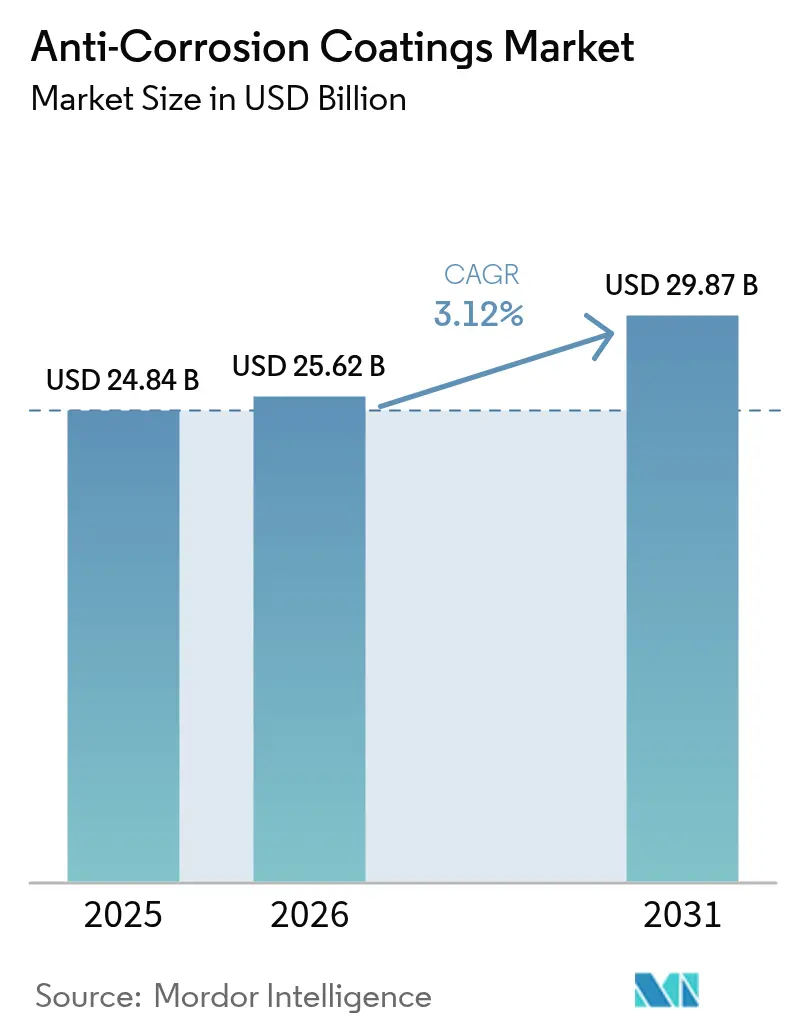
| Market Size (2026) | USD 25.62 Billion |
| Market Size (2031) | USD 29.87 Billion |
| Growth Rate (2026 - 2031) | 3.12 % |
| Fastest Growing Market | Middle East and Africa |
| Largest Market | Asia Pacific |
| Market Concentration | Medium |
Major Players *Disclaimer: Major Players sorted in no particular order Image © Mordor Intelligence. Reuse requires attribution under CC BY 4.0. | |
Anti-Corrosion Coatings Market Analysis by Mordor Intelligence
The Anti-Corrosion Coatings Market size was valued at USD 24.84 billion in 2025 and is estimated to grow from USD 25.62 billion in 2026 to reach USD 29.87 billion by 2031, at a CAGR of 3.12% during the forecast period (2026-2031). Demand is advancing because governments are tightening volatile-organic-compound thresholds, ship operators must meet the International Maritime Organization’s new Carbon Intensity Indicator grades, and asset owners are shortening recoating cycles to protect higher-value infrastructure. In parallel, epoxy raw-material volatility and anti-dumping duties on Asian resin imports are squeezing formulators, prompting a shift toward water-borne and high-solids chemistries that reduce exposure to diisocyanates. Capital allocated to highway, bridge, and offshore-wind projects in the United States, European Union, and Japan is anchoring long-duration volume, while Asia-Pacific’s petrochemical and pipeline workstreams keep the Anti-Corrosion Coatings market on a solid baseline. Competition remains moderate: the five largest suppliers hold about 40% of global capacity, yet regional specialists win niche contracts by offering powder, UV-cured, and foul-release systems that deliver faster cure and zero VOCs.
Key Report Takeaways
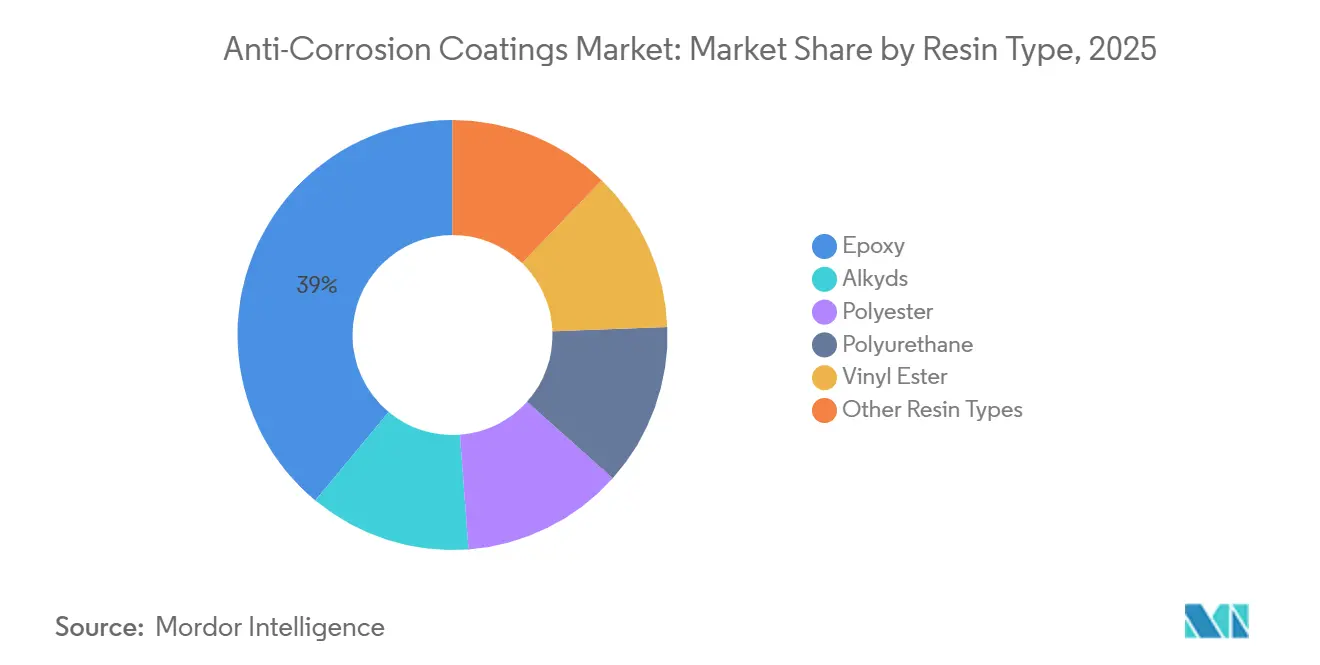
- By resin type, epoxy captured 38.98% of the anti-corrosion coatings market share in 2025, while polyurethane is projected to post the fastest 3.81% CAGR through 2031.
- By technology, solvent-borne systems retained 57.66% revenue share in 2025; water-borne alternatives are set to expand at a 3.72% CAGR to 2031.
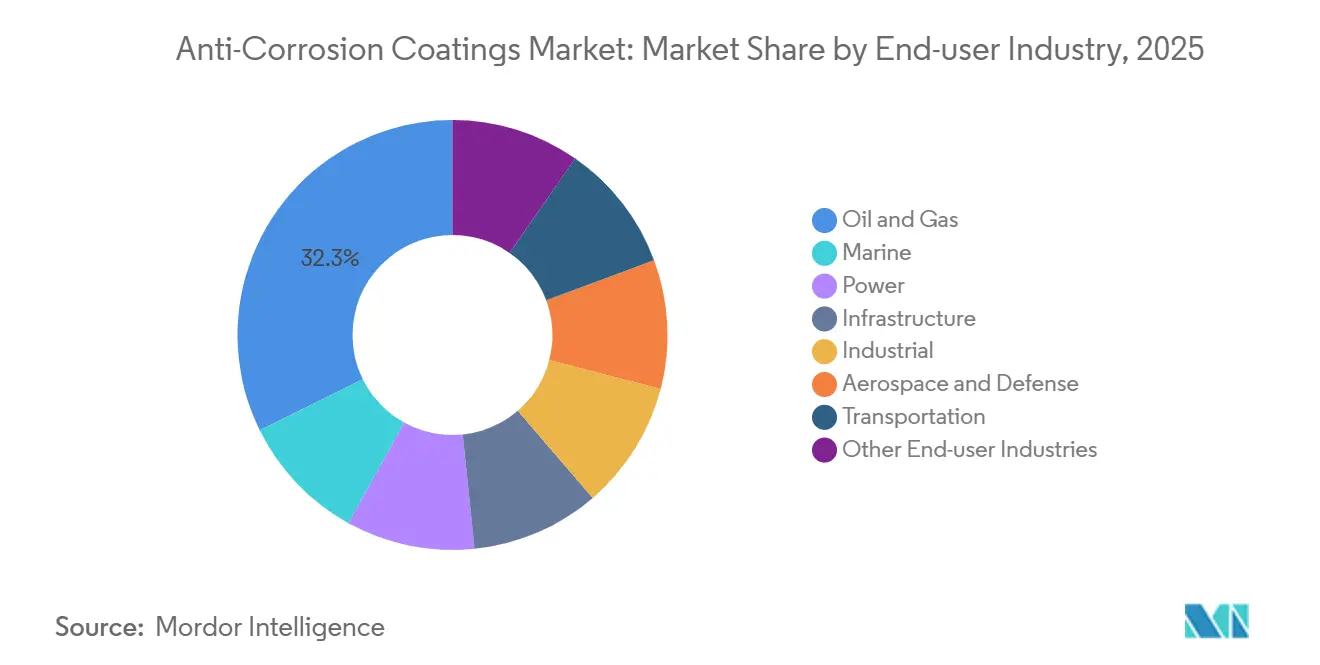
- By end-user industry, oil and gas held 32.29% of the anti-corrosion coatings market size in 2025, whereas infrastructure projects are advancing at a 4.12% CAGR over 2026-2031.
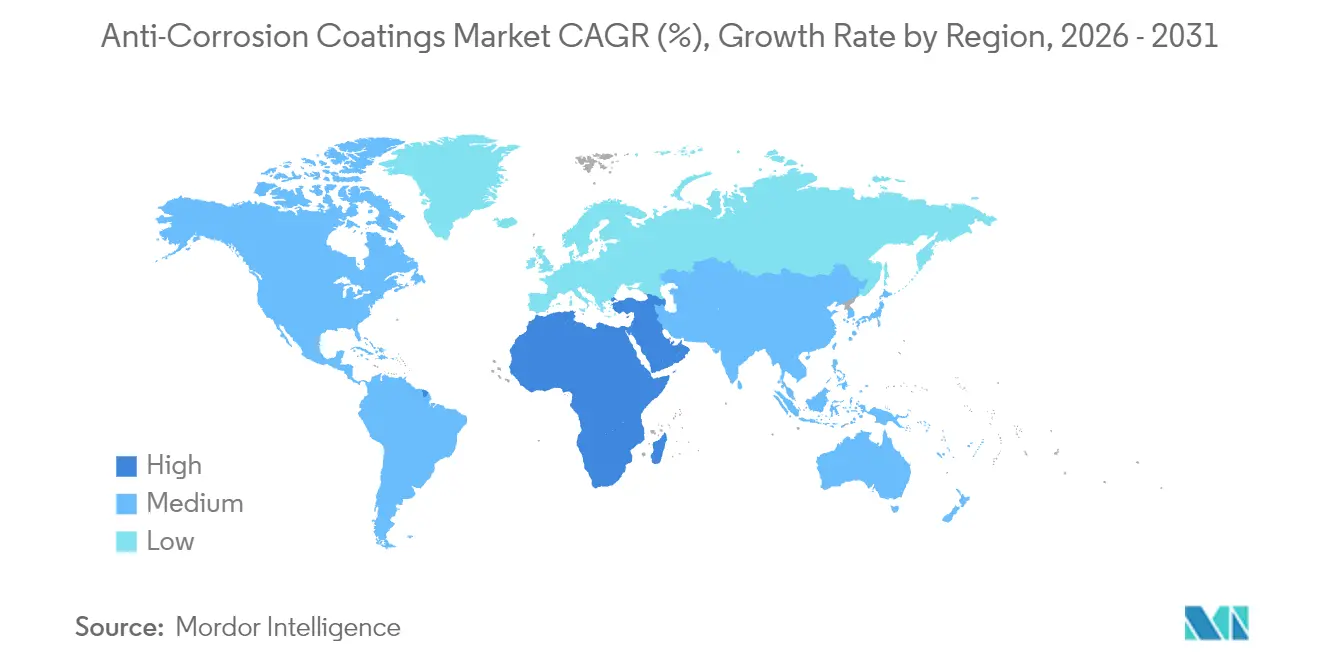
- By geography, Asia-Pacific commanded 46.72% revenue in 2025; the Middle East and Africa region is forecast to grow at a 3.41% CAGR through 2031.
Note: Market size and forecast figures in this report are generated using Mordor Intelligence’s proprietary estimation framework, updated with the latest available data and insights as of 2026.
Market Trends and Insights
Drivers Impact Analysis of Anti-Corrosion Coatings Market*
| Driver | (~) % Impact on CAGR Forecast | Geographic Relevance | Impact Timeline |
|---|---|---|---|
| Infrastructure-renewal super-cycle in U.S., European Union and Japan | +0.8% | North America, Europe, Japan | Long term (≥ 4 years) |
| Offshore wind-farm coating boom | +0.6% | Europe, APAC coastal regions, North America Atlantic seaboard | Medium term (2-4 years) |
| Offshore pipeline life-extension spend in Asia-Pacific | +0.5% | APAC core, spill-over to Middle East | Medium term (2-4 years) |
| IMO CII rules driving more frequent hull recoating | +0.4% | Global, with concentration in major shipping registries | Short term (≤ 2 years) |
| CUI-driven specification upgrades at LNG terminals | +0.3% | Global, with early gains in Qatar, Australia, U.S. Gulf Coast | Long term (≥ 4 years) |
| Source: Mordor Intelligence | |||
Infrastructure-Renewal Super-Cycle in US, European Union and Japan
Bridge, tunnel, and rail assets are aging in lockstep across three mature economies. The United States has earmarked USD 110 billion for roads and bridges; state transportation agencies now require three-coat epoxy-polyurethane systems that meet SSPC-Paint 36 for steel structures. Japan’s Ministry of Land, Infrastructure, Transport and Tourism reported in 2025 that 63% of the nation’s 730,000 bridges exceed 50 years of age, unlocking JPY 5.3 trillion (USD 35 billion) for corrosion remediation through 2030[1]. Meanwhile, Germany alone is replacing 4,000 Autobahn bridges under an EUR 2.8 billion initiative. These synchronized budgets create a durable floor for the Anti-Corrosion Coatings market, as steel recoating cycles last 15-25 years and specification bodies insist on ISO 12944-C5-M compliance.
Offshore Wind-Farm Coating Boom
Installed offshore-wind capacity reached 75 GW by late 2025, and every monopile, transition piece, and offshore substation demands multi-layer zinc-epoxy-polysiloxane protection[2]. Ørsted’s 2.9 GW Hornsea Three project requires 25-year service-life coatings approved after 10,000-hour salt-spray testing. On the US side, six Atlantic lease areas auctioned in 2024 will need roughly 180,000 tons of coatings through 2032. Because fewer than 20 global yards hold DNV certification for offshore-wind fabrication, coating specifications are tightly controlled, pushing the Anti-Corrosion Coatings market toward premium chemistries that command 30-40% price premiums.
Offshore Pipeline Life-Extension Spend in Asia-Pacific
More than 45,000 km of subsea pipelines installed during the 1990s now face corrosion fatigue. Petronas let a USD 320 million rehabilitation contract in 2025, mandating fusion-bonded epoxy and polypropylene overwrap in accordance with ISO 21809. Woodside Energy is spending AUD 1.2 billion (USD 780 million) to extend North West Shelf assets by 15 years, with coatings grabbing 18% of that budget. These projects favor suppliers that can mobilize offshore crews and validate coating integrity in real time, deepening loyalty to multinational brands in the Anti-Corrosion Coatings market.
IMO CII Rules Driving More Frequent Hull Recoating
The Carbon Intensity Indicator applies letter grades that affect charter rates and port-state control. Hull fouling degrades scores, so operators are cutting dry-dock intervals from 60 months to as little as 36 months. Maersk advanced 42 dockings in 2025 and spent USD 180 million on silicone foul-release technology, citing an 8% fleetwide fuel-cut. Nippon Paint Marine’s hydrogel system claimed a 12% saving in Japan’s National Maritime Research Institute trials. These moves reinforce the Anti-Corrosion Coatings market’s cadence in marine segments, accelerating throughput for suppliers with advanced R&D capabilities.
Restraints Impact Analysis of Anti-Corrosion Coatings Market*
| Restraint | (~) % Impact on CAGR Forecast | Geographic Relevance | Impact Timeline |
|---|---|---|---|
| Global VOC / isocyanate exposure caps tightening | -0.5% | Europe, North America, with Asia-Pacific adoption by 2028 | Medium term (2-4 years) |
| Epoxy raw-material price spikes (Bis-A, ECH) | -0.4% | Global, with acute pressure in Europe post-tariff | Short term (≤ 2 years) |
| Deferred CAPEX in oil-&-gas downturn cycles | -0.3% | Global, concentrated in offshore and upstream segments | Short term (≤ 2 years) |
| Source: Mordor Intelligence | |||
Global VOC / Isocyanate Exposure Caps Tightening
Directive 2020/1149 compels every European worker handling >0.1% diisocyanate to complete certified training, adding EUR 5,000-15,000 per facility in compliance costs. The European Chemicals Agency will enforce a 6 µg NCO/m³ limit by 2029, roughly 10 times stricter than prior levels. The United States is following with a proposed OSHA 5 µg NCO/m³ limit. These caps penalize solvent polyurethane lines and nudge buyers toward water-borne dispersions, though 4-6 hour dry times hamper throughput in fabrication shops.
Epoxy Raw-Material Price Spikes (Bis-A, ECH)
Unplanned cracker outages pushed liquid epoxy resin spot prices in Asia to USD 2,450/t in Q1 2026, up 18% YoY. Europe imposed anti-dumping duties of 10-170% on imports from China, South Korea, Taiwan, and Thailand in January 2025. Huntsman disclosed USD 42 million in added costs during 2025, forcing three price surcharges totaling 12%. Formulators with backward integration, such as Olin, fared better, widening the cost gap inside the Anti-Corrosion Coatings market.
*Our forecasts treat driver/restraint impacts as directional, not additive. The impact forecasts reflect baseline growth, mix effects, and variable interactions.
Anti-Corrosion Coatings Market Segment Analysis
By Resin Type:
Epoxy Dominance Meets Polyurethane MomentumEpoxy systems represented 38.98% of the Anti-Corrosion Coatings market share in 2025, underscoring the chemistry’s adhesion to steel and compatibility with cathodic-protection schemes. The Anti-Corrosion Coatings market size attributable to epoxy is projected to climb at a steady clip as refiners, pipeline operators, and offshore platforms renew tank linings and splash-zone barriers. Polyurethane demand is rising faster, expanding 3.81% CAGR, because onshore wind towers, solar frames, and façade steel require UV stability and color retention.
Alkyd and polyester resins persist in cost-sensitive niches, yet their growth trails the overall Anti-Corrosion Coatings market. Hybrid epoxy-primer plus polyurethane topcoat systems are blurring category lines, rewarding suppliers that validate cross-link compatibility through accelerated weathering. Self-healing and corrosion-sensing pigments, highlighted by 14 Akzo Nobel patents in 2024-25, point to next-generation chemistries that could elongate maintenance intervals beyond 25 years, strengthening premium positions within the Anti-Corrosion Coatings industry.

By Technology:
Solvent-Borne Retreat, Water-Borne AdvanceSolvent-borne platforms held 57.66% of the Anti-Corrosion Coatings market in 2025, thanks to rapid dry times and robust performance in humid marine yards. However, regulatory pressure and worker-exposure limits are steering asset owners toward 85-90% solids or water-borne systems that cut VOCs by up to 60%. Water-borne volumes will grow at 3.72% through 2031, gradually eroding solvent-borne share within the overall Anti-Corrosion Coatings market size.
Powder and UV-cured systems remain single-digit slices, constrained by oven-curing footprints and line-of-sight limitations, yet they thrive in appliances, rebar, and flat-panel sub-sectors where zero VOCs unlock air-permit exemptions. These eco-friendly niches, while small, deliver above-average margins, attracting R&D funds from both multinationals and agile regional players determined to capture specialty Anti-Corrosion Coatings market value.
By End-User Industry:
Oil and Gas Leadership, Infrastructure AccelerationOil and gas dominated 32.29% of 2025 demand, reflecting nonstop maintenance of offshore jackets, storage tanks, and gathering lines. That slice fluctuates with crude prices, so suppliers diversify toward infrastructure segments that are forecast to expand at a 4.12% CAGR and add durable tonnage to the Anti-Corrosion Coatings market size.
Marine, power generation, and industrial facilities together occupy the balance. IMO hull-recoating cycles and LNG CUI standards are ratcheting performance thresholds upward, pushing buyers toward high-solids epoxies and silicone foul-release topcoats. Infrastructure’s bridge-and-tunnel backlog makes it the steadiest growth vector, enabling the Anti-Corrosion Coatings industry to cushion cyclical oil-price swings with government-funded workstreams.
Geography Analysis
APAC Anti-Corrosion Coatings Market
Asia-Pacific generated 46.72% of the Anti-Corrosion Coatings market revenue in 2025, backed by China’s eight new refineries totaling 2.4 million b/d and India’s coastal pipeline rehabilitation initiatives. The Anti-Corrosion Coatings market size in the region swells further as Southeast Asian operators extend 18,000 km of subsea lines and Japanese authorities funnel JPY 5.3 trillion into bridge lifeline upgrades.
North America and Europe Anti-Corrosion Coatings Market
In North America, the USD 110 billion US bridge budget is channeling demand for SSPC-certified three-coat systems, while Canada’s oil sands keep high-temperature epoxy-phenolic orders consistent. Europe’s 20% share rides on North Sea offshore wind and Autobahn bridge replacements, both specifying ISO 12944-C5-M coatings that drive premium pricing.
MEA, LATAM and APAC Anti-Corrosion Coatings Market
The Middle East & Africa is the fastest rising geography at 3.41% CAGR. Saudi Aramco’s USD 12 billion Marjan and Berri expansions, ADNOC’s sour-gas megaproject, and Gulf desalination plants collectively ensure steady throughput for suppliers able to meet hydrogen-sulfide and brine-exposure criteria. Latin America and South Asia trail but offer episodic surges tied to Petrobras pre-salt maintenance and Indian port construction. This mosaic keeps the Anti-Corrosion Coatings market geographically diversified, limiting overreliance on a single demand hub.
Value Chain Analysis
The anti-corrosion coatings value chain begins with upstream petrochemical and minerals inputs, including epoxy and polyurethane feedstocks, solvents, titanium dioxide, zinc powder, and performance additives. Formulators and blenders convert these materials into primers, intermediates, and topcoats across solvent-borne, water-borne, powder, and UV-cured systems, then validate performance against customer requirements, such as marine foul-release performance, CUI resistance at LNG terminals, and ISO 12944 classes in infrastructure projects. Recent raw-material disruption has been especially visible in epoxy, with Asia liquid epoxy resin spot prices reaching USD 2,450/t in Q1 2026 (up 18% YoY). Europe also imposed anti-dumping duties of 10-170% on epoxy resin imports from China, South Korea, Taiwan, and Thailand in January 2025, which increases the value of backward integration and contractual supply management.
On the downstream side, supply routes split between direct-to-project deliveries for large asset owners and EPCs (oil and gas, offshore wind, bridges) and channel partners serving maintenance, repair, and overhaul (MRO) demand. Applicators, shipyards, and steel fabricators act as key value-capture nodes because they shape surface preparation, film build quality, and recoat scheduling, which in turn drive lifetime cost and warranty risk. The chain is also being shaped by technology partnerships and localization moves in growth geographies: PPG renewed its India joint venture with Asian Paints in a 15-year agreement (effective 2026) covering protective, marine, and industrial coatings, and Hexigone partnered with Alfaa Chem in April 2025 to distribute smart corrosion inhibitors in the GCC, supporting local formulation and faster customer qualification cycles.
Competitive Landscape
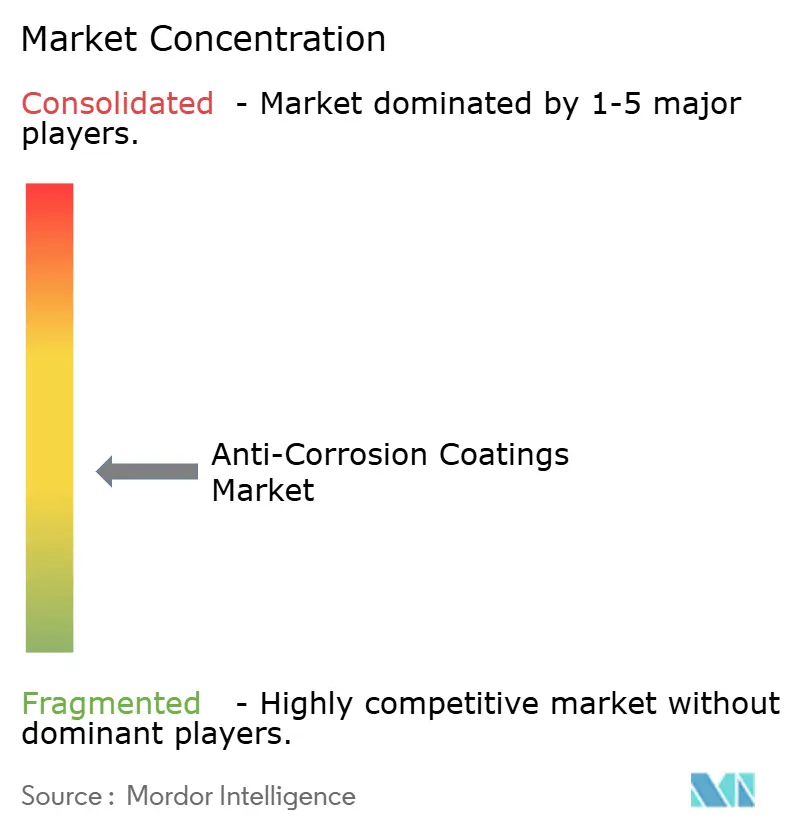
The Anti-Corrosion Coatings market is moderately fragmented. Regional challengers carve profitable corners with powder, UV-cured, and niche epoxy-novolac systems, offering fast turnaround and zero VOCs that bypass new air permits. Digital platforms are emerging as tie-breakers; Hempel’s Oceanics software schedules hull-cleaning windows based on real-world vessel data, embedding service revenue beyond the coating gallon. M&A remains a favored route, these transactions reveal a market where scale plus specialized chemistry is the winning formula, preserving moderate concentration while allowing agile entrants to flourish in high-growth pockets of the Anti-Corrosion Coatings market.
Anti-Corrosion Coatings Industry Leaders
-
Akzo Nobel N.V.
-
Hempel A/S
-
Jotun
-
PPG Industries, Inc.
-
The Sherwin-Williams Company
- *Disclaimer: Major Players sorted in no particular order
Anti-Corrosion Coatings Market Companies Covered in this Report
- Akzo Nobel N.V.
- Axalta Coating Systems, LLC
- BASF
- Beckers Group
- Berger Paints India
- Carboline
- Chugoku Marine Paints, Ltd.
- H.B. Fuller Company
- Hempel A/S
- Jotun
- Kansai Paint Co., Ltd.
- Nippon Paint Holdings Co., Ltd.
- PPG Industries, Inc.
- RPM International Inc.
- Sika AG
- Teknos Group
- The Sherwin-Williams Company
- Tikkurila
Market Opportunities and Future Outlook
A clearer opportunity is emerging for faster-to-apply, lower-emissions systems that reduce downtime for infrastructure owners and ship operators, while staying within tightening exposure limits. Shop-applied corrosion protection is an immediate focus for water-borne and rapid-cure technologies in structural steel and fabrication, supported by supplier launches such as PPG AQUACRON waterborne shop primers (March 2026), and by adjacent capacity build-outs in industrial coatings, including Sherwin-Williams completing a Bowling Green, Kentucky coil-coatings expansion in March 2026 that increased production capacity by 60% versus 2025 levels. In marine and offshore assets, demand is shifting toward coatings that demonstrate hull performance and longer service life to help operators manage maintenance cadence under IMO CII-driven dry-dock optimization, which has supported commercialization of differentiated topcoats and additive platforms, including graphene-enhanced protective coatings from AkzoNobel reaching commercial availability in May 2026.
Regional build-out in the Middle East and Asia also creates a path for suppliers that can pair coatings with application know-how and pipe-coating capability. East Pipes approved a USD 20.9 million investment (January 2026) to build a new external steel pipe coating line at its Dammam plant, aligning with corrosion-control needs in pipelines and industrial projects across Saudi Arabia and neighboring markets. On the input side, debottlenecking in specialty intermediates supports higher-performance formulations and localization: Evonik commissioned expanded specialty amine production in Nanjing (April 2026) to serve polyurethane and epoxy-based corrosion coatings demand, while Arkema announced a 20% expansion of Kynar PVDF capacity at Changshu, China (March 2026), reinforcing a materials pathway for harsh-environment protection where fluoropolymer performance is specified.
Recent Industry Developments in Anti-Corrosion Coatings Market
- June 2026: Jotun COSCO Marine Coatings signed a memorandum of cooperation with COSCO SHIPPING Bulk covering antifouling coating systems for 125 newbuilding bulk carriers. The agreement links coating supply to a defined newbuild pipeline, supporting standardized specifications across a large series of vessels and strengthening share capture in Asia shipbuilding.
- May 2026: AkzoNobel confirmed commercial availability of a graphene-enhanced Interzone 954 protective coating incorporating ecosparc additive, produced in Australia. The move from development to commercialization broadens the set of high-wear, high-corrosion service conditions where premium formulations can command higher pricing.
- March 2026: PPG introduced the PPG AQUACRON WSP waterborne shop primers series for structural steel with rapid-curing performance for shop-applied corrosion protection. The launch is designed to improve fabrication throughput and reduce VOCs, supporting steel processors and EPC supply chains as they transition away from solvent-borne primers.
Anti-Corrosion Coatings Market Report Scope and Research Methodology
Market Definition and Coverage
For this methodology, the anti-corrosion coatings market covers coating materials applied on metal assets to slow down corrosion driven by moisture, salt, chemicals, and oxidation. Market size is measured as revenue generated from the sale of these coating products.
Scope exclusions: It excludes non-coating corrosion protection methods (such as cathodic protection systems) and general decorative paints that are not sold or specified for corrosion control.
Segments Covered in This Report
- By Resin Type
- Epoxy
- Alkyds
- Polyester
- Polyurethane
- Vinyl Ester
- Other Resin Types
- By Technology
- Water-borne
- Solvent-borne
- Powder
- UV-cured
- By End-user Industry
- Oil and Gas
- Marine
- Power
- Infrastructure
- Industrial
- Aerospace and Defense
- Transportation
- Other End-user Industries
- By Geography
- Asia-Pacific
- China
- India
- Japan
- South Korea
- ASEAN Countries
- Rest of Asia-Pacific
- North America
- United States
- Canada
- Mexico
- Europe
- Germany
- United Kingdom
- France
- Spain
- Italy
- NORDIC Countries
- Rest of Europe
- South America
- Brazil
- Argentina
- Rest of South America
- Middle-East and Africa
- Saudi Arabia
- United Arab Emirates
- South Africa
- Nigeria
- Rest of Middle-East and Africa
- Asia-Pacific
Data Sources, Market Sizing, and Validation
Desk Research
Desk research was used to anchor market context and to set practical guardrails for demand by end use. Public references were reviewed, including US Geological Survey data for metals and industrial activity signals, International Energy Agency releases for upstream and power asset outlook, and World Steel Association updates for steel production trends that influence coated surface area.
To tighten assumptions, we also used sources such as UN Comtrade and customs dashboards to understand trade direction for resins and related chemicals. EPA and OSHA pages were reviewed for coatings and solvent-related rules that can shift technology mix. Annual reports, investor presentations, and press releases from coating suppliers and large asset owners were reviewed for capacity additions, pricing commentary, and end-market exposure. Paid subscription databases for company financials and shipment-level import and export checks were used selectively to validate a few company and trade data points. These sources are illustrative, and other public documents were also referenced to fill gaps and cross-check numbers.
Primary Interviews and Surveys
Primary work was done through structured interviews and short surveys with coating manufacturers, raw material participants, applicators, and asset owner procurement and maintenance teams across major regions. This helped test the assumptions from desk research in plain terms, including what is actually specified on site, what drives repaint cycles, and how pricing moves through contracts. When the model showed unusual swings, we re-contacted a limited set of respondents to check drivers and timing.
Distribution of primary research fieldwork respondents
| Company type | Respondent position | Region |
|---|---|---|
| Top tier: 30% | CXOs: 12% | APAC: 45% |
| Mid tier: 56% | Functional/Unit leaders: 35% | EMEA: 35% |
| Smaller Players: 14% | Managers: 53% | Americas: 20% |
Market-Sizing & Forecasting
Sizing starts with a top-down build where industrial output and installed asset signals are translated into a corrosion protection demand pool, then converted into coatings value using typical consumption and pricing patterns by end use. Totals are corroborated with selective bottom-up approximations, including sampled supplier revenue splits, channel checks from applicators, and a volume times average selling price sense-check for a few high-use categories.
Model inputs include upstream and midstream project activity, marine and ship repair cycles, infrastructure maintenance spending, and power generation asset additions, since each changes coated surface area and repaint frequency. Resin and solvent cost movements are also tracked, along with shifts between solvent-borne, water-borne, and powder systems, because mix and pricing translate into final revenue even when volumes stay stable. Where a bottom-up data point was missing for a country or end use, gaps were handled using proxy ratios from similar markets, then adjusted using interview feedback.
For forecasting, scenario analysis was applied around oil and gas capital spending, marine maintenance intensity, and large infrastructure programs. A multivariate regression was then used where history supported it, linking demand to industrial production and construction-related indicators. Price progression assumptions were aligned to how contracts are reset in the field, rather than applying a single flat inflation factor across all technologies.
Data Validation & Update Cycle
Validation is done through multiple checks so the final number is not driven by one dataset. Outputs are compared against independent signals, including coatings company commentary, trade flows for key inputs, and shifts in end-market activity, with outliers investigated before internal sign-off.
If a country or end use shows variance that cannot be explained by real demand drivers, assumptions are revisited and a limited set of experts is contacted again to confirm the correction. Reports are refreshed on an annual cycle, with interim adjustments when material events occur, such as large capacity changes, regulation shifts affecting solvent use, or sharp raw material price swings. Before delivery, a final review pass is completed so the client receives the latest updated view.
Mordor Intelligence's Anti Corrosion Coatings Market Estimate Compared With Other Published Estimates
Published market sizes for anti-corrosion coatings often do not match, because each publisher draws the line differently on which products and surfaces are counted, and they also use different base years and pricing assumptions. Differences can also come from how far the model goes in validating repaint cycles and end-use exposure, which can materially move the revenue total.
In practice, the biggest gap drivers are usually whether coatings on non-metal substrates are included, whether general protective paints are bundled with corrosion-grade systems, and whether the study reports manufacturer-level revenue or a broader installed-and-service value. Another common driver is how technology mix is treated, since water-borne conversion rates and zinc-rich specification rates can change average pricing, and a slower refresh cadence can leave older price levels in the base year.
Benchmark comparison
| Source | Market Size | Gaps in Research Methodology |
|---|---|---|
| Mordor Intelligence | USD 24.84 B (2025) | |
| Global Consultancy A | USD 36.72 B (2025) | A wider definition is applied by including anti-corrosion coatings used on concrete and adjacent protective paint volumes, which lifts the total beyond metal-focused corrosion control demand. |
| Industry Publisher B | USD 32.10 B (2024) | Reported value appears to bundle anti-corrosion paints and coatings in one pool and uses a different base year, which can embed older pricing and broader channel markups. |
The table shows that the spread is mainly explained by scope and value-chain choices, rather than a simple math difference. When only corrosion-grade coatings tied to metal asset protection are counted, and repaint and pricing assumptions are checked with applicators and asset owners, the 2025 total stays lower, a scope choice applied by Mordor Intelligence.
Key Questions Answered in the Report
How large will global demand for Anti-Corrosion Coatings be by 2031?
The Anti-Corrosion Coatings market is projected to reach USD 29.87 billion by 2031, reflecting a 3.12% CAGR from 2026 to 2031.
Which resin class dominates protective-coating applications?
Epoxy systems led the market with 38.98% share in 2025, driven by strong adhesion and chemical resistance on steel substrates.
Why are shipowners recoating hulls more frequently?
The International Maritime Organization’s Carbon Intensity Indicator grades penalize hull fouling, prompting operators to shorten dry-dock intervals and apply low-friction silicone or hydrogel coatings that cut fuel burn.
What region will add coatings demand fastest through 2031?
The Middle East & Africa segment is forecast to grow at 3.41% CAGR thanks to Saudi Aramco, ADNOC, and Gulf desalination investments.
How are regulations shaping technology choices?
Stricter VOC and isocyanate exposure limits are steering buyers toward water-borne, high-solids, and powder offerings that slash emissions without sacrificing corrosion protection.