
Italy Operations Service Consulting Market Size and Share
Market Overview
| Study Period | 2020 - 2031 |
|---|---|
| Forecast Data Period | 2026 - 2031 |
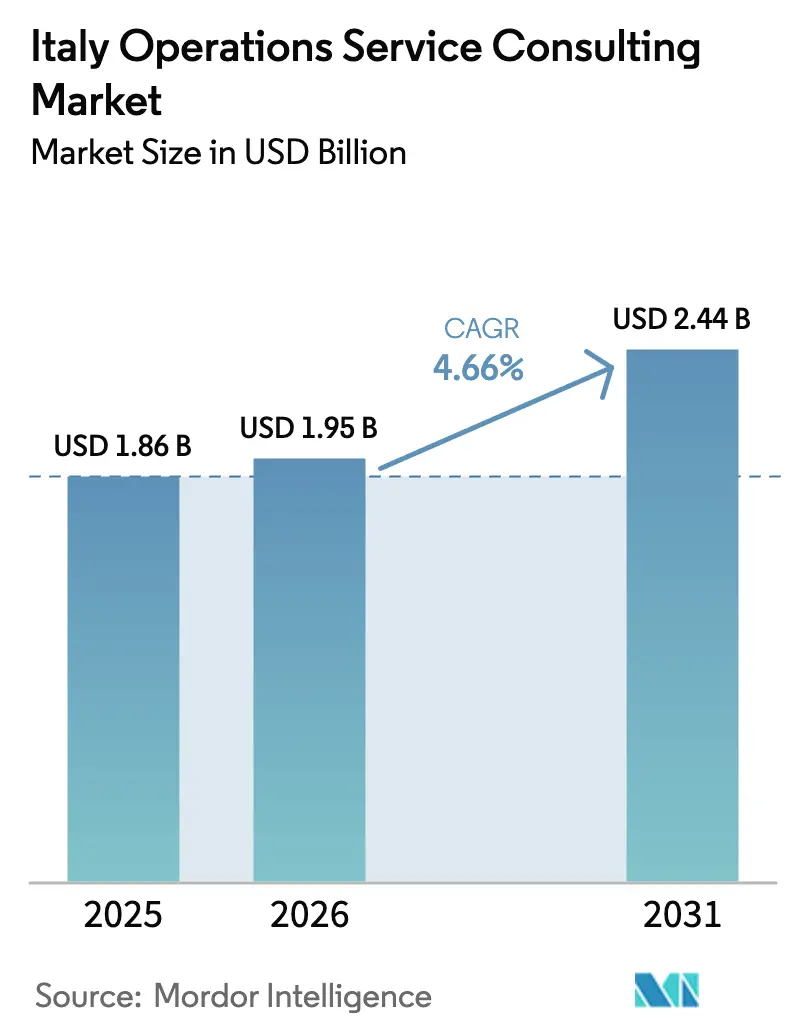
| Base Year Market Size (2025) | USD 1.86 Billion |
| Market Size (2026) | USD 1.95 Billion |
| Market Size (2031) | USD 2.44 Billion |
| Growth Rate (2026 - 2031) | 4.66 % |
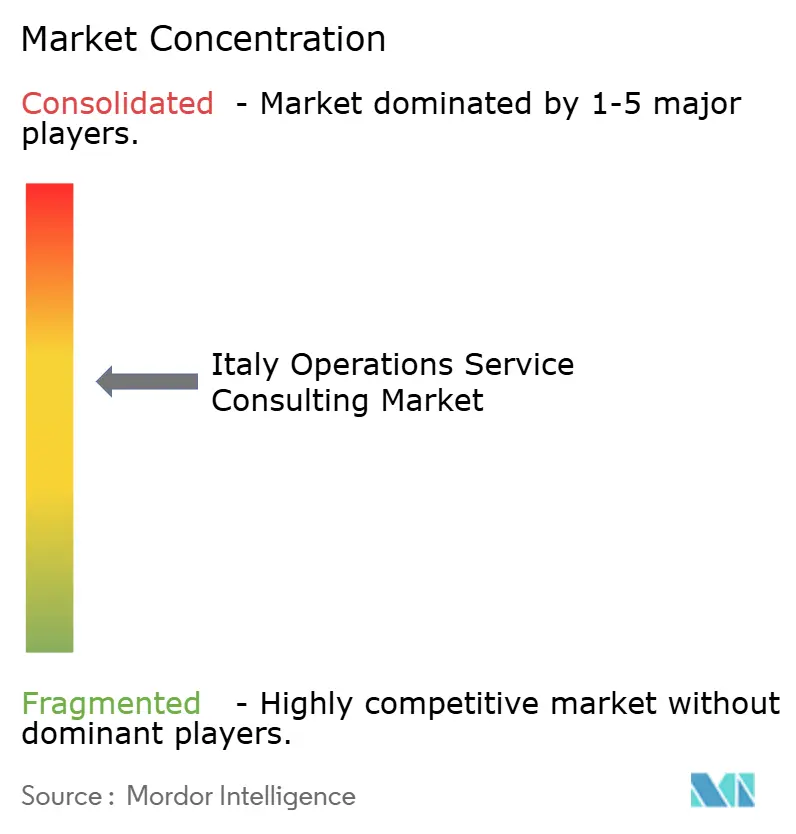
| Market Concentration | Medium |
Major Players
*Disclaimer: Major Players sorted in no particular order Image © Mordor Intelligence. Reuse requires attribution under CC BY 4.0. |
|
Italy Operations Service Consulting Market Analysis by Mordor Intelligence
Italy operations service consulting market size in 2026 is estimated at USD 1.95 billion, growing from 2025 value of USD 1.86 billion with 2031 projections showing USD 2.44 billion, growing at 4.66% CAGR over 2026-2031. This steady expansion rests on three intertwined forces: the EUR 191.5 billion National Recovery and Resilience Plan (PNRR), client urgency to offset global supply-chain turbulence, and the country’s long-running effort to narrow the North-South productivity gap. Government incentives accelerate cloud migration, Industry 4.0 modernization, and ESG reporting, while persistent labor shortages intensify demand for external expertise. Northern industrial districts underpin high-value engagements, yet Southern regions now command disproportionate growth thanks to cohesion funds and targeted PNRR allocations.[1]Ministry of Economy and Finance, “Documento di Finanza Pubblica 2025,” dt.mef.gov.it Competitive pressure pushes consultancies toward hybrid delivery models that combine on-site relationship building with remote analytics, keeping fees controllable for both large enterprises and a growing SME client base. At the same time, AI-enabled productivity tools and sector-specific accelerators allow providers to handle more complex mandates without proportionally scaling headcount.
Key Report Takeaways
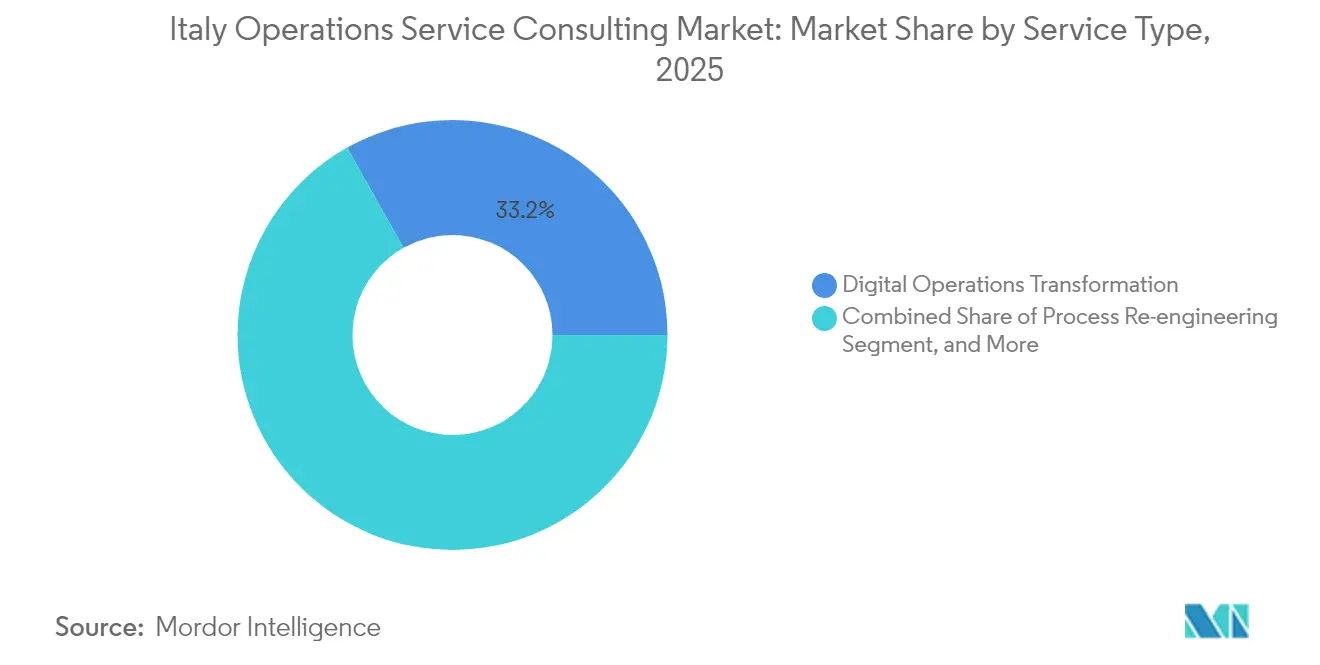
- By service type, Digital Operations Transformation led with 33.15% of Italy operations service consulting market share in 2025, and Supply Chain Optimisation is projected to expand at a 6.05% CAGR through 2031.
- By end-user industry, Manufacturing accounted for a 28.55% share of the Italy operations service consulting market size in 2025, whereas Healthcare and Life Sciences are advancing at a 6.52% CAGR through 2031.
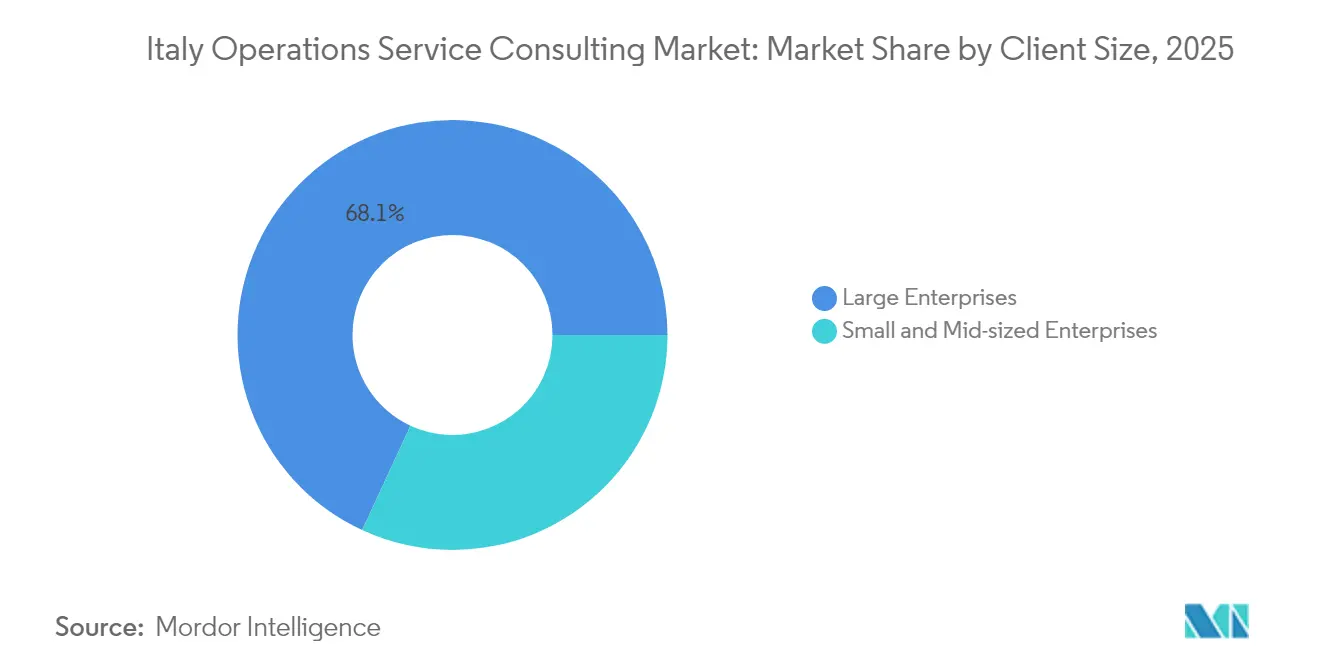
- By client size, Large Enterprises held 68.10% of the Italian operations service consulting market share in 2025, but SMEs are growing at a 5.18% CAGR to 2031.
- By consulting approach, Hybrid delivery captured 51.80% of the Italy operations service consulting market size in 2025, while pure-play digital consulting is demonstrating a 5.64% CAGR.
- By region, Northern Italy led with 55.10% revenue share of the Italy operations service consulting market in 2025; Southern Italy and the Islands display the highest regional CAGR at 5.38% to 2031.
Note: Market size and forecast figures in this report are generated using Mordor Intelligence’s proprietary estimation framework, updated with the latest available data and insights as of 2026.
Italy Operations Service Consulting Market Trends and Insights
Drivers Impact Analysis*
| Driver | (~) % Impact on CAGR Forecast | Geographic Relevance | Impact Timeline |
|---|---|---|---|
| Growing investment in emerging technologies | +1.2% | National, with concentration in Northern Italy industrial districts | Medium term (2-4 years) |
| Increasing adoption of advanced data analytics and BI | +0.9% | National, with early adoption in financial services and manufacturing | Short term (≤ 2 years) |
| Digital transformation mandates from Italian governmental incentives | +1.5% | National, with enhanced focus on Southern Italy and Islands | Short term (≤ 2 years) |
| Rising pressure on cost optimisation amid talent shortages | +0.8% | National, with acute impact in Northern Italy | Medium term (2-4 years) |
| Surge in reshoring of manufacturing back to Italy | +0.7% | Northern and Central Italy manufacturing corridors | Long term (≥ 4 years) |
| Expansion of ESG-linked performance contracts | +0.6% | National, with regulatory compliance focus | Medium term (2-4 years) |
| Source: Mordor Intelligence | |||


Digital Transformation Mandates from Government Incentives
Mission 1 of the PNRR dedicates EUR 40.29 billion (USD 45.6 billion) to digitalization, innovation, and competitiveness. The accompanying Piano Triennale ICT 2024-2026 obliges every public administration to adopt cloud services. These programs spill over into private-sector supply chains, prompting enterprises to re-engineer processes, modernize legacy systems, and align with Transizione 4.0 and 5.0 tax incentives. Consultants capable of navigating overlapping schemes, securing fiscal benefits, and orchestrating technology change command premium fees and long-run multiyear contracts.
Growing Investment in Emerging Technologies
Italian companies funneled EUR 7.1 billion (USD 8.0 billion) into new technology in 2024, with AI and automation rising fastest.[2]Intesa Sanpaolo, “2022-2025 Business Plan,” group.intesasanpaolo.com Agentic platforms reduce repetitive tasks and free scarce talent for higher-value roles, yet AI skill shortages widen. Consultants close the gap by integrating AI modules, IoT sensors, and blockchain pilots across manufacturing sites. Demand also rises for strategic governance frameworks that mitigate algorithmic risks and ensure GDPR-compliant data flows.
Increasing Adoption of Advanced Data Analytics and BI
End-to-end analytics projects accelerate among discrete manufacturers deploying predictive maintenance. The banking sector amplifies uptake: Intesa Sanpaolo earmarked EUR 4.8 billion (USD 5.4 billion) for IT upgrades, much of it aimed at enterprise data layers and customer analytics. Hospitals rolling out Fascicolo Sanitario Elettronico 2.0 seek consulting on interoperability standards and privacy safeguards. Cross-industry, the biggest obstacles remain fragmented data architectures and a shortage of governance specialists, conditions that sustain a robust pipeline of analytics engagements.
Surge in Reshoring of Manufacturing
Disrupted global logistics and elevated geopolitical risk continue to motivate Italian manufacturers to repatriate production. Reshoring amplifies demand for supply-chain mapping, facility digitization, and process optimization. Consultants design optimal plant layouts, implement MES solutions, and advise on labor automation to offset domestic cost structures. A long-term uptick in factory retooling supports durable growth in specialized operations consulting revenues.
Restraints Impact Analysis*
| Restraint | (~) % Impact on CAGR Forecast | Geographic Relevance | Impact Timeline |
|---|---|---|---|
| Shift toward in-house capability building | -0.8% | National, with stronger impact in large enterprises | Medium term (2-4 years) |
| Compliance complexities from evolving EU regulations | -0.6% | National, with regulatory concentration in financial services | Short term (≤ 2 years) |
| Fragmentation of Italy's SME landscape | -0.4% | National, with acute impact in Central and Southern regions | Long term (≥ 4 years) |
| Brain drain of experienced consultants abroad | -0.5% | National, with severe impact in Northern Italy | Medium term (2-4 years) |
| Source: Mordor Intelligence | |||
Shift Toward In-House Capability Building
Large Italian corporates expand internal digital teams and centers of excellence to lower recurring consulting spend. Intesa Sanpaolo plans to recruit or reskill 4,600 technology staff and redeploy 8,000 employees into tech-heavy roles. While this move reduces external reliance for routine improvements, it pushes consultants up the value chain toward strategic advisory, advanced system integration, and change leadership assignments that internal units cannot deliver at scale.
Compliance Complexities from Evolving EU Regulations
Italy transposed the Corporate Sustainability Reporting Directive through Decree 125/2024, exposing firms to fines up to EUR 10 million or 5% of turnover for non-compliance.[3]ICLG, “Environmental, Social and Governance Law Italy 2025,” iclg.com Parallel supply-chain due diligence rules strain budgets and divert funds from discretionary operations projects. SMEs, already capital-constrained, face the stark choice between regulatory advice and transformational consulting. Providers must therefore blend compliance and performance offerings to retain wallet share.
*Our forecasts treat driver/restraint impacts as directional, not additive. The impact forecasts reflect baseline growth, mix effects, and variable interactions.
Segment Analysis
By Service Type: Technology-Enabled Transformation Takes Center Stage
Digital Operations Transformation generated USD 616.6 million and 33.15% of the Italy operations service consulting market size in 2025, mirroring nationwide cloud and ERP migrations. Supply Chain Optimisation will climb at a 6.05% CAGR to 2031 as reshoring intensifies. Process re-engineering holds steady within legacy SME bases, while Lean Six Sigma retains relevance for quality-driven exporters. Consultants increasingly bundle ESG advisory into operational mandates, a response to CSRD pressure on Italian multinationals.
Hybrid methodologies integrate design-thinking workshops, data-backed diagnostics, and rapid-prototype sprints. Providers differentiate by embedding analytics accelerators and sector-specific AI libraries. Service lines now intertwine: process re-engineering feeds data pipelines, which power real-time control towers used in supply-chain programs. Firms that orchestrate these linkages defend premium pricing and outperform pure-play specialists.


By End-User Industry: Manufacturing Commands Value, Healthcare Accelerates
Manufacturing accounted for a 28.55% share of the Italy operations service consulting market share in 2025, backed by governmental Transizione 4.0 tax credits. Robotics retrofits, digital twins, and predictive maintenance dominate current scopes. Healthcare and Life Sciences is projected to post a 6.52% CAGR, driven by EUR 15.63 billion (USD 17.7 billion) under PNRR Mission 6 for hospital modernization.
Banks and insurers sustain a sizable pipeline around Basel III end-game rules, cloud core-banking conversions, and open-banking API architectures. Energy utilities, energized by the green-transition mandate, seek advice on grid digitization and renewable integration, leveraging Terna’s EUR 21 billion (USD 23.8 billion) investment plan. Retailers and logistics operators pursue omnichannel fulfillment, last-mile visibility, and cost-to-serve analytics to protect margins amid inflation.
By Client Size: Large Enterprises Dominate, SMEs Gain Momentum
Large Enterprises represented 68.10% of fees in 2025, underpinned by multi-year, multi-tower transformation programs. SMEs nevertheless log a 5.18% CAGR, reflecting democratized cloud solutions and simplified consulting packages. Providers now publish menu-based offerings—fixed-price diagnostics, remote coaching, shared-services support that fit SME budgets while yielding acceptable margins.
The SME segment is strategically consequential: businesses with <250 staff represent nearly 100% of Italian firms and roughly two-thirds of national employment. Consultancies cultivate regional delivery hubs, graduate-talent academies, and partner ecosystems to penetrate this fragmented market. EY’s Puglia expansion to 700 professionals exemplifies capacity building geared to high-growth but lower-ticket clients.
By Consulting Approach: Hybrid Delivery as the New Norm
Hybrid engagements captured 51.80% of the Italy operations service consulting market size in 2025, marrying Italian relationship culture with cost-efficient remote analysis. Pure-digital projects grow fastest at 5.64% CAGR, especially among tech-savvy SMEs that prize speed over traditional workshops. Face-to-face remains indispensable for cultural change, union negotiations, and complex business-model rewiring.
Providers invest in virtual collaboration suites, digital twins, and AI-enabled code generators to shorten cycle times. Simultaneously, client-onboarding rituals, executive steering committees, and plant-floor walk-throughs preserve the trust central to Italian commerce. Firms that flex seamlessly between modes enjoy shorter sales cycles and higher net-promoter scores.
Geography Analysis
Northern Italy delivered 55.10% of 2025 billings, anchored by Lombardy, Veneto, and Emilia-Romagna industrial clusters rich in advanced automation. Northern Italy’s consulting hub is powered by Milan’s finance cluster and dense manufacturing supply chains around Brescia and Bologna. Engagements frequently involve AI-driven quality assurance, supply-chain risk mapping, and ERP-to-cloud migrations. High client sophistication supports premium billing rates, yet fierce competition for scarce data engineers inflates salary costs and squeezes margins.
Central Italy leverages Rome-based ministerial digital programs and a diversified economy that spans tourism and aerospace. PNRR-funded e-procurement and e-health projects sustain a robust pipeline. Consultants in the region increasingly bundle project-management services with compliance tracking to meet strict milestone-based disbursement rules tied to EU funding.
Southern Italy and Islands claim the highest CAGR at 5.38% out to 2031. Southern Italy and Islands capitalize on sizable grants targeting broadband rollout, renewable parks, and port upgrades. Market entry is relationship-intensive; local government bodies and SMEs often require extensive capability-building before transformation benefits materialize. Consultancies adopt community-based hiring, localized training curricula, and outcome-based pricing to align incentives and mitigate affordability concerns.
Regulatory Landscape
Italy operations service consulting engagements are shaped by overlapping EU and national rules on digital operations, cybersecurity, data, and sustainability reporting. On sustainability compliance, Italy transposed the Corporate Sustainability Reporting Directive through Decree 125/2024, introducing penalties up to EUR 10 million or 5% of turnover for non-compliance, which is raising demand for operating-model redesign, data governance, and controls development alongside reporting readiness.
On digital and cyber, the National Cybersecurity Agency (ACN) is a central authority for NIS2 implementation via Legislative Decree No. 138/2024 and ACN Determinations 127434/2026 and 127437/2026. These cover entity and service categorization and recurring update obligations, including the May 1 to June 30 annual window through ACN platforms. AGCom regulates electronic communications and digital platforms and acts as Italy’s Digital Services Coordinator for Digital Services Act enforcement, while the 2026 Budget Law added new contribution obligations for digital, media, and platform activities. Taken together, these mandates lift demand for compliance-led operational consulting, including security-by-design, risk and control frameworks, and vendor governance, and they also shape delivery requirements for public and regulated clients.
Value Chain Analysis
Demand is driven by large enterprises and SMEs pursuing operational efficiency, supply-chain resilience, and technology-enabled process modernization, alongside a sizable public-sector pipeline linked to PNRR programs and the Piano Triennale per l’Informatica nella Pubblica Amministrazione 2024-2026. Buying centers commonly draw in COO or operations, CIO or CTO, procurement, and risk or compliance functions. Scope definition typically blends diagnostic assessment, target operating model design, and implementation roadmaps with measurable KPIs such as cost-to-serve, lead-time, service levels, and auditability.
Service delivery is carried out by global consultancies and system integrators, including Deloitte, Accenture, PwC, EY, and KPMG, with support from technology vendors across cloud, ERP or MES, analytics, and cybersecurity, plus local niche specialists. In the public sector, procurement is often mediated through Consip S.p.A. framework agreements, which public bodies use to source PMO and specialist digital-transformation support. AgID also sets standards and guidance for public administration digitalization, including cloud strategy and interoperability. Downstream, implementation partners and client internal teams operationalize changes through process redesign, data and platform integration, training, and managed services, while compliance checkpoints are shaped by ACN cybersecurity obligations and CSRD-aligned reporting controls.
Competitive Landscape
The market is moderately concentrated. The Big Four and strategy trios command long-standing relationships with blue-chip corporates, yet local champions such as Prometeia and Reply win share through domain depth in risk analytics and IoT solutions, respectively. Accenture’s net-zero and 5G acquisitions illustrate a shift toward capability bolt-ons that address Italy-specific infrastructure gaps. Technology vendors and consulting firms collaborate via joint centers of excellence, accelerating time-to-value for cloud migrations and ESG reporting.
Boutique firms thrive in niches: ESG-linked performance contracts, PNRR grant navigation, and lean plant assessments for mid-caps. Talent scarcity propels hiring from universities and cross-border rotations, while AI accelerators allow leading consultancies to deliver more output per consultant. Fee models drift toward value-based and gain-share structures, especially in manufacturing efficiency and energy-savings engagements.
Competitive intensity is expected to rise as global players redeploy capacity from slower economies into Italy’s resilient consulting demand. Meanwhile, internal capability building at large clients keeps pressure on providers to move up the value chain and demonstrate measurable outcomes within shorter timeframes.
Italy Operations Service Consulting Industry Leaders
-
Deloitte Touche Tohmatsu Limited
-
Accenture Public Limited Company
-
PricewaterhouseCoopers International Limited
-
Ernst and Young Global Limited
-
KPMG International Limited
- *Disclaimer: Major Players sorted in no particular order

Market Opportunities and Future Outlook
A major whitespace is emerging where compliance mandates meet productivity programs, with organizations seeking integrated delivery that combines operating-model redesign with data governance, cybersecurity controls, and reporting readiness. In Italy, CSRD implementation via Decree 125/2024 and NIS2 execution led by ACN through Legislative Decree No. 138/2024 plus ACN Determinations 127434/2026 and 127437/2026 are generating recurring demand around controls design, supplier and third-party risk management, and audit-ready process documentation. This is particularly relevant for manufacturers and critical-service operators with complex supply chains.
Public administration transformation remains a visible demand pool with practical procurement routes that support opportunities for consultancies able to package delivery into repeatable, framework-compliant modules. The Piano Triennale ICT 2024-2026 requires public administrations to adopt cloud services, and PNRR-linked initiatives, including the Single Digital Gateway and skills-building programs for digital transition and AI, are being sourced through mechanisms such as Consip frameworks and AgID-led standards and transparency processes. This structure favors providers that can pair PMO rigor with cloud migration execution, interoperability and open-source capabilities aligned with platforms such as Developers Italia, and change management aimed at improving adoption across public-sector staff and SME supply chains connected to public tenders.
Recent Industry Developments
- July 2026: Accenture secures a 7-year, 200 million euro NATO contract to develop the Protected Business Network with Leonardo. The engagement strengthens Italy's defense and OT cybersecurity posture through an integrated network of capabilities. It expands accretive government-facing and public-sector cyber modernization capacity in the country under a major multi-year program.
- July 2026: EY Italy appoints 46 new partners, with Donato Ferri as Consulting Leader of EY Italy. The leadership expansion underscores a broadened capability footprint and recruiting of senior talent in the Italian consulting market. It signals strong growth and international senior-talent mobilization in Italy’s operations service market.
- June 2026: Accenture completes two acquisitions in Italy to strengthen healthcare and manufacturing capabilities, including the Industries eXcellence Group (IndX). The acquisitions expand high-value sector expertise and bolster delivery capabilities in Italy’s key industries. The move broadens service delivery capacity and accelerates value realization for Italian clients in core sectors.


Research Methodology Framework and Report Scope
Market Definition and Coverage
For this methodology, the Italy operations service consulting market covers paid advisory and implementation support that helps organizations improve day to day operations. This includes process redesign, performance improvement, and operating model execution, where the service is delivered by external consulting teams based in Italy.
Scope exclusions: In this estimate, pure IT outsourcing, staff augmentation sold as temporary labor, and standalone software license revenues are excluded unless they are bundled inside an operations consulting engagement.
Segmentation Overview
-
By Service Type
- Process Re-engineering
- Digital Operations Transformation
- Supply Chain Optimisation
- Lean Six Sigma Implementation
- Change Management and Training
- Other Service Types
-
By End-user Industry
- Financial Services
- Manufacturing
- Energy and Utilities
- Public Sector
- Retail and E-commerce
- Healthcare and Life Sciences
- Transportation and Logistics
- Other End-user Industries
-
By Client Size
- Large Enterprises
- Small and Mid-sized Enterprises
-
By Consulting Approach
- Traditional On-site Consulting
- Hybrid (On-site + Remote)
- Pure-play Digital / Virtual Consulting
-
By Region
- Northern Italy
- Central Italy
- Southern Italy and Islands
Data Sources, Market Sizing, and Validation
Desk Research
Desk work starts by mapping what drives operations consulting demand in Italy, then collecting consistent public signals that can be checked year over year. We used sources such as ISTAT for macro and business activity indicators, Banca d'Italia for credit and investment signals, Eurostat for harmonized services and enterprise data, and OECD datasets for productivity and structural indicators. Public procurement portals and EU Recovery and Resilience Facility disclosures were reviewed to understand consulting-linked program activity and timing.
To keep the model grounded in what gets billed, we also reviewed company filings, investor presentations, reputable business press, and association publications that discuss consulting demand and pricing behavior. Where available, paid subscription data for company financials and intelligence was used to normalize reported Italy revenues and service mix. A patent database was used only as a directional check on industrial change activity, not as a revenue proxy. The desk sources mentioned above are illustrative and not exhaustive, since many other public documents and datasets were used for cross-checks and clarification.
Primary Interviews and Surveys
Primary work is used to pressure test the desk assumptions that usually move the totals, especially billable day rates, utilization, project duration, and how much work is delivered as implementation versus advice. We spoke with a mix of consulting delivery leaders, practice heads, and buying side stakeholders across manufacturing, banking, retail, logistics, and public sector programs, so that Italy specific contracting patterns and budgeting cycles were reflected. We also ran channel style checks across different firm sizes to avoid over-weighting a single delivery model.
Distribution of primary research fieldwork respondents
| Company type | Respondent position |
|---|---|
| Top tier: 32% | CXOs: 15% |
| Mid tier: 49% | Functional/Unit leaders: 28% |
| Smaller Players: 19% | Managers: 57% |
Market-Sizing & Forecasting
Sizing starts with a top-down build that reconstructs the Italy consulting revenue pool from services activity and spending capacity signals. It then narrows to operations-focused work using observed service mix splits from public disclosures and interview feedback. Once that envelope is set, we corroborate it with selective bottom-up approximations, such as sampled fee rate ranges multiplied by plausible billable capacity, plus cross-checks using supplier roll ups for a limited set of visible players.
A few market fingerprints were kept in view during modeling, since they explain most year to year movement. These include consulting billing rate progression in Italy, average utilization and bench levels by firm type, the share of transformation work tied to cost takeout versus growth programs, the portion of projects that convert into multi-quarter implementation, and the timing of public and EU funded programs that can pull demand forward. Where bottom-up visibility is thin, for example smaller boutiques with limited disclosure, we used conservative capacity assumptions that are later adjusted during validation.
Forecasts were produced using scenario analysis, because growth depends on a small set of variables that can shift with policy timing and corporate confidence. The scenarios are anchored on expected investment cycles, hiring capacity, and pricing momentum, and then aligned to what primary respondents described as realistic delivery constraints and pipeline conversion behavior in Italy.
Data Validation & Update Cycle
Model outputs are checked against independent signals, including macro services trends, consulting hiring and capacity signals, and large program announcements. Where variances fall outside the expected band, the drivers are re-opened, assumptions are re-tested, and targeted re-contacts are triggered to confirm whether the change is real or caused by timing, currency, or mix effects.
Reports are refreshed annually, with interim updates made when material events occur that can shift demand, pricing, or delivery capacity. Before delivery, a final analyst pass is completed so clients receive the most up to date view available at the time of release.
Mordor Intelligence's Italy Operations Service Consulting Market Size Measured Against Other Published Estimates
Published market values for Italy operations service consulting can look far apart, even when they appear to discuss similar services, because the moving parts are defined and refreshed differently. Differences usually come from what is counted as operations work, how fee rates are translated into revenue, and whether the timing of updates captures recent pricing and utilization changes.
The biggest gap drivers in this market tend to be scope boundaries and refresh timing. Some estimates blend wider management consulting services into the total, or they count IT outsourcing style delivery as consulting revenue, which inflates the number. Currency conversion timing and how fast average billing rates are stepped up also affect the output. By rechecking utilization and rate assumptions close to publication and locking USD conversion to the same reference period, Mordor Intelligence reduces drift that can build up in older models.
Benchmark comparison
| Source | Market Size | Gaps in Research Methodology |
|---|---|---|
| Mordor Intelligence | USD 1.86 B (2025) | |
| Regional Consultancy A | USD 4.80 B (2026) | Uses a broader definition that can roll in wider management consulting and adjacent delivery, and the figure is reported for a different year, which can amplify the total when rate growth is applied quickly. |
| Industry Reseller B | USD 1.83 B (2025) | Close to the same level, but it typically relies on lighter validation of Italy billing rates and utilization, and it can apply a simpler fee rate progression that smooths out short-term pricing changes. |
Taken together, the spread is mainly explained by boundary choices and how fast pricing and capacity assumptions are refreshed. Our approach keeps the total traceable to clear demand and delivery variables, so the market value can be repeated and explained without relying on opaque roll ups.


Key Questions Answered in the Report
What is the 2026 value of the Italy operations service consulting market?
The market is valued at USD 1.95 billion in 2026.
How fast is the Italy operations service consulting market expected to grow?
It is projected to post a 4.66% CAGR between 2026 and 2031.
Which service type holds the largest share in Italy?
Digital Operations Transformation commands 33.15% of 2025 revenue.
Which Italian region shows the quickest growth in consulting demand?
Southern Italy and Islands lead with a 5.38% CAGR forecast through 2031.
Why are SMEs important for consultants operating in Italy?
SMEs represent nearly all Italian firms and are adopting digital tools rapidly, driving a 5.18% CAGR in consulting spend.
How does EU sustainability regulation influence consulting demand?
The CSRD and related directives force firms to seek advisory help for compliance, boosting specialized ESG consulting engagements.
Page last updated on:


 Your data is secure and never sold or shared.


