
South America Lime Market Analysis by Mordor Intelligence
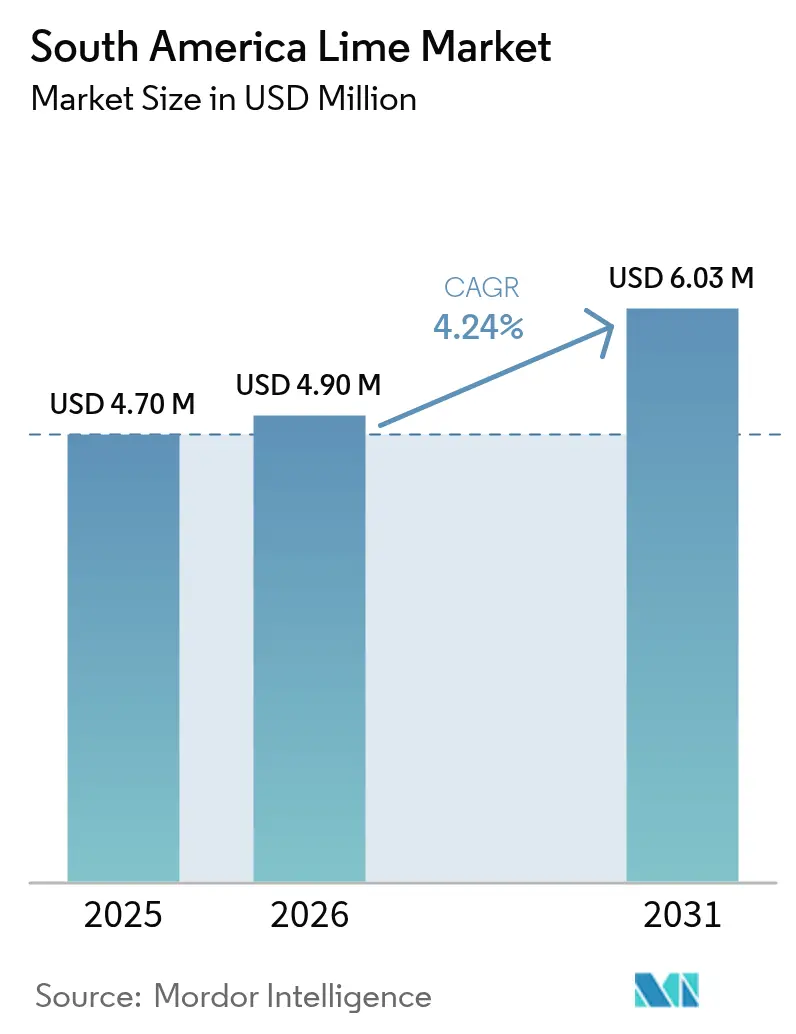
The South America lime market size was valued at USD 4.7 billion in 2025 and estimated to grow from USD 4.9 billion in 2026 to reach USD 6.03 billion by 2031, at a CAGR of 4.24% during the forecast period (2026-2031). The market expansion stems from improved export logistics, enhanced irrigation infrastructure, and increased applications across food, beverages, and nutraceuticals. Brazil dominates the market, accounting for a significant share through its Tahiti lime orchards, modern packing facilities, and established maritime infrastructure. Peru demonstrates the highest growth rate, expanding production through extensive irrigation projects. Colombia, Argentina, and Chile contribute to market supply through production capacity, seasonal advantages, and product variants. Market volumes continue to increase due to demand from functional beverage manufacturers, natural flavor producers, and freeze-dry processors, while the adoption of precision farming improves operational efficiency. The market faces challenges, including residue regulation compliance, container availability constraints, and fluctuating farm-gate prices, which impact profitability.
Key Report Takeaways
- By geography, Brazil held 47.60% of the South America lime market share in 2025, and Peru is on a 4.42% CAGR track through 2031 in the South America lime market.
Note: Market size and forecast figures in this report are generated using Mordor Intelligence’s proprietary estimation framework, updated with the latest available data and insights as of 2026.
Market Trends and Insights
Drivers Impact Analysis of South America Lime Market*
| Driver | (~) % Impact on CAGR Forecast | Geographic Relevance | Impact Timeline |
|---|---|---|---|
| Expanding Lime-growing Acreage | +0.8% | Peru, Brazil, and Colombia | Medium term (2-4 years) |
| Surge in Food and Beverage Processing Demand | +1.2% | Global, with concentration in Brazil and Argentina | Short term (≤ 2 years) |
| Booming Nutraceutical and Functional Food Adoption | +0.9% | Global, early adoption in urban centers | Medium term (2-4 years) |
| Government Subsidies for Export Logistics | +0.6% | Peru, Argentina, and Chile | Long term (≥ 4 years) |
| Rising Precision-Agriculture Investments | +0.4% | Brazil, Argentina, and advanced farms in Peru | Long term (≥ 4 years) |
| Climate-Smart Lime Cultivation Programs | +0.5% | Regional, with focus on drought-prone areas | Long term (≥ 4 years) |
| Source: Mordor Intelligence | |||
Expanding Lime-growing Acreage
South America is experiencing significant growth in lime cultivation through large-scale irrigation projects that convert unused land into productive orchards. Peru's new water infrastructure is increasing planted area and providing stable water access. Chile's growers are transitioning from water-intensive avocados to more profitable lemon and lime orchards, optimizing land use and export timing. Brazil demonstrates successful scaling of production through organic lime systems with high yields. Colombia is reducing climate risks by diversifying lime plantations across coastal and inland areas. Argentina is accessing premium markets through internationally certified orchards. These expansions are strengthening the region's raw fruit supply and processing capabilities.
Surge in Food and Beverage Processing Demand
The lime market is experiencing growth driven by rising demand from food and beverage processors seeking a consistent supply of juice and peel. Manufacturers are focusing on meeting consumer preferences for natural flavors, health-focused beverages, and clean-label products. To enhance efficiency and reduce waste, some processors are now utilizing lime peel and seed by-products alongside juice extraction, creating value-added ingredients or co-products that indirectly support sustainable food and beverage operations. Seasonal promotions, merchandising initiatives, and favorable trade conditions are further boosting sales, while expanding distribution networks help stabilize supply chain demand.
Booming Nutraceutical and Functional Food Adoption
Limes are emerging in the nutraceutical market due to their limonene, flavonoids, and sensory characteristics. These components are used in gummies, drink sachets, and fortified teas. Organic limes receive premium prices in global markets, benefiting growers who meet quality and sustainability requirements. Research confirming lime's digestive and neuroprotective properties supports regulatory approvals and premium pricing. The fruit is utilized in hydration products for its electrolyte content and flavor, while peel extracts enhance antioxidant tea blends. Breeding programs focusing on nutraceutical-rich varieties are increasing South American limes' market value.
Government Subsidies for Export Logistics
Government investment in transportation and cold-chain infrastructure is resolving citrus trade constraints. Large-scale corridors and cold-chain incentives reduce the historical inland-to-port bottlenecks that once curtailed fresh citrus trade.[1] ICWA, “The Bioceanic Corridor – The Road to Development in South America,” icwa.in New transportation routes between farms and ports reduce delivery times and improve export competitiveness. Cold-storage facilities are expanding capacity and implementing monitoring systems to maintain product quality during transport. Simplified regulations and adjusted tariffs are facilitating market access, while trade agreements create mutual opportunities. These policies strengthen South America's lime export infrastructure.
Restraints Impact Analysis of South America Lime Market*
| Restraint | (~) % Impact on CAGR Forecast | Geographic Relevance | Impact Timeline |
|---|---|---|---|
| Volatile Farm-gate Prices | -0.7% | Regional, with highest impact in Peru and Colombia | Short term (≤ 2 years) |
| Shortage of Refrigerated Containers | -0.5% | Export-dependent regions, particularly Peru and Chile | Medium term (2-4 years) |
| High Compliance Costs for EU MRL Standards | -0.6% | Argentina, Brazil, and Colombia | Medium term (2-4 years) |
| Labor Scarcity during Peak Harvest | -0.4% | Rural production areas across all countries | Short term (≤ 2 years) |
| Source: Mordor Intelligence | |||
Volatile Farm-gate Prices
Lime producers face challenges from unstable farm-gate prices. Weather changes, currency fluctuations, and variable processor demand create price instability that affects investment in cultivation and technology. Market prices can decrease during harvest peaks due to increased global supply. Small-scale growers without financial reserves or stable contracts may reduce agricultural inputs, affecting crop quality. Currency uncertainty and limited insurance options complicate financial management. These factors create market risk and reduce capital investment for expansion.
Shortage of Refrigerated Containers
Limited cold-chain capacity creates export challenges. Port congestion and container distribution issues increase shipping costs and cause delays, affecting product quality. Insufficient refrigerated containers force exporters to accept suboptimal schedules or alternative routes. Temperature control issues during transport can damage market reputation and result in import rejections. Small exporters without long-term container agreements often rely on domestic markets. This infrastructure limitation continues to restrict growth in the South America lime market.
*Our forecasts treat driver/restraint impacts as directional, not additive. The impact forecasts reflect baseline growth, mix effects, and variable interactions.
Geography Analysis
Brazil Lime Market
Brazil holds a significant share of the South America lime market size, supported by extensive Tahiti lime plantations and continuous harvest cycles. The country's integrated supply chains, large-scale juicing facilities, and advanced fertigation systems deliver consistent quality and volume. Organic certification enables access to premium European and North American markets, while efficient logistics to ports reduce product loss. Brazilian processors generate additional revenue by converting lime peel waste into pectin. The country's lime industry maintains its market leadership through established research institutions and stable domestic beverage demand.
Peru Lime Market
Peru's lime industry is expanding with a 4.42% CAGR. New irrigation projects enable cultivation expansion while improving disease resistance and geographic diversification. Small-scale farmers operate in organized groups that ensure traceability and compliance with international residue requirements. The country's exporters benefit from counter-seasonal production timing and shared transportation networks. Port-adjacent cold storage facilities maintain product quality for international distribution. Peru's combination of expanding production, sustainability practices, and technology adoption, including IoT moisture monitoring and drone surveillance, attracts investment and strengthens its market position.
South America Lime Market
Argentina and Chile utilize established export networks and improved Asian market access through the Bioceanic Corridor. Argentina maintains market confidence through transparent compliance systems, while Chilean producers increase citrus production in response to market conditions. Colombia provides production stability through geographically diverse growing regions that enable harvest scheduling and minimize weather-related risks. These countries enhance the South America lime market through specialized varieties, efficient distribution systems, and adaptable cultivation methods, complementing the large-scale operations of Brazil and Peru.
Regulatory Landscape
Regulation in the South America lime market is shaped by phytosanitary and residue-compliance rules that govern both intra-regional movement and access to export destinations. Within MERCOSUR, GMC Resolution No. 67/06 provides a harmonized baseline for phytosanitary requirements applicable to citrus trade among member states (Argentina, Brazil, Paraguay, and Uruguay), while national plant health authorities administer registration, inspection, and certification systems for export consignments.
Country-specific protocols continue to define market access and compliance costs for exporters. Chile's Servicio Agricola y Ganadero (SAG) issued Resolution No. 5040/2025, covering phytosanitary requirements for imports of fresh lemons from Argentina. In 2025, SAG also set out procedures and guidelines for citrus exports to Mexico and Indonesia, including registration in official systems (SRA) and implementation of BPM and HACCP. On residues and import compliance, exporters supplying the European Union must align with EU pesticide MRL rules under Commission Implementing Regulation (EU) 2022/632 (consolidated updates in force from April 2025), reinforcing the need for traceability and documented field-to-packhouse controls across South American supply chains.
Value Chain Analysis
The value chain begins with nurseries and input suppliers (seedlings, crop nutrition, crop protection, and irrigation equipment), followed by orchard production that is increasingly tied to water availability and farm-level technology adoption, including fertigation and moisture monitoring in Peru and Brazil. Harvesting and primary handling feed into packinghouses where sorting, grading, washing, and residue-management protocols are implemented to meet destination standards, with a portion of volumes routed to processing (juice, peel, and extract streams) as processors monetize by-products and stabilize returns.
Export-oriented distribution relies on cold chain, reefer and container availability, and efficient farm-to-port corridors. Port congestion and refrigerated-container shortages remain key friction points, translating into quality losses and shipment delays. Brazil anchors regional export flows with production concentrated in Sao Paulo and Minas Gerais, supported by exporter networks and industry bodies such as CitrusBR, while Peru's supply is organized around Piura and Lambayeque with growing use of coordinated grower groups to meet traceability and phytosanitary requirements. Downstream, limes move through importers, wholesalers, and retail and foodservice channels, and in some countries processed streams and lime by-products create additional offtake alongside fresh-fruit exports.
Market Opportunities and Future Outlook
Export-market diversification is an active opportunity area, with regulators and exporters widening destination coverage through formal access protocols and bilateral arrangements. A concrete example is the April 2025 agreement that granted market access for Brazilian Tahiti lime and other citrus products into India, complementing the region's established routes into Europe and broadening the buyer portfolio for exporters managing farm-gate price volatility.
Operational and product-upgrading opportunities also tie back to compliance and logistics bottlenecks already visible in the market. Investments that improve cold-chain reliability, packinghouse process controls (HACCP/BPM), and farm-to-pack traceability directly address rejections and shelf-life losses linked to stringent import rules such as EU MRL compliance (Implementing Regulation (EU) 2022/632, updated in force from April 2025) and destination-specific phytosanitary systems. On the supply side, commercialization of improved varieties and productivity programs, including Brazil's Embrapa-linked development work on Tahiti lime varieties referenced in the category context, creates room for growers and exporters to lift yield stability and standardize export quality. Processors can also deepen value capture by expanding use of peel and seed co-products already being adopted by some regional players.
Recent Industry Developments in South America Lime Market
- April 2026: Calidra Group announced expansion of its Argentinian lime production capacity to support large-volume customers. The update strengthens regional supply and logistics capabilities in the Southern Cone.
- November 2025: IDB Invest announced USD 50 million in financing for Calcem S.A. to build a new lime production plant in the Junin region of Peru with planned capacity of about 200,000 tons per year. The project supports industrial lime supply for mining-linked demand and adds a large, modern facility that can reshape regional sourcing and logistics patterns.
- March 2024: Save Foods, Inc. partnered with Brazil's Citrus Tree (CT Agroindustria e Comercio de Frutos Citricos LTDA) to apply post-harvest solutions aimed at reducing pathogens and pesticide residues on Tahiti limes. The collaboration targets longer shelf life and lower waste, which supports exporters shipping into destinations with strict residue and quality requirements.


South America Lime Market Report Scope and Research Methodology
Market Definition and Coverage
For this study, the market refers to fresh limes sold for consumption and food use across South America, measured in value terms, and supported with production, trade, and pricing signals.
Scope exclusions: Excludes industrial lime products (such as quicklime, hydrated lime, and hydraulic lime) and related construction or water-treatment inputs.
Segments Covered in This Report
- By Geography (Production Analysis (Volume), Consumption Analysis (Volume and Value), Import Analysis (Volume and Value), Export Analysis (Volume and Value), and Price Trend Analysis)
- Argentina
- Brazil
- Peru
- Colombia
- Chile
Data Sources, Market Sizing, and Validation
Desk Research
Desk work starts with mapping the demand and supply flow, so we can see where limes are produced, where they move through trade, and where prices are formed. We rely on public datasets such as FAOSTAT for crop production, UN Comtrade for import and export flows, national agriculture ministries and statistical offices in key countries, and customs or port authority releases where available. Price direction is cross-checked using association updates and reputed agriculture press to make sure seasonality and weather shocks are reflected in the model.
In parallel, we review company filings, investor presentations, and exporter and grower association websites to understand product mix and route-to-market patterns. Patent and IP checks are used selectively to sanity-check post-harvest handling and packing trends that can influence losses and realizable volumes. A paid subscription for company financials and intelligence, and an import-export shipment-level database, are used only to validate scale and trade routing where public reporting is thin. These sources are illustrative and not exhaustive, and many other public references were also consulted for data collection, validation, and clarification.
Primary Interviews and Surveys
Interviews and surveys with growers, packers, exporters, processors, distributors, and buyers in South America are used to test production, quality, channel, pricing, and export assumptions. Respondents help explain missing country data, assess seasonality and water risks, and reconcile fresh-market flows with official trade records. Their input is also used to triangulate the final analysis.
Distribution of primary research fieldwork respondents
| Company type | Respondent position |
|---|---|
| Top tier: 30% | CXOs: 15% |
| Mid tier: 50% | Functional/Unit leaders: 30% |
| Smaller Players: 20% | Managers: 55% |
Market-Sizing & Forecasting
Sizing is built using top-down and bottom-up checks, so the final number stays tied to observable crop and trade signals. From the top-down side, production and trade data are used to reconstruct the available lime pool by country, which is then filtered through utilization and loss factors that were validated in interviews. Only after the physical flow is made consistent do we translate volumes into value using a price stack that reflects farmgate and wholesale movements.
To keep the model practical, we focus on a few inputs that move the market year to year, such as harvested area, yield per hectare, export share, post-harvest loss rates, seasonal price spreads, and average unit values in cross-border trade. Where country reporting is uneven, gaps are handled by using nearest-neighbor country ratios and then re-checking the outcome against trade balances and stakeholder feedback. Results are corroborated with selective bottom-up approximations, such as sampled price times volume checks at key nodes and exporter channel checks, which are then used to adjust the regional total if the math does not reconcile.
For forecasting, scenario analysis is applied around weather variability, planted area response, and export demand strength, and then the selected path is smoothed using short time-series techniques so the curve does not overreact to one abnormal season. Assumptions were aligned with what interviewees described as realistic for yields, losses, and price progression over the forecast window.
Data Validation & Update Cycle
Validation is done in layers, starting with internal consistency checks so production, imports, exports, and implied consumption do not contradict each other at country level. Analysts then compare the outputs with independent signals such as trade unit values, reported farmgate price direction, and known seasonality patterns, and outliers are reviewed before sign-off.
When a variance cannot be explained by data notes or seasonality, we re-contact sources and re-run the model with corrected assumptions. Reports are refreshed annually, and interim updates are added when material events occur, such as major crop shocks, sudden trade restrictions, or sharp currency moves. Before delivery, a final review pass is completed so clients receive the latest updated view.
Mordor Intelligence's South America Lime Market Size Compared With Other Published Estimates
Published market values for lime can look far apart because different studies may not be talking about the same product, the same value point in the chain, or even the same geography bucket. In our checks, the biggest drivers are usually whether the estimate is volume-led or price-led, how trade is treated, and how strongly the numbers are cross-verified with seasonality and country-level balances.
Industrial lime (quicklime, hydrated lime, and hydraulic lime) sits outside Mordor Intelligence's scope here, which is why industrial-use estimates for construction, water treatment, and mining will naturally print at a very different scale. Gaps also come from mixing Latin America with the Caribbean, using nominal wholesale prices instead of fresh-fruit selling values, and applying unit price growth without validating it against export unit values and local price patterns.
Benchmark comparison
| Source | Market Size | Gaps in Research Methodology |
|---|---|---|
| Mordor Intelligence | USD 4.70 M (2025) | |
| Trade Statistics Publisher A | USD 3.50 B (2024) | Covers quicklime, slaked lime, and hydraulic lime for Latin America and the Caribbean, and values are stated in nominal wholesale prices, which is a different product set and value basis than fresh limes. |
| Global Industry Publisher B | USD 2.14 B (2025) | Tracks industrial lime types (quick lime and hydrated lime) for Latin America, with end uses such as building materials and water treatment, so the demand pool is not comparable to fresh lime consumption. |
Taken together, the spread is mainly explained by product definition and the value basis used in the calculation, followed by geography alignment and refresh timing. By anchoring the model to crop output, trade flows, and realistic price realization, the estimate stays traceable to inputs that can be repeated and rechecked over time.


Key Questions Answered in the Report
How large is the South America Lime Market in 2026?
The market is valued at USD 4.9 billion in 2026 and will advance on a 4.24% CAGR path to USD 6.03 billion in 2031.
Which country commands the highest share of the South America Lime Market?
Brazil leads with 47.60% revenue share in 2025, backed by extensive Tahiti orchards and modern processing assets.
What are the key growth drivers that benefit suppliers?
Acreage expansion, processing demand for natural flavors, nutraceutical adoption, and government-backed logistics upgrades each add positive momentum.
Which restraints currently limit market acceleration?
Farm-gate price volatility and shortages of refrigerated containers pose the most immediate checks on growth.
Page last updated on:


 Your data is secure and never sold or shared.


