
Colombia Floriculture Market Analysis by Mordor Intelligence
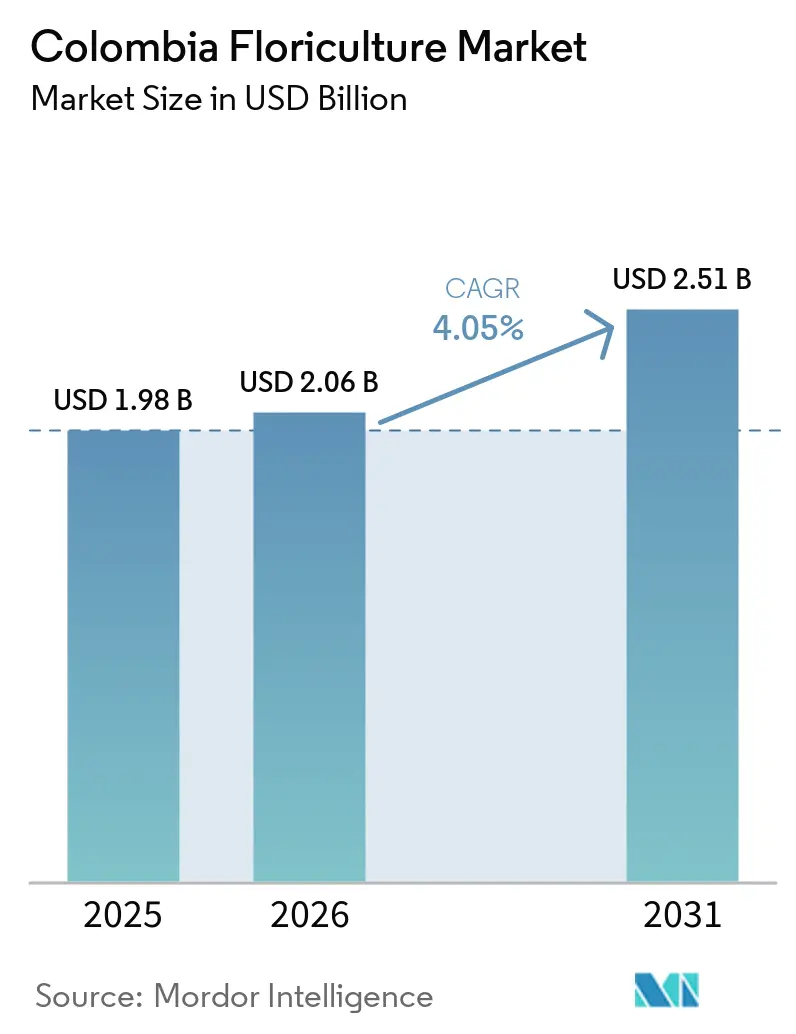
The Colombia floriculture market size in 2026 is estimated at USD 2.06 billion, growing from 2025 value of USD 1.98 billion with 2031 projections showing USD 2.51 billion, growing at 4.05% CAGR over 2026-2031. This growth trajectory reflects Colombia’s entrenchment as the world’s second-largest flower exporter and its duty-free access to the United States under the United States–Colombia Trade Promotion Agreement[1]Source: World Bank, “Colombia Fresh Cut Flowers and Buds Exports by Country 2023,” wits.worldbank.org. Strong year-round production conditions at high altitudes, well-developed cold-chain links through Miami International Airport, and rapid certification uptake for Florverde Sustainable Flowers continue to underpin competitiveness. Demand momentum is reinforced by large United States grocery chains that now treat floral assortments as staple SKUs, by the spread of e-commerce fulfillment models that value predictable quality, and by the accelerating rollout of AI-enabled crop and demand planning systems within Colombian farms and foreign retail chains. Competitive pressure from Ecuador and Kenya is rising, yet Colombia’s cost advantage under duty-free rules and its established supply chain infrastructure mitigate substitution risk. Meanwhile, exporters offset freight cost volatility by increasing automation, negotiating long-term air-capacity contracts, and investing in greenhouse technology aimed at higher-margin premium varieties.
Key Report Takeaways
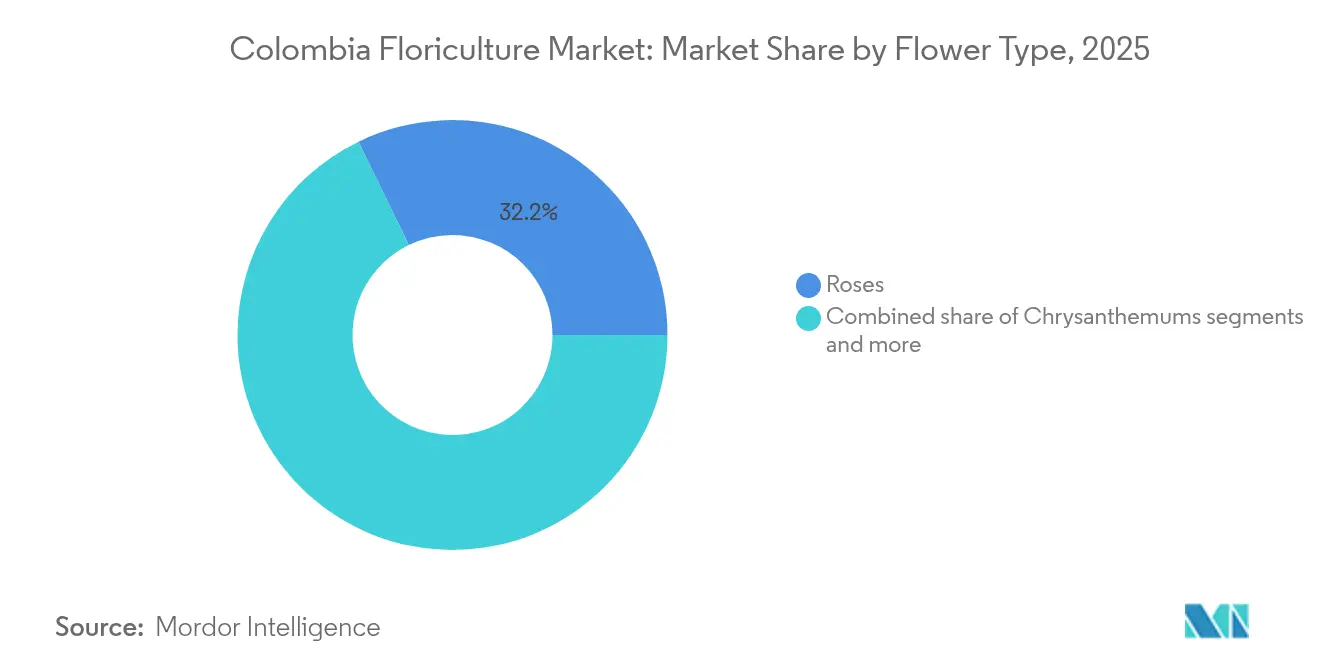
- By flower type, roses led with 32.20% of Colombia floriculture market share in 2025; hydrangeas are projected to advance at a 6.50% CAGR through 2031.
Note: Market size and forecast figures in this report are generated using Mordor Intelligence’s proprietary estimation framework, updated with the latest available data and insights as of 2026.
Colombia Floriculture Market Trends and Insights
Drivers Impact Analysis*
| Driver | (~) % Impact on CAGR Forecast | Geographic Relevance | Impact Timeline |
|---|---|---|---|
| Stable demand for year-round cut flowers | +0.8% | North America and Europe | Long term (≥ 4 years) |
| United States–Colombia Trade Promotion Agreement duty-free access | +0.6% | United States | Long term (≥ 4 years) |
| Growth of e-commerce floral delivery platforms | +0.7% | Global, with concentration in North America | Medium term (2-4 years) |
| Rising retailer adoption of Florverde and other eco-labels | +0.5% | North America and Europe | Medium term (2-4 years) |
| Miami International Airport cold-chain expansion | +0.4% | United States | Short term (≤ 2 years) |
| AI-driven demand forecasting by grocers | +0.3% | North America | Medium term (2-4 years) |
| Source: Mordor Intelligence | |||
Stable Demand for Year-Round Cut Flowers
United States retailers increasingly view a continuous floral assortment as a shopper-loyalty driver, which locks in steady import volumes from equatorial suppliers. Colombia’s altitude-based micro-climates allow uninterrupted production cycles that align with this merchandising model. Retailers also pay premiums during Northern Hemisphere off-seasons when Colombia can fill gaps left by temperate producers. This driver sustains predictable cash-flow for growers, anchors long-term contracting with airlines, and supports continual greenhouse investment that further raises output quality.
United States–Colombia Trade Promotion Agreement Duty-Free Access
The United States–Colombia trade promotion agreement eliminates tariffs that reach as high as competing South American flower imports, conferring an enduring landed-cost advantage for Colombian blooms. The preference was stress-tested during a policy dispute but remained intact, preserving exporter margins and retail shelf prices. Duty-free terms also accelerate customs clearance through streamlined documentation, reducing cycle time and shrinkage. Without this edge, industry economists estimate Colombian shipments to the United States would contract by roughly one-quarter as price-sensitive mass-market channels pivot to lower-cost substitutes.
Growth of E-commerce Floral Delivery Platforms
Direct-to-consumer platforms have captured a majority share of consumer floral spending in the United States, rewarding suppliers capable of packaging stems for parcel networks and providing end-to-end digital traceability. Colombian farms responded by adopting QR-enabled labeling, individual-stem hydration packs, and order-management integrations with platform APIs. Digital ordering compresses the time between harvest and consumer delivery, improving vase life and enabling farms to earn higher price-realization compared with traditional wholesale auctions. As platforms scale, smaller Colombian exporters that digitize operations gain disproportionate visibility with algorithm-driven product rankings.
Rising Retailer Adoption of Florverde and Other Eco-Labels
Over half of Colombian exports now carry Florverde certification, reflecting measurable reductions in pesticide toxicity and water usage[2]Source: Asocolflores, “Florverde Sustainable Flowers Annual Report 2024,” asocolflores.org. Major grocery chains have embedded eco-label compliance in supplier scorecards, moving sustainability from optional to threshold criteria. Certified farms capture 10-15% price premiums and face lower risk of delisting under tightening ESG mandates. Early adopters also benefit from cooperative marketing funds supplied by retailers that showcase sustainable sourcing in consumer campaigns, further reinforcing demand pull for certified Colombian stems.
Restraints Impact Analysis*
| Restraint | (~) % Impact on CAGR Forecast | Geographic Relevance | Impact Timeline |
|---|---|---|---|
| Stringent phytosanitary compliance and policy risk | -0.5% | Global, with emphasis on United States | Long term (≥ 4 years) |
| Air-freight and fuel-surcharge cost volatility | -0.4% | Global | Short term (≤ 2 years) |
| Resurgence of local specialty flower farms | -0.3% | North America and Europe | Medium term (2-4 years) |
| Labor shortages in floral logistics hubs | -0.2% | United States | Medium term (2-4 years) |
| Source: Mordor Intelligence | |||
Stringent Phytosanitary Compliance and Policy Risk
USDA Animal and Plant Health Inspection Service (APHIS) mandates detailed pest-free certifications that can delay clearance, especially when white rust alerts trigger hold-and-inspect orders[3]Source: USDA APHIS, “Cut Flower Import Requirements,” usda.gov. Compliance costs run 3-5% of FOB value for documentation, treatments, and traceability audits. Smaller farms struggle to absorb these overheads, which can throttle entry of new producers. Periodic lobbying by domestic United States growers for stricter enforcement introduces policy uncertainty that complicates long-range export planning.
Air-Freight and Fuel-Surcharge Cost Volatility
Flowers are almost entirely air-shipped, exposing exporters to jet fuel price swings and seasonal peak surcharges. Carriers often levy holiday premiums that coincide with Valentine’s Day and Mother’s Day, when Colombia loads high in a three-week window. Even when crude prices dip, northbound freight rates can stay elevated because southbound capacity imbalance persists. Growers hedge by locking in multi-year block-space agreements, but smaller operators lacking credit lines remain vulnerable to margin compression.
*Our forecasts treat driver/restraint impacts as directional, not additive. The impact forecasts reflect baseline growth, mix effects, and variable interactions.
Segment Analysis
By Flower Type: Roses Anchor Premium Volume While Hydrangeas Drive Acceleration
Roses generated 32.20% of Colombia floriculture market share in 2025, reflecting altitude-optimized cultivation on the Bogotá Savannah that yields long-stemmed varieties prized by North American mass retailers. Hydrangeas hold the fastest growth outlook at a 6.50% CAGR through 2031 as designers favor voluminous heads for event décor and as the crop’s tolerance for varied micro-climates expands production zones beyond traditional Andean belts. Within carnations, Colombia preserves outright global leadership, buoyed by decades of varietal refinement and robust Dutch auction demand in Europe. Chrysanthemums, lilies, alstroemerias, and niche exotics collectively broaden bouquets, enabling mixed-stem export cartons that optimize freight cost per kilogram.
Exporters increasingly allocate greenhouse real estate toward varieties demonstrating resilience to longer transit times as e-commerce distribution accelerates. AI-guided cultivar trials identify genetic lines with extended vase life, supporting subscription-based platforms promising minimum seven-day freshness. Investment in sensor-enabled irrigation and real-time climate modulation systems further elevates stem quality, reinforcing Colombia’s differential positioning against lower-cost but longer-haul African competitors. As premium varieties multiply, the Colombia floriculture market size attached to specialty stems is projected to expand its revenue contribution faster than volume share.



Geography Analysis
The Bogotá Savannah accounted for major share in Colombia floriculture market in 2025, confirming its dominance within the Colombia floriculture market. Its elevation, volcanic soils, and year-round daylight create optimal conditions for premium roses, carnations, and chrysanthemums harvested. Proximity to El Dorado International Airport shortens transit to Miami and reinforces an integrated cold-chain corridor that safeguards stem freshness. Scale breeds network effects: centralized pack houses, input suppliers, and skilled labor pools confine most expansion plans to the plateau, while widespread adoption of IoT sensors and AI crop-management systems boosts yields that justify premium pricing.
The Medellín valley, including Rionegro and nearby districts, captured good share in national output in 2025, carving a niche for temperate varieties such as orchids, specialty roses, and fast-growing hydrangeas suited to its micro-climates. Premium growers like Alexandra Farms exploit this altitude band to cultivate large-headed English garden roses under manual care regimens that command above-average FOB prices. Innovation hubs clustered around the University of Antioquia feed automation advances, exemplified by an AI-guided chrysanthemum-cutting selector, that raise quality consistency and labor productivity. José María Córdova International Airport offers alternative export gates that lessen reliance on Bogotá’s airfreight slots and diversify route risk for time-sensitive cargo.
Emerging zones such as Quindío and adjoining coffee belts supplied the remaining output in 2025, but they register the fastest hectare growth as farmers pivot from commodity coffee to high-value stems. Existing agronomic know-how and expanding 5G networks enable rapid uptake of precision-ag tools first proven in coffee, including real-time moisture probes and AI yield-forecast dashboards that improve cut-flower pack-out rates. Access to Pacific ports positions growers for direct sailings to Asian markets, easing dependence on the northbound air corridor and broadening the Colombia floriculture market size in underpenetrated regions. Government diversification grants and rural employment incentives further sweeten returns, signaling that Quindío and peers could lift their combined share well above today’s single digits by 2030.
Regulatory Landscape
Colombian floriculture exports operate under phytosanitary and registration controls led by the Instituto Colombiano Agropecuario (ICA). Exporting farms and operators must keep approved status and supporting documentation to preserve market access. A key update is ICA Resolution 2191 of March 13, 2024, which set unified requirements for the registration of production sites and exporters of ornamental cut flowers and branches through the SimplifICA digital system, tightening standardization while reducing reliance on manual processing.
Export compliance is reinforced through coordinated logistics and security facilitation under Plan Pétalo, a long-running public-private framework led by Asocolflores in coordination with government entities. ICA Resolution 00030058 of November 25, 2025, added a defined inspection program for maritime export of cut flowers and foliage. It includes enablement of packing plants, post-harvest areas, and cargo consolidation centers as points of origin for phytosanitary inspection, widening regulatory-supported pathways beyond the traditional air corridor.
Value Chain Analysis
The Colombia floriculture value chain starts with propagation material, substrates, fertilizers, crop-protection products, and farm-level technology inputs. Production concentrates in Cundinamarca (Bogota Savannah) and Antioquia, followed by post-harvest processes including grading, bouquet assembly, hydration, cold storage, and packing at farm or centralized packhouse level. Digital traceability and certification workflows, notably Florverde Sustainable Flowers, increasingly act as commercial gatekeepers for large North American and European buyers.
Downstream, the chain depends on time-sensitive cold-chain logistics, phytosanitary clearance, and export distribution through wholesalers, mass retailers, and e-commerce fulfillment networks. Airfreight remains the dominant mode, but regulatory enablement for maritime inspection (ICA Resolution 00030058, November 2025) supports alternative routings for select shipments and can shift consolidation activity to approved packing and cargo centers. Trade-policy and compliance management has also become more explicit in 2026, with Asocolflores coordinating with U.S. trade bodies (including SAF, AFIA, and IFPA) and submitting formal inputs to U.S. authorities in July 2026 to address tariff and labor-related trade actions that could disrupt the core U.S.-bound channel.
Market Opportunities and Future Outlook
Opportunities are shifting toward differentiated products and premium access conditions, rather than pure volume growth, especially where sustainability credentials and traceability unlock higher-value channels. Industry reporting indicates that over half of exports carry Florverde certification, and large retailers embed eco-label requirements into supplier scorecards. Growers that extend certification coverage and document reductions in inputs (including water and pesticide toxicity) have clearer routes into higher-spec retail programs and e-commerce assortments that require consistent quality and data-rich labeling.
Operational and product innovation also creates room to improve propagation efficiency and crop-risk management. In February 2026, Selecta one reported successful commercial implementation of its RCS 2.0 substrate-free rooting system at Colibri Flowers, pointing to a scalable approach to reduce waste and standardize young-plant performance for export-grade stems. On crop protection, hydrangea growers using rapid field diagnostics such as Agdia Phytophthora ImmunoStrips (results in under 30 minutes) illustrate how faster decision cycles can reduce off-target chemical use and limit losses, which supports premium varieties that are sensitive to shrink during export handling. At the market-structure level, the sector remains heavily oriented toward the United States, keeping destination diversification and alternative logistics channels, including newly enabled maritime inspection points of origin, as practical areas for commercialization and risk balancing.
Recent Industry Developments
- July 2026: Asocolflores submitted formal comments to U.S. authorities on July 6, 2026, arguing against including Colombian flowers in potential U.S. import restrictions tied to trade and labor-related investigations. The filing reinforced sector-wide emphasis on documented labor and compliance practices as a prerequisite for maintaining stable access to the United States, the industrys primary destination market.
- April 2026: Flores el Capiro commenced a first-ever flower container shipment routed from Puerto Antioquia, marking a milestone use case for maritime-linked export logistics for perishable floriculture cargo. The shipment broadens routing options beyond peak-season air constraints and aligns with Colombias regulatory shift toward enabling phytosanitary inspection at approved points of origin for maritime export flows.
- November 2024: Alexandra Farms received Florverde Sustainable Flowers certification, aligning its production with the environmental and social criteria increasingly embedded in buyer procurement scorecards. The certification supports participation in premium programs in North America and Europe, where eco-label compliance functions as a threshold requirement rather than a marketing add-on.


Research Methodology Framework and Report Scope
Market Definition and Coverage
For this study, the market is defined as the value generated from floriculture activity in Colombia, covering flowers grown and traded as loose or cut stems. Value is estimated through domestic consumption plus external trade flows.
Scope exclusions: It excludes downstream retail bouquet services and event decor services. It also excludes non-flower ornamentals, such as live plants used mainly for landscaping.
Segmentation Overview
- By Flower Type
- Roses
- Chrysanthemums
- Carnations
- Alstroemerias
- Hydrangeas
- Lilies
- Other Flowers
Data Sources, Market Sizing, and Validation
Desk Research
Desk work starts with building a clear baseline for Colombia flower production and trade, so later assumptions stay tied to public facts. We reference official and public sources such as DANE agriculture statistics, DIAN customs releases, UN Comtrade mirror trade, and FAOSTAT time series to sense-check volumes, values, and year-to-year shifts.
To refine pricing and product mix, we also review sources such as ICA and Agriculture Ministry publications, trade association updates from the flower sector, and reputable press coverage on freight, phytosanitary rules, and peak-season demand. Company filings and investor materials are used to cross-check capacity signals and export focus. A paid subscription for company financials, plus a shipment-level import-export database, is used selectively when public tables are too aggregated. These examples are not exhaustive, and many other public documents were also used for data collection, validation, and clarification during the research.
Primary Interviews and Surveys
Primary checks are completed through expert interviews and structured surveys with growers, exporters, logistics providers, and buyer-side specialists connected to the Colombia flower chain. We test demand seasonality, export corridor dynamics, and realized pricing by flower type, then use those inputs to close gaps and confirm the final assumptions before the numbers are finalized.
Distribution of primary research fieldwork respondents
| Company type | Respondent position |
|---|---|
| Top tier: 25% | CXOs: 14% |
| Mid tier: 60% | Functional/Unit leaders: 37% |
| Smaller Players: 15% | Managers: 49% |
Market-Sizing & Forecasting
Sizing starts with a top-down build where Colombia production and trade series are translated into an implied demand pool, and then valued using observed price trends for key flower types and typical export price realization. Once the first total is formed, it is corroborated with selective bottom-up approximations, such as sampled exporter volumes times average selling prices and channel checks tied to freight and handling costs. These comparisons are then used to adjust any large mismatch.
Inputs used in the model include export and import values and volumes, production volume direction, flower type mix shifts (for example, roses versus other stems), seasonal shipment peaks around major holidays, and farm-gate to export price movement linked to freight and exchange-rate timing. Forecasting is built through scenario analysis with simple trend fitting, and primary inputs help set realistic paths for volume growth and pricing rather than extending a single flat rate. Where smaller-grower detail is not visible in public data, the gap is handled through proportional allocation using verified mix shares and trade-intensity indicators before totals are rolled up.
Data Validation & Update Cycle
Outputs are validated through multiple checks so the final totals line up with independent market signals, including trade balances, year-over-year production changes, and the direction of price trends. If a spike cannot be explained by weather, logistics disruption, or a known policy change, assumptions are revisited and the supporting data is re-checked.
Before sign-off, another analyst reviews the work so calculation logic, units, and currency conversions remain consistent across years. The report is refreshed annually, with interim updates triggered by material events such as freight disruptions or changes in key export market access. Right before delivery, a final pass is completed so clients receive the latest updated view.
Mordor Intelligence's Colombia Floriculture Market Size Compared Against Other Published Estimates
Published market sizes for Colombia floriculture can differ because the counted value pool is not the same across sources, even when the report titles look similar. Most gaps come from the scope of products included, such as whether the number is export-only or market-wide, the anchor year used, and how pricing and currency timing are treated.
Some external figures narrow the market to a smaller slice by emphasizing select applications, which can lower the total value presented. Other figures align more closely to an export sector value and can drift upward if domestic consumption and import offsets are not treated in the same structure. In Mordor Intelligence, imports, exports, production, consumption, and flower type price trends are kept together so loose and cut flowers are counted without adding adjacent fragrance and colorant uses.
Benchmark comparison
| Source | Market Size | Gaps in Research Methodology |
|---|---|---|
| Mordor Intelligence | USD 1.98 B (2025) | |
| Global Consultancy A | USD 202.86 M (2025) | The estimate appears to be based on a narrower counted pool shaped by application-focused scoping, which can exclude a large share of floriculture trade-linked value captured in production and export flows. |
| Government Brief B | USD 2.40 B (2026) | The figure is communicated as an export sector value, so it can over-represent outbound shipments and not fully reflect domestic consumption and import offsets for the same year. |
The table shows that the biggest swings come from export-only versus market-wide accounting, and from whether non-core application uses are included alongside flower stems. When inputs are tied back to trade volumes, production direction, and observable price series by flower type, the total becomes easier to explain and easier to refresh as new annual statistics are released.


Key Questions Answered in the Report
How large is the Colombia floriculture market in 2026?
The Colombia floriculture market size is USD 2.06 billion in 2026 with a projected 4.05% CAGR through 2031.
Which flower type leads Colombian exports?
Roses hold the lead, accounting for 32.20% of 2025 export value.
What is the fastest-growing segment within Colombian flower types?
Hydrangeas are projected to expand at a 6.50% CAGR between 2026 and 2031.
Why is the United States critical for Colombian flower sales?
The United States absorbs 80% of Colombia's flower exports, supported by duty-free access and Miami's specialized cold-chain infrastructure.
How important is sustainability certification to Colombian growers?
Over 50% of export stems now carry Florverde certification, and major North American and European retailers increasingly require such eco-labels for supplier approval.
What challenges could slow market growth?
Key headwinds include stringent phytosanitary rules, freight cost volatility, and domestic-production campaigns in importing countries.
Page last updated on:




