
South America Cashew Market Analysis by Mordor Intelligence
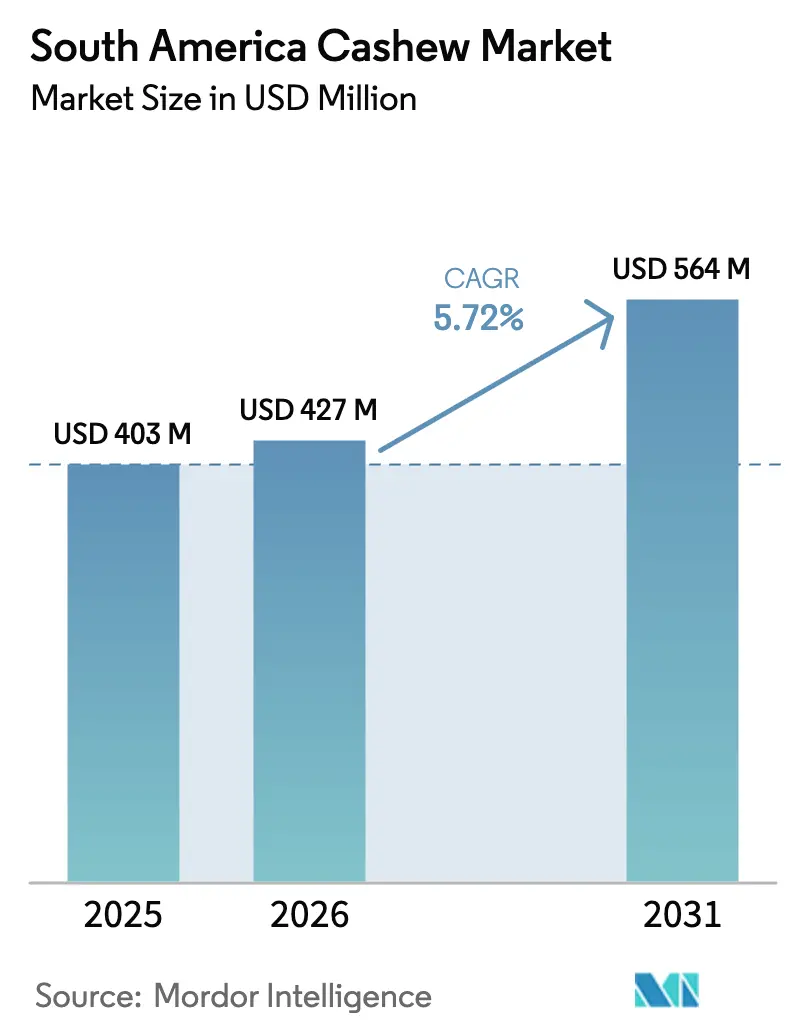
The South America cashew market size was valued at USD 403.00 million in 2025 and is estimated to grow from USD 427.00 million in 2026 to reach USD 564.00 million by 2031, at a CAGR of 5.72% during the forecast period (2026-2031). Structural shifts in global sourcing are steering multinational snack and confectionery brands toward Brazilian kernels, while integrated cashew-cocoa agroforestry is lifting smallholder resilience and raw-nut availability. State-backed drip irrigation, carbon credit monetization, and port upgrades at Pecém are compressing production and logistics costs, enabling suppliers to defend margins despite lower world reference prices. Simultaneously, droughts associated with La Niña and labor shortages during the harvest season continue to pose challenges that constrain the growth trajectory. Overall, the South America cashew commodity market is transitioning from a purely raw-nut exporter to a kernel-processing and value-added hub that can meet rising demand for traceable, non-Asian-origin products in Europe and North America.
Key Report Takeaways
- By geography, Brazil accounted for 82.5% of the South America cashew market size in 2025, while Colombia is anticipated to grow at a 12.5% CAGR through 2031.
Note: Market size and forecast figures in this report are generated using Mordor Intelligence’s proprietary estimation framework, updated with the latest available data and insights as of January 2026.
Market Trends and Insights
Drivers Impact Analysis of South America Cashew Market*
| Driver | (~) % Impact on CAGR Forecast | Geographic Relevance | Impact Timeline |
|---|---|---|---|
| Expansion of integrated cashew–cocoa agro-forestry systems | +0.8% | Brazil (Bahia, Ceará) and Colombia (Magdalena) | Medium term (2-4 years) |
| Shift of multinational roasters toward Brazilian kernel sourcing contracts | +1.2% | Global demand felt primarily in Brazil and Colombia | Short term (≤ 2 years) |
| Emergence of carbon-credit revenue streams for cashew orchards | +0.6% | Brazil (Northeast), and Peru (Piura) | Long term (≥ 4 years) |
| Digitized farm-gate procurement boosting smallholder throughput | +0.7% | Brazil (Ceará, Piauí, Bahia), and Colombia (Atlántico) | Medium term (2-4 years) |
| State-backed irrigation in Brazil’s Northeast cerrado | +0.9% | Brazil (Ceará, Piauí, and Rio Grande do Norte) | Medium term (2-4 years) |
| Port corridor upgrades lowering export freight costs | +0.5% | Brazil, with spillovers to Argentina and Chile | Short term (≤ 2 years) |
| Source: Mordor Intelligence | |||
Expansion of Integrated Cashew–Cocoa Agro-Forestry Systems
Dual-crop planting of cashew and cocoa has shifted land-use economics in Bahia and southern Ceará, where trials posted net income 35% to 40% higher than in cashew monoculture between 2024 and 2025 [1]. World Bank climate-smart funding of USD 22 million in 2025 accelerated adoption across 12,000 hectares by subsidizing seedlings and drip-irrigation. Cocoa’s off-season cash flow smooths farmer revenue and reduces orchard abandonment, securing processors’ raw-nut supply. Shade from cashew trees lowers cocoa heat stress, while cocoa’s deeper roots improve soil moisture retention. Colombia began pilot programs in 2025, demonstrating early replication potential along the Caribbean coast.
Shift of Multinational Roasters Toward Brazilian Kernel Sourcing Contracts
Global snack brands decreased reliance on Vietnam, which supplied 65% of world kernels in 2024, by signing multi-year Brazilian contracts in 2025 [2]. Olam International added 15 cooperatives to its Vitória da Conquista buying desk, covering 4,500 smallholders. European Union imports of Brazilian kernels jumped 22% in 2025 as processors met stringent aflatoxin limits without fumigation. Locked-in 2026-2027 volumes offer processors the confidence to expand capacity, and spillover supplies are improving kernel availability for Chile and Argentina.
Emergence of Carbon-Credit Revenue Streams for Cashew Orchards
Brazilian orchards under the Verified Carbon Standard earned USD 18 per hectare in carbon credits in 2025, adding 12% to farm income in low-yield zones. Nine projects covered 18,000 hectares and issued 42,000 credits that sold at USD 12–15 per metric ton. Peru’s Piura region enrolled 1,200 hectares under Gold Standard to attract beverage-sector buyers seeking nature-based offsets [3]. High transaction fees challenge smallholders, but aggregation platforms are reducing per-hectare costs. The revenue diversifies income, delays orchard abandonment, and supports sustainability branding in premium export channels.
Digitized Farm-Gate Procurement Boosting Smallholder Throughput
Mobile platforms in Ceará and Piauí reduced intermediary margins by 15% to 20% in 2025, enabling farmers to secure real-time bids and receive earlier payments. Usibras’ WhatsApp pilot reached 2,300 growers and cut post-harvest loss by 10% through faster collection. Colombia’s AgroNet added cashew pricing dashboards, empowering cooperatives with transparent market data. Digital records also meet the traceability requirements of European buyers, who pay 20% premiums for fully documented kernels. Smartphone adoption still lags at 58% in rural Piauí, but public connectivity programs are narrowing the gap.
Restraints Impact Analysis of South America Cashew Market*
| Restraint | (~) % Impact on CAGR Forecast | Geographic Relevance | Impact Timeline |
|---|---|---|---|
| Recurring La Niña–linked drought cycles | -0.9% | Brazil (Ceará, Piauí, Rio Grande do Norte) and Peru (Piura) | Short term (≤ 2 years) |
| Labor shortages during peak harvest in Ceará and Piauí | -0.6% | Brazil (Northeast) and Colombia | Medium term (2-4 years) |
| Limited phytosanitary labs delaying export clearances | -0.4% | Brazil with backlogs in Fortaleza and Natal | Short term (≤ 2 years) |
| Vietnam kernel oversupply suppressing global reference prices | -1.1% | Global with acute impact in Brazil, Colombia, and Peru | Medium term (2-4 years) |
| Source: Mordor Intelligence | |||
Recurring La Niña–Linked Drought Cycles
Rainfall in Ceará’s cashew belt was 35% to 45% below normal during the 2024-2025 season, cutting flowering and nut-set rates by up to 22% in rain-fed orchards. Peru’s Piura registered a 40% deficit in the same window, causing similar stress. Tree vigor does not fully recover in the next season, compounding losses. Climate models from the Intergovernmental Panel on Climate Change project a 15% increase in La Niña frequency by 2030, urging a faster rollout of irrigation. Only 8% of Brazilian cashew acreage held weather-indexed insurance in 2025, leaving most farmers exposed.
Labor Shortages During Peak Harvest in Ceará and Piauí
The rural labor pool in Ceará shrank 12% between 2020 and 2025 as workers moved to coastal service jobs. Daily wages reached BRL 95 (USD 19) in 2025, yet 12% of the Piauí crop remained unharvested due to a shortage of pickers. Prototype tree shakers achieved 70% efficiency but cost USD 80,000, limiting uptake to large estates. Colombia’s Atlántico region mirrors this trend, with labor shifting to banana and palm oil plantations. Mobile harvest crews are trialed, but housing and transport overheads erode savings.
*Our forecasts treat driver/restraint impacts as directional, not additive. The impact forecasts reflect baseline growth, mix effects, and variable interactions.
Geography Analysis
Brazil Cashew Market
Brazil accounts for 88.7% of regional production, utilizing 520,000 hectares of bearing orchards. However, it trails behind Colombia's growth rate of 12.5% CAGR due to the near saturation of irrigated land in Ceará and Piauí. Ceará contributes significantly to national output, but recurrent droughts have reduced rain-fed yields for 2024-2025 by 18%. The country operates 38 shelling plants, providing scale economies and enabling Brazil to secure 90.6% of exports. Despite this, per-capita domestic consumption remains low at 0.18 kg, indicating potential for increased retail demand.
Colombia Cashew Market
Colombia acts as the growth engine, centered in Atlántico, Magdalena, and Cesar, where bimodal rainfall allows two flowering cycles. Dwarf varieties enter bearing 18 months sooner and yield 30% more than traditional clones, though only four shelling lines operate domestically. Raw-nut exports to Brazil rose 40% year on year, indicating integration of cross-border processing. Investment in Colombian shelling could capture the margin now ceded to Brazilian processors.
Chile and Argentina Cashew Market
Chile and Argentina pull regional demand via imports, with Chile’s supermarket nut sections expanding 22% in volume sales during 2025. Argentina’s currency controls cap volume but lift unit value as importers focus on high-margin organic and flavored kernels. Peru’s Piura and Tumbes contribute modestly with 2,200 hectares, and new traceability laws align with the United States Food Safety Modernization Act rules to unlock North American buyers. Divergent sanitary regulations across the region invite third-party certification firms to standardize audits and lower compliance costs.
Regulatory Landscape
Regulatory oversight for cashew in South America is carried out by country-level food-safety and agricultural authorities, with Brazil setting much of the region's practical export compliance baseline given its scale in production and processing. In Brazil, the Ministry of Agriculture and Livestock (MAPA) regulates plant products and export certification processes, while ANVISA (under the Ministry of Health) oversees requirements relevant to processed foods placed on the domestic market. Export-oriented kernel processors typically align operations to GMP and HACCP-based controls and maintain required MAPA registrations for plant product inspection and export routines.
Premium destinations are shaped by how domestic identity and quality rules interact with importing-market contaminant and labeling requirements, particularly in the European Union. Exporters shipping to the EU work through MAPA documentation and traceability routines while also meeting EU contaminant limits, commonly managed through internal testing and documented controls for hazards such as aflatoxins. These expectations reinforce the role of formal processing plants with auditable quality systems and raise the importance of sampling, packaging, labeling, and laboratory capacity in the regional cashew trade.
Value Chain Analysis
The South America cashew value chain is anchored in farm-level raw cashew nut production concentrated in Northeast Brazil (notably Ceará, Piauí, and Rio Grande do Norte), followed by aggregation through cooperatives and buying desks, industrial shelling and peeling, grading and sorting, and then distribution of bulk or branded kernels into export channels and regional retail. Processing capacity and export logistics remain concentrated in Brazil, supporting cross-border flows where neighboring countries supply raw nuts or semi-processed output into Brazilian shelling and quality-control systems.
Key friction points sit upstream and midstream. Smallholder constraints around technical assistance, orchard renovation, and access to harvesting and processing technology contribute to variable quality and post-harvest losses, while limited specialized infrastructure increases the cost of consistent grading and compliance. Differentiation tools are also emerging to support chain coordination. Geographic indication initiatives such as Serra do Mel (Rio Grande do Norte), which received its first GI recognition in November 2025 with support from Sebrae-RN, formalize origin-linked standards and can improve market access and pricing. On-farm support programs similarly feed throughput and quality, including the Amigos do Bem project backed by the AGCO Agriculture Foundation, which targeted distribution of 10,000 cashew seedlings to 50 farmers in Mauriti, Ceará by end-2025 to rebuild productive capacity.
Competitive Landscape
The South America cashew commodity market is moderately concentrated. The top five processors accounted for a significant share of 2025 revenue. Usibras is one of the leading players, with 18,000 hectares and three plants with a capacity of around 45,000 metric tons. Amêndoas do Brasil follows, partnering with 4,200 smallholders and investing in roasting lines to enter retail-ready formats. Cione Alimentos holds a substantial market share by providing processing services to cooperatives that do not have the capital to invest in shellfish processing infrastructure.
Olam International’s Brazil operations have been growing steadily, integrating cashew into a broader tree-nut portfolio that shares logistics and quality control, thereby lowering per-unit costs. Grupo Agrocaju is one of the significant players focusing on organic and fair-trade kernels, exporting the majority of its output to specialty retailers in Europe and North America. Only three of the top five operate automated color sorters, leaving manual graders in smaller plants and limiting uniform quality. European buyers pay an additional 8% to 12% for blockchain-verified traceability, which Olam piloted in 2025 and has since been adopted by competitors.
Opportunities exist in value-added products such as cashew butter and milk alternatives, which currently have lower consumption levels but exhibit higher growth rates. Colombian processors are exploring joint ventures with Brazilian firms to access shelling technologies and export channels, which could recast the regional balance. In 2025, the number of Brazilian plants certified under the International Organization for Standardization Food Safety System Certification 22000 jumped from 7 to 12, becoming the baseline for European Union access. Capital intensity remains the main barrier. A 30,000 metric-ton automated facility costs over USD 15 million, discouraging new entrants.
Market Opportunities and Future Outlook
A near-term opportunity is productivity recovery and supply stabilization through state-backed orchard renovation and climate-resilience inputs in Brazil's Northeast, where drought sensitivity has constrained output. The Government of Ceará (SDA) contracted 408,000 dwarf cashew seedlings for the 2025/2026 crop cycle across 75 municipalities, expanding the pipeline of higher-density, earlier-bearing orchards and supporting processor utilization and procurement volumes. At the national level, Conab's May 2026 monthly cashew analysis points to 2026 production at 140.9 thousand tons (up 12.8% over 2025), strengthening the case for processors and traders to secure raw-nut supply and align contracts to improving availability.
A second whitespace is value capture beyond kernels through origin differentiation, circular use of byproducts, and export readiness through traceability and quality systems. The first geographical indication for cashew nuts in Serra do Mel (recognized in November 2025) provides a template for other producing micro-regions to standardize quality and branding. In Colombia, initiatives integrating cashew shell waste into circular materials, including the Uniandes-led Jurui project initiated in June 2026 in Vichada, point to industrial end-uses for shells that can reduce disposal costs and create secondary revenue streams. Across the region, buyer demand for documented traceability premiums supports investment in digital farm-gate records, lab testing capacity, and certification-ready processing lines to expand access to stringent markets.
Recent Industry Developments in South America Cashew Market
- May 2026: Embrapa Tropical Agroindustry introduced an early dwarf cashew clone designed to withstand severe drought with a deeper root system and begin fruiting within one to two years after planting. The release supports orchard renovation strategies in Northeast Brazil by shortening the time to commercial output and improving resilience where rainfall volatility has been constraining yields.
- November 2025: Serra do Mel in Rio Grande do Norte received its first geographical indication (IP) for cashew nuts, supported by Sebrae-RN. The designation strengthens origin-based differentiation and encourages standardized practices across growers and handlers, which can lift kernel consistency and open higher-value sales channels.
- June 2024: Research teams in Brazil advanced work on higher-productivity, stress-tolerant cashew genetics (including dwarf materials) aimed at improving yields under semi-arid conditions. The R&D pipeline underpins longer-term gains in orchard performance and helps align farm output with processor requirements for uniformity and throughput.
South America Cashew Market Report Scope and Research Methodology
Market Definition and Coverage
For this study, the market covers cashew nuts traded and consumed across South America, measured in value terms, and tied to regional demand and supply flows for edible cashews.
Scope exclusions: We exclude cashew apple and its beverages, along with non-edible byproducts and any unrelated tree nuts.
Segments Covered in This Report
- By Geography
- Argentina
- Production Analysis (Area Harvested, Yield, and Production Volume)
- Consumption Analysis (Consumption Value and Volume)
- Import Market Analysis (Import Value, Volume, and Key Supplying Markets)
- Export Market Analysis (Export Value, Volume, and Key Destination Markets)
- Wholesale Price Trend Analysis and Forecast
- Regulatory Framework
- List of Key Players
- Logistics and Infrastructure
- Seasonality Analysis
- Brazil
- Production Analysis (Area Harvested, Yield, and Production Volume)
- Consumption Analysis (Consumption Value and Volume)
- Import Market Analysis (Import Value, Volume, and Key Supplying Markets)
- Export Market Analysis (Export Value, Volume, and Key Destination Markets)
- Wholesale Price Trend Analysis and Forecast
- Regulatory Framework
- List of Key Players
- Logistics and Infrastructure
- Seasonality Analysis
- Chile
- Production Analysis (Area Harvested, Yield, and Production Volume)
- Consumption Analysis (Consumption Value and Volume)
- Import Market Analysis (Import Value, Volume, and Key Supplying Markets)
- Export Market Analysis (Export Value, Volume, and Key Destination Markets)
- Wholesale Price Trend Analysis and Forecast
- Regulatory Framework
- List of Key Players
- Logistics and Infrastructure
- Seasonality Analysis
- Colombia
- Production Analysis (Area Harvested, Yield, and Production Volume)
- Consumption Analysis (Consumption Value and Volume)
- Import Market Analysis (Import Value, Volume, and Key Supplying Markets)
- Export Market Analysis (Export Value, Volume, and Key Destination Markets)
- Wholesale Price Trend Analysis and Forecast
- Regulatory Framework
- List of Key Players
- Logistics and Infrastructure
- Seasonality Analysis
- Peru
- Production Analysis (Area Harvested, Yield, and Production Volume)
- Consumption Analysis (Consumption Value and Volume)
- Import Market Analysis (Import Value, Volume, and Key Supplying Markets)
- Export Market Analysis (Export Value, Volume, and Key Destination Markets)
- Wholesale Price Trend Analysis and Forecast
- Regulatory Framework
- List of Key Players
- Logistics and Infrastructure
- Seasonality Analysis
- Argentina
Data Sources, Market Sizing, and Validation
Desk Research
Desk research was used to set up the starting structure of the market, especially around production, consumption, and trade patterns that are visible in public datasets. We reviewed sources such as FAOSTAT, UN Comtrade, national agriculture ministries and statistics agencies in South America, and central bank or customs releases for trade reporting. For quality and safety context, we also referenced Codex Alimentarius.
To make the numbers workable in a market model, we pulled secondary inputs from company annual reports, investor presentations, association websites, and reputable press coverage of harvest conditions and processing activity. In a few places, we also used paid subscriptions for company financial intelligence, news and financials, and patent databases to confirm corporate footprints and track new processing and packaging activity. These desk sources are illustrative only, and we relied on additional public references to collect, validate, and clarify data points during the work.
Primary Interviews and Surveys
We use interviews and surveys with growers, processors, traders, distributors, retailers, and food buyers operating in South America. Respondents help clarify production levels, kernel recovery, consumption, prices, imports, exports, and processing capacity, particularly where official data are delayed or reported on different bases. Conflicting responses prompt source rechecks before the figures are triangulated.
Distribution of primary research fieldwork respondents
| Company type | Respondent position |
|---|---|
| Top tier: 28% | CXOs: 16% |
| Mid tier: 47% | Functional/Unit leaders: 34% |
| Smaller Players: 25% | Managers: 50% |
Market-Sizing & Forecasting
Sizing starts from a top-down reconstruction where production, imports, exports, and apparent consumption are used to rebuild the regional demand pool, and then value is derived using wholesale price and trade value signals. To keep the totals grounded, selective bottom-up checks were run, including sampling supplier and processor revenues where available, and validating typical price bands with channel participants.
A few inputs that repeatedly shaped the model were harvested volume and yield signals, import and export volumes and values, wholesale price trend direction, processing conversion factors (raw to kernel), and country level seasonality that shifts shipment timing. Where direct observations were thin, gaps were handled with conservative proxy ratios taken from nearby years or comparable countries, then rechecked with interview feedback before locking the assumption.
For forecasting, scenario analysis was used so the outlook can flex with weather driven harvest changes, trade policy shifts, and inflation led price movements. The scenario weights were aligned with what primary respondents described as the most likely path for supply, demand, and price behavior over the forecast window.
Data Validation & Update Cycle
Outputs were cross-checked against independent signals, including trade balances by country, price progression consistency, and whether implied consumption trends matched what buyers and distributors see on the ground. Where a variance appeared, we isolated the driver, revisited assumptions, and recalculated the line item before internal review.
Before sign-off, the model and narrative are reviewed in multiple steps so arithmetic, unit conversions, and country totals stay consistent. The report is refreshed annually, with interim updates when material events occur, and a final pre-delivery pass so clients receive the latest view available at the time of release.
Mordor Intelligence's South America Cashew Market Size Compared With Other Published Estimates
It is normal to see different market values for cashews because studies do not always use the same geography, price point, or product form. Even the base year for sizing can differ across publishers. The benchmark table highlights this spread, and in Mordor Intelligence's model the South America total is tied to production, consumption, and trade flows using wholesale price trend inputs, rather than mixing in wider Latin America coverage or adjacent cashew-derived products.
The largest gaps usually come from how value is built. Some estimates lean more on retail priced consumption, while others use trade values that can move with currency timing and freight. Differences also show up when a publisher uses an earlier base year, applies a single average price across the whole region, or updates less frequently after harvest and export season changes.
Benchmark comparison
| Source | Market Size | Gaps in Research Methodology |
|---|---|---|
| Mordor Intelligence | USD 427.00 M (2026) | |
| Trade Portal A | USD 582.24 M (2025) | Uses a different base year and appears to apply broader demand-side valuation that can lean closer to consumer pricing, which typically lifts the total versus wholesale-linked modeling. |
| Industry Publisher B | USD 733.50 M (2024) | Covers Latin America rather than only South America and can capture additional country demand, with totals that may also reflect a different pricing point and currency timing in the reference year. |
Taken together, the table suggests that scope and pricing point choices explain most of the difference, with year selection adding further movement. By keeping the model steps traceable to trade, supply, and price indicators, the final figure is easier to reproduce and check when new harvest or trade data is released.
Key Questions Answered in the Report
What is the current value of the South America cashew commodity market?
The market was worth USD 427 million in 2026 and is projected to reach USD 564 million by 2031.
Which country is growing the fastest in cashew production?
Colombia is forecast to grow at 12.5% CAGR from 2026 to 2031 due to new coastal plantations and policy support.
How are port upgrades influencing regional competitiveness?
The Pecém terminal expansion cut transit time to Europe by six days and lowered refrigerated-container costs by 22%, improving delivered pricing for Brazilian kernels.
What are the main threats to growth?
Recurring La Niña droughts, harvest labor shortages, and global price pressure from Vietnamese oversupply are the principal restraints on market expansion.