
South America Quinoa Seeds Market Analysis by Mordor Intelligence
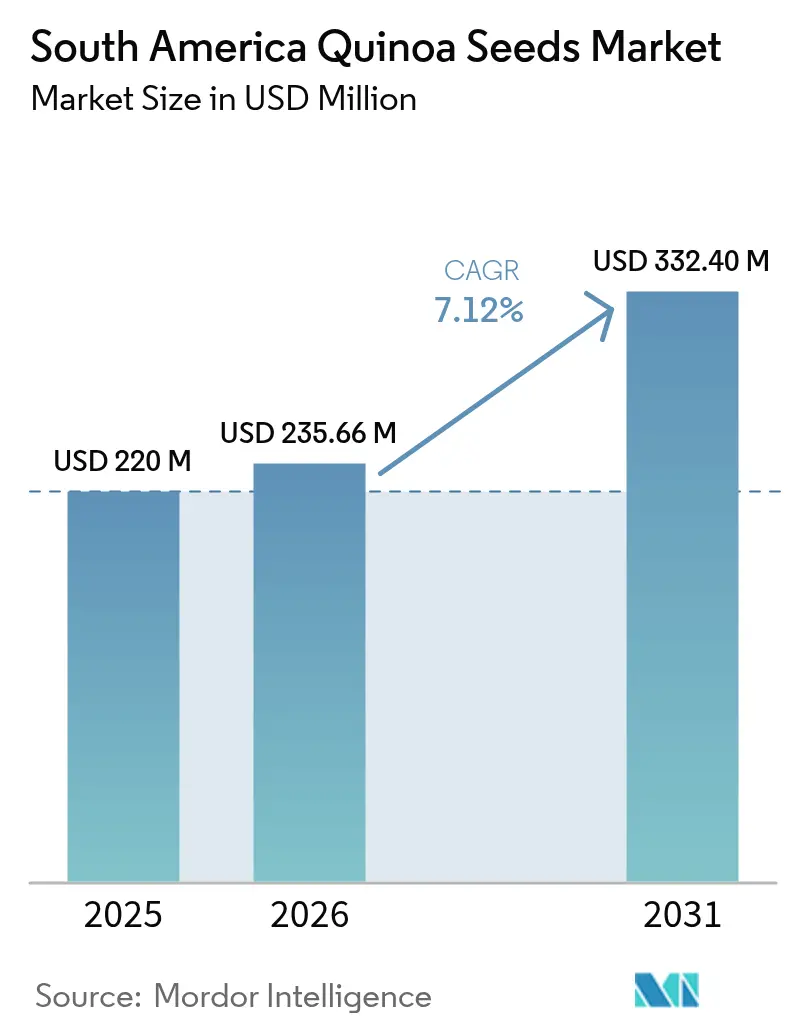
The South America quinoa seeds market size was valued at USD 220 million in 2025 and estimated to grow from USD 235.66 million in 2026 to reach USD 332.4 million by 2031, at a CAGR of 7.12% during the forecast period (2026-2031). Strong export demand from North America and Europe, coupled with rising domestic consumption in Brazil, Colombia, and Argentina, sustains this robust trajectory. Peru and Bolivia together supply more than 80% of global quinoa exports, giving the region a structural advantage even as emergent producers enter world trade. Price premiums attached to certified organic and colored varieties encourage farmers to diversify crops and adopt higher-margin practices. Vertical integration at the processing tier, exemplified by recent United States acquisitions, is improving product consistency, traceability, and brand value. Climate resilience of quinoa in high-altitude Andean zones adds a buffer against weather volatility that increasingly threatens traditional cereals.
Key Report Takeaways
- By geography, Peru captured 36.25% share of the South America quinoa seeds market size in 2025; Brazil is projected to post the fastest 7.18% CAGR between 2026 and 2031.
Note: Market size and forecast figures in this report are generated using Mordor Intelligence’s proprietary estimation framework, updated with the latest available data and insights as of 2026.
Market Trends and Insights
Drivers Impact Analysis of South America Quinoa Seeds Market*
| Driver | (~) % Impact on CAGR Forecast | Geographic Relevance | Impact Timeline |
|---|---|---|---|
| Increasing the area harvested under quinoa | +1.8% | Peru, Bolivia, and Brazil | Medium term (2-4 years) |
| High regional exports to the United States and Europe | +2.1% | Global, concentrated in Peru and Bolivia | Short term (≤ 2 years) |
| Growing local quinoa consumption | +0.9% | Brazil, Colombia, and Argentina | Long term (≥ 4 years) |
| Climate-resilient crop for Andean highlands | +1.2% | Peru, Bolivia, and Ecuador | Long term (≥ 4 years) |
| Rural development incentives in Andean nations | +0.7% | Peru, Bolivia, and Ecuador | Medium term (2-4 years) |
| Expansion of public-private partnership for seed distribution and research | +1.3% | Global, with primary impact on Peru and Bolivia | Short term (≤ 2 years) |
| Source: Mordor Intelligence | |||
Increasing Area Harvested Under Quinoa
Peru enlarged its quinoa area from 67,704 ha in 2020 to 69,677 ha in 2022, while Bolivia grew from 115,973 ha to 126,287 ha over the same period[1]Source: Luis Cruces et al., “Advances in the Integrated Pest Management of Quinoa,” insects.mdpi.com. This expansion reflects both horizontal scaling into previously uncultivated lands and intensification of existing production zones. The area growth enables supply elasticity to meet rising international demand, yet cultivation is spreading into fragile highland ecosystems, intensifying soil-erosion risks and sparking NGO calls for rotational fallows. The trend supports medium-term market growth as new areas reach productive maturity, though yield optimization remains critical for maintaining competitiveness against emerging global producers.
High Regional Exports to the United States and Europe
The United States absorbed 63.3% of global quinoa imports in 2024, and the European Union, underscoring the region’s export orientation. Diversifying to 61 overseas destinations by 2023 reduced concentration risk yet preserved scale economies in core Western markets. White organic quinoa fetched USD 2.80/kg FOB Callao in 2023, rewarding certification investments. This export orientation creates vulnerability to trade policy changes and food safety regulations in destination markets, yet provides the revenue base supporting continued production investment and technological advancement across the supply chain.
Growing Local Quinoa Consumption
Bolivian per-capita intake climbed from 1.35 kg in 2020 to 2.47 kg in 2024 on the back of school-feeding initiatives and maternal nutrition programs[2]Source: PROINPA Foundation,"Revista 54: Revista de Agricultura" proinpa.org. Brazilian urban shoppers increasingly favor gluten-free ancient grains, pulling quinoa into mainstream bakery, snack, and breakfast categories. Government procurement rules that mandate local grain purchases for feeding schemes shield growers from export price downturns. Food technologists in São Paulo formulated quinoa-cassava extruded snacks that met sensory acceptance scores above 7 on a nine-point scale. Domestic utilization, therefore, complements export earnings and stabilizes farm income.
Climate-Resilient Crop for Andean Highlands
Quinoa tolerates temperatures from −8 °C to 38 °C and soils with salinity up to 40 dS/m, outperforming maize and wheat under erratic rainfall. Scientists breeding heat-tolerant lines at the University of San Andrés and Japan’s JIRCAS target flowering-stage resilience. The crop’s ability to set seed at 4,000 m elevation allows Andean communities to maintain food security as glaciers retreat and water regimes shift. Nonetheless, heat stress during anthesis can cripple yields, so extension agents promote cultivar zoning and adjusted sowing calendars.
Restraints Impact Analysis of South America Quinoa Seeds Market*
| Restraint | (~) % Impact on CAGR Forecast | Geographic Relevance | Impact Timeline |
|---|---|---|---|
| Price volatility in domestic and export channels | -1.4% | Global, particularly Peru and Bolivia | Short term (≤ 2 years) |
| High prevalence of pests and diseases | -0.8% | Peru, Bolivia, and Ecuador | Medium term (2-4 years) |
| Limited on-farm storage and primary processing capacity | -0.6% | Bolivia, Peru, and Ecuador | Medium term (2-4 years) |
| Land-use competition from soy and corn expansion | -0.9% | Brazil and Argentina | Long term (≥ 4 years) |
| Source: Mordor Intelligence | |||
Price Volatility in Domestic and Export Channels
Price volatility stems from multiple factors, including weather-driven production variability, competition from non-traditional producing countries, and buyer inventory management strategies that amplify supply-demand imbalances. The development of parametric agricultural insurance products, as explored by researchers at the Institute for Advanced Development Studies (INESAD) for Bolivian quinoa producers, represents one approach to managing price and production risks. This volatility constrains investment in processing infrastructure and variety development, as stakeholders struggle to justify capital commitments amid uncertain returns.
High Prevalence of Pests and Diseases
Downy mildew (Peronospora variabilis) thrives at high humidity above 80% and can wipe out 90% of the yield without timely fungicide sprays. Bird predation can result in crop losses up to 60% in Peruvian highlands, requiring expensive exclusion measures such as netting systems. Integrated pest management adoption remains limited among smallholder producers due to knowledge gaps and input costs. Pesticide residue violations have caused export shipment rejections, particularly affecting Peruvian exports to European markets with strict maximum residue limits. The expansion of quinoa cultivation into new geographic areas often encounters novel pest complexes that lack established management protocols, creating additional production risks.
*Our forecasts treat driver/restraint impacts as directional, not additive. The impact forecasts reflect baseline growth, mix effects, and variable interactions.
Geography Analysis
Peru Quinoa Seeds Market
Peru retained a 36.25% share in 2025, fortified by multi-zone production that supports staggered harvests and year-round shipping windows. State-run price dashboards improve transparency, reducing opportunistic middleman margins and reinforcing exporter competitiveness. Yet the 2023 drought trimmed national output by 25–30%, exposing climatic sensitivities even for leading suppliers. The development of predictive pricing software using artificial neural networks by researchers at Universidad Nacional del Altiplano demonstrates technological innovation in agricultural planning and risk management.
South America Quinoa Seeds Market
Brazil is poised for a 7.18% CAGR through 2031, propelled by federal diversification grants and domestic health-food demand. Local processors invest in puffed-grain technology, cereal bars, and baby food mixes, expanding captive demand that cushions growers from currency-driven export fluctuations. Argentina and Chile, though smaller, cultivate strategic footholds aligned with national food-security and agro-export targets. Ecuador experienced boom-and-bust cycles, highlighting the importance of coordinated market intelligence and contract farming in maintaining grower confidence.
Southern Altiplano Quinoa Seeds Market
Bolivia remains a formidable force, especially in specialty Royal Quinoa cultivated in the Southern Altiplano under Denomination of Origin rules. Smallholder organizations such as National Association of Quinoa Producers in Bolivia (ANAPQUI) channel fair-trade and organic certifications to secure European shelf space. Soil degradation from shortened fallows prompted research into biofertilizers crafted from endemic microorganisms, lifting soil organic matter by 0.4 percentage points in pilot plots. Government-backed municipal insurance pilots now reimburse drought-trigger payouts, cushioning livelihood shocks in districts like Tarija.
Regulatory Landscape
The regulatory environment for quinoa seeds in South America is shaped by export-facing phytosanitary controls and national quality standards, reflecting the region's dependence on the United States and European Union as key destination markets. In Peru, the Servicio Nacional de Sanidad Agraria (SENASA) administers risk-based inspection and phytosanitary certification requirements for plant-product exports, including quinoa, with exporters using standardized procedures to obtain phytosanitary export or re-export certificates.
Product quality and conformity programs also influence tradability and price realization. In Peru, the Instituto Nacional de Calidad (INACAL) has published technical quality requirements for quinoa grains (including parameters such as purity and limits for contaminants), supporting consistency for processors and exporters. In Bolivia, SENASAG governs food safety and sanitary controls for facilities, including requirements tied to the registration and authorization of processing and packing lines, while Bolivia's Denomination of Origin framework for Royal Quinoa provides an additional rules-based layer for specialty positioning in premium channels.
Value Chain Analysis
The South America quinoa seeds value chain is anchored in smallholder production in Peru and Bolivia, supported by input suppliers (seed, crop protection, and soil amendments), extension and public programs, local aggregators, producer associations, and a mix of formal and informal trading channels that feed into processing and export. Post-harvest steps typically include cleaning, saponin removal, drying, grading, and packaging before shipments move through exporters and international buyers, with certification (organic and fair trade) and traceability central to accessing higher-value demand in North America and Europe.
Bottlenecks persist in on-farm storage, primary processing, and financing for mechanization, which can raise quality variability and transaction costs. Public interventions have focused on tightening the chain at the farm and first-mile levels, such as Bolivia's provision of technological kits to quinoa producers in Potosi (January 2025) and Peru's MIDAGRI equipment distribution to small-producer organizations in Puno under the ProQuinua investment project (August 2025). Alongside these programs, industry bodies and associations help coordinate market access and export readiness, while informal trade hubs can still amplify price volatility and complicate consistent quality delivery to processors and exporters.
Market Opportunities and Future Outlook
Opportunities in the South America quinoa seeds market center on improving export logistics, scaling value-added processing, and formalizing domestic demand channels that stabilize farmgate prices. Peru's focus on agro-export infrastructure provides a practical pathway for supply-chain efficiency, with port modernization and investment programs referenced in 2026 policy and infrastructure announcements. Named terminals mentioned in these initiatives include Callao and Matarani, aligning with the market's dependence on containerized and bulk agri-food flows and supporting exporters and processors that need predictable transit times and lower logistics friction.
On the demand side, domestic consumption growth (notably in Brazil, Colombia, and Argentina) creates space for local processors to expand quinoa into mainstream food categories such as bakery, snacks, and breakfast products. Government procurement and nutrition programs in parts of the region (for example, Bolivia's school-feeding initiatives) reinforce baseline offtake. Policy actions under discussion also create a lever for affordability and market deepening in producing countries, such as Peru's March 2026 legislative discussion around IGV tax treatment for quinoa aimed at lowering consumer prices. Across the chain, productivity and compliance gaps (pest and disease management, residue control, and farm record-keeping) keep room for targeted services, including certification support, IPM adoption packages, and storage and cleaning upgrades tied to export-grade specifications.
Recent Industry Developments in South America Quinoa Seeds Market
- July 2026: Bolivian white quinoa prices were reported as steady at around EUR 3.20/kg FCA Dordrecht amid a calm seasonal period. Stable pricing in a major reference market supported continued buyer activity while highlighting the importance of reliable logistics and quality consistency from Andean supply chains.
- April 2026: Impaqto Capital launched the Amazon Andes Fund to finance processors and exporters of natural ingredients across the Andean region, including Peru and Bolivia. Dedicated capital for processing and export capabilities supports upgrades in traceability, quality control, and value addition for quinoa supply chains.
- August 2024: Saco Foods acquired Quinoa Corp., including the Ancient Harvest and Pamela's brands, from Encore Consumer Capital. The deal strengthened brand and distribution control over quinoa-based consumer products and reinforced the role of vertically integrated players in shaping sourcing requirements and product specifications for South American origin quinoa.


South America Quinoa Seeds Market Report Scope and Research Methodology
Market Definition and Coverage
For this methodology, the market covers the value of quinoa seeds supplied for planting and commercial cultivation across South America, captured at the point of seed sale to growers and distributors in the region.
Scope exclusions: This sizing does not count quinoa grain sold for food consumption, processed quinoa ingredients, or retail packaged quinoa products.
Segments Covered in This Report
-
By Geography
-
Brazil
- Production Analysis
- Consumption Analysis
- Import Analysis
- Export Analysis
- Price Trend Analysis
-
Argentina
- Production Analysis
- Consumption Analysis
- Import Analysis
- Export Analysis
- Price Trend Analysis
-
Peru
- Production Analysis
- Consumption Analysis
- Import Analysis
- Export Analysis
- Price Trend Analysis
-
Bolivia
- Production Analysis
- Consumption Analysis
- Import Analysis
- Export Analysis
- Price Trend Analysis
-
Chile
- Production Analysis
- Consumption Analysis
- Import Analysis
- Export Analysis
- Price Trend Analysis
-
Colombia
- Production Analysis
- Consumption Analysis
- Import Analysis
- Export Analysis
- Price Trend Analysis
-
Brazil
Data Sources, Market Sizing, and Validation
Desk Research
We start by building a fact base on quinoa cultivation and seed movement across key South American countries, so the model is tied to real acreage and seed demand signals. Public sources used for this step include agriculture statistics and farmer series from national ministries, trade and tariff line data from UN Comtrade, FAOSTAT crop and production series, and price notes from official statistics offices where available.
To make the numbers usable for a value model, we also pull supporting context from seed trade associations, peer reviewed agronomy papers on seed rates and varietal performance, and company filings or investor presentations that discuss seed portfolios and regional exposure. In addition, we referenced paid subscriptions for company financials and intelligence, along with an import export shipment-level database, to sanity check trade flows and supplier footprints. The desk research sources mentioned above are illustrative, and other public references were also used for data collection, validation, and clarification.
Primary Interviews and Surveys
We consult farmers, seed distributors, processors, exporters, importers, and agricultural officials across South America. Their input helps check official production and trade series, clarify food and planting use, fill price and demand gaps, and triangulate final assumptions without relying on any single source.
Distribution of primary research fieldwork respondents
| Company type | Respondent position |
|---|---|
| Top tier: 31% | CXOs: 18% |
| Mid tier: 47% | Functional/Unit leaders: 30% |
| Smaller Players: 22% | Managers: 52% |
Market-Sizing & Forecasting
The core sizing uses a top-down demand pool build that reconstructs seed demand from quinoa cultivated area and seed-rate norms, then adjusts for replacement cycles and informal seed reuse. These totals are corroborated with selective bottom-up checks using sampled distributor price lists and margins, along with a limited supplier roll-up by country to confirm that implied volumes and revenues are realistic.
Key inputs treated as variables in the model include quinoa acreage trends by country, average seeding rate per hectare, the share of certified versus farm-saved seed, import dependency for specific varieties, and seasonal price movements that influence realized ASPs. For forecasting, we relied mainly on scenario analysis supported by expert views on acreage expansion, export pull, and farmgate profitability, then built yearly values using expected ASP progression rather than applying a flat growth rate. Where bottom-up signals were incomplete, such as thinner distributor coverage in smaller markets, we used proxies from neighboring countries with similar agronomy and then corrected them using interview-based validation.
Data Validation & Update Cycle
We triangulate the model output against independent signals such as quinoa cultivation area, seed trade flows, and country-level pricing patterns, then investigate any mismatches before final sign-off. Outliers are reviewed through a second analyst pass, and follow-up calls are triggered when an assumption moves the total beyond a reasonable band versus observed acreage or trade.
Reports are refreshed on an annual cycle, with interim updates when material changes occur, such as policy shifts, sharp currency moves, or large swings in seed pricing. Before delivery, we run a fresh data pass so the final view reflects the latest available statistics and interview feedback.
Mordor Intelligence's South America Quinoa Seeds Market Size Compared With Other Published Estimates
Published market sizes for quinoa seeds in South America can vary widely, and the differences usually come from what is being counted and when the prices are converted to USD. When yearly ASPs are refreshed using recent seed pricing signals and the currency timing is kept consistent across countries, Mordor Intelligence ends up with a value that is less affected by one-off price spikes or mixed-year exchange rates.
A second source of spread comes from scope boundaries that are easy to blur in this topic, since quinoa grain for food and quinoa seed for planting often sit in the same trade and price conversations. Some estimates also appear to assume aggressive acreage expansion or use a single regional price point, which can overstate value when informal seed reuse is common and country prices move differently.
Benchmark comparison
| Source | Market Size | Gaps in Research Methodology |
|---|---|---|
| Mordor Intelligence | USD 220.00 M (2025) | |
| Market Research Publisher A | USD 4.50 B (2023) | The figure is materially higher than seed-only economics, which suggests the scope likely blends food quinoa grain and downstream products with planting seed, and may apply broad regional revenue assumptions without a seed-rate and replacement-cycle build. |
| Horizon Databook B | USD 83.90 M (2023) | The estimate is for Latin America rather than South America specifically, and it appears to be built around consumption and processing categories, which can undercount seed market value when planted-area driven demand and certified seed pricing are modeled separately. |
Overall, the spread in published values is mostly explained by scope mixing (seed versus edible grain), region coverage, and how prices are translated into annual USD values. By tying the model to acreage, seed rate, and replacement behavior, the result stays traceable to inputs that can be checked and updated in repeatable steps.


Key Questions Answered in the Report
What is the projected value of the South America quinoa seeds market by 2031?
The market is forecast to reach USD 332.4 million by 2031.
Which country captured the South American quinoa market?
Peru leads, accounting for 36.25% share of the South America quinoa seeds market in 2025.
What are the main restraints affecting quinoa seeds market?
The quinoa seeds market faces several constraints, including price volatility, high prevalence of pests and diseases, and limited on-farm storage.
Which country segment has the fastest forecast CAGR?
Brazil is poised for a 7.18% CAGR from 2026 to 2031.
Page last updated on:


 Your data is secure and never sold or shared.



