
Market Overview
| Study Period | 2021 - 2031 |
|---|---|
| Forecast Data Period | 2026 - 2031 |
| Historical Data Period | 2021 - 2024 |
| Growth Rate | 12.17 % |
Major Players *Disclaimer: Major Players sorted in no particular order Image © Mordor Intelligence. Reuse requires attribution under CC BY 4.0. | |
South America Commercial Aircraft Aviation Fuel Market Analysis by Mordor Intelligence
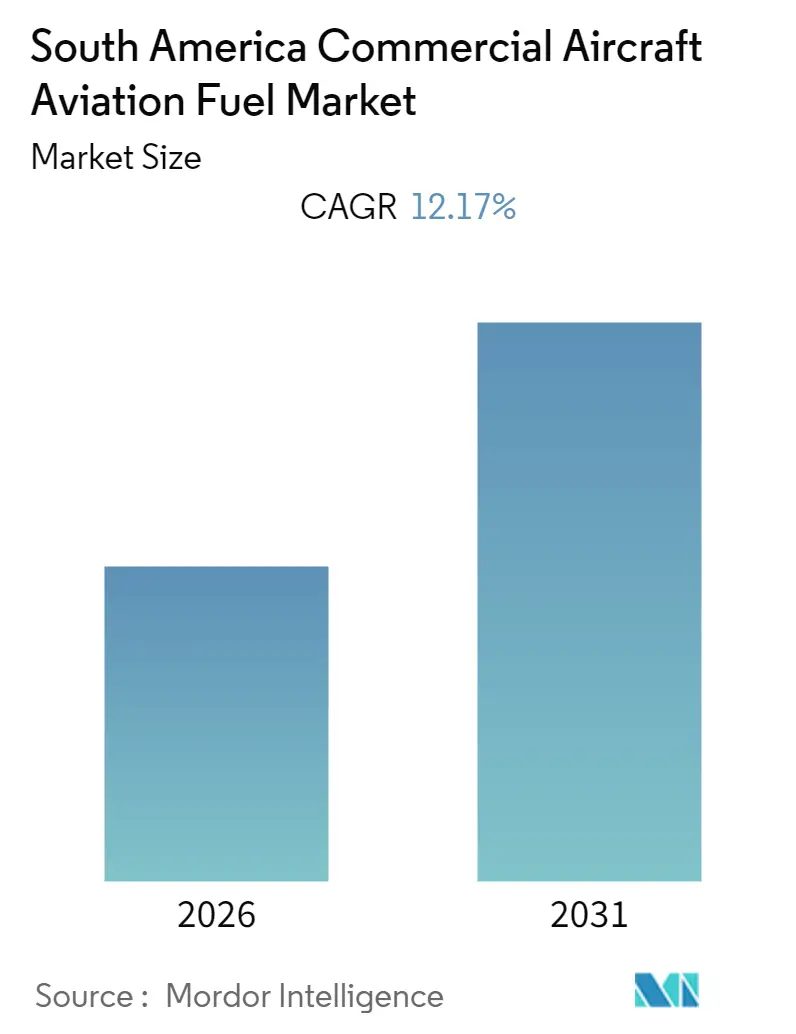
The South America Commercial Aircraft Aviation Fuel Market size is expected to register a CAGR of 12.17% during the forecast period (2026-2031).
- With increasing connectivity globally and decreasing airfares, the commercial sector is increasing the demand for ATF. With a significant share, ATF is leading the market and is expected to dominate the market during the forecast period.
- South America is one of the leading regions in biofuels. With an increasing shift towards aviation biofuels, significant opportunities are likely to be created in the near future.
- Brazil is the largest consumer of aviation fuels in South America, resulting in dominance in the region. With a growing market, the nation is expected to continue its dominance during the forecast period as well.
Note: Market size and forecast figures in this report are generated using Mordor Intelligence’s proprietary estimation framework, updated with the latest available data and insights as of 2026.
South America Commercial Aircraft Aviation Fuel Market Trends and Insights
ATF to Dominate the Market
- According to IATA, the air transport market in Chile is forecasted to grow by 78% in the coming years, which would result in an additional 13.2 million passenger journeys by 2037, driving the number of aircraft movements and consumption of ATF in the country.
- According to IATA, the air transport market in Chile is forecasted to grow by 78% in the upcoming year, which would result in an additional 13.2 million passenger journeys by 2037, driving the number of aircraft movements in the country and demand air turbine fuel.
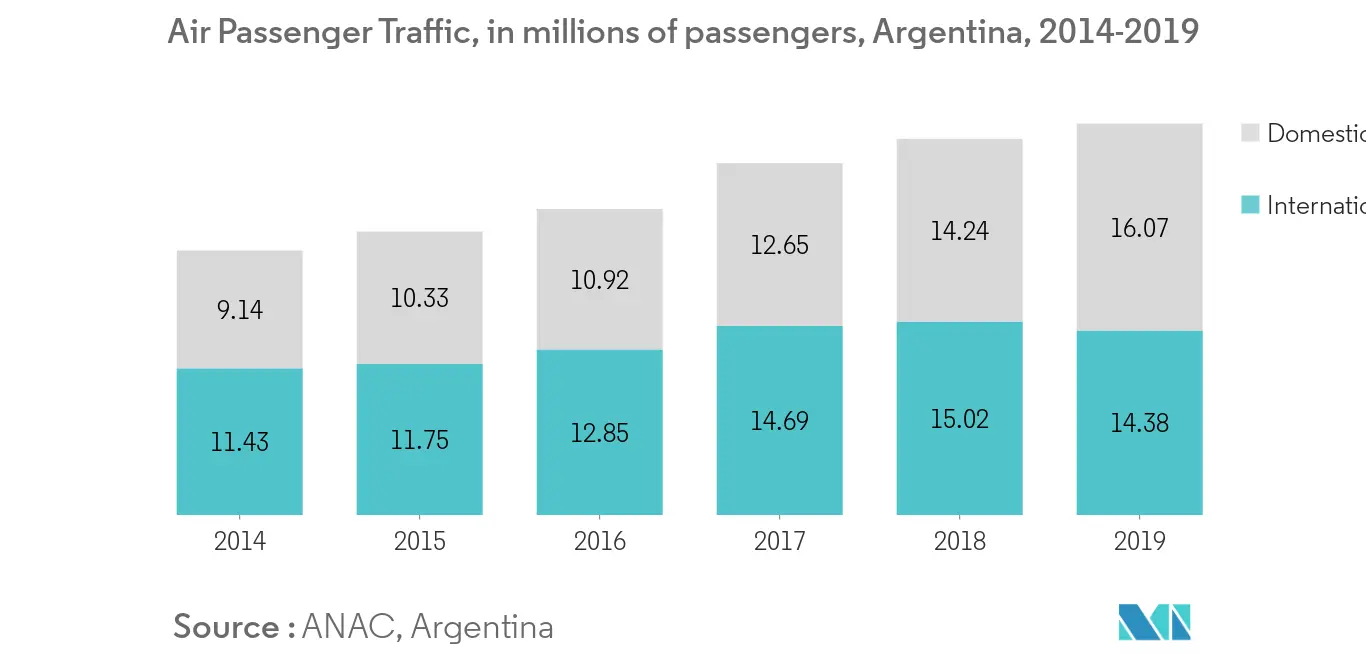
- Argentina's aviation industry contributes about 2.1% to the country's GDP (IATA), supported by the air transport sector and foreign tourists arriving. The total number of air passengers to and from different airports in Argentina was at a record high of 20.43 million in 2019.
- According to Argentina's Ministry of Transport, more than three million passengers have traveled on low-cost airlines until 2019 in Argentina since the country's first budget carrier began operating commercial flights in January 2018. Therefore, as new airlines work to expand in the country in the upcoming years, the market is expected to be driven during the forecast period.
- Moreover, in Colombia, airlines are increasing their fleet size to carter to total passenger levels, which could reach 100 million by the end of the decade, in turn, promulgating the aviation fuel market in the country.
- However, due to COVID-19, the market growth is expected to be hampered as there is reduced demand for aviation fuel, which is expected to recover post-2021.
Brazil to Dominate the Market
- Brazil is one of the largest consumers of aviation fuels in South America. The products specified for use in aircraft in the country are aviation kerosene (QAV), aviation gasoline, and alternative aviation kerosene (alternative QAV).
- The sales of aviation fuels have remained stable in the past few years, with a monthly average of 3,658.81 thousand barrels for aviation kerosene in 2019 and 25.40 thousand barrels of aviation gasoline sales in the same year.
- Further, in South America, Brazil is expected to pioneer the development of renewable fuels from sugarcane, which is expected to replace traditional jet fuel. Currently, although there are no specific federal policies in place for sustainable aviation fuel (SAF), initiatives are in place at the state level.
- Moreover, in 2018, Brazil signed an Open Skies agreement with the U.S. that allows airlines to increase the number of flights between the two countries, in turn having a positive impact on the aviation fuel market.
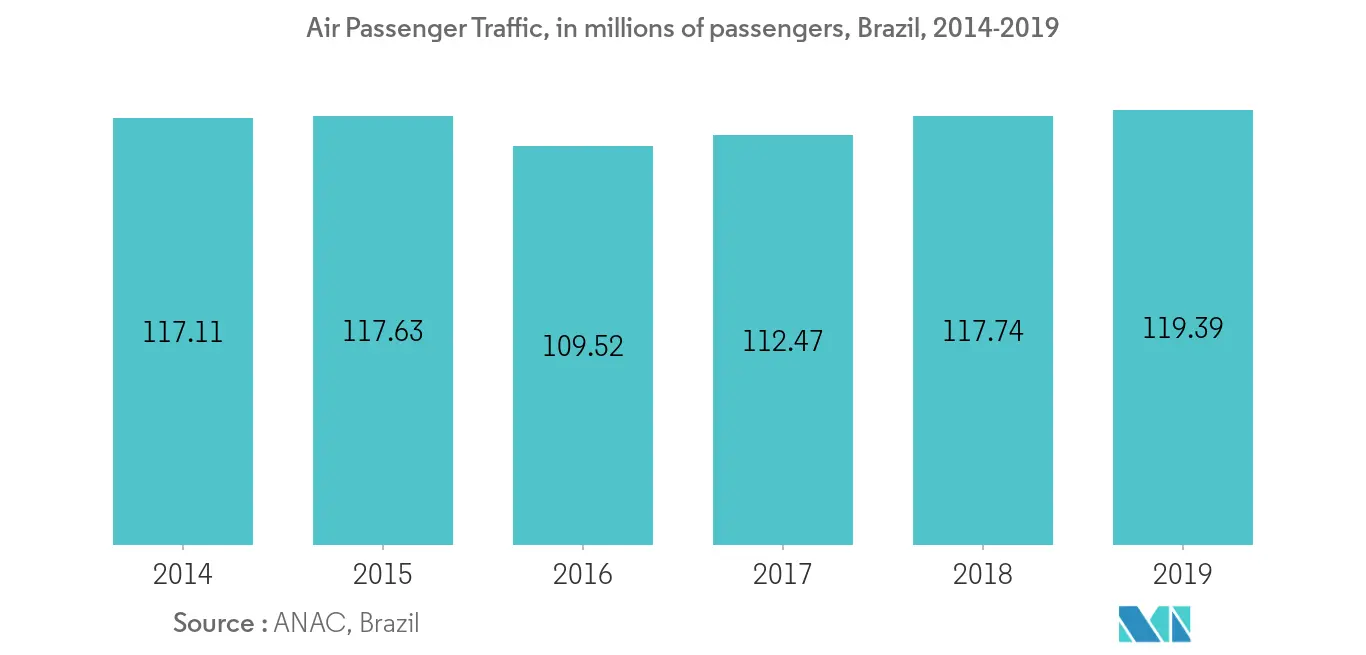
- According to the Brazilian Civil Aviation Regulator (ANAC, Brazil), the total number of air passengers in the country in 2019 was 119.39 million, increasing from 107.36 million in 2012. The increase in the number of passengers can be attributed to city-pair connections to and from the country, which is likely to drive the demand for aviation fuel in the country.
- However, due to COVID-19 pandemic, until the end of 2021, the market studied is expected to be restrained, post which, with increasing passengers and air travel demand, the aviation fuel market is expected to grow for the rest of the forecast period.
Regulatory Landscape
In Brazil, the policy backbone for sustainable aviation fuel (SAF) strengthened with Law No. 14.993/2024 (Fuels of the Future). The law created the National Program for Sustainable Aviation Fuel (ProBioQAV) and set a trajectory for domestic aviation emissions reduction requirements starting in 2027. At the same time, Brazil continued aligning aviation decarbonization planning with international frameworks such as ICAO CORSIA through national action planning led by the civil aviation ecosystem, including ANAC.
Fuel quality and market operation rules are also being updated. ANP Resolution No. 997 (March 25, 2026) updated Brazilian specifications for JET A and JET A-1 and addressed synthetic blend components, influencing procurement and compliance for suppliers serving commercial airports. ANP also signaled an ongoing 2025-2026 regulatory review of aviation fuel distribution and resale, including concepts such as airport self-supply and storage sharing. In parallel, Chile advanced decarbonization governance through its Vuelo Limpio program and a SAF Roadmap 2050 targeting 50% SAF penetration by 2050, alongside updates to its State Action Plan for CO2 reduction aligned to ICAO guidance.
Value Chain Analysis
The conventional aviation fuel value chain across South America continues to run from crude sourcing and refinery production of jet fuel, through storage and logistics providers, into airport fuel farms, and then to in-plane service for commercial airlines. In Brazil, product definitions and compliance reference points include aviation kerosene (QAV), aviation gasoline, and alternative aviation kerosene, with national regulators (ANP/ANAC) shaping specifications and operational requirements at the distribution and airport interface.
SAF value chains are increasingly built around co-processing and certification pathways that can plug into existing refinery and airport infrastructure. Examples include Petrobras REDUC receiving ISCC CORSIA certification (October 2025) to support SAF via HEFA co-processing and Ecopetrol's Cartagena refinery supplying Jet A-1 coprocessed with renewable content for LATAM Airlines Colombia operations (September 2024). Demand aggregation and chain-of-custody solutions are also developing, such as LATAM Airlines use of book-and-claim SAF for charter operations between Chile and Argentina (June 2026), while feedstock linkages are being formalized through partnerships like LATAM Airlines and Fedepalma (July 2025) to connect agricultural inputs to SAF supply in Colombia.
Competitive Landscape
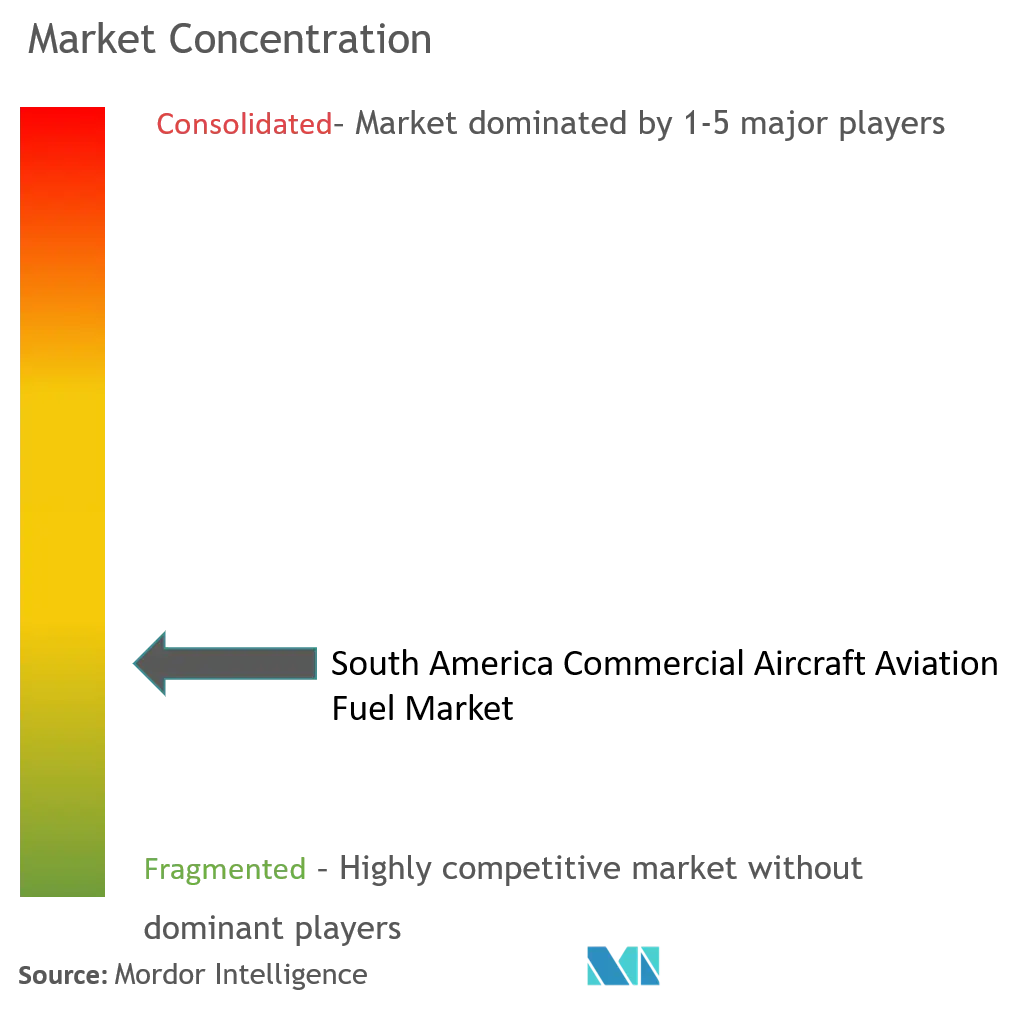
The South America commercial aircraft aviation fuel market is moderately fragmented. Some of the major companies include Petroleo Brasileiro S.A., BP PLC, Royal Dutch Shell PLC, Total SA, Repsol SA.
South America Commercial Aircraft Aviation Fuel Industry Leaders
-
Petroleo Brasileiro S.A.
-
Repsol SA
-
BP PLC
-
Royal Dutch Shell PLC
-
Total SA
- *Disclaimer: Major Players sorted in no particular order
Market Opportunities and Future Outlook
The most visible opportunity set in South America is scaling SAF supply alongside the region's large commercial aviation fuel base, with Brazil acting as the primary policy and project anchor. Law No. 14.993/2024 established ProBioQAV and set a mandated domestic aviation emissions reduction pathway beginning in 2027. That framework creates compliance pull-through for certified SAF volumes and for supporting services such as sustainability certification, blending logistics, and airport storage handling that aligns with updated fuel specifications.
Investment and project development signals are also relevant. BNDES and Finep launched a SAF and maritime fuels public call in August 2024 that received 76 proposals seeking more than BRL 167 billion in financing, indicating a sizable pipeline even where final investment decisions vary by project. On the supply side, Acelen Renovaveis announced in May 2026 the structuring of a USD 1.5 billion HEFA biorefinery investment in Bahia targeting 1 billion liters per year of SAF and renewable diesel by 2029, while co-processing capacity already exists in the region. As of 2025, there are four HEFA co-processing plants, including three in Brazil and one in Colombia. Beyond near-term HEFA scaling, the development whitespace includes Alcohol-to-Jet pathways linked to Brazil's ethanol platform and CORSIA-aligned approval of additional local feedstocks, which can expand eligibility and improve unit economics across regional SAF supply chains.
Recent Industry Developments
- June 2026: Honeywell announced it will provide UOP Ethanol-to-Jet process technology for Petrobras first large-scale ethanol-to-jet project in Latin America, tied to a SAF initiative in Brazil. The announcement adds an ATJ route to the regions technology stack beyond HEFA co-processing, connected to Brazils ethanol ecosystem. It also raises the importance of certification, feedstock contracting, and airport-ready logistics for future SAF supply.
- October 2025: Petrobras Duque de Caxias (REDUC) refinery received ISCC CORSIA certification for SAF production via the HEFA co-processing route. This added a recognized sustainability and chain-of-custody credential to refinery-based SAF supply, supporting airline and fuel supplier compliance needs under international accounting frameworks. The certification also helps standardize SAF commercialization across airport supply chains in Brazil.
- October 2024: Brazil enacted Law No. 14.993/2024 (Fuels of the Future), creating the ProBioQAV program and establishing a mandate-driven pathway for domestic aviation emissions reductions starting in 2027. By formalizing a national legal basis for SAF obligations, the law increased policy clarity for refiners, distributors, and airlines evaluating production, blending, and offtake structures. It also reinforced the role of ANP and ANAC-aligned requirements in governing fuel quality and sustainability compliance.
Research Methodology Framework and Report Scope
Market Definition and Coverage
This market covers the value of aviation fuels supplied for commercial aircraft operations across South America, counted at the point of fuel sale to airlines and other commercial operators, and expressed in USD.
Scope exclusions: This sizing excludes military aviation fuel use, general aviation fuel use, and non-aviation fuel products even if sold by the same suppliers.
Segmentation Overview
- Fuel Type
- Air Turbine Fuel (ATF)
- Aviation Biofuel
- AVGAS
- Geography
- Brazil
- Argentina
- Colombia
- Rest of South America
Data Sources, Market Sizing, and Validation
Desk Research
Desk research helped us set clear market boundaries and create a consistent demand picture that can be checked against real flight activity in South America. We pulled publicly available aviation statistics and energy indicators to understand how passenger traffic shifts, how fleets are deployed, and how that translates into jet fuel uplift.
Sources reviewed include public datasets and publications such as IATA traffic indicators, ICAO aviation statistics, airport operator traffic releases, and civil aviation authority statistics in the region (for example, ANAC type publications for Brazil and similar national bodies elsewhere). We also used energy and fuel market references such as IEA statistics and OPEC market reports for oil market direction, followed by customs and trade statistics where available to assess supply flows. Company annual reports, investor presentations, and reputable press were used to confirm capacity plans and fuel cost trends, and a paid subscription for news and financials plus an aviation database with aircraft-level and engine-level details supported additional cross-checks. The sources listed here are not exhaustive, and many other public documents and datasets were used for validation and clarification.
Primary Interviews and Surveys
We interview airline fuel buyers, airport fuel managers, refiners, distributors, aviation regulators, and commercial aviation analysts within South America. These discussions test fuel volumes, contract pricing, airport supply conditions, SAF adoption, and aircraft utilization assumptions, while surveys help identify gaps in secondary records. Responses are reviewed against published data before assumptions and final analysis are confirmed.
Distribution of primary research fieldwork respondents
| Company type | Respondent position |
|---|---|
| Top tier: 28% | CXOs: 18% |
| Mid tier: 47% | Functional/Unit leaders: 32% |
| Smaller Players: 25% | Managers: 50% |
Market-Sizing & Forecasting
Sizing starts from a top-down build where flight activity and capacity indicators are translated into an implied jet fuel demand pool for commercial operations across South America. After that demand pool is established, value is estimated using an average selling price (ASP) logic that aligns with common contract resets and typical pass-through timing rather than relying on a single spot price point.
Inputs used in the model include aircraft movement and passenger traffic trends, available seat kilometer direction, shifts in fleet mix (narrow-body versus wide-body utilization), and typical burn-rate assumptions by aircraft class. We also consider how the domestic versus international split changes uplift patterns, and how supply tightness signals can affect local differentials. To corroborate totals, selective bottom-up checks are run, such as sampled ASP times volume calculations and airport-level reasonableness checks where visibility exists, and then gaps are adjusted using consistent assumptions.
For forecasting, scenario analysis was used so traffic growth, capacity discipline, and fuel price direction can be flexed in a controlled way. Assumptions were aligned to what industry participants said they see in scheduling, load factors, and contract pricing expectations, and then the output path was checked for unrealistic jumps before being finalized.
Data Validation & Update Cycle
Validation is done in layers so the final values line up with aviation activity and fuel economics. We compare outputs with independent signals such as passenger and flight movement trends, reported airline fuel cost movements, and major fleet or route changes, and then investigate outliers before sign-off.
A second analyst reviews the key assumptions and checks for variance versus the expected range implied by traffic and pricing indicators. When gaps remain, follow-up outreach is triggered to confirm whether the issue is coverage, timing, or a change in local market behavior. Reports are refreshed annually, with interim updates for material events, and a final pre-delivery pass is completed so clients receive the most current view available.
Mordor Intelligence's South America Commercial Aircraft Aviation Fuel Market Size Compared Against Other Published Estimates
Published market sizes for South America commercial aircraft aviation fuel can differ because each publisher handles scope boundaries and pricing conversion steps in their own way. Currency timing, the way annual prices are averaged, and whether demand is tied back to observed commercial flight activity are usually the biggest reasons the USD totals do not match.
The gap often gets larger when an estimate uses a single period price proxy, assumes uniform recovery across all South American routes, or blends in adjacent aviation demand that is not strictly commercial. Because refresh checks re-run the FX conversion timing and the jet fuel ASP progression against updated traffic signals before the annual release, the market value stays closer to what operators experienced during the year, which is reflected in Mordor Intelligence.
Benchmark comparison
| Source | Market Size | Gaps in Research Methodology |
|---|---|---|
| Mordor Intelligence | USD 0.00 B (2025) | |
| Industry Data Portal A | USD 10.80 B (2025) | Applies a broad aviation fuel boundary that can blend commercial demand with other aviation use, and it uses simplified annual pricing that is not clearly aligned to airline contract reset timing. |
| Regional Consultancy B | USD 14.60 B (2025) | Leans on a faster traffic ramp assumption and a spot-linked pricing view, which can overstate value in years with sharp price swings and uneven capacity restoration across countries. |
Overall, the spread across published figures is mainly explained by scope interpretation and how price and FX timing are translated into a USD annual value. When the demand pool is built from commercial flight activity and pricing is carried through with a transparent ASP path, the resulting number can be repeated and checked using the same inputs over time.
Key Questions Answered in the Report
What is the current South America Commercial Aircraft Aviation Fuel Market size?
The South America Commercial Aircraft Aviation Fuel Market is projected to register a CAGR of 12.17% during the forecast period (2026-2031)
Who are the key players in South America Commercial Aircraft Aviation Fuel Market?
Petroleo Brasileiro S.A., Repsol SA, BP PLC, Royal Dutch Shell PLC and Total SA are the major companies operating in the South America Commercial Aircraft Aviation Fuel Market.
What years does this South America Commercial Aircraft Aviation Fuel Market cover?
The report covers the South America Commercial Aircraft Aviation Fuel Market historical market size for years: 2020, 2021, 2022, 2023 and 2024. The report also forecasts the South America Commercial Aircraft Aviation Fuel Market size for years: 2025, 2026, 2027, 2028, 2029 and 2030.