
Market Overview
| Study Period | 2021 - 2031 |
|---|---|
| Forecast Data Period | 2026 - 2031 |
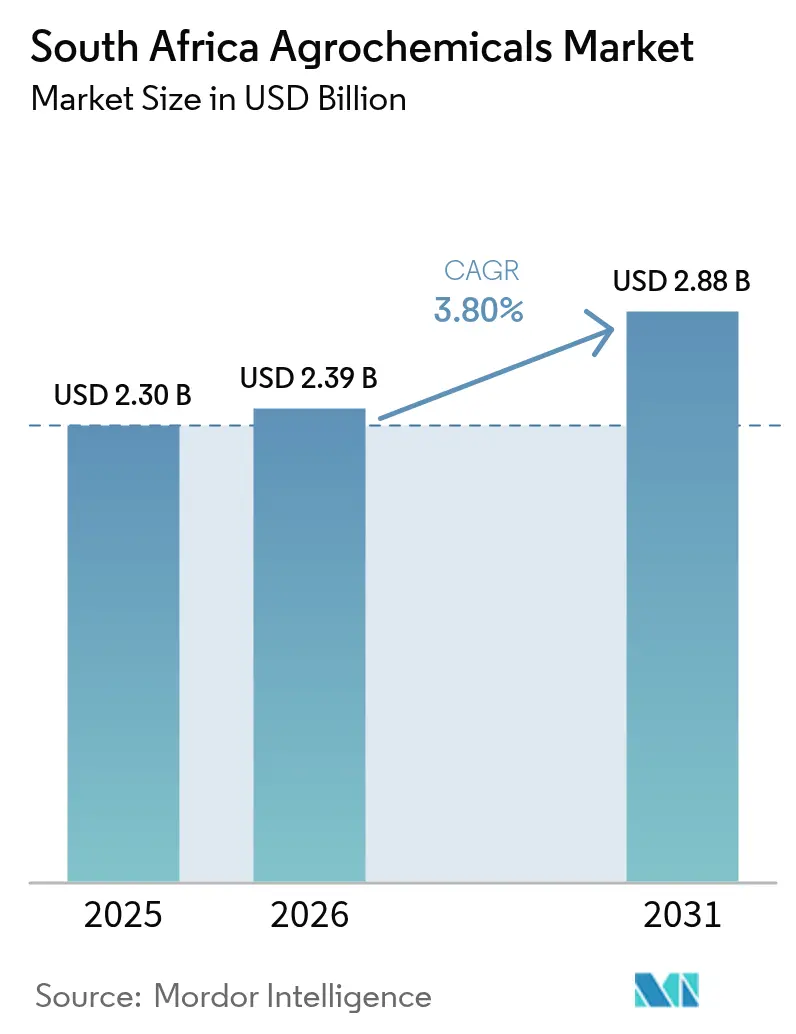
| Base Year Market Size (2025) | USD 2.3 Billion |
| Market Size (2026) | USD 2.39 Billion |
| Market Size (2031) | USD 2.88 Billion |
| Growth Rate (2026 - 2031) | 3.80 % |
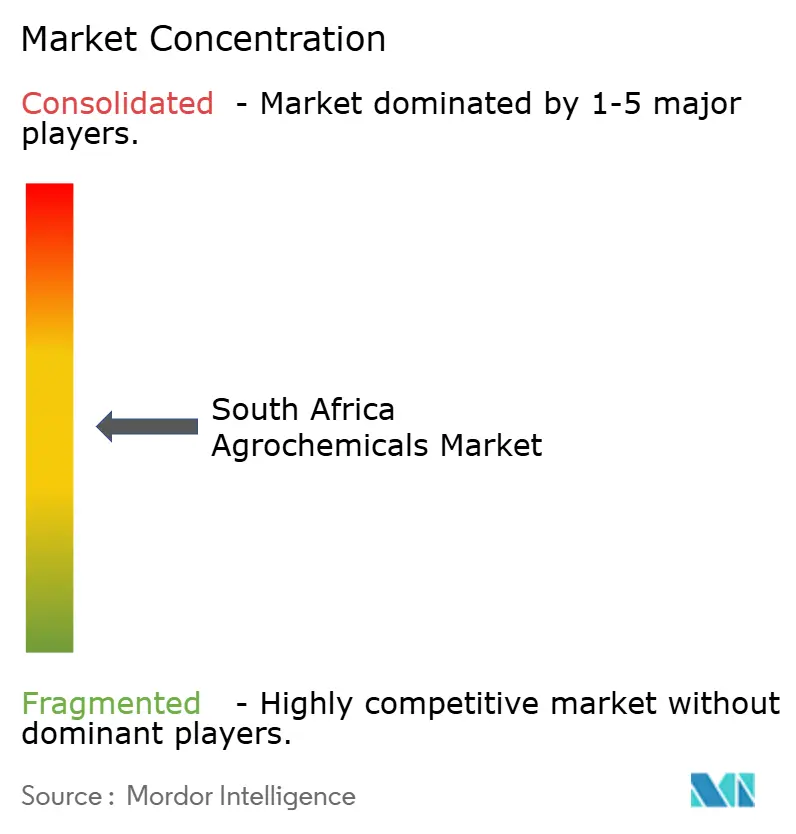
| Market Concentration | Medium |
Major Players *Disclaimer: Major Players sorted in no particular order Image © Mordor Intelligence. Reuse requires attribution under CC BY 4.0. | |
South Africa Agrochemicals Market Analysis by Mordor Intelligence
The South Africa agrochemicals market size is expected to grow from USD 2.3 billion in 2025 to USD 2.39 billion in 2026 and is forecast to reach USD 2.88 billion by 2031 at 3.8% CAGR over 2026-2031. The market growth is driven by fertilizer subsidies, commercial farm modernization, and increased adoption of precision agriculture technologies, despite high raw material costs. The government's Agriculture and Agro-processing Master Plan encourages private investment in value-addition facilities and innovation centers.[3] Companies are establishing local blending and formulation facilities to strengthen supply chains and reduce exposure to currency fluctuations on imported inputs. Industry consolidation, such as Omnia's acquisition of Oro Agri, reflects a shift toward environmentally sustainable products, helping suppliers meet stricter residue regulations and export standards.
Key Report Takeaways
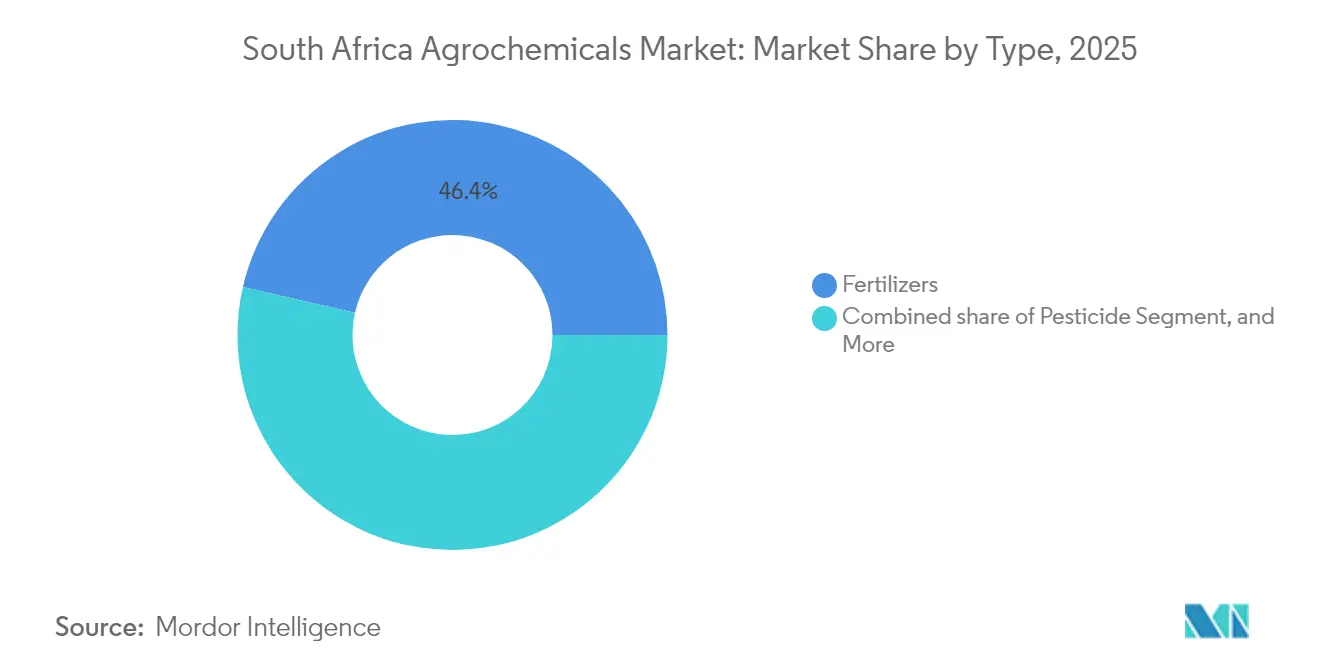
- By type, fertilizers led with 46.42% of South Africa agrochemicals market share in 2025, while adjuvants are rising the fastest at a 6.1% CAGR through 2031.
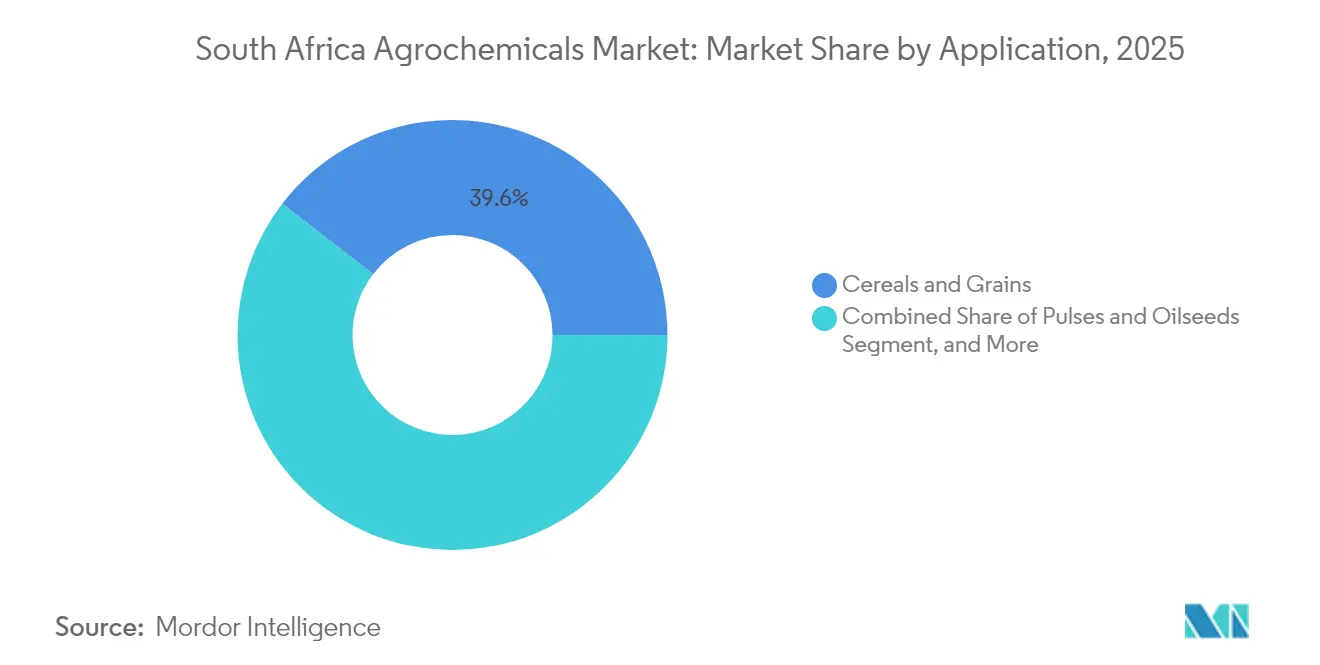
- By application, grains and cereals held 39.55% revenue share of the South Africa agrochemicals market size in 2025, and fruits and vegetables are projected to grow at a 5.45% CAGR to 2031.
- Bayer AG, Syngenta Group, Corteva Agriscience, BASF SE, and Omnia Group Limited collectively controlled nearly half of South Africa's agrochemicals market share in 2025.
Note: Market size and forecast figures in this report are generated using Mordor Intelligence’s proprietary estimation framework, updated with the latest available data and insights as of 2026.
Market Trends and Insights
Drivers Impact Analysis of South Africa Agrochemicals Market*
| Driver | ( ~ ) % Impact on CAGR Forecast | Geographic Relevance | Impact Timeline |
|---|---|---|---|
| Government Fertilizer Purchase Subsidies | +1.2% | National, focused on smallholder farmers | Medium term (2-4 years) |
| Expansion of Controlled Release Fertilizer Technologies | +0.8% | Western Cape, KwaZulu-Natal commercial farms | Long term (≥ 4 years) |
| Expansion of Commercial Farming Operations | +1.0% | Free State, Mpumalanga, Limpopo | Medium term (2-4 years) |
| Increasing Crop Disease Pressure from Climate Variability | +0.9% | National, Eastern Cape smallholders | Short term (≤ 2 years) |
| Rising Adoption of Drone Based Precision Spraying | +0.6% | Western Cape, Northern Cape commercial farms | Long term (≥ 4 years) |
| Rising Use of Plant-Growth Regulators to Maximize Fruit Set and Uniform Ripening | +0.4% | Western Cape fruit regions | Medium term (2-4 years) |
| Source: Mordor Intelligence | |||
Government Fertilizer Purchase Subsidies
South Africa's fertilizer subsidy program supports small-scale growers by reducing input costs and maintaining consistent nutrient application.[1] Diesel refunds provide relief for commercial producers, though administrative requirements limit access for smaller farms. The government's outreach efforts aim to improve subsidy distribution equity across rural communities. Regulatory oversight under agricultural legislation maintains product quality and prevents counterfeit fertilizer circulation. While subsidy voucher conversion rates vary by province, these programs contribute to food security and rural livelihoods. Extension services remain essential for farmers to access and utilize these benefits.
Expansion of Controlled Release Fertilizer Technologies
Farmers are adopting controlled-release fertilizers to match nutrient availability with crop demand, reducing environmental impact and improving water efficiency. Distribution networks in major agricultural hubs facilitate access to these formulations, particularly in grain-producing regions. Trials in regenerative farming systems demonstrate improved yields with reduced synthetic inputs. Export-oriented fruit estates increasingly use these technologies to achieve uniform ripening and visual quality for international markets. Controlled-release products decrease fertilizer application frequency, reducing labor and fuel costs, while supporting climate-smart agriculture and soil conservation.
Expansion of Commercial Farming Operations
Mechanization and digital agriculture tools increase planted area and productivity across key provinces. Smallholders achieve labor efficiency gains, allowing more time for precision monitoring and crop management. Financial platforms offering integrated services, including climate analytics and input financing, help farmers manage drought and energy-related risks. Despite rising technology adoption, equipment costs, and skilled labor shortages persist, creating opportunities for leasing and training programs. Agribusiness-cooperative partnerships help reduce technology gaps, while rural infrastructure improvements support continued growth.
Increasing Crop Disease Pressure from Climate Variability
Climate variability increases pest and disease pressure across South African farms. Warmer conditions expand invasive species distribution, including aphids and fall armyworm, increasing pesticide use in maize cultivation. While warmer seasons can increase grain production, they elevate input costs, particularly for crop protection. Balanced nutrient management remains critical for yield stability under drought conditions. Smallholders face greater challenges due to limited access to crop insurance and monitoring services. Integrated pest management approaches help reduce chemical dependence, while research institutions and farmer networks distribute early warning data and adaptation strategies.
Restraints Impact Analysis of South Africa Agrochemicals Market*
| Restraint | ( ~ ) % Impact on CAGR Forecast | Geographic Relevance | Impact Timeline |
|---|---|---|---|
| Raw Material Price Volatility | -1.1% | National, high import exposure provinces | Short term (≤ 2 years) |
| Stricter MRL Regulations on Synthetics | -0.7% | Export-oriented Western Cape fruit zone | Medium term (2-4 years) |
| Shift Toward Regenerative, Low Input Farming | -0.6% | Durban and Cape Town corridors | Short term (≤ 2 years) |
| Export Restrictions on Key Fertilizer Ingredients | -0.5% | Eastern Cape and KwaZulu-Natal smallholders | Medium term (2-4 years) |
| Source: Mordor Intelligence | |||
Raw Material Price Volatility
Fertilizer price volatility affects the agricultural sector by increasing working capital requirements and complicating input planning. Large-scale producers manage these challenges through early procurement and local blending initiatives. Small-scale farmers often respond by reducing application rates or using lower-quality inputs, which reduces crop yields and soil fertility. Global supply chain disruptions, geopolitical conflicts, and export restrictions intensify these challenges. Currency fluctuations and energy costs increase input price unpredictability, potentially leading to delayed planting decisions and reduced investment in productivity-enhancing technologies.
Stricter MRL Regulations on Synthetics
The implementation of stringent maximum residue level (MRL) regulations affects crop protection practices across the industry. Exporters and processors must modify their spray programs and product formulations to meet these enhanced standards, increasing operational costs. Product labeling and safety documentation requirements create operational challenges, particularly for small-scale distributors. The regulations require increased coordination between manufacturers, retailers, and compliance bodies. Non-compliance with new standards risks market access, especially for export-oriented producers.
*Our forecasts treat driver/restraint impacts as directional, not additive. The impact forecasts reflect baseline growth, mix effects, and variable interactions.
South Africa Agrochemicals Market Segment Analysis
By Type:
Fertilizers Lead Market TransformationFertilizers dominate the South Africa agrochemicals market share, commanding 46.42% of the total share in 2025, primarily due to intensive sugarcane cultivation. The segment's growth is supported by controlled-release formulations that improve nutrient efficiency in water-scarce conditions. Nitrogen pricing volatility influences grower decisions on application timing and rates, while government subsidies help small-scale farmers manage cost variations. The phosphatic fertilizer segment faces supply constraints due to export limitations, while potash remains stable but is subject to transportation risks. Fertilizer manufacturers are incorporating micronutrients into premium blends specifically designed for export-oriented horticultural crops.
Adjuvants are experiencing the fastest growth in the South Africa agrochemicals market, with a projected 6.1% CAGR through 2031. The integration of technology improves nutrient-use efficiency, supporting regenerative farming practices. Large commercial farms use digital soil monitoring systems and variable-rate spreaders to reduce application overlap and optimize input usage. Small-scale farmers access fertilizer spreading services through cooperatives, maintaining consistent fertilizer demand despite stabilizing application rates. Infrastructure investments in inland bulk terminals improve supply reliability and reduce transportation costs, particularly benefiting rural areas affected by currency fluctuations.

By Application:
Grains Drive Volume, Fruits and Vegetables Accelerate GrowthGrains and cereals constitute the largest application segment, accounting for 39.55% of the South Africa agrochemicals market size in 2025. Maize production requires balanced fertilizer programs and strategic pesticide applications, with improved technology enabling precise application methods. The adoption of conservation tillage and cover crop systems maintains herbicide demand for managing crop residue while preserving soil quality.
The fruits and vegetables segment is growing at a 5.45% CAGR through 2031, supported by strong export prices that justify higher input investments. Western Cape fruit operations depend on plant-growth regulators and specific fungicide programs to meet international market requirements. Growth continues as vineyard and berry farm operations expand, while greenhouse cultivation systems increase local pesticide use intensity. Farmers maintain profitability through data-driven management practices and premium product positioning, despite increasing input expenses.
Geography Analysis
Western Cape, KwaZulu-Natal, and Free State anchor South Africa’s commercial agrochemical demand, each reflecting distinct cropping systems and input strategies. Western Cape leads the market with the largest share, driven by fruit orchards that rely heavily on high-spec inputs and plant-growth regulators. Export protocols shape precise spray schedules, and orchardists increasingly turn to specialty products to manage climatic challenges like insufficient winter chilling.
KwaZulu-Natal blends sugarcane estates with horticultural zones, resulting in strong fertilizer demand and rising adjuvant use, especially for aerial applications. The subtropical climate intensifies fungal disease pressure, prompting widespread use of systemic fungicides. Proximity to Durban’s port and rail infrastructure improves input access, though congestion risks encourage growers to maintain on-farm reserves for uninterrupted operations. Free State dominates maize and wheat production, focusing on bulk fertilizer shipments and herbicide programs that support conservation tillage. While adoption of advanced formulations is slower due to cost sensitivity, cooperative trials show potential for improved nutrient efficiency. Short growing seasons make timely delivery critical, and regional logistics continue to evolve to meet seasonal demand. Inland provinces like Limpopo and Gauteng add diversity, with irrigation-driven citrus and macadamia expansion and intensive peri-urban vegetable farming shaping localized input needs.
Regulatory Landscape
Agrochemicals in South Africa are regulated primarily under the Fertilizers, Farm Feeds, Agricultural Remedies and Stock Remedies Act, 1947 (Act 36 of 1947), which covers registration, importation, manufacture, sale, and use of agricultural remedies. The Registrar of Act 36 of 1947, housed in the Directorate: Agriculture Inputs Control (DAIC), administers registrations and requires that entities importing, manufacturing, or selling agricultural remedies be registered with the Registrar and be a South African citizen or a juristic person with a registered office in South Africa.
Compliance requirements have tightened through amendments and implementation actions affecting product availability and time-to-market. Regulations restrict registrations and renewals for products containing designated substances of concern after 1 June 2024 unless a derogation is granted following risk assessment and public comment. This increases the importance of portfolio reviews and alternative actives. From 1 April 2026, the Department of Agriculture stopped accepting manual applications for pesticide registrations as submissions transition to a digital or updated submission protocol. Packaging and labeling must also align with SANS 10229, which raises documentation and compliance demands for registrants and distributors.
Competitive Landscape
The South Africa agrochemicals market remains moderately fragmented, with the five largest players holding nearly a half share in 2024. Bayer AG, Syngenta Group, Corteva Agriscience, BASF SE, and Omnia Group Limited collectively control this portion of the market. These companies maintain their positions through diversified portfolios, strategic acquisitions, and strong distribution networks. Their market presence is supported by technical expertise, brand recognition, and integration with commercial farming systems. Investment in local blending facilities and agronomic support strengthens their reach across estate-scale and smallholder operations.
Digital platforms are transforming supplier engagement by simplifying ordering processes and improving advisory services. Local specialists expand operations to provide rapid-response inputs and customized agronomic support. Data analytics and remote diagnostics optimize input usage and minimize waste. The integration of precision agriculture tools into crop management strategies improves operational efficiency and strengthens supplier relationships. These platforms also enable traceability and compliance monitoring, which are essential for export-oriented growers and high-value horticultural producers across key provinces.
Supply chain resilience has become a strategic priority, with companies investing in inland warehousing, on-site formulation, and port logistics to manage market volatility. The complex regulatory environment benefits well-capitalized companies that can effectively navigate compliance requirements. These factors create entry barriers for new players while strengthening established firms' positions. Companies adapt to changing climate conditions and infrastructure limitations by modifying delivery models and regional service offerings. Long-term success depends on operational agility, regulatory understanding, and consistent product availability throughout growing seasons.
South Africa Agrochemicals Industry Leaders
-
Bayer AG
-
Syngenta Group
-
Corteva Agriscience
-
BASF SE
-
Omnia Group Limited
- *Disclaimer: Major Players sorted in no particular order
South Africa Agrochemicals Market Companies Covered in this Report
- Bayer AG
- Syngenta Group
- Corteva Agriscience
- BASF SE
- FMC Corporation
- UPL Limited
- Yara International ASA
- Sumitomo Chemical Co., Ltd.
- Gowan Company (Isagro S.r.l.)
- Rovensa S.A (Partners Group)
- Sasol Limited
- K+S Aktiengesellschaft
- Omnia Group Limited
- AECI Limited
- Rolfes Agri (Pty) Ltd. (DPI- Solevo Group)
Market Opportunities and Future Outlook
Regulatory actions under Act 36 of 1947 are reshaping product portfolios and creating space for lower-residue and biologically derived crop protection, especially in export-oriented horticulture where maximum residue level (MRL) compliance is central to market access. The prohibition process around Terbufos points to the enforcement direction: a prohibition notice was gazetted in January 2026 following cabinet approval in June 2025, and in May 2026 the Agriculture Minister, John Steenhuisen, published a notice banning acquisition, disposal, sale, and use of agricultural remedies containing Terbufos. Alongside this, the 2023 Regulations Relating to Agricultural Remedies are adding phase-out pressure for substances of concern, with renewal cut-offs after 1 June 2024 unless derogations are obtained.
Opportunities are also emerging in compliance-enabled distribution models and advisory services, since restricted agricultural remedies require tighter controls over who can buy and apply them, including registration requirements for Pest Control Operators (PCOs) for certain categories. The shift to digital registration submissions from 1 April 2026 increases demand for local regulatory capability, dossier management, and reformulation work that maintains efficacy while meeting residue and hazard constraints. Named company activity in biological and residue-focused solutions in South Africa (for example, biological insecticide introductions targeted at high-value export crops) supports the commercial pathway for alternatives alongside conventional chemistries where resistance management and label-compliant programs still matter.
Recent Industry Developments in South Africa Agrochemicals Market
- June 2026: Bayer Crop Science South Africa introduced FLiPPER, a biological contact insecticide positioned for high-value crops such as citrus, table grapes, and blueberries. The launch supports spray programs designed around export residue requirements, reinforcing the shift toward biological and lower-residue crop protection options in South Africa.
- August 2025: BASF Agricultural Solutions South Africa launched Revytek, a fungicide for maize disease management. The introduction broadened fungicide choices for a major field-crop segment, where disease pressure and resistance management drive product rotation and program upgrades.
- August 2024: BASF Agricultural Solutions South Africa launched Revycare for citrus black spot, featuring the Revysol active ingredient. This added a targeted option for an export-linked crop system where compliance with buyer protocols and residue limits influences product selection and timing.
South Africa Agrochemicals Market Report Scope and Research Methodology
Market Definition and Coverage
For this study, the market covers the value of agrochemical products sold and used in South Africa for crop production, including fertilizers, pesticides, adjuvants, and plant growth regulators, across major crop groups and managed turf and ornamental uses.
Scope exclusions: We exclude farm equipment, irrigation systems, seeds, and purely advisory services because these do not represent agrochemical product revenues.
Segments Covered in This Report
- By Type
- Fertilizers
- Nitrogenous
- Phosphatic
- Potassic
- Other Fertilizers
- Pesticides
- Herbicides
- Insecticides
- Fungicides
- Other Pesticides
- Adjuvants
- Plant-Growth Regulators
- Fertilizers
- By Application
- Grains and Cereals
- Oilseeds and Pulses
- Fruits and Vegetables
- Plantation Crops
- Turf, and Ornamentals
Data Sources, Market Sizing, and Validation
Desk Research
Desk research was used to set the base context for demand and pricing in South Africa, then to sanity check what we heard in interviews. We referred to public sources such as South Africa government agriculture and trade statistics, customs and tariff-line import and export releases, and regulator or standards-body publications that shape product use and registrations.
To understand demand direction, we also used sources such as FAO data for crop area and yields, World Bank macro indicators, and agriculture research outputs from universities and peer-reviewed journals on pests, resistance, and crop protection practices. Company annual reports, investor presentations, and reputable press were reviewed to understand channel coverage and product-mix shifts. We used a paid subscription for company financials and a shipment-level trade database selectively to cross-check supplier exposure and import intensity. The sources listed here are illustrative only, and many other public documents and datasets were reviewed for data collection, validation, and clarification.
Primary Interviews and Surveys
Primary work focused on validating what is purchased in-season and how pricing moves, especially when exchange rates and input costs change. We interviewed manufacturers, importers, distributors, large farm operators, and agronomy advisors across key producing provinces, then used these inputs to confirm product splits, usage rates, and realistic price bands by crop and chemistry.
The discussions also helped close gaps where public data is not detailed enough, including how much demand is served via imports versus local formulation, and how channel margins and discounting change between years.
Distribution of primary research fieldwork respondents
| Company type | Respondent position |
|---|---|
| Top tier: 32% | CXOs: 22% |
| Mid tier: 46% | Functional/Unit leaders: 22% |
| Smaller Players: 22% | Managers: 56% |
Market-Sizing & Forecasting
Sizing started with a top-down demand pool build using crop area and cropping intensity across grains and cereals, oilseeds and pulses, fruits and vegetables, plantation crops, and turf and ornamentals, then combined with typical application intensity by product group. To keep the model practical, we used market fingerprints such as planted hectares by crop, pest and disease pressure cycles, fertilizer nutrient demand direction, import dependence for active ingredients, and in-season price moves that follow exchange-rate swings.
The totals were then corroborated using selective bottom-up checks, including sampled price per liter or kilogram multiplied by estimated volumes through key channels, and supplier exposure checks based on public financial disclosures and trade flows. Where direct volumes were unclear, gaps were handled by using crop-level usage rate ranges confirmed in interviews, followed by conservative mid-point selection and sensitivity checks.
For forecasting, scenario analysis was used because volumes and pricing are both affected by weather, global input costs, and currency shifts. The scenarios were tied back to crop area outlook and expected changes in product mix (for example, movement toward higher value formulations). Assumptions were reviewed with primary respondents so the final trajectory aligned with on-ground buying behavior.
Data Validation & Update Cycle
Outputs were validated through triangulation across independent signals, such as crop area changes, trade flow direction, and observed retail price movement during the season. When a number looked out of line, the driver was traced back to either a usage-rate assumption, an ASP input, or a crop weighting issue, and then corrected only after re-checking with at least one additional source.
Before sign-off, the model and write-up go through multi-step analyst review so calculation logic, units, and year labeling stay consistent. Reports are refreshed annually, and interim updates are triggered when there are material events such as sharp currency moves, regulatory changes, or major shifts in import availability. Right before delivery, a final pass is completed so clients receive the latest updated view.
Mordor Intelligence's South Africa Agrochemicals Market Size Measured Against Other Published Estimates
Published market sizes for South Africa agrochemicals can look far apart because the timing of currency conversion, the way average selling prices are normalized across a season, and how imports are treated versus local formulation are not handled the same way by all authors. Differences also appear when one study places more weight on crop protection only, while another rolls in a wider crop nutrition and adjacent on-farm inputs basket.
In our refresh-led approach, the ASP layer is recalibrated each cycle using current-year channel feedback and observed trade-linked cost movement, and the exchange-rate window used is kept consistent with the selling season. This is then checked back against demand signals by crop and product group, a discipline applied by Mordor Intelligence.
Benchmark comparison
| Source | Market Size | Gaps in Research Methodology |
|---|---|---|
| Mordor Intelligence | USD 2.39 B (2026) | |
| Global Consultancy A | USD 1.29 B (2024) | Uses an earlier base year and a narrower pricing window, which can understate inflation-led ASP movement, and it may not fully carry through the same application coverage across fertilizers, adjuvants, and growth regulators. |
| Industry Publisher B | USD 1.80 B (2033) | Anchors on a long-range end-year point with broad CAGR smoothing, which can mask short-cycle FX and input-cost shocks, and the forward value is sensitive to how the product mix is assumed to shift over the period. |
Taken together, the spread mostly comes from timing and scope choices rather than a single right or wrong number. By keeping the currency timing, ASP normalization, and crop-linked demand checks explicit, the estimate stays traceable to practical inputs that can be re-tested as conditions change.
Key Questions Answered in the Report
How large is the South Africa agrochemicals market in 2026?
The market stands at USD 2.39 billion in 2026 and grows toward USD 2.88 billion by 2031 at a 3.8% CAGR.
Which segment accounts for the highest revenue?
Fertilizers lead with 46.42% of total sales to support intensive sugarcane and grain nutrition needs.
Which input type is growing the fastest?
Adjuvants record the fastest growth at a 6.1% CAGR due to precision spraying integration.
How concentrated is supplier competition?
The five largest manufacturers control 46% of sales, pointing to moderate fragmented and room for new entrants.