
Permanent Magnet Market Size and Share
Market Overview
| Study Period | 2021 - 2031 |
|---|---|
| Market Size (2026) | USD 54.91 Billion |
| Market Size (2031) | USD 74.11 Billion |
| Growth Rate (2026 - 2031) | 6.18 % |
| Fastest Growing Market | Asia Pacific |
| Largest Market | Asia Pacific |
| Market Concentration | Low |
Major Players *Disclaimer: Major Players sorted in no particular order Image © Mordor Intelligence. Reuse requires attribution under CC BY 4.0. | |
Permanent Magnet Market Analysis by Mordor Intelligence
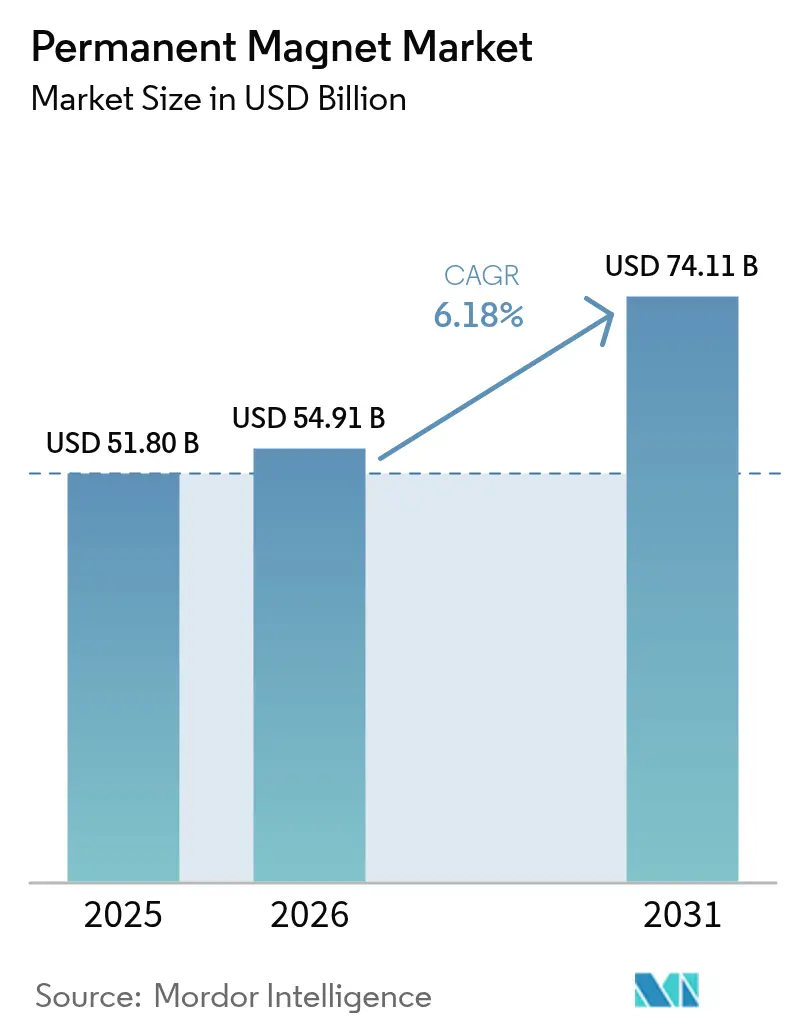
The Permanent Magnet Market size is projected to grow from USD 51.80 billion in 2025 to USD 54.91 billion in 2026, and reach USD 74.11 billion by 2031, growing at a CAGR of 6.18% from 2026 to 2031. Electrification requirements in transportation, renewable-energy targets, and precision-manufacturing upgrades are aligning to lift long-term demand for high-energy-density grades, particularly sintered neodymium-iron-boron (NdFeB) magnets. Ferrite magnets still contribute nearly half of 2025 revenue because they are cost-competitive in auxiliary motors and low-power devices; however, designers of traction drives and direct-drive wind generators are migrating toward rare-earth compositions that tolerate higher temperatures and stronger magnetic fields. Magnet suppliers are narrowing dysprosium content through grain-boundary diffusion to cut exposure to volatile heavy rare-earth prices, while downstream buyers invest in recycling loops that reclaim neodymium from end-of-life motors and hard-disk drives. Moderate industry concentration allows regional specialists to succeed in additive manufacturing, grain-boundary-diffused chemistries, and custom small-lot runs that quickly prototype geometrically complex parts for aerospace, robotics, and medical imaging.
Key Report Takeaways
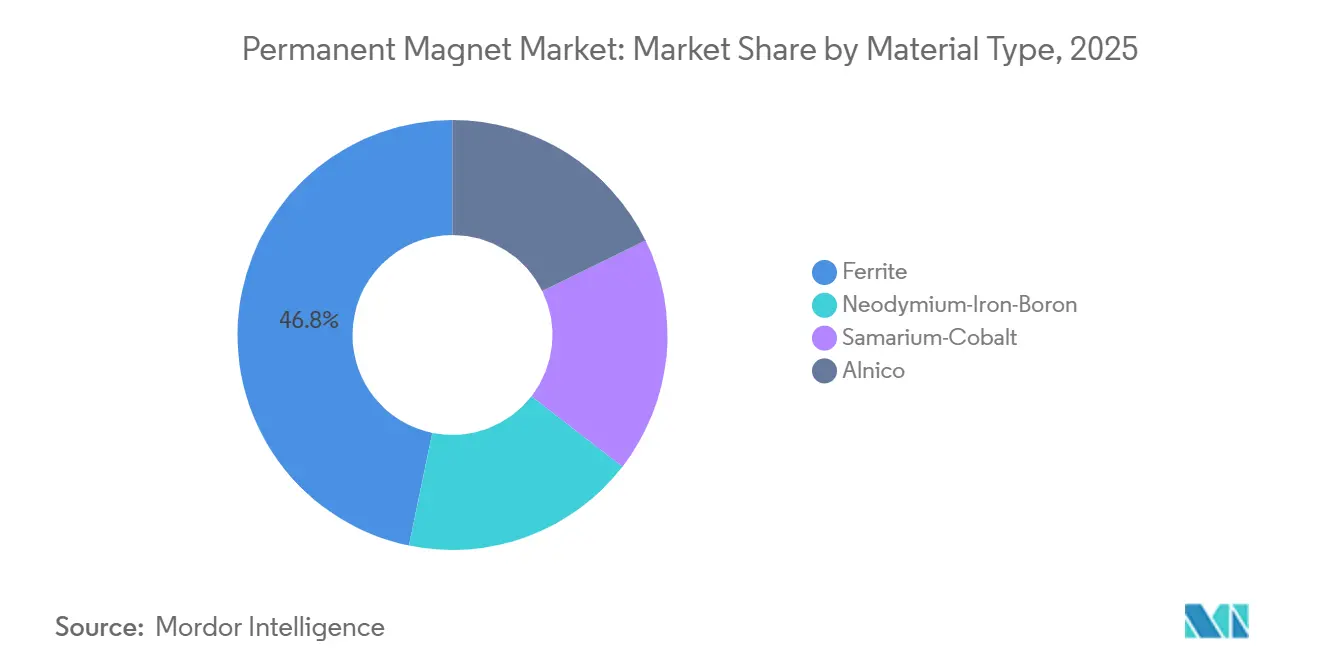
- By material type, ferrite magnets held 46.76% of the permanent magnet market share in 2025, while neodymium-iron-boron grades are forecast to post the fastest 7.18% CAGR through 2031.
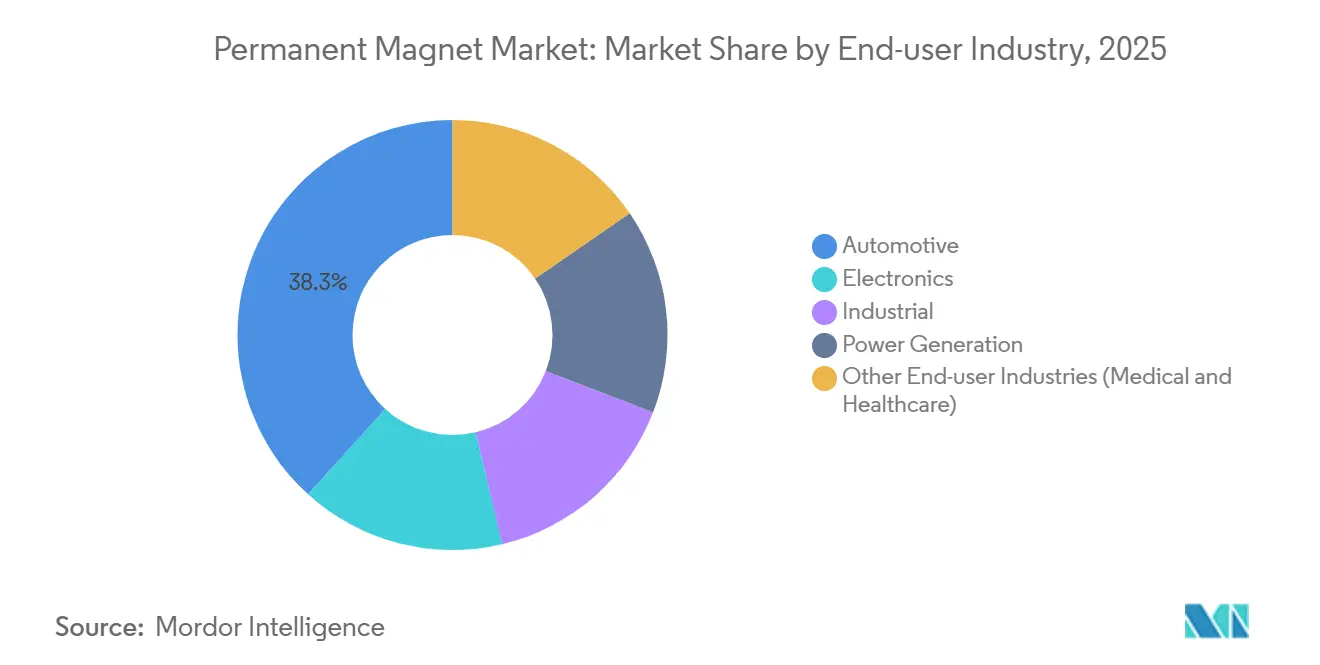
- By end-user industry, automotive led with 38.29% revenue share in 2025; Other end-user industries segment including medical imaging and surgical robotics, are set to grow at an 8.54% CAGR to 2031.
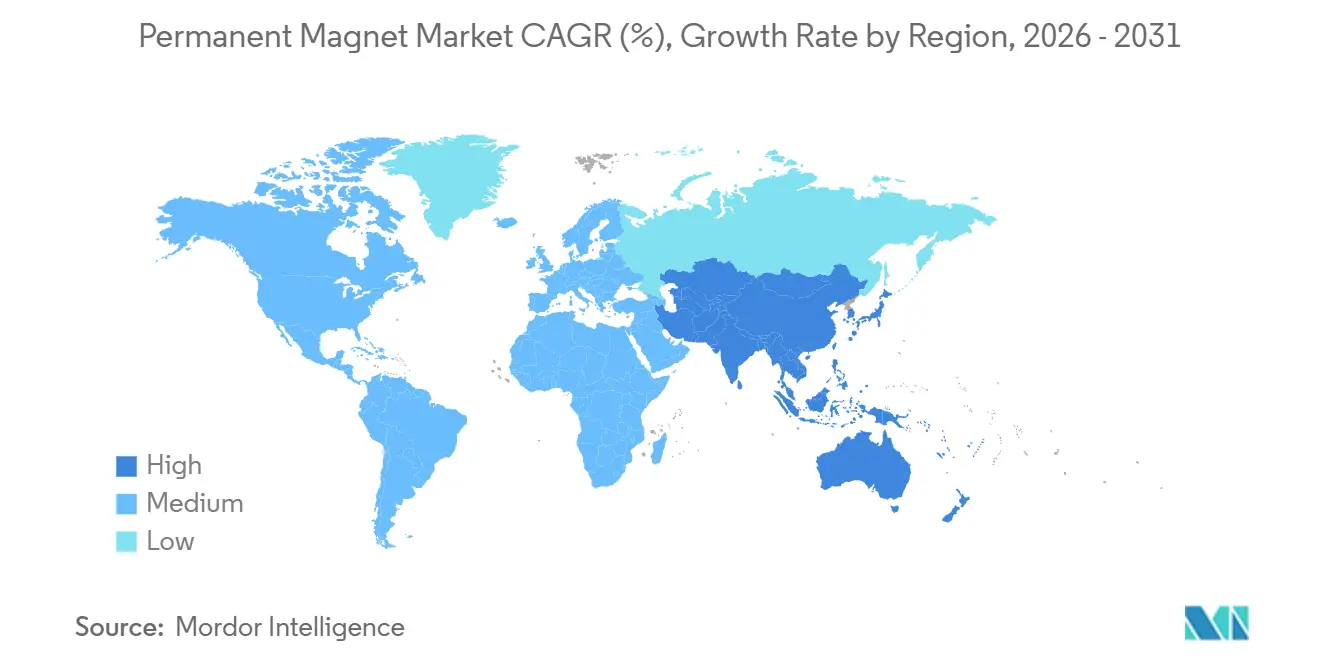
- By geography, Asia-Pacific captured 53.72% of 2025 revenue and is advancing at a 7.25% CAGR through 2031.
Note: Market size and forecast figures in this report are generated using Mordor Intelligence’s proprietary estimation framework, updated with the latest available data and insights as of 2026.
Market Trends and Insights
Drivers Impact Analysis of Permanent Magnet Market*
| Drivers | (~) % Impact on CAGR Forecast | Geographic Relevance | Impact Timeline |
|---|---|---|---|
| Electrification of passenger and commercial EV fleets | +1.8% | Global, led by Asia-Pacific and Europe | Medium term (2-4 years) |
| Surging direct-drive wind-turbine installations | +1.2% | Offshore Europe, China, US Atlantic Coast | Long term (≥ 4 years) |
| Miniaturization in high-precision consumer electronics | +0.9% | Core Asia-Pacific, spillover to North America | Short term (≤ 2 years) |
| Industrial automation and humanoid-robot investments | +1.4% | North America, Europe, Japan, emerging China | Medium term (2-4 years) |
| Commercialization of 3-D-printed net-shape magnets | +0.5% | North America and Europe | Long term (≥ 4 years) |
| Source: Mordor Intelligence | |||
Electrification of Passenger and Commercial EV Fleets
Battery-electric vehicle output hit 14 million units in 2025, with each passenger car averaging 2 kg of sintered NdFeB and heavy trucks using up to 8 kg. BYD’s e-platform 3.0 specified 180 °C-rated NdFeB rotors, while Daimler Truck and Volvo doubled magnet content in dual-motor drivetrains. The Euro 7 tailpipe rule, effective July 2025, locks in permanent-magnet synchronous machines for new urban buses, embedding long-run demand across a 40,000-unit replacement cycle in the permanent magnet market.
Surging Direct-Drive Wind-Turbine Installations
Offshore wind added 22 GW in 2025, and 68% used direct-drive generators that require 600–1,200 kg of NdFeB per turbine. China’s 42 GW pipeline and recent US lease areas specify the same topology, tightening the supply–demand balance for high-grade rare-earth magnets.
Miniaturization in High-Precision Consumer Electronics
Apple’s iPhone 16 employed ultra-thin sintered NdFeB micro-magnets that raised haptic force by 30% while cutting volume 18%True-wireless earbuds shipped 450 million units in 2025, absorbing 135 tons of NdFeB, a margin-rich niche driven by stringent grinding and coating tolerances. Foldable handsets like Samsung Galaxy Z Fold 6 integrated detent magnets that further lifted ultra-thin demand.
Industrial Automation and Humanoid-Robot Investments
Figure AI’s 28-joint humanoid packs 2.1 kg of high-grade NdFeB, and Series C funding signals intent to reach 500,000 units by 2028. Factory servo-motor shipments in China jumped 19% in 2025 as pneumatic drives were swapped for permanent-magnet frameless motors offering 40% energy savings. Boston Dynamics deployed linear-motor warehouse robots that clock 800 box moves per hour, highlighting throughput gains that justify premium magnet grades and support demand across the permanent magnet market.
Restraints Impact Analysis of Permanent Magnet Market*
| Restraints | (~) % Impact on CAGR Forecast | Geographic Relevance | Impact Timeline |
|---|---|---|---|
| Rare-earth price volatility and export controls | -0.8% | Global, acute for non-Chinese producers | Short term (≤ 2 years) |
| Rise of ferrite/soft-magnetic composite substitutes | -0.6% | Automotive and industrial auxiliaries | Medium term (2-4 years) |
| Patent restrictions on high-grade NdFeB technology | -0.3% | Producers in Southeast Asia and India | Long term (≥ 4 years) |
| Source: Mordor Intelligence | |||
Rare-Earth Price Volatility and Export Controls
Neodymium oxide spiked 42% in 2025 after Myanmar halted heavy-rare-earth output and China imposed a 15% export tariff, squeezing non-Chinese refiners and trimming Lynas margins to 22%. Spot prices of praseodymium-neodymium alloy averaged USD 68/kg, adding USD 32 to a 2 kg EV motor bill-of-materials, creating cost pressures across the permanent magnet market.
Rise of Ferrite/Soft-Magnetic Composite Substitutes
TDK’s 0.46-T ferrite launched in 2025 allowed Volkswagen to replace bonded NdFeB in 12-V auxiliaries, displacing 180 tons annually. Soft-magnetic composites climbed to 8% of industrial servo shipments, valued by conveyor and packaging OEMs that prioritize cost stability above peak torque.
*Our forecasts treat driver/restraint impacts as directional, not additive. The impact forecasts reflect baseline growth, mix effects, and variable interactions.
Permanent Magnet Market Segment Analysis
By Material Type:
NdFeB Premiumization Reshapes MixNeodymium-Iron-Boron (NdFeB) magnets outpace the permanent magnet market at 7.18% CAGR through 2031 as electric-mobility and wind-power designers demand energy products above 35 MGOe. Ferrite retained 46.76% of 2025 revenue because smartphones, loudspeakers, and low-speed motors value low cost per kilogram, yet its share erodes as traction motors standardize on sintered NdFeB. Samarium-cobalt remains a niche for aerospace and oil-and-gas tools thanks to stability beyond 250 °C, while alnico slips under 5% after rare-earth options displaced it in sensors and precision instruments. Shin-Etsu shipped 14% more sintered NdFeB in fiscal 2025, underscoring the shift from bonded forms.
Bonded NdFeB is relegated to thin micro-speaker rings and smartwatch haptics where net-shape molding outweighs energy limits. The permanent magnet market size for NdFeB is therefore projected to capture an outsized share of absolute value gains through 2031 while ferrite largely tracks global GDP.



By End-User Industry:
Medical and Automotive Drive Divergent TrajectoriesAutomotive captured 38.29% of 2025 revenue, with battery-electric platforms averaging 3.5 kg of permanent magnets versus 0.8 kg in internal-combustion vehicles. Tight Euro 7 rules and China’s zero-emission bus mandates support sustained demand for high-grade rotors, steering assist, and brake-by-wire actuators. In contrast, the Other end-user industries’ segment, led by MRI scanners and surgical robots, is expanding at an 8.54% CAGR—higher than any other segment—because 3 T and 7 T machines require large shimming arrays containing 1,800 kg of NdFeB per unit.
Electronics posted a modest rise in 2025 as handset shipments cooled, yet wearables and earbuds partly compensated, maintaining steady ferrite and bonded-rare-earth pull. Industrial machinery growth is driven by servo-motor retrofits that replace hydraulics, while power generation is growing amid offshore wind orders for direct-drive units. Collectively, these dynamics keep the permanent magnet market size expanding even where unit volumes plateau.
Geography Analysis
APAC Permanent Magnet Market
Asia-Pacific generated 53.72% of global value in 2025 and is rising at a 7.25% CAGR, reinforcing its leadership in the permanent magnet market. China alone refined 85% of global rare-earth oxides and produced 187,000 tons of NdFeB magnets, bolstered by low electricity costs and integrated mine-to-magnet clusters[2]China MIIT, “Statistical Bulletin 2025,” miit.gov.cn. Japan maintains technology leadership, but limited domestic raw materials capped output at 31,000 tons. India’s production grew 18% under Production-Linked Incentives that reimburse up to 20% of capital outlay for new plants.
North America and Europe Permanent Magnet Market
North America plus Europe accounted for significant revenue in 2025. MP Materials’ Stage II refinery produced neodymium-praseodymium oxide in California, marking the first US upstream step toward integrated magnets since 2015, strengthening the US permanent magnet market. Germany’s VACUUMSCHMELZE lifted Hanau's sintering capacity 30% to supply European EV plants under multiyear take-or-pay contracts.
EMEA, South America and APAC Permanent Magnet Market
South America and the Middle East and Africa are witnessing a rising demand for permanent magnets. Brazil’s offshore wind build-out supports local magnet assemblies, and South African mines install permanent-magnet conveyor drives to save 25% energy. South Korea exported 18,000 tons of magnets in 2025, feeding Vietnamese and Thai supply chains. Across Europe, the extended Ecodesign Directive, effective 2025, pushes industrial motor efficiency thresholds that effectively favor permanent-magnet synchronous machines in ratings above 7.5 kW.

Value Chain Analysis
The value chain starts with rare-earth mining and beneficiation (notably for neodymium, praseodymium, dysprosium, and terbium) and with non-rare-earth inputs (iron, boron, and barium/strontium for ferrites). Processing and separation into oxides and metals/alloys remain the key choke points for rare-earth magnets, and China retains a dominant position across mining, refining, and finished sintered NdFeB output. Heavy rare earths (dysprosium and terbium) are still a bottleneck for high-temperature grades used in EV traction motors and direct-drive wind generators. Upstream volatility and policy actions flow through to midstream costs, including the 2026 US Section 301 duty environment for imported NdFeB magnets, which is pushing buyers to reassess sourcing and logistics.
Midstream steps include powder making (strip casting, hydrogen decrepitation/milling), pressing and sintering, heat treatment, machining/grinding, and surface coating, followed by magnetization and quality testing. Downstream, magnets move through component makers and tier suppliers into end uses such as automotive traction and auxiliary motors, wind generators, industrial servos, and consumer electronics. Distribution is split between direct supply contracts for large OEM programs and specialist channels for custom geometries and small-lot runs. The chain is becoming more regionalized through new or expanding capacity nodes and recycling loops, including MP Materials moving forward with its Northlake, Texas magnet facility and US Department of Defense funding to ReElement Technologies for refining and magnet recycling equipment in Marion, Indiana. Europe is also adding non-China capacity through Neo Performance Materials magnet manufacturing in Narva, Estonia.
Competitive Landscape
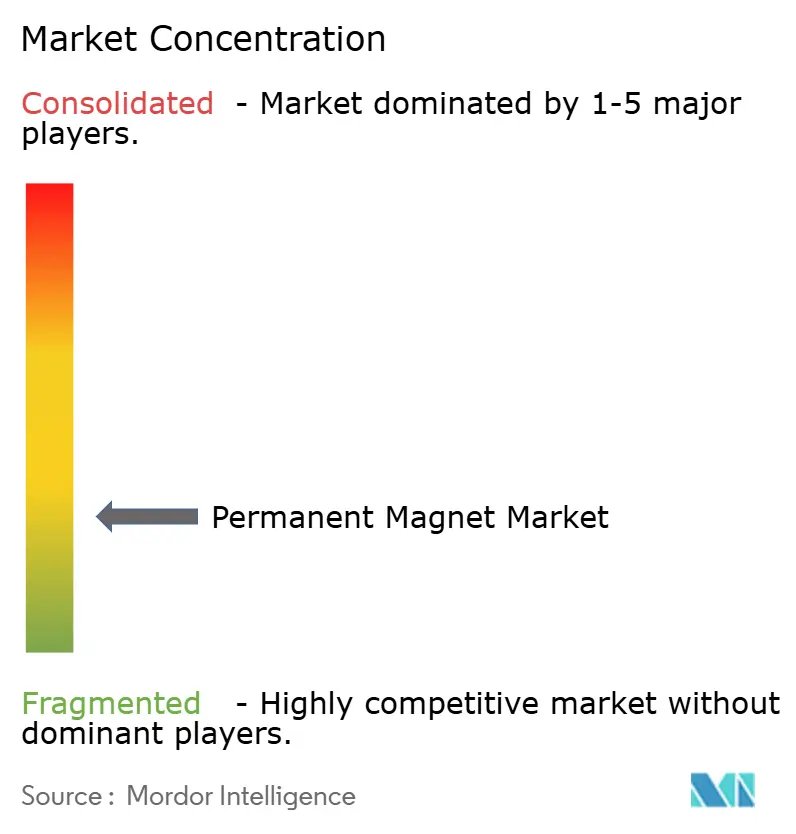
The permanent magnet market is fragmented in nature. Miners are integrating forward; Lynas and Blue Line will build a USD 450 million Texas magnet plant leveraging domestic rare-earth feedstock. Automakers such as General Motors and Stellantis invested USD 320 million in minority stakes in magnet fabrication, locking in supply.
Recycling is emerging as a competitive plank. Hitachi Metals recovered 98% of neodymium and dysprosium from retired hard-disk drives in a pilot that yielded 120 tons of oxides at costs 30% below virgin input, projecting 15% recycled feedstock coverage by 2030. Start-ups explore non-rare-earth chemistries; Niron Magnetics piloted iron-nitride magnets at 28 MGOe, suitable for cost-sensitive conveyor drives. Patent activity rose 22% in 2025, two-thirds from Chinese applicants, as firms race to reduce heavy-rare-earth use without violating existing diffusion claims.
Permanent Magnet Industry Leaders
Hitachi Metals, Ltd.
JL MAG Rare-Earth Co., Ltd.
Shin-Etsu Chemical Co., Ltd.
NINGBO YUNSHENG co., Ltd
VACUUMSCHMELZE GmbH & Co. KG
- *Disclaimer: Major Players sorted in no particular order
Permanent Magnet Market Companies Covered in this Report
- Arnold Magnetic Technologies
- Daido Steel Co., Ltd.
- Dmegc.de
- Galaxymagnets
- Hitachi Metals, Ltd.
- JL MAG Rare-Earth Co., Ltd.
- Lynas Rare Earths Ltd.
- NEO
- NINGBO YUNSHENG co., Ltd
- Powder Metallurgy
- Shin-Etsu Chemical Co., Ltd.
- TDK Corporation
- VACUUMSCHMELZE GmbH & Co. KG
- Yantai Zhenghai Magnetic Material Co.,Ltd.
- Zhongke Sanhuan

Market Opportunities and Future Outlook
Non-China, qualified NdFeB supply built around localized refining, alloying, and sintering is emerging as a key opportunity area, supported by government programs and corporate vertical integration. India approved an INR 7,280 crore scheme (announced in 2025) to establish 6,000 MTPA of integrated rare earth permanent magnet capacity, while the UK government announced a GBP 50 million Critical Minerals Programme and a GBP 20 million Magnet Hub competition (June 2026) to support domestic manufacturing. In the United States, policy focus and legislative activity around magnet supply chains, including the introduction of the Magnets Value Chain Support Act of 2026, aligns with build-outs such as MP Materials selecting a 120-acre Northlake, Texas site for its 10X magnet manufacturing campus and USA Rare Earth commissioning a Phase 1a commercial magnet production line at its Stillwater, Oklahoma facility.
Circular supply and heavy-rare-earth risk reduction offer a second opportunity track across EV, HVAC, and industrial motors. Buyers are pursuing cost and supply stability rather than relying only on higher-energy products. HyProMag USA advancing expansion concept studies (January 2026) for recycling hubs in South Carolina and Nevada points to efforts to scale recycled NdFeB feedstock, complementing magnet makers work to reduce dysprosium content through process and chemistry improvements. On the demand side, direct-drive wind, EV traction, and industrial automation continue to pull high-grade sintered NdFeB, while ferrite substitution in lower-power auxiliaries creates a more cost-driven track that favors suppliers able to tailor material choice and performance-to-price across mixed motor portfolios.
Recent Industry Developments in Permanent Magnet Market
- June 2026: Shin-Etsu Chemical announced a JPY 35 billion (about USD 220 million) investment to build a new rare-earth refinery in Fukui Prefecture, Japan, targeting production of dysprosium, terbium, and yttrium. The project improves access to heavy rare earths that underpin high-temperature NdFeB grades used in EV and wind applications. It also supports supply diversification for Japanese and regional customers that want reduced exposure to external refining bottlenecks.
- February 2026: MP Materials selected Northlake, Texas as the site for its 10X rare earth magnet manufacturing campus. The decision advances a large-scale, US-based pathway from upstream rare earths toward finished magnets, aimed at shortening lead times and aligning supply with local EV and industrial demand. The move increases competitive pressure on existing suppliers as customers seek more resilient sourcing options.
- November 2025: Lynas started its Kalgoorlie processing plant in Western Australia, adding 4,000 tons of mixed-oxide capacity. The start-up expands non-China processing capacity that can feed downstream alloy and magnet production, supporting buyers that prioritize traceable, free-trade aligned supply chains. It also improves the feasibility of regional magnet projects by increasing availability of processed rare-earth intermediates outside China.


Permanent Magnet Market Report Scope and Research Methodology
Market Definition and Coverage
This market covers the revenue generated from the sale of permanent magnets that retain magnetism without external power, supplied into end uses such as automotive, electronics, industrial equipment, and power generation across major regions.
Scope exclusions: We exclude downstream assemblies where a magnet is bundled inside a priced component, and we exclude temporary or electro-magnet systems that require powered excitation.
Segments Covered in This Report
- By Material Type
- Neodymium-Iron-Boron
- Ferrite
- Samarium-Cobalt
- Alnico
- By End-user Industry
- Automotive
- Electronics
- Industrial
- Power Generation
- Other End-user Industries (Medical and Healthcare)
- By Geography
- Asia-Pacific
- China
- Japan
- India
- South Korea
- Rest of Asia-Pacific
- North America
- United States
- Canada
- Mexico
- Europe
- Germany
- United Kingdom
- France
- Italy
- Rest of Europe
- South America
- Brazil
- Argentina
- Rest of South America
- Middle East and Africa
- Saudi Arabia
- South Africa
- Rest of Middle East and Africa
- Asia-Pacific
Data Sources, Market Sizing, and Validation
Desk Research
Desk research is used to build a clean fact base using supply, demand signals, and pricing context, so later assumptions can be traced back to public data series. We review sources such as the US Geological Survey for rare earth and related mineral statistics, the International Energy Agency for EV and energy transition indicators, and the World Bank and IMF for macro and industrial output direction.
Trade and manufacturing signals are also checked through sources such as UN Comtrade for cross-border flows, along with government tariff notices, customs publications, and peer reviewed materials journals that discuss magnet grades and performance trends. Company annual reports, investor presentations, and reputed press coverage are used to track capacity additions, plant restarts, and end market exposure, and selective paid subscriptions support company financials and intelligence, patent searches, and shipment-level import and export checks. This desk source list is illustrative only, and many other references were used for data collection, validation, and research clarification.
Primary Interviews and Surveys
Primary research helps close gaps that desk sources do not answer well, particularly around realized pricing by grade, application-level magnet intensity, and short-term demand shifts by region. We interview participants across the chain, including alloy and powder suppliers, magnet manufacturers, distributors, and technical or procurement stakeholders covering automotive, electronics, industrial equipment, and power generation, with coverage across APAC, EMEA, and the Americas.
Distribution of primary research fieldwork respondents
| Company type | Respondent position | Region |
|---|---|---|
| Top tier: 28% | CXOs: 14% | APAC: 48% |
| Mid tier: 58% | Functional/Unit leaders: 32% | EMEA: 30% |
| Smaller Players: 14% | Managers: 54% | Americas: 22% |
Market-Sizing & Forecasting
The sizing model starts with a top-down build, where end-use demand pools are reconstructed from indicators like EV and hybrid production trends, installed wind capacity additions, industrial motor and automation activity, and electronics manufacturing output, and then translated into magnet demand using typical intensity factors and mix by magnet type. Value is then derived using observed average selling price ranges by material and grade, which get adjusted for region and application mix so the totals do not drift away from how the market actually sells.
To keep results grounded, we corroborate the totals with selective bottom-up approximations, such as sampling supplier exposure to permanent magnet revenue, channel checks on distributor markups, and volume times ASP cross-checks by magnet type (NdFeB, ferrite, SmCo, and alnico). When a smaller country or end use lacks a reliable volume signal, gaps are handled using proxy indicators like nearby-country manufacturing intensity, import dependence, and the local EV and wind buildout pattern, and the assumptions are then rechecked through calls. Forecasts are primarily built using scenario analysis, where input variable outlooks are aligned to expert consensus so raw material tightness, policy changes, and substitution between magnet types are reflected in a practical way.
Data Validation & Update Cycle
Validation is done in multiple passes, and the first check compares outputs against independent signals such as rare earth supply trends, announced magnet capacity changes, and trade direction shifts by region. If a modeled move cannot be explained by a clear driver like a price swing or a demand spike, the inputs are rechecked, and experts are re-contacted to confirm the assumption.
Before sign-off, the work is reviewed for unit consistency, currency timing, and regional split logic, and then an analyst review step is completed to ensure the final table ties back to the model. Reports are refreshed annually, with interim updates when material events occur such as major supply disruptions, large capacity starts, or policy actions that change EV or renewable deployment expectations. Right before delivery, a final pass is performed so clients receive the latest updated view.
Mordor Intelligence's Permanent Magnet Market Size Compared With Other Published Estimates
Published market sizes for permanent magnets can differ even when the topic label looks the same, because firms do not always count the same revenue lines or refresh the same price and mix assumptions at the same time. The gaps usually come from whether downstream components are bundled in, how magnet grade mix is treated, and how currency conversion timing is handled when rare earth prices move quickly.
Some external estimates stay closer to magnet-only sales using broad regional averages, and others expand the total by blending in adjacent magnetic materials or parts of finished components. Permanent magnet revenue is counted only at the magnet sale level in Mordor Intelligence, and the grade-mix ASP progression is rechecked through interviews and trade signals so short-term price spikes do not get mistaken for demand growth.
Benchmark comparison
| Source | Market Size | Gaps in Research Methodology |
|---|---|---|
| Mordor Intelligence | USD 51.80 B (2025) | |
| Industry Publisher A | USD 33.18 B (2024) | Uses an earlier base year and a different forecast window, and the published total appears to rely on broader average pricing without a clear grade-mix uplift check by application. |
| Global Publisher B | USD 25.90 B (2025) | Shows a lower value base that can result from conservative average pricing assumptions and limited reconciliation to end-use demand indicators such as EV build and wind additions. |
The spread across these figures is mainly explained by scope inclusion, base year choice, and how grade-mix pricing and currency timing are carried forward. When the sizing steps are tied back to repeatable demand signals and then cross-checked with field feedback, it becomes easier to trace why totals move year to year and why different publications land on different values.


Key Questions Answered in the Report
How great will global demand for permanent magnets be by 2031?
The permanent magnet market is projected to reach USD 74.11 billion by 2031 by growing with a CAGR of 6.18% during the forecast period.
Which region expands fastest through 2031?
Asia-Pacific leads at a 7.25% CAGR thanks to integrated rare-earth supply in China and rising EV production in India and Japan.
How serious is the risk of rare-earth supply disruption?
Price spikes in 2025 showed neodymium oxide can jump 40% within months when Myanmar or Chinese exports tighten, trimming the market CAGR by 0.8 percentage points.
Are ferrite magnets replacing NdFeB in autos?
Only in low-power auxiliaries; traction drives still need high-flux NdFeB that ferrite cannot deliver within space and weight limits.
What role does recycling play by 2030?
Pilots such as Hitachi Metals’ 98%-recovery plant suggest recycled feedstock could supply 15% of Japan’s magnet needs, easing pressure on virgin rare-earth mining.
When will 3-D-printed magnets become cost-competitive?
Producers estimate break-even near 500 tons annual output, implying commercial parity around 2028 for aerospace and defense volumes.
Page last updated on:


 Your data is secure and never sold or shared.


