
Solid State Circuit Breaker Market Size and Share
Market Overview
| Study Period | 2022 - 2032 |
|---|---|
| Market Size (2027) | USD 0.47 Billion |
| Market Size (2032) | USD 1.92 Billion |
| Growth Rate (2027 - 2032) | 32.65 % |
| Fastest Growing Market | Asia Pacific |
| Largest Market | Asia Pacific |
| Market Concentration | Low |
Major Players *Disclaimer: Major Players sorted in no particular order Image © Mordor Intelligence. Reuse requires attribution under CC BY 4.0. | |
Solid State Circuit Breaker Market Analysis by Mordor Intelligence
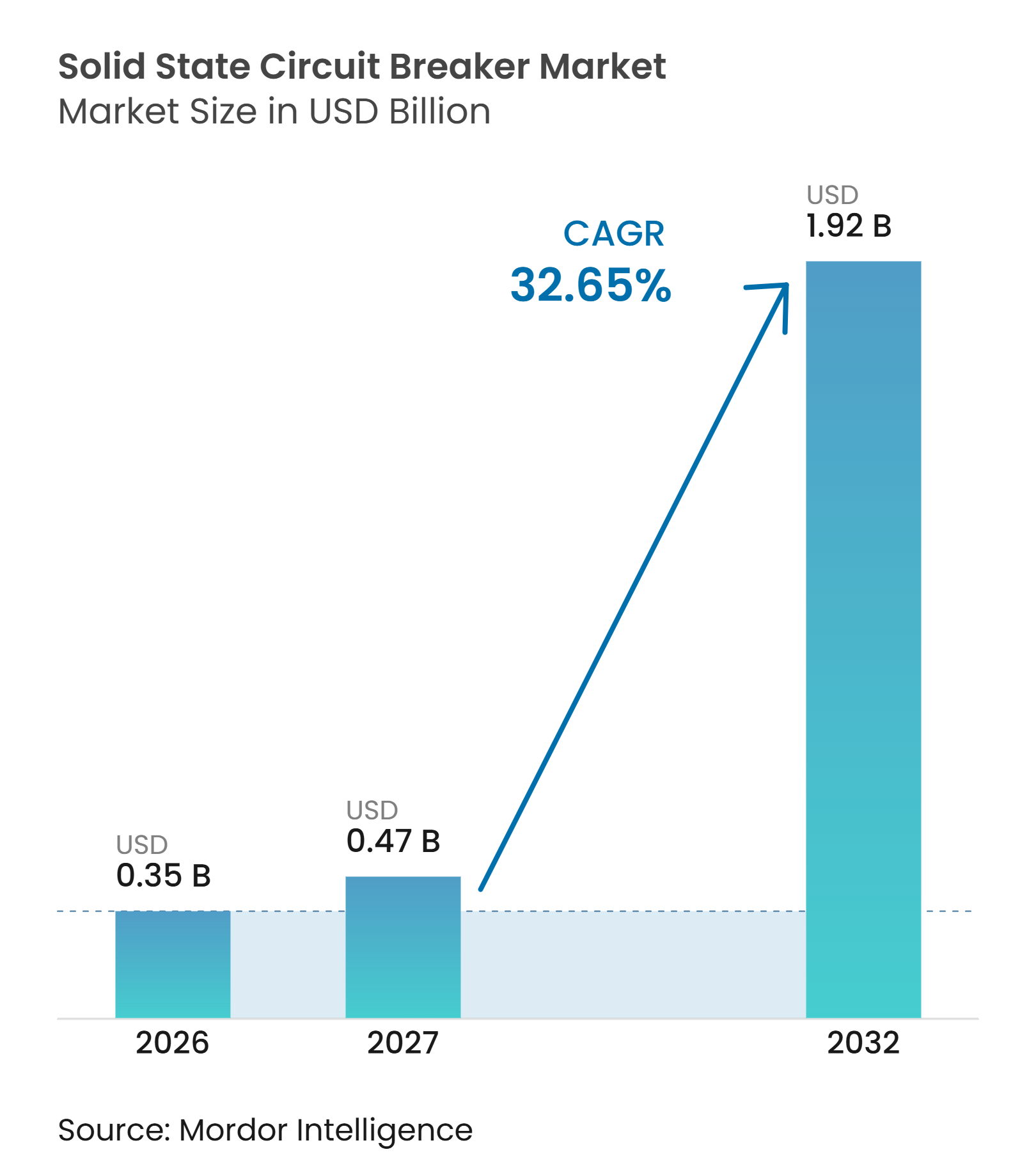
The Solid State Circuit Breaker Market size is projected to be USD 0.35 billion in 2026, USD 0.47 billion in 2027, and reach USD 1.92 billion by 2032, growing at a CAGR of 32.65% from 2027 to 2032. The solid state circuit breaker market is gaining momentum because AI data centers, battery storage systems, and fast-charging networks need faster fault isolation than conventional mechanical equipment can provide. Direct-current systems have no natural current zero crossing, so fault interruption is more difficult, and arc risks are higher. This makes semiconductor-based switching more relevant in applications that use high-voltage DC power. Certification is also becoming a purchasing requirement, particularly after the publication of IEC 60947-10:2026 for semiconductor circuit breakers[1]. The solid state circuit breaker market still faces a cost gap against mechanical breakers, as well as heat generated during continuous operation, which limits adoption in lower-criticality installations.
Key Report Takeaways
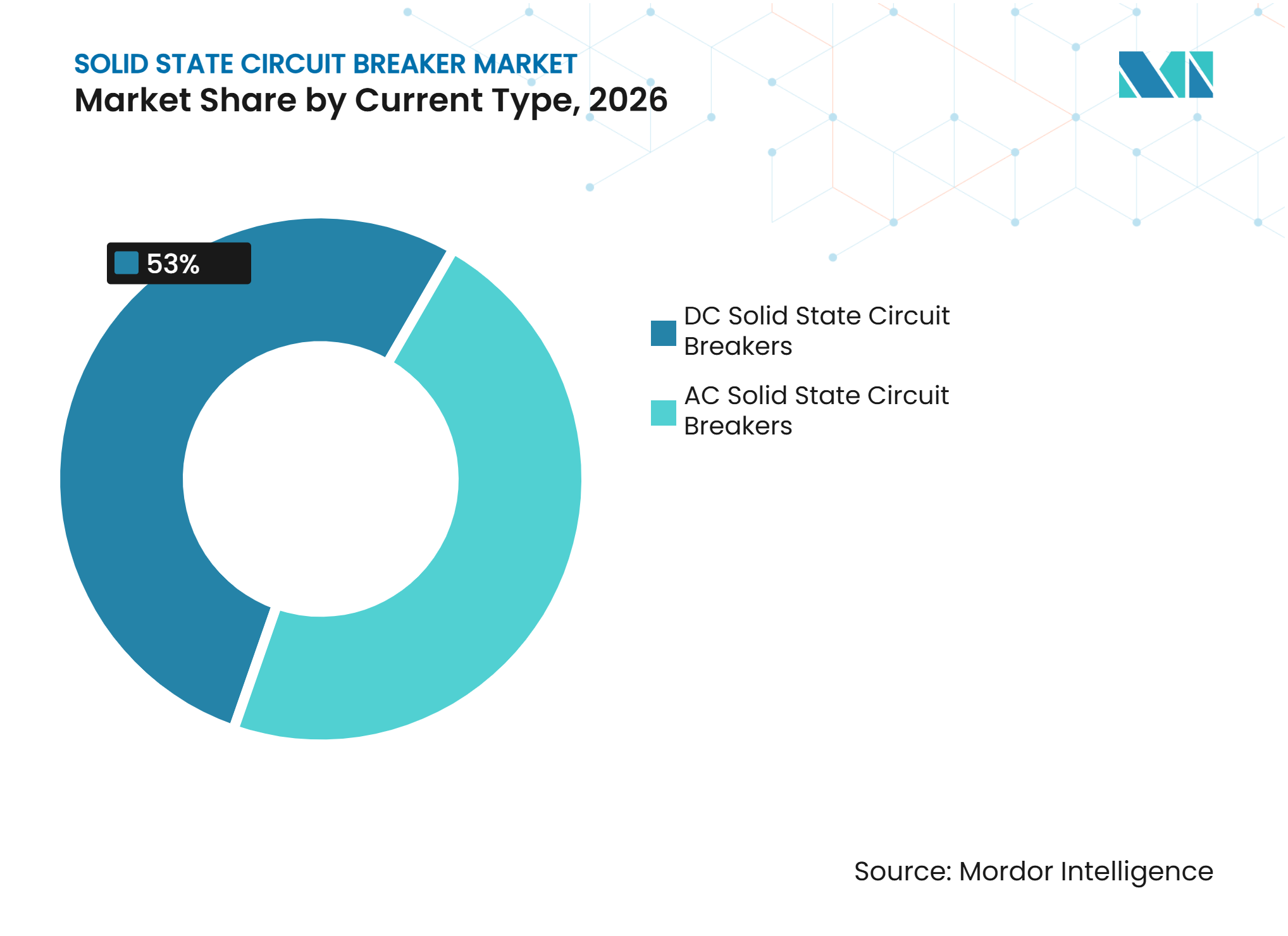
- By current type, DC solid state circuit breakers held 53% of the solid state circuit breaker market share in 2026 and are projected to grow at a 34.2% CAGR through 2032.
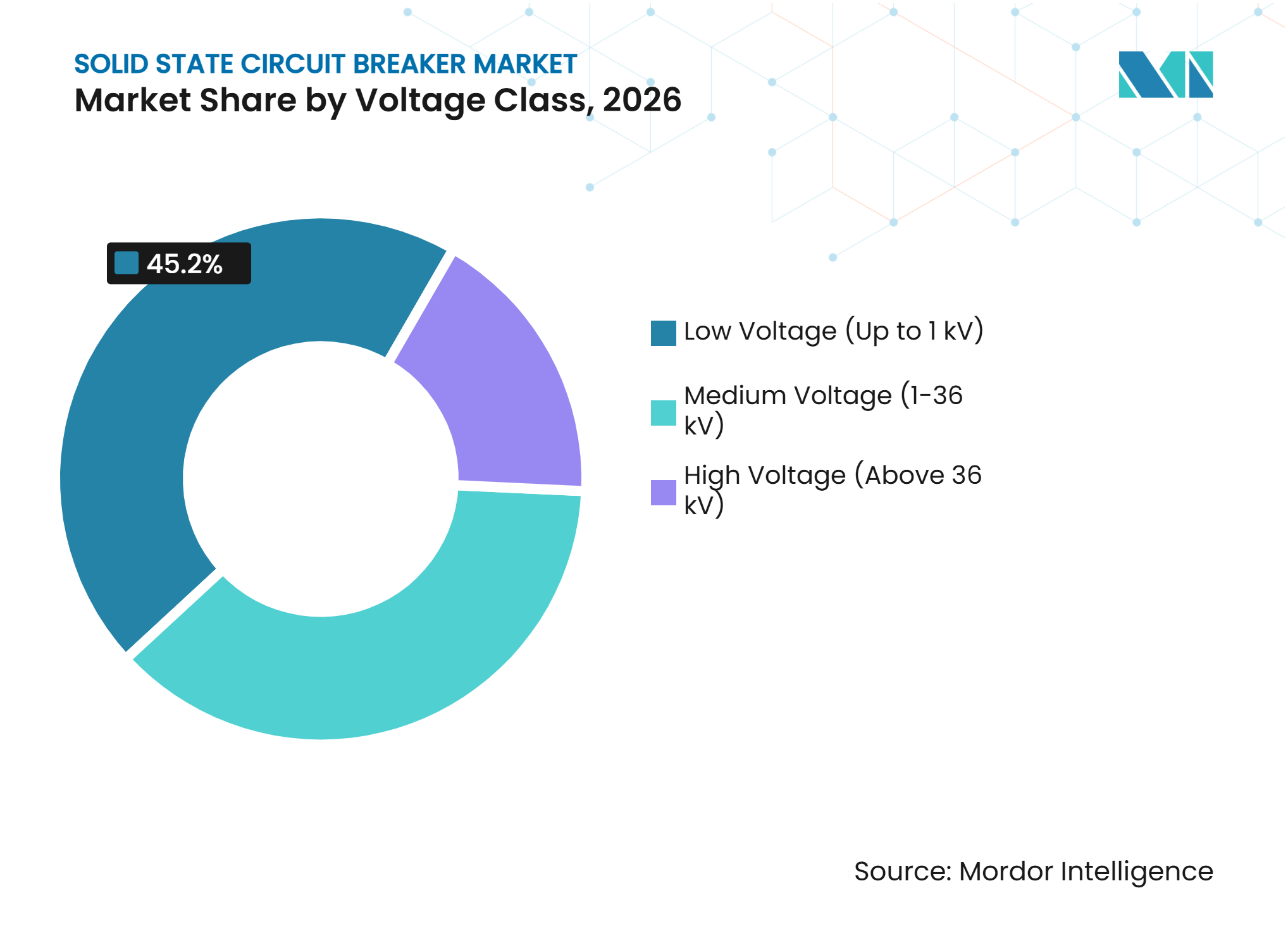
- By voltage class, Low Voltage, up to 1 kV, accounted for 45.2% of the solid state circuit breaker market size in 2026, while High Voltage, above 36 kV, is projected to grow at a 35.2% CAGR through 2032.
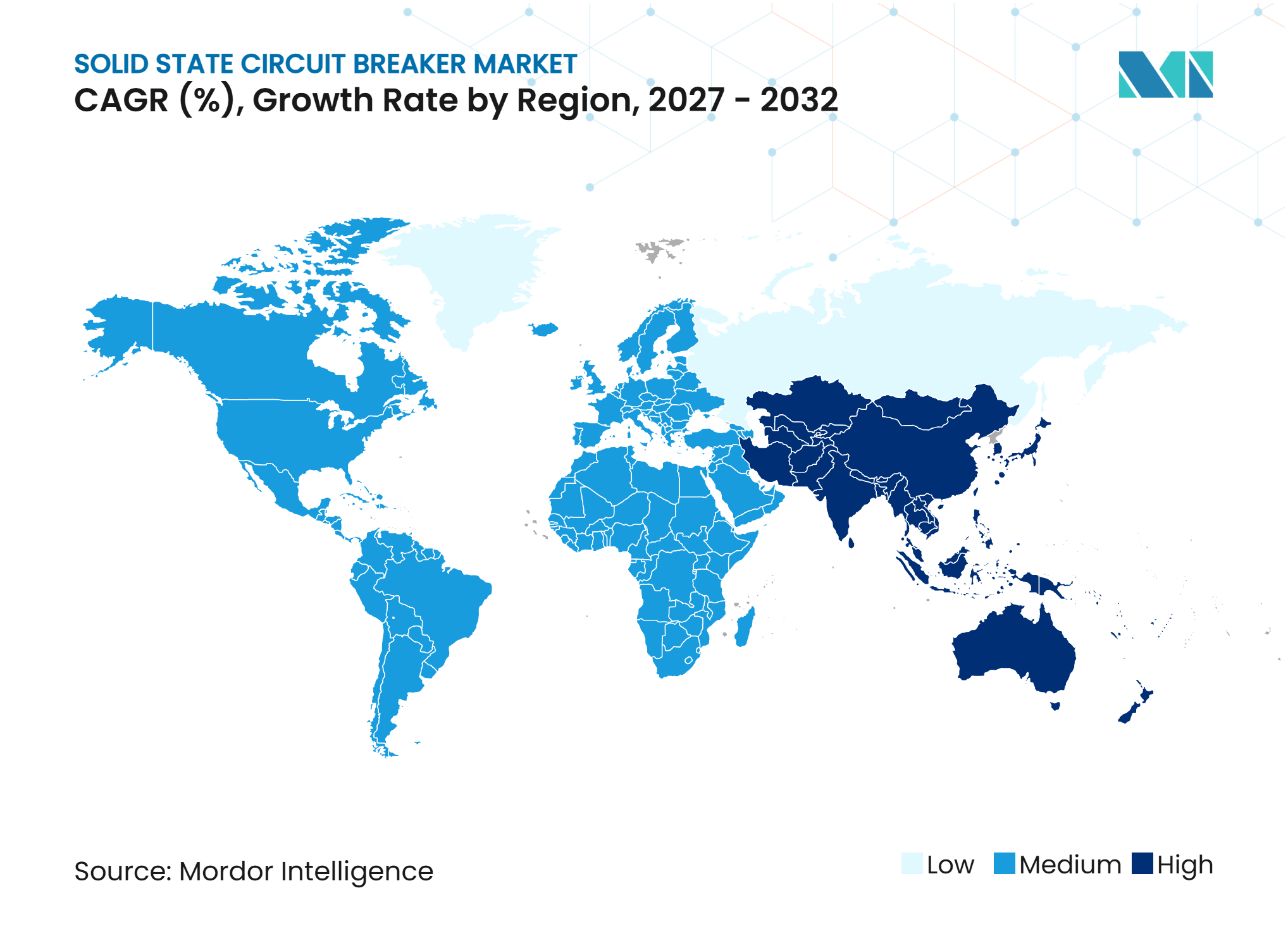
- By geography, Asia-Pacific held 42.3% of the solid state circuit breaker market share in 2026 and is forecast to expand at a 36.5% CAGR through 2032.
Note: Market numbers in this report are based on Mordor Intelligence's proprietary estimation framework, which combines nine months of actuals with Q4 projections for base year 2026.
Market Trends and Insights
Drivers Impact Analysis of Solid State Circuit Breaker Market*
| Driver | (~) % Impact on CAGR Forecast | Geographic Relevance | Impact Timeline |
|---|---|---|---|
| Grid Modernization and Bidirectional Power Flows | +5.5% | Global, strongest in North America, Europe, and China | Medium term (2-4 years) |
| Data Center Demand for Ultra-Fast Protection | +6.8% | Global, with concentration in North America, China, South Korea, and Japan | Short term (≤ 2 years) |
| Electrification of Transportation and EV Charging | +4.2% | Global, especially China, Europe, and North America | Medium term (2-4 years) |
| Distributed Renewable Energy and Battery Storage | +3.5% | Global, particularly China, Germany, India, and Australia | Medium term (2-4 years) |
| Thermal-Aware Wide-Bandgap Semiconductor Performance | +3% | Global, particularly Japan, Germany, South Korea, and China | Long term (≥ 4 years) |
| Certification-Led Adoption of Digital Breakers | +2.5% | North America and the European Union, with spillover to Asia-Pacific | Medium term (2-4 years) |
| Source: Mordor Intelligence | |||
Data Center Demand for Ultra-Fast Protection
The solid state circuit breaker market is benefiting from the move by AI data centers toward 800 V DC power distribution. Higher rack power requirements place greater pressure on the power system and its protection equipment. Mechanical breakers can struggle to distinguish a fault from normal inrush current at the response speeds needed in these systems. Infineon’s work with NVIDIA on 800 V DC architectures uses hot-swap-capable semiconductor protection, allowing server boards to be replaced without shutting down adjacent racks[2]. This makes protection design an integral part of data center power architecture. The U.S. Federal Register also identified a need for 20 GW of added grid capacity for AI and manufacturing demand, which extends the need for digital protection beyond the data center itself.
Grid Modernization and Bidirectional Power Flows
Grid modernization is changing the fault-protection requirements for the solid state circuit breaker market. Distributed solar and battery assets can feed power back into the grid, so fault current direction and magnitude can change by location and operating condition. This conflicts with the unidirectional protection assumptions used in many conventional breaker schemes. Oak Ridge National Laboratory demonstrated a semiconductor circuit breaker that interrupted 1,400 V DC in less than 50 microseconds and identified a path toward 10,000 V capability[3]. Public research support for HVDC breaker cost reduction reflects the importance of this technology gap. Building microgrids and industrial campuses also need protection coordination for bidirectional flows, supporting further demand in the solid state circuit breaker market.
Electrification of Transportation and EV Charging
Fast-charging infrastructure is broadening the application base for the solid state circuit breaker market. EV chargers commonly operate at 400 V to 1,000 V DC and can use currents up to 500 A, which increases the consequences of a rapidly rising fault current. Conventional mechanical DC breakers have limited ability to suppress the resulting arc under these conditions. Researchers at TU Delft validated a solid-state circuit breaker with a 200-nanosecond fault-clearing time for DC transport protection[4]. Compact charging power-distribution units are likely to place greater value on integrated semiconductor protection. IEC 61851 charging requirements further reinforce the need for reliable interruption performance in charging-network equipment.
Distributed Renewable Energy and Battery Storage
Battery energy storage systems create a fault environment that favors the solid state circuit breaker market. During a battery discharge fault, current can rise by thousands of amperes per microsecond, well beyond the response range of thermal-magnetic trip mechanisms. The U.S. Department of Energy awarded Lehigh University a February 2025 project for a resonant solid-state breaker for MVDC systems that combine distributed generation and storage. This work supports compact protection for building-integrated distributed energy resources. Chinese suppliers are deploying silicon-carbide devices for solar, storage, data center, and smart-building applications, including devices rated for 100 kA breaking capacity and interruption below 100 microseconds. As storage systems become more accessible, the solid state circuit breaker market expands beyond demand for the battery pack itself.
Restraints Impact Analysis of Solid State Circuit Breaker Market*
| Restraint | (~) % Impact on CAGR Forecast | Geographic Relevance | Impact Timeline |
|---|---|---|---|
| High Upfront Cost Versus Mechanical Protection | -4.5% | Global, especially India, Southeast Asia, and Latin America | Medium term (2-4 years) |
| Thermal Losses at Continuous Current | -2.8% | Global, with a strong effect in high-load industrial applications | Medium term (2-4 years) |
| Application-Specific Protection Coordination | -2% | North America, Europe, and Japan | Long term (≥ 4 years) |
| Cybersecurity and Fail-Safe Control Complexity | -1.8% | North America and the European Union, with spillover to global critical infrastructure | Long term (≥ 4 years) |
| Source: Mordor Intelligence | |||
High Upfront Cost Versus Mechanical Protection
High upfront cost remains the largest barrier to wider solid state circuit breaker market adoption. A solid-state breaker can cost 3 to 10 times as much as a comparable mechanical molded-case breaker because it needs semiconductor devices, control electronics, and thermal hardware. Greater silicon-carbide production is expected to narrow this gap by improving access to lower-loss power devices. Longer service life, lower maintenance needs, and reduced arc-flash exposure can improve lifecycle economics in facilities where downtime is costly. That case is strongest in hyperscale data centers and mission-critical industrial sites. Commercial buildings and light industrial facilities in price-sensitive markets still have a strong reason to retain mechanical alternatives.
Thermal Losses at Continuous Current
Continuous conduction losses also limit the solid state circuit breaker market in high-current uses. Semiconductor devices produce heat when they conduct, unlike a closed mechanical contact that has limited ongoing loss. Heat sinks, forced-air systems, or liquid cooling can therefore raise capital cost and make system integration more difficult. TYT Teyon Longmarch Technology introduced a liquid-cooling option for its MBS1-2500 series that it states reduces thermal resistance by 60% against conventional designs. GaN and SiC JFET designs can reduce switching losses compared with IGBT predecessors, but conduction loss at rated current remains a physical constraint. Protection coordination and cybersecurity introduce another layer of complexity because IEC 60947-10:2026 refers to IEC 63208 cybersecurity requirements for connected semiconductor breakers.
*Our forecasts treat driver/restraint impacts as directional, not additive. The impact forecasts reflect baseline growth, mix effects, and variable interactions.
Solid State Circuit Breaker Market Segment Analysis
By Current Type:
DC Variants Lead Across ApplicationsDC solid state circuit breakers accounted for 53% of the solid state circuit breaker market size in 2026 and are projected to grow at a 34.2% CAGR through 2032. The segment is supported by DC power distribution in data centers, solar-plus-storage microgrids, and high-current EV charging. DC circuits do not have a natural zero crossing, so mechanical interruption is more arc-intensive and can cause greater damage during a fault. This gives semiconductor-based switching a technical advantage that does not rely only on cost or a narrow performance comparison. ABB launched SACE Infinitus in December 2025 as a solid-state breaker certified to IEC 60947-2 and approved by DNV for marine applications, showing how DC qualification is extending to regulated safety-critical uses.
The solid state circuit breaker industry is therefore seeing DC demand move beyond early industrial applications. Data centers need rapid isolation to protect high-density racks and preserve service continuity. Renewable and storage installations require bidirectional protection as generation and load conditions change. EV charging needs compact protection that can operate across high-voltage DC architectures. These applications also require system suppliers to combine power modules, sensing, controls, and thermal design instead of supplying a conventional standalone breaker. The DC segment should retain a leading role as these applications add installed capacity.
AC solid-state breakers hold the remaining portion of demand and remain useful where AC-to-DC conversion is unnecessary. In these settings, arc-flash reduction and compliance within existing plant architectures matter more than achieving the fastest possible response. IEC 60947-10:2026 provides a common performance framework for AC-rated and DC-rated semiconductor circuit breakers. This gives procurement teams a clearer basis for specifying devices in the same way that they specify established mechanical equipment. Rockwell Automation received U.S. Patent 12,224,575 for sequenced multi-pole opening and closing in solid-state breakers to reduce arc-flash hazard in industrial automation systems.
AC applications are likely to center on integration, safety, and operating consistency. Industrial facilities often prefer equipment that fits established distribution architectures and maintenance practices. This supports products that can manage fault energy without requiring a complete redesign of the facility power system. Manufacturers can also use the new standard to improve confidence among plant owners that have historically relied on thermal-magnetic and electromechanical equipment. As certification expands, AC solid-state breakers can address regulated facilities where safety requirements are a stronger buying factor than switch speed.



By Voltage Class:
High Voltage Growth Signals Semiconductor MaturityLow Voltage, up to 1 kV, held 45.2% of the solid state circuit breaker market size in 2026. Its leading position reflects the scale of commercial and industrial installations that operate at standard distribution voltages. ANSI/UL 489I, published in October 2025, is the first dedicated U.S. standard for solid-state and solid-state hybrid circuit breakers up to 1,000 Vac and 1,500 Vdc. The standard gives buyers working under National Electrical Code requirements a recognized basis for equipment selection. It can help facilities that delayed procurement because there was no dedicated product standard. Low-voltage products are also suited to data center distribution, commercial facilities, and many renewable-energy installations.
Medium Voltage, from 1 kV to 36 kV, is becoming a key institutional application area outside data centers. Utilities, industrial facilities, and renewable parks value faster interruption and reduced outage exposure compared with vacuum and SF6-based alternatives. These buyers must also manage equipment qualification, network protection settings, and site-specific thermal conditions. The segment provides a bridge between proven low-voltage deployments and the demanding requirements of transmission-oriented systems. It therefore creates an opportunity for suppliers that can package semiconductor devices with established switchgear engineering. Wider acceptance depends on reliable testing, certification, and integrated protection coordination.
High Voltage, above 36 kV, is projected to expand at a 35.2% CAGR through 2032. Wide-bandgap modules that can block voltages above 10 kV are making this class more commercially feasible. Oak Ridge National Laboratory’s 1,400 V DC demonstration and its 10,000 V research path show how the voltage capability of semiconductor protection is progressing. The outlook for high-voltage applications will depend on whether this technical progress can be converted into certified and economical transmission-class products. HVDC transmission, large renewable installations, and grid reinforcement projects create the clearest demand setting. Each improvement in SiC or GaN voltage ratings can open applications that have historically used only mechanical switchgear.
This voltage class is also closely linked to supplier access to high-performance semiconductor modules. European efforts to build SiC and GaN manufacturing capacity through the WBG Pilot Line reflect the value of a more resilient component supply base. Breaker producers need power devices that satisfy electrical, thermal, and reliability requirements at a manageable cost. Equipment developers that can validate these modules within full protection systems will have an advantage over companies supplying only discrete components. The growth outlook is strong, but product qualification cycles can remain lengthy. This keeps established switchgear capabilities relevant even as semiconductor performance improves.

Geography Analysis
Asia-Pacific
Asia-Pacific held 42.3% of regional demand in 2026 and is projected to grow at a 36.5% CAGR through 2032. China supports the regional installed base through DC microgrid deployment, domestic manufacturing, and hyperscale data center construction in Guangdong, Beijing, and Inner Mongolia. South Korea adds demand from hyperscale data centers and semiconductor manufacturing. Infineon and LS Electric entered a partnership in August 2026 to develop high-efficiency DC power solutions for AI data centers, linking component expertise with local distribution systems. India also offers an expanding grid-modernization application base. These developments give the solid state circuit breaker market access to a region with both high equipment demand and expanding manufacturing capability.
North America
North America has a demanding qualification environment that can exclude commodity suppliers while favoring products with established certification. ANSI/UL 489I and National Electrical Code requirements give buyers a defined route for specifying solid-state devices in service entrance, feeder, and branch circuit applications. The federal action seeking 20 GW of additional capacity for AI and manufacturing growth also supports demand for high-speed protection in new grid and facility projects. RTX is developing a 1 kV and 1 kA SiC solid-state DC breaker through NASA’s Advanced Air Vehicles Program, indicating that aerospace-grade protection technology can move into terrestrial distribution systems. Public work on HVDC breaker cost reduction could also lower a barrier to broader commercial use. The solid state circuit breaker market in the region is shaped by compliance factors, public support for grid resilience, and high data center investment.
Europe, South America, and Middle East and Africa
Europe is building demand around renewable integration and a regional supply chain for wide-bandgap semiconductors. The WBG Pilot Line launched in September 2025 with USD 358.27 million (EUR 320 million) in European Commission funding across 7 countries, supporting SiC and GaN production infrastructure. Germany has demand from industrial automation and offshore wind, while France and the United Kingdom add data center and grid reinforcement activity. In South America, Brazil and Chile offer early demand from solar development and mining electrification, where remote DC installations need reliable protection. The Middle East and Africa remain at an early stage, but Saudi Arabia and the United Arab Emirates are investing in AI and renewable projects that require dependable DC power in high ambient temperatures. Regional growth in these mixed geographies will depend on local project execution, equipment certification, and access to semiconductor supply.
Competitive Landscape
Market Concentration
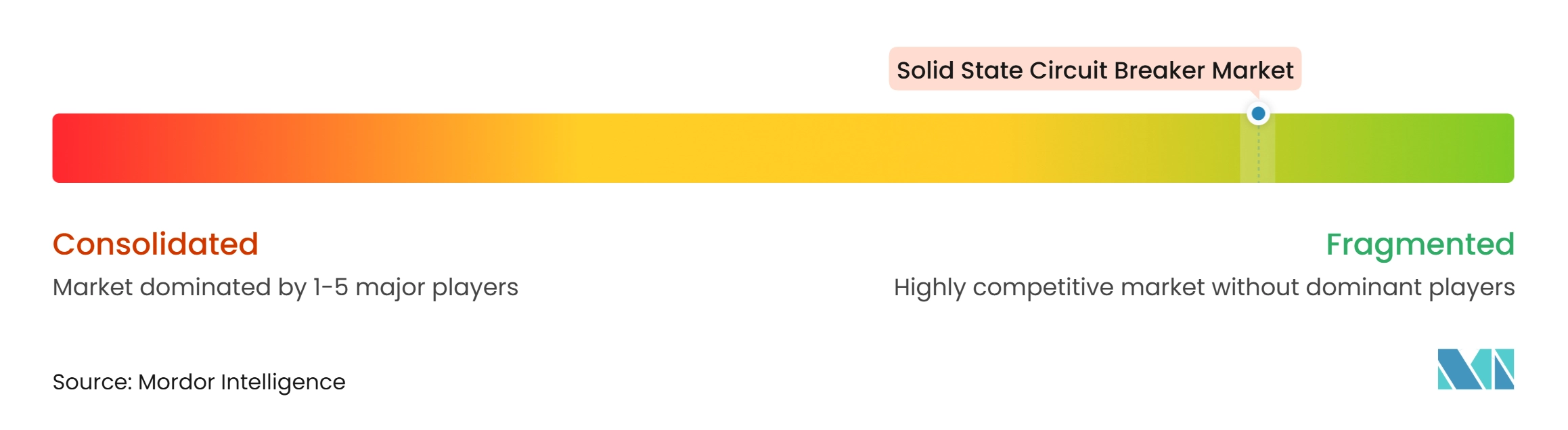
The solid state circuit breaker market is fragmented. Established electrical-equipment manufacturers have strong positions in certified enterprise and utility applications, while specialist firms are securing design wins in emerging uses. Leading strategies rely more on semiconductor partnerships than on full internal device development. Medium-voltage grid applications and retrofits of mechanical switchgear panels remain open areas where few suppliers offer certified drop-in products at competitive cost. Companies with power-device expertise and switchgear assembly capability are well placed to address this gap.
Specialist innovators are differentiating through lower-loss switching architectures. ABB’s December 2025 SACE Infinitus launch brought IEC 60947-2 certification and DNV approval to marine low-voltage uses. Eaton also introduced its Polaris solid-state circuit breaker for data center and renewable-energy DC architectures in November 2025. Infineon and LS Electric also partnered on high-efficiency DC power solutions for AI data centers. These moves show that certification, thermal efficiency, and system integration are central to competition.
The solid state circuit breaker market also benefits from suppliers that can meet demanding defense thermal and shock requirements. These designs may increasingly move into industrial and infrastructure applications where reliability has a high value. IEC 60947-10:2026 creates an important competitive threshold because it covers performance, electromagnetic compatibility, and cybersecurity provisions for semiconductor and hybrid circuit breakers. Manufacturers without compliant products risk missing utility and enterprise procurement cycles as the standard gains traction. The solid state circuit breaker market therefore rewards firms that can pair device performance with clear certification and application engineering.
Solid State Circuit Breaker Industry Leaders
-
ABB Ltd.
-
Siemens AG
-
Eaton Corporation plc
-
Schneider Electric SE
-
Mitsubishi Electric Corporation
- *Disclaimer: Major Players sorted in no particular order
Solid State Circuit Breaker Market Companies Covered in this Report
- ABB Ltd.
- AMETEK, Inc.
- Atom Power, Inc.
- Blixt Tech AB
- Eaton Corporation plc
- Fuji Electric Co., Ltd.
- GE Vernova, Inc.
- Havells India Ltd.
- HIITIO New Energy Co., Ltd.
- Hitachi, Ltd.
- Ideal Power, Inc.
- Infineon Technologies AG
- LS Electric Co., Ltd.
- Mitsubishi Electric Corporation
- Redler Technologies Ltd.
- Rockwell Automation, Inc.
- RTX Corporation
- Schneider Electric SE
- Siemens AG
- Toshiba Corporation
Recent Industry Developments in Solid State Circuit Breaker Market
- October 2026: Power Integrations and Ideal Power announced a collaboration to develop always-on solid-state circuit breakers for 800 VDC AI data center applications. The proposed architecture combines Power Integrations' 1,700 V InnoMux-2 power conversion ICs with Ideal Power's patented B-TRAN bidirectional semiconductor switches. The integration covers power conversion, gate-drive supplies, control electronics, and fault-sensing capabilities to support rapid fault isolation without an external auxiliary power supply. The companies also reported demonstrating a working prototype and progressing toward a reference design.
- September 2026: SolarEdge Technologies and Infineon Technologies announced an expanded collaboration to develop solid-state circuit breaker solutions for high-voltage DC distribution in AI and hyperscale data centers. Under the collaboration, SolarEdge is leading the SSCB system design, while Infineon is contributing its silicon carbide (SiC) JFET semiconductor technology. The development focuses on 800 VDC power distribution architectures, which are gaining attention as data centers require higher power density and more efficient electrical infrastructure.
- August 2026: HIITIO introduced its HSB1 Series solid-state circuit breakers for DC power distribution applications. The product family covers current ratings from 40 A to 4,000 A and voltage ratings from 220 V to 1,500 VDC, with fault-clearing times as low as 10 to 20 microseconds, depending on configuration. The series incorporates IGBT- and SiC MOSFET-based technologies and includes fully solid-state and hybrid architectures, targeting industrial power distribution, marine electrification, battery energy storage, and data center applications.
- July 2026: ABB announced an independently verified Type III environmental product declaration (EPD) for its SACE Infinitus solid-state circuit breaker product family. The SACE Infinitus I25L is designed for high-speed DC protection applications, with ratings of up to 2,500 A at 1,000 VDC and fault interruption in less than 25 microseconds. The product reports up to 70% lower power losses compared with equivalent semiconductor-based solutions and integrates circuit breaker, contactor, isolator, and energy-metering functions, supporting marine electrification, smart transportation, microgrids, and DC power distribution.
Global Solid State Circuit Breaker Market Report Scope
A solid-state circuit breaker (SSCB) is an electrical protection device that uses semiconductor components, such as power transistors, insulated-gate bipolar transistors (IGBTs), metal-oxide-semiconductor field-effect transistors (MOSFETs), or silicon carbide (SiC) devices, to interrupt electrical current during fault conditions without relying on mechanical contacts.
The global solid state circuit breaker market is segmented by current type, voltage class, and geography. By current type, the market is segmented into AC solid state circuit breakers and DC solid state circuit breakers. By voltage class, the market is segmented into low voltage (up to 1 kV), medium voltage (1–36 kV), and high voltage (above 36 kV). The report also covers the market size and forecasts for the global solid state circuit breaker market across 26 countries in key regions. For each segment, the market sizing and forecasts are provided on the basis of value (USD).
Segmentation Overview
| AC Solid State Circuit Breakers |
| DC Solid State Circuit Breakers |
| Low Voltage (Up to 1 kV) |
| Medium Voltage (1-36 kV) |
| High Voltage (Above 36 kV) |
| North America | United States |
| Canada | |
| Mexico | |
| Europe | Germany |
| United Kingdom | |
| France | |
| Italy | |
| Switzerland | |
| Norway | |
| Russia | |
| Rest of Europe | |
| Asia-Pacific | China |
| Japan | |
| South Korea | |
| India | |
| Singapore | |
| Australia | |
| Rest of Asia-Pacific | |
| South America | Brazil |
| Chile | |
| Argentina | |
| Rest of South America | |
| Middle East and Africa | Saudi Arabia |
| United Arab Emirates | |
| Israel | |
| Turkey | |
| South Africa | |
| Egypt | |
| Nigeria | |
| Rest of Middle East and Africa |
| By Current Type | AC Solid State Circuit Breakers | |
| DC Solid State Circuit Breakers | ||
| By Voltage Class | Low Voltage (Up to 1 kV) | |
| Medium Voltage (1-36 kV) | ||
| High Voltage (Above 36 kV) | ||
| By Geography | North America | United States |
| Canada | ||
| Mexico | ||
| Europe | Germany | |
| United Kingdom | ||
| France | ||
| Italy | ||
| Switzerland | ||
| Norway | ||
| Russia | ||
| Rest of Europe | ||
| Asia-Pacific | China | |
| Japan | ||
| South Korea | ||
| India | ||
| Singapore | ||
| Australia | ||
| Rest of Asia-Pacific | ||
| South America | Brazil | |
| Chile | ||
| Argentina | ||
| Rest of South America | ||
| Middle East and Africa | Saudi Arabia | |
| United Arab Emirates | ||
| Israel | ||
| Turkey | ||
| South Africa | ||
| Egypt | ||
| Nigeria | ||
| Rest of Middle East and Africa | ||
Key Questions Answered in the Report
What is driving demand for solid-state circuit breakers?
AI data centers, battery storage, grid modernization, and EV fast charging need fault protection that can react faster than mechanical equipment.
How large is the solid state circuit breaker market?
It is valued at USD 0.47 billion in 2027 and is forecast to reach USD 1.92 billion by 2032 at a 32.65% CAGR.
Why are DC solid-state circuit breakers important?
DC systems lack a natural current zero crossing, making fast semiconductor-based interruption especially useful in data centers, storage systems, and EV charging.
Which region leads demand for solid-state circuit breakers?
Asia-Pacific held 42.3% share in 2026 and is expected to grow at a 36.5% CAGR through 2032.
What is the main barrier to broader adoption?
Solid-state breakers can cost 3 to 10 times more than comparable mechanical breakers, and thermal management adds design and installation complexity.
Which standards affect solid-state circuit breaker adoption?
IEC 60947-10:2026 and ANSI/UL 489I give buyers recognized performance and compliance frameworks for semiconductor circuit-breaker products.