
Temporary Power Market Size and Share
Market Overview
| Study Period | 2021 - 2031 |
|---|---|
| Market Size (2026) | USD 7.02 Billion |
| Market Size (2031) | USD 10.86 Billion |
| Growth Rate (2026 - 2031) | 9.14 % |
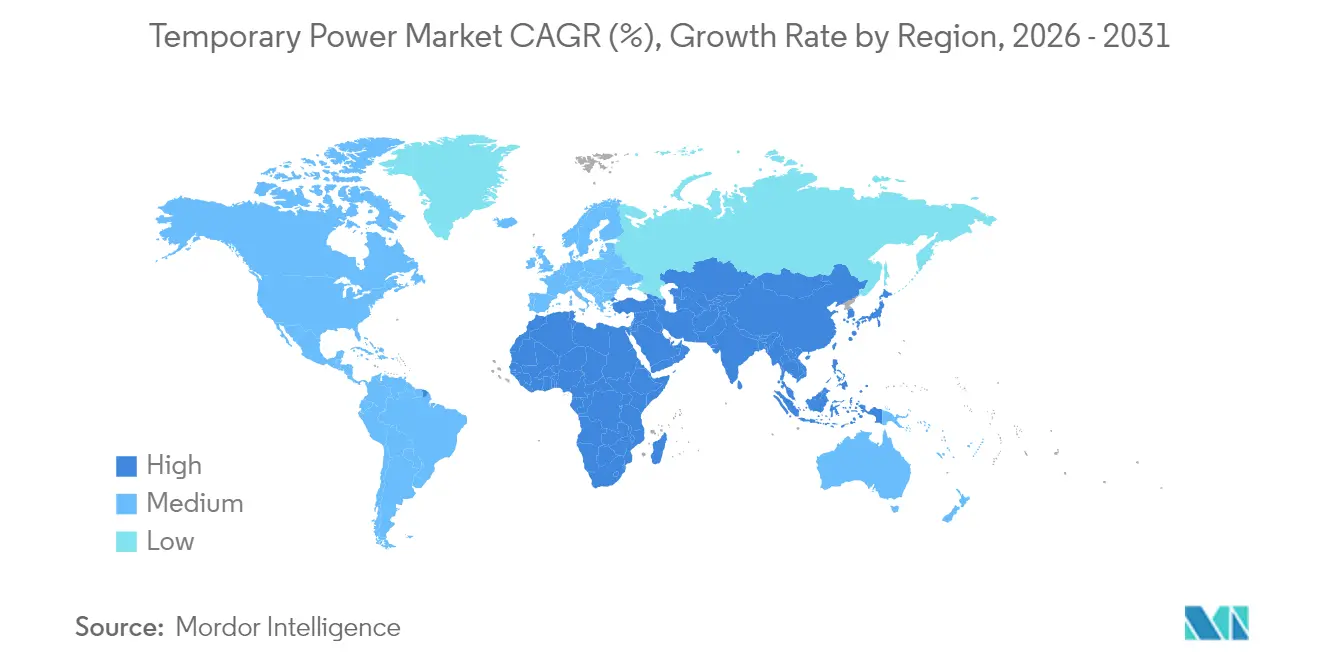
| Fastest Growing Market | Asia-Pacific |
| Largest Market | North America |
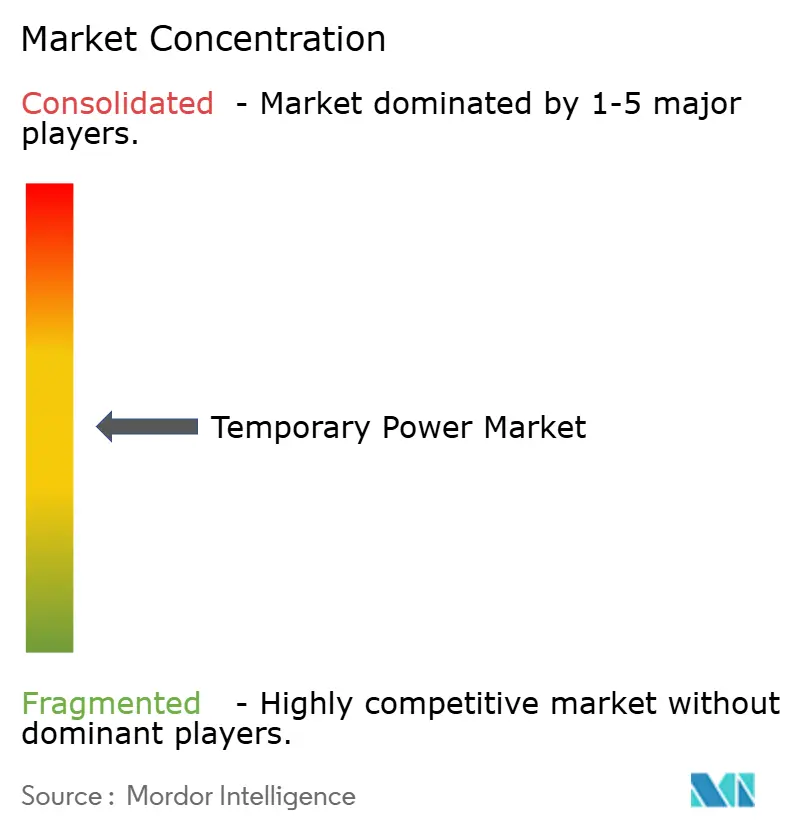
| Market Concentration | Medium |
Major Players *Disclaimer: Major Players sorted in no particular order Image © Mordor Intelligence. Reuse requires attribution under CC BY 4.0. | |
Temporary Power Market Analysis by Mordor Intelligence
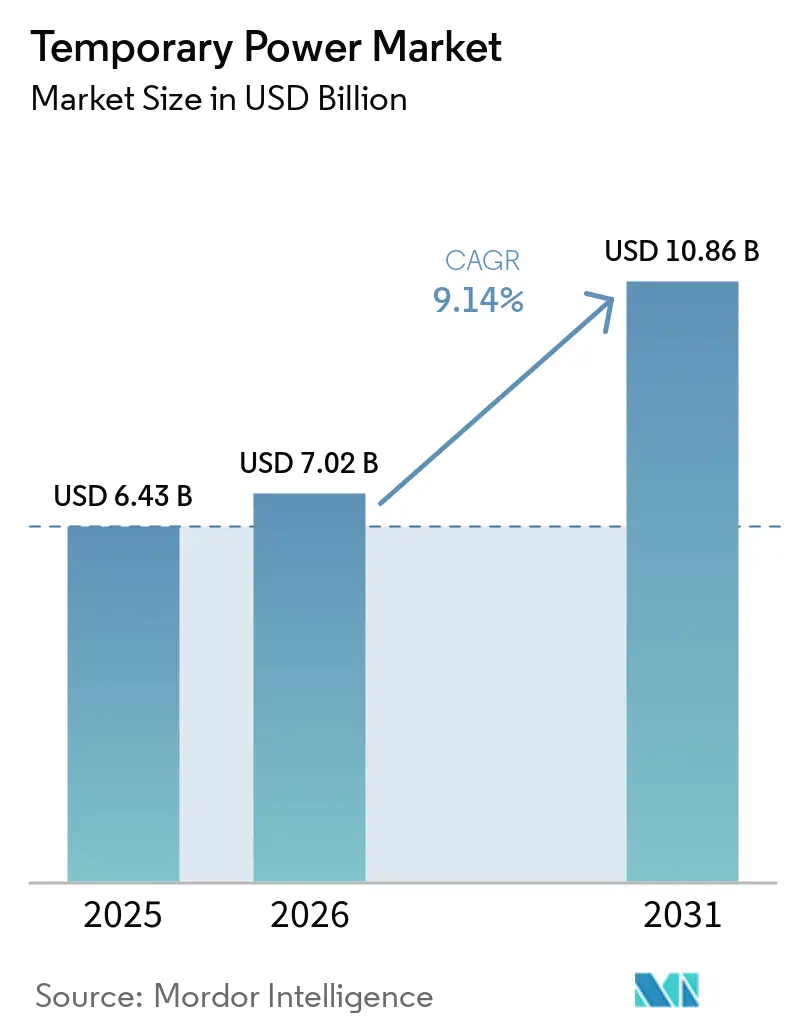
Temporary Power market size in 2026 is estimated at USD 7.02 billion, growing from 2025 value of USD 6.43 billion with 2031 projections showing USD 10.86 billion, growing at 9.14% CAGR over 2026-2031.
Growth is propelled by grid‐modernization programs, extreme-weather disruptions, and accelerating data-center construction, all elevating the need for reliable bridging power. Diesel units retain a sizeable installed base, yet regulatory pressure and ESG targets are spurring hybrid fleet investments. Data-center developers, utilities, and large construction firms anchor demand, while rapid deployment expectations sharpen competition on service capability rather than equipment ownership. North America remains the revenue leader regionally, but Asia-Pacific contributes the greatest absolute volume growth as industrial expansion and infrastructure spending intensify.
Key Report Takeaways
- By fuel type, diesel generators commanded 69.85% of 2025 revenue; hybrid and renewable solutions are forecast to expand at 15.05% CAGR through 2031.
- By power rating, the 501-2,000 kW class led with 32.35% temporary power market share in 2025; units exceeding 2,000 kW are projected to advance at 11.02% CAGR to 2031.
- By application, base-load service held 38.85% of 2025 revenue; grid-support deployments are expected to grow at 10.55% CAGR over the same horizon.
- By end-user industry, utilities captured 31.70% of temporary power market revenue in 2025; data-center and ICT users are set to record a 12.26% CAGR through 2031.
- By geography, North America accounted for 35.05% of revenue in 2025, while Asia-Pacific is anticipated to post a 11.94% CAGR to 2031.
Note: Market size and forecast figures in this report are generated using Mordor Intelligence’s proprietary estimation framework, updated with the latest available data and insights as of 2026.
Market Trends and Insights
Drivers Impact Analysis of Temporary Power Market*
| Driver | (~) % Impact on CAGR Forecast | Geographic Relevance | Impact Timeline |
|---|---|---|---|
| Rising frequency of extreme-weather outages | +2.1% | Global, with acute effects in North America, Europe | Short term (≤ 2 years) |
| Industrialisation & construction booms in emerging markets | +1.8% | Asia-Pacific core, spill-over to MEA | Medium term (2-4 years) |
| Ageing grid infrastructure & planned maintenance shutdowns | +1.5% | North America & EU, expanding to developed APAC | Long term (≥ 4 years) |
| Multi-gigawatt data-centre "utility-gap" demand | +2.3% | Global, concentrated in major data center hubs | Short term (≤ 2 years) |
| Renewable integration requiring flexible peaking capacity | +1.2% | Europe, North America, progressive APAC markets | Medium term (2-4 years) |
| ESG-driven shift toward low-emission & hybrid rental fleets | +0.9% | Global, led by Europe and North America | Long term (≥ 4 years) |
| Source: Mordor Intelligence | |||
Rising Frequency of Extreme-Weather Outages
Hurricanes, heat waves, wildfires, and monsoon floods are triggering longer and more frequent grid failures, causing emergency generator rentals to spike immediately after each event. Utilities and municipal authorities now pre-stage rental fleets ahead of storm seasons, allowing suppliers to reposition assets and optimize pricing. Insurance underwriters increasingly insist on on-site backup for hospitals, telecom nodes, and cold-chain warehouses. These contractual safeguards convert what was once sporadic, disaster-driven revenue into predictable seasonal demand. As climate variability intensifies, emergency power services have become an embedded line item in North America and Europe's resilience budgets.
Industrialisation & Construction Booms in Emerging Markets
Megaproject pipelines in India, Indonesia, and the Gulf Cooperation Council nations require high-capacity generators to run cranes, concrete plants, and dewatering pumps when grid feeds are absent or unstable. Local rental providers typically supply ≤ 500 kW units, but multinational contractors now prefer bundled packages of 1 MW and above to lower per-kilowatt logistics costs.[1] The resulting scale shift allows global fleets to deliver containerized plants on accelerated timelines, strengthening demand in the temporary power market. Government stimulus for roads, ports, and industrial corridors further widens the user base, supporting steady multi-year contracts rather than one-off rentals.
Ageing Grid Infrastructure & Planned Maintenance Shutdowns
The average power transformer in the United States has operated for 38 years, and replacement lead times now exceed two years for large units. Utilities mitigate the risk of prolonged outages by leasing multi-megawatt mobile generators during scheduled tie-line or substation upgrades. Rental agreements often span several months, providing suppliers with high utilization and stable cash flows. In Europe, similar modernization drives under the “Fit for 55” package require temporary power during switchgear retrofits, further institutionalizing the service model.
Multi-Gigawatt Data-Center “Utility-Gap” Demand
New hyperscale campuses often face multi-year waits for permanent grid interconnection. Developers bridge the gap by leasing 1.5 MW diesel or gas sets clusters, sometimes exceeding 100 MW aggregate on a single site.[2] Regulators in Virginia and Dublin have granted waivers allowing temporary generators to operate during grid emergencies, demonstrating official acknowledgement of supply constraints. The accelerated adoption of artificial-intelligence workloads, which carry five-to-six-times higher power density, magnifies the opportunity for rental operators willing to engineer bespoke solutions in the temporary power market.
Restraints Impact Analysis of Temporary Power Market*
| Restraint | (~) % Impact on CAGR Forecast | Geographic Relevance | Impact Timeline |
|---|---|---|---|
| Diesel-price volatility & fuel-logistics disruptions | -1.4% | Global, acute in remote and island markets | Short term (≤ 2 years) |
| Stricter global & local emission standards on gensets | -0.8% | Europe, North America, expanding to APAC | Medium term (2-4 years) |
| Battery storage & micro-grids eroding genset demand | -0.6% | Global, concentrated in urban and grid-connected areas | Long term (≥ 4 years) |
| Generator-component supply-chain bottlenecks | -0.9% | Global, with acute effects in North America & Europe | Short term (≤ 2 years) |
| Source: Mordor Intelligence | |||
Stricter Global & Local Emission Standards on Gensets
EU Stage V rules oblige particulate filters on 19-560 kW engines; India’s forthcoming CPCB IV+ will extend coverage to 800 kW sets, while California is drafting Tier 5 proposals likely to surpass European stringency.[3] Each tightening cycle raises capital costs and compresses residual values of legacy fleets, lowering return on invested capital for rental operators. Urban authorities also deploy low-emission zones that limit runtime hours, constraining traditional diesel utilization in core city projects. Although cleaner technologies can offset lost volumes, the transition demands funding and technical retraining.
Diesel-Price Volatility & Fuel-Logistics Disruptions
Global distillate prices experienced three double-digit swings between 2022 and 2024, complicating rental bid formulas that often hold fixed rates for six to twelve months. Supply‐chain bottlenecks extend generator-package lead times beyond 90 weeks and gas-turbine backlogs beyond five years, creating allocation dilemmas for fleet managers.[4] Remote mining and island grids face additional marine-delivery risks, heightening the attractiveness of propane, renewable, or battery-hybrid alternatives despite higher capital intensity.
*Our forecasts treat driver/restraint impacts as directional, not additive. The impact forecasts reflect baseline growth, mix effects, and variable interactions.
Temporary Power Market Segment Analysis
By Fuel Type:
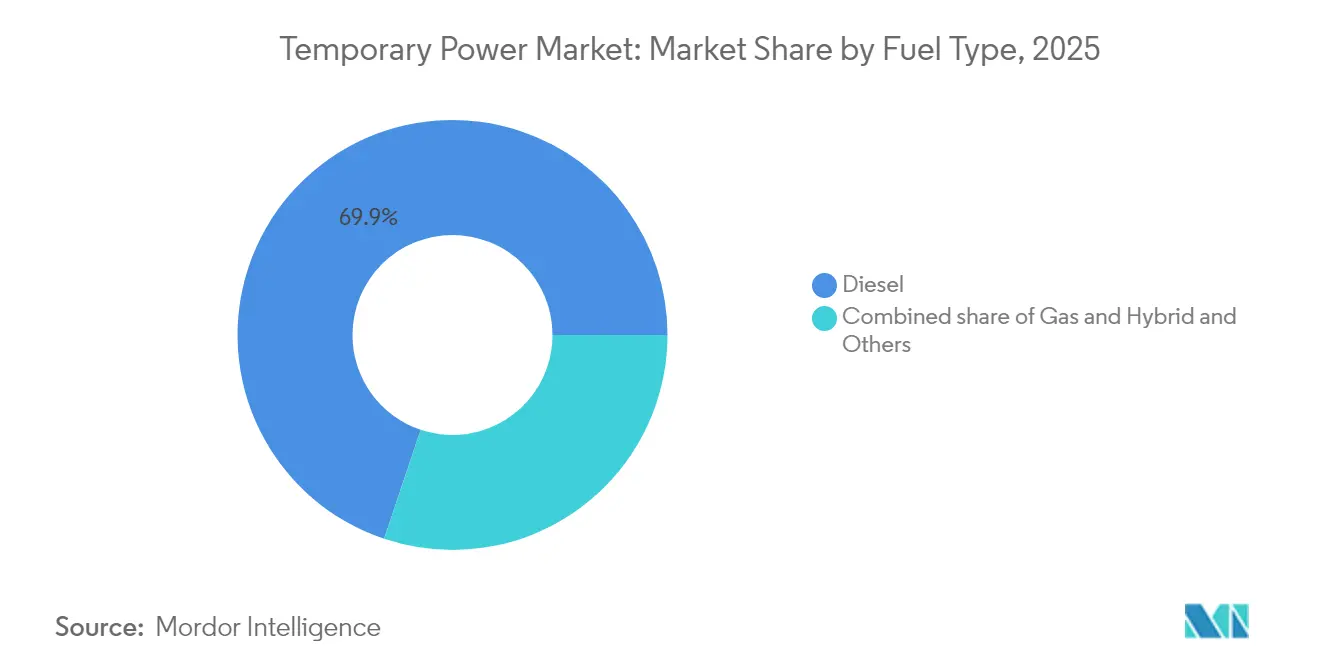
Diesel Dominance Faces Hybrid ChallengeDiesel sets generated 69.85% of 2025 revenue, reflecting ubiquitous service infrastructure, high energy density, and rapid response capabilities that remain indispensable on disaster sites and off-grid projects. Nevertheless, the temporary power market is pivoting toward hybrid formats that combine solar arrays, battery packs, or propane engines, a category forecast to compound at 15.05% annually through 2031. Aggreko’s Martin County microgrid, built around five 1.3 MW gas generators, illustrates the scaling potential for cleaner fuels in oilfield operations. Construction firms adopting electric excavators also request low-noise solar-battery generators, signaling how equipment electrification ripples through the broader temporary power industry. As cost curves fall, hybrid packages shift from pilot deployments to core rental offerings, redesigning procurement specifications across Europe and North America.

By Power Rating:
Large-Scale Dominance Driven by Data CentersSets in the 501-2,000 kW band held 32.35% of 2025 revenue, serving industrial processes and sizeable construction jobs that value transportability alongside capacity. Above-2,000 kW machines deliver the highest forecast growth at 11.02% CAGR, underpinned by hyperscale data-center commissioning schedules that now demand 100 MW-plus bridging solutions. Aggreko’s rollout of eight 1.5 MVA gensets for a Malaysian data-center complex exemplifies how modular design lets operators match rising load profiles without extended downtime, supporting demand in the temporary power market. Meanwhile, the up-to-50 kW niche retains relevance for residential and small commercial backup, but its share erodes as telecom towers and clinics migrate to solar-battery kits.
By Application:
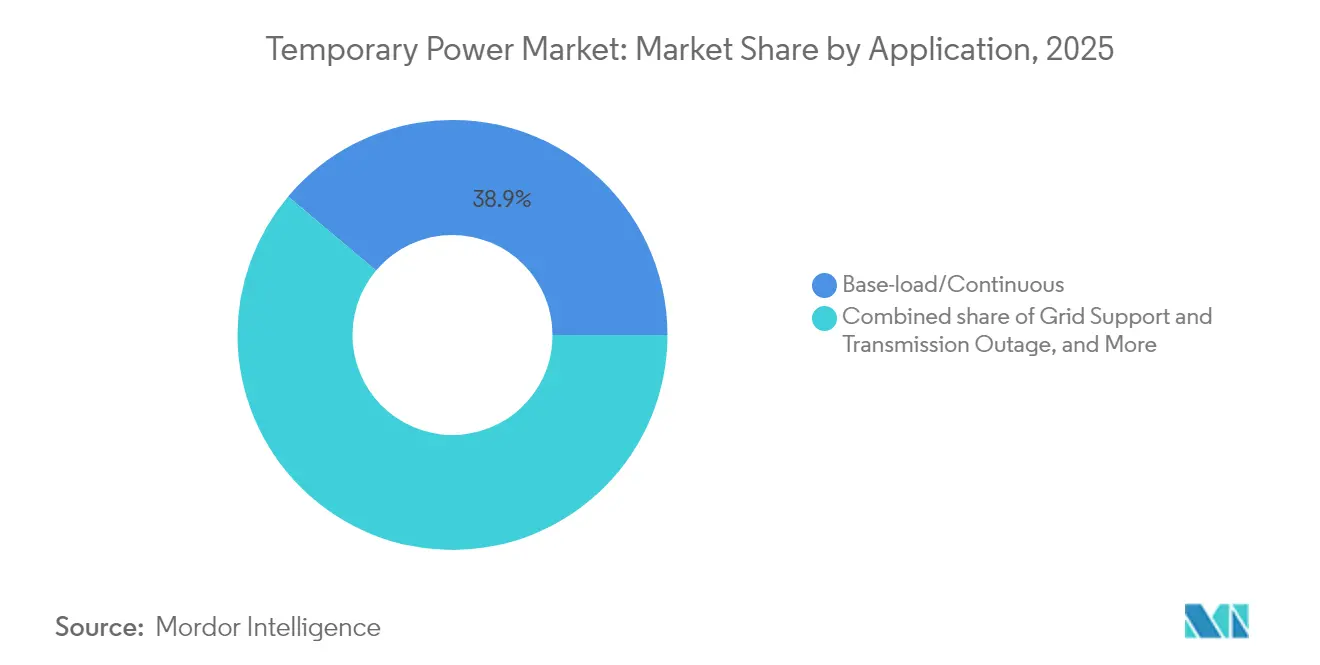
Base-Load Leadership Meets Grid-Support GrowthBase-load and continuous use cases held 38.85% of 2025 revenue, including long-term power for remote mines, bottling plants, and island hospitality assets. Yet grid-support deployments will outpace all others at 10.55% CAGR, amplified by scheduled transmission upgrades and peak-shaving programs. CenterPoint Energy’s plan to install 15 mobile generation units totaling 450 MW for summer 2025 grid stability typifies how utilities now embed mobile assets into reliability strategies. The convergence of emergency, maintenance, and peaking services erodes traditional application silos, broadening the opportunity for suppliers that offer turnkey engineering and remote monitoring.
By End-User Industry:
Utilities Lead as Data Centers SurgeUtilities contributed 31.70% of 2025 rental revenue, driven by planned maintenance at substations, transformer replacements, and hurricane-season contingencies. The data-center segment, however, is set to log a 12.26% CAGR to 2031 as AI-training clusters push power density beyond grid‐connection timelines. Cummins reported a 24% rise in power-generation sales in Q3 2024, attributing growth largely to this customer class. Oil-and-gas clients maintain a stable demand for offshore drilling, gas-lift compression, and decommissioning, while event organizers favor low-noise, Stage V-compliant units for urban festivals.
Geography Analysis
North America Temporary Power Market
North America’s leadership in the temporary power market rests on a sophisticated rental ecosystem, deep OEM–dealer partnerships, and disciplined asset-management practices. United Rentals alone operates 1,591 locations and manages a USD 21.4 billion equipment fleet, enabling rapid mobilization when storms threaten Gulf Coast refineries or when Midwest utilities announce transformer change-outs. The United States accounts for most regional demand, while Canada supplements with LNG plant builds and hydro dam refurbishments. Mexico adds volume through nearshoring-driven factory expansions.
APAC Temporary Power Market
Asia-Pacific supplies the highest growth trajectory as governments channel multi-year funding into roads, airports, and urban transit. China drives headline volumes but faces policy-induced caps on diesel runtime in tier-1 cities, accelerating migration toward gas and hybrid sets. India adopts similar standards under CPCB IV+ yet remains a diesel stronghold for rural electrification and construction. ASEAN economies, Vietnam, Indonesia, and the Philippines, present diverse grid resiliency challenges, favoring mid-scale containerized solutions. Japanese and Korean contractors specify Stage V-equivalent engines, anchoring premium demand in the region.
Europe Temporary Power Market
Europe’s market centres on emission compliance and renewable-grid integration. Germany, France, and the United Kingdom purchase large fleets of Stage V gensets paired with battery pods for low-noise urban applications. The region also pioneers hydrogen-ready mobile turbines to balance offshore wind intermittency in the North Sea. Southern and Eastern European countries grow more modestly but exhibit episodic spikes tied to hydro-dam refurbishments and gas-pipeline expansions. Across the continent, city authorities incentivize hybrid rental packages by granting low-emission‐zone access, thereby shaping fleet renewal cycles.
Regulatory Landscape
Temporary power deployments sit across electrical installation safety requirements, non-road emissions compliance, and grid-emergency directives. In January 2026, IEC published IEC 60364-7-717:2026, updating requirements for electrical installations of mobile or transportable units. In March 2026, ISO published ISO 8528-13:2026 for safety requirements for internal-combustion engine-driven generating sets up to 36 kV, raising the baseline for compliant design, installation, and inspection practices for rental fleets and EPCs operating multi-unit sites.
On emissions and emergency operations, compliance remains regionally split (EU Stage V for most non-road mobile machinery versus US EPA Tier 4 Final requirements for many non-emergency engines). In the United States, DOE actions under Federal Power Act Section 202(c) highlighted how behind-the-meter backup generation can be incorporated into grid-stability operations. DOE Order No. 202-26-33 (effective June 30, 2026) authorized PJM Interconnection to direct backup generation resources at large sites during energy emergencies, and DOE Order No. 202-26-35 (effective July 14, 2026) extended that authority until July 21, 2026. These steps increase the importance of operating permits, telemetry, dispatch readiness, and documented emissions performance for assets that can shift from standby to grid-support roles.
Competitive Landscape
Competitive intensity remains moderate as the top five suppliers account for about 60% of global rental revenue, leaving ample space for regional specialists. Aggreko leverages its global footprint and application engineering to capture multi-site, multi-megawatt contracts in data centers, utilities, and mining. Caterpillar and Cummins monetize deep vertical integration, engine, alternator, and control systems, offering faster lead times in markets with volatile demand. Atlas Copco expands its Specialty Rental arm via bolt-on acquisitions in New Zealand and South Africa, signalling a strategy to build localized hubs rather than centralized megafleets.
Consolidation gathers pace in North America. Herc Holdings proposed a USD 5.3 billion merger with H&E Equipment Services, aiming for USD 300 million in annual synergies and enhanced access to industrial clientele. Deutz’s acquisition of Blue Star Power Systems diversifies its engine business into packaged generators and is expected to add USD 100–150 million in annual revenue. Technology-oriented deals also rise: Generac’s purchase of PowerPlay Battery Energy Storage Systems arms the company with commercial BESS capacity up to 7 MWh, complementing its generator lineup for hybrid offerings.
Differentiation increasingly hinges on emissions performance, digital monitoring, and turnkey service capability rather than equipment count alone. United Rentals markets solar-battery generator sets for urban construction sites, while Caterpillar pilots Dynamic Energy Transfer platforms that automatically balance diesel, solar, and battery inputs on remote mines. Smaller regional players carve niches by tailoring fleets to extreme climates, arctic oilfields, tropical mining camps, or high-altitude construction, where global firms may lack localized engineering. Suppliers that invest in telemetry and analytics gain a pricing edge as customers demand outcome-based contracts, measured in uptime percentages or fuel-savings guarantees.
Temporary Power Industry Leaders
-
Aggreko plc
-
Cummins Inc.
-
APR Energy Ltd
-
Caterpillar Inc.
-
United Rentals Inc.
- *Disclaimer: Major Players sorted in no particular order
Temporary Power Market Companies Covered in this Report
- Aggreko PLC
- Caterpillar Inc.
- Cummins Inc.
- APR Energy Ltd
- Atlas Copco AB
- Kohler Co.
- United Rentals Inc.
- Ashtead Group plc (Sunbelt Rentals)
- Speedy Hire plc
- Generac Holdings Inc.
- Wärtsilä Corp.
- HIMOINSA S.L. (Yanmar)
- Rolls-Royce plc (mtu Solutions)
- Multiquip Inc.
- Doosan Portable Power
- JCB Power Products
- Energyst Rental Solutions
- Altaaqa Global Energy Services
Market Opportunities and Future Outlook
Regulatory clarification around temporary assets is creating a clear whitespace for higher-spec, compliant fleets and engineered, dispatch-ready solutions. In January 2026, the US EPA finalized NSPS updates for stationary combustion turbines and created a distinct subcategory for stationary temporary combustion turbines (up to 850 MMBtu/hr for up to 24 months at a single location) with a NOx standard of 25 ppm using combustion controls, supporting more standardized permitting pathways for short-duration turbine-based projects. Texas then implemented new requirements for temporary emergency generation under SB 231 (PUC rules adopted February 6, 2026), including mobility and response-time constraints (mobile units capable of generating within three hours) and a 5 MW capacity cap per lease, pushing utilities and vendors toward modular, rapidly deployable packages.
Grid-constrained geographies and islanded systems continue to rely on large temporary solutions as a commissioning bridge, widening demand beyond traditional construction and events. Puerto Rico Energy Bureau actions around emergency generation capacity programs (including mobile units and generation barges) to address a reported 700-850 MW shortfall show how procurement can become regulator-visible and structured for temporary capacity. In Mexico, the use of powership-type assets to manage seasonal stress on the Yucatan Peninsula also points to demand for high-capacity, fast-track supply paired with fuel logistics (LNG) and grid-integration services. Across these applications, supplier differentiation is increasingly tied to compliance documentation, remote monitoring, and fuel-flexible designs, particularly natural gas and hybridization, as temporary power takes on a larger role in grid-support and resilience programs.
Recent Industry Developments in Temporary Power Market
- June 2026: Cummins Power Generation introduced an expanded high-horsepower Centum Series generator portfolio for 50 Hz markets, built around the QSK78 platform. The update broadens addressable demand in regions where 50 Hz containerized power is standard. It also supports Cummins positioning in large, fast-deployable temporary power packages for utilities, industry, and data-center bridging loads.
- April 2025: APR Energy announced delivery of a 150 MW fast-power project supporting Mexicos grid in Baja California. The contract highlights continued reliance on rapid-deployment fleets for grid support and emergency capacity. It reinforces demand for turnkey engineering, mobilization, and fuel-logistics execution rather than equipment-only rentals.
- July 2024: Aggreko Energy Transition Solutions acquired Infiniti Energy, a US commercial and industrial solar company, expanding Aggrekos distributed solar capabilities. The acquisition strengthens Aggreko's pathway to hybrid temporary power offerings that combine generation with renewables and controls. This aligns fleet upgrades with tighter emissions constraints and customer ESG-driven procurement.
Temporary Power Market Report Scope and Research Methodology
Market Definition and Coverage
For this study, the temporary power market is defined as revenue generated from short-duration, mobile power supply used to cover planned or unplanned power needs across commercial and industrial sites, including associated equipment rental and service support when it is bundled in the offering.
Scope exclusions: It excludes permanent standby generator installations and on-site generation built as fixed infrastructure.
Segments Covered in This Report
- By Fuel Type
- Diesel
- Gas
- Hybrid and Others
- By Power Rating
- Up to 50 kW
- 51 to 280 kW
- 281 to 500 kW
- 501 to 2,000 kW
- Above 2,000 kW
- By Application
- Base-load/Continuous
- Grid Support and Transmission Outage
- Disaster Relief and Emergency
- Remote-area Electrification
- By End-User Industry
- Utilities and Power
- Oil and Gas
- Construction and Mining
- Manufacturing and Industrial
- Events and Entertainment
- Data Centres and ICT
- By Geography
- North America
- United States
- Canada
- Mexico
- Europe
- Germany
- United Kingdom
- France
- Italy
- NORDIC Countries
- Russia
- Rest of Europe
- Asia-Pacific
- China
- India
- Japan
- South Korea
- ASEAN Countries
- Rest of Asia-Pacific
- South America
- Brazil
- Argentina
- Rest of South America
- Middle East and Africa
- Saudi Arabia
- United Arab Emirates
- South Africa
- Egypt
- Rest of Middle East and Africa
- North America
Data Sources, Market Sizing, and Validation
Desk Research
Desk research started by mapping where temporary power demand shows up in public data, then converting those signals into usable model inputs. For power system context, we used the US Energy Information Administration, and for global electricity and grid indicators we used the International Energy Agency. For macro and infrastructure markers, we used the World Bank, and for trade flows tied to generator equipment we used UN Comtrade.
To keep assumptions grounded, we also reviewed government disaster response and resilience publications, grid reliability and outage reporting where available, and peer-reviewed energy systems papers that discuss backup and rental generation use cases. Company annual reports, investor presentations, association websites, and reputable press were used to confirm pricing direction and fleet utilization themes, and paid subscriptions that provide company financials and patent coverage were used selectively to cross-check revenue exposure and technology adoption. The sources listed here are illustrative only, and we relied on many other public references to collect data, validate numbers, and clarify open questions.
Primary Interviews and Surveys
Fieldwork was used to pressure-test what desk sources could not fully explain, especially how fleets are deployed, how contracts are priced, and how fuel choices shift by application. We spoke with participants across rental providers, equipment makers, service contractors, and end users, and then balanced feedback across key regions so seasonality, outage patterns, and project cycles were not overfit to one geography. Where answers diverged, we used follow-up questions to revisit assumptions until the pricing and utilization logic matched how deals are structured in practice.
Distribution of primary research fieldwork respondents
| Company type | Respondent position | Region |
|---|---|---|
| Top tier: 28% | CXOs: 21% | APAC: 38% |
| Mid tier: 50% | Functional/Unit leaders: 24% | EMEA: 35% |
| Smaller Players: 22% | Managers: 55% | Americas: 27% |
Market-Sizing & Forecasting
Sizing starts from a top-down build that reconstructs the addressable demand pool using electricity reliability and outage exposure, new project activity that typically needs rental power, and the mix of end-user industries that rely on rapid power bridging. Those totals are then corroborated through selective bottom-up checks, such as sampled rental rate cards and utilization ranges applied to representative fleet capacity, followed by channel checks on how much revenue is tied to temporary deployments.
Key inputs used in the model include power rating mix (for example, smaller sets versus multi-megawatt packages), fuel type mix (diesel, gas, and hybrid), application split (base-load use versus grid support and outage coverage), and end-user pull from utilities, oil and gas, and data centers. Where bottom-up signals were thin for a country or niche application, we filled gaps using regional analogs with similar outage intensity and project cadence, and then adjusted with expert feedback. Forecasts were shaped using scenario analysis, where macro activity, grid reliability initiatives, and expected pricing movement were varied. The final curve was selected based on the most consistent consensus from interviewees.
Data Validation & Update Cycle
We validate the output by checking that implied revenues make sense against independent signals, such as generator equipment trade direction, reported fleet expansion, and public indicators of outage risk and construction intensity. Outliers are reviewed in a second pass, and any large variance triggers a re-check of the assumptions that drive it. When needed, we also do targeted re-contact with sources to close the remaining gaps.
The report is refreshed annually, and interim updates are made when a material event can change pricing, fuel availability, or demand patterns. Before delivery, an analyst runs a final review so the model and narrative reflect the latest available public data and the confirmed field inputs.
Mordor Intelligence's Temporary Power Market Size Compared With Other Published Estimates
Published market sizes for temporary power often vary because the boundary between equipment rental, full-service power packages, and adjacent generator sales is not handled the same way, and because base years can shift the implied run-rate. Differences also come from how providers convert local revenues into USD, how they treat fuel pass-through versus service revenue, and how frequently pricing and utilization assumptions are revisited.
In practice, the biggest gaps usually show up when rental day-rates are projected forward without checking contract resets, regional currency timing, and the share of hybrid deployments that change the average selling price logic. By refreshing exchange-rate timing and rental pricing inputs during model reviews, and then rechecking utilization ranges with field feedback, the 2026 total of USD 7.02 B in this study stays anchored to repeatable checks applied by Mordor Intelligence.
Benchmark comparison
| Source | Market Size | Gaps in Research Methodology |
|---|---|---|
| Mordor Intelligence | USD 7.02 B (2026) | |
| Trade Journal A | USD 6.62 B (2024) | Uses an earlier base year and appears to treat the market closer to equipment-only rental, which can undercount full-service temporary power packages and multi-week project deployments. |
| Regional Consultancy B | USD 8.23 B (2024) | Applies higher blended pricing and a broader scope that can pull in adjacent generator sales and longer-term power contracts, and the USD conversion timing is not clearly stated. |
The spread in the table is mainly explained by timing and scope boundaries, followed by how pricing and currency are handled. When the included revenue streams are kept consistent and key assumptions like utilization and rate progression are refreshed and revalidated, the market size becomes easier to trace and compare year to year.
Key Questions Answered in the Report
What is the current size of the temporary power market?
The temporary power market size reached USD 7.02 billion in 2026 and is forecast to hit USD 10.86 billion by 2031.
Which segment is growing fastest within the temporary power market?
Hybrid and renewable-fuel generators are projected to expand at 15.05% CAGR through 2031, outpacing traditional diesel sets.
Why are data centers important to temporary power demand?
Hyperscale campuses often face multi-year grid-connection delays, requiring 100 MW-plus temporary power installations to bridge the “utility gap.”
How do emission regulations affect rental fleets?
EU Stage V and forthcoming U.S. Tier 5 rules mandate advanced particulate control, increasing capital costs and accelerating hybrid‐fleet adoption.
Which region will add the most new temporary power capacity?
Asia-Pacific is set to record a 11.94% CAGR to 2031, driven by infrastructure investment in China, India, and Southeast Asia.
What technologies are emerging alongside diesel generators?
Mobile gas turbines capable of burning hydrogen blends, battery-integrated solar systems, and propane-hybrid generators are all gaining traction for low-emission deployments.