
Generator Circuit Breaker Market Size and Share
Market Overview
| Study Period | 2021 - 2031 |
|---|---|
| Forecast Data Period | 2026 - 2031 |
| Historical Data Period | 2021 - 2024 |
| Growth Rate | 3.03 % |
| Fastest Growing Market | Asia Pacific |
| Largest Market | Asia Pacific |
| Market Concentration | High |
Major Players *Disclaimer: Major Players sorted in no particular order Image © Mordor Intelligence. Reuse requires attribution under CC BY 4.0. | |
Generator Circuit Breaker Market Analysis by Mordor Intelligence
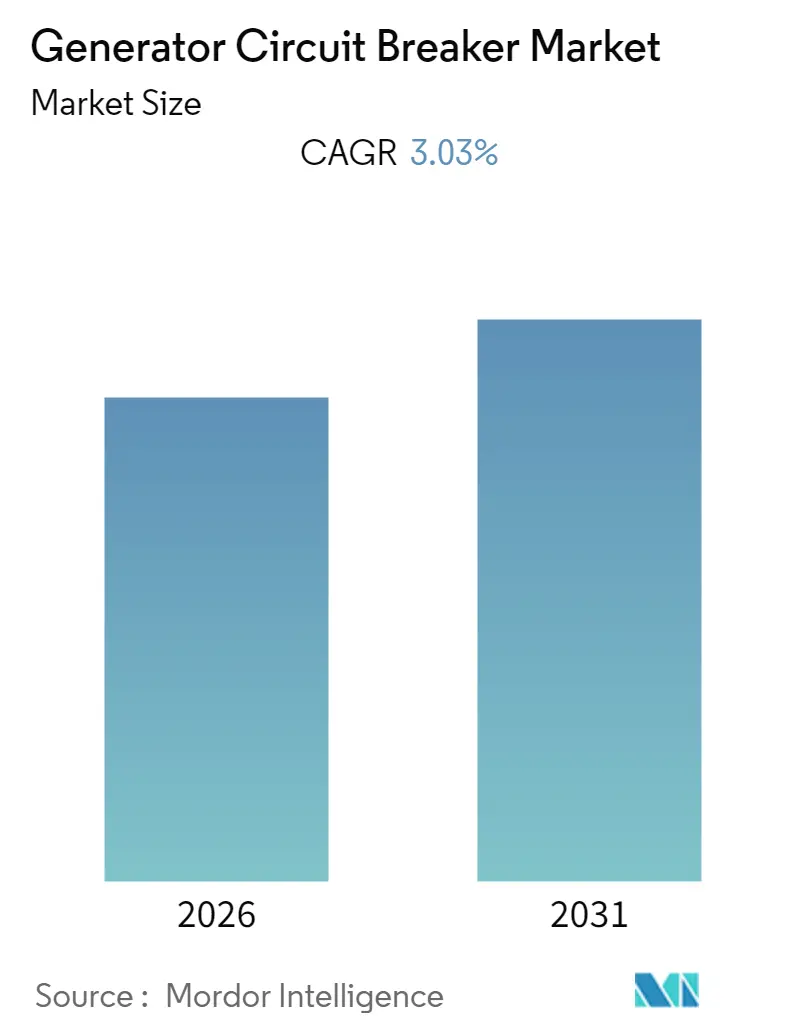
The Generator Circuit Breaker Market size is expected to register a CAGR of 3.03% during the forecast period (2026-2031).
- The gas-based power plants sector is expected to be the fastest-growing market during the forecast period, owing to factors like increasing shift of energy production from cleaner resources and a rise in investment in utility size gas-based power plants.
- Globally, the focus has increased on investments in clean energy projects and the development of cleaner energy resources. As a result, the extensive development of new clean energy projects, and rising electricity usage is likely to create an excellent opportunity for the generator circuit breaker market in the future.
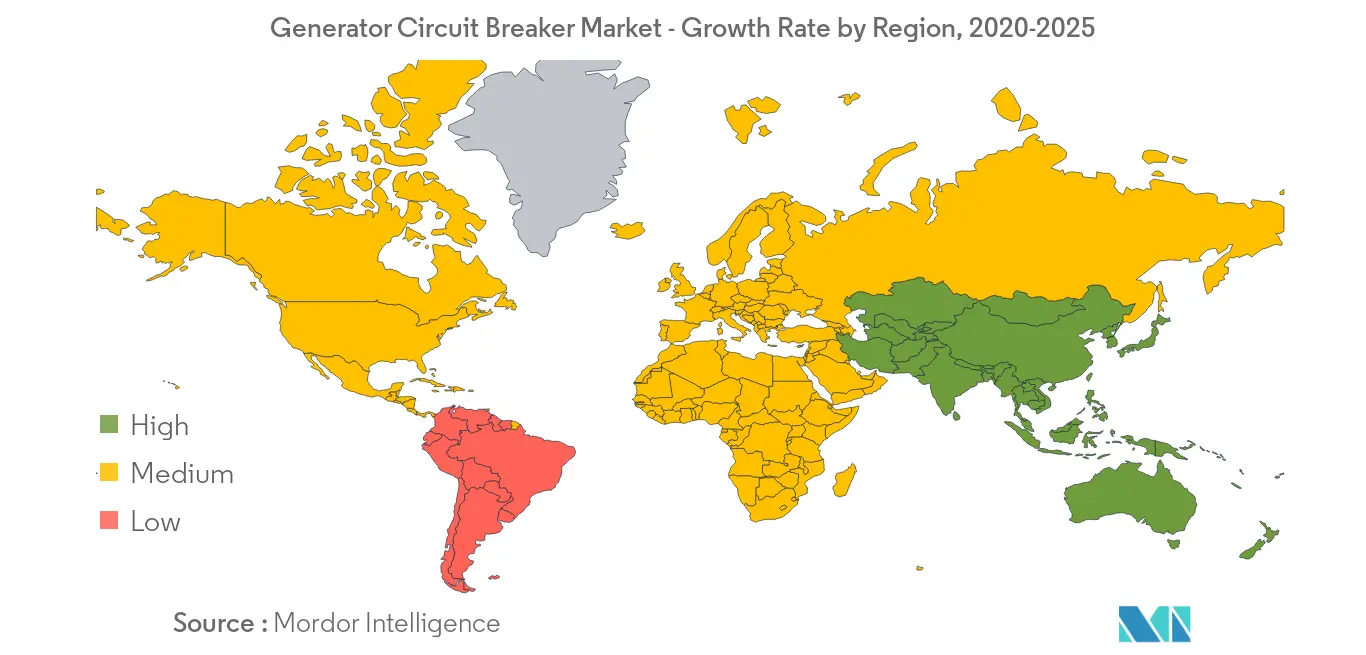
- Asia-Pacific has dominated the generator circuit breaker market in 2019 and is expected to witness significant market growth in the forecast period, with the majority of the demand coming from China, Japan, and India.
Note: Market size and forecast figures in this report are generated using Mordor Intelligence’s proprietary estimation framework, updated with the latest available data and insights as of 2026.
Global Generator Circuit Breaker Market Trends and Insights
Gas-fired Power Plant Sector to Dominate the Market Growth
- Gas-fired power plant sector is expected to witness significant growth in the forecast period, owing to factors like rising clean electricity demand and an increasing number of utility size gas-fired power projects.
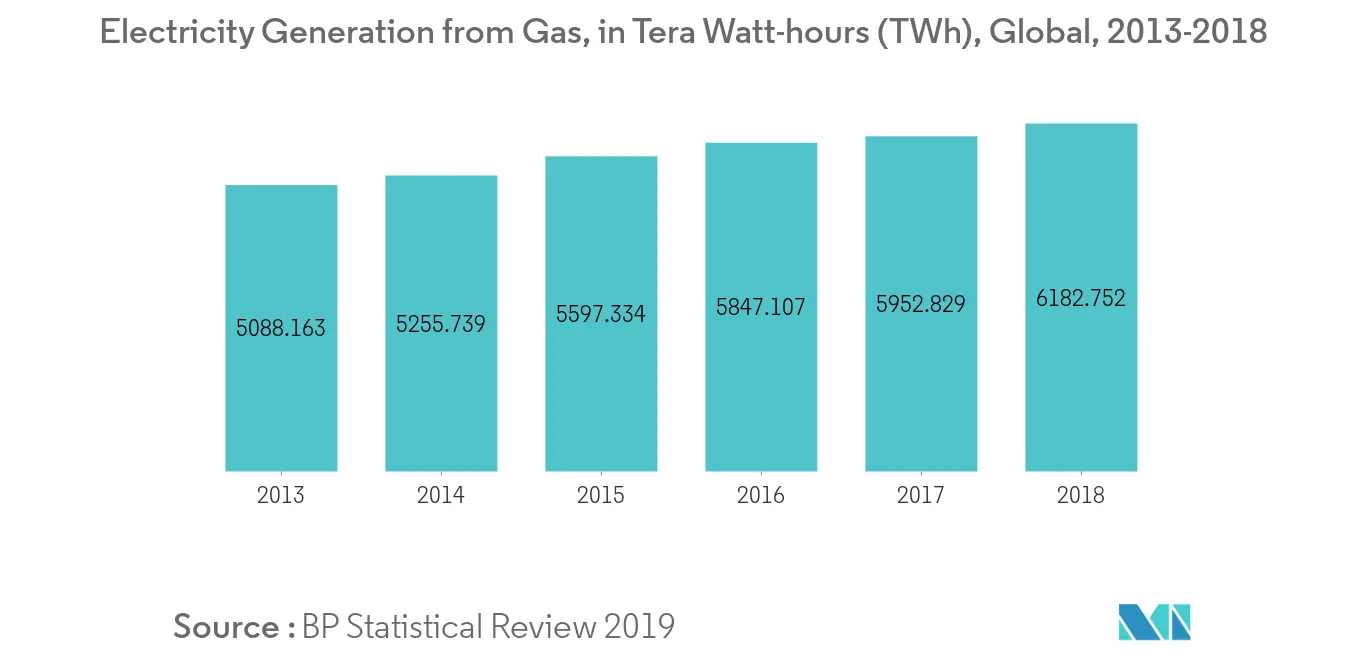
- In recent years there has been an active shift of energy generation from conventional resources like coal and nuclear energy, towards relatively cleaner gas-based power generation. Although the share of electricity generation from gas saw a minor increase in the share of global electricity generation, the shift away from coal and nuclear is clearly visible.
- According to IEA, gas-fired power generation saw a growth of around 4% in 2018, mainly supported by the 17% growth in the United States. In the United States, gas-based power generation accounts for about 30% of the total generation, and in China, it accounts for around 30% of the total energy mix as of 2018.
- Increasing demand for clean energy is one of the primary drivers for the gas-based power plant sector and, in turn, for the generator circuit breakers in the sector. The electricity generation from gas registered a growth of around 39.4% in the decade from 2008 to 2018. Electricity generation from gas in 2008 was 4432.5 TWh, while in 2018 it was 6182.8 TWh.
- Therefore, with the increase in the demand for clean energy, the gas-based power plant sector is expected to rise, and in turn the market is expected to grow for generator circuit breakers in the sector.


Asia-Pacific to Dominate the Market Growth
- Asia-Pacific has dominated the generator circuit breaker market in 2019 and is expected to continue its dominance in the coming years as well.
- Asia-Pacific is one of the fastest-growing regions in the world because of the increasing population, urbanization, and industrialization. As a result, the demand for guaranteed power supply is high. For addressing these demands, many countries are investing in the clean energy sector and transmission and distribution infrastructure.
- The world's most populated country China has seen a two-fold increase in its electricity consumption from 3495.8 TWh in 2008 to 7111.8 TWh in 2018. The country has over 259,000 MW of new coal plants in various stages of development and accounts for more than 1/3 of the global coal plant pipeline.
- On the other hand, the coal consumption rate of India registered a growth rate of 8.7% in 2018, which indicated that the country is still highly dependent on coal for energy generation. India is also thinking of reviving its 24 GW of stressed gas-based power plants which were running at just 23.27% of their capacity as of October 2019.
- This, in turn, is likely to propel the demand of the generator circuit breakers in the region during the forecast period.

Regulatory Landscape
Generator circuit breakers are governed primarily by IEC/IEEE 62271-37-013, the dual-logo international standard covering AC generator circuit-breakers installed between generator and transformer terminals for systems above 1 kV up to 38 kV (typically for generator/transformer ratings of 10 MVA and above). In November 2024, Corrigendum 1 to IEC/IEEE 62271-37-013:2021 was published, reinforcing updates to testing and application requirements that suppliers must reflect in design verification and type-test documentation for global tenders.
Regional compliance frameworks also shape product qualification. In China, GB/T 1984-2024 (high-voltage AC circuit breakers) entered implementation in April 2025, creating a national standard pathway that OEMs and EPCs need to meet for domestic projects and procurement. In the United States, reliability and interconnection-related requirements can influence generator-side protection packages. In July 2026, FERC issued an order (Docket No. RD26-7-000) directing NERC to file mandatory reliability standards for computational load integration by December 31, 2026, increasing the importance of documented protection performance and coordination for power systems supporting rapidly changing large-load profiles.
Value Chain Analysis
The generator circuit breaker value chain starts with upstream inputs and subassemblies, including conductors and copper/aluminum bus work, insulation systems, vacuum interrupters or SF6-based interrupting components depending on design, sensors and control electronics for condition monitoring, and metal enclosures. Product definition and qualification are anchored by IEC/IEEE 62271-37-013, which standardizes technical requirements for GCBs installed between generator and step-up transformer terminals. The 2021 edition broadened applicability to configurations such as pumped-storage plants and multi-generator arrangements connected to a single transformer, which affects engineering, testing, and certification steps before shipment.
Midstream activities include design engineering, type testing, factory acceptance testing (increasingly supported by remote FAT), manufacturing and assembly, and integration into generator switchgear lineups. Downstream, OEMs and EPCs supply GCBs into utility and industrial generation projects, including gas, steam, hydro, pumped storage, and nuclear. They also manage commissioning, spares, and service contracts where availability and lifecycle cost are key purchase criteria. Major suppliers with end-to-end offerings and service networks include Hitachi Energy, Siemens Energy, and GE Vernova, with differentiation increasingly tied to digital monitoring. Hitachi Energy GMS600 is one example, alongside technology transitions such as vacuum switching and SF6-free designs.
Competitive Landscape
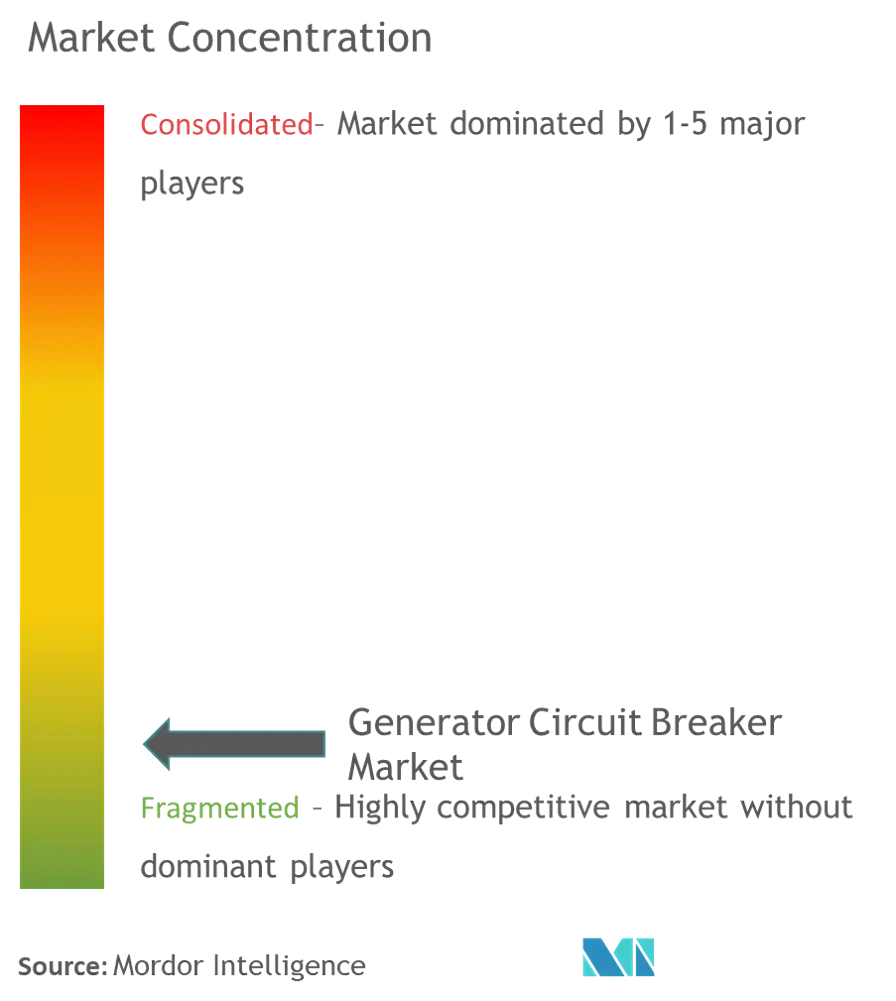
The generator circuit breaker market is partially fragmented. Some of the key players in this market include ABB Ltd, Toshiba Corp, Mitsubishi Electric Corporation, General Electric Company, and Siemens AG.
Generator Circuit Breaker Industry Leaders
Toshiba Corp
Mitsubishi Electric Corporation
General Electric Company
Siemens AG
Schneider Electric SE
- *Disclaimer: Major Players sorted in no particular order

Market Opportunities and Future Outlook
Technology substitution creates a focused opportunity around SF6 reduction and vacuum-based, SF6-free generator switching solutions, particularly where utilities and industrial operators prioritize lower lifecycle handling and environmental compliance. Product portfolios and application guidance already reflect this direction, including Siemens vacuum circuit-breakers for generator switching applications designed to meet IEC/IEEE 62271-37-013. OEM roadmaps that add monitoring and diagnostics to reduce forced outages also support replacement cycles and service-led buying. Digital condition monitoring packages such as Hitachi Energy GMS600 create additional demand within the installed base as asset owners look for higher availability and more predictable maintenance windows.
Application expansion within the standard scope supports opportunities beyond traditional large central stations. IEC/IEEE 62271-37-013:2021 explicitly addresses broader plant architectures, including pumped-storage power plants and power plants with multiple generators tied to a single step-up transformer, which increases the need for engineered protection solutions and compact layouts in constrained switchgear rooms. Packaged or decentralized generation projects and industrial combined-cycle sites also require generator-to-transformer protection tuned to site-specific short-circuit levels and operating regimes, creating demand for customizable, compact GCB designs and retrofit-friendly offerings from established suppliers and qualified regional manufacturers.
Recent Industry Developments
- May 2026: Shaanxi West Power Tongzhong Electrical Co., Ltd. (XDTZ) disclosed development of the VTZ-15/T5000-63 vacuum generator circuit breaker rated at 5000 A under natural cooling, positioned as a replacement for foreign-manufactured models. The program highlights higher-rated vacuum switching as a competitive lever and supports domestic substitution in markets that previously relied on imported GCB solutions.
- April 2025: China implements GB/T 1984-2024 for high-voltage AC circuit breakers, creating a national standard pathway that OEMs and EPCs must meet for domestic projects and procurement. This standardization sharpens qualification criteria for generator circuit breakers used in domestic generation assets.
- July 2024: Mitsubishi Electric Corporation received an order from Kansai Transmission and Distribution, Inc. for 84 kV dry air insulated switchgear featuring in-house vacuum interrupters, with delivery scheduled for March 2026. The project underscores adoption of SF6-free insulation approaches at transmission-class voltages and supports broader acceptance of vacuum interrupter-based platforms within utility switchgear portfolios that interface with generation and grid assets.


Research Methodology Framework and Report Scope
Market Definition and Coverage
For this methodology, the generator circuit breaker market includes dedicated high voltage breakers installed between a generator and step-up transformer, along with related control and monitoring hardware sold as part of the GCB package.
Scope exclusions: We exclude standard switchgear feeders, low voltage molded case devices, and protection relays sold as standalone products.
Segmentation Overview
- Type
- Air Blast Circuit Breakers
- SF6 Circuit Breakers
- Vacuum Circuit Breakers
- Others
- Application
- Coal Based Power Plants
- Natural Gas Power Plants
- Nuclear Power Plants
- Others
- Geography
- North America
- Europe
- Asia-Pacific
- South America
- Middle-East and Africa
Data Sources, Market Sizing, and Validation
Desk Research
Desk work starts with getting the demand context right, since GCBs are tied to large generators and grid connection rules. We used public references such as IEA power generation statistics, World Bank energy indicators, IRENA renewable capacity data, and US Energy Information Administration generation and plant data to understand how the installed base and additions are moving.
To make sure specifications and procurement patterns match real projects, we also reviewed open standards and guidance (such as IEC and IEEE publications), plus utility and grid operator connection requirements where available. Company annual reports, investor presentations, and reputable industry news were then used to identify new plant builds, generator uprates, and major retrofit activity. In some cases, paid subscriptions supporting company financials and patent databases were used to validate product positioning and technology shifts. These sources are illustrative, and we checked other public and paid references to clarify data gaps and confirm assumptions.
Primary Interviews and Surveys
Primary work focuses on how often GCBs are specified and replaced, and what typically drives pricing and lead times. We spoke with OEM-facing stakeholders, EPC and utility buyers, and service teams, covering the major power generation regions so assumptions could be tested against real bid and project behavior.
Distribution of primary research fieldwork respondents
| Company type | Respondent position | Region |
|---|---|---|
| Top tier: 39% | CXOs: 18% | APAC: 42% |
| Mid tier: 43% | Functional/Unit leaders: 34% | EMEA: 36% |
| Smaller Players: 18% | Managers: 48% | Americas: 22% |
Market-Sizing & Forecasting
Sizing is built from a top-down demand pool where generator additions, major refurbishments, and grid connection upgrades are translated into likely GCB installations by voltage class and plant type. Since these breakers are not used across every generator, the model applies adoption rates tied to unit size, connection configuration, and reliability requirements, and then converts demand into value using typical price bands by rating and installation scope.
To keep totals realistic, we then corroborate the output with selective bottom-up checks, such as sampled project awards, channel checks with service providers, and a volume times ASP cross-check for a set of representative regions. Inputs used in the model include annual capacity additions and retirements, the mix of coal, gas, nuclear, and hydro projects, generator MVA ranges and typical connection schemes, retrofit cycles for older plants, and regional procurement timelines that shift booking patterns.
Forecasts are developed using scenario analysis, because plant build pipelines can change with permitting, fuel economics, and grid reliability mandates. Assumptions are tightened using expert views on near-term project slippage, replacement propensity, and expected price progression for SF6, vacuum, and alternative interruption designs. Where data is thin for smaller countries, we scale from comparable markets using generation mix and installed capacity indicators, then re-check against import trends and publicly announced projects.
Data Validation & Update Cycle
Outputs are checked against independent signals like power generation capacity additions, major plant project counts, and known generator upgrade waves, and any large swings are investigated before sign-off. We also run variance checks across regions so one geography does not overgrow beyond what its build pipeline and installed base can support.
Before publication, assumptions are reviewed across multiple analysts, and follow-up calls are triggered when an interview conflicts with a key input such as adoption rate, pricing band, or retrofit timing. Reports are refreshed annually, and interim updates are made when major policy shifts, large project cancellations, or technology changes materially affect the market. Right before delivery, a final review pass is completed so the numbers reflect the latest available public information.
Mordor Intelligence's Generator Circuit Breaker Market Size Compared Against Other Published Estimates
Published market sizes for generator circuit breakers can vary widely, mostly because each publisher draws the line around what counts as a GCB package and how project timing is treated. Some estimates also differ due to currency conversion timing and whether pricing is held flat or allowed to move with technology and compliance requirements.
Power plant addition data, publicly announced retrofit programs, and interview backed price bands are the evidence we use to keep Mordor Intelligence's estimate tied to a realistic generator connection demand pool. The biggest gaps usually come from including adjacent switchgear and protection hardware, counting low and medium voltage breakers used elsewhere in the plant, or assuming all large generators require a dedicated breaker in every configuration.
Benchmark comparison
| Source | Market Size | Gaps in Research Methodology |
|---|---|---|
| Mordor Intelligence | USD 0.00 B (2024) | |
| Global Consultancy A | USD 0.00 B (2024) | Often rolls generator step-up switchgear bays and related protection packages into the total, which expands scope beyond dedicated generator circuit breakers. |
| Industry Association B | USD 0.00 B (2025) | May report shipment value using member disclosures that miss non-member sales and do not normalize for project slippage between booking and commissioning years. |
Across the three views, the spread is mainly explained by scope boundaries and by how project timing is converted into annual value. When the counted products are restricted to true GCB installations and the demand is anchored to generator additions and retrofit cycles, results become easier to reproduce and compare year to year.


Key Questions Answered in the Report
What is the current Generator Circuit Breaker Market size?
The Generator Circuit Breaker Market is projected to register a CAGR of 3.03% during the forecast period (2026-2031)
Who are the key players in Generator Circuit Breaker Market?
Toshiba Corp, Mitsubishi Electric Corporation, General Electric Company, Siemens AG and Schneider Electric SE are the major companies operating in the Generator Circuit Breaker Market.
Which is the fastest growing region in Generator Circuit Breaker Market?
Asia Pacific is estimated to grow at the highest CAGR over the forecast period (2026-2031).
Which region has the biggest share in Generator Circuit Breaker Market?
In 2025, the Asia Pacific accounts for the largest market share in Generator Circuit Breaker Market.
What years does this Generator Circuit Breaker Market cover?
The report covers the Generator Circuit Breaker Market historical market size for years: 2020, 2021, 2022, 2023 and 2024. The report also forecasts the Generator Circuit Breaker Market size for years: 2026, 2027, 2028, 2029, 2030 and 2031.
Page last updated on:





