
Solenoid Valves Market Size and Share
Market Overview
| Study Period | 2020 - 2031 |
|---|---|
| Market Size (2026) | USD 4.79 Billion |
| Market Size (2031) | USD 6.16 Billion |
| Growth Rate (2026 - 2031) | 5.13 % |
| Fastest Growing Market | Middle East and Africa |
| Largest Market | Asia Pacific |
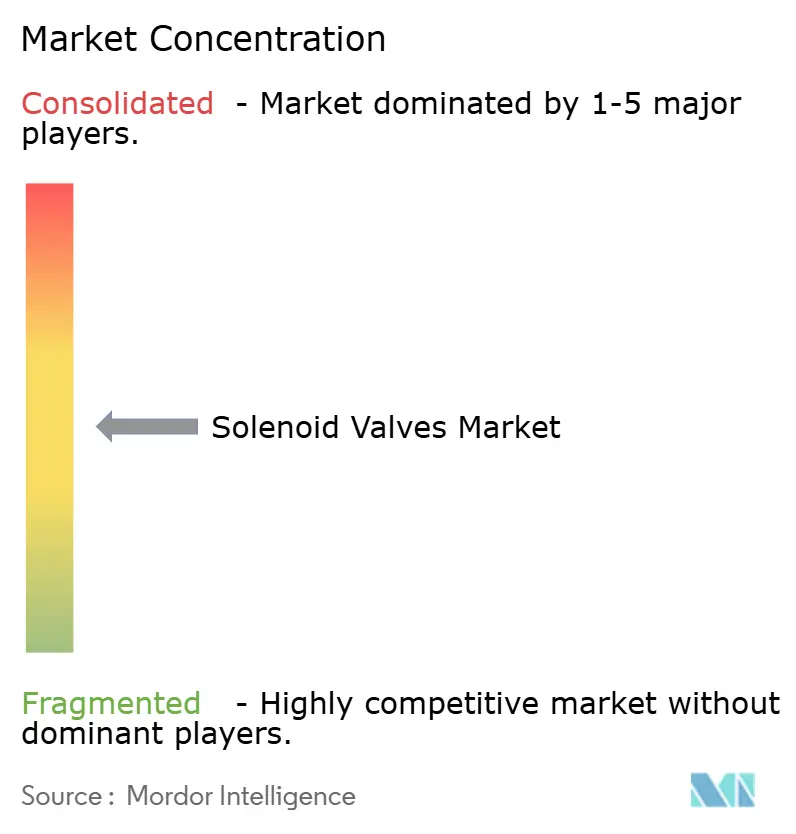
| Market Concentration | Medium |
Major Players
*Disclaimer: Major Players sorted in no particular order Image © Mordor Intelligence. Reuse requires attribution under CC BY 4.0. |
|
Solenoid Valves Market Analysis by Mordor Intelligence
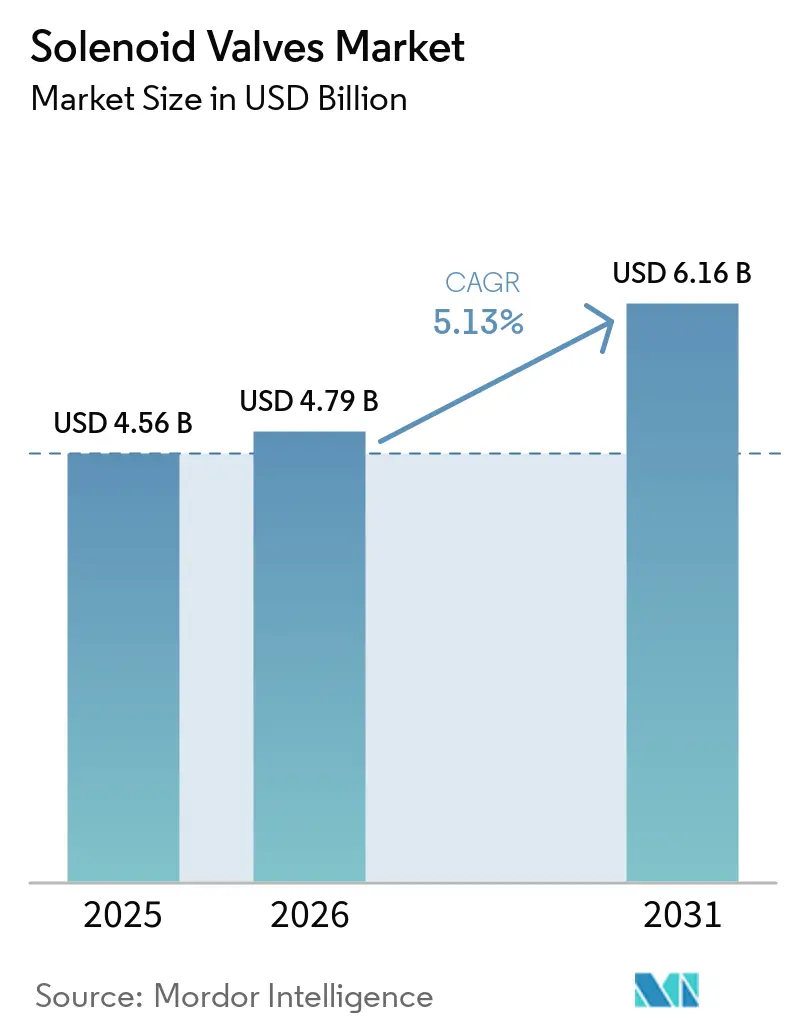
The solenoid valves market size is expected to grow from USD 4.56 billion in 2025 to USD 4.79 billion in 2026 and is forecast to reach USD 6.16 billion by 2031 at 5.13% CAGR over 2026-2031. Demand stems from automation projects in water reuse, shale-gas wellheads, hydrogen electrolyzers, and compact electric-vehicle (EV) thermal loops. Asia-Pacific retains volume leadership, while the Middle East and Africa exhibits the fastest expansion because of economic diversification programs. Technology differentiation is shifting toward zero-emissions actuation, IO-Link-enabled diagnostics, and lightweight engineering plastics that satisfy automotive range targets. Despite growing price competition from low-cost Asian producers and alloy cost swings, OEMs continue to prioritize smart, service-friendly solenoid architectures that limit downtime and enable predictive maintenance.
Key Report Takeaways
- By operating principle, direct-acting valves held 41.60% of solenoid valves market share in 2025, whereas pilot-operated designs are set to grow at 6.65% CAGR to 2031.
- By port configuration, two-way units captured 54.30% revenue share in 2025; three-way variants lead growth at 6.18% CAGR through 2031.
- By valve body material, stainless steel commanded 37.50% share of solenoid valves market size in 2025, yet engineering plastics will expand at 7.30% CAGR.
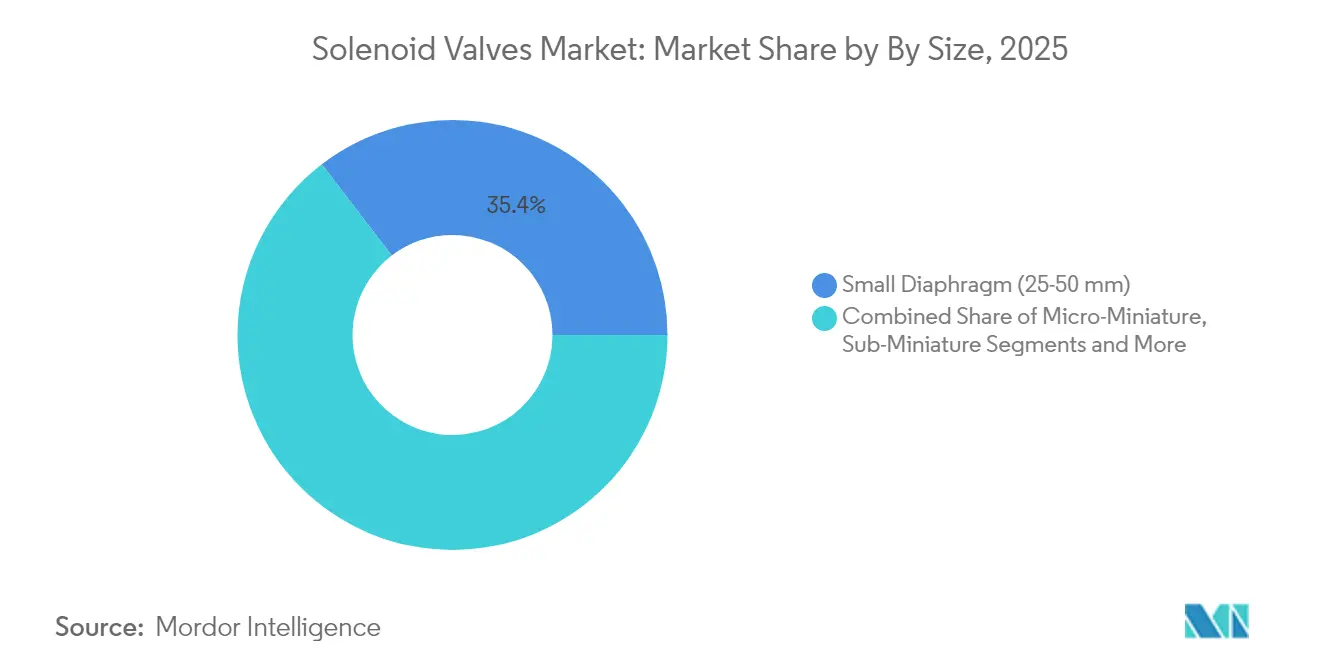
- By size, the 25-50 mm class contributed 35.40% of 2025 revenues; micro-miniature (<5 mm) devices advance fastest at 7.95% CAGR.
- By end-user, oil & gas recorded 22.60% of 2025 sales, while healthcare & pharmaceutical applications will post a 6.85% CAGR to 2031.
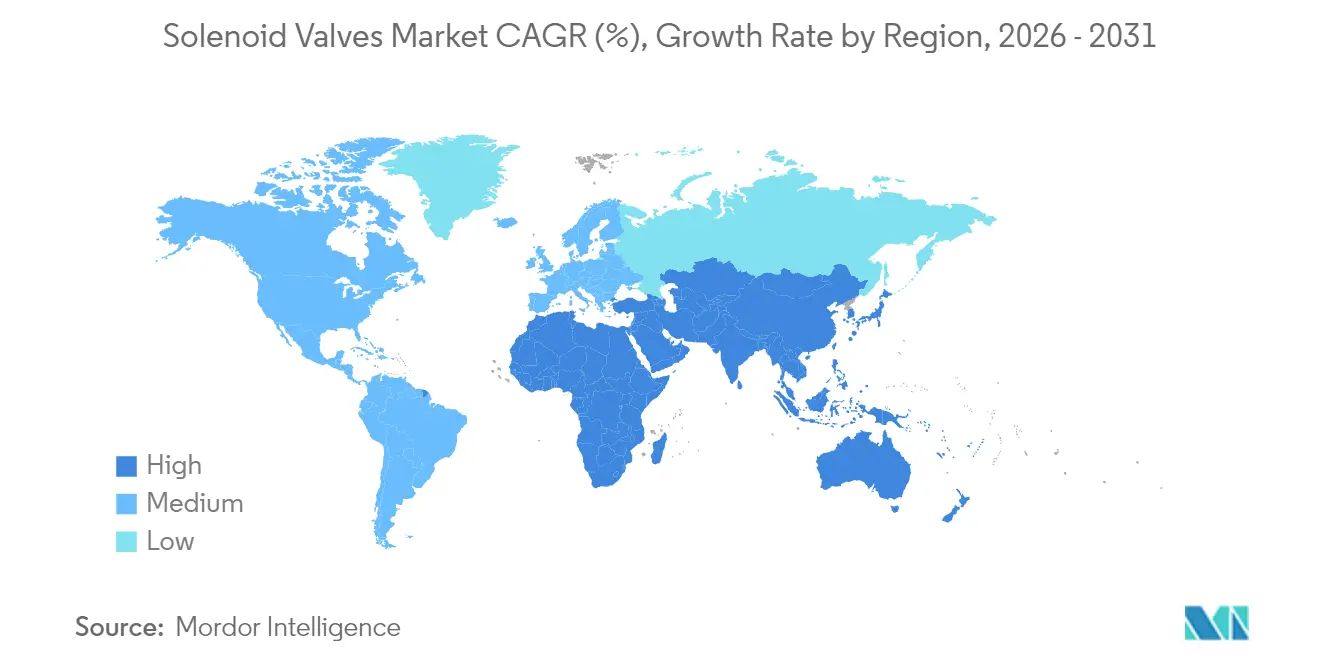
- By geography, Asia-Pacific represented 33.70% of 2025 turnover; the Middle East and Africa is projected to post 7.10% CAGR.
- Top firms Emerson, Parker-Hannifin, and Danfoss together account for roughly 35% of global revenue in 2025, signalling a moderately fragmented competitive field.
Note: Market size and forecast figures in this report are generated using Mordor Intelligence’s proprietary estimation framework, updated with the latest available data and insights as of 2026.
Global Solenoid Valves Market Trends and Insights
Drivers Impact Analysis*
| DRIVER | (~) % IMPACT ON CAGR FORECAST | GEOGRAPHIC RELEVANCE | IMPACT TIMELINE |
|---|---|---|---|
| Expansion of Industrial Waste-water Re-use Schemes in EU & GCC | 0.8% | Europe & Middle East | Medium term (2-4 years) |
| Surge in Compact EV Thermal-Management Loops Requiring Micro-Solenoids | 1.2% | Global, concentrated in APAC & North America | Short term (≤ 2 years) |
| Rapid Retrofit of Legacy Beverage Lines in ASEAN for Hygienic Design | 0.6% | Asia-Pacific (ASEAN focus) | Short term (≤ 2 years) |
| Gas Well-Head Automation in Shale Basins of US & Argentina | 0.9% | North America & South America | Medium term (2-4 years) |
| Hydrogen Electrolyzer Build-Out in Europe & Japan | 1.1% | Europe & Japan | Long term (≥ 4 years) |
| Growing Preference for Smart, IO-Link-Enabled Valves in Pharma 4.0 | 0.7% | Global, led by North America & Europe | Medium term (2-4 years) |
| Source: Mordor Intelligence | |||
Expansion of Industrial Waste-water Re-use Schemes in EU & GCC
Circular-economy directives in the European Union and water-scarcity mandates in the Gulf Cooperation Council are accelerating investments in advanced treatment plants that need automated chemical dosing, back-flush control, and stage switching. Solenoid valves enable precise, low-leak actuation that manual devices cannot match, especially when treatment recipes shift with feed-water variability. Oil producers adopting zero-liquid-discharge plants in the Middle East prefer stainless-steel or duplex bodies coupled with digital position feedback to meet environmental audits.[1]
Surge in Compact EV Thermal-Management Loops Requiring Micro-Solenoids
Battery cooling, power-electronics chillers, and cabin HVAC in next-generation EVs integrate multi-loop circuits that depend on fast, energy-efficient micro-solenoids. Suppliers such as Sanhua Automotive have commercialized refrigerant versions able to cycle millions of times while operating inside constrained battery packs. Lightweight PEEK bodies and low-power coils extend driving range, making the segment a core growth engine for the solenoid valves market.[2]
Rapid Retrofit of Legacy Beverage Lines in ASEAN for Hygienic Design
Bottling plants across Thailand, Vietnam, and Indonesia are modernizing to comply with international food-safety codes. Three-way stainless or polymer-lined valves allow clean-in-place routines without manual disconnection, minimizing downtime. Retrofits favor IO-Link-capable models that transmit temperature and cycle counts to plant SCADA systems for predictive maintenance.
Gas Well-Head Automation in Shale Basins of US & Argentina
Remote shale pads deploy electric dump valves that eliminate methane bleed and reduce site visits. Emerson’s ASCO solution cuts actuation power by 98.75% versus pneumatics while meeting EPA methane limits. Pilot-operated variants withstand the high pressures typical of shale gas, reinforcing demand in the solenoid valves market.
Restraints Impact Analysis*
| RESTRAINTS | (~) % IMPACT ON CAGR FORECAST | GEOGRAPHIC RELEVANCE | IMPACT TIMELINE |
|---|---|---|---|
| High Switching-Cycle Fatigue in >120°C Applications | -0.9% | Global, particularly in power generation & chemical processing | Short term (≤ 2 years) |
| Price Volatility of Specialty Alloys (e.g., Duplex SS) | -0.7% | Global manufacturing regions | Medium term (2-4 years) |
| Skilled-Labor Shortage for Field Retro-Commissioning in LATAM | -0.4% | Latin America | Medium term (2-4 years) |
| Rising Competition from Piezo-Electric Micro-Valves in Medical OEMs | -0.6% | Global, concentrated in medical device manufacturing hubs | Long term (≥ 4 years) |
| Source: Mordor Intelligence | |||
High Switching-Cycle Fatigue in >120 °C Applications
Steam lines and high-temperature reactors expose solenoid coils to accelerated insulation breakdown. Premium high-temp copper windings and perfluoro-elastomer seals are available but raise bill-of-material cost, curbing adoption in price-sensitive projects. Utilities facing extended maintenance intervals perceive risk in swapping to higher-density windings, moderating growth for the solenoid valves market.
Price Volatility of Specialty Alloys (e.g., Duplex Stainless)
Nickel and molybdenum price swings inflate the cost of corrosion-resistant valve bodies. OEMs attempt to hedge with polymer composites, yet qualification cycles in petrochem and pharmaceutical plants delay shifts, creating margin uncertainty for valve suppliers.
*Our forecasts treat driver/restraint impacts as directional, not additive. The impact forecasts reflect baseline growth, mix effects, and variable interactions.
Segment Analysis
By Operating Principle: Pilot-Operated Designs Scale High-Flow Demands
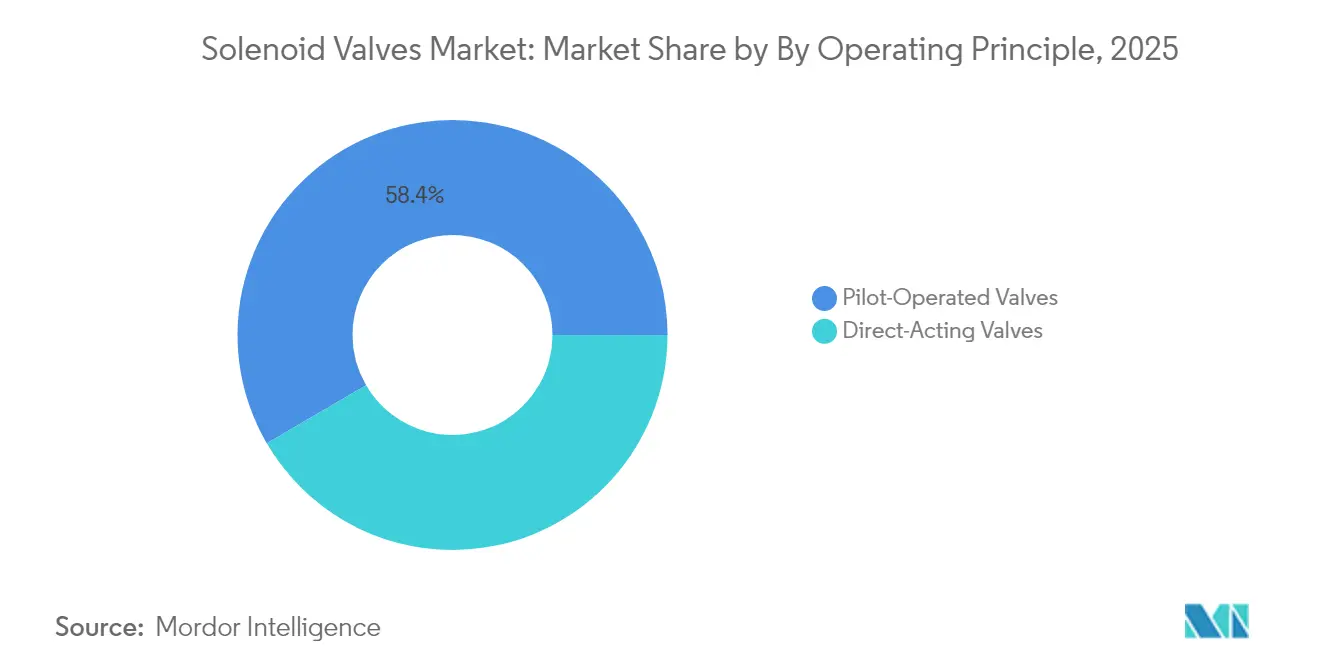
Direct-acting valves led the solenoid valves market with 41.60% share in 2025, translating to an estimated USD 1.99 billion of 2026 revenue. Their simple architecture, minimal pressure drop, and fast cycling suit utilities water lines and OEM machinery. Yet pilot-operated mechanisms, advancing at 6.65% CAGR, increasingly service wellheads, power boilers, and large chemical reactors that require ports above 25 mm and pressures exceeding 100 bar. Emerson’s shale-gas solution highlights the shift, pairing a minute electromagnetic pilot with a piston diaphragm able to pass thousands of standard cubic meters per hour. Industries upgrading to predictive maintenance platforms value the lower inrush current and quieter closing profile typical of pilot-operated units.
The move alters supply-chain needs: coils must tolerate fluctuating upstream pressures, diaphragms demand abrasion-resistant elastomers, and housings often integrate threaded sensors that feed PLCs. Asian fabricators now replicate classic pilot-operated geometries at scale, intensifying price pressure but also expanding availability across emerging economies, thereby broadening the solenoid valves market.

By Port/Flow Configuration: Three-Way Routes Tackle Flexible Production
Two-way shut-off valves remain the workhorse, holding 54.30% revenue in 2025, roughly USD 2.48 billion of solenoid valves market size. They dominate irrigation, compressed-air, and basic process isolation. However, as food, beverage, and biotech adopters demand rapid SKU changeovers, three-way diverter designs grow 6.18% annually. These valves alternate between production, CIP, and sterilization streams without manual spool changes, aligning with hygienic directives. Certain pharmaceutical skids now bundle twenty or more three-way units on a single digital manifold, trimming footprint by 30% and slashing install time.
Manufacturers respond with cavity-free internals and FDA-approved seals that eliminate dead legs where contaminants accumulate. Control software maps each port to PLC tags, enabling recipe-driven flow paths. Multi-port innovations bleed into semiconductor wet benches, where chemistries must route through multiple rinse and etch tanks in milliseconds, reinforcing three-way adoption across the solenoid valves market.
By Valve Body Material: Engineering Plastics Cut Weight and Contamination
Stainless steel captured 37.50% of 2025 sales, thanks to its corrosion resistance and cleanability in dairy, petrochem, and steam service. Yet its density hampers mobile and miniature designs. Engineering plastics and composites are rising 7.30% CAGR, supporting lightweight EV thermal circuits, single-use biopharma assemblies, and portable medical devices. Grades such as PEEK withstand 150 °C and aggressive solvents while offering 50% mass savings over steel. Suppliers mold complex internal channels that would demand costly machining in metal, reducing per-unit assembly time.
OEMs leverage translucent polymers to enable visual inspection of flow and seal condition, a feature prized in labs and pilot plants. That said, plastic valves endure lower pressure ratings, so stainless retains leadership in refinery and offshore duty, ensuring a dual-track material roadmap that shapes procurement across the solenoid valves market.
By Size: Micro-Miniature Valves Drive Precision Instrumentation
The 25-50 mm class held 35.40% of 2025 shipments, underlining its ubiquity in standard automation. Micro-miniature (<5 mm) models will rise 7.95% CAGR, albeit from a small base, as diagnostic analyzers, ventilators, and microfluidic test rigs demand microliter dosing accuracy. Emerson’s micro-solenoid line achieves 0.004 mL stroke volumes while drawing under 1 W, critical for battery-fed devices. Engineering challenges include retaining magnetic force in truncated cores and perfecting O-ring seals tolerant of millions of flex cycles.
Lab automation integrators favor manifold blocks that integrate multiple micro-valves with pressure sensors, reducing dead volume and response lag. High-density PCB connectors replace traditional DIN plugs, shrinking envelope size further. Such innovations enlarge the solenoid valves market as precision sectors grow.
By End-User Industry: Healthcare Automation Sustains Highest CAGR
Oil & gas generated 22.60% of 2025 revenue, underlining its historic dependency on solenoid-based actuation for burner, separator, and pipeline skids. However, regulatory scrutiny to curb fugitive emissions propels upgrades toward zero-bleed electric valves. Meanwhile, healthcare and pharmaceutical plants show a foreseeable 6.85% CAGR, embracing single-use bioreactors, continuous tablet presses, and clean steam generation. Smart solenoid arrays simplify changeover documentation, a core FDA expectation.
Automotive demand broadens as EV production accelerates, embedding dozens of coolant valves per vehicle. Heavy Commercial Vehicles and Buses follow regulatory timelines on diesel after-treatment; each Euro VI SCR system uses multiple dosing valves alongside DEF level sensors, maintaining a resilient baseline within the automotive solenoid market. Chemical processors pursuing modular production architecture also specify top-entry, easy-clean solenoids to minimize downtime, reinforcing multi-sector pull across the solenoid valves market.
Geography Analysis
Asia-Pacific, home to 33.70% of 2025 revenue, leverages China’s vast electronics output, Japan’s precision robotics, and India’s expanding pharma exports. Governments supporting domestic semiconductor fabs and battery plants fuel manifold adoption, while hydrogen pilot corridors in Japan and Korea demand high-integrity valves able to tolerate 700 bar gaseous service. Additionally, rising water-reuse mandates in coastal Chinese provinces add fresh municipal demand.
The Middle East and Africa, posting a projected 7.10% CAGR, benefits from Vision 2030 diversification projects in Saudi Arabia and petrochemical mega-sites in the UAE. Hydrogen-ammonia export plans from Oman and Saudi NEOM require specialized pilot-operated valves compatible with cryogenic and high-pressure duty. African growth centers on South African mining dewatering and Egyptian food-processing expansion, driving moderate yet diverse uptake.
North America contributes steady aftermarket turnover in shale gas, LNG, and pharma. The rapid rollout of zero-emissions wellhead valves across Colorado and Texas showcases regulatory-driven capex that refreshes installed bases. In Canada, carbon-capture demonstration plants call for corrosion-proof solenoids handling CO₂ mixed streams. Europe, a mature yet innovation-led region, pivots to green hydrogen and digitalized manufacturing. That pivot secures value for smart IO-Link-ready valves despite slower headline growth, anchoring premium price bands within the solenoid valves market.
Regulatory Landscape
Regulatory requirements for solenoid valves increasingly converge around functional safety, electrical safety, and application-specific hygiene rules, tightening qualification for OEMs selling into building services, process industries, and regulated utilities. In Europe, EN 17955:2024 anchors functional-safety expectations for industrial valves in automated safety functions, while IEC 60730-2-8:2025 (and its national adoptions) governs automatic electrical controls that include electrically operated valves used in appliances and similar installations.
Application-driven rules also constrain materials and construction. DIN 35911:2025-12 specifies requirements for solenoid valves used in drinking-water system installations, which raises documentation and material-suitability expectations for water and building-automation suppliers. For laboratory and measurement/control environments, UL 61010-2-202:2024 introduces specific electrical-safety requirements for electrically operated valve actuators, increasing the focus on electrical immunity and hazard prevention during certification and market entry. For hazardous locations, IECEx certification remains a key gateway for solenoid actuators deployed in explosive atmospheres.
Value Chain Analysis
The value chain starts with raw materials and critical components such as stainless steel and specialty alloys (including duplex grades), engineering plastics (for example, PEEK), elastomer seals, copper windings, and electronic subassemblies for IO-Link diagnostics. Valve and actuator manufacturing includes machining or molding of bodies, coil winding and encapsulation, assembly, leak and cycle testing, and certification packages aligned with market-specific standards, including functional-safety and electrical-safety regimes. OEM channels split between direct supply to equipment makers (water treatment skids, EV thermal loops, wellhead automation, and pharma equipment) and distribution networks that support retrofit and MRO demand.
Two dynamics shape recent value-chain strategies. First, lead-time pressure on high-spec components and documented material traceability push buyers toward standardized valve specifications and multi-sourcing to stabilize inventory planning. Second, portfolio and capability expansion is being pursued through inorganic moves, illustrated by Control Devices acquiring Solenoid Solutions (July 2026) to broaden engineered flow-control offerings and integrate manufacturing capacity. Technology partnering also signals how specialized actuation know-how is being embedded into established catalogs, such as magnetically actuated zero-emission valve licensing between MagDrive Technologies and Williams Valve Corp in August 2025.
Competitive Landscape
Competition remains moderate, with the top five suppliers capturing about 55% of global revenue. Emerson expanded scope by acquiring Aventics in 2024, adding five plants and robust pneumatics depth. Parker-Hannifin continues to demonstrate disciplined cost control, delivering 22.1% segment margin in its FY 2025 second quarter. Danfoss leverages strong HVAC heritage to cross-sell energy-efficient valve solutions within heat-pump and district-energy projects.
New entrants focus on piezo-electric micro-valves, principally in medical and analytical niches. Incumbents counter by integrating piezo drivers into hybrid products, extending product breadth inside the solenoid valves industry. Supply-chain tension persists in high-nickel steels, prompting dual sourcing and regional machining hubs to avoid freight bottlenecks.
Solenoid Valves Industry Leaders
-
Emerson Electric Co.
-
Danfoss A/S
-
Parker-Hannifin Corp.
-
SMC Corporation
-
IMI plc (Norgren)
- *Disclaimer: Major Players sorted in no particular order
Market Opportunities and Future Outlook
Energy and emissions constraints in automation are creating whitespace for low-power, electronically managed solenoid architectures that reduce coil energy while adding diagnostics. An example of this shift is Burkert introducing Kick and Drop coil technology (April 2026), positioned to cut solenoid energy consumption (reported up to 80%) for applications such as data center liquid cooling, where power efficiency and thermal stability influence procurement decisions. In parallel, the growing preference for IO-Link-enabled valves in Pharma 4.0 and other smart-factory programs supports retrofit opportunities via smart connectors that convert installed DIN 43650 valve populations into monitored assets capable of reporting cycle counts, temperature, and coil current without changing pipework.
High-density manufacturing environments also open room for compact manifolds and valve terminals that reduce footprint and wiring complexity. Festo introducing the VTOC valve terminal for semiconductor gas box applications (June 2026), with capacity to control up to 96 process points in one unit, highlights demand for modular, service-friendly designs in advanced fabs and other precision plants. On the supplier side, M&A aimed at engineered solenoid valve capability, including Control Devices acquiring Solenoid Solutions (July 2026) for markets including medical, appliance, and instrumentation, points to active investment in differentiated solenoid platforms rather than commodity on/off valves.
Recent Industry Developments
- April 2026: Emerson introduced the Fisher SVX Steam Conditioning Valve for turbine bypass and other severe steam-conditioning duties. While not a standalone solenoid product, the release expands Emersons valve portfolio in power and process applications that frequently pair control valves with solenoid-driven actuation and shutdown architectures, reinforcing demand for higher-reliability ancillary valve components across projects.
- November 2025: Emerson relaunched the ASCO Series 327C solenoid valve with new Intrinsically Safe and Manual Reset construction versions. The update improves fit for hazardous-area and safety-interlock use cases where certification and serviceability drive purchasing, supporting upgrades in oil and gas and other regulated plants.
- February 2024: Danfoss launched an integrated and expanded cartridge valve portfolio that includes solenoid, check, flow, and directional valves, manufactured across facilities in the United States, China, the United Kingdom, Italy, and Mexico. The broadened range and multi-region footprint support OEM sourcing strategies that require both platform standardization and localized supply for hydraulics-intensive equipment.
Research Methodology Framework and Report Scope
Market Definition and Coverage
This market covers the revenue generated from solenoid valves sold for controlling flow of liquids or gases in industrial and commercial systems, including direct-acting and pilot-operated designs used across common automation and process applications.
Scope exclusions: We exclude broader valve packages and plant systems where the solenoid valve is bundled as part of a larger skid or turnkey solution and cannot be separated as a distinct valve value.
Segmentation Overview
-
By Operating Principle
- Direct-Acting
- Pilot-Operated
-
By Port/Flow Configuration
- Two-Way
- Three-Way
- Four-Way and Above
-
By Valve Body Material
- Brass
- Stainless Steel
- Aluminum
- Engineering Plastics and Composites
-
By Size
- Micro-Miniature (less than 5 mm)
- Sub-Miniature (5-10 mm)
- Miniature (10-25 mm)
- Small Diaphragm (25-50 mm)
- Large Diaphragm (greater than 50 mm)
-
By End-user Industry
-
Food and Beverage
- Filtration Systems
- Filling / Dosing Lines
-
Automotive
- Air-Suspension
- Fuel Injection and Emission
- Safety and Security Systems
- Transmission and Driveline
- Others (HVAC, Doors)
-
Chemical and Petrochemical
- Direction Control for Storage
- Isolation Valves
-
Power Generation
- Steam Control and Feeders
- Lifts and Pumping
- Deluge Systems
-
Oil and Gas
- Drilling
- Extraction
- Downstream Supply
- Healthcare and Pharmaceutical
- Other Verticals (Agri-Tech, Aerospace, Textile, etc.)
-
Food and Beverage
-
By Geography
-
North America
- United States
- Canada
- Mexico
-
Europe
- United Kingdom
- Germany
- France
- Italy
- Rest of Europe
-
Asia-Pacific
- China
- Japan
- India
- South Korea
- Rest of Asia-Pacific
-
Middle East
- Israel
- Saudi Arabia
- United Arab Emirates
- Turkey
- Rest of Middle East
-
Africa
- South Africa
- Egypt
- Rest of Africa
-
South America
- Brazil
- Argentina
- Rest of South America
-
North America
Data Sources, Market Sizing, and Validation
Desk Research
Desk research sets the foundation by helping us lock the market perimeter and the demand centers before we start building the model. We use public sources such as the US Census Bureau manufacturing and trade tables, UN Comtrade country trade statistics, Eurostat industrial production releases, and national statistical offices for output indicators linked to automation-heavy industries.
To keep the view practical, we also review materials from ISA and similar automation associations, and we use ASTM and ISO standard references that clarify product definitions. Patent databases are also reviewed to understand technology shifts in coils, sealing, and compact form factors. These are supplemented with company filings, investor presentations, product catalogs, and reputed press to map typical application areas and price bands, and then cross-checked with paid subscriptions for company financials and for shipment-level import and export signals where available. The sources mentioned here are illustrative only, and many other public and paid references were used for data collection, validation, and clarification.
Primary Interviews and Surveys
Primary work focuses on getting reality checks on how volumes and pricing are moving across key end users like chemical and petrochemical, oil and gas, power generation, water handling, automotive, and food and beverage. Interviews cover manufacturers, distributors, system integrators, and large users across APAC, EMEA, and the Americas, so assumptions on replacement cycles, typical specifications, and regional pricing can be confirmed and adjusted.
Distribution of primary research fieldwork respondents
| Company type | Respondent position | Region |
|---|---|---|
| Top tier: 31% | CXOs: 13% | APAC: 44% |
| Mid tier: 55% | Functional/Unit leaders: 41% | EMEA: 32% |
| Smaller Players: 14% | Managers: 46% | Americas: 24% |
Market-Sizing & Forecasting
The sizing starts from a top-down demand pool build using industrial activity and automation intensity, where production and trade data help reconstruct where solenoid valves are most consumed by end users. Once that structure is in place, we corroborate totals using selective bottom-up approximations, such as sampled price per unit multiplied by estimated unit volumes for common configurations, supported with channel checks across large buying industries.
Inputs that shape the model include industrial production trends in process industries, capex and maintenance activity in oil and gas and power assets, water and wastewater project spending signals, the mix shift between direct-acting and pilot-operated valves, and typical ASP movement by material choices and port configuration. For forecasting, scenario analysis is applied around capex cycles and automation adoption, and yearly growth paths are cross-checked with interview feedback on lead times, substitution risk, and regional demand softness or strength. Where bottom-up evidence is thinner for smaller countries, gaps are handled through proportional allocation based on industry footprint and import intensity, then rechecked against regional totals.
Data Validation & Update Cycle
Outputs are tested through multiple checks so the numbers do not only fit the model, but also align with observable market signals. We compare market totals with independent indicators such as valve shipment trends, trade movement, industrial production, and the implied installed-base replacement need, and then investigate any unusual jumps before sign-off.
A second analyst review is used to confirm definitions, currency handling, and year alignment, and follow-up outreach is triggered when interview feedback conflicts with the desk view. The report is refreshed on an annual cycle, with interim updates when major events materially change pricing, supply, or demand. Before delivery, a final pass is completed so the latest public releases and field inputs are incorporated.
Mordor Intelligence's Solenoid Valves Market Size Versus Other Published Estimates
Published market sizes for solenoid valves often differ because the product perimeter and the base year chosen for the headline number are not consistent across sources, and small pricing assumptions can change the total meaningfully. Differences also come from how each study treats end-use coverage, regional currency timing, and how frequently the underlying assumptions are refreshed.
Some external estimates anchor the market in earlier base years and then roll forward using a single global CAGR, and a few apply broad average pricing without separating configuration and material mix. In Mordor Intelligence, the headline value is for 2026 and is built from end-use demand signals, then checked with configuration-level price logic. Broader valve assemblies or non-separable packaged system value is not counted.
Benchmark comparison
| Source | Market Size | Gaps in Research Methodology |
|---|---|---|
| Mordor Intelligence | USD 4.79 B (2026) | |
| Industry Research Publisher A | USD 4.88 B (2023) | Uses a 2023 base with historical roll-forward logic and can understate later-year price mix changes if configuration and material splits are simplified. |
| Global Publisher B | USD 5.38 B (2025) | Presents a 2025 base and may reflect a broader average ASP view, which can lift totals if premium materials or higher-spec applications are weighted more heavily than typical volumes. |
The spread in the table is mainly explained by the base year selected and how pricing is carried forward across regions and configurations. By keeping the scope limited to separable solenoid valve value and by tying price and volume to observable demand drivers, the estimate stays traceable to clear inputs and can be repeated when new data points arrive.
Key Questions Answered in the Report
What is the current size of the solenoid valves market?
The solenoid valves market stands at USD 4.79 billion in 2026.
How fast is the solenoid valves market expected to grow?
It is projected to expand at 5.13% CAGR, reaching USD 6.16 billion by 2031.
Which region leads the solenoid valves market?
Asia-Pacific holds the largest share at 33.70% of 2025 revenue.
Which application segment is growing fastest?
Healthcare and pharmaceutical plants will post a 6.85% CAGR thanks to automation and compliance investments.
What material trend is influencing solenoid valve design?
Engineering plastics are gaining ground at 7.30% CAGR, driven by lightweight EV and single-use biopharma requirements.
Why are IO-Link-enabled valves important?
They provide real-time diagnostics that support predictive maintenance, reducing unplanned downtime across smart factories.