
Soap Market Size and Share
Soap Market Analysis by Mordor Intelligence
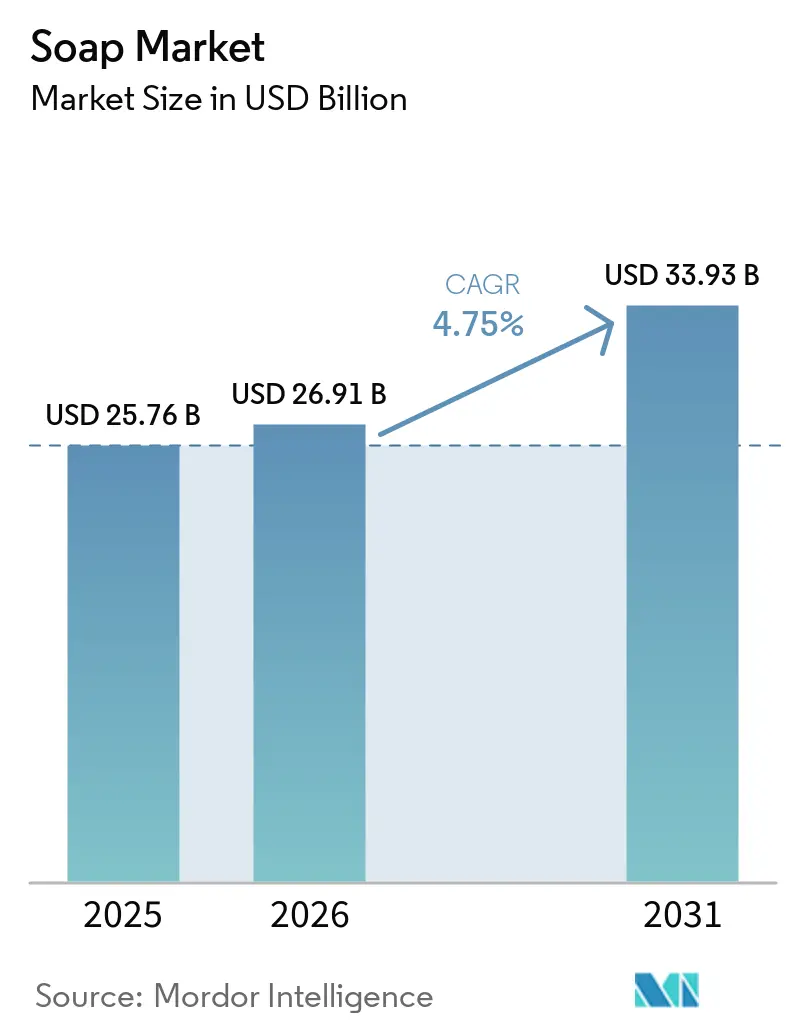
The soap market size was valued at USD 26.91 billion in 2026 and estimated to grow from USD 28.19 billion in 2027 to reach USD 35.3 billion by 2032, at a CAGR of 4.6% during the forecast period (2027-2032).
Hygiene-related use supports recurring demand, while premium bars in India offer a route to develop value within solid cleansing formats. Formulation work and direct digital channels give suppliers ways to distinguish bars and reach buyers. Body-wash competition in India pressures bathing occasions, while input inflation can leave less soap at a fixed price. Packaging and classification duties also shape the offers suppliers can bring to particular destinations. Growth depends on suppliers turning a differentiated bar into repeat use while body-wash competition and palm-linked input costs press on bathing occasions and pack sizes at fixed prices.
Key Report Takeaways
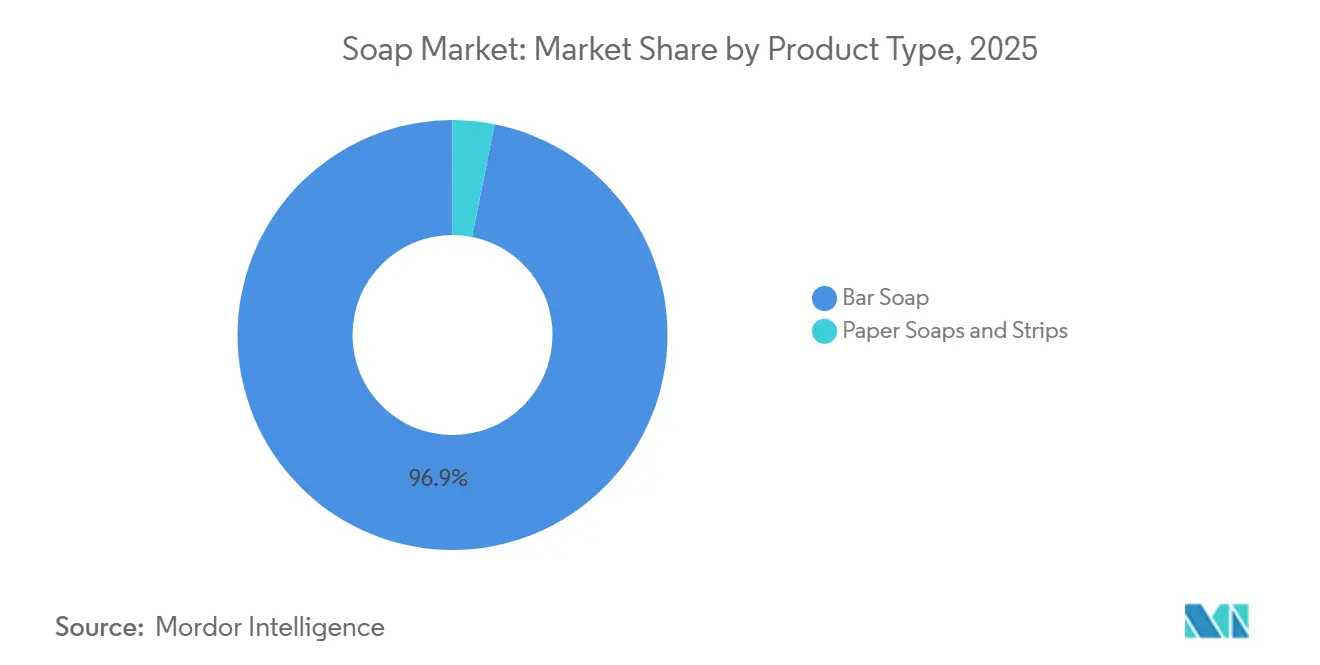
- By product type, bar soap held a 96.86% soap market share in 2026, while paper soaps and strips are forecast to grow fastest at a 5% CAGR during 2027-2032.
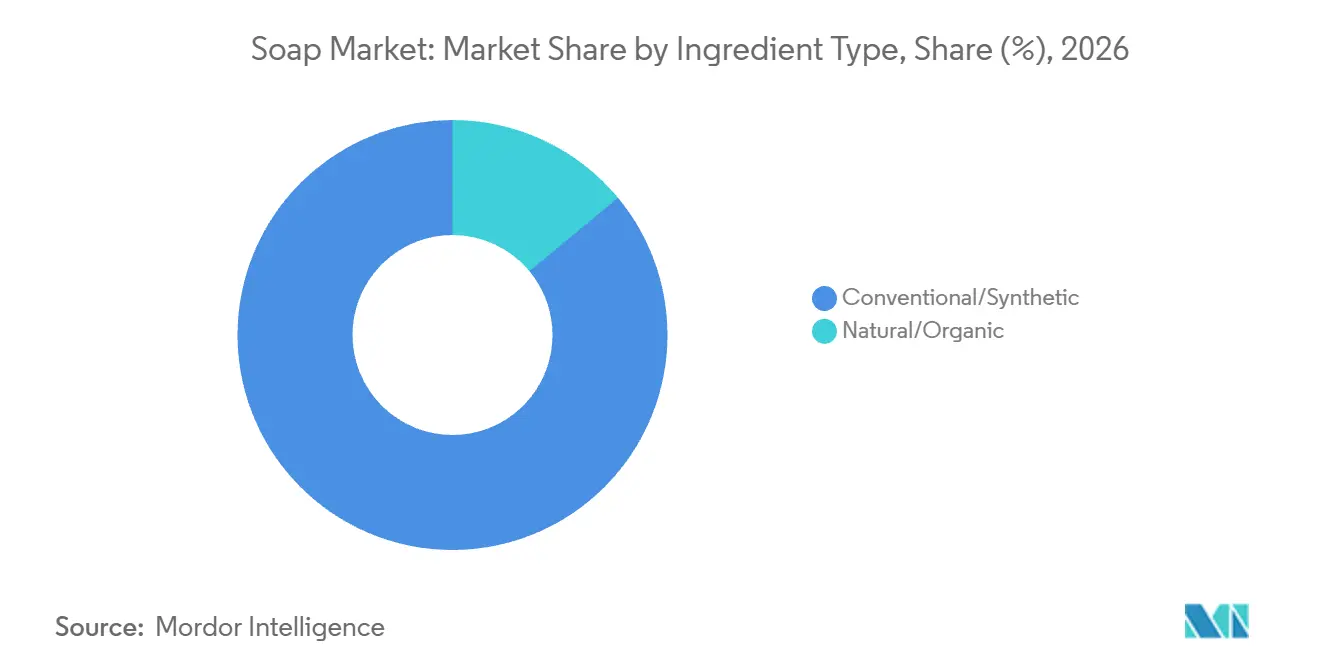
- Among ingredient types, conventional/synthetic soap held an 86.02% share of the soap market size in 2026, and natural/organic soap is the fastest-growing segment at a 5.7% CAGR during 2027-2032.
- The mass category led with 87.3% of market value in 2026, whereas premium soap is the fastest-growing segment at a 5.6% CAGR during 2027-2032.
- By end user, adults accounted for 93.05% of market value in 2026, and children's soap is the fastest-growing segment at a 5.5% CAGR during 2027-2032.
- Supermarkets/hypermarkets led distribution with 35.48% of market value in 2026, while online retail stores are forecast to grow fastest at a 5.75% CAGR during 2027-2032.
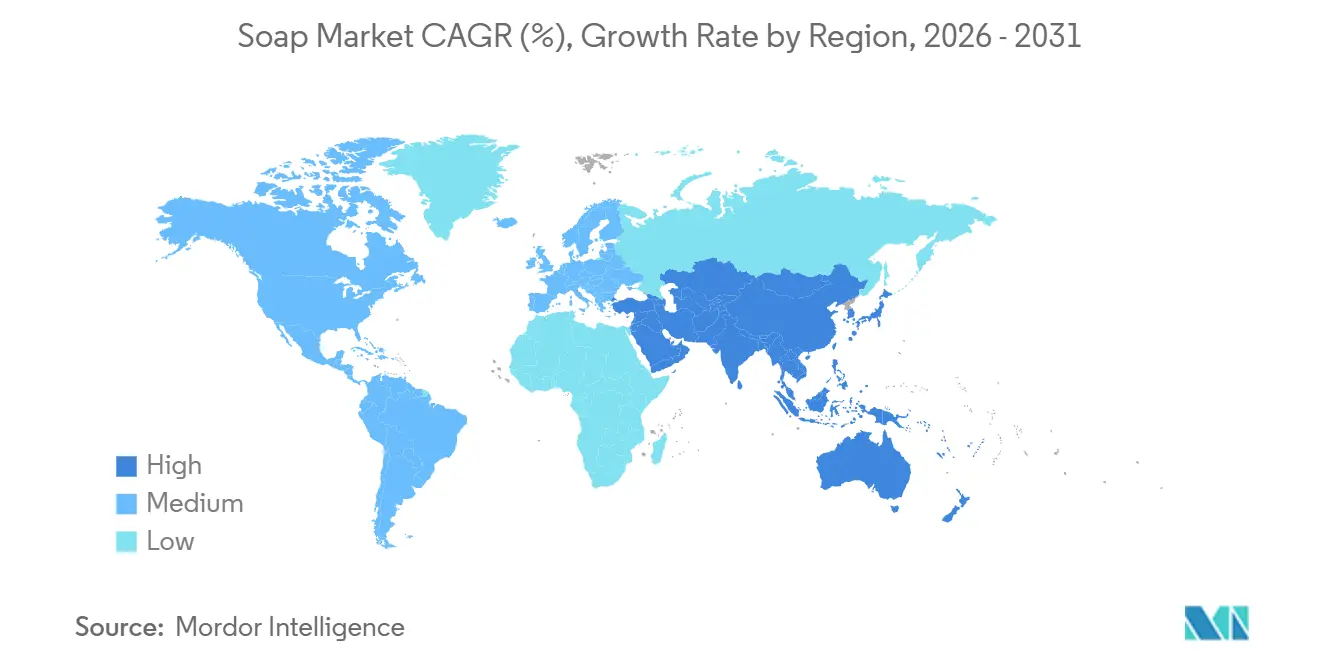
- Asia-Pacific led geography with 37.68% of market value in 2026, whereas Middle East & Africa is the fastest-growing region at a 5.12% CAGR during 2027-2032.
Note: Market numbers in this report are based on Mordor Intelligence's proprietary estimation framework, which combines nine months of actuals with Q4 projections for base year 2026.
Market Trends and Insights
Drivers Impact Analysis of Soap Market*
| Driver | (~) % Impact on CAGR Forecast | Geographic Relevance | Impact Timeline |
|---|---|---|---|
| Rising consumer awareness of personal hygiene and handwashing practices | +1.8% | The United States | Short term (≤ 2 years) |
| Increasing demand for antibacterial, medicated, and germ-protection soaps | +0.9% | India's domestic market | Medium term (2-4 years) |
| Expansion of premium, organic, natural, and herbal soap segments | +1.6% | India's domestic market | Medium term (2-4 years) |
| Growth of e-commerce and omnichannel retail distribution networks | +1.4% | The United States | Short term (≤ 2 years) |
| Product innovation in skin-nourishing, moisturizing, and dermatologically tested formulations | +0.6% | Japan's domestic market | Medium term (2-4 years) |
| Increasing demand for sustainable, eco-friendly, and ethically sourced soap products | +0.4% | The United States | Long term (≥ 4 years) |
| Source: Mordor Intelligence | |||
Rising consumer awareness of personal hygiene and handwashing practices
More frequent handwashing can support recurring soap use through additional cleansing occasions. A National Foundation for Infectious Diseases survey fielded in November and December 2024 and March 2025 found that 33% of US adult respondents reported washing their hands more than during the COVID-19 pandemic.[1] The self-reported comparison points to additional washing occasions among those respondents. For a bar supplier, the commercial opportunity depends on which cleansing format serves those occasions.
Increasing demand for antibacterial, medicated, and germ-protection soaps
Germ protection can support bar-soap demand without making a medicated formulation the only relevant product proposition. In Q1 2025, Reckitt Benckiser Group reported strong performance for its bar-soap business in India in its Dettol results discussion. The World Health Organization's 2025 community guideline recommends plain soap and water for hand hygiene. It identifies hand rub containing at least 60% alcohol as an effective alternative when hands are not visibly dirty. For suppliers, this makes formulation and claim selection a commercial choice within hand hygiene, rather than a requirement to market every bar as medicated.
Expansion of premium, organic, natural, and herbal soap segments
Premium soap can add sales value through an upgrade for a cleansing occasion already served by an everyday bar. Hindustan Unilever reported double-digit growth in premium soaps in India in the quarter ended September 30, 2025. A supplier can pursue that opportunity through a distinct premium offer alongside an existing everyday range. For a producer serving buyers willing to upgrade, the commercial limit is the extra formulation and presentation cost that the higher selling price can cover.
Growth of e-commerce and omnichannel retail distribution networks
Growth outside a large marketplace gives soap suppliers more than one route to build digital distribution. Naples Soap Company's direct-to-consumer and e-commerce sales across its broader personal-care portfolio, excluding Amazon, grew 15% year over year to approximately USD 2.8 million in 2025.[2] For a supplier, an independent digital route offers a distribution choice beyond using a large marketplace as the sole point of entry. Naples sells skin, hair, and personal-care products, including soaps, through the broader assortment covered by this result.
Restraints Impact Analysis of Soap Market*
| Restraint | (~) % Impact on CAGR Forecast | Geographic Relevance | Impact Timeline |
|---|---|---|---|
| Intense competition from alternative cleansing products such as body washes and shower gels | -0.6% | The United Kingdom | Medium term (2-4 years) |
| Volatility in raw material prices, particularly vegetable oils, palm oil, fragrances, and surfactants | -0.9% | India's domestic market | Short term (≤ 2 years) |
| Rising environmental concerns regarding packaging waste and ingredient sourcing | -0.4% | The United Kingdom | Short term (≤ 2 years) |
| Stringent regulatory requirements for product safety, labeling, and ingredient compliance | -0.2% | European Union member countries | Long term (≥ 4 years) |
| Source: Mordor Intelligence | |||
Intense competition from alternative cleansing products such as body washes and shower gels
Body wash competes for bathing occasions that might otherwise support repeat purchases of bar soap. In India, household penetration of liquid formats rose from 52% to 58% in the year ended June 2026 across face wash, hand wash, body wash, liquid detergents, and dishwashing liquids. Hindustan Unilever reported double-digit Bodywash growth momentum and improved market leadership in India for the quarter ended June 30, 2026. A narrower clinical substitution route appears in NHS Dorset's 2025-26 advice for patients with diagnosed dermatological conditions to use their usual emollient instead of soap. Prescribed bath and shower emollients were reserved for specialist recommendations for severe eczema or infants under 1 year, with pharmacy purchase also permitted. Where a liquid or emollient replaces a bar in repeated bathing, the supplier risks losing subsequent bar purchases rather than only a single trial.
Volatility in raw material prices, particularly vegetable oils, palm oil, fragrances, and surfactants
Input inflation can constrain affordability through the amount of soap supplied at a fixed price, rather than through the shelf price alone. In May 2026, Godrej Consumer Products reported that one fixed-price Godrej No. 1 bar in India weighed about 46 or 47 grams. The company linked earlier weight reductions to palm-price increases and described the revised pack as 15% to 20% lighter than a year earlier. Part of the weight had been restored after the earlier cuts. The remaining burden was less soap per pack, limiting how much value the supplier could preserve at that price point without absorbing the higher input cost.
*Our forecasts treat driver/restraint impacts as directional, not additive. The impact forecasts reflect baseline growth, mix effects, and variable interactions.
Soap Market Segment Analysis
By Product Type:
Bar Production Anchors a Predominant FormatBar soap accounted for a 96.86% share of the soap market size in 2026. Blue Power Group, a Jamaican manufacturer, produced more than 20 million soap bars in 2025, which shows the bar format's reach among regional producers. For an incumbent, the dominant format provides an established commercial base on which to develop product differentiation while continuing to serve routine cleansing demand. Because solid form alone offers little differentiation in such a concentrated product mix, a new supplier needs a proposition that wins a place within the existing bar format.
Paper soaps and strips are the fastest-growing segment, with a 5% CAGR forecast for 2027-2032. For a travel-focused offer, commercial development hinges on giving each soap strip a defined cleansing task and quantity. A pack organized around a trip's intended handwashing occasions makes the unit of sale a set of uses, creating room for a supplementary travel purchase alongside a household bar.

By Ingredient Type:
Reformulation and Natural Brands Offer Different RoutesConventional/synthetic soap held 86.02% of the market in 2026, making it the largest segment. Unilever reported scaling soap-bar reformulation across priority brands in India and Indonesia in 2025, using patented structuring technology to reduce palm-oil-derived total fatty matter. This places formulation development inside established bar brands, allowing a producer to improve the product proposition without making a separate ingredient-positioned brand the only route to innovation.
Natural/organic soap is the fastest-growing segment, with a 5.7% CAGR forecast for 2027-2032. Dr. Squatch sells cold-process bar soap that it describes as made with natural ingredients, within a broader grooming portfolio that also includes deodorant, hair care, skin care, and cologne. Unilever completed the acquisition of a 98.7% stake in that US-based natural personal-care business on September 2, 2025. The acquisition adds a natural-ingredient bar brand to an owner also reformulating conventional bars, placing two ingredient routes within one group.
By Category:
Everyday Value and Premium Benefits Require Different OffersMass soap was the largest segment, accounting for 87.3% of market value in 2026. Wipro Consumer Care and Lighting reported about 6% volume growth in India for Santoor, positioned as a premium-mass soap brand, during July to September 2025. The Times of India linked that positioning with a strong response in rural markets. For a mass-bar supplier, this rural example supports brand differentiation within the broad price tier rather than reserving a distinctive proposition for a premium-only range.
Premium soap is the fastest-growing segment, with a 5.6% CAGR forecast for 2027-2032. In India, Hindustan Unilever reported competitive double-digit, volume-led growth in Premium Bars within Skin Cleansing for the quarter ended June 30, 2026. The volume-led result gives a higher-price tier a commercial signal beyond revenue increases that could come solely from pricing. For a producer weighing investment in premium bars, additional physical use offers a route to expand production alongside the higher-value proposition.
By End User:
Adult Preferences and School Use Shape Bar OffersAdults represented a 93.05% soap market share in 2026. In a May 2025 Shabondama Soap survey, 25% of 457 respondents ages 20 to 60 reported using solid soap to wash their bodies. Respondents cited value for money, cleansing performance, ease of rinsing, and environmental considerations as reasons for choosing solid soap. These motivations give suppliers serving the largest segment several practical ways to differentiate, with the bar's use experience and value proposition carrying more commercial relevance than an age label alone.
Children's soap is the fastest-growing segment, with a 5.5% CAGR forecast for 2027-2032. During January to June 2025, UNICEF's school cholera-prevention response in Angola, working with World Vision, distributed more than 50,000 soap bars. The response also trained teachers and community agents in prevention activities. For suppliers, school hygiene offers a defined setting in which a bar can be paired with guidance about when and how it is used. The phased delivery to outbreak hotspots shows how the setting shapes the timing of institutional soap supply.
By Distribution Channel:
Large Retail Footprints Meet Digital ExpansionSupermarkets/hypermarkets were the largest segment, with 35.48% of market value in 2026. Walmart reported 3,569 US Supercenters as of July 31, 2026. That footprint makes shelf access commercially significant for soap suppliers seeking placement alongside health and beauty aids within grocery consumables. A soap supplier entering this retail system can pursue a large physical channel while coordinating its offer with a retailer that also operates an online route.
Online retail stores are the fastest-growing segment, with a 5.75% CAGR forecast for 2027-2032. China's online retail sales of physical daily necessities increased 4.1% year over year in 2025, without adjustment for price factors. This activity is relevant to soap suppliers because it places everyday consumables within an expanding digital retail route serving a broader category of routine products.
Geography Analysis
Asia-Pacific Soap Market
Asia-Pacific was the largest region, accounting for 37.68% of the soap market size in 2026. Godrej Consumer Products inaugurated its fourth manufacturing unit at Malanpur, Madhya Pradesh, India, on August 26, 2026, and reported total soap capacity at the multi-product site of more than 200,000 metric tons per year.[3] Malanpur's broader output includes hair colors and household insecticides, placing the soap expansion within a facility with several consumer-product roles. Expansion at an established multi-product site can reinforce local soap-supply capacity without making a separate soap-only factory the sole route to scale.
Middle East & Africa Soap Market
Middle East & Africa is the fastest-growing region, with a 5.12% CAGR forecast for 2027-2032. PZ Cussons Nigeria Plc reported that Joy soap net sales grew 65% and volume grew 9% in FY2025, the year ended May 31, 2025. The company also described Joy's strength in the traditional 56- to 70-gram beauty-soap pack segment. The volume gain is the physical-demand signal, while the much larger net-sales increase includes effects beyond unit growth. Expanding units in an established small beauty-soap format is a clearer production objective than treating nominal revenue growth as equivalent demand.
In North America, Jamaica's Blue Power reported lost sales in some value-priced bath-soap lines in the year ended April 2026 after a 40% duty on soapmaking inputs imported from outside CARICOM. Blue Power attributed those lost sales to the duty amid intense competition from sporadic informal imports. In Europe, CBI identifies luxury soap bars as gifts and home-use products, connecting their offer to a small indulgence within the home. In South America, Neogrid's April 2024 to March 2025 Brazilian grocery-retail panel recorded bar-soap purchase incidence of 37.5% in the Center-West and 43.4% in the North. For Blue Power's value-priced bath bars, informal-import competition limits the room to recover the non-CARICOM input duty through higher selling prices.
Regulatory Framework and Outlook
Selected jurisdictions are compared from the perspective of a small artisanal supplier of finished cleansing bars. The assumed producer uses ingredients of recognized safe use in simple, low-water formulas and controls all stages from ingredient selection through manual production and packaging without outsourcing. Ratings assess market-entry compliance, including the effect of product classification on required documentation. The US comparison concerns qualifying cleansing-only fatty-acid soap, while Saudi documentation duties apply to products classified as cosmetics.
Regulatory Table of Soap Market
| Decision factor | United States | Germany | China | Brazil | Saudi Arabia |
|---|---|---|---|---|---|
| Primary authority | Consumer Product Safety Commission | German state authorities | Ministry of Industry and Information Technology for the soap standard; National Medical Products Administration and local drug regulators for cosmetics | Anvisa | Saudi Food and Drug Authority |
| Key instruments or direction | Soap exception from cosmetics; conditional Federal Hazardous Substances Act (FHSA) safety duties | EU cosmetic safety report; listed-allergen disclosure above 0.01% in rinse-off cosmetics | Soap exception unless special cosmetic effects are claimed; recommended QB/T 2485-2023 | RDC 907/2024 notification route; scheduled RDC 1.045/2026 and IN 474/2026 artisanal framework | Cosmetics notification; announced adoption of SFDA.CO/GSO 1943:2024 and SFDA.CO/GSO 2528:2024 |
| Commercial effect | Qualifying true soap uses the consumer-safety framework, with hazard labels conditional on FHSA criteria | Responsible person obtains a pre-market cosmetic safety assessment and report | Cosmetic manufacturing requires licensing when that classification applies | Registration-exempt soaps follow simplified notification | Cosmetics notification requires authorization, product and label images, and ingredient concentrations and functions |
| Current policy attractiveness | High | Medium | High | Medium | Medium |
| Future direction of policy attractiveness | No change | Hardening | No change | Easing | No change |
| Source: Mordor Intelligence | |||||
The US and China receive High and No change judgments because qualifying cleansing-only soap retains a lighter entry route through their respective soap exclusions, with conditional US hazard labeling and a recommended Chinese standard. SFDA's June 2025 update moved ingredient-control lists online, while its live cosmetics service requires authorization, product and label images, and ingredient concentrations and functions. Those continuing dossier duties support Saudi Arabia's Medium and No change judgments, while Germany's pre-market safety work and July 31, 2028 allergen availability deadline support Medium and Hardening. Brazil's Medium rating moves toward Easing for eligible artisans under the framework scheduled to take effect 60 days after October 5, 2026, with safety and quality duties retained.
Value Chain Stages
The value chain compares how ingredient suppliers, bar manufacturers, distributors, and retailers earn from successive stages of soap production and sale. In Malaysia, Natural Soap produces soap noodles within Wilmar PGEO Group, while US-based Bradford Soapworks formulates and manufactures specialty bars for brand customers. These distinct roles allow formulation and production capabilities to earn manufacturing revenue before distributors and retailers capture earnings from placing finished products with buyers.
Value Chain Analysis Table of Soap Market
| Primary activity | Key participants | Value capture | Bottleneck | Resilience response |
|---|---|---|---|---|
| Soap-noodle supply | Soap-noodle producers such as Natural Soap, a Wilmar PGEO Group subsidiary, and exporters such as Mars Oleochemicals | Ingredient and soap-noodle sales | Exposure to palm-derived input prices | Qualify alternative sources against the same input specification |
| Formulation and bar manufacturing | Bar-soap manufacturers such as Bradford Soapworks and PT Oleochem & Soap Industri | Formulation and finished-bar manufacturing revenue | Matching specialized formulations with production capabilities | Assign formulations to facilities with suitable capabilities |
| Finished-soap distribution | Soap manufacturers and distributors such as PZ Cussons in the year ended May 31, 2026 | Wholesale sales of finished soap | Passing input inflation through without weakening price positioning | Combine selective pricing with supply-chain cost savings |
| Retail placement and sale | Retailers such as Walmart, with a limited-time US Beauty Bar placement from December 2025 | Retail sales of finished soap | Coordinating limited-time store and online assortments | Align promotional availability across both retail routes |
| Source: Mordor Intelligence | ||||
Godrej Consumer Products reported renewed palm-oil and other commodity-input inflation across its broader input basket in July to September 2026, alongside calibrated pricing, cost savings, and supply-chain efficiencies. Pricing paired with cost savings makes recovery depend on both the selling price and the costs retained within the finished-product business. Manufacturers and distributors therefore bear the gap between input inflation and the price adjustment their buyers accept.
Competitive Landscape
An established branded core includes Unilever PLC, The Procter & Gamble Company, Colgate-Palmolive Company, Reckitt Benckiser Group, and Henkel AG & Co. KGaA. Henkel sells bar soap through Dial, while regional manufacturers such as Jamaica's Blue Power Group add local supply alongside multinational brands. In Mexico, Colgate-Palmolive reported double-digit sales growth for the year to date in 2026 for Palmolive Neutro Balance, a line that includes bar soaps and shower gels. The company positions the bars around hydration and the gels around balanced-pH cleansing. Colgate-Palmolive's paired formats make the bar's hydration benefit a point of differentiation within the brand, rather than relying on the shared name alone.
Reckitt's 2025 Dettol performance illustrates the reach of a protection brand across several national consumer markets. Reckitt reported that Dettol grew double digit in 2025, led by emerging markets, with high-single-digit growth in India and double-digit growth in ASEAN and China following new innovations. In its FY2025 results, Reckitt also reported that a Dettol personal-care restage focused on 12-hour protection had launched in the Middle East.
Regulatory positioning can set a practical boundary on how US bar suppliers differentiate their products. Under the Food and Drug Administration's soap interpretation, the bulk of nonvolatile matter must consist of fatty-acid alkali salts, and those compounds must provide the detergent action. The product must also be labeled, sold, and represented only as soap to stay within that classification. Other products intended to cleanse the human body fall under the cosmetics route. For Henkel's Dial bar offer, that boundary makes composition and cleansing-only presentation a joint positioning decision within a range that also includes body wash.
Soap Industry Leaders
-
Unilever PLC
-
The Procter & Gamble Company
-
Colgate-Palmolive Company
-
Reckitt Benckiser Group
-
Henkel AG & Co. KGaA
- *Disclaimer: Major Players sorted in no particular order
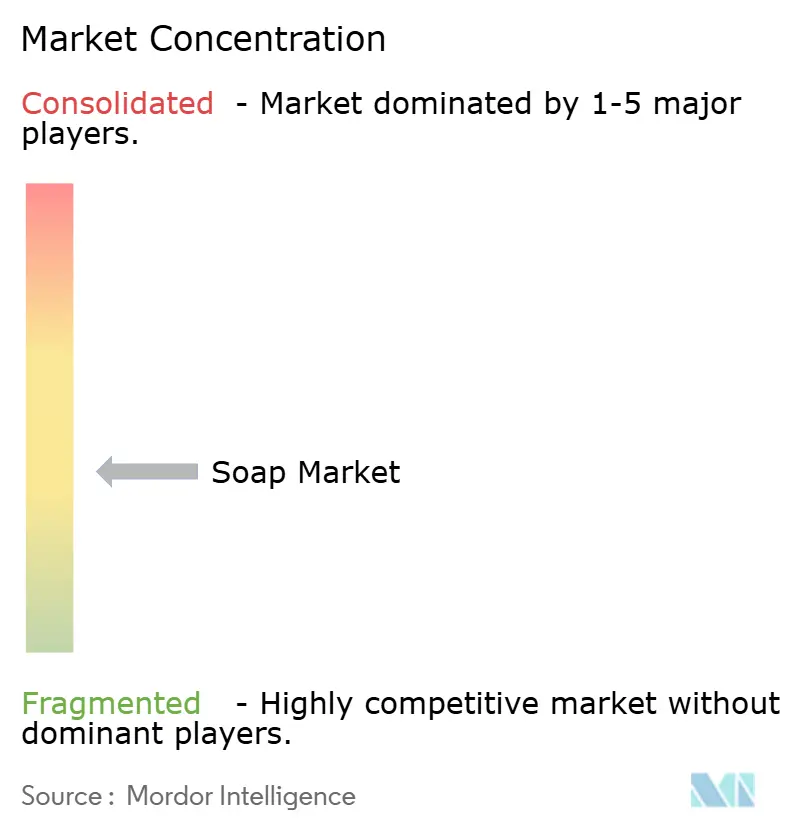
Soap Market Companies Covered in this Report
- Unilever PLC
- The Procter & Gamble Company
- Colgate-Palmolive Company
- Reckitt Benckiser Group
- Henkel AG & Co. KGaA
- Kao Corporation
- Lion Corporation
- Beiersdorf AG
- Godrej Consumer Products Limited
- Kenvue Inc.
- Natura Cosméticos S.A.
- L'Occitane International S.A.
- Dabur India Limited
- Wipro Consumer Care and Lighting
- Nirma Limited
- The Clorox Company
- Church & Dwight Co., Inc.
- Amway Corporation
- Shanghai Jahwa United Co., Ltd.
- Ecolab Inc.
Key Opportunities for Market Participants
The opportunities compare packaging decisions for existing retail bars, accommodation supplies, and new premium ranges. The European Commission's 2026 guidance interprets the requirement for all packaging placed on the EU market to be recyclable as applying from August 12, 2026. From January 1, 2030, EU economic operators may not place specified single-use accommodation packaging for cosmetics, hygiene, and toiletries on the market. This covers packs intended for one booking and discarded before the next guest arrives, including sachets around bar soap.
Market Opportunities Table of Soap Market
| Opportunity | Why now | Buyer / lead segment | Recommended play | Main barrier | Likely beneficiaries |
|---|---|---|---|---|---|
| Recyclable packaging for existing retail bars | Packaging recyclability requirement applies | Suppliers of established retail bar ranges | Qualify a recyclable replacement before changing the existing pack | Changing pack specifications across established ranges | Soap suppliers and packaging converters able to coordinate conversion |
| Redesign of single-booking accommodation soap packaging | Adopted restriction on the specified single-use accommodation packs | Soap suppliers serving accommodation buyers | Develop a packaging approach outside the restricted format and verify its suitability | Maintaining guest usability while replacing the restricted package | Bar-soap suppliers and accommodation packaging specialists |
| Packaging compliance built into new premium ranges | The recyclable-packaging requirement also applies to new ranges | Suppliers introducing premium retail bars | Develop presentation and recyclable packaging together before launch | Reconciling presentation requirements with the selected recyclable design | Premium bar producers and specialist pack designers |
| Source: Mordor Intelligence | |||||
The strongest near-term play is to build recyclable packaging into the bar's product design before deciding how it will be sold. Accommodation suppliers also need to account for the later restriction on a specified single-booking format when choosing their longer-term package. Considering material and use-format requirements together can reduce the risk of replacing a package twice, making coordinated soap-and-pack development a more durable commercial offer.
Recent Industry Developments in Soap Market
- Oct 2026: Anvisa published RDC 1.045/2026 and IN 474/2026 for artisanal cosmetics, including bar soap, with both scheduled to take effect 60 days after October 5, 2026.
- Aug 2026: Godrej Consumer Products inaugurated its fourth manufacturing unit at Malanpur, Madhya Pradesh, India, expanding a site that produces soaps, hair colors, household insecticides, and other consumer products.
Soap Market Report Scope and Research Methodology
Market Definition and Coverage
Soap market measures annual value of finished soap products sold to consumers worldwide through retail and other distribution channels. It counts annual consumer spending in USD across product forms, formulations, price tiers and intended age groups.
Scope exclusions: Liquid soap, including foaming soap, body wash and shower gel, and soap-making oils, fats, surfactants and other ingredients sold separately are excluded.
Segments Covered in This Report
- By Product Type
- Bar Soap
- Paper Soaps and Strips
- By Ingredient Type
- Conventional/Synthetic
- Natural/Organic
- By Category
- Mass
- Premium
- By End User
- Kids/Children
- Adults
- By Distribution Channel
- Supermarkets/Hypermarkets
- Health & Beauty Stores
- Online Retail Stores
- Other Distribution Channels
- By Geography
- North America
- United States
- Canada
- Mexico
- Rest of North America
- Europe
- Germany
- United Kingdom
- Italy
- France
- Spain
- Netherlands
- Poland
- Belgium
- Sweden
- Rest of Europe
- Asia-Pacific
- China
- India
- Japan
- Australia
- Indonesia
- South Korea
- Thailand
- Singapore
- Rest of Asia-Pacific
- South America
- Brazil
- Argentina
- Colombia
- Chile
- Peru
- Rest of South America
- Middle East & Africa
- South Africa
- Saudi Arabia
- United Arab Emirates
- Nigeria
- Egypt
- Morocco
- Turkey
- Rest of Middle East and Africa
- North America
Data Sources, Market Sizing, and Validation
Desk Research
The World Health Organization and UNICEF provide hand-hygiene guidance and household access indicators that help frame soap use, while World Bank population series support regional demand estimates. United Nations Statistics Division product classifications and UN Comtrade trade records, such as categories covering bars and paper impregnated with soap as well as liquid skin-washing preparations, help test product boundaries and interpret cross-border flows.
Company annual reports and regulatory filings can clarify brand portfolios, reported product sales, manufacturing changes and input cost effects, while reputable retail and trade press can provide dated checks on launches, pricing and channel activity. These named sources are not exhaustive, and further sources inform collection, validation and clarification.
Primary Interviews and Surveys
Interviews and structured surveys would target soap manufacturers, brand and category leaders, distributors, retail buyers, and specialists in formulation or procurement across APAC, EMEA, and the Americas. Questions would test secondary findings on product boundaries, realized selling prices, channel mix, regional demand and input pass-through, with conflicting or missing answers checked against public records and comparable markets. Analysts would reconcile differences through follow-up questions and triangulation across respondent roles and independent evidence.
Distribution of primary research fieldwork respondents
| Company type | Respondent position | Region |
|---|---|---|
| Top tier: 32% | CXOs: 20% | APAC: 43% |
| Mid tier: 45% | Functional/Unit leaders: 35% | EMEA: 27% |
| Smaller Players: 23% | Managers: 45% | Americas: 30% |
Market-Sizing & Forecasting
A top-down model estimates annual finished-product spending across countries, then allocates the total by product form, ingredient type, price tier, end user and sales channel using market and company evidence. Population and households indicate the user base, WHO and UNICEF hand-hygiene data inform use occasions, and disposable income and retail development help explain price-tier and channel mix. Soap prices and input costs distinguish value growth from unit changes, while trade flows provide a supply cross-check. Regional and segment shares draw on observed product availability, consumer use, channel structure, company disclosures and trade evidence, with missing shares estimated from adjacent years or comparable markets and tested for sensitivity. Scenario analysis combines demand and price signals for forecasts. Where channel data permit, analysts cross-check the top-down total against sampled retail prices times observed or estimated unit volumes and supplier or channel roll-ups. Primary experts would test assumptions about price changes, channel shifts and product mix, with unresolved gaps represented through ranges and sensitivity checks.
Data Validation & Update Cycle
Analysts triangulate the estimate against independent signals from company filings, trade flows, population and hygiene data, retail activity and input prices, then investigate unusual year-to-year movements and material differences between comparable sources. A second review checks scope, currency, units, segment totals and forecast logic, with analysts resolving anomalies before sign-off and re-contacting respondents when answers conflict or a material price, regulation, supply or channel event changes an assumption. The model is refreshed annually, updated between cycles after material market events, and given a fresh source and arithmetic review before delivery.
Mordor Intelligence's Soap Market Size Measured Against Other Published Estimates
Published global soap estimates diverge because their totals cover different finished-product families and end uses. Mordor Intelligence's estimate follows a consumer-spending boundary for bar soap and paper soaps or strips across retail and other consumer channels, while the Global Consultancy A and Global Consultancy B estimates count broader soap categories.
Key Gap Drivers are the product families and users included in each total. Global Consultancy A's page describes bar, liquid, foaming and medicated soap and identifies household, commercial, healthcare and hospitality users, so its estimate includes liquid formats and non-household demand beyond this report's bar and paper-soap consumer boundary. Global Consultancy B counts bath and body, kitchen and laundry soaps in both solid and liquid forms, and lists individual, commercial, industrial and institutional users. Those additional product uses and buyers can raise its total even though its page uses an earlier base year. The differences therefore reflect the definition of the measured market and its users, not a like-for-like consumer bar-soap comparison.
Benchmark comparison
| Source | Market Size | Gaps in Research Methodology |
|---|---|---|
| Mordor Intelligence | USD 28.19 B (2027) | |
| Global Consultancy A | USD 56.13 B (2026) | At its 2026 base, this estimate is 99.1% above this report's 2027 value of USD 28.19 B, 1 year later. Includes liquid, foaming and medicated soap and commercial, healthcare and hospitality users beyond the consumer bar and paper-soap boundary. |
| Global Consultancy B | USD 55.46 B (2025) | At its 2025 base, this estimate is 96.7% above this report's 2027 value of USD 28.19 B, 2 years later. Includes kitchen and laundry soaps, liquid forms, and commercial, industrial and institutional users beyond the consumer bar and paper-soap boundary. |
Because both external totals include product categories and institutional or commercial uses outside the defined consumer market, their higher values should be read as broader soap-market estimates rather than direct measures of the bar and paper-soap market.
Key Questions Answered in the Report
What is the soap market size and projected growth?
The size was USD 26.91 billion in 2026. It is estimated at USD 28.19 billion in 2027 and projected to reach USD 35.3 billion by 2032, at a 4.6% CAGR during 2027-2032.
What supports demand for bar soap?
Hygiene-related use and premium products support demand. In India, Hindustan Unilever reported double-digit, volume-led premium-bar growth in the quarter ended June 30, 2026.
Which soap product type holds the largest share?
Bar soap accounted for 96.86% of market value in 2026. Paper soaps and strips are forecast to grow at a 5% CAGR during 2027-2032.
Which companies compete in the bar-soap industry?
Major participants include Unilever PLC, The Procter & Gamble Company, Colgate-Palmolive Company, Reckitt Benckiser Group, and Henkel AG & Co. KGaA.
What is a key challenge for soap suppliers?
Body wash competes for bathing occasions. In India, Hindustan Unilever reported double-digit Bodywash growth momentum and improved market leadership in the quarter ended June 30, 2026.
What regional pattern defines the soap industry's outlook?
Asia-Pacific led with 37.68% of market value in 2026. Middle East & Africa is forecast to grow fastest, at a 5.12% CAGR during 2027-2032.