
Smokeless Tobacco Market Size and Share
Market Overview
| Study Period | 2021 - 2031 |
|---|---|
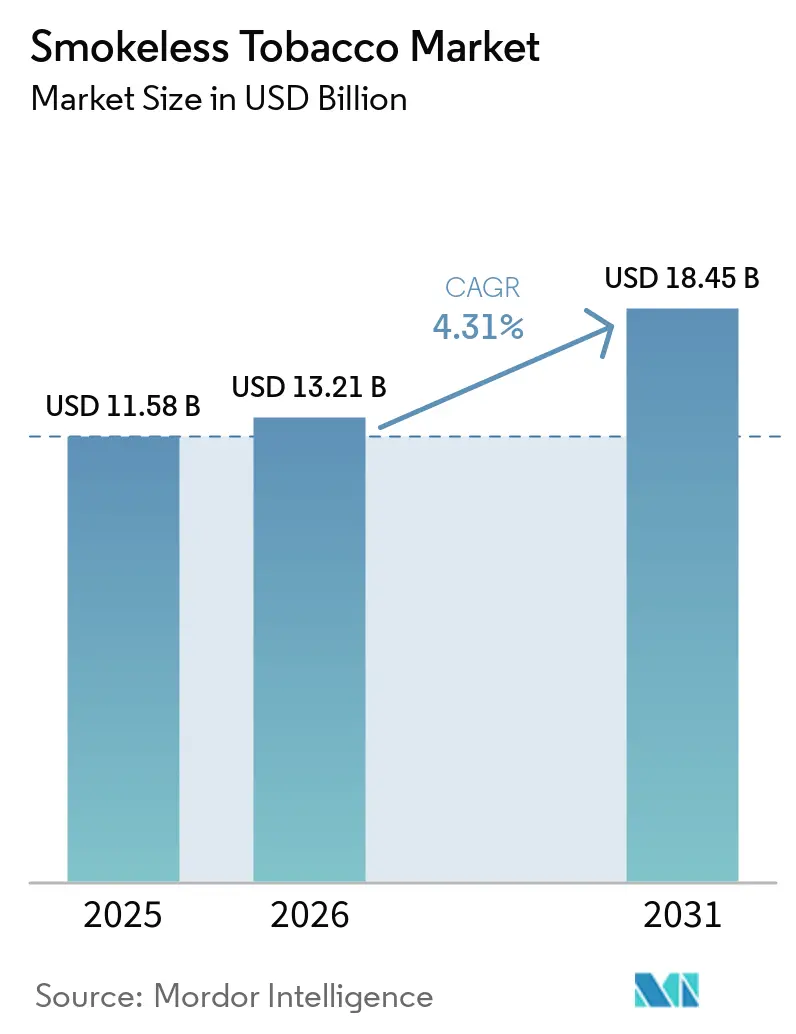
| Market Size (2026) | USD 13.21 Billion |
| Market Size (2031) | USD 18.45 Billion |
| Growth Rate (2026 - 2031) | 4.31 % |
| Fastest Growing Market | Asia Pacific |
| Largest Market | North America |
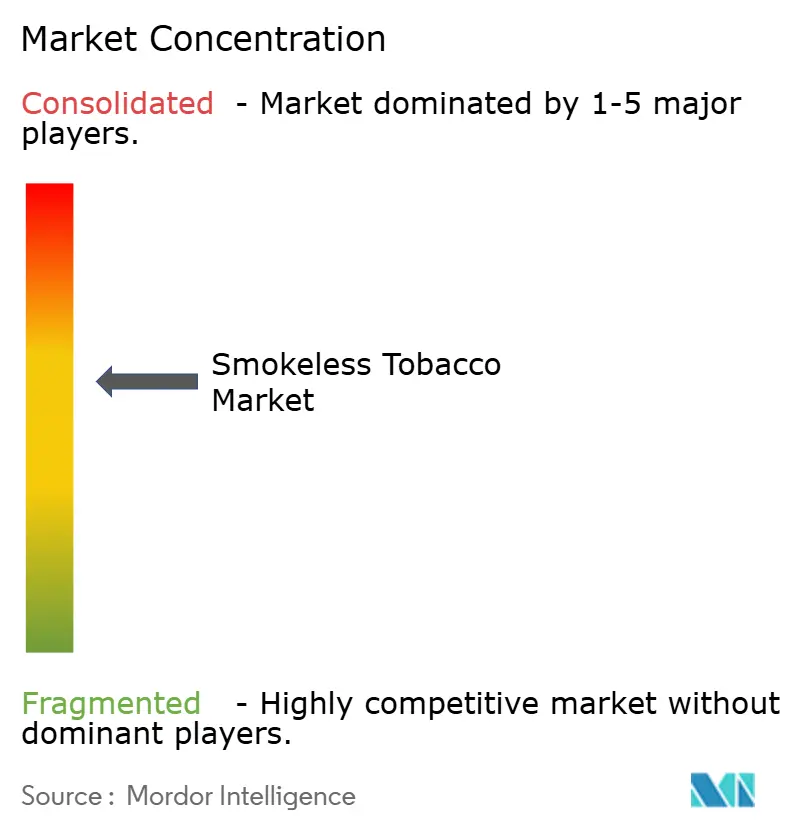
| Market Concentration | Medium |
Major Players
*Disclaimer: Major Players sorted in no particular order Image © Mordor Intelligence. Reuse requires attribution under CC BY 4.0. |
|
Smokeless Tobacco Market Analysis by Mordor Intelligence
The smokeless tobacco market size was valued at USD 11.58 billion in 2025 and estimated to grow from USD 13.21 billion in 2026 to reach USD 18.45 billion by 2031, at a CAGR of 4.31% during the forecast period (2026-2031). The sector balances regulatory tightening in high-income nations against deep-rooted cultural acceptance in South Asia and the Nordics. Product innovation in tobacco-free nicotine pouches broadens appeal among smokers facing indoor-smoking bans, yet mounting scientific scrutiny of oral-tobacco health risks tempers expansion. North American incumbents leverage FDA marketing authorizations and capacity investments to defend dominant shares, while Asian producers exploit cost advantages and rising urban incomes. Direct-to-consumer subscription models are eroding dependence on the brick-and-mortar channel and reshaping promotional strategies.
Key Report Takeaways
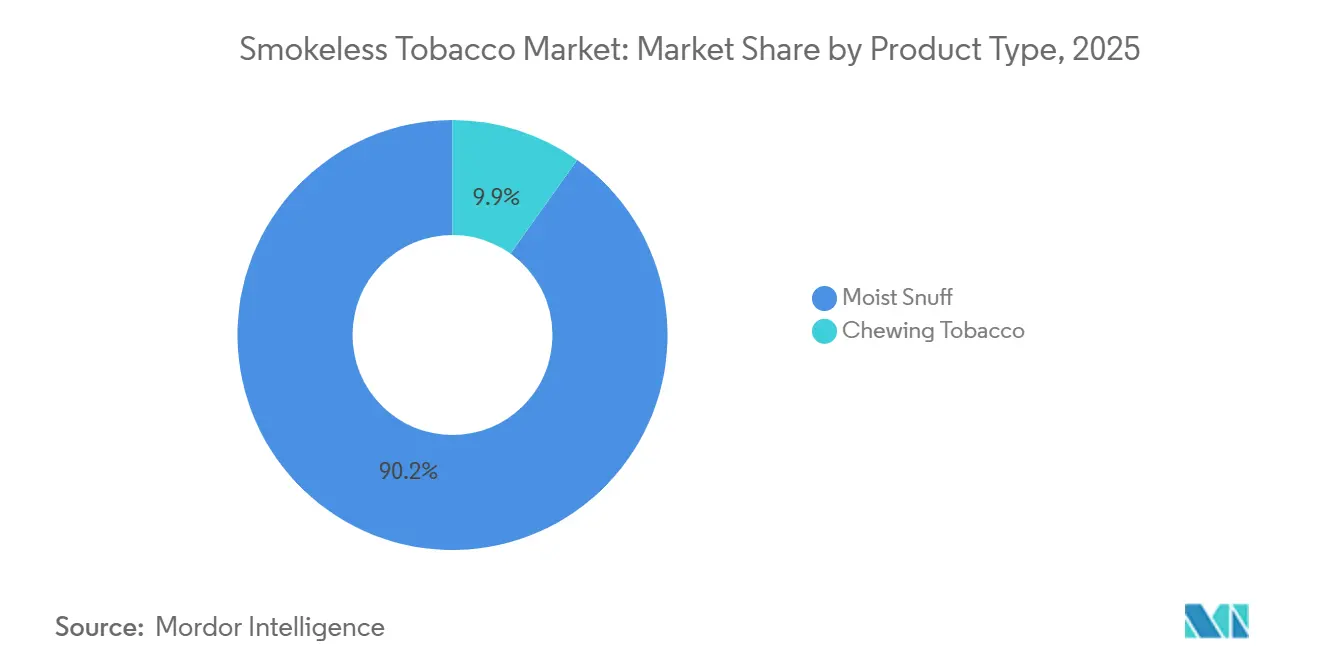
- By product type, moist snuff held 90.15% of the smokeless tobacco market share in 2025, while chewing tobacco is forecast to grow at a 5.85% CAGR through 2031.
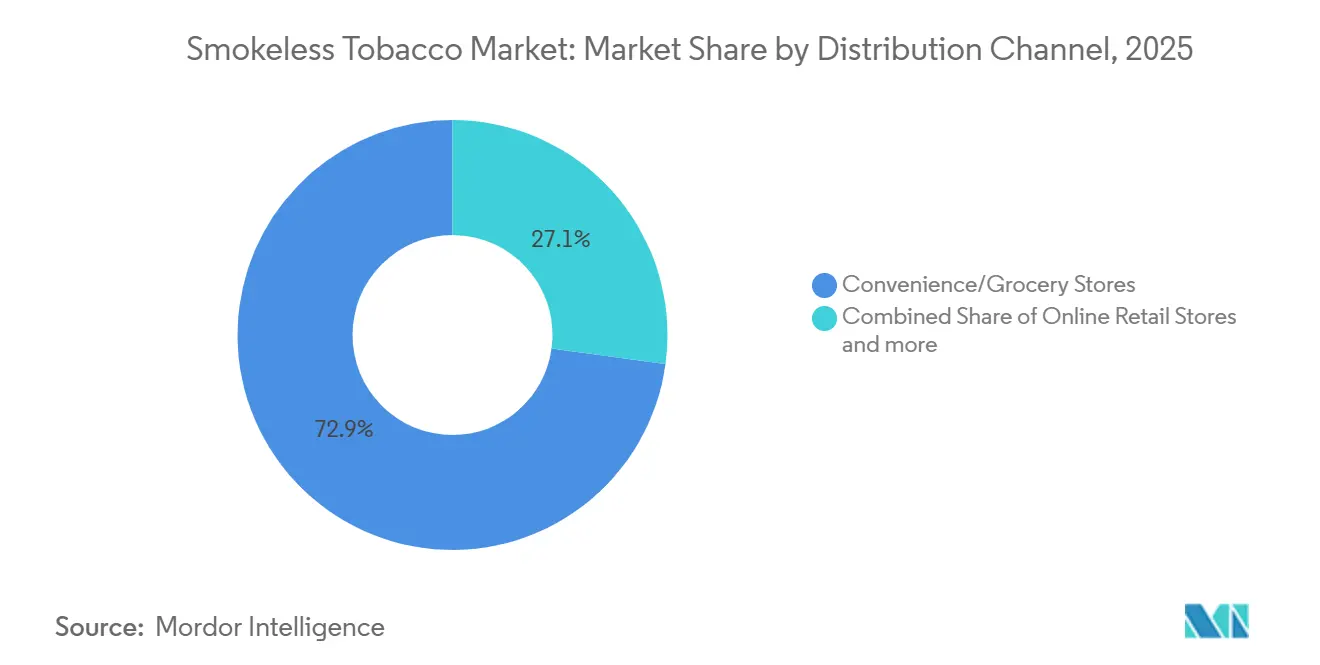
- By distribution channel, convenience and grocery stores captured 72.85% revenue in 2025; online retail is projected to advance at a 6.73% CAGR to 2031.
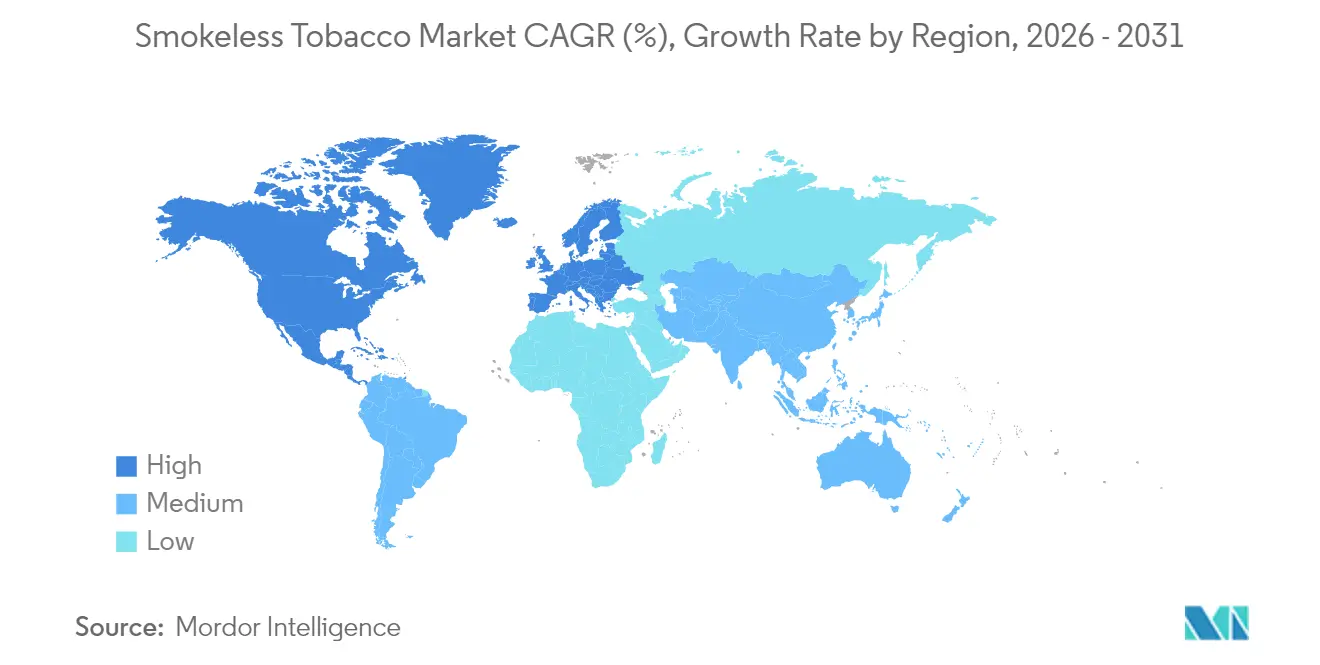
- By geography, North America commanded 72.63% revenue share in 2025, whereas Asia-Pacific is expected to post the fastest 6.28% CAGR through 2031.
Note: Market size and forecast figures in this report are generated using Mordor Intelligence’s proprietary estimation framework, updated with the latest available data and insights as of 2026.
Market Trends and Insights
Drivers Impact Analysis of Smokeless Tobacco Market*
| Drivers | (~) % Impact on CAGR Forecasts | Geographic Relevance | Impact Timeline |
|---|---|---|---|
| Public Smoking Bans Fueling Shift To Smokeless Options | +0.8% | Global, with strongest effect in North America, Western Europe, and urban Asia-Pacific | Medium term (2-4 years) |
| Innovations In Nicotine Pouch Products And Flavors | +1.1% | North America, Nordic Europe, emerging adoption in UK and Poland | Short term (≤ 2 years) |
| Strategic Marketing Targeting Youth Demographics | +0.5% | North America, Europe (regulatory scrutiny rising) | Short term (≤ 2 years) |
| Cultural And Traditional Acceptance In Key Regions | +0.9% | Asia-Pacific (India, Bangladesh), Nordic Europe (Sweden, Norway), North Africa (Algeria) | Long term (≥ 4 years) |
| High-Potency Nicotine Delivery Satisfying Addictive Needs | +0.7% | Global, particularly North America and Nordic markets with established oral-tobacco use | Medium term (2-4 years) |
| Rise Of Synthetic-Nicotine And Herbal Alternatives In Restricted Areas | +0.6% | North America (regulatory arbitrage), select Asia-Pacific markets with tobacco bans | Medium term (2-4 years) |
| Source: Mordor Intelligence | |||


Public Smoking Bans Fueling Shift To Smokeless Options
Since 2020, over 60 countries have enacted comprehensive indoor smoking bans, limiting opportunities for combustible tobacco use. As a result, adult nicotine consumers are increasingly turning to discreet oral formats that comply with workplace and hospitality venue regulations. Sweden's long-standing snus tradition highlights key snus market trends: in 2024, daily snus usage among Swedish men reached 20%, coinciding with one of Europe's lowest smoking rates, as reported by the Swedish Public Health Agency[1]Source: Swedish Public Health Agency, “Tobacco Habits in Sweden 2024,” folkhalsomyndigheten.se. The FDA's marketing authorization for ZYN nicotine pouches in January 2025 underscores the rationale behind these bans, with regulators drawing clearer distinctions between combustion-based and noncombustion nicotine methods. This distinction opens doors for manufacturers adept at navigating premarket reviews and obtaining modified risk labels. In January 2026, Philip Morris International presented to the FDA's Tobacco Products Scientific Advisory Committee, advocating for a claim that switching entirely to ZYN could lower the risk of six smoking-related diseases. If granted, this endorsement could revolutionize marketing strategies and hasten the adoption of such products.
Innovations In Nicotine Pouch Products And Flavors
Flavor diversification and nicotine strength segmentation have propelled pouches from a niche market in the Nordic region to a global powerhouse. Manufacturers are now introducing 3 milligram and 6 milligram variants, alongside exotic flavors like citrus, coffee, and cinnamon, aligning with consumer preferences highlighted in sensory research. In June 2024, Altria filed premarket tobacco product applications for its on! PLUS line. This line boasts a proprietary soft feel material and seamless construction, setting it apart from leading tobacco derived nicotine brands. Additionally, integrated disposal compartments tackle littering concerns highlighted in municipal ordinances. In late 2024, British American Tobacco launched Velo Plus across the U.S., broadening flavor and nicotine choices to directly challenge ZYN, which holds a dominant 50.7% value share in tracked U.S. channels. The strategy hinges on portfolio segmentation: the entry level 3 milligram pouches aim to attract cigarette smokers wary of high nicotine doses, while the 6 milligram and stronger variants cater to heavy users familiar with the quick absorption of moist snuff. Furthermore, flavor innovation acts as a safeguard against potential menthol cigarette bans, given that adult menthol smokers show a greater inclination to try mint and wintergreen pouches over unflavored ones.
Strategic Marketing Targeting Youth Demographics
In 2024, the FDA issued warning letters to manufacturers for using youthful imagery in campaigns or neglecting robust age gating on branded websites. This highlights the agency's increasing scrutiny on digital advertising and influencer partnerships on social media. Altria's decision to voluntarily halt online sales on ZYN.com in June 2024 came after a subpoena from the District of Columbia. The subpoena was linked to compliance with the city's 2022 flavored tobacco ban, underscoring the reputational and legal challenges of direct to consumer channels that sidestep traditional age verification methods. Yet, despite these enforcement actions, the category continues to grow, suggesting that marketing to legal age adults is proving more effective than concerns over youth uptake. In January 2026, Philip Morris International presented findings to the FDA, highlighting that youth prevalence of nicotine pouch use remains low. Their data also indicated that exposure to modified risk claims did not boost usage intentions among young adults, bolstering their argument for adult targeted messaging. As more brands pursue modified risk authorizations, the balancing act between commercial speech and public health will become even more pronounced. Compliance with the FDA's stringent labeling and promotional guidelines will be crucial for brands to avoid market withdrawal.
Cultural And Traditional Acceptance In Key Regions
India stands as the world's largest market for oral tobacco, which includes products like gutka and khaini. These products are deeply woven into the social fabric, especially among agricultural and blue collar workers. ITC Limited, a leading player in India's tobacco landscape, has set its sights on significantly boosting its raw tobacco exports to British American Tobacco. By the fiscal year 2025 26, ITC aims to secure supply contracts worth INR 2,350 crore (around USD 282 million). This ambition not only highlights India's stature as a major consumption hub but also as a pivotal global sourcing center. Meanwhile, in Nordic Europe, the snus tradition, enjoying a unique EU exemption for Sweden, boasts per capita consumption rates that are unparalleled. Notably, even with domestic sales restrictions, consumers in Norway and Denmark are gravitating towards Swedish style snus products. Such deep rooted cultural ties ensure a consistent demand, resilient to price hikes and anti tobacco campaigns. This is evident as snus volumes in Sweden remain stable or even grow, contrasting with the decline in cigarette sales. For multinational companies, the hurdle is clear: they must cultivate a similar cultural acceptance in regions where oral tobacco is a novel concept. Achieving this will demand years of consumer education and navigating regulatory landscapes.
Restraints Impact Analysis of Smokeless Tobacco Market*
| Restraints | (~) % Impact on CAGR Forecasts | Geographic Relevance | Impact Timeline |
|---|---|---|---|
| Expansion Of Safer Nicotine Alternatives | -0.6% | Global, strongest in North America and Western Europe where heated-tobacco and e-vapor penetration is high | Medium term (2-4 years) |
| Intensified Anti-Tobacco Public Campaigns | -0.4% | Global, with concentrated efforts in OECD countries and WHO FCTC signatories | Long term (≥ 4 years) |
| Stricter Government Regulations And Prohibitions | -0.7% | North America (FDA premarket review), EU (flavor bans, plain packaging), select Asia-Pacific markets (India state-level bans) | Short term (≤ 2 years) |
| Mounting Scientific Evidence of Health Risks | -0.5% | Global, influencing policy in evidence-based regulatory regimes (FDA, EU, Australia) | Medium term (2-4 years) |
| Source: Mordor Intelligence | |||
Expansion Of Safer Nicotine Alternatives
Heated-tobacco products and closed-system e-vapor devices are drawing users away from both combustible and smokeless formats. These innovations offer adult smokers a tech-savvy experience, appealing especially to early adopters who are less inclined towards traditional oral tobacco. In 2024, Japan Tobacco's Ploom brand boasted a volume growth of around 40%. The company, eyeing a mid-teens market share in pivotal regions like Japan and Italy by 2028, backed its ambitions with a hefty JPY 135 billion capital expenditure in 2024. Meanwhile, British American Tobacco's Vuse secured a 40.3% global value share in closed-system consumables in 2024. Notably, its share in U.S. tracked channels hit 50.7%, underscoring vapor's potential to overshadow both cigarettes and smokeless products. For smokeless manufacturers, the landscape is mixed: while nicotine pouches can thrive alongside vapor for users seeking discretion, traditional moist snuff and chewing tobacco are witnessing a decline as younger generations pivot to modern alternatives. Philip Morris International is pushing for a modified-risk authorization for ZYN, aiming to rebrand pouches as a scientifically-backed harm-reduction tool, a crucial move to rival heated tobacco's regulatory wins in various markets.
Intensified Anti-Tobacco Public Campaigns
WHO Framework Convention on Tobacco Control signatories have extended mass-media campaigns beyond combustibles to encompass all tobacco and nicotine products, deploying graphic health warnings and testimonial advertising that emphasize oral cancer, gum disease, and cardiovascular risks associated with smokeless use. These campaigns resonate particularly in markets where smokeless tobacco lacks the cultural normalization seen in Sweden or India, creating headwinds for category expansion in Western Europe and Oceania. The FDA's January 2026 review of ZYN's modified-risk application included explicit consideration of youth exposure to reduced-risk messaging, with the agency noting that claim exposure did not increase use intentions among young adults but requiring ongoing post-market surveillance to detect unintended uptake[2]Source: Food and Drug Administration, "Meeting of the Tobacco Products Scientific Advisory Committee (TPSAC)", fda.gov. This regulatory caution reflects public-health advocates' concerns that harm-reduction claims, even when scientifically accurate, may renormalize nicotine use and undermine decades of denormalization efforts. The net effect is a constrained marketing environment where manufacturers must balance commercial imperatives against reputational risks, often resulting in conservative messaging that fails to communicate product benefits to adult smokers who might otherwise switch.
*Our forecasts treat driver/restraint impacts as directional, not additive. The impact forecasts reflect baseline growth, mix effects, and variable interactions.
Smokeless Tobacco Market Segment Analysis
By Product Type:
Moist Snuff Dominance Anchors North American RevenueIn 2025, Moist Snuff dominated the global product type revenue, capturing a significant 90.15% share. This dominance underscores the format's deep-rooted presence in the U.S., where both dip and snus have longstanding traditions, and in Nordic Europe, where the Swedish-style snus not only enjoys cultural acceptance but also benefits from a regulatory exemption, sidestepping the EU's oral tobacco ban. Within the realm of Moist Snuff, U.S. style dip, characterized by loose or pouched tobacco placed between the cheek and gum, and Swedish-style snus, which comes as pasteurized tobacco in portion bags, cater to distinct consumer preferences. Dip enthusiasts prioritize a robust nicotine delivery and the ritual of spitting, whereas snus aficionados appreciate discretion and the convenience of not having to expectorate. In a clear nod to the industry's evolving dynamics, Philip Morris International made headlines in 2024 with a USD 232 million expansion in Kentucky and a separate investment in a Colorado facility. These moves, centered on boosting ZYN nicotine pouch capacity rather than traditional snus, highlight a strategic shift towards tobacco-free oral nicotine, even as the company continues to benefit from the cash flow generated by legacy moist snuff volumes.
Chewing Tobacco, accounting for the remaining product-type share in 2025, is poised for growth, projected to grow at a 5.85% CAGR through 2031, the fastest among its peers. This surge is largely attributed to India's expansive consumption base and the rising incomes in Sub-Saharan Africa, where loose-leaf and plug tobacco serve as accessible nicotine sources. ITC Limited's ambitious strategy to more than double its raw tobacco exports to British American Tobacco by the fiscal year 2025-26 highlights India's dual significance: as a major consumption market and a pivotal global supply hub. Leveraging its agricultural integration, ITC ensures its offerings meet the stringent quality specifications demanded by international buyers. However, the growth of Chewing Tobacco isn't without challenges. State-level gutka bans in India have disrupted distribution, nudging consumption towards unregulated avenues. Additionally, flavor restrictions in Western markets curtail product differentiation. Yet, the segment's allure lies in its relatively straightforward manufacturing process and lower capital intensity compared to pouches. This advantage empowers regional players to engage in price competition, especially in markets where brand loyalty is tenuous, and consumers lean towards nicotine content over nuanced sensory experiences.

By Distribution Channel:
E-commerce Disrupts Traditional RetailIn 2025, convenience and grocery stores dominated smokeless-tobacco distribution, claiming a substantial 72.85% share. This dominance can be attributed to factors like impulse buying, widespread geographic presence, and the capability to enforce age verification at the point of sale, thanks to trained personnel and ID-scanning technology. While North America and Europe showcase a mature market, the Asia-Pacific region presents a different picture. Here, oral-tobacco sales are largely led by independent kirana stores and paan shops, with modern retail only making inroads in major cities. Online retail, despite its modest share in 2025, is set to surge at a 6.73% CAGR through 2031, outpacing all other channels. This growth is fueled by direct-to-consumer subscription models that ensure repeat purchases and a regulatory edge in areas where e-commerce age-verification lags behind traditional retail. Highlighting the challenges of the online realm, Altria's June 2024 halt of ZYN.com sales came in the wake of a District of Columbia subpoena, underscoring the heightened legal and reputational stakes tied to online channels and their scrutiny over youth access.
Distribution channels like supermarkets, hypermarkets, tobacco specialty shops, military commissaries, and duty-free outlets play distinct roles based on geography. For instance, in Nordic Europe, supermarkets are normalizing snus by placing it alongside confectionery items, while U.S. military commissaries leverage tax-advantaged pricing to boost sales among service members. The competition is fierce, especially for backbar visibility and promotional allowances. Manufacturers vie for prime spots behind checkout counters, where decisions are made in mere seconds. British American Tobacco's December 2024 trading update highlighted the success of Velo's revamped brand and Grizzly Modern Oral in U.S. retail. The nationwide rollout of Velo Plus aims to diversify flavor and nicotine offerings. However, this surge in product variety is tightening retail shelf space, leading to the delisting of slower-moving SKUs and favoring brands with rapid sales and robust trade ties. Online platforms, with their boundless virtual shelf space, sidestep these limitations. They empower niche brands to connect with scattered consumer segments without needing a national distribution network. This evolving landscape is poised to gradually diminish the share of convenience stores in the market.

Geography Analysis
North America Smokeless Tobacco Market
In 2025, North America contributed 72.63% of global revenue, with the U.S. dominating most snuff and pouch consumption. In contrast, Canada faced restrictions due to flavored-tobacco bans. The FDA's 2025 approval of ZYN legitimized this product category, triggering a wave of pre-market applications. Investments exceeding USD 800 million by 2025 ensured an adequate supply. Although litigation risks remain high, clearer regulations provide a strategic framework for marketing teams.
Europe Smokeless Tobacco Market
Europe exhibits a divided landscape: the Nordic exemption zone allows legal snus sales, while the rest of the EU permits only tobacco-free pouches in retail. Consumers in Sweden, Norway, and Denmark lead globally in per-capita usage. British American Tobacco reported strong performance for Velo in newer launch markets, including the United Kingdom and Poland, during 2024, with the brand achieving 11.2% volume share of total oral products and 28.2% of modern oral in top markets[3]Source: British American Tobacco, “2024 Full-Year Pre-Close Trading Update,” bat.com. The brand's future growth depends on potential EU reforms or broader acceptance of nicotine pouches under separate regulatory frameworks.
APAC and Africa Smokeless Tobacco Market
The Asia-Pacific region is experiencing rapid growth, with a projected 6.28% CAGR by 2031. India's entrenched chewing-tobacco culture drives significant volume, while urbanization supports a shift toward premium products. State-level gutka bans in India have fueled informal sales but have not reduced overall demand. Pakistan and Bangladesh reflect India's consumption patterns but lack scalable branded supply chains. Entering this market requires navigating fragmented retail structures and diverse excise policies. The Rest of the World, including South Africa and Algeria, offers modest yet strategic opportunities. South Africa's regulated oral-tobacco market provides a testing ground for branded products. Conversely, Algeria's rural loose-leaf market delivers high volume but operates on low margins. Due to currency volatility and sudden policy changes, a phased approach to capital investment is recommended.

Regulatory Landscape
Regulation for smokeless tobacco and modern oral nicotine continues to converge around tobacco-control frameworks, with tighter marketing limits and product oversight in high-income markets and uneven enforcement across parts of Asia-Pacific. In the United States, the FDA has positioned premarket review as the key gatekeeper for nicotine pouches, authorizing 20 ZYN nicotine pouch products through the PMTA pathway in January 2025. In January 2026, FDA activity also extended to packaging and advertising compliance, submitting information-collection items to OMB tied to required warning-rotation plans for smokeless tobacco and reinforcing ongoing operational burdens for manufacturers beyond initial authorization.
In Europe, the compliance baseline increasingly includes supply-chain controls and smoke-free environment rules, even as product legality differs by country (including Sweden's unique position for snus within the EU). The EU traceability system was extended to cover all tobacco products as of May 2024, broadening tracking obligations for smokeless categories alongside cigarettes and roll-your-own tobacco. At the same time, global public-health bodies continue to publish smokeless-tobacco-specific guidance, with WHO FCTC implementation materials in 2025 emphasizing stronger controls and reduced industry interference, keeping pressure on product presentation, health warnings, and retail restrictions across signatory markets.
Competitive Landscape
In the global smokeless tobacco market, where concentration is moderate, established giants are adopting acquisitions and product innovations to maintain their competitive edge. While these market leaders diversify and integrate vertically to capitalize on the broader nicotine ecosystem, newer entrants are focusing on niche areas, such as tobacco-free options and synthetic nicotine. For example, Philip Morris International's USD 16 billion acquisition of Swedish Match highlights the industry's shift toward smokeless alternatives. Similarly, Japan Tobacco International's USD 2.4 billion purchase of Vector Group in October 2024 reflects the ongoing drive to expand market share through mergers and acquisitions.
Amid advertising restrictions, companies are leveraging technology to improve product formulations, enhance manufacturing efficiency, and strengthen digital marketing efforts, ensuring direct consumer engagement. A clear trend is evident: firms are making significant R&D investments to develop synthetic nicotine and tobacco-free products. They are skillfully navigating regulatory challenges while aligning with consumer preferences. In 2024, Imperial Brands allocated USD 329 million to next-generation product development, focusing on oral nicotine pouches, heated tobacco, and vaping alternatives.
Emerging opportunities are arising from regulatory differences between tobacco-derived and synthetic products, geographic expansion into regions with lenient harm reduction policies, and targeting health-conscious consumers seeking cigarette alternatives. The FDA's regulatory framework not only provides competitive advantages for authorized products but also creates barriers for new entrants, particularly those lacking regulatory expertise or the financial resources for extensive approval processes.
Smokeless Tobacco Industry Leaders
-
Altria Group, Inc.
-
British American Tobacco Plc
-
Philip Morris International, Inc.
-
Imperial Brands Plc
-
Japan Tobacco Inc.
- *Disclaimer: Major Players sorted in no particular order
Smokeless Tobacco Market Companies Covered in this Report
- Altria Group Inc.
- British American Tobacco plc
- Philip Morris International Inc.
- Imperial Brands plc
- Swedish Match AB
- Japan Tobacco Inc.
- KT&G Corporation
- Turning Point Brands Inc.
- DS Group
- Dholakia Tobacco Pvt Ltd.
- Regie Nationale des Tabacs et des Allumettes
- Kothari Group Ltd.
- ITC Limited
- Black Buffalo Inc.
- Swisher International Inc.
- Kretek International Inc.
- Scandinavian Tobacco Group A/S
- Mac Baren Tobacco Company A/S
- Fiedler & Lundgren AB
- Snus AB

Market Opportunities and Future Outlook
Premiumization and the formalization of modern oral nicotine remain the clearest opportunity, supported by the United States regulatory and capacity signals that underpin most monetization in the category. The FDA authorization of 20 ZYN nicotine pouch products in January 2025 created a clearer pathway for large-scale commercialization via PMTA, while also encouraging competing submissions, including Altria filing PMTAs for its on! PLUS line in June 2024. Manufacturing scale-up adds execution room for wider distribution and fewer out-of-stocks, with Philip Morris International expanding ZYN capacity through a USD 232 million investment in Owensboro, Kentucky in August 2024, and Reynolds American expanding oral nicotine pouch manufacturing at its Tobaccoville, North Carolina facility in March 2025.
Outside mature U.S. channels, opportunity depends more on handling regulatory fragmentation and building compliant routes-to-market. E-commerce and direct-to-consumer models have shown demand capture but also underline enforcement risk, as reflected by Altria halting online sales on ZYN.com in June 2024 after a District of Columbia subpoena related to flavored tobacco restrictions. In Asia-Pacific, where cultural acceptance supports high volumes (particularly in India), the focus shifts toward branded, quality-controlled supply in markets shaped by state-level gutka bans and fragmented retail, together with export-oriented sourcing strategies such as ITC Limited targeting expanded raw tobacco supply to British American Tobacco by fiscal year 2025-26.
Recent Industry Developments in Smokeless Tobacco Market
- June 2026: Philip Morris International received a US FDA modified risk tobacco product (MRTP) authorization covering 20 ZYN nicotine pouch variants, allowing marketing with reduced-risk claims versus cigarettes. This materially strengthens ZYNs competitive positioning in the largest value pool for modern oral nicotine by pairing scale with a differentiated regulatory permission set.
- June 2025: 22nd Century Group launched new Pinnacle VLN and moist snuff products in more than 1,700 convenience stores across 27 US states following an update to its manufacturing and marketing agreement with a major c-store chain. The rollout expanded shelf presence for both low-nicotine cigarettes and smokeless offerings, signaling broader attempts to secure national retail access amid tightening marketing controls.
- August 2024: Philip Morris International invested USD 232 million through a Swedish Match affiliate to expand ZYN nicotine pouch production capacity at its Owensboro, Kentucky facility. The project reinforced the shift of capital toward tobacco-free oral nicotine formats and supported wider distribution in tracked US channels where pouches have been gaining share.


Smokeless Tobacco Market Report Scope and Research Methodology
Market Definition and Coverage
This market covers the sale of smokeless tobacco products that are consumed without burning, measured in value terms using revenues generated through common retail and trade channels across major regions.
Scope exclusions: nicotine replacement therapies, e-cigarettes and vapes, and combustible tobacco products are excluded from this market sizing.
Segments Covered in This Report
-
By Product Type
- Chewing Tobacco
- Moist Snuff
- US-Style Moist Snuff (Dip)
- Swedish Style Snus
-
By Distribution Channel
- Supermarkets/Hypermarkets
- Convenience/Grocery Stores
- Online Retail Stores
- Other Distribution Channels
-
By Geography
-
North America
- United States
- Canada
-
Europe
- Czech Republic
- Denmark
- Norway
- Sweden
- Rest of Europe
-
Asia-Pacific
- India
- Rest of Asia-Pacific
-
Rest of the World
- South Africa
- Algeria
- Other Countries
-
North America
Data Sources, Market Sizing, and Validation
Desk Research
Desk research starts by mapping the basic demand and policy context for smokeless tobacco, so the model does not hinge on a single data point. We reviewed public sources such as the World Health Organization (tobacco control and prevalence indicators), the US CDC (adult tobacco use and smokeless-specific indicators), and national health agencies where smokeless is tracked as a separate category.
To keep pricing and trade assumptions grounded, we also used sources such as UN Comtrade and customs summaries where available, along with excise tax notes and regulatory updates from government portals. Company annual reports, investor decks, and trusted press coverage were reviewed to understand portfolio mix, route-to-market shifts, and packaging trends. A few paid subscriptions were referenced only for company financials, patent lookups, and shipment-level trade signals to cross-check the public storyline. These examples are not exhaustive, and many other sources were also consulted for data collection, validation, and clarification.
Primary Interviews and Surveys
Primary work was used to pressure-test desk assumptions that usually swing totals, especially pack price ladders, tax pass-through timing, and channel splits between convenience retail and other outlets. We spoke with manufacturers, distributors, retailers, and category specialists across APAC, EMEA, and the Americas, so gaps in product definitions and reporting lags could be corrected before final sign-off.
Distribution of primary research fieldwork respondents
| Company type | Respondent position | Region |
|---|---|---|
| Top tier: 38% | CXOs: 12% | APAC: 50% |
| Mid tier: 41% | Functional/Unit leaders: 32% | EMEA: 30% |
| Smaller Players: 21% | Managers: 56% | Americas: 20% |
Market-Sizing & Forecasting
Market sizing uses a top-down build where adult tobacco use indicators and smokeless share trends are translated into a demand pool, then converted to value using typical consumption intensity and retail price ladders by region. To keep totals grounded, we run selective bottom-up checks such as sampled price per pack multiplied by implied volumes, plus channel checks on convenience store dependence, and we adjust the model when the gap is persistent.
Key inputs in this market include adult smokeless usage prevalence, excise tax changes and effective dates, average pack sizes and price per unit, the split between moist snuff and other product families, and the share of online retail where it is permitted. When data is patchy, missing country values are filled using nearby market analogs and policy similarity, then reviewed again in interviews for plausibility. For forecasting, scenario analysis is used around regulation and tax shocks, followed by exponential smoothing for steady demand patterns where year-to-year change is gradual.
Data Validation & Update Cycle
Validation is done through several passes so the numbers align with real-world signals and do not drift due to one optimistic assumption. We compare outputs against independent checks such as regional tobacco spending trends, known tax step-ups, and observed channel shifts, then rework any outliers until the drivers explain the result clearly.
Before publishing, the model and write-up go through multi-step analyst review, and interview follow-ups are triggered when a price, volume proxy, or regulatory assumption changes the outcome more than expected. Reports are refreshed annually, and interim updates are made when material events occur, such as major tax reforms or product restrictions, followed by a final freshness pass right before delivery.
Mordor Intelligence's Smokeless Tobacco Market Size Versus Other Published Estimates
It is common to see different market values for smokeless tobacco, even when the topic appears the same at a glance. The gaps usually come from what gets counted as a smokeless product, which year is used as the base, how pack prices are converted across countries, and how quickly assumptions are refreshed after tax or regulation changes.
Heated tobacco and vaping formats are excluded, and that item sits outside Mordor Intelligence's scope for the smokeless tobacco market, which is one reason our 2026 value can look lower than estimates that fold adjacent nicotine categories into the same total. Pricing differences also matter, since some publishers use broad CPI inflation for pack prices, whereas we apply tax-step timing and product mix shifts (moist snuff versus other formats) to avoid overstating value in heavily taxed markets.
Benchmark comparison
| Source | Market Size | Gaps in Research Methodology |
|---|---|---|
| Mordor Intelligence | USD 13.21 B (2026) | |
| Global Consultancy A | USD 17.57 B (2024) | Uses a different base year and frames the scope as smokeless tobacco products, which can shift totals when country coverage and product lists are not aligned to the same smokeless-only definition. |
| Industry Publisher B | USD 22.20 B (2025) | Starts from a 2025 base and applies a broader type and route mapping, which can push value upward if regional price ladders and tax pass-through timing are simplified. |
Looking across the table, the spread is mainly explained by scope adjacency and year alignment, followed by how pack pricing is updated after excise changes. When the definition, currency timing, and tax-driven price steps are kept consistent, the estimate becomes easier to trace back to clear drivers and to reproduce in future refreshes.


Key Questions Answered in the Report
How large will the smokeless tobacco market be in 2031?
It is projected to reach USD 18.45 billion by 2031, expanding at a 4.31% CAGR between 2026 and 2031.
Which region dominates value sales?
North America held 72.63% of global revenue in 2025, driven by entrenched moist-snuff and pouch consumption.
What is the fastest-growing region?
Asia-Pacific is forecast to post a 6.28% CAGR through 2031, led by India’s chewing-tobacco base and rising urban income.
Which product type leads share?
Moist snuff commanded 90.15% revenue share in 2025, anchored by U.S. dip and Swedish snus demand.
Page last updated on:


 Your data is secure and never sold or shared.


