
Smart Ovens Market Size and Share
Market Overview
| Study Period | 2020 - 2031 |
|---|---|
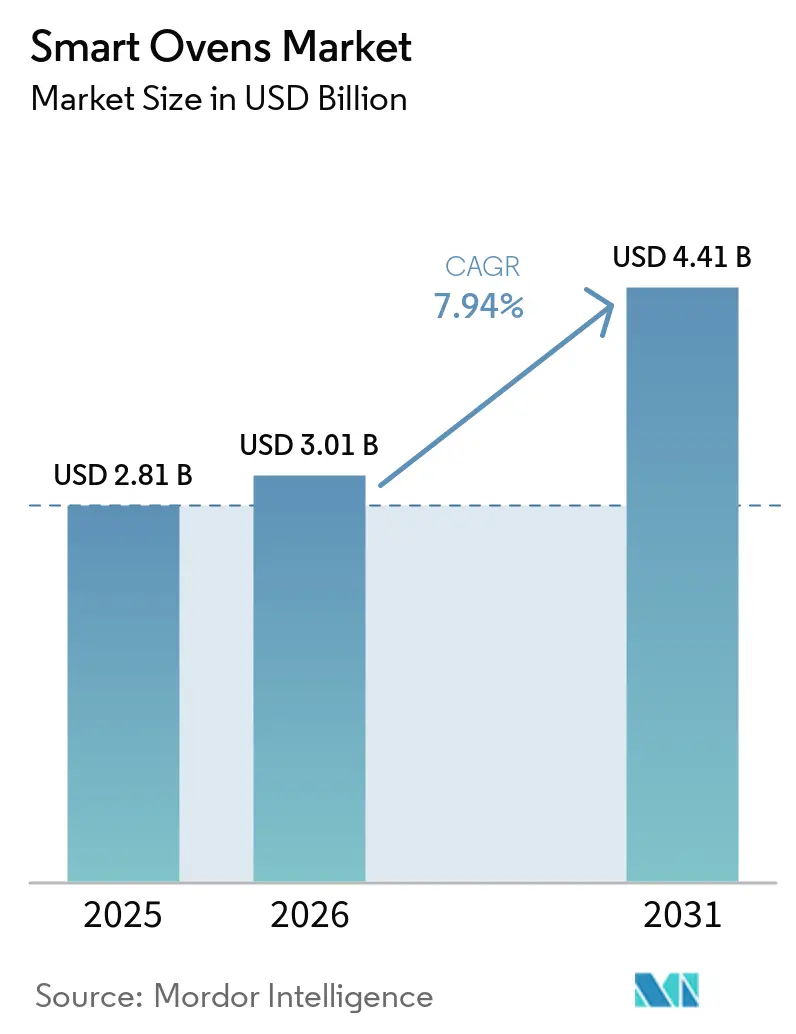
| Market Size (2026) | USD 3.01 Billion |
| Market Size (2031) | USD 4.41 Billion |
| Growth Rate (2026 - 2031) | 7.94 % |
| Fastest Growing Market | Asia-Pacific |
| Largest Market | North America |
| Market Concentration | Medium |
Major Players *Disclaimer: Major Players sorted in no particular order Image © Mordor Intelligence. Reuse requires attribution under CC BY 4.0. | |
Smart Ovens Market Analysis by Mordor Intelligence
The smart oven market size was valued at USD 2.81 billion in 2025 and is estimated to grow from USD 3.01 billion in 2026 to reach USD 4.41 billion by 2031, at a CAGR of 7.94% during the forecast period (2026-2031). The smart oven market is expanding as AI-assisted cooking moves from a premium add-on to a core product feature, especially in households that already use connected appliances. Samsung’s 2026 kitchen lineup shows how voice control, SmartThings connectivity, and remote management are now built into the broader kitchen proposition rather than sold as isolated oven features[1]. The smart oven market is also gaining support from renovation activity, as brands increasingly sell complete built-in suites for premium kitchens rather than single replacement units, a trend evident in recent LG and GE Appliances launches. Direct digital selling is becoming more important as manufacturers use webstores, marketplaces, and connected services to more tightly shape pricing, content, and after-sales engagement [2]. Premium pricing and concerns about data, reliability, and long-term software support still limit the smart oven market among more cautious, price-sensitive buyer groups.
Key Report Takeaways
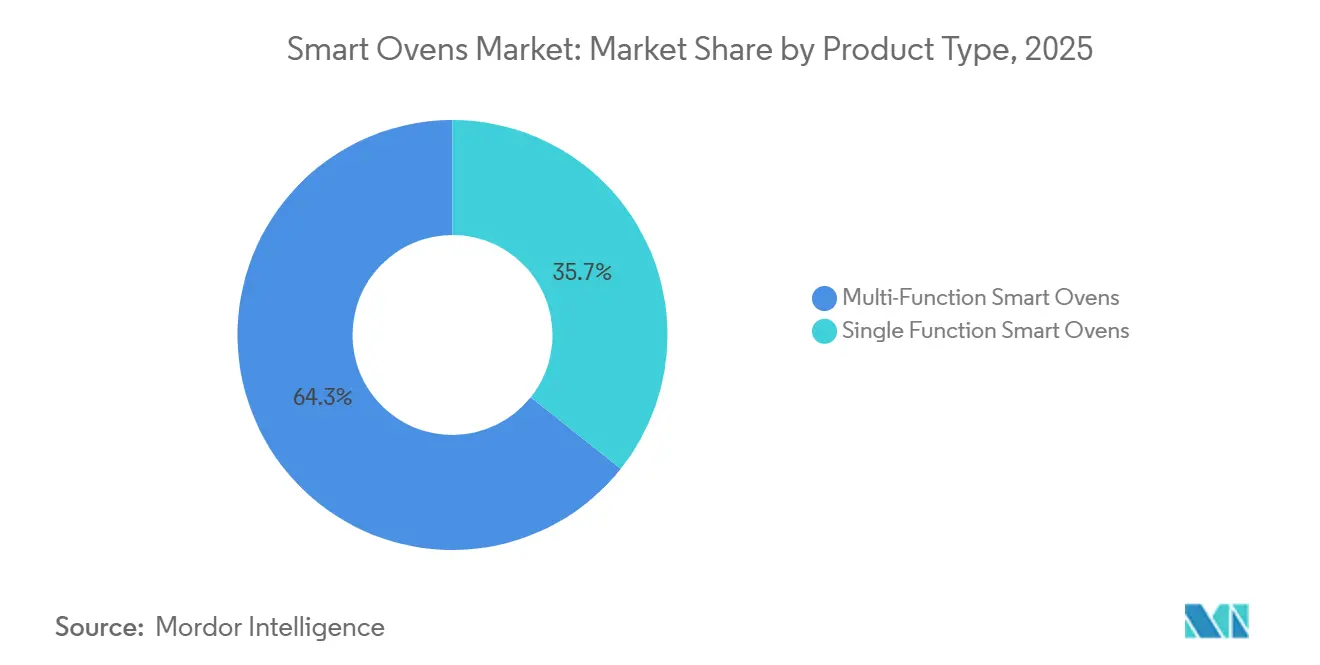
- By product type, multi-function smart ovens led with 64.31% revenue share of the smart ovens market in 2025, while single-function smart ovens remained the smaller format.
- By structure type, countertop units accounted for 52.73% of the smart ovens market's revenue share in 2025, while built-in models posted the highest projected CAGR of 8.25% through 2031.
- By capacity, 31-50 L ovens accounted for 40.51% of the smart ovens market's revenue share in 2025, while ovens above 50 L are forecast to grow at an 8.04% CAGR through 2031.
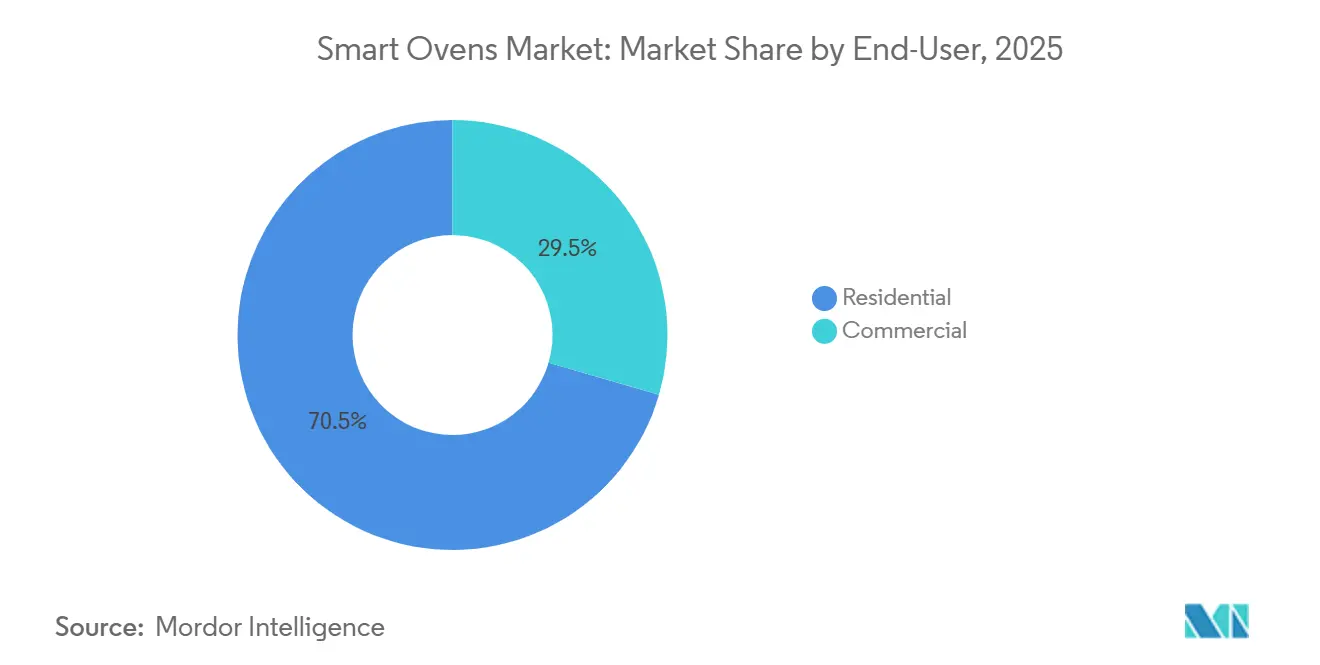
- By end-user, residential users accounted for 70.52% of the smart ovens market's revenue share in 2025, while the commercial segment is advancing at an 8.58% CAGR through 2031.
- By distribution channel, B2C and retail channels represented 75.91% of the smart ovens market's revenue share in 2025, while the B2B and project channels are projected to expand at an 8.16% CAGR through 2031.
- By geography, North America accounted for 35.8% of revenue in 2025, while Asia-Pacific is forecast to grow at an 8.84% CAGR through 2031.
Note: Market size and forecast figures in this report are generated using Mordor Intelligence’s proprietary estimation framework, updated with the latest available data and insights as of January 2026.
Market Trends and Insights
Drivers Impact Analysis of Smart Ovens Market*
| Driver | (~) % Impact on CAGR Forecast | Geographic Relevance | Impact Timeline |
|---|---|---|---|
| Smart-home and voice assistant integration | +1.8% | Global, led by North America and the Asia-Pacific urban centers | Short term (≤ 2 years) |
| Multi-function healthy cooking demand | +1.5% | Global | Short term (≤ 2 years) |
| Premium built-in kitchen renovation demand | +1.2% | North America & Western Europe | Medium term (2–4 years) |
| Online-led D2C appliance discovery | +0.9% | Global, with a concentration in China and the United States | Short term (≤ 2 years) |
| Matter-based interoperability upgrades | +0.7% | North America, Western Europe, Asia-Pacific | Medium term (2–4 years) |
| Home-energy orchestration use cases | +0.6% | Europe & North America | Long term (≥ 4 years) |
| Source: Mordor Intelligence | |||
Smart-Home and Voice Assistant Integration Accelerates Repurchase Cycles
The smart oven market is increasingly shaped by the depth of the home platform around the appliance, not only by the oven’s individual cooking functions. Buyers who already use connected speakers, home apps, and multi-device dashboards are more likely to prefer ovens that fit into the same digital environment. Samsung presented its KBIS 2026 kitchen lineup as a connected suite with Bixby voice control, SmartThings connectivity, recipe support, and remote management features. That approach matters because the purchase decision now involves the refrigerator, display, mobile app, and service layer simultaneously. Once a household is tied to a single platform, the cost of switching rises because replacing the oven can affect the broader kitchen workflow. This makes the smart oven market more favorable to brands that can keep users within a single connected ecosystem across multiple appliance cycles.
Multi-Function Healthy Cooking Demand Extends Average Selling Prices
The smart oven market is also benefiting from demand for cooking modes that support steaming, roasting, air frying, grilling, and other healthier preparation methods in one unit. Buyers often view a multi-function product as a replacement for several separate appliances, which supports higher average selling prices without changing the basic kitchen footprint. Sharp’s 2026 Healsio launch in Japan reflected that direction, with superheated steam models linked to the CookTalk AI service for recipe generation and cooking schedules. The value proposition is stronger when the appliance combines health-oriented cooking with guided software, because the benefit extends beyond hardware alone. This supports premium positioning in both replacement demand and first-time upgrade demand. It also helps explain why multi-function formats have stayed well ahead of single-function models in the smart oven market.
Premium Built-In Kitchen Renovation Demand Sustains High-Value Order Books
The smart oven market is seeing stronger built-in demand, with renovation projects planned as complete kitchen programs rather than isolated appliance purchases. In that setting, the oven is sold as part of a coordinated design, which lifts the chance of higher-value orders and brand-wide suite wins. GE Appliances introduced the GE Profile Smart Convection Wall Oven with Cooking Assistant and CookCam AI in March 2026 as part of its broader USD 3 billion United States manufacturing investment through 2029. LG Electronics also unveiled a full built-in kitchen suite at EuroCucina 2026, including an AI Gourmet Camera Oven and a compact 6-in-1 multi oven aimed at the European premium built-in category. These launches show that leading suppliers want the oven to anchor a broader renovation sale rather than compete only on one appliance. As a result, the smart oven market is becoming more closely linked to premium home improvement spending and new-build kitchen specification decisions.
Online-Led D2C Appliance Discovery Compresses Margin Channels
The smart oven market is changing as digital discovery shifts more control toward brands that own the customer relationship before and after the sale. Electrolux described D2C as a strategic channel for growth, margin expansion, product differentiation, exclusivity, and direct engagement across the product lifetime. Haier reported that DTC-fulfilled orders accounted for 57% of total volume in 2025, demonstrating how direct channel execution can scale when the manufacturer invests in platform control and dealer participation[3]. This matters for the oven category because digital selling enables brands to bundle hardware with accessories, services, software, and content in a single buying journey. It also shortens the path from product discovery to purchase, especially when cooking content and app-led guidance are visible during the decision process. That shift gives the smart oven market an advantage by enabling suppliers to coordinate commerce, service, and software through a single channel architecture.
Restraints Impact Analysis of Smart Ovens Market*
| Restraint | (~) % Impact on CAGR Forecast | Geographic Relevance | Impact Timeline |
|---|---|---|---|
| Premium upfront pricing | -0.9% | Global, most acute in mid-income emerging markets | Short term (≤ 2 years) |
| Privacy, cybersecurity, and remote-control trust concerns | -0.7% | Global | Medium term (2–4 years) |
| Ecodesign, reparability, and standby compliance burden | -0.6% | EU & OECD markets | Medium term (2–4 years) |
| Remote-start safety limits and low cycle flexibility | -0.4% | Global | Medium term (2–4 years) |
| Source: Mordor Intelligence | |||
Premium Upfront Pricing Limits Addressable Market Breadth
The smart oven market still faces a clear ceiling in households that compare connected ovens with lower-priced conventional models. The pricing gap reflects more than just metal and heating components, because connected models also include software, sensors, connectivity, and interface costs. Many recent launches still target premium kitchens and high-spec buyers, which shows that suppliers continue to see better economics at the upper end of the category. That focus helps margins, but it also narrows the immediate buyer base in middle-income households and price-sensitive markets. Brands can widen the addressable base only if they preserve the most valued smart functions while reducing physical complexity or installation costs. Until that balance improves, premium pricing will continue to limit how quickly the smart oven market can move into broader mass-market demand.
Privacy and Cybersecurity Concerns Introduce Adoption Friction
The smart oven market also faces hesitation from households that are uneasy about cloud connectivity, usage tracking, and the reliability of remote control functions. A connected oven can record cooking behavior, scheduling patterns, and app-based interactions, raising questions about data ownership and long-term privacy. EU rules on standby, networked standby, software behavior, and information disclosure have become more demanding for connected products, including electric ovens, adding technical and compliance pressure on manufacturers. Samsung has highlighted regular software updates and remote management support as part of its connected appliance proposition, underscoring that ongoing support is now central to customer trust, not just a service add-on. The issue is harder for smaller brands because they must sustain secure software, updates, and cloud services over a long ownership cycle. This keeps the smart oven market from converting every feature-aware consumer into an active connected buyer.
*Our forecasts treat driver/restraint impacts as directional, not additive. The impact forecasts reflect baseline growth, mix effects, and variable interactions.
Smart Ovens Market Segment Analysis
By Product Type:
Multi-Function Ovens Consolidate the CategoryMulti-function smart ovens held 64.31% of the smart oven market share in 2025, which placed them well ahead of single-function formats. Their lead reflects a simple buyer calculation, because one connected appliance can cover baking, grilling, air frying, steaming, and related tasks in the same unit. That combination reduces counter clutter and lowers the need for separate specialty devices. It also supports higher ticket values because the customer is comparing a premium oven to several smaller appliances, not just a basic oven. In the smart oven market, that logic keeps multi-function models closer to the center of the value proposition than to the edges of product innovation.
Single-function smart ovens still have a place in entry-level demand and in use cases where the buyer wants a single clear cooking outcome rather than a wide menu of modes. They are easier to position where price, simplicity, or menu discipline matters more than broad flexibility. Even so, the software layer now tends to favor multi-mode products because guided cooking works best when the appliance can switch between multiple heat settings during a single recipe. Fresco’s AI Cooking Companion and Guided Cooking rollout across partner brands underlines how recipe-aware control is moving toward broader appliance compatibility and more adaptive cooking flows. As these connected experiences spread, the smart oven market is likely to keep rewarding formats that combine multiple cooking modes with software-led convenience in one platform.
By Structure Type:
Built-In Gains Ground as Renovation Pipelines StrengthenCountertop units accounted for 52.73% of the smart oven market in 2025, supported by lower installation requirements, easier placement, and a better fit for rental housing and smaller apartments. They remain the practical choice for buyers who want connected cooking without a full kitchen remodel. This matters in cities where living space is tighter and appliance upgrades happen one piece at a time. Countertop products also benefit from faster retail turnover because they are easier to compare, stock, ship, and replace. For those reasons, the smart oven market still depends heavily on countertop demand to support category reach and volume.
Built-in models are forecast to grow at an 8.25% CAGR through 2031, making them the faster-growing side of this split. Their momentum comes from renovation cycles in higher-income households, new residential projects, and kitchen designs that prioritize a coordinated appliance suite. GE Appliances and LG both used 2026 product launches to reinforce this part of the category, with new wall ovens and built-in suite offerings aimed at premium kitchen specifications. The important shift is that brands now want the built-in oven to help secure the rest of the kitchen contract, not just the cooking category. That makes the smart oven market more sensitive to renovation pipelines, developer specifications, and premium design trends than it was when the category was mainly a countertop upgrade story.
By Capacity:
Mid-Range Volume Anchors, Large-Format Finds Commercial PullThe 31-50 L band accounted for 40.51% of the smart oven market in 2025, underscoring how closely the category aligns with mainstream household cooking needs. This range fits the daily meal volume of family households without forcing the buyer to install oversized equipment. It also matches the common form factor of many multi-mode consumer ovens, which keeps product choice broad and pricing more competitive. In practical terms, this capacity range sits near the center of residential demand, which helps it anchor market value. The smart oven market, therefore, relies on this mid-range band as the main bridge between premium features and everyday use.
The 20-30 L segment remains relevant for compact apartments, one-person households, and buyers who want a smaller countertop footprint. At the other end, ovens above 50 L are projected to grow at an 8.04% CAGR through 2031 as larger households and lighter commercial users seek greater volume and flexibility. That growth is important because it shows the category stretching into use cases that sit between residential cooking and full professional kitchen equipment. Hotels, small foodservice operators, and institutional settings can use these formats when they need connected control without making a heavier investment in a combi-oven. This gives the smart oven market an added growth path beyond classic household replacement demand. It also supports suppliers that can scale capacity without losing the software simplicity that makes these products appealing to mixed-use buyers.
By End-User:
Residential Revenue Base Remains Firm, Commercial Growth LeadsResidential users accounted for 70.52% of the smart oven market in 2025, keeping households as the main source of current demand. This leadership reflects the stronger installed base of consumer appliances, wider retail access, and higher visibility of connected cooking in smart homes. The smart oven market has been built first around residential upgrades, especially in developed markets where connected ecosystems, kitchen remodeling, and premium appliance spending are already established. In this setting, the oven is often purchased for convenience, guided cooking, and design alignment with the rest of the kitchen. That keeps residential revenue broad even when premium pricing slows the pace of mass-market adoption.
The commercial segment is projected to grow at an 8.58% CAGR through 2031, making it the fastest end-user segment. Food service operators are using connected ovens to improve consistency, reduce dependence on skilled labor, and gain better visibility into appliance usage and maintenance. The user logic differs from residential demand because the buyer seeks repeatable output, centralized recipe control, and reduced operational friction across locations. Intelligent combi-style platforms already show how cloud dashboards and remote updates can support distributed kitchen management in the wider smart oven industry. The line between residential and commercial use is also becoming less rigid in micro-commercial settings such as hotel suite kitchens, co-working food spaces, and kiosk formats. As a result, the smart oven market is starting to benefit from commercial adoption even when the product roots are still closer to consumer appliance design.
By Distribution Channel:
Retail Channels Hold Volume, B2B Segments AccelerateB2C and retail channels held 75.91% of the 2025 market value, which kept consumer-facing sales outlets in the lead. That position reflects the role of multi-brand stores, exclusive brand stores, online retail, and other direct consumer touchpoints in a category where product comparison still matters. Many buyers want to verify size, features, finish, and ease of use before committing to a premium connected appliance. The smart oven market, therefore, still depends on retail visibility even as the purchase path becomes more digital. Retail remains the largest route because it combines education, merchandising, and immediate availability within a single channel.
The B2B and project channel is forecast to grow at an 8.16% CAGR through 2031, supported by hotel renovations, institutional catering upgrades, and commercial kitchen expansions. That growth is meaningful because bulk and project purchases can shift supplier economics faster than one-by-one consumer upgrades. At the same time, online-led discovery is reshaping the consumer side of the category through brand content, app-led demonstrations, and cooking-focused digital media.
Electrolux described D2C as a strategic route for differentiation and exclusivity, while Haier’s 2025 results showed that direct fulfillment can scale materially when the operating model is in place. This dual pattern means the smart oven market is no longer defined by store shelves alone, because project sales are expanding while direct digital engagement gains importance on the retail side. Brands that can balance retail reach, project selling, and owned digital relationships are in the strongest position to defend margins and keep customer attention.
Geography Analysis
The Americas Smart Ovens Market
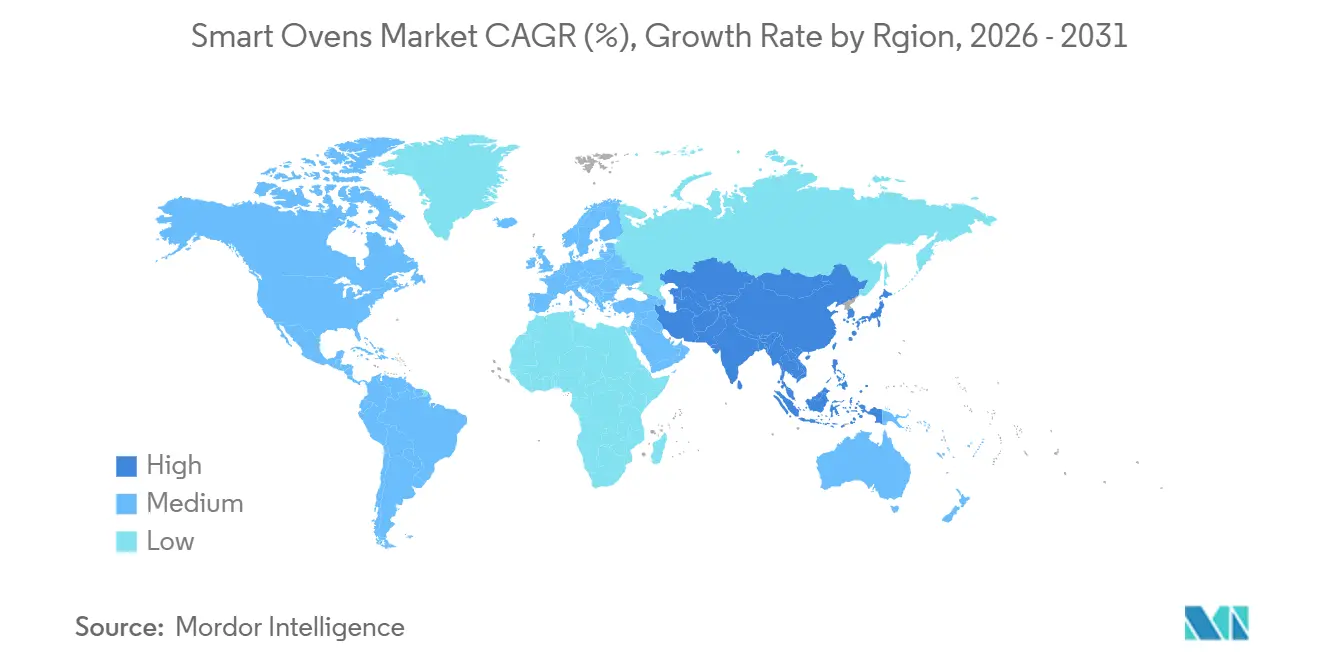
North America held 35.84% of the smart oven market share in 2025, which made it the largest regional contributor to current revenue. The United States remains the core demand engine, supported by strong smart-home adoption, higher familiarity with AI-enabled appliances, and premium renovation activity. GE Appliances reinforced that demand base with its March 2026 launch of the GE Profile Smart Convection Wall Oven with Cooking Assistant and CookCam AI, tied to a broader USD 3 billion domestic manufacturing program through 2029. Canada adds steady demand from major urban centers, while Mexico is emerging as a more price-sensitive upgrade market as distribution normalizes. South America, led by Brazil, is still smaller in scale, but online retail and rising interest in premium appliances are creating a more stable path for the smart oven market across the region.
Europe Smart Ovens Market
Europe remains a structurally important region because regulation and compliance shape product decisions almost as much as end demand. EU ecodesign rules for standby and networked standby, applied from May 9, 2025, cover electric ovens by setting tighter power limits, information requirements, and timing rules for compliant low-power states[4]. That raises redesign and testing pressure for manufacturers that have not yet updated EU-market platforms. Germany, the United Kingdom, and Italy remain important revenue anchors, while the Nordics stand out where dynamic tariffs and high smart-home usage make energy-aware connected cooking more relevant.
APAC and MEA Smart Ovens Market
Asia-Pacific is projected to expand at an 8.84% CAGR within the smart oven market size through 2031, making it the fastest-growing regional block. China, Japan, South Korea, and India are the main regional demand centers, supported by rising middle-class spending, urbanization, and appliance upgrade activity. Government-backed replacement and renewal programs in China and India are helping households move from conventional cooking products toward connected models. Japan adds a distinct premium layer, where Sharp’s 2026 Healsio range shows how AI-enabled steam cooking can command attention in a market that values meal quality and guided preparation. The Middle East and Africa remain earlier-stage markets, but GCC luxury housing and hotel projects are giving the smart oven market a visible entry path through premium built-in demand.
Competitive Landscape
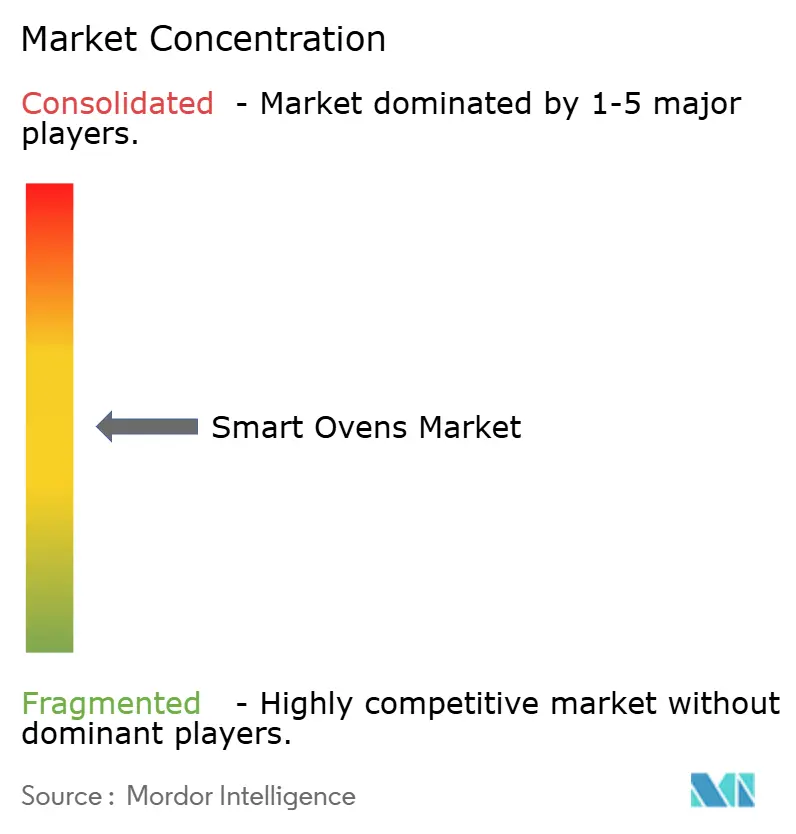
The smart oven market has a moderately concentrated top tier, with Samsung, LG Electronics, BSH Hausgeräte, GE Appliances, and Midea holding the strongest positions in premium and mid-range residential demand. Their advantage comes from manufacturing scale, distribution reach, and the ability to combine hardware with proprietary software ecosystems. The competitive focus is moving away from hardware specification alone and toward the breadth of the connected kitchen experience. Samsung’s CES 2026 plans clearly showed that the company linked AI Vision, Google Gemini, SmartThings, and related kitchen functions into a single appliance ecosystem rather than a single isolated product update. This keeps the smart oven market tied to ecosystem depth, which favors suppliers that already manage connected categories across the home.
A second layer of competition comes from software-led specialists such as Tovala, Brisk It, Brava Home, and similar challengers that focus on guided cooking, camera-led automation, or subscription-based engagement. These companies do not match the largest appliance brands in terms of manufacturing footprint, but they can move quickly on user experience and cooking software. Fresco adds another competitive twist by enabling its AI Cooking Companion to work across partner brands rather than locking users into a single hardware label. That creates pressure on incumbents because software value can now sit above the appliance brand in parts of the cooking journey.
The smart oven market is also splitting more clearly by buyer tier. Miele, Breville, and Dacor focus on luxury residential projects where design integration, build quality, and warranty support still matter. Commercial specialists such as RATIONAL AG, UNOX S.p.A., Alto-Shaam, and Welbilt compete on fleet management, service support, and operating consistency for professional users. GE Appliances’ 2026 wall oven launch, LG’s built-in suite rollout, and Samsung’s connected kitchen strategy all show that leading companies are using software, AI, and ecosystem services to strengthen their position across different price bands. The result is a market where the leaders are strong, but no single company defines the whole category. That keeps the smart oven market competitive enough for new software models and region-specific brands to remain relevant even as the largest appliance groups scale up their connected cooking platforms.
Smart Ovens Industry Leaders
-
Samsung Electronics Co., Ltd
-
LG Electronics Inc.
-
Whirlpool Corporation
-
BSH Hausgeräte GmbH
-
GE Appliances
- *Disclaimer: Major Players sorted in no particular order
Smart Ovens Market Companies Covered in this Report
- Samsung Electronics Co., Ltd.
- LG Electronics Inc.
- Whirlpool Corporation
- BSH Hausgeräte GmbH
- GE Appliances
- Miele Group
- Breville Group Limited
- Panasonic Corporation
- Sharp Corporation
- Midea Group Co., Ltd.
- Tovala, Inc.
- Brava Home, Inc.
- June Life, Inc.
- Dacor, Inc.
- Sub-Zero Group, Inc.
- UNOX S.p.A.
- Alto-Shaam, Inc.
- RATIONAL AG
- Welbilt, Inc.
- Fagor Professional
Recent Industry Developments in Smart Ovens Market
- June 2026: Sharp Corporation launched 4 new Healsio superheated steam oven models (AX-LSX3D, AX-RS1D, AX-N1D, AX-U1D) in Japan, all featuring the CookTalk AI service for automatic recipe generation and schedule optimization; the AX-LSX3D and AX-RS1D began shipping on June 18, 2026, marking the brand's most AI-integrated Healsio line update to date.
- May 2026: Fresco launched its AI Cooking Companion Recipe Import and Guided Cooking experience, enabling users to convert recipes from any source into guided cooking sequences across Fresco-powered partner appliances, including Panasonic, LG, Bosch, GE Appliances, Viking, and Instant Brands; this cross-brand integration signals a platform-as-a-service model that sits above individual hardware ecosystems.
- April 2026: LG Electronics unveiled its "LG Built-in" full kitchen suite at EuroCucina 2026 in Milan, featuring an AI Gourmet Camera Oven with AI-driven cooking recommendations, No Preheat Air Cooking, and Knock-on InstaView; the built-in compact oven offers 6-in-1 multi-mode cooking, targeting the European premium renovation channel
- March 2026: GE Appliances introduced the GE Profile Smart Convection Wall Oven with Cooking Assistant™ and CookCam AI at its Roper Corporation facility in LaFayette, Georgia, with production commencing in July 2026. The launch is embedded in GE Appliances' USD 3 billion domestic manufacturing investment through 2029 and positions the brand at the premium intersection of AI recognition and voice-controlled cooking.
Global Smart Ovens Market Report Scope
Segmentation Overview
| Single Function Smart Ovens |
| Multi-Function Smart Ovens |
| Countertop |
| Built-in |
| 20-30 L |
| 31- 50 L |
| More than 50 L |
| Residential |
| Commercial |
| B2C/Retail Channels | Multi-Brand Stores |
| Exclusive Brand Stores | |
| Online | |
| Other Distribution Channels | |
| B2B/Project | Direct from the manufacturers |
| Dealers/Hospitality Procurement Companies |
| North America | United States |
| Canada | |
| Mexico | |
| South America | Brazil |
| Peru | |
| Chile | |
| Argentina | |
| Rest of South America | |
| Europe | United Kingdom |
| Germany | |
| France | |
| Spain | |
| Italy | |
| Russia | |
| BENELUX | |
| NORDICS | |
| Rest of Europe | |
| Asia-Pacific | India |
| China | |
| Japan | |
| Australia | |
| South Korea | |
| Southeast Asia | |
| Rest of Asia-Pacific | |
| Middle East and Africa | United Arab Emirates |
| Saudi Arabia | |
| South Africa | |
| Nigeria | |
| Rest of Middle East And Africa |
| By Product Type | Single Function Smart Ovens | |
| Multi-Function Smart Ovens | ||
| By Structure Type | Countertop | |
| Built-in | ||
| By Capacity | 20-30 L | |
| 31- 50 L | ||
| More than 50 L | ||
| By End-User | Residential | |
| Commercial | ||
| By Distribution Channel | B2C/Retail Channels | Multi-Brand Stores |
| Exclusive Brand Stores | ||
| Online | ||
| Other Distribution Channels | ||
| B2B/Project | Direct from the manufacturers | |
| Dealers/Hospitality Procurement Companies | ||
| By Geography | North America | United States |
| Canada | ||
| Mexico | ||
| South America | Brazil | |
| Peru | ||
| Chile | ||
| Argentina | ||
| Rest of South America | ||
| Europe | United Kingdom | |
| Germany | ||
| France | ||
| Spain | ||
| Italy | ||
| Russia | ||
| BENELUX | ||
| NORDICS | ||
| Rest of Europe | ||
| Asia-Pacific | India | |
| China | ||
| Japan | ||
| Australia | ||
| South Korea | ||
| Southeast Asia | ||
| Rest of Asia-Pacific | ||
| Middle East and Africa | United Arab Emirates | |
| Saudi Arabia | ||
| South Africa | ||
| Nigeria | ||
| Rest of Middle East And Africa | ||
Key Questions Answered in the Report
What is the 2031 outlook for smart ovens?
The category is projected to reach USD 4.41 billion by 2031 from USD 3.01 billion in 2026, growing at a 7.94% CAGR over 2026-2031.
Which product type leads revenue today?
Multi-function smart ovens held 64.31% of 2025 revenue, showing that buyers prefer one appliance that can handle several cooking modes.
Why are built-in models growing faster than countertop models?
Built-in models are forecast to grow at 8.25% CAGR through 2031 because premium renovation projects increasingly specify integrated kitchen suites.
Which end-user group is growing fastest?
Residential users generated 70.52% of 2025 revenue, but commercial demand is rising faster at an 8.58% CAGR as food service operators look for consistency and lower labor dependence.
Which region has the strongest current position and which region is growing fastest?
North America led with 35.8% share in 2025, while Asia-Pacific is projected to expand at an 8.84% CAGR through 2031.