
Outdoor Cooking Appliances Market Size and Share
Market Overview
| Study Period | 2020 - 2031 |
|---|---|
| Market Size (2026) | USD 7.33 Billion |
| Market Size (2031) | USD 10.18 Billion |
| Growth Rate (2026 - 2031) | 6.79 % |
| Fastest Growing Market | Asia-Pacific |
| Largest Market | North America |
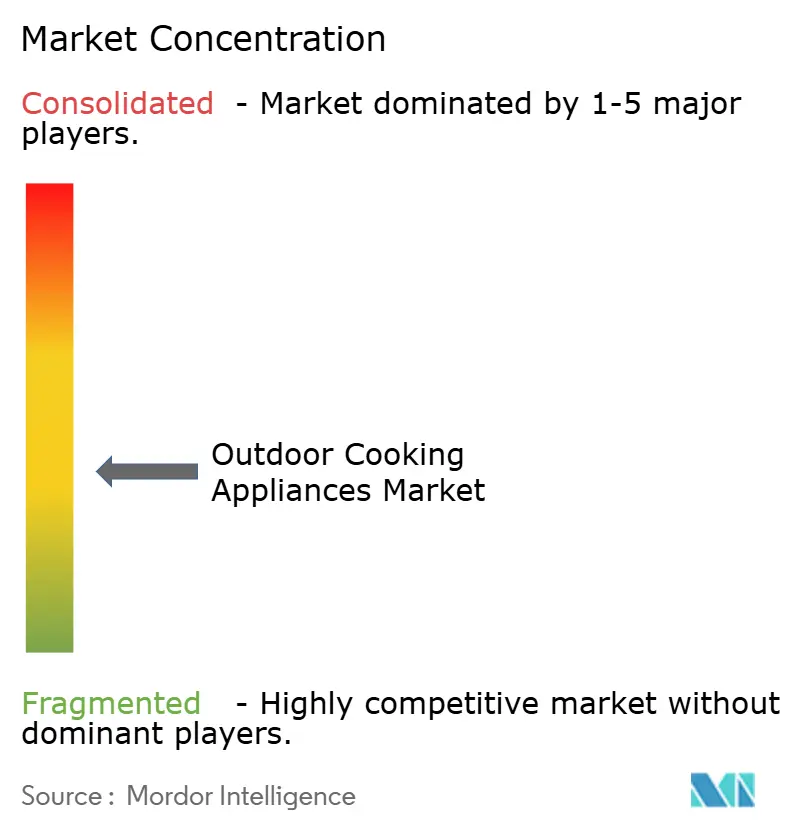
| Market Concentration | Medium |
Major Players *Disclaimer: Major Players sorted in no particular order Image © Mordor Intelligence. Reuse requires attribution under CC BY 4.0. | |
Outdoor Cooking Appliances Market Analysis by Mordor Intelligence
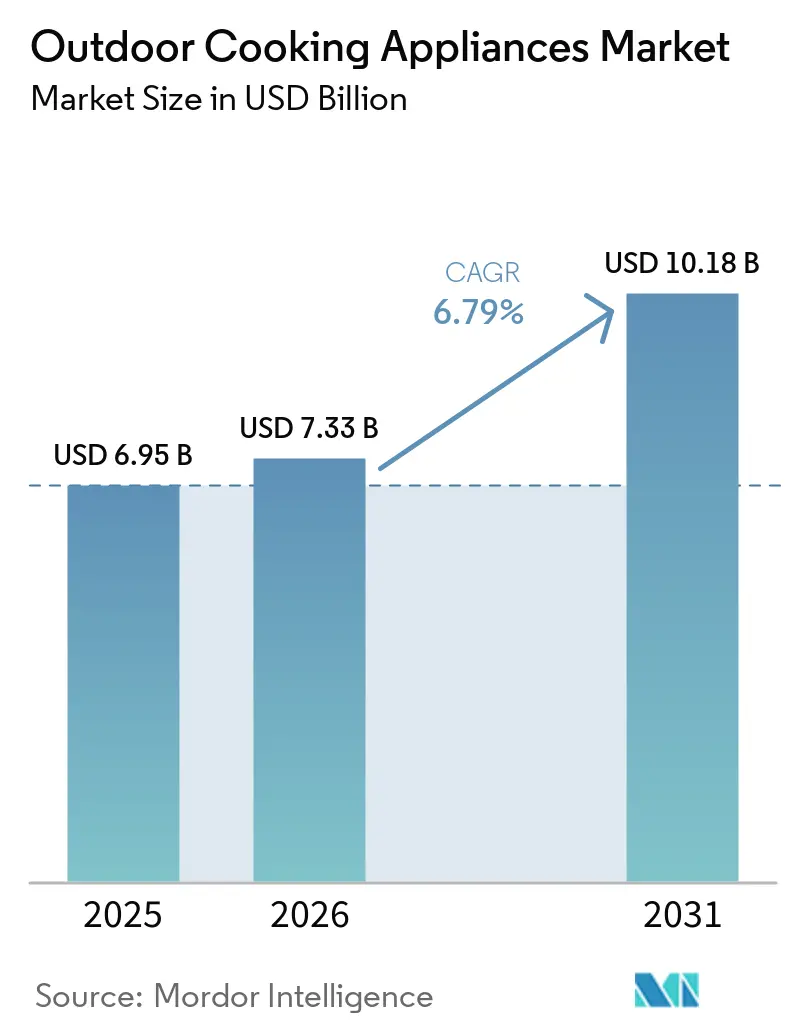
The outdoor cooking appliances market size is projected to expand from USD 6.95 billion in 2025 to USD 7.33 billion in 2026 and to USD 10.18 billion by 2031, registering a CAGR of 6.79% between 2026 and 2031. The Houzz 2026 United States Outdoor Trends Study, which surveyed 1,191 United States homeowners, found that 12% added or upgraded an outdoor kitchen, with 95% of those being new builds rather than renovations, a signal that first-time installations are accelerating, not plateauing. Outdoor kitchens now feature grills in 85% of installations, beverage refrigerators in 62%, and sinks in 59%, underscoring how deeply cooking appliances are embedded in outdoor infrastructure spending[1]. Competitive activity in the outdoor cooking appliances market is sharpening as scale players pursue consolidation. At the same time, focused brands expand into adjacent formats such as griddles and pizza ovens to capture second- and third-appliance purchases. The clearest opportunity across the outdoor cooking appliances market remains premiumization through broader cooking ecosystems. In contrast, the main pressure points remain discretionary spending sensitivity, urban usage limits, and uneven input cost recovery.
Key Report Takeaways
- By product type, outdoor grills led with 57.52% of the outdoor cooking appliances market share in 2025, while outdoor pizza ovens are projected to expand at a 7.02% CAGR through 2031.
- By fuel type, gas held 50.21% of the outdoor cooking appliances market share in 2025, whereas hybrid fuel systems are forecast to grow at a 6.87% CAGR through 2031.
- By end-user, residential captured 66.83% of the outdoor cooking appliances market share in 2025, while commercial is expected to advance at a 7.15% CAGR through 2031.
- By distribution channel, B2C/Retail channels led with 70.92% of the outdoor cooking appliances market share in 2025, while B2B/Project channels are projected to expand at a 6.96% CAGR through 2031.
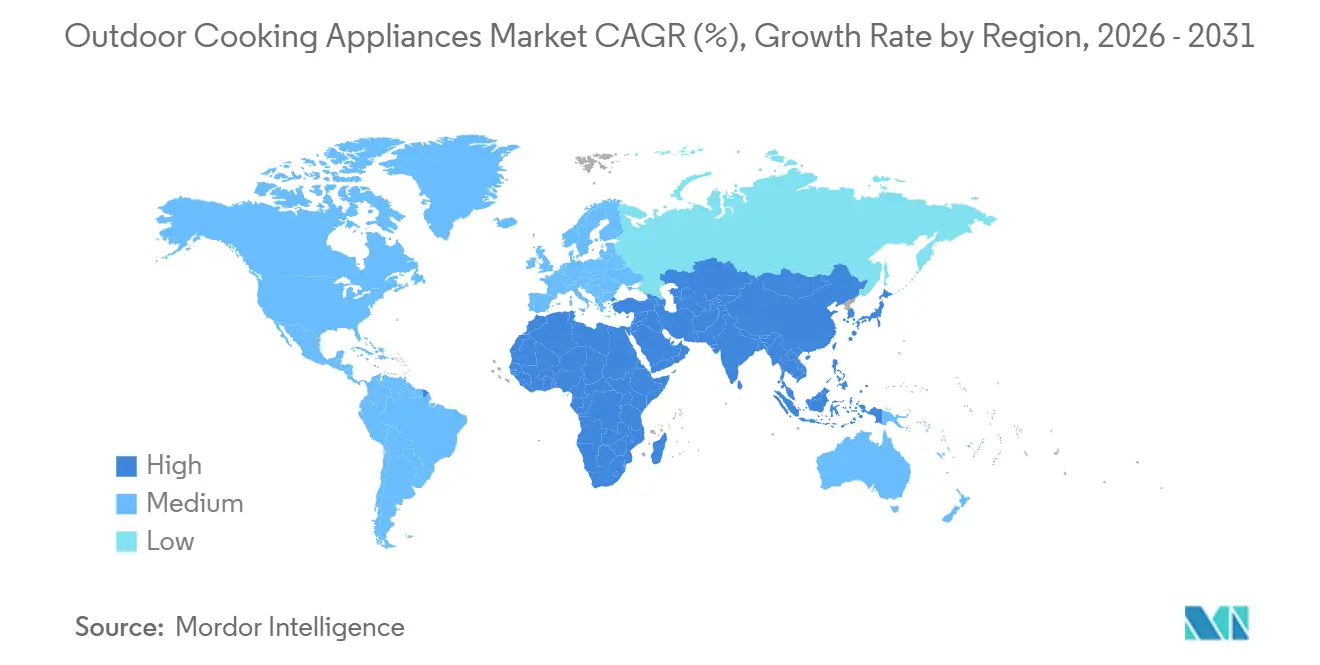
- By geography, North America held 41.41% of the outdoor cooking appliances market share in 2025, whereas Asia-Pacific is forecast to grow at a 7.23% CAGR through 2031.
Note: Market size and forecast figures in this report are generated using Mordor Intelligence’s proprietary estimation framework, updated with the latest available data and insights as of January 2026.
Market Trends and Insights
Drivers Impact Analysis of Outdoor Cooking Appliances Market*
| Driver | (~) % Impact on CAGR Forecast | Geographic Relevance | Impact Timeline |
|---|---|---|---|
| Rising Outdoor Living And Backyard Remodeling | +1.4% | North America and Europe, with emerging gains in the Asia-Pacific | Medium term (2-4 years) |
| Premium And Smart Grill Adoption | +1.1% | North America first, followed by Europe and Australia | Medium term (2-4 years) |
| Gas And Pellet Grill Adoption For Convenience And Flavor | +0.8% | Global, strongest in North America and Asia-Pacific | Short term (≤ 2 years) |
| Expansion Of E-Commerce And Direct-To-Consumer Models | +0.6% | Global, with faster channel development in Asia-Pacific and South America | Short term (≤ 2 years) to Medium term (2-4 years) |
| Social-Media-Led Outdoor Cooking Culture | +0.5% | Global, especially Asia-Pacific, North America, and Europe | Short term (≤ 2 years) |
| Hybrid Fuel Innovation For Balcony Cooking | +0.4% | Dense urban markets in East Asia, North America, and Europe | Long term (≥ 4 years) |
| Source: Mordor Intelligence | |||
Rising Outdoor Living Investment Structurally Embeds Grill Demand
The outdoor cooking appliances market is benefiting from a shift in buying intent, as outdoor cooking areas are now treated less as seasonal add-ons and more as part of the home. This favors larger baskets that include grills, griddles, side burners, and refrigeration, rather than a single standalone unit. It also supports built-in and modular formats, which carry higher ticket values and create more room for brand-led kitchen systems. In Europe, the premium mix held up in 2026 even as the broader grill environment softened, suggesting that trade-up demand remains intact among committed buyers. That pattern matters for the outdoor cooking appliances market because premium demand is less exposed to short replacement cycles and more tied to durable lifestyle spending. It also means that brands with broad product suites are better positioned to capture a larger share of household budgets for outdoor renovations.
Smart Grills and Connected Ecosystems Create Platform Lock-In Analogous to Consumer Electronics
The outdoor cooking appliances market is seeing connected features move from niche appeal into a more standard expectation in the higher price bands. Weber expanded its WEBER CONNECT platform in January 2026 across charcoal, gas, and pellet products, adding connected thermometers, a Smart Hub Display, and retrofit accessories that work through a single app. This matters because connected probes, sensors, and app workflows create accessory revenue after the initial hardware sale. The result is that the outdoor cooking appliances market is starting to look less like a one-time appliance purchase and more like a platform category with repeat spending opportunities. It also raises switching costs, because consumers who learn one app and build a set of compatible accessories are less likely to move brands at the next replacement point. That shift gives larger brands an advantage by enabling them to spread software and accessory development across multiple fuel types and product tiers.
Hybrid Fuel Innovation Opens the Urban Apartment Market
The outdoor cooking appliances market has historically been strongest in suburban and low-density settings, but hybrid and electric formats are widening access in urban homes. These products matter because they reduce some of the traditional barriers to balcony or compact-space cooking, including open-flame restrictions, reliance on fixed fuels, and one-mode cooking designs. The fastest growth in hybrid fuel reflects category expansion into new households rather than simple substitution among existing grill owners. It also explains why multi-function formats are getting more attention, since smaller homes tend to value flexibility more than single-purpose hardware. The outdoor cooking appliances market is therefore gaining a new layer of demand from consumers who want to grill, smoke, and sear in one compact unit. Over time, this should shift some future growth away from large backyard installations and toward more flexible, urban-friendly products.
E-Commerce and DTC Models Redistribute Channel Power
The outdoor cooking appliances market is changing at the channel level as brands use direct digital touchpoints to influence discovery, launch timing, and repeat sales. Traeger reshaped its channel strategy in 2026 by exiting Costco roadshows and discontinuing its own direct-to-consumer channel, while refocusing retail relationships toward formats with better conversion and margin outcomes. Ooni has also used a direct-first model for selected product launches, demonstrating how owned communities can accelerate adoption when a brand has strong consumer engagement. In France, 1.9 million BBQ and outdoor cooking appliances were sold in 2025, generating USD 285.84 million (EUR 243 million) in retail revenue, with a broader product mix that shows buyers are exploring more formats through specialized and online routes[2]. For the outdoor cooking appliances market, that means shelf control still matters, but brand-owned demand generation now plays a larger role in moving consumers from interest to purchase. It also gives smaller, focused brands a practical way to scale without relying only on large physical retail networks.
Restraints Impact Analysis of Outdoor Cooking Appliances Market*
| Restraint | (~) % Impact on CAGR Forecast | Geographic Relevance | Impact Timeline |
|---|---|---|---|
| Pronounced Seasonality In Colder Regions | -0.8% | Northern Europe, Canada, and the Northern United States | Short term (≤ 2 years) to Medium term (2-4 years) |
| Fire And Safety Regulations In Dense Urban Areas | -0.6% | North American metro areas, urban Europe, and East Asian high-rises | Long term (≥ 4 years) |
| Volatile Metals And Freight Costs | -0.5% | Global, most acute for mass-market suppliers sourcing from East Asia | Short term (≤ 2 years) |
| Shared Amenity Spaces In Multi-Family Housing | -0.4% | Dense cities globally, especially in Europe and the Asia-Pacific | Medium term (2-4 years) to Long term (≥ 4 years) |
| Source: Mordor Intelligence | |||
Stringent Fire and Safety Regulations Constrain Dense Urban Demand
The outdoor cooking appliances market still faces a structural limit in dense urban housing, where building rules and fire safety concerns shape product use. This issue is more durable than short-term pricing pressure because it affects where certain products can be used at all. That creates a natural ceiling for some open-flame formats in apartment-heavy markets, even when consumer interest is present. It also pushes suppliers toward electric, compact, and lower-emission designs that can fit more locations with fewer restrictions. In the outdoor cooking appliances market, the restraint does not eliminate demand but redirects it toward products that can operate within tighter physical and regulatory constraints. This is why future growth in cities is likely to depend as much on compliant design as on brand strength or promotional spending.
Volatile Input Costs and Freight Exposure Squeeze Manufacturer Margins
The outdoor cooking appliances market remains exposed to material and logistics swings, as steel, stainless steel, aluminum, and freight continue to influence delivered appliance costs. Traeger reported a Q1 fiscal 2026 gross margin of 45.7%, but the figure included a USD 12.4 million tariff refund, and the underlying margin, excluding that item, was 32.6%[3]. That gap shows how quickly tariff and sourcing changes can alter profitability even when retail demand is stable. It also favors premium suppliers that can hold pricing or absorb temporary cost pressure without losing core buyers. The outdoor cooking appliances market, therefore, continues to separate into brands with pricing power and brands that remain more exposed to cost-led margin erosion. Freight costs have eased from the earlier peak, but sourcing concentration still leaves many manufacturers vulnerable to renewed supply disruption.
*Our forecasts treat driver/restraint impacts as directional, not additive. The impact forecasts reflect baseline growth, mix effects, and variable interactions.
Outdoor Cooking Appliances Market Segment Analysis
By Product Type:
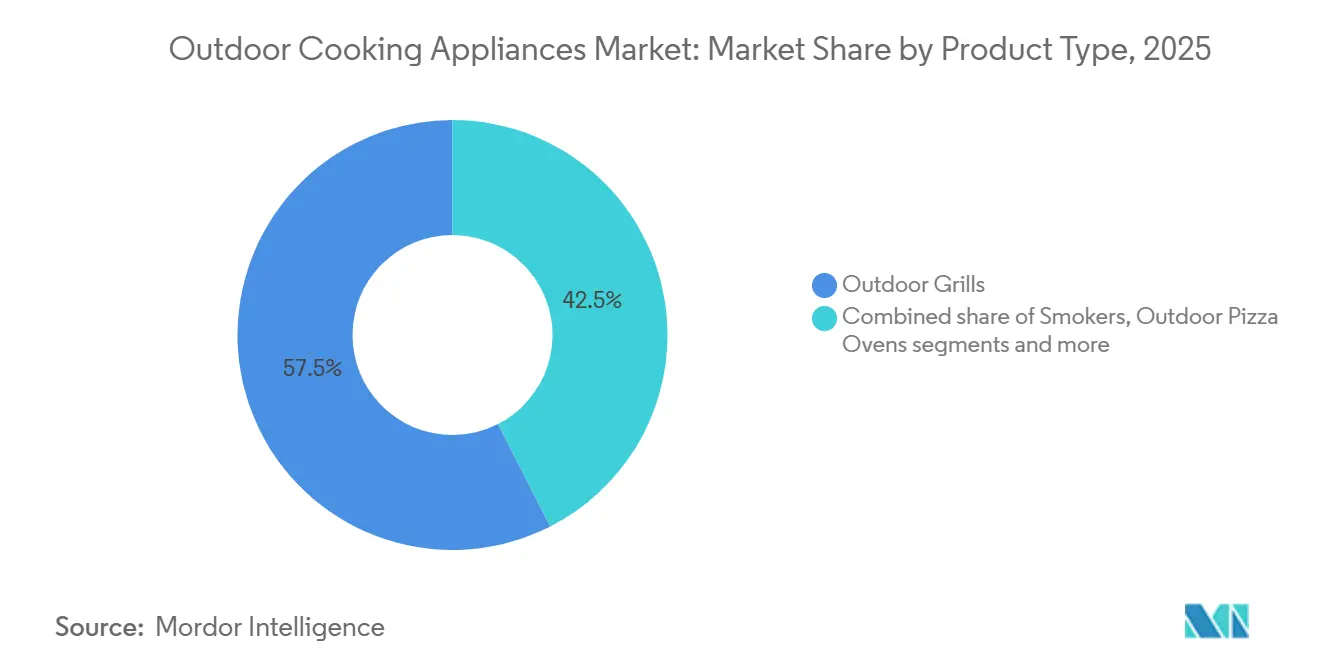
Outdoor Grills Dominate, Pizza Ovens AccelerateOutdoor grills accounted for 57.52% of the outdoor cooking appliances market in 2025, making them the anchor category across residential and commercial buying. Their lead comes from broad price coverage, strong retail presence, and familiarity across first-time and replacement purchases. The segment also benefits from its role as the starting point for broader outdoor kitchen spending, as many households add other appliances only after the grill is in place. In the outdoor cooking appliances industry, grills remain the category with the deepest assortment and the widest installed base.
Weber demonstrated this continued focus in January 2026, when it extended smart functionality across more charcoal, gas, and pellet models within a single connected ecosystem. That move reflects how the outdoor cooking appliances market is using technology to refresh a mature core category rather than relying solely on new household formation. Smokers continue to benefit from flavor-focused enthusiasts, while griddles have become a meaningful second purchase for households seeking greater meal versatility. Traeger reinforced its adjacency in April 2026 with the Irontop Series, which expanded the brand beyond pellet grills into a faster-growing cooking format[4]. Outdoor pizza ovens are projected to grow at a 7.02% CAGR through 2031, showing that the outdoor cooking appliances market still has room for category creation when the use case is distinct and socially visible.

By Fuel Type:
Gas Holds the Core, Hybrid Signals the FutureGas accounted for 50.21% of revenue in 2025, maintaining its position as the primary fuel type in the outdoor cooking appliances market. Its scale reflects long-standing user preference for fast ignition, predictable heat, and easy control. Gas also benefits from established propane and natural gas infrastructure, which lowers friction at the point of use compared with some alternative formats. For these reasons, gas remains the practical benchmark against which newer fuel systems are measured. The next stage of competition is less about replacing gas outright and more about narrowing its convenience advantage. Pellet products continue to appeal to consumers who want wood-fired flavor with more controlled operation, while charcoal keeps a loyal following among buyers who value craft-style cooking. In France, charcoal accounted for 34.9% of appliance sales in 2025, while gas accounted for 37.2%, suggesting the gap can narrow as consumers place greater value on the cooking experience and flavor identity.
Hybrid fuel systems are forecast to grow at a 6.87% CAGR through 2031, and that performance shows where the outdoor cooking appliances market is finding incremental demand. The outdoor cooking appliances market for hybrid fuel is growing because a single unit can accommodate multiple cooking preferences, fit into tighter spaces, and meet compliance requirements. This also helps the outdoor cooking appliances industry address buyers who want flexibility without committing to several separate appliances. Electric products are also gaining more credibility as engineering improves. Ooni expanded that addressable base in September 2025 with the Volt 2 Electric Pizza Oven at USD 699, which was positioned for indoor and outdoor dual use. The outdoor cooking appliances market is therefore shifting from a fuel hierarchy built only on tradition to one increasingly shaped by use-case fit, product versatility, and location constraints.
By End-User:
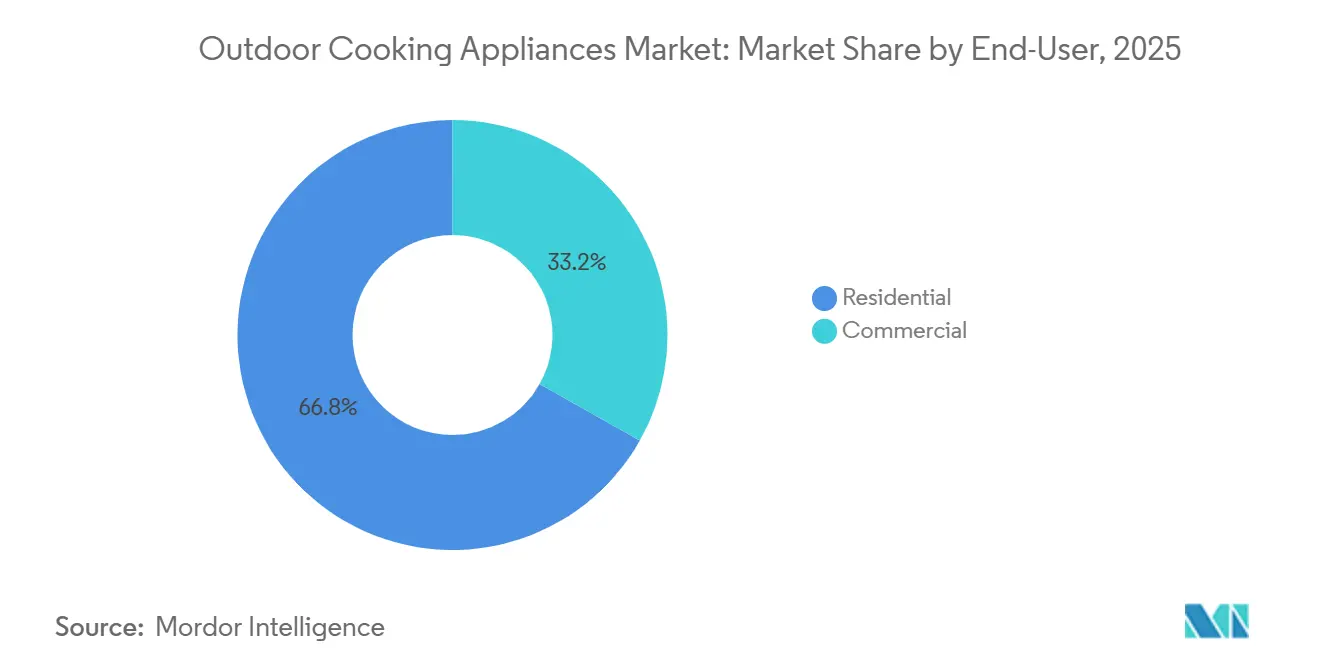
Residential Commands Share, Commercial Drives GrowthIn 2025, residential demand accounted for 66.83% of the outdoor cooking appliances market value, making it the largest segment. This demand is driven by household outdoor leisure, family cooking, and home-centered entertainment. The segment accommodates a wide range of pricing, from entry-level charcoal products to premium built-in systems, catering to various income groups and home layouts. The residential segment remains central even when some discretionary categories experience slower growth. The evolving buyer profile includes traditional weekend grillers, multi-appliance users, compact-space users who prefer electric or hybrid models, and younger consumers who view outdoor cooking as a social activity. This diversity supports both first-time purchases and follow-on demand for products like griddles and pizza ovens. Premium brands also benefit from households upgrading their outdoor spaces by offering complete systems instead of individual units. Residential use continues to dominate, driven by broad adoption across regions.
The commercial segment is projected to grow at a compound annual growth rate of 7.15% through 2031, making it the fastest-growing end-user group. Growth is supported by restaurants, hospitality venues, and recreational sites investing in permanent outdoor cooking solutions instead of temporary seasonal equipment. Operators incorporating live-fire or visible cooking into guest experiences, particularly in resort, leisure, and experiential dining settings, contribute to this growth. Brands with strong service support, certified product lines, and specification-driven sales approaches are well-positioned in this segment. Although commercial demand starts from a smaller base, its structured procurement process can lead to consistent repeat demand once a brand is approved across property networks.
By Distribution Channel:
Retail Channels Lead, B2B Channels Gaining TractionB2C and retail channels accounted for 70.92% of the market value in 2025, making them the largest route to market for outdoor cooking appliances. This reflects the continued role of home improvement chains, specialty BBQ stores, and online platforms in serving household demand. Retail remains important because many buyers still want to compare sizes, finishes, and accessories before committing to a higher-ticket purchase. It also supports a wide assortment of exposure for entry- and mid-range products. At the same time, the online layer inside retail is becoming more influential in launch sequencing and brand building. Ooni’s direct-led launch approach and Traeger’s 2026 channel restructuring show that brands are actively revising how they balance owned demand with partner retail placement. In the outdoor cooking appliances market, specialty retailers still matter because they can explain premium features and bundled configurations better than general merchandise environments.
B2B and project channels are forecast to grow at a 6.96% CAGR through 2031, making them the fastest-growing channels in relative terms. Their expansion is tied to hospitality, foodservice, luxury residential development, and the procurement of recreational facilities. These sales are often more structured than retail sales because they depend on specifications, service support, and repeat replacement cycles rather than one-time consumer decisions. That structure creates longer selling cycles, but it can also create more durable account relationships once a brand is approved. In the outdoor cooking appliances market, B2B growth is important because it broadens the business away from purely discretionary household demand.
Geography Analysis
North America Outdoor Cooking Appliances Market
In 2025, North America accounted for 41.41% of the global outdoor cooking appliances market value, making it the largest regional contributor. The region benefits from established grilling habits, widespread suburban housing, and a mature retail and specialty dealer network that supports both entry-level and premium products. It also serves as a key base for multi-appliance outdoor kitchen spending, enabling premium brands to expand beyond initial grill purchases. The region plays a significant role in category launches, the adoption of connected products, and the development of accessory ecosystems. Growth in North America now relies more on premiumization, adjacent categories, and replacement upgrades rather than first-time ownership, as the market has reached maturity.
APAC Outdoor Cooking Appliances Market
Asia-Pacific is projected to grow at a compound annual growth rate of 7.23% through 2031, making it the fastest-growing regional market for outdoor cooking appliances. This growth is driven by increasing disposable incomes, urban housing expansion, and a younger consumer base adopting outdoor cooking as part of lifestyle-driven spending. The region also benefits from hospitality sector expansion and foodservice demand in tourism-focused markets, adding a commercial dimension to household growth. Product formats such as pizza ovens, compact electric appliances, and flexible gas systems are gaining traction, reducing entry barriers in markets where the category is still developing. This adaptability positions Asia-Pacific as a key region for both premium and mass-premium product expansion.
EMEA and South America Outdoor Cooking Appliances Market
Europe remains an important contributor to the outdoor cooking appliances market, with countries such as Germany, the United Kingdom, and France driving demand. In 2025, France sold 1.9 million outdoor cooking appliances, generating EUR 243 million (USD 266 million) in retail revenue. It reflects strong market engagement and a growing product mix beyond standard gas and charcoal units. Seasonality in colder markets poses challenges, but demand for premium, all-weather, and craft-style cooking solutions helps offset this limitation. South America, the Middle East, and Africa are smaller in absolute terms but offer growth opportunities supported by communal grilling traditions and hospitality-driven spending.
Competitive Landscape
The outdoor cooking appliances market is moderately concentrated at the top, but it remains fragmented through the middle and specialist tiers. The strongest scale move came in February 2026 when 26North completed its majority transaction for Middleby’s residential kitchen unit and formed Composition Brands around Kamado Joe, Masterbuilt, Char-Griller, Lynx, and Viking Outdoor. That move created a more focused platform across mass, premium, and ultra-luxury outdoor cooking categories. It also showed that investors still see room for portfolio scaling in a category where brand identities remain distinct by product style and price band. The outdoor cooking appliances market, therefore, combines early consolidation at the top with a wide competitive landscape below.
A second layer of rivalry now sits around software, accessories, and the broader ownership ecosystem. Weber strengthened that approach in January 2026 by extending WEBER CONNECT to more products and fuel types, helping the brand tie hardware sales to probes, displays, and app-led use. Traeger is pursuing a related path, but it is doing so while also managing channel changes and margin recovery, underscoring that platform building in the outdoor cooking appliances market still carries execution risk. This contest is important because future differentiation is less likely to come from steel and burners alone. Brands that create repeat interactions after the initial purchase are better positioned to defend pricing and retention.
The most disruptive challengers are still the ones creating new demand pockets rather than attacking the core grill category head-on. Ooni did this by turning the home pizza oven into a mainstream outdoor cooking proposition, and it widened that base again in 2025 through both the Koda 2 launch and the Volt 2 electric format. Solo Stove followed another adjacency route in March 2026, extending beyond fire pits into pizza ovens, griddles, and coolers, leveraging the strength of an existing consumer brand and distribution engine. These moves show that the outdoor cooking appliances market still rewards specialist brands that define clear use cases and then extend into nearby categories. As a result, the competitive field is likely to stay mixed, with a few broad platforms at the top and many focused brands competing through product identity, community strength, and format innovation.
Outdoor Cooking Appliances Industry Leaders
-
Weber-Stephen Products LLC
-
Traeger Inc.
-
Char-Broil LLC
-
Napoleon Grills
-
Coleman Company (Newell)
- *Disclaimer: Major Players sorted in no particular order
Outdoor Cooking Appliances Market Companies Covered in this Report
- Weber-Stephen Products LLC
- Traeger Inc.
- Char-Broil LLC
- Napoleon Grills
- Coleman Company (Newell)
- Blackstone Products
- Pit Boss (Dansons)
- Middleby Corporation (Lynx, Viking Outdoor)
- Big Green Egg
- Ooni Pizza Ovens
- Masterbuilt Manufacturing
- Camp Chef (Vista Outdoor)
- Landmann USA
- Broil King (Onward Manufacturing)
- Char-Griller
- Hestan Outdoor
- R&V Works (Cajun Fryer)
- Everdure by Heston Blumenthal
- Kenmore Appliances
- Cuisinart Outdoor
Recent Industry Developments in Outdoor Cooking Appliances Market
- April 2026: Traeger Inc. launched the Irontop Series griddle, expanding beyond the pellet-grill segment to target the growing griddle market. The product is priced to be more accessible. This launch followed the 2026 Westwood Series introduction and reflects a deliberate multi-product outdoor cooking strategy.
- March 2026: Solo Stove, under Solo Brands, announced a brand expansion that includes pizza ovens, the Steelfire Griddle, and the Windchill Cooler. The company utilized its established smokeless fire-pit distribution infrastructure to enter the broader outdoor cooking appliances market at scale.
- January 2026: Weber introduced the 2026 smart grilling lineup, extending the WEBER CONNECT platform across charcoal, gas, and pellet fuel types. The lineup includes the Performer Smart Charcoal Grill priced between USD 599 and USD 799, updated GENESIS and SPIRIT smart gas grills starting at USD 599, a Smart Hub Display priced at USD 89.99, and wireless probe accessories. This development created the first cross-fuel smart ecosystem for backyards.
- September 2025: Ooni launched the Volt 2 Electric Pizza Oven, a re-engineered indoor and outdoor dual-use unit with enhanced control and expanded versatility. It is priced at USD 699 and became available on October 1, 2025. This launch expanded Ooni's addressable market to include apartment dwellers without access to outdoor gas.
Global Outdoor Cooking Appliances Market Report Scope
Outdoor cooking appliances are specialized culinary units engineered for open-air food preparation, offering distinct flavor profiles and high-temperature performance unmatched by conventional indoor kitchen setups. The outdoor cooking appliances market is segmented by product type, fuel type, end-user, distribution channel, and geography. By product type, the market is segmented into outdoor grills, outdoor pizza ovens, smokers, outdoor cooktops & stoves, outdoor fryers & boilers, outdoor griddles, and hybrid / multi-function cooking appliances. By fuel type, the market is segmented into gas (propane/natural gas), wood, pellet, electric, charcoal, and hybrid. By end-user, the market is segmented into residential and commercial (with further breakdowns into restaurants & catering, hospitality & resorts, and recreational parks & campgrounds). By distribution channel, the market is segmented into B2C/retail channels (including multi-brand stores, exclusive brand stores, online, and other distribution channels) and B2B/project channels (including direct from the manufacturers and dealers/hospitality procurement companies). By geography, the market is segmented into North America, South America, Europe, Asia-Pacific, and the Middle East & Africa. The report provides the market size in USD for all the above-mentioned segments.
Segmentation Overview
| Outdoor Grills |
| Outdoor Pizza Ovens |
| Smokers |
| Outdoor Cooktops & Stoves |
| Outdoor Fryers & Boilers |
| Outdoor Griddles |
| Hybrid / Multi-Function Cooking Appliances |
| Gas (Propane/Natural Gas) |
| Wood |
| Pellet |
| Electric |
| Charcoal |
| Hybrid |
| Residential | |
| Commercial | Restaurants & Catering |
| Hospitality & Resorts | |
| Recreational Parks & Campgrounds |
| B2C/Retail Channels | Multi-Brand Stores |
| Exclusive Brand Stores | |
| Online | |
| Other Distribution Channels | |
| B2B/Project | Direct from the manufacturers |
| Dealers/Hospitality Procurement Companies |
| North America | United States |
| Canada | |
| Mexico | |
| South America | Brazil |
| Peru | |
| Chile | |
| Argentina | |
| Rest of South America | |
| Europe | United Kingdom |
| Germany | |
| France | |
| Spain | |
| Italy | |
| BENELUX (Belgium, Netherlands, Luxembourg) | |
| NORDICS (Denmark, Finland, Iceland, Norway, Sweden) | |
| Rest of Europe | |
| Asia-Pacific | India |
| China | |
| Japan | |
| Australia | |
| South Korea | |
| South East Asia (Singapore, Malaysia, Thailand, Indonesia, Vietnam, Philippines) | |
| Rest of Asia-Pacific | |
| Middle East and Africa | United Arab Emirates |
| Saudi Arabia | |
| South Africa | |
| Nigeria | |
| Rest of Middle East and Africa |
| By Product Type | Outdoor Grills | |
| Outdoor Pizza Ovens | ||
| Smokers | ||
| Outdoor Cooktops & Stoves | ||
| Outdoor Fryers & Boilers | ||
| Outdoor Griddles | ||
| Hybrid / Multi-Function Cooking Appliances | ||
| By Fuel Type | Gas (Propane/Natural Gas) | |
| Wood | ||
| Pellet | ||
| Electric | ||
| Charcoal | ||
| Hybrid | ||
| By End-User | Residential | |
| Commercial | Restaurants & Catering | |
| Hospitality & Resorts | ||
| Recreational Parks & Campgrounds | ||
| By Distribution Channel | B2C/Retail Channels | Multi-Brand Stores |
| Exclusive Brand Stores | ||
| Online | ||
| Other Distribution Channels | ||
| B2B/Project | Direct from the manufacturers | |
| Dealers/Hospitality Procurement Companies | ||
| By Geography | North America | United States |
| Canada | ||
| Mexico | ||
| South America | Brazil | |
| Peru | ||
| Chile | ||
| Argentina | ||
| Rest of South America | ||
| Europe | United Kingdom | |
| Germany | ||
| France | ||
| Spain | ||
| Italy | ||
| BENELUX (Belgium, Netherlands, Luxembourg) | ||
| NORDICS (Denmark, Finland, Iceland, Norway, Sweden) | ||
| Rest of Europe | ||
| Asia-Pacific | India | |
| China | ||
| Japan | ||
| Australia | ||
| South Korea | ||
| South East Asia (Singapore, Malaysia, Thailand, Indonesia, Vietnam, Philippines) | ||
| Rest of Asia-Pacific | ||
| Middle East and Africa | United Arab Emirates | |
| Saudi Arabia | ||
| South Africa | ||
| Nigeria | ||
| Rest of Middle East and Africa | ||
Key Questions Answered in the Report
What is the 2031 value outlook for outdoor cooking appliances?
The outdoor cooking appliances market is forecast to reach USD 10.18 billion by 2031, rising from USD 7.33 billion in 2026 at a 6.79% CAGR from 2026 to 2031.
Which product category leads global demand?
Outdoor grills led the category mix with 57.52% of revenue in 2025, keeping them the core format across residential and commercial use.
Which fuel type is growing fastest in outdoor cooking?
Hybrid fuel systems are projected to post the fastest 6.87% CAGR through 2031, as they combine flexibility with a better fit for compact and regulated settings.
Why is Asia-Pacific gaining momentum in this space?
Asia-Pacific is projected to grow at a 7.23% CAGR through 2031, supported by rising income, urban housing expansion, and stronger lifestyle spending on outdoor cooking.
What is driving company competition in this category?
Brands are competing through connected ecosystems, accessory attachment, and adjacent product expansion, not only through hardware pricing or basic feature upgrades.
Why are project and commercial channels becoming more important?
B2B and project channels are projected to grow at a 6.96% CAGR through 2031 as hospitality, foodservice, and premium development projects add more permanent outdoor cooking installations.