
Smart Conveyor Systems In Packaging Automation Market Size and Share
Market Overview
| Study Period | 2019 - 2030 |
|---|---|
| Market Size (2025) | USD 6.73 Billion |
| Market Size (2030) | USD 9.87 Billion |
| Growth Rate (2025 - 2030) | 7.96 % |
| Fastest Growing Market | Asia Pacific |
| Largest Market | Asia Pacific |
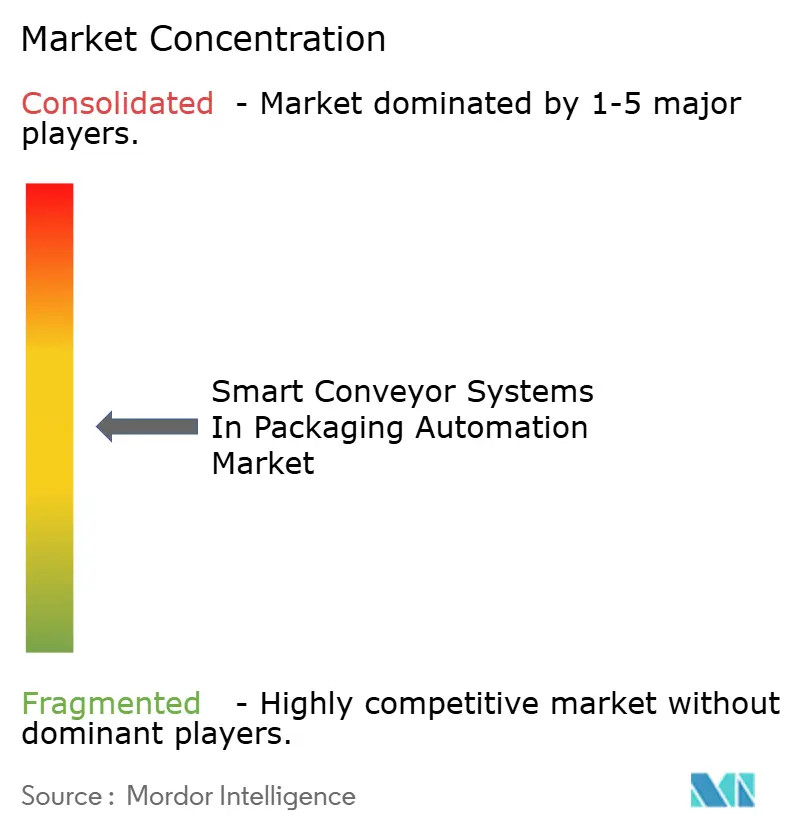
| Market Concentration | Medium |
Major Players *Disclaimer: Major Players sorted in no particular order Image © Mordor Intelligence. Reuse requires attribution under CC BY 4.0. | |

Smart Conveyor Systems In Packaging Automation Market Analysis by Mordor Intelligence
The Smart Conveyor Systems In Packaging Automation Market size is estimated at USD 6.73 billion in 2025, and is expected to reach USD 9.87 billion by 2030, at a CAGR of 7.96% during the forecast period (2025-2030). Demand escalation is anchored in the rapid growth of e-commerce fulfillment, rising labor costs in mature economies, and the ongoing integration of edge-AI predictive-maintenance modules that reduce unplanned downtime. Investments are further propelled by stricter global food-safety traceability mandates and corporate carbon-neutrality targets that favor energy-efficient material-handling assets. Competitive intensity is rising as traditional conveyor makers embed IoT sensors and digital-twin software, while system integrators bundle conveyors with robotics and warehouse control platforms to deliver end-to-end automation. Asia-Pacific remains the principal revenue contributor, but North America’s mature e-commerce ecosystem and Europe’s sustainability incentives are accelerating adoption across all load capacities.
Key Report Takeaways
- By conveyor type, belt systems led with 38.23% revenue share in 2024, whereas modular plastic chain conveyors are forecast to expand at a 13.87% CAGR to 2030.
- By automation level, fully automated lines held 44.21% share in 2024, while integrated autonomous cells are projected to advance at a 15.43% CAGR through 2030.
- By end-user industry, food and beverage applications accounted for 29.54% share in 2024; pharmaceuticals are expected to grow at a 14.91% CAGR through 2030.
- By load capacity, light-duty units dominated with 46.87% share in 2024, but heavy-duty systems are set to register a 12.24% CAGR between 2025 and 2030.
- By geography, Asia-Pacific generated 41.12% of global revenue in 2024 and is poised to record the fastest 14.05% CAGR over the forecast horizon.
Note: Market size and forecast figures in this report are generated using Mordor Intelligence’s proprietary estimation framework, updated with the latest available data and insights as of January 2026.
Market Trends and Insights
Drivers Impact Analysis of Smart Conveyor Systems In Packaging Automation Market*
| Driver | (~) % Impact on CAGR Forecast | Geographic Relevance | Impact Timeline |
|---|---|---|---|
| E-commerce packaging throughput surge | +2.3% | Global - North America and Asia-Pacific emphasis | Short term (≤ 2 years) |
| Rising labor-cost inflation in OECD and China | +1.8% | OECD economies and China with spillover to emerging markets | Medium term (2-4 years) |
| Stricter food-safety traceability mandates | +1.2% | United States, European Union, developed Asia-Pacific | Medium term (2-4 years) |
| Modular plug-and-play conveyor architectures | +1.4% | Strongest in North America and Europe | Short term (≤ 2 years) |
| Edge-AI predictive-maintenance adoption | +0.9% | Initially North America and Europe, scaling to Asia-Pacific | Long term (≥ 4 years) |
| Carbon-neutral plant design incentives | +0.4% | Europe leading, North America following, gradual Asia-Pacific | Long term (≥ 4 years) |
| Source: Mordor Intelligence | |||
E-commerce Packaging Throughput Surge
Global online retail sales are expected to hit USD 7 trillion in 2025, a milestone that forces fulfillment centers to absorb 15% yearly growth in order volumes without compromising same-day service requirements.[1]SupplyChainBrain Editorial Staff, “Market for Warehouse Automation Expected to Grow to USD 55 Billion by 2030,” supplychainbrain.com Urban micro-fulfillment sites, where commercial rent exceeds USD 20 per square foot annually, are deploying compact, high-speed sortation conveyors able to reroute mixed-SKU orders in real time. Amazon’s ongoing retraining of 100,000 warehouse associates illustrates how operators view automation as a pathway to productivity rather than pure labor substitution. Compliance with ISO 13849 safety norms remains essential as smart conveyor systems integrate with collaborative robots inside densely packed facilities. Taken together, these dynamics translate into sustained capital flows toward high-throughput conveyor installations that anchor the smart conveyor systems market.
Rising Labor-Cost Inflation in OECD and China
Annual wage inflation above 5% across the United States, Western Europe, Japan, and coastal China is accelerating automation initiatives, with 84% of surveyed warehouse operators citing hiring and retention challenges in 2024.[2]Manhattan Associates, “State of Warehouse Operations 2024,” manhattan.com Smart conveyor systems equipped with edge-AI modules can self-diagnose mechanical anomalies and alert maintenance teams, trimming operator headcount by up to 30% while safeguarding throughput consistency. Facilities also leverage conveyor-embedded sensors to dynamically alter belt speed during shift transitions, mitigating the productivity dips typical of human-centric operations. Management increasingly frames such deployments as workforce augmentation: repetitive transport tasks shift to automated lines, allowing staff to focus on exception handling, quality checks, and continuous improvement projects. The resulting payback periods narrow even in high-wage regions, reinforcing the smart conveyor systems market growth path.
Stricter Food-Safety Traceability Mandates
The U.S. FDA’s Food Safety Modernization Act and Europe’s equivalent regulations oblige manufacturers to maintain end-to-end visibility from production batches to distribution lanes.[3]U.S. Food and Drug Administration, “Food Safety Modernization Act Final Rule on Traceability,” fda.gov Conveyor lines now embed RFID gateways, OCR cameras, and barcode scanners that write location and process data directly to enterprise resource planning databases. PepsiCo’s Poland snack plant exemplifies the trend: its new packaging hall links smart conveyors to an automated pallet monorail for seamless tracking from seasoning troughs to outbound truck loading bays. Sanitary-design requirements under 21 CFR Part 117 have also increased demand for FDA-approved belt materials that withstand aggressive washdown yet retain sensor calibration. Collectively, these mandates push food manufacturers to renew legacy conveyors in favor of smart configurations, boosting the smart conveyor systems market.
Modular Plug-and-Play Conveyor Architectures
Manufacturers need packaging lines that switch from one package size to another within hours; modular plastic chain designs answer that call. Tool-less, standardized connectors enable reconfiguration in under five minutes, allowing production planners to schedule mixed-SKU campaigns without costly downtime. Interroll recently invested EUR 5 million (USD 5.5 million) in additional RollerDrive capacity, underscoring demand for modular components that slot into both greenfield and brownfield facilities.[4]Interroll Group, “Interroll Invests Five Million Euro on Wermelskirchen Site Universal T-Slot framing further streamlines integration with sensors, guardrails, and lane diverters sourced from multiple vendors. The modular approach also lowers inventory requirements because spare parts fit a variety of conveyor lengths and curves, reducing total cost of ownership over the asset’s lifecycle. As a result, modularity has become a critical purchase criterion inside the smart conveyor systems market.
Restraints Impact Analysis of Smart Conveyor Systems In Packaging Automation Market*
| Restraint | (~) % Impact on CAGR Forecast | Geographic Relevance | Impact Timeline |
|---|---|---|---|
| High up-front CAPEX versus payback horizons | -1.6% | More acute in price-sensitive emerging markets | Medium term (2-4 years) |
| Complex brownfield retrofit integration | -0.9% | North America and Europe with legacy infrastructure | Short term (≤ 2 years) |
| Cyber-security vulnerabilities in OT networks | -0.7% | Developed markets with advanced connectivity | Medium term (2-4 years) |
| Acoustic-noise compliance in urban plants | -0.4% | Europe and North America urban manufacturing zones | Long term (≥ 4 years) |
| Source: Mordor Intelligence | |||
High Up-front CAPEX versus Payback Horizons
Smart conveyor installations often cost 40-60% more than conventional belt lines, pushing a mid-sized facility’s investment above USD 500,000 and extending ROI expectations to three-five years. The capital burden intensifies when operators add preventive-maintenance contracts, spare-parts kits, and cloud analytics subscriptions that lift total cost of ownership by another 15-20%. Supply-chain tightness for servo drives and high-performance thermoplastics has stretched lead times, resulting in 20-30% project delays and further diluting near-term financial returns. Smaller manufacturers struggle most, as limited borrowing capacity competes with other digitalization projects—often delaying large-scale conveyor upgrades. Vendors that articulate flexible financing, usage-based pricing, or retrofit pathways therefore gain traction despite the expenditure hurdle.
Complex Brownfield Retrofit Integration
Many packaging halls still rely on legacy PLCs, outdated power feeds, and floor plans that predate today’s automation density. Retrofitting smart conveyor systems in such environments necessitates protocol converters, structural reinforcements, and phased installation schedules to minimize downtime. Projects frequently uncover sub-floor channels that lack room for new power conduits or discover mezzanines unable to bear the weight of overhead spirals. These unanticipated issues lengthen installation windows, drive up labor costs, and impose temporary production slowdowns that offset early efficiency gains. Manufacturers increasingly tackle integration in modular phases, swapping discrete conveyor sections during scheduled maintenance weekends—a strategy that keeps lines running but extends overall project duration. Consequently, retrofit complexity remains a headwind for the smart conveyor systems market growth trajectory.
*Our forecasts treat driver/restraint impacts as directional, not additive. The impact forecasts reflect baseline growth, mix effects, and variable interactions.
Smart Conveyor Systems In Packaging Automation Market Segment Analysis
By Conveyor Type:
Belt Leadership with Modular MomentumBelt units remain the backbone of packaging halls and commanded 38.23% of smart conveyor systems market share in 2024, owing to their ability to handle a broad spectrum of weights, sizes, and product fragilities without line interruptions. Their continuous-surface design supports high-speed throughput while minimizing scuffing, an attribute prized in food, beverage, and consumer-electronics packaging. Energy-efficient motors and low-tension belting have cut operating costs by as much as 15% against legacy designs, reinforcing their wide adoption. The segment also benefits from decades-deep aftermarket ecosystems that provide quick-ship replacement belts, rollers, and idlers worldwide.
Modular plastic chain conveyors, however, are closing the gap with a 13.87% CAGR through 2030, fueled by demand for reconfigurable lines that negotiate sharp curves, variable inclines, and elevation changes without product rollover. FDA-approved resins and tool-less release pins allow five-minute belt swaps during allergen changeovers, slashing sanitation downtime for bakery and meat processors. The embedded tracking sensors in newer chain links feed vibration and temperature data into cloud dashboards, enabling predictive maintenance. Overhead and spiral formats complement floor-level conveyors in space-constrained sites, handling ascending lane merges to mezzanine palletizers. Collectively, these innovations ensure that the smart conveyor systems market maintains a balanced mix of legacy reliability and modular flexibility.




By Automation Level:
Autonomous Cells Accelerate AdoptionFully automated lines held 44.21% of 2024 revenues, reflecting demand for turnkey systems that tie conveyors, sorters, and palletizers into warehouse management software for lights-out operations on night shifts. These lines increase order picking accuracy, sync with real-time inventory counts, and enable just-in-time replenishment across multiple storage zones. Operators also report double-digit improvements in overall equipment effectiveness once human error is removed from repetitive transport tasks.
Integrated autonomous cells are expected to outpace all other formats, expanding at 15.43% CAGR to 2030 as plant designers adopt modular pods combining smart conveyors, collaborative robots, and vision-guided inspection. The cells handle up to 2,100 parcels per hour and can switch between SKUs through algorithmic software updates rather than mechanical re-tooling. Safety frameworks such as ISO 13849 validate human-robot coexistence, permitting technicians to approach cells for replenishment without full system shutdown. Semi-automated lines still occupy applications where tactile assessment or regulatory sign-off demands periodic human interaction, especially in pharmaceutical blister-pack stations. Yet the overarching trajectory clearly tilts toward autonomous configurations that maximize continuous flow, cementing their role in the future smart conveyor systems market.
By End-User Industry:
Pharmaceutical Uptick Surpasses Food DominanceFood and beverage lines captured 29.54% of 2024 revenue, leveraging antimicrobial belts, stainless-steel frames, and washdown enclosures that comply with USDA and BISSC guidelines. Real-time sensor networks embedded in these conveyors log temperature, humidity, and belt-tension metrics, substantiating Hazard Analysis Critical Control Point documentation for auditors. Compact side-grip elevators and narrow-pitch modular chains accommodate lightweight pouches and beverage cans, maintaining orientation during high-speed transfers.
Pharmaceutical installations, by contrast, are projected to expand at 14.91% CAGR as serialization mandates take hold across all major markets. Cleanroom-certified conveyors employ anodized aluminum extrusions and sealed bearings to minimize particulate generation within ISO Class 7 zones. Inline machine-vision cameras verify 2D barcodes and aggregation codes at up to 400 packs per minute, automatically rejecting non-compliant cartons into lockable bins for quality-assurance review. Smart conveyor systems in cosmetics and personal care plants emphasize gentle handling surfaces that avoid scuffing embossed containers, while consumer electronics packaging favors anti-static belt materials with ±50 V potential thresholds. Logistics and warehousing remain a pivotal cross-vertical segment, channeling e-commerce growth into floor-level and mezzanine sorter installations that represent a sizable slice of the overall smart conveyor systems market size.

By Load Capacity:
Heavy-Duty Lines Gain MomentumLight-duty configurations under 50 kg per meter retained 46.87% revenue share in 2024, underpinned by parcel sortation, pharmaceutical blister transport, and electronics device handling. Brushless DC motors and zero-pressure accumulation logic prevent carton-to-carton contact, reducing returns from cosmetic blemishes. The segment also benefits from the expansive retrofit market, where aging gravity lines receive motorized rollers connected via plug-and-play cables.
Heavy-duty systems above 200 kg per meter, however, will chart a 12.24% CAGR to 2030 as manufacturers automate palletizing of bulk goods and incorporate collaborative robots capable of stacking 100 cases per minute onto outbound skids. Load sensors mounted beneath each deck section transmit torque profiles to PLCs, preventing overload events and extending component life. Energy-optimized drives cut electricity usage 15-30% relative to fixed-speed motors, aligning with corporate carbon-reduction pledges. Medium-duty conveyors bridge the range by servicing mixed case lines in beverage and household-chemical plants. Collectively, these capacity tiers mirror the growing sophistication inside the smart conveyor systems market.
Geography Analysis
APAC Smart Conveyor Systems in Packaging Automation Market
Asia-Pacific generated 41.12% of smart conveyor systems market revenue in 2024 and is on track for a 14.05% CAGR through 2030 as Chinese e-commerce titans widen their same-day delivery footprint. Government incentives under China’s Intelligent Manufacturing 2025 plan reimburse up to 15% of qualifying automation capex, accelerating conveyor upgrades in coastal fulfillment hubs. Japan leverages conveyor miniaturization for electronics packaging in Kanagawa and Aichi prefectures, while India’s pharmaceutical exporters upgrade belt lines to comply with EU Good Manufacturing Practice audits. ASEAN members such as Vietnam and Thailand adopt modular conveyors in export-oriented food plants, reflecting the diffusion of Industry 4.0 concepts across the region.
North America Smart Conveyor Systems in Packaging Automation Market
North America stands second in revenue contribution, buoyed by the United States where Amazon, Walmart, and Target collectively opened more than 25 high-throughput fulfillment centers in 2024 alone. The region prioritizes software-defined controls that overlay existing mechanical assets, extending lifespan while adding predictive-maintenance analytics. Canada’s food processors invest in conveyor upgrades to satisfy U.S. traceability import rules, while Mexico benefits from near-shoring trends that reposition consumer-electronics assembly closer to North American end markets.
EMEA Smart Conveyor Systems in Packaging Automation Market
Europe’s smart conveyor systems market emphasizes sustainability; new build permits in Germany and the Netherlands often include mandatory energy-audits that favor high-efficiency motor and VFD combinations. Pharmaceutical cleanroom applications flourish in Switzerland, Ireland, and Denmark, where strict sterility standards justify premium conveyor designs. The European Union’s Fit-for-55 carbon agenda drives early adoption of regenerative braking conveyors that recapture kinetic energy on downhill or decelerating sections. Meanwhile, the Middle East and Africa emerge as niche but growing markets: United Arab Emirates airports integrate baggage lines capable of 15,000 bags per hour, and South African miners deploy ruggedized conveyors rated at 2,000 kg per meter to automate bulk material transfer. Collectively, regional dynamics ensure geographically diversified demand within the broader smart conveyor systems market.


Competitive Landscape
The top five players-Daifuku, Interroll, SSI SCHÄFER, Honeywell-Intelligrated, and Swisslog—controlled roughly 35-40% of 2024 revenue, producing a moderately consolidated field. Each leverages decades-long service networks and deep client rosters to upsell sensor-ready gear and digital-twin diagnostics. Daifuku’s acquisition of two warehouse robotics firms in 2024 extended its reach into autonomous mobile robots and edge-computing hubs, allowing bundled proposals that integrate conveyors, lifts, and bots into a single software stack. Interroll’s expansion of its Wermelskirchen plant added 20% annual output capacity for its RollerDrive modules, ensuring rapid fulfillment of modular conveyor components.
Mid-tier vendors jockey for differentiation through cleanroom certifications, low-noise profiles, and carbon-footprint metrics. Niche specialists concentrate on market gaps such as FDA-compliant curve belts, stainless-steel spiral lifts rated for 200°C bake-out, and conveyor rollers embedded with piezoelectric harvesters that reclaim vibrational energy. Robotics entrants such as KUKA position smart conveyors as auxiliary axes for collaborative cells, tightening competition as software ecosystems overlap.
Price pressure remains contained so far due to rising raw-material costs and strong demand, but customer expectations around open-architecture controls and vendor-agnostic spares are reshaping commercial strategies. Vendors offering retrofit sensor kits that convert legacy conveyors into smart assets can secure brownfield opportunities at lower price points, thus broadening their addressable base. Overall, technological leadership coupled with service responsiveness defines competitive advantage across the smart conveyor systems market.
Smart Conveyor Systems In Packaging Automation Industry Leaders
Daifuku Co., Ltd.
Interroll Holding AG
SSI SCHÄFER AG
TGW Logistics Group GmbH
Honeywell Intelligrated
- *Disclaimer: Major Players sorted in no particular order
Smart Conveyor Systems In Packaging Automation Market Companies Covered in this Report
- Daifuku Co., Ltd.
- Interroll Holding AG
- SSI SCHÄFER AG
- TGW Logistics Group GmbH
- Honeywell Intelligrated
- FlexLink AB
- Dorner Manufacturing Corp.
- BEUMER Group GmbH and Co. KG
- Fives Intralogistics SAS
- Vanderlande Industries B.V.
- Hytrol Conveyor Company, Inc.
- Bastian Solutions, LLC
- Swisslog Holding AG
- KUKA AG (Swisslog Automation)
- Itoh Denki Co., Ltd.
- Habasit Holding AG
- Forbo Siegling GmbH
- Ultimation Industries LLC
- MK North America, Inc.
- Glide-Line™ (Nexus AI, Inc.)
- Richmond Rolling Solutions Pty Ltd
- Kardex Remstar LLC
- Precision Automation® Company, Inc.
- AmbaFlex Spiral Conveyor Solutions
- Interlink Conveyors Inc.
- Phoenix Mecano AG (Montech)

Recent Industry Developments in Smart Conveyor Systems In Packaging Automation Market
- October 2024: MK Group launched an all-electric Versamove pallet carrier family featuring lift-and-transfer, lift-and-rotate, and lift-and-locate units targeting energy-efficient packaging lines.
- October 2024: Dorner previewed its C3 Belted Curve Conveyor with FDA-approved fabric belting and BISSC compliance at PACK EXPO, enabling 90° and 180° sanitary curves for bakery and confectionery environments.
- September 2024: Pacteon Group exhibited end-of-line solutions at PACK EXPO International, showcasing Descon’s single-lane empty-can vacuum transfer running 1,800 cans per minute with integrated laser coding.


Global Smart Conveyor Systems In Packaging Automation Market Report Scope
The Smart Conveyor Systems in Packaging Automation Market Report is Segmented by Conveyor Type (Belt Conveyors, Roller Conveyors, Modular Plastic Chain Conveyors, Pallet and Spiral Conveyors, Overhead and Other Specialized), Automation Level (Semi-Automated Lines, Fully Automated Lines, Integrated Autonomous Cells), End-User Industry (Food and Beverage, Pharmaceuticals, Cosmetics and Personal Care, Consumer Electronics, Logistics and Warehousing), Load Capacity (Light Duty, Medium Duty, Heavy Duty), and Geography. The Market Forecasts are Provided in Terms of Value (USD).
| Belt Conveyors |
| Roller Conveyors |
| Modular Plastic Chain Conveyors |
| Pallet and Spiral Conveyors |
| Overhead and Other Specialized Conveyor Types |
| Semi-Automated Lines |
| Fully Automated Lines |
| Integrated Autonomous Cells |
| Food and Beverage |
| Pharmaceuticals |
| Cosmetics and Personal Care |
| Consumer Electronics |
| Logistics and Warehousing |
| Light Duty (< 50 kg) |
| Medium Duty (50 - 200 kg) |
| Heavy Duty (> 200 kg) |
| North America | United States | |
| Canada | ||
| Mexico | ||
| South America | Brazil | |
| Argentina | ||
| Rest of South America | ||
| Europe | Germany | |
| United Kingdom | ||
| France | ||
| Italy | ||
| Spain | ||
| Russia | ||
| Rest of Europe | ||
| Asia-Pacific | China | |
| Japan | ||
| India | ||
| South Korea | ||
| South-East Asia | ||
| Rest of Asia-Pacific | ||
| Middle East and Africa | Middle East | Saudi Arabia |
| United Arab Emirates | ||
| Turkey | ||
| Rest of Middle East | ||
| Africa | South Africa | |
| Nigeria | ||
| Rest of Africa | ||
| By Conveyor Type | Belt Conveyors | ||
| Roller Conveyors | |||
| Modular Plastic Chain Conveyors | |||
| Pallet and Spiral Conveyors | |||
| Overhead and Other Specialized Conveyor Types | |||
| By Automation Level | Semi-Automated Lines | ||
| Fully Automated Lines | |||
| Integrated Autonomous Cells | |||
| By End-User Industry | Food and Beverage | ||
| Pharmaceuticals | |||
| Cosmetics and Personal Care | |||
| Consumer Electronics | |||
| Logistics and Warehousing | |||
| By Load Capacity | Light Duty (< 50 kg) | ||
| Medium Duty (50 - 200 kg) | |||
| Heavy Duty (> 200 kg) | |||
| By Geography | North America | United States | |
| Canada | |||
| Mexico | |||
| South America | Brazil | ||
| Argentina | |||
| Rest of South America | |||
| Europe | Germany | ||
| United Kingdom | |||
| France | |||
| Italy | |||
| Spain | |||
| Russia | |||
| Rest of Europe | |||
| Asia-Pacific | China | ||
| Japan | |||
| India | |||
| South Korea | |||
| South-East Asia | |||
| Rest of Asia-Pacific | |||
| Middle East and Africa | Middle East | Saudi Arabia | |
| United Arab Emirates | |||
| Turkey | |||
| Rest of Middle East | |||
| Africa | South Africa | ||
| Nigeria | |||
| Rest of Africa | |||


Key Questions Answered in the Report
What is the current value of the smart conveyor systems market?
The smart conveyor systems market is valued at USD 6.73 billion in 2025.
How fast is the market expected to grow?
The market is forecast to grow at a 7.96% CAGR, reaching USD 9.87 billion by 2030.
Which region leads demand?
Asia-Pacific generated 41.12% of 2024 revenue and is projected to deliver the fastest regional CAGR of 14.05% through 2030.
What conveyor type is expanding most rapidly?
Modular plastic chain conveyors are poised for a 13.87% CAGR due to their reconfigurability and sanitary design benefits.
Why are pharmaceuticals adopting smart conveyors?
Serialization and track-and-trace mandates necessitate conveyor-integrated vision inspection and cleanroom-compatible materials, driving a 14.91% CAGR in pharmaceutical uptake.
What is the biggest hurdle to broader adoption?
High upfront capital expenditure, which lifts project ROI horizons to three-five years, remains the main barrier for small and mid-size manufacturers.
Page last updated on:





