
Skin Antiseptic Products Market Size and Share
Market Overview
| Study Period | 2020 - 2031 |
|---|---|
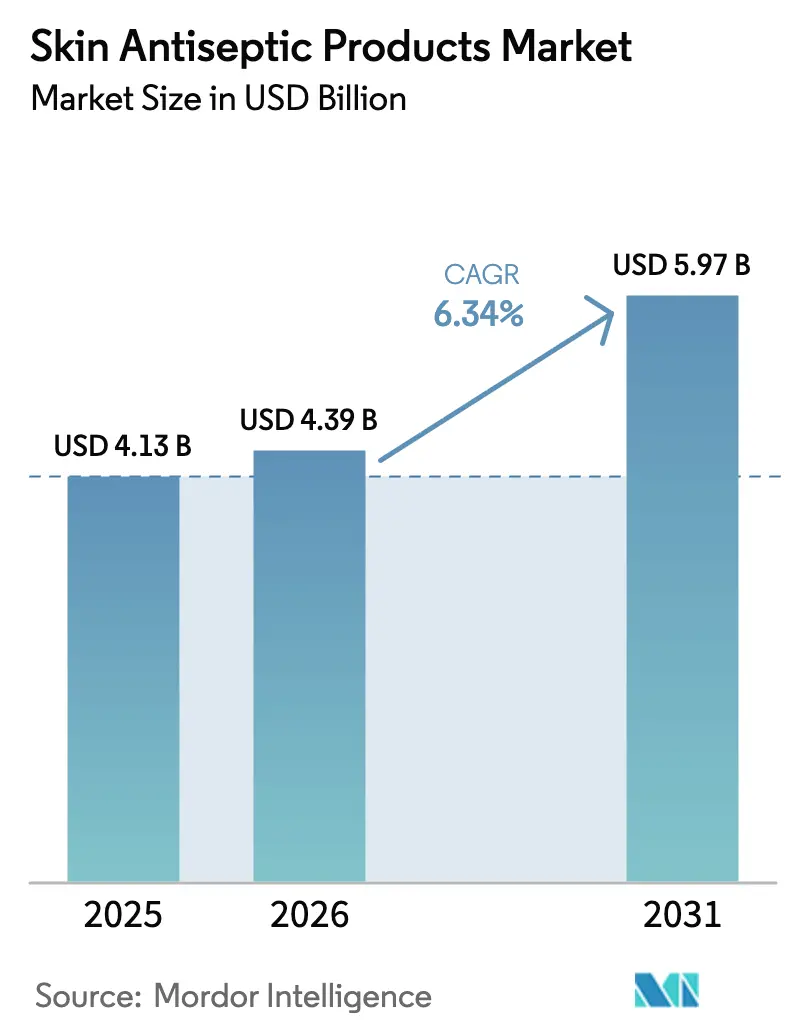
| Market Size (2026) | USD 4.39 Billion |
| Market Size (2031) | USD 5.97 Billion |
| Growth Rate (2026 - 2031) | 6.34 % |
| Fastest Growing Market | Asia Pacific |
| Largest Market | North America |
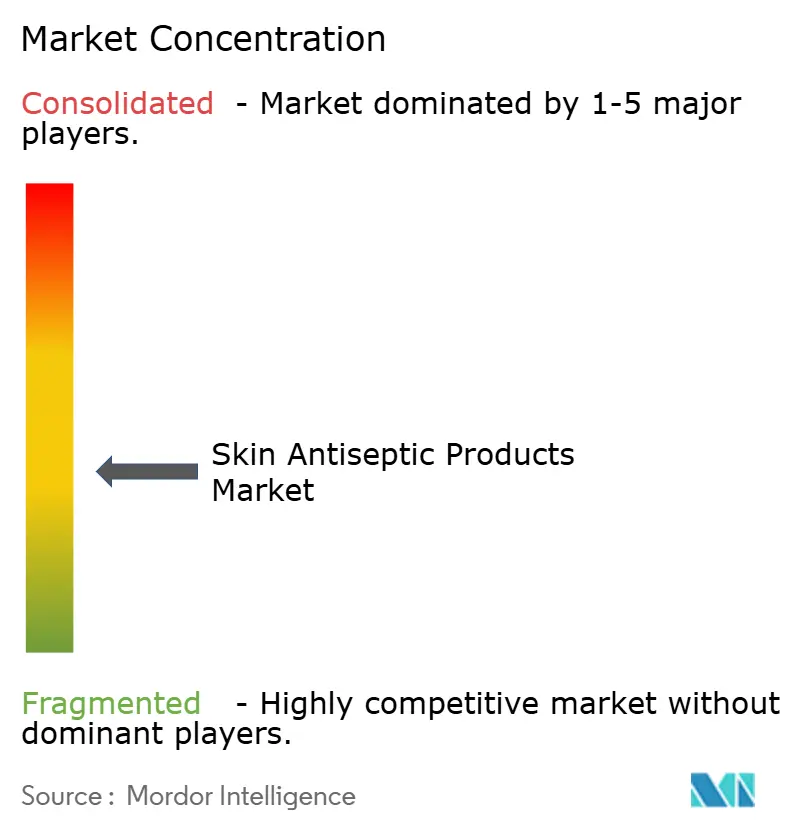
| Market Concentration | Medium |
Major Players *Disclaimer: Major Players sorted in no particular order Image © Mordor Intelligence. Reuse requires attribution under CC BY 4.0. | |
Skin Antiseptic Products Market Analysis by Mordor Intelligence
The skin antiseptic products market size was valued at USD 4.13 billion in 2025 and is estimated to grow from USD 4.39 billion in 2026 to reach USD 5.97 billion by 2031, at a CAGR of 6.34% during the forecast period (2026-2031). Hospitals are intensifying infection-prevention protocols, ambulatory surgery centers are gaining volume, and outpatient care models in the Asia-Pacific and the Gulf Cooperation Council are drawing capital into single-use formats. Continuous declines in central line-associated bloodstream infections and catheter-associated urinary tract infections, coupled with 40–60% cost savings in freestanding surgery centers, encourage formulary expansions for broad-spectrum agents. Supply-chain disruptions for chlorhexidine gluconate and volatile organic compound regulations in Europe prompt diversification into iodine and alcohol-free alternatives, while antimicrobial peptide research signals future product differentiation.[1] Against this backdrop, the skin antiseptic products market is poised for steady growth as infection-control mandates tighten and procedural volumes rise across both high- and middle-income economies.
Key Report Takeaways
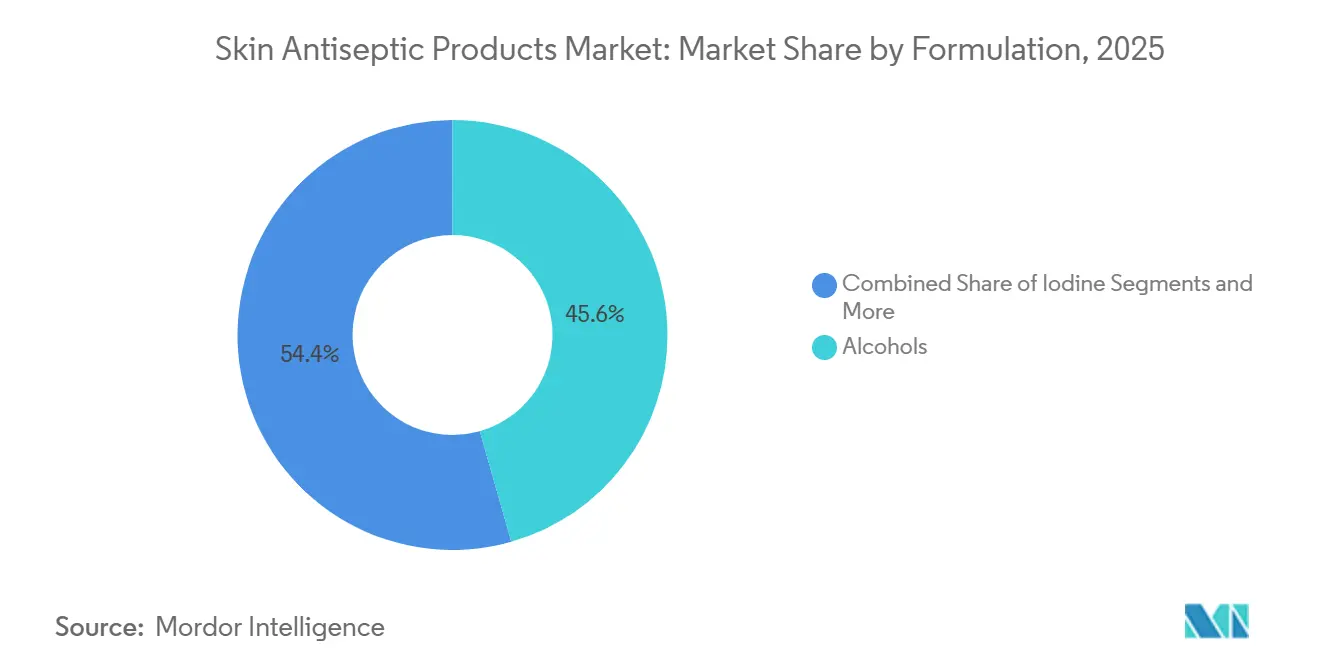
- By formulation, alcohol-based agents led with 45.59% revenue share in 2025, whereas iodine formulations are forecast to expand at a 7.21% CAGR through 2031.
- By type, solutions commanded 52.34% of 2025 revenue, while wipes are projected to grow at a 7.32% CAGR over the same horizon.
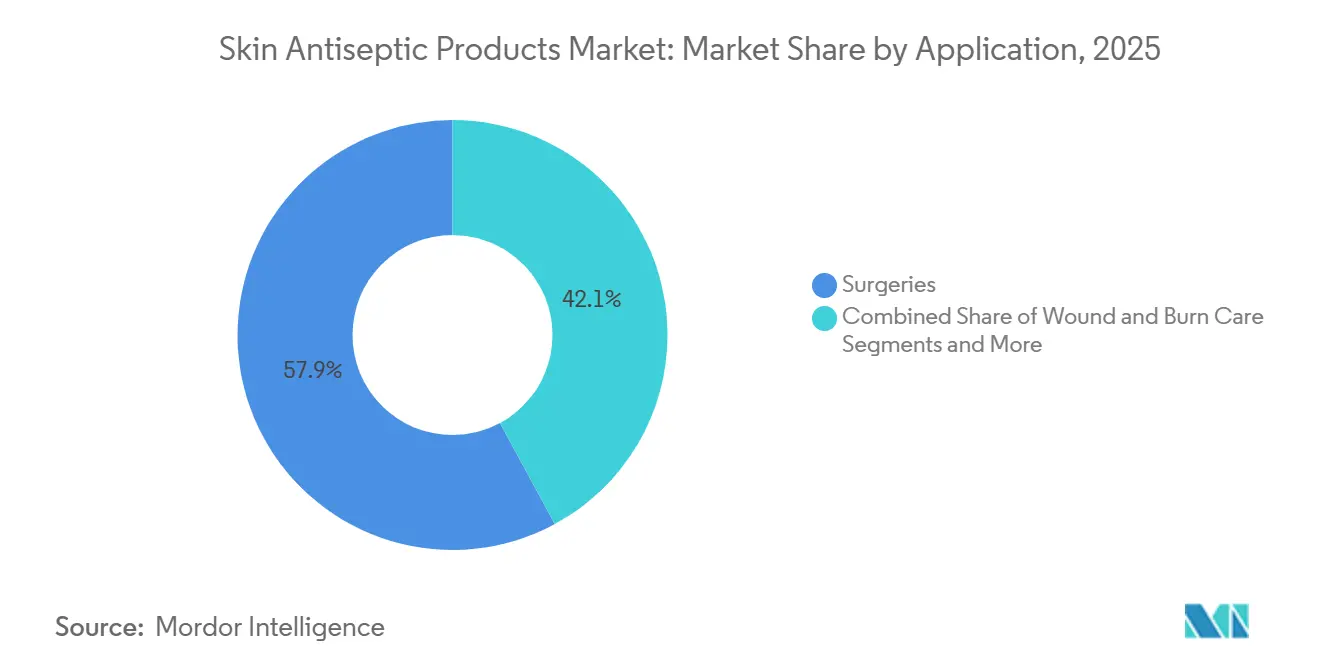
- By application, surgeries contributed 57.89% of demand in 2025, yet injection and catheter site preparation is advancing at a 7.35% CAGR to 2031.
- By end-user, hospitals held 48.44% of 2025 revenue, whereas home-care and telehealth settings are set to rise at a 7.41% CAGR.
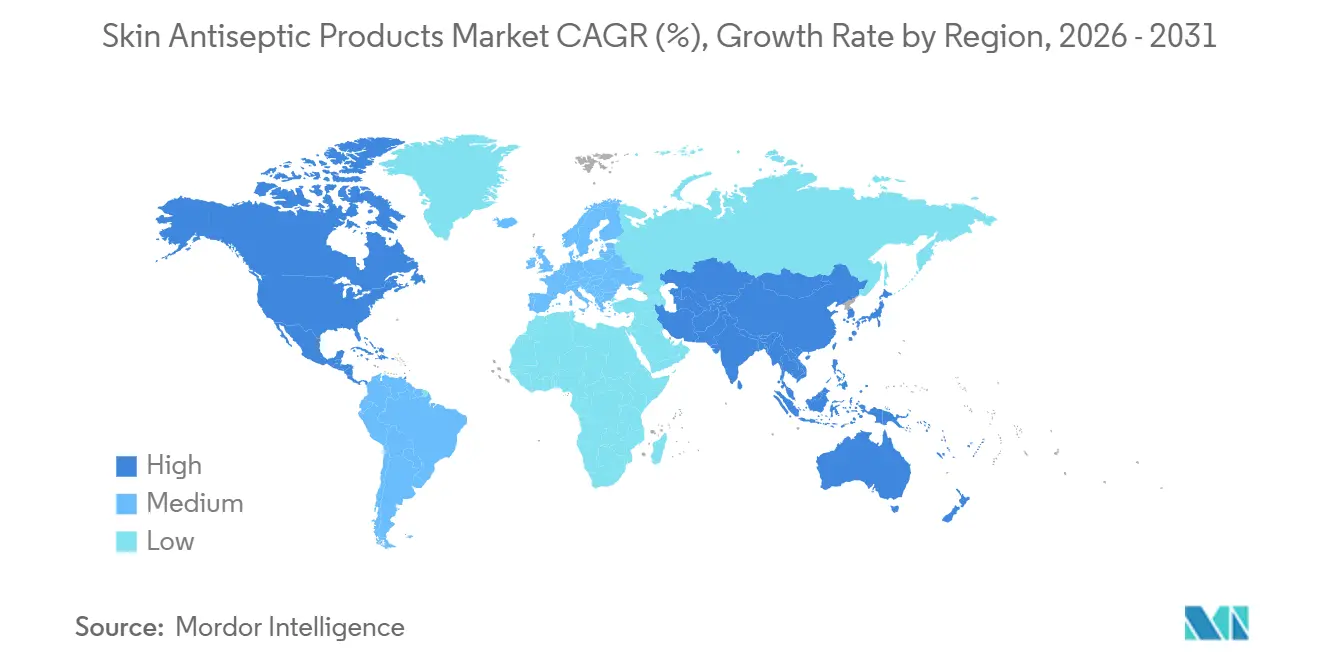
- By geography, North America accounted for 38.39% of 2025 revenue, while Asia–Pacific is expected to deliver the fastest 7.45% CAGR to 2031.
Note: Market size and forecast figures in this report are generated using Mordor Intelligence’s proprietary estimation framework, updated with the latest available data and insights as of January 2026.
Market Trends and Insights
Drivers Impact Analysis of Skin Antiseptic Products Market*
| Driver | (~) % Impact on CAGR Forecast | Geographic Relevance | Impact Timeline |
|---|---|---|---|
| Rising prevalence of hospital-acquired infections | +1.2% | Global, with acute focus in North America and Europe | Medium term (2-4 years) |
| Increasing number of surgical and minimally-invasive procedures | +1.1% | APAC core, spill-over to Middle East and Latin America | Long term (≥ 4 years) |
| Expansion of outpatient and ambulatory surgery centers in emerging markets | +0.9% | Asia-Pacific, GCC, Brazil, Argentina | Medium term (2-4 years) |
| Surge in adoption of ready-to-use single-use applicators and wipes | +0.8% | North America and Europe, expanding to APAC | Short term (≤ 2 years) |
| Regulatory push for alcohol-free long-acting formulations | +0.6% | Europe (EU BPR), North America (FDA guidance) | Medium term (2-4 years) |
| Development of antimicrobial-peptide and nanoparticle skin antiseptics | +0.4% | North America and Europe (R&D hubs), future global rollout | Long term (≥ 4 years) |
| Source: Mordor Intelligence | |||
Rising Prevalence of Hospital-Acquired Infections
Hospital-acquired infections cost U.S. providers USD 28.4 billion each year and still affect roughly 1 in 31 in-patients despite recent gains. Central line and catheter infection declines of 13% and 11% between 2022 and 2023 demonstrate the value of standardized skin preparation, yet multidrug-resistant organisms such as carbapenem-resistant Enterobacteriaceae and Candida auris keep pressure on antiseptic purchasing. Chlorhexidine bathing reached 90% U.S. penetration in 2024, up from 7% a decade earlier, affirming hospital commitment to broad-spectrum agents. Global antimicrobial-resistance action plans embed skin antisepsis as a front-line defense, underpinning predictable demand in the skin antiseptic products market. Financial penalties tied to infection metrics further entrench procurement in North America and Europe.
Increasing Number of Surgical and Minimally-Invasive Procedures
China carried out 65.2 million surgeries in 2023, and India’s procedural count is growing 8–10% annually as facilities expand into tier-2 cities. Laparoscopic and robotic systems require meticulous skin preparation despite smaller incisions, pushing antiseptic orders in Japan, South Korea, and the Middle East. More than 1 million reconstructive procedures were logged in 2024 by U.S. plastic surgeons, with 56% inside hospitals, underscoring the enduring role of acute-care facilities. These volumes anchor long-term expansion of the skin antiseptic products market, especially in Asia–Pacific where procedure growth outpaces GDP.
Expansion of Outpatient and Ambulatory Surgery Centers in Emerging Markets
The United States hosts over 6,100 ambulatory surgery centers that cut costs by up to 60%, a model now exported to Saudi Arabia, the United Arab Emirates, and Brazil.[2] Medicare reimbursement updates and private-equity funding accelerate center rollouts, while Vision 2030 budgets drive facility construction across the Gulf. India’s urban districts are developing day-surgery hubs even as national rules mature. Single-use wipes and applicators dominate ASC formularies, propelling short-cycle replenishment in the skin antiseptic products market.
Surge in Adoption of Ready-to-Use Single-Use Applicators and Wipes
Becton, Dickinson and Company secured multiple 510(k) clearances for ChloraPrep devices that include dye indicators to verify coverage, reducing variability during surgery. U.S. Food and Drug Administration guidance reinforces one-time-use expectations, and European institutions mirror the practice to satisfy infection audits. Hospitals report better compliance with contact-time standards when nurses use pre-filled devices. Asia–Pacific tenders increasingly specify wipes to lower cross-contamination. These dynamics produce a near-term lift for single-use segments within the skin antiseptic products market.
Restraints Impact Analysis of Skin Antiseptic Products Market*
| Restraint | (~) % Impact on CAGR Forecast | Geographic Relevance | Impact Timeline |
|---|---|---|---|
| Skin irritation and allergic reactions to certain actives | -0.5% | Global, with heightened sensitivity reporting in North America and Europe | Short term (≤ 2 years) |
| Stricter VOC and biocide regulations limiting alcohol content | -0.4% | Europe (EU BPR, ECHA), North America (EPA, FDA) | Medium term (2-4 years) |
| Rise of antiseptic-tolerant microbial strains in ICU settings | -0.3% | Global, concentrated in high-acuity ICUs | Long term (≥ 4 years) |
| Supply-chain risk for high-purity chlorhexidine API | -0.3% | Global, with acute impact in North America due to FDA shortage notifications | Short term (≤ 2 years) |
| Source: Mordor Intelligence | |||
Skin Irritation and Allergic Reactions to Certain Actives
Chlorhexidine hypersensitivity cases reported to MedWatch climbed in 2024, including episodes of anaphylaxis after surgical prep.[3] Hospitals now screen for allergies and stock povidone-iodine as an alternative, while alcohol-based products cause dryness that hampers compliance in home care. These issues curb usage in chronic settings, nudging suppliers to create emollient-rich or alcohol-free variants. The restraint shaves near-term growth for the skin antiseptic products market but also sparks formulation innovation.
Stricter VOC and Biocide Regulations Limiting Alcohol Content
European and U.S. regulations restrict ethanol levels and demand environmental risk assessments, forcing reformulation or withdrawal of high-alcohol products. Smaller firms struggle with compliance costs, allowing multinationals to consolidate share. Portfolio rationalization is underway, trimming some legacy stock-keeping units. The regulatory squeeze is a medium-term brake on the skin antiseptic products market yet establishes a pathway for compliant, premium-priced offerings.
*Our forecasts treat driver/restraint impacts as directional, not additive. The impact forecasts reflect baseline growth, mix effects, and variable interactions.
Skin Antiseptic Products Market Segment Analysis
By Formulation:
Iodine Strengthens Amid Resistance ConcernsAlcohol-based agents contributed 45.59% of the skin antiseptic products market share in 2025, yet iodine agents are forecast to grow 7.21% per year through 2031 as hospitals hedge against Candida auris and chlorhexidine-tolerant strains. Povidone-iodine’s broad spectrum and minimal resistance potential attract formulary committees, and recent 510(k) clearances for iodine applicators validate safety in U.S. theaters. The skin antiseptic products market size for iodine formulations is therefore set to widen as Europe enforces volatile-organic-compound limits and Asia–Pacific diversifies supply.
Broader wound-healing compatibility positions iodine for chronic-care uptake, and its supply chain is less geographically concentrated than chlorhexidine. Benzalkonium chloride fills smaller alcohol-free niches, while hydrogen peroxide solutions appeal where non-staining properties are crucial. Collectively, these shifts indicate a balanced product mix that buffers the skin antiseptic products market against single-ingredient shortages.

By Type:
Wipes Improve Compliance and SafetyMulti-dose solutions captured 52.34% of 2025 revenue, maintaining popularity in high-throughput operating rooms that prize low cost per use. However, wipes are expanding at a 7.32% CAGR, driven by audit evidence showing higher adherence to recommended contact times. The skin antiseptic products market size attributed to wipes is growing quickly inside ambulatory surgery centers that emphasize rapid turnover and sterile-barrier integrity.
Visual dye indicators on applicators and foil-pouched wipes reduce variance in technique, satisfying infection-control teams under intense scrutiny. Spray and foam dispensers fulfill large-area or self-application needs but remain niche. In home care, patients favor wipe packs for intuitive use and reduced spill risk, adding an incremental growth layer to the skin antiseptic products market.
By Application:
Catheter Site Preparation Gathers MomentumSurgical site prep accounted for 57.89% of 2025 volumes, yet catheter and injection sites are advancing 7.35% yearly as guidelines prescribe chlorhexidine-alcohol for vascular access. Medicare penalty structures sharpen focus on central line infections, expanding spend on dedicated applicators for peripheral lines as well. Catheter prep thus anchors the fastest incremental contribution to the skin antiseptic products market.
Wound and burn care benefits from iodine’s tissue-friendly profile, broadening demand outside the operating theater. Consumer personal hygiene remains a stable, lower-acuity niche. Together, these patterns ensure that skin antiseptic products market share remains skewed toward clinical procedures even as outpatient and chronic-care settings rise.
By End-User:
Home Care and Telehealth AccelerateHospitals still represented 48.44% of 2025 revenue, but hospital-at-home programs and remote monitoring lift home-care growth to 7.41% through 2031. Telehealth platforms embed antiseptic reminders, and caregiver kits include ready-to-use wipes to offset training gaps. The skin antiseptic products market size linked to home settings is therefore widening rapidly.
Ambulatory surgery center counts keep rising, cementing procurement pipelines for single-use formats. Long-term and urgent-care facilities add steady baseline demand. End-user diversification bodes well for resilience in the skin antiseptic products market during macroeconomic swings.
Geography Analysis
North America Skin Antiseptic Products Market
North America generated 38.39% of 2025 revenue as Medicare penalties drove strict infection targets, and more than 6,100 ambulatory surgery centers ordered single-use devices to standardize practice. Active U.S. Food and Drug Administration oversight spurred rapid iteration in applicator design, while Canadian provinces added antiseptic compliance checks to surgical safety lists. Chlorhexidine shortages in 2024 triggered supplier diversification, reinforcing iodine uptake across leading hospital systems.
Europe Skin Antiseptic Products Market
Europe’s skin antiseptic products market contends with Biocidal Products Regulation constraints on volatile organic compounds, pushing alcohol-free innovation. Germany, the United Kingdom, France, Italy, and Spain are early movers on benzalkonium chloride adoption, whereas Eastern European facilities weigh cost over sustainability. Environmental mandates also boost recycling-ready applicators that appeal to procurement teams under circular-economy targets. Established multinationals dominate, but niche startups address neonatal and dermatology needs with specialized blends.
APAC Skin Antiseptic Products Market
Asia–Pacific posts the fastest 7.45% CAGR thanks to China’s 65.2 million annual surgeries, India’s double-digit procedure growth, and Japan’s aging population that requires chronic wound care. South Korea’s medical tourism regulations ensure Joint Commission International-aligned infection controls, and Australia’s Therapeutic Goods Administration approval pathway serves as a regional gatekeeper. Concentrated chlorhexidine production creates both cost leverage and supply vulnerability, prompting hospitals to dual-source whenever possible. Emerging Southeast Asian markets, notably Vietnam and the Philippines, gain access via new regional distribution centers, broadening addressable demand for the skin antiseptic products market.
Regulatory Landscape
In the United States, many skin antiseptic products marketed for first aid and skin preparation fall under the FDA's OTC topical antimicrobial framework (21 CFR Part 333) and related OTC monograph administrative orders, which govern permitted actives, labeling, and evidence expectations for safety and effectiveness. Where an active ingredient or intended use is not covered by an applicable OTC pathway, products can be treated as new drugs requiring NDA/ANDA-type submissions, which increases the data and time burden for launches and line extensions. In Europe, market access commonly splits between medicinal product pathways for certain cutaneous uses and the Biocidal Products Regulation (BPR, Regulation (EU) No 528/2012) for skin disinfection biocides, with environmental and toxicology data requirements influencing formulation choices, including VOC-sensitive alcohol systems. Updates to USP Chapter 1072 on disinfection and antiseptics also reinforce more rigorous and standardized efficacy testing, and more explicit disinfectant selection considerations, supporting stronger documentation packages for procurement audits and regulated manufacturing settings.
Value Chain Analysis
The value chain starts with upstream suppliers of high-purity actives and excipients, including chlorhexidine gluconate, iodophors, alcohols, and quaternary ammonium compounds such as benzalkonium chloride, produced under pharmaceutical-quality systems aligned with cGMP and ICH Q7 expectations. Converters and device-component suppliers then support downstream manufacturing of finished solutions, wipes, swab sticks, and single-use applicators, where sterile-barrier packaging, fill-finish control, and contamination prevention are critical differentiators for hospital-grade SKUs. Finished products move mainly through medical-surgical distributors and group purchasing organization-aligned channels into hospitals, ambulatory surgery centres, and expanding home-care kits. Tender specifications increasingly favor single-use formats that standardize contact time and technique.
Recent quality events, such as BD's 2026 ChloraPrep-related ship hold and the subsequent shipment resumption after additional release testing, show how supply continuity can be constrained by release protocols. That dynamic reinforces dual-sourcing of actives, including shifts toward iodine alternatives, and inventory strategies that balance compliance, lead times, and SKU rationalization pressure in VOC- and biocide-regulated markets.
Competitive Landscape
Global suppliers hold advantageous formulary spots, yet the skin antiseptic products market remains moderately consolidated rather than dominated by a single player. Becton, Dickinson and Company capitalizes on its ChloraPrep franchise with integrated dye applicators, reinforcing presence in high-volume operating rooms. Solventum, spun off from 3M in January 2025, directs capital exclusively toward infection-prevention lines, signaling renewed competition for surgical prep spend.
Cardinal Health and Medline compete on private-label economics, offering chlorhexidine and povidone-iodine lines at discounts for group-purchasing organizations. Ecolab bundles surface disinfection and skin prep under enterprise contracts, deepening account stickiness across hospitals and ambulatory centers. In Europe, Mölnlycke’s alcohol-free chlorhexidine applicators meet volatile-organic-compound limits and carve out share in sustainability-focused facilities.
Future white-space revolves around peptide and nanoparticle research, alcohol-free long-acting formats, and home-care-friendly packs. Mid-sized innovators such as Schülke & Mayr and PDI aim at neonatal or long-term-care niches, while digital integrations that verify application technique create new value layers. As hospital systems consolidate, suppliers able to produce real-world infection-reduction data are best positioned to hold ground in the evolving skin antiseptic products market.
Skin Antiseptic Products Industry Leaders
-
Becton, Dickinson & Co.
-
Ecolab Inc.
-
Johnson & Johnson (Ethicon)
-
Solventum
-
B. Braun SE
- *Disclaimer: Major Players sorted in no particular order
Skin Antiseptic Products Market Companies Covered in this Report
- B. Braun
- Beckton Dickinson
- Cardinal Health
- Ecolab
- Gojo Industries
- Johnson & Johnson
- Kimberly-Clark Corp.
- Medline Industries
- Molnlycke Health Care
- PDI Inc.
- Perrigo Company
- PSK Pharma Pvt. Ltd.
- Reckitt Benckiser Group
- Sage Products
- Schülke & Mayr GmbH
- Sirmaxo Chemicals
- Solventum
- STERIS
- Tricol Biomedical Inc.
- Xttrium Laboratories
Market Opportunities and Future Outlook
A key opportunity is emerging at the intersection of regulatory tightening and workflow standardization. Healthcare systems are embedding one-time-use behavior into audits and protocols, which sustains demand for ready-to-use wipes and applicators that reduce technique variability across high-volume sites such as ambulatory surgery centres. The FDA's ongoing focus on topical antiseptic products, including evidence requirements for safety and effectiveness under applicable pathways, keeps differentiation tied to robust test packages, packaging integrity, and clear labeling, favoring suppliers that can operationalize compliance across broad SKU portfolios.
White space is also expanding in advanced skin-protection and infection-prevention formats that complement conventional liquids, particularly for wound and device-adjacent use cases. In 2026, academic work highlighted materials-science approaches such as sprayable antimicrobial film systems and antibacterial hydrogel microneedle constructs for wound applications, pointing to product-development avenues that combine barrier formation, controlled delivery, and antimicrobial performance. On the manufacturing side, capacity investments outside traditional multinational hubs provide additional sourcing options for commoditized antiseptic categories. This is reflected by Mengda Commodity Co., Ltd. commissioning a new production facility in April 2026 to expand output for disinfectant and sanitizer-type products.
Recent Industry Developments in Skin Antiseptic Products Market
- May 2026: Becton, Dickinson and Company resumed U.S. shipments of ChloraPrep and PurPrep after a voluntary ship hold and completion of additional final release testing initiated on May 6, 2026. The action underscored the role of quality-release controls in ensuring continuity of supply for procedure-driven antiseptic demand and highlighted how shipment interruptions can influence hospital sourcing and safety-stock strategies.
- April 2026: PDI Healthcare and Johnson & Johnson MedTech entered an exclusive commercial collaboration for BioPatch Protective Disk with CHG, linking it with PDI's Prevantics portfolio used in clinical infection-prevention workflows. The agreement strengthened bundled skin-prep and dressing offerings around catheter-associated bloodstream infection prevention and broadened go-to-market reach through a specialized infection-prevention channel.
- April 2026: Mengda Commodity Co., Ltd. commissioned a new production facility to expand output for disinfectant and sanitizer-type products. The project advances supply capabilities for high-use antiseptic categories and supports broader geographic coverage.
Skin Antiseptic Products Market Report Scope and Research Methodology
Market Definition and Coverage
For this study, the skin antiseptic products market covers ready to use topical antiseptic formulations applied on skin to lower microbial load, mainly for pre procedure preparation and common clinical and home care uses. The market is sized in value terms across products sold through healthcare and consumer channels.
Scope exclusions: We exclude surface and instrument disinfectants, hand sanitizers positioned mainly for hand hygiene, and systemic anti infective drugs.
Segments Covered in This Report
- By Formulation
- Alcohols
- Chlorhexidine
- Iodine
- Other Formulations
- By Type
- Solutions
- Swab Sticks
- Wipes
- Sprays & Foams
- By Application
- Surgeries
- Injection and Catheter site preparation
- Wound & Burn Care
- Non-clinical Personal Hygiene
- By End-User
- Hospitals
- Ambulatory Surgery Centres
- Home-care and Tele-health
- Others
- By Geography
- North America
- United States
- Canada
- Mexico
- Europe
- Germany
- United Kingdom
- France
- Italy
- Spain
- Rest of Europe
- Asia-Pacific
- China
- Japan
- India
- Australia
- South Korea
- Rest of Asia-Pacific
- Middle East and Africa
- GCC
- South Africa
- Rest of Middle East and Africa
- South America
- Brazil
- Argentina
- Rest of South America
- North America
Data Sources, Market Sizing, and Validation
Desk Research
Desk work starts by mapping what is being bought and used, and then aligning it to measurable demand signals. We refer to public health and infection control references such as CDC guidance, WHO technical documents, and peer reviewed articles indexed in PubMed to understand recommended antiseptic agents and use settings. For procedure linked demand, we review hospital activity and patient care indicators from sources such as OECD Health Statistics and national health ministries.
On the supply side, we review company filings, investor decks, and product labeling and regulatory references from bodies such as the US FDA (including OTC monographs and safety communications). Trade flows and input availability are cross checked using customs and UN Comtrade style trade series, and patents are scanned using a paid patent database to spot formulation and delivery trends. We also use a paid company financials and news database to track business mix and major portfolio changes, and these examples are not exhaustive since many other public and paid sources were consulted for data collection and cross checks.
Primary Interviews and Surveys
Primary work is used to test what we could not reliably see in public data, especially real world product mix shifts and pricing behavior by channel. We speak with hospital procurement and infection prevention professionals, clinicians and nursing staff, distributors, and product managers across APAC, EMEA, and the Americas so assumptions on application mix, usage frequency, and replacement patterns can be tightened before finalizing the model.
Distribution of primary research fieldwork respondents
| Company type | Respondent position | Region |
|---|---|---|
| Top tier: 30% | CXOs: 18% | APAC: 46% |
| Mid tier: 48% | Functional/Unit leaders: 24% | EMEA: 35% |
| Smaller Players: 22% | Managers: 58% | Americas: 19% |
Market-Sizing & Forecasting
Sizing is built using a top-down approach where procedure volumes and care setting activity are converted into a demand pool for skin prep and related antiseptic use, which is then translated into value using typical units per use and observed price bands. The key inputs are guided by how the products are actually used, such as surgical and outpatient procedure counts, catheter and dialysis care activity, wound care incidence, share of alcohol based versus chlorhexidine or iodine regimens, and the shift between solutions, wipes, swabs, gels, and applicator kits.
To keep totals realistic, we corroborate the output with selective bottom-up checks, including sampled price per pack by channel, distributor feedback on fast moving SKUs, and sanity checks using supplier revenue exposure where it is separately disclosed. Where product mix data is incomplete in smaller markets, gaps are handled by applying region level mix patterns that are adjusted for local procedure intensity and channel structure.
For forecasting, scenario analysis is used because adoption and usage can change quickly with guideline updates, infection control policies, and care delivery shifts. Assumptions for procedure growth, home care penetration, and price movement are reviewed with interviewees, and then rolled forward to produce the year by year view.
Data Validation & Update Cycle
Outputs are cross checked against independent signals so the final number stays tied to observable healthcare activity and sell through patterns. We run variance checks by region and by major application, and outliers are reviewed by another analyst before sign off so modeling mistakes do not pass through.
If new information suggests a step change, such as a major recall, a policy change that alters preferred actives, or a sharp raw material driven price move, sources are rechecked and selected experts are recontacted. Reports are refreshed annually, and interim updates are made when material events impact the market. Before delivery, a final pass is completed so the published view reflects the latest available public data.
Mordor Intelligence's Skin Antiseptic Products Market Estimate Compared With Other Published Estimates
Published market sizes for skin antiseptic products often vary because the same words are used for different scopes, and because volume based demand checks are not always tied to clinical use patterns. Differences also show up when one estimate leans more on retail and home care use, while another leans mostly on hospital driven prep products.
The main gap comes from whether broad antiseptic and hygiene items are mixed into the count, where Mordor Intelligence treats this market as procedure and care linked skin prep and antisepsis and avoids pulling in adjacent disinfectant or general hand hygiene categories that can inflate totals.
Benchmark comparison
| Source | Market Size | Gaps in Research Methodology |
|---|---|---|
| Mordor Intelligence | USD 4.13 B (2025) | |
| Industry Publisher A | USD 6.27 B (2025) | This figure appears to run on a broader inclusion set and can capture overlapping antiseptic and hygiene demand, which expands the addressable pool beyond procedure and care linked skin prep. |
| Industry Publisher B | USD 2.05 B (2025) | This estimate reads closer to a narrower skin antiseptic definition that can undercount higher value hospital formats like applicator kits and premium actives, and may rely more on general category sizing than application led usage building. |
The spread is mainly explained by what gets counted and how demand is anchored to real use settings. By tying assumptions to procedure and care activity, and then checking pricing and mix through interviews and channel signals, the resulting number stays traceable and can be reproduced with clear steps.
Key Questions Answered in the Report
What is the current value of the skin antiseptic products market?
The market was valued at USD 4.39 billion in 2026 and is forecast to rise to USD 5.97 billion by 2031.
Which formulation is expanding fastest through 2031?
Iodine-based antiseptics are projected to grow at a 7.21% CAGR due to broad antimicrobial coverage and regulatory tailwinds.
Why are wipes gaining popularity in procedural settings?
Single-use wipes improve compliance, cut cross-contamination risk, and align with audit standards in ambulatory surgery centers.
Which region is expected to log the highest growth rate?
Asia–Pacific is set to achieve a 7.45% CAGR as surgical volumes climb and outpatient infrastructure expands.
What factor most threatens supply stability for chlorhexidine products?
Quality-control failures at key API plants in China and India triggered FDA shortage notices, elevating procurement risk.
How are regulations shaping product innovation in Europe?
The Biocidal Products Regulation is driving the shift toward alcohol-free, long-acting formulations that meet volatile-organic-compound limits.