
Outsourced Semiconductor Assembly And Test (OSAT) Market Size and Share
Outsourced Semiconductor Assembly And Test (OSAT) Market Analysis by Mordor Intelligence
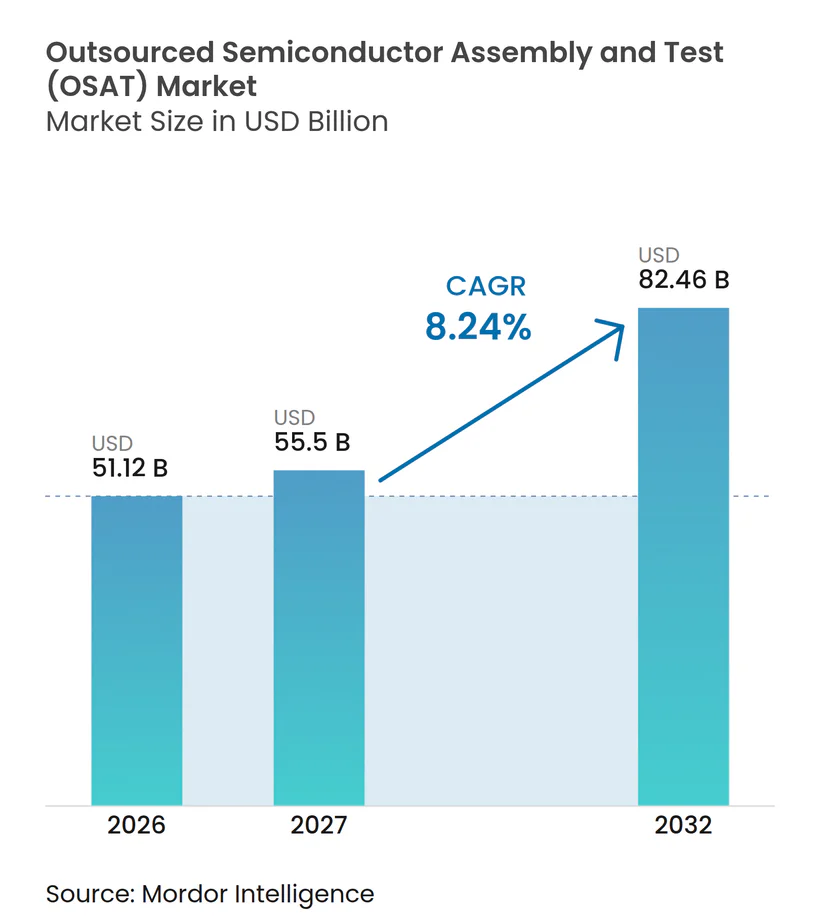
The outsourced semiconductor assembly and test (OSAT) market size is projected to expand from USD 51.12 billion in 2026 and USD 55.5 billion in 2027 to USD 82.46 billion by 2032, registering a CAGR of 8.24% between 2027 and 2032.
Artificial intelligence (AI) and high-performance computing (HPC) programs pull advanced packaging and test work toward providers able to commit capacity early. Projected increases in vehicle electronics content broaden potential demand alongside 5G deployment, while constrained integrated packaging capacity can create external work in Taiwan. Equipment delays reported in July 2026 amid AI infrastructure demand and global fab investment complicate capacity delivery. Capital demands and customer qualification can slow conversion into service revenue, favoring providers able to fund and qualify capacity before customer production ramps.
Key Report Takeaways
- Service revenue was led by packaging, with a 76.4% outsourced semiconductor assembly and test (OSAT) market share in 2026, while testing is forecast to be the fastest-growing segment at a 10.05% CAGR between 2027 and 2032.
- Across packaging types, ball grid array (BGA) led with 23.58% of packaging-services revenue in 2026, while fan-out packaging is projected to be the fastest-growing segment at a 10.72% CAGR between 2027 and 2032.
- By application, communication held a 31.77% share of the outsourced semiconductor assembly and test (OSAT) market size in 2026, while automotive is forecast to be the fastest-growing segment at a 12.55% CAGR between 2027 and 2032.
- Technology-node revenue was led by ≥28 nm, with 45.14% of OSAT revenue in 2026, while the 5 nm and below segment is forecast to grow fastest at a 13.95% CAGR between 2027 and 2032.
- Geographically, Asia-Pacific was both the largest region, with 73.47% of OSAT revenue in 2026, and the fastest-growing region, with a projected 9.1% CAGR between 2027 and 2032.
Note: Market numbers in this report are based on Mordor Intelligence's proprietary estimation framework, which combines nine months of actuals with Q4 projections for base year 2026.
Market Trends and Insights
Drivers Impact Analysis of Outsourced Semiconductor Assembly And Test (OSAT) Market*
| Driver | (~) % Impact on CAGR Forecast | Geographic Relevance | Impact Timeline |
|---|---|---|---|
| Soaring semiconductor content per vehicle | +2.6% | North America, Europe, and Asia | Medium term (2-4 years) |
| 5G-led demand for advanced RF packages | +1.9% | North America, Nordics, Gulf Cooperation Council countries, and parts of Asia | Short term (≤ 2 years) |
| AI/HPC chiplet architectures needing heterogeneous integration | +3.2% | United States and Taiwan | Medium term (2-4 years) |
| Foundry capacity shortages driving fab-lite outsourcing | +1.8% | Taiwan's packaging and test centers | Short term (≤ 2 years) |
| U.S. CHIPS and EU Chips Acts incentivizing local OSAT build-out | +1.2% | United States and Italy | Medium term (2-4 years) |
| Sustainability mandates pushing wafer-level fan-out adoption | +0.5% | Asia-Pacific, North America, and Europe | Long term (≥ 4 years) |
| Source: Mordor Intelligence | |||
Soaring semiconductor content per vehicle
Vehicle electronics offer packaging suppliers a demand opportunity through both powertrain mix and semiconductor value within electric platforms. Infineon estimated average semiconductor bills of materials of approximately USD 750 per internal combustion vehicle and USD 1,400 per battery electric vehicle in 2025.[1] It projected the battery electric figure at approximately USD 1,600 in 2030. For high-end cars, its 2030 estimate extended up to approximately USD 2,500, indicating a distinct value opportunity within that forecast. OSAT suppliers can participate in this richer electronics content when chip suppliers outsource the associated assembly and testing. Securing electronics-intensive vehicle platforms would consequently expose a service provider to a larger semiconductor value pool without depending solely on more vehicles being produced.
5G-led demand for advanced RF packages
5G gives packaging suppliers exposure to both network infrastructure investment and the expansion of connected device services. Ericsson reported 162 million additional 5G subscriptions globally in the first quarter of 2026, taking the total to 3.1 billion. Amkor Technology, Inc. identified continued infrastructure build-out and 5G-enabled devices among the trends fueling outsourced packaging and test services. Ericsson's June 2026 report also identified uneven regional uptake of 5G fixed wireless access. Ericsson places the strongest fixed wireless uptake in North America, the Nordics, Gulf Cooperation Council countries, and parts of Asia, locating service demand behind Amkor's 5G infrastructure trend in those markets.
AI/HPC chiplet architectures needing heterogeneous integration
AI/HPC programs are combining heterogeneous integration development with long-term outsourced packaging capacity commitments. On July 23, 2026, Amkor Technology, Inc. announced a multiyear USD 1.5 billion agreement with NVIDIA for advanced packaging and development for next-generation AI and accelerated-computing platforms.[2] The partners planned to align roadmaps for high-density interconnects and heterogeneous integration, while NVIDIA would provide a prepayment for U.S. capacity expansion. Separately, Advanced Semiconductor Engineering, Inc. (ASE), a member of ASE Technology Holding Co., Ltd., broke ground in Kaohsiung, Taiwan, on March 11, 2026. ASE said the planned high-end packaging and testing facility would serve AI/HPC needs, with completion expected in the second quarter of 2028. Pairing integration roadmaps with capacity financing commitments can embed an OSAT provider in platform development before its new facilities enter production.
Foundry capacity shortages driving fab-lite outsourcing
In July 2026, Taiwanese OSATs including ASE and Siliconware Precision Industries Co., Ltd. (SPIL) benefited from order spillover as TSMC's CoWoS advanced-packaging capacity was undersupplied. The bottleneck gave outsourced back-end providers an additional role within a manufacturing chain already served by an integrated foundry. For fab-lite customers, external packaging capacity can provide another route to completing chips when integrated packaging slots are limited. An OSAT's available processing capacity consequently becomes commercially relevant alongside its technology offering, because both are needed to accept overflow work. Foundry integration can therefore generate outsourcing business through its own capacity constraints, making the same producer a competitor and a source of demand for specialist packaging providers.
Restraints Impact Analysis of Outsourced Semiconductor Assembly And Test (OSAT) Market*
| Restraint | (~) % Impact on CAGR Forecast | Geographic Relevance | Impact Timeline |
|---|---|---|---|
| Vertical integration by leading foundries and IDMs | -1.2% | Asia-Pacific and North America | Long term (≥ 4 years) |
| Cap-ex intensity and long equipment lead-times | -1% | Asia-Pacific and North America | Short term (≤ 2 years) |
| Geopolitical export controls on advanced tools | -0.5% | United States and China | Short term (≤ 2 years) |
| Skilled-labor shortages in advanced packaging engineering | -0.3% | Asia-Pacific manufacturing centers | Medium term (2-4 years) |
| Source: Mordor Intelligence | |||
Vertical integration by leading foundries and IDMs
When a foundry or integrated device manufacturer (IDM) retains packaging and testing within its production chain, the externally addressable service pool can narrow. An independent OSAT can face competition for the processing stages that a customer chooses to place outside that integrated flow. TSMC operates the CoWoS advanced-packaging process, placing that back-end service within a foundry's own offering. For AI-chip suppliers using this process, the foundry can therefore serve as both wafer manufacturer and advanced-packaging provider. Independent providers seeking that packaging work face a narrower opening when the integrated flow can accommodate it, with external access dependent on the foundry's capacity limits.
Cap-ex intensity and long equipment lead-times
Capacity expansion creates a financial constraint when an OSAT must fund a larger capital base while absorbing its operating expenses. Amkor warned that ongoing capital expenditure requirements may strain cash and liquidity in its 2025 annual filing. The company expected depreciation and factory operating expenses associated with capacity additions to pressure gross profit during capital-base expansion, at least in the near term. These exposures can make the ability to finance a ramp as important as the technical ability to install more packaging and test resources. In July 2026, a supplier of semiconductor packaging equipment to Micron reported that lead times for some products had increased about 50%, with some deliveries taking more than a year. Funding capacity additions can therefore expose suppliers to both near-term profit pressure and delayed equipment delivery.
*Our forecasts treat driver/restraint impacts as directional, not additive. The impact forecasts reflect baseline growth, mix effects, and variable interactions.
Outsourced Semiconductor Assembly And Test (OSAT) Market Segment Analysis
By Service Type:
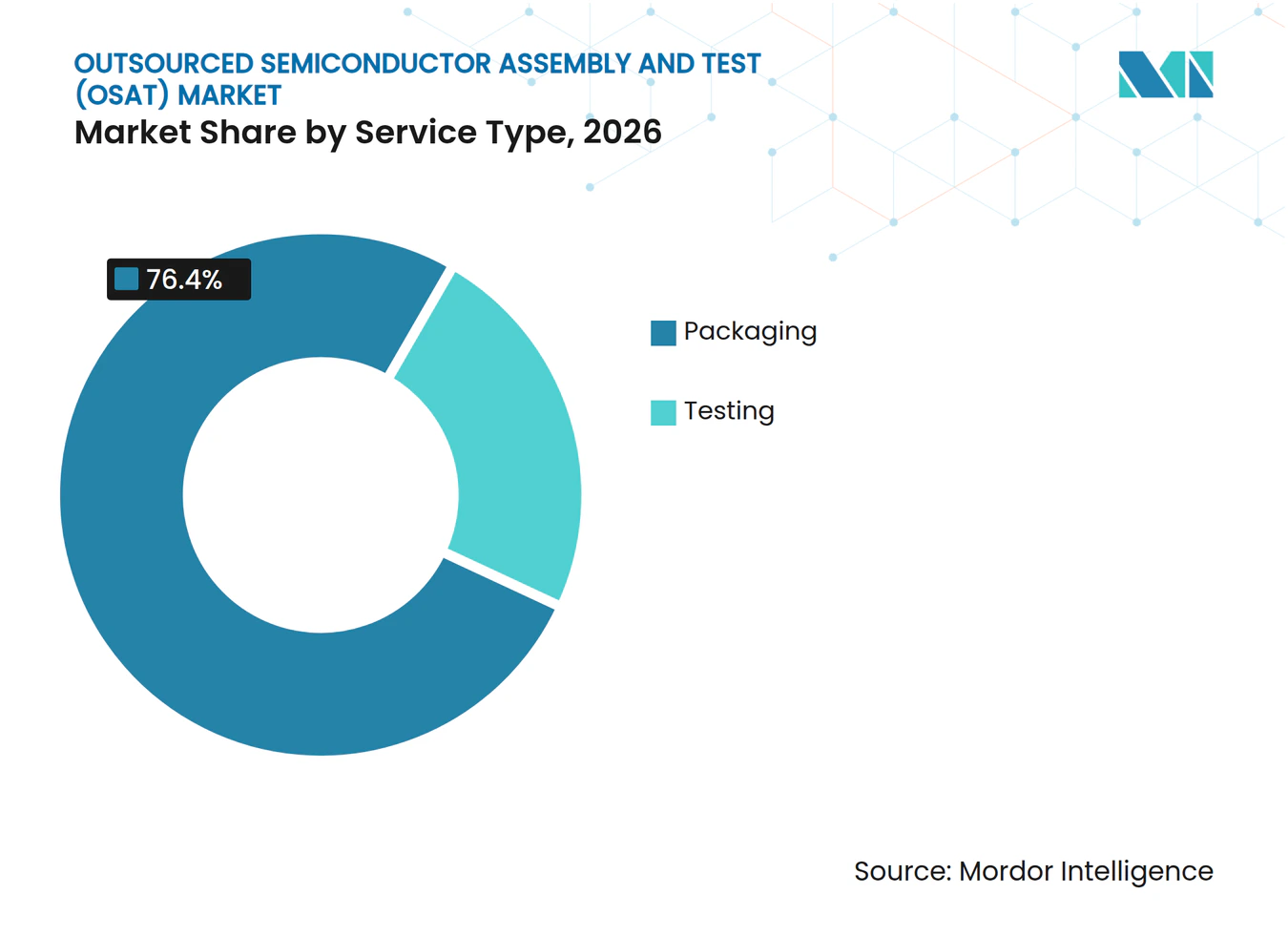
Packaging Scale Supports Growing Testing DemandPackaging accounted for a 76.4% share of the outsourced semiconductor assembly and test (OSAT) market size in 2026. Within this largest service segment, ASE Technology Holding Co., Ltd. reported unaudited 2025 packaging revenue of TWD 308.3 billion (USD 9.83 billion). The group also reported growth in its leading-edge advanced packaging business in the first half of 2026 compared with the first half of 2025. Its packaging revenue had increased 17.8% from 2024 to 2025, tying ASE's reported scale to expansion of the service business.
Testing is forecast to grow at a 10.05% CAGR between 2027 and 2032, making it the fastest-growing service segment. ASE said its testing business outpaced the 35% year-over-year growth of its core packaging and testing revenue in the first half of 2026. The group reported USD 1.14 billion in testing equipment capital expenditures out of USD 3.4 billion in total equipment capital expenditures in 2025. Testing was approximately 11% of 2025 group net revenue across packaging, testing, electronic manufacturing services, and other operations. Testing absorbed about 34% of ASE's 2025 equipment capital expenditures, aligning its disproportionate equipment commitment with a business that subsequently outpaced core-business growth.



By Packaging Type:
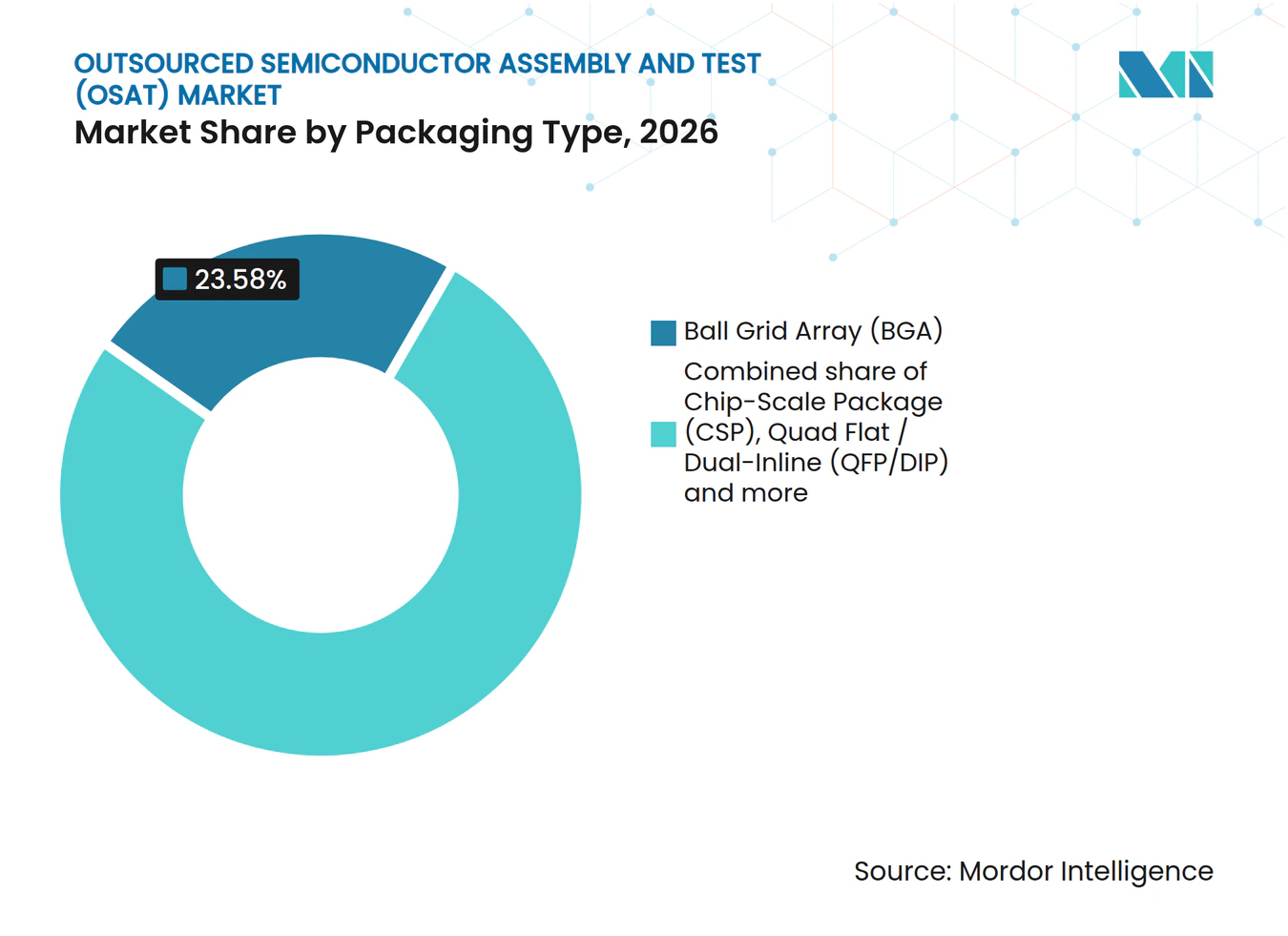
Established BGA Demand Meets Fan-Out ExpansionBall grid array (BGA) was the largest packaging-type segment, accounting for 23.58% of packaging-services revenue in 2026. Tongfu Microelectronics Co., Ltd. reported that its oversized, multi-chip FCBGA packaging reached batch mass production in 2025. The company also reported developing key technologies for these packages and thermal-management solutions, linking its production milestone to a specific flip-chip BGA format. Providers pursuing oversized multi-chip BGA programs therefore need to connect package and thermal-management engineering with batch-production execution, making production capability part of the competitive offer.
Fan-out packaging (FO-WLP / FO-BGA) is projected to grow at a 10.72% CAGR between 2027 and 2032, making it the fastest-growing packaging-type segment. In May 2025, Deca Technologies and IBM agreed to implement Deca's M-Series and Adaptive Patterning technologies at IBM's Bromont, Quebec, facility. IBM planned a high-volume manufacturing line focused on Deca's M-Series Fan-out Interposer Technology. System-in-package (SiP) provides a separate integration route, with Amkor reporting approximately USD 3.08 billion in 2025 advanced SiP module sales for applications including RF front-end, connectivity, sensors, and memory. In fan-out, IBM's planned Bromont line would extend deployment of Deca's interposer process into IBM's manufacturing operations, giving fan-out technology providers a growth route through implementation at an existing packaging site.

By Application:
Communication Scale Meets Automotive ExpansionCommunication represented a 31.77% outsourced semiconductor assembly and test (OSAT) market share in 2026. Within this largest application segment, Amkor's communications business, covering smartphones and tablets, represented 42% of its net sales in the second quarter of 2026. Smartphone and tablet program timing therefore matters particularly to Amkor, whose communications category was its largest end-market exposure in that quarter.
Automotive is forecast to grow at a 12.55% CAGR between 2027 and 2032, making it the fastest-growing application segment. JCET Group Co., Ltd. reported that automotive-electronics revenue rose 25% in the first half of 2026 compared with the first half of 2025. Amkor's computing business, covering data centers, infrastructure, personal computers (PCs), laptops, and storage, represented 22% of Q2 2026 net sales, unchanged from Q2 2025. Consumer electronics represented 14% of Amkor's Q2 2026 net sales, down from 18% in Q2 2025, across augmented reality (AR) and gaming, connected home, home electronics, and wearables. JCET's reported increase shows vehicle-electronics growth already reaching a back-end provider's 2026 results, ahead of the forecast period.
By Technology Node:
Established-Node Scale Complements Advanced CapabilityThe ≥28 nm segment held 45.14% of OSAT revenue in 2026, making it the largest technology-node segment. On January 15, 2026, Silicon Storage Technology (SST), a Microchip subsidiary, and United Microelectronics Corporation (UMC) released SST's ESF4 embedded SuperFlash on UMC's 28HPC+ platform for automotive controllers. The platform completed automotive Grade 1 qualification and used fewer additional mask steps than other foundries' 28 nm HKMG eFlash offerings. Automotive Grade 1 qualification on a 28 nm platform shows qualification-intensive automotive-controller development within the ≥28 nm group.
The 5 nm and below segment is projected to grow at a 13.95% CAGR between 2027 and 2032, making it the fastest-growing technology-node segment. In its June 2026 prospectus, Tongfu Microelectronics reported technology and large-scale production capability for 5 nm products within its integrated-circuit packaging and testing business. The company's service chain includes chip testing, assembly, and finished-product testing. For a chip supplier seeking back-end execution at 5 nm, this combination creates a potential service partner with production capability and several processing steps in the same business. Commercial participation at this node can therefore depend on connecting node capability with the assembly-and-test service sequence that a customer program requires.
Geography Analysis
Asia-Pacific Outsourced Semiconductor Assembly And Test (OSAT) Market
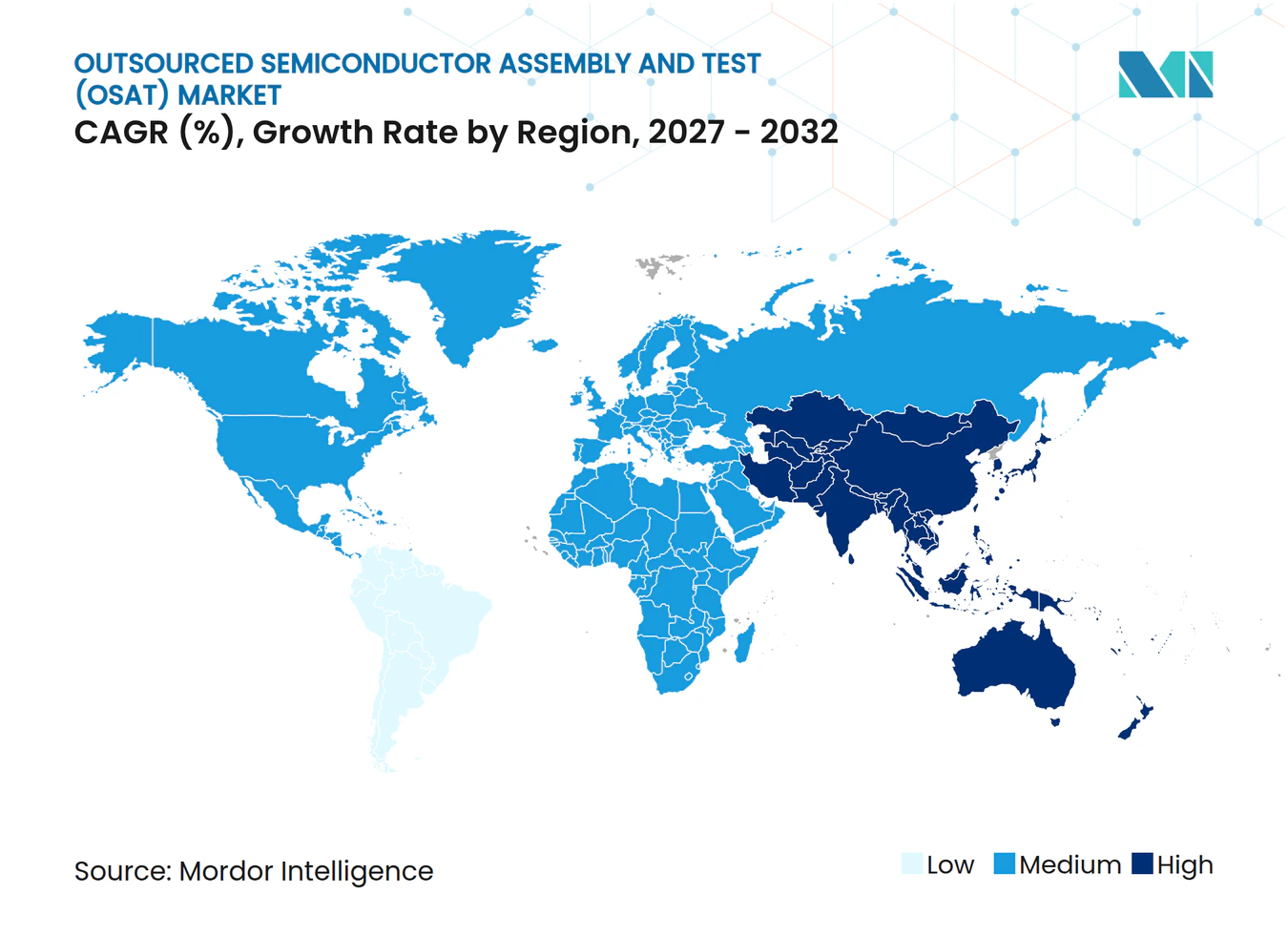
Asia-Pacific held a 73.47% outsourced semiconductor assembly and test (OSAT) market share in 2026 and is forecast to grow at a 9.1% CAGR between 2027 and 2032, making it the largest and fastest-growing region. On May 8, 2026, Advanced Semiconductor Engineering, Inc. and WUS Printed Circuit Co., Ltd. announced a planned FOCoS and FC-BGA packaging facility in Kaohsiung, Taiwan, for AI, cloud computing, and autonomous driving. Completion was scheduled for September 2029. UTAC Group's network also includes UTAC Thai Limited factories in Thailand and PT UTAC Manufacturing Services Indonesia's manufacturing site in Indonesia. For suppliers serving advanced computing, Taiwan's project illustrates a growth path through FOCoS and FC-BGA investment, complementing the region's established cross-country assembly and test footprint.
North America's capacity opportunity includes a customer-backed advanced packaging and test campus project in the United States. In September 2026, Amkor announced an Arizona Phase 2 expansion expected to add 60,000 square meters of cleanroom space after customer commitments exceeded Phase 1's planned 33,000 square meters. Europe has an established service channel through Portugal, where Amkor provides packaging and test services through its factories and other operations. These locations imply different commercial timelines for buyers seeking regional capacity, with Arizona's additional space dependent on project delivery and Portugal supported by an existing operating footprint.
In South America, the Brazilian development bank BNDES approved financing for HT Micron Semicondutores in São Leopoldo, Brazil, in September 2026. The Hana Micron group company planned to add assembly, packaging, and test capacity specifically for LPDDR5X memory devices. HT Micron's Brazilian operation serves the information and communications technology industry through integrated-circuit packaging and testing. In the Gulf Cooperation Council (GCC) countries, Ericsson's June 2026 Mobility Report attributes 5G fixed wireless adoption to demand for high-speed alternatives to fixed broadband and to national initiatives for underserved areas and smart cities. That telecom build-out gives communications-oriented semiconductor suppliers a regional end-use context.
Regulatory Framework and Outlook
The comparison covers selected jurisdictions from the perspective of an OSAT operator developing local packaging and test capacity. Commercial attractiveness depends on access to applicable incentives and the conditions for project or enterprise qualification. Brazil's PADIS eligibility links packaging and testing to domestic research and development (R&D) and innovation investment, while China's 2026 list covers eligible advanced-packaging and test enterprises. Investment-credit treatment in the United States and Italy's approved advanced-packaging aid example illustrate other forms of conditional policy support.
Regulatory Table of Outsourced Semiconductor Assembly And Test (OSAT) Market
| Decision factor | United States | Brazil | Italy | China |
|---|---|---|---|---|
| Primary authority | Internal Revenue Service; Bureau of Industry and Security | Ministry of Science, Technology and Innovation | European Commission | National Development and Reform Commission; Ministry of Industry and Information Technology |
| Key instruments or direction | Section 48D investment credit; approved-OSAT-list advisory-opinion process | PADIS eligibility for local wafer cutting, packaging, and testing with required R&D investment | European Chips Act aid framework and Silicon Box Novara approval | 2026 annual tax-incentive list for eligible advanced-packaging and test enterprises |
| Commercial effect | 35% of qualified investment for qualifying manufacturing property placed in service after December 31, 2025; recordkeeping for approved-list status requests | Specified PIS/Pasep and Cofins taxes on sellers' revenue zero-rated for eligible PADIS-qualified purchases; annual domestic R&D minimum of 5% of incentivized gross-revenue base | Project-specific aid approval for advanced-packaging capacity in Novara | Eligibility, application, and annual-list inclusion required; prior-year beneficiaries must reapply for 2026 |
| Current policy attractiveness | High | Medium | Medium | Medium |
| Future direction of policy attractiveness | Hardening | No change | No change | No change |
| Source: Mordor Intelligence | ||||
Property whose construction begins after December 31, 2026 cannot qualify for the credit in the United States, supporting a hardening outlook for later-starting developers. Brazil's conditional tax relief and annual R&D duty balance its current attractiveness, while its 2029 review and at least 24 months of adaptation for any reorientation favor continuity in commercial planning. Italy's project-specific aid and the June 2026 Chips Act 2.0 proposal's continued coverage of packaging, assembly, and test support continuity of policy focus during the ongoing legislative process. China's 2026 reapplication requirement and discretionary criteria-adjustment power keep participation conditional, supporting continuity of the qualification burden under its annual-list model.
Value Chain Stages
Value capture is compared across customer program allocation, package execution, and electrical test services. Amkor's direct sales to Apple and Qualcomm represented 29.8% and 11.1% of its net sales, respectively, in 2025. This concentration can expose a supplier's factory workload to decisions made by a small number of large customers at the program-allocation stage. Operational resilience also depends on obtaining packaging and test equipment in time to meet changing capacity needs, a dependency Amkor identifies in its business.
Value Chain Analysis Table of Outsourced Semiconductor Assembly And Test (OSAT) Market
| Primary activity | Key participants | Value capture | Bottleneck | Resilience response |
|---|---|---|---|---|
| Program allocation and contracting | OSAT service buyers such as Apple and Qualcomm | OSAT service-contract sales | Amkor's revenue concentration in large customer programs | Broaden the customer and program mix |
| Package assembly and integration | Packaging providers such as ASE Technology Holding Co., Ltd., JCET Group Co., Ltd., and Amkor Technology, Inc. | Assembly and integration service fees | Amkor's dependence on timely equipment availability | Coordinate equipment orders and supplier delivery plans |
| Electrical testing and verification | Testing providers such as ASE Technology Holding Co., Ltd., Chipbond Technology Corporation, and Powertech Technology Inc. | Wafer-sort and final-test service fees | ASE Technology Holding's wafer-sort/final-test capacity near full in Q2 2026, excluding lines entering service | Align test-equipment commissioning with program ramps |
| Source: Mordor Intelligence | ||||
Amkor offers wafer-level system-in-package and 3D package-stacking services, including package-on-package and face-to-face assembly. ASE reported in Q2 2026 that its wafer-sort and final-test capacities were running near full, excluding equipment lines being placed into service. Where a program pairs complex assembly with test, available test capacity can therefore govern delivery of the completed service, favoring providers that commission test lines alongside package lines.
Competitive Landscape
Market Concentration
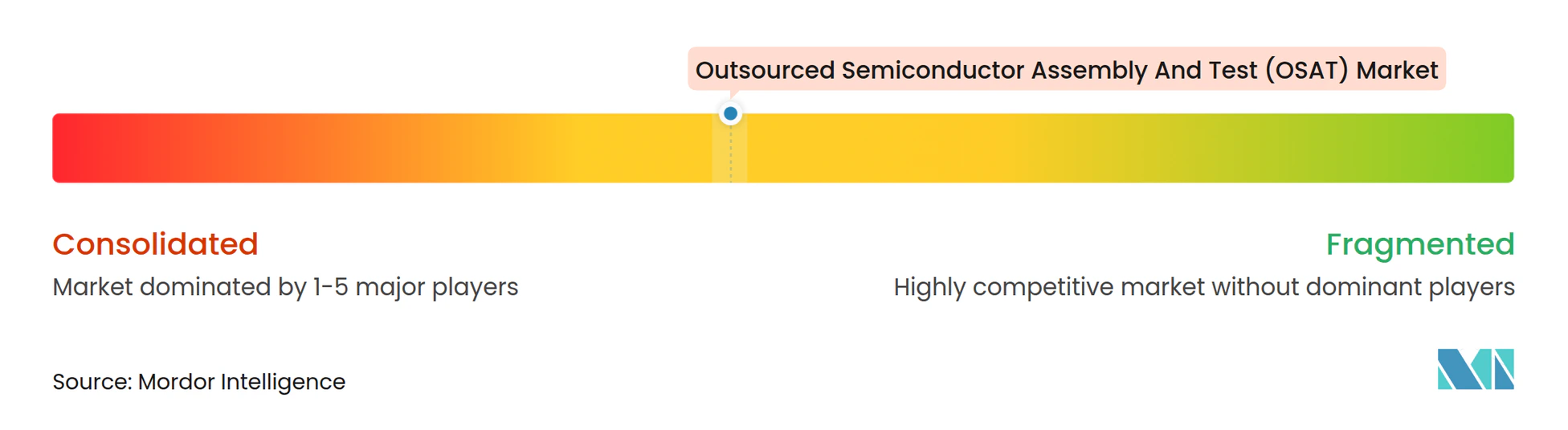
The supplier structure is moderately concentrated, combining diversified groups such as ASE Technology Holding Co., Ltd. and Amkor Technology, Inc. with more specialized providers. Amkor reported USD 6.71 billion in 2025 net sales, up 6% from 2024, including USD 5.56 billion from advanced products covering flip-chip, memory, wafer-level processing, and related testing.[3] Powertech Technology Inc.'s consolidated revenue mix in 2025 was 67% packaging, 22% testing, and 11% SiP/module services. ChipMOS Technologies Inc. reported that memory-product revenue rose 26.6% from 2024 and represented 46% of its total revenue in 2025. King Yuan Electronics Co., Ltd. specializes in semiconductor testing, giving buyers a different service profile from packaging-led groups.
ASE Technology Holding's Advanced Semiconductor Engineering business announced development of an automated panel-level packaging line on May 26, 2026. Advanced Semiconductor Engineering expected the 310 mm × 310 mm line for FOCoS and FOCoS-Bridge platforms to enter production in the first half of 2027. Powertech completed the purchase of a factory facility in Hsinchu Science Park, Taiwan, in December 2025 to support future expansion. ASE is developing panel-level packaging capacity for FOCoS platforms, while Powertech secured factory space for future expansion, so competition involves both new process lines and available floor space.
King Yuan Electronics began operating a facility through its Singapore subsidiary in Ang Mo Kio on May 22, 2026. At opening, it offered chip-probe, final-test, burn-in, and system-level testing for automotive, high-performance AI, and computer, communications, and consumer-electronics demand across Southeast Asia. Powertech's Plant 3C completed Taiwan's Cleaner Production Assessment process in 2025, and the Ministry of Economic Affairs' Industrial Development Administration issued its certificate in December 2025. The certificate applies to Plant 3C, giving Powertech a plant-specific environmental credential. King Yuan's Singapore opening extends specialist test coverage, whereas packaging-led ASE announced a new process line and Powertech acquired factory space for future expansion.
Outsourced Semiconductor Assembly And Test (OSAT) Industry Leaders
-
ASE Technology Holding Co., Ltd.
-
Amkor Technology, Inc.
-
Powertech Technology Inc.
-
ChipMOS Technologies Inc.
-
King Yuan Electronics Co., Ltd.
- *Disclaimer: Major Players sorted in no particular order
Outsourced Semiconductor Assembly And Test (OSAT) Market Companies Covered in this Report
- ASE Technology Holding Co., Ltd.
- Amkor Technology, Inc.
- JCET Group Co., Ltd.
- Siliconware Precision Industries Co., Ltd.
- Powertech Technology Inc.
- King Yuan Electronics Co., Ltd.
- Tongfu Microelectronics Co., Ltd.
- Tianshui Huatian Technology Co., Ltd.
- UTAC Holdings Ltd.
- Unisem (M) Berhad
- Hana Micron Inc.
- ChipMOS Technologies Inc.
- Formosa Advanced Technologies Co., Ltd.
- Chipbond Technology Corporation
- Lingsen Precision Industries, Ltd.
- Suchi Semicon Pvt. Ltd.
- Nepes Corporation
- Silicon Box Pte. Ltd.
- Shinko Electric Industries Co., Ltd.
- Carsem (M) Sdn. Bhd.
- SFA Semicon Co., Ltd.
- STATS ChipPAC Pte. Ltd.
- Orient Semiconductor Electronics, Ltd.
- Integra Technologies LLC
- Amkor Technology Korea, Inc.
Read Analysis of Outsourced Semiconductor Assembly And Test (OSAT) Companies
Key Opportunities for Market Participants
The opportunities compare extensions of existing packaging work with specialized test services addressing computing and vehicle-electronics requirements. Amkor's computing end-market sales increased 16% in 2025 from 2024, primarily driven by AI-related PC devices and networking infrastructure. Its combined automotive and industrial end-market sales rose 8% over the same period, primarily due to advanced content growth for advanced driver-assistance systems (ADAS). The commercial route is selective, as Amkor says customers usually require its complex packaging and test services to pass qualification that may take several months.
Market Opportunities Table of Outsourced Semiconductor Assembly And Test (OSAT) Market
| Opportunity | Why now | Buyer / lead segment | Recommended play | Main barrier | Likely beneficiaries |
|---|---|---|---|---|---|
| Advanced packaging for AI PCs and networking | Strength in Amkor's AI-related PC and networking-infrastructure business in 2025 | AI-PC and networking-chip suppliers | Qualify integrated packaging and test offers for additional computing programs | Amkor's customer qualification is usually lengthy and may take several months | Amkor Technology, Inc.; ASE Technology Holding Co., Ltd.; JCET Group Co., Ltd. |
| ADAS packaging and reliability testing | Amkor's combined automotive/industrial growth in 2025 was primarily linked to ADAS content | ADAS semiconductor suppliers | Develop program-specific packaging and reliability-test qualification | Long design-in and product life cycles, stringent qualification, very low defect-rate requirements, and high-reliability standards | Amkor Technology, Inc. |
| Dedicated inference-AI test services | Advantest's July 2026 outlook for inference-AI test demand exceeded its April 2026 projection | Inference-AI semiconductor suppliers | Stage dedicated test-equipment commitments around program readiness | Test equipment generally requires more capital and has longer lead times than most packaging equipment | Amkor Technology, Inc.; Powertech Technology Inc. |
| Source: Mordor Intelligence | |||||
Advantest's July 2026 outlook anticipated the largest-ever semiconductor tester market in 2026, driven by rising AI-related production volumes and chip complexity. Amkor also linked automotive qualification, reliability, and product-cycle requirements to greater operating challenges and investment costs. Amkor states that test equipment is generally more capital-intensive than packaging and tends to have longer delivery lead times than most packaging equipment. The central opening is to link equipment commitments to qualification milestones, allowing an OSAT to pursue AI and ADAS demand while limiting capital exposure before a program is ready for production.
Recent Industry Developments in Outsourced Semiconductor Assembly And Test (OSAT) Market
- Sep 2026: JCET Group Co., Ltd. signed an advanced packaging and test project in Wuxi, China, focused on silicon-interposer 2.5D packaging research and industrialization for AI and HPC applications.
- Sep 2026: BNDES approved financing for HT Micron Semicondutores, a Hana Micron group company, to add LPDDR5X memory-device assembly, packaging, and test capacity at its São Leopoldo plant in Brazil.
- Sep 2026: Amkor Technology, Inc. announced Arizona packaging and test campus Phase 2 after customer commitments exceeded Phase 1's planned 33,000 square meters of cleanroom space. The planned addition of 60,000 square meters would bring the campus to approximately 93,000 square meters and total planned project investment to approximately USD 12 billion.
Outsourced Semiconductor Assembly And Test (OSAT) Market Report Scope and Research Methodology
Market Definition and Coverage
The outsourced semiconductor assembly and test (OSAT) market measures third-party revenue from outsourced semiconductor packaging and testing services performed for semiconductor manufacturers globally. It covers annual fees for these services.
Scope exclusions: Foundry wafer fabrication, in-house assembly and test done by integrated device manufacturers, semiconductor equipment sales, separately sold packaging materials and inputs, and semiconductor device sales are excluded.
Segments Covered in This Report
- By Service Type
- Packaging
- Testing
- By Packaging Type
- Ball Grid Array (BGA)
- Chip-Scale Package (CSP)
- Quad Flat / Dual-Inline (QFP/DIP)
- Multi-Chip Module (MCM)
- Wafer-Level Packaging (WLP)
- Fan-Out Packaging (FO-WLP / FO-BGA)
- System-in-Package (SiP)
- Through-Silicon Via (2.5D/3D TSV)
- Flip-Chip (FC-BGA / FC-CSP)
- By Application
- Communication
- Consumer Electronics
- Automotive
- Computing and Networking
- Industrial
- Other Applications
- By Technology Node
- ≥28 nm
- 16/14 nm
- 10/7 nm
- 5 nm and below
- Legacy (90-65 nm)
- By Geography
- North America
- United States
- Canada
- Mexico
- South America
- Brazil
- Argentina
- Rest of South America
- Europe
- Germany
- France
- United Kingdom
- Italy
- Netherlands
- Russia
- Rest of Europe
- Asia-Pacific
- China
- Taiwan
- South Korea
- Japan
- Singapore
- Malaysia
- India
- Rest of Asia-Pacific
- Middle East and Africa
- Middle East
- Israel
- United Arab Emirates
- Saudi Arabia
- Turkey
- Rest of Middle East
- Africa
- South Africa
- Nigeria
- Rest of Africa
- Middle East
- North America
Data Sources, Market Sizing, and Validation
Desk Research
Public evidence is reviewed to establish semiconductor demand, supply capacity, service offerings and technology changes, using sources such as World Semiconductor Trade Statistics (WSTS) for global chip sales and end-market trends, Amkor's public test-service descriptions for service and capability definitions, and company investor releases such as Amkor's annual results and advanced-packaging partnership announcement for service revenue, capital plans and customer programs. These sources inform demand indicators and regional capacity checks, while company disclosures help distinguish OSAT service revenue from device, equipment and input sales.
Company annual filings, investor presentations and reputable semiconductor trade reporting provide additional checks on service mix, capacity additions, utilization and customer demand. The named sources are not exhaustive, and further sources inform collection, validation and clarification.
Primary Interviews and Surveys
Interviews and structured surveys would include executives, service-line and regional leaders, and operating managers at large, mid-sized and smaller OSAT providers, alongside semiconductor procurement, packaging and test specialists. Respondents would review secondary estimates of outsourced service revenue, packaging and test mix, capacity, pricing and regional demand, and explain material differences in definitions or timing. Where evidence is incomplete, analysts would record the gap, seek clarification from relevant respondents and triangulate the answer against filings, facility disclosures and market indicators before using it.
Distribution of primary research fieldwork respondents
| Company type | Respondent position | Region |
|---|---|---|
| Top tier: 35% | CXOs: 20% | APAC: 60% |
| Mid tier: 45% | Functional/Unit leaders: 35% | EMEA: 15% |
| Smaller Players: 20% | Managers: 45% | Americas: 25% |
Market-Sizing & Forecasting
The global estimate is built top down from the annual fees semiconductor manufacturers pay independent providers for packaging and test, then checked selectively against supplier revenue roll-ups and sampled service price times estimated outsourced activity. The model tracks semiconductor sales by end market, customer outsourcing propensity, OSAT capacity and utilization, packaging and testing service mix, and package complexity or advanced-package adoption. These indicators connect chip demand and available back-end capacity to service revenue and its composition. Segment shares are derived from provider disclosures, service and package capabilities, application exposure, node mix and regional facility footprints. Where direct segment evidence is incomplete, comparable provider mix and facility evidence support shares only when they describe the relevant activity. Forecasts use scenario analysis around demand, outsourcing and capacity ramps, with trend-based checks against the observed market trajectory. Primary respondents would test whether each driver and its direction are commercially plausible, while unresolved inputs are held as ranges and checked against supplier and channel evidence.
Data Validation & Update Cycle
Analysts triangulate the estimate against independent supplier disclosures, industry sales and capacity signals, then investigate material variances by year, service scope, geography and source basis. A second analyst reviews source mapping, calculations, segment shares and forecast drivers, and the lead analyst resolves anomalies before sign-off. When a source reporting period differs from the model year, the analyst retains its original year and documents the alignment. Re-contact is triggered when a respondent's explanation conflicts with a filing, later disclosure or another independent signal. The model is refreshed annually, updated between cycles when material events change demand or capacity, and receives a fresh source and calculation review before delivery.
Mordor Intelligence's Osat Market Estimate Compared With Other Published Estimates
Published estimates can differ in the transactions and products they count and the inputs used to model demand. The outsourced semiconductor assembly and test (OSAT) market measures third-party revenue from outsourced semiconductor packaging and testing services performed for semiconductor manufacturers globally.
Key Gap Drivers include the study's defined coverage and market-specific modeling choices. The model tracks semiconductor sales by end market, customer outsourcing propensity, OSAT capacity and utilization, packaging and testing service mix, and package complexity or advanced-package adoption.
Benchmark comparison
| Source | Market Size | Gaps in Research Methodology |
|---|---|---|
| Mordor Intelligence | USD 55.5 B (2027) | |
| Global Consultancy A | USD 46.5 B (2025) | At its 2025 base, this estimate is 16.2% below this report's 2027 value of USD 55.5 B, 2 years later. This estimate is 16.2% below the 2027 value, with its earlier base year and published growth path placing it before the later estimate. |
| Global Consultancy B | USD 45.2 B (2025) | At its 2025 base, this estimate is 18.6% below this report's 2027 value of USD 55.5 B, 2 years later. This estimate is 18.6% below the 2027 value, consistent with its lower stated forecast rate over the published period. |
Mordor Intelligence's analysts triangulate the estimate against independent supplier disclosures, industry sales and capacity signals, then investigate material variances by year, service scope, geography and source basis.
Key Questions Answered in the Report
What is the outsourced semiconductor assembly and test (OSAT) market size and growth outlook?
The market is projected to grow from USD 55.5 billion in 2027 to USD 82.46 billion by 2032, at a CAGR of 8.24% between 2027 and 2032.
What is driving demand for outsourced chip packaging and testing?
AI/HPC integration, 5G deployment, and projected growth in vehicle electronics content support demand. Infineon projected approximately USD 1,600 in semiconductor content per battery electric vehicle in 2030.
Which chip packaging or testing service has the largest share?
Packaging accounted for 76.4% of OSAT revenue in 2026. Testing is forecast to grow at a 10.05% CAGR between 2027 and 2032.
Which companies are major OSAT service providers?
ASE Technology Holding Co., Ltd., Amkor Technology, Inc., Powertech Technology Inc., ChipMOS Technologies Inc., and King Yuan Electronics Co., Ltd. are major service providers.
What can constrain expansion of advanced packaging and test services?
Capital demands and qualification requirements can slow capacity development. Amkor Technology, Inc. said customers usually require qualification that may take several months.
Which region leads the OSAT industry?
Asia-Pacific held 73.47% of OSAT revenue in 2026 and is projected to be the fastest-growing region at a 9.1% CAGR between 2027 and 2032.