
Market Overview
| Study Period | 2020 - 2031 |
|---|---|
| Forecast Data Period | 2026 - 2031 |
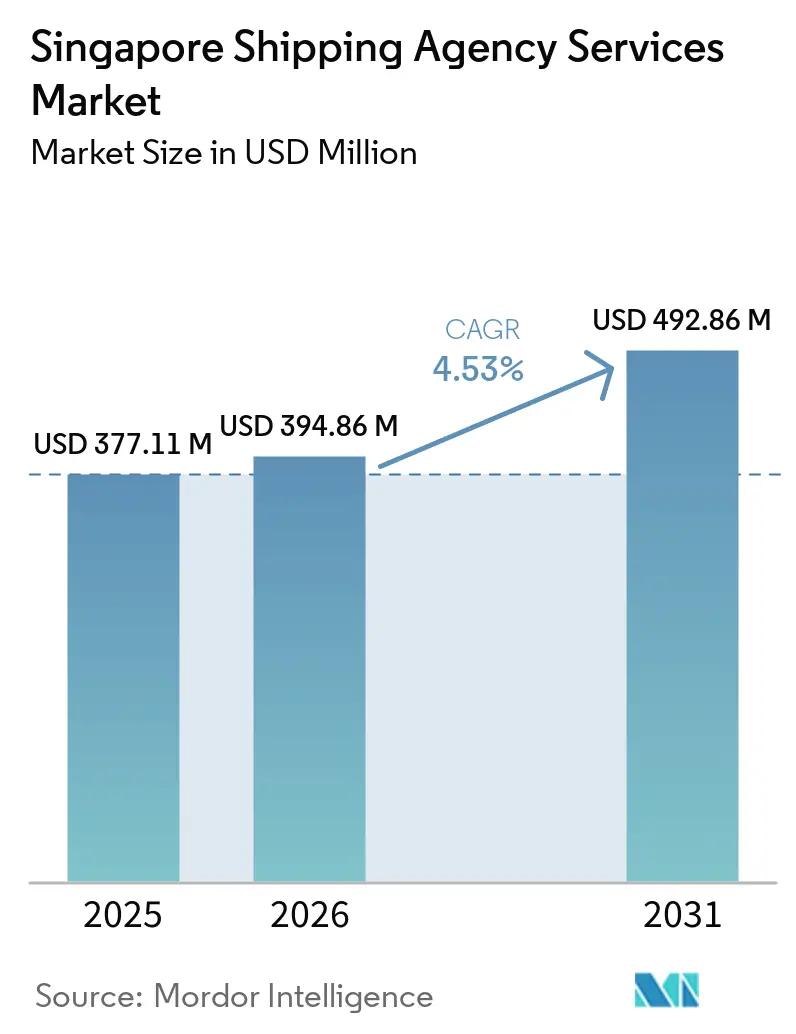
| Base Year Market Size (2025) | USD 377.11 Million |
| Market Size (2026) | USD 394.86 Million |
| Market Size (2031) | USD 492.86 Million |
| Growth Rate (2026 - 2031) | 4.53 % |
| Market Concentration | Low |
Major Players *Disclaimer: Major Players sorted in no particular order Image © Mordor Intelligence. Reuse requires attribution under CC BY 4.0. | |
Singapore Shipping Agency Services Market Analysis by Mordor Intelligence
The Singapore shipping agency services market was valued at USD 377.11 million in 2025 and estimated to grow from USD 394.86 million in 2026 to reach USD 492.86 million by 2031, at a CAGR of 4.53% during the forecast period (2026-2031).
The Singapore shipping agency services market is supported by Singapore’s role as a major port hub, where commercial vessel activity creates a continuing need for licensed agents. Record vessel arrivals, container movement, and marine fuel sales in 2025 widened the operating base for port-call support and documentation services. The Singapore shipping agency services market also benefits as methanol, LNG, and biofuel operations add specialized coordination, certification, and electronic documentation requirements. Digital systems are changing how agents manage declarations, berth planning, trade documents, and financial administration, which favors operators that can connect their processes with official platforms[1]“Singapore Posts Record Port Performance in 2025 and Develops Future Readiness Through Industry Collaborations for 2026,” Maritime and Port Authority of Singapore, mpa.gov.sg. Price competition remains significant among smaller providers, while higher-value mandates increasingly depend on digital capability, alternative-fuel knowledge, and dependable compliance execution.
Key Report Takeaways
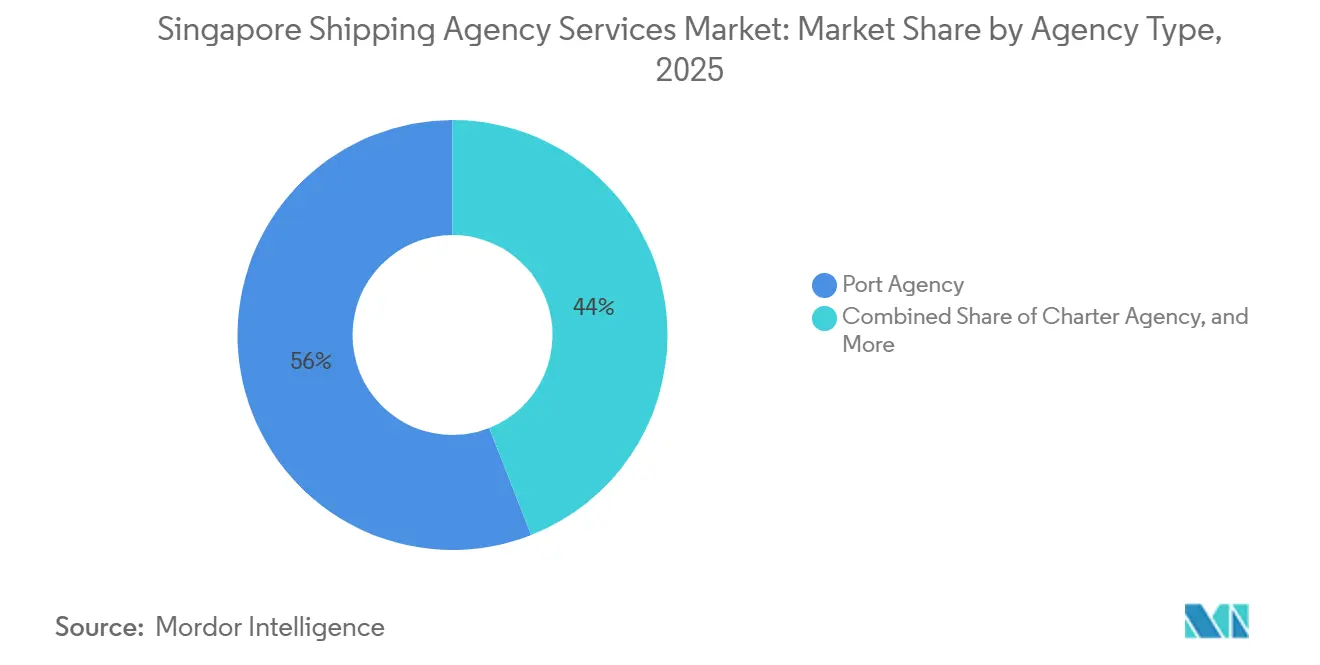
- By agency type, port agency held 55.97% of the Singapore shipping agency services market share in 2025, while charter agency is forecast to grow at a 5.33% CAGR through 2031.
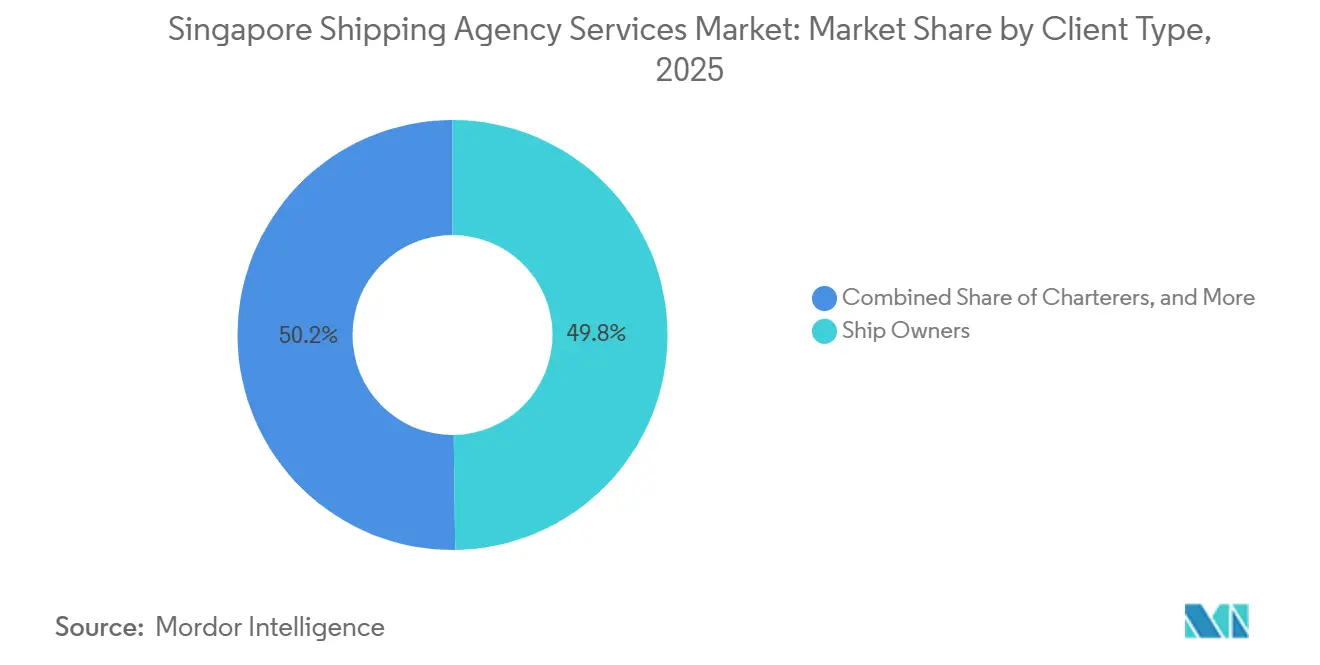
- By client type, ship owners accounted for 49.79% of the Singapore shipping agency services market size in 2025 revenue, while charterers/lessees are projected to expand at a 5.02% CAGR through 2031.
- By service type, shipping services led with 35.1% of the Singapore shipping agency services market share in 2025, while customs clearance and trade compliance are forecast to advance at a 5.15% CAGR through 2031.
Note: Market size and forecast figures in this report are generated using Mordor Intelligence’s proprietary estimation framework, updated with the latest available data and insights as of January 2026.
Singapore Shipping Agency Services Market Trends and Insights
Drivers Impact Analysis*
| Driver | (~) % Impact on CAGR Forecast | Geographic Relevance | Impact Timeline |
|---|---|---|---|
| Growth in Singapore Port Throughput and Vessel Arrivals | +1.5% | Global, concentrated at Port of Singapore | Short term (≤ 2 years) |
| Expansion of Bunkering and Alternative Marine Fuel Calls | +1.0% | Port of Singapore, adjacent ASEAN anchorages | Medium term (2-4 years) |
| Rising Demand for Integrated Port Call and Husbandry Services | +0.7% | Port of Singapore, Jurong Port, Tuas Megaport | Medium term (2-4 years) |
| Adoption of Interoperable Electronic Bills of Lading | +0.8% | Global, concentrated in Singapore-ASEAN and Singapore-China trade lanes | Short term (≤ 2 years) |
| Strategic Location on the Strait of Malacca | +0.5% | Global | Long term (≥ 4 years) |
| Increasing Need for Cybersecurity and Digital Compliance Support | +0.3% | Global, with primary impact at Port of Singapore | Medium term (2-4 years) |
| Source: Mordor Intelligence | |||
Growth in Singapore Port Throughput and Vessel Arrivals
The Singapore shipping agency services market draws a direct volume base from vessel arrivals and container handling because commercial calls require local agency support. Vessel arrivals reached 3.22 billion GT in 2025, while container throughput reached 44.66 million TEUs. The MPA Act and port regulations require a licensed agent to handle arrival declarations and clearance documentation through digitalPORT@SG™. The Singapore Registry of Ships expanded 27% to 137.46 million GT in 2025, which increased the group of vessel principals that can appoint local agents. This expansion included LNG fleet managers and offshore vessel operators that often need wider husbandry support rather than narrow, transaction-based services. More than 150 port users had joined the Just-In-Time Planning and Coordination Platform after its 2024 launch, making real-time coordination more important when berth and marine-service windows are tighter.
Expansion of Bunkering and Alternative Marine Fuel Calls
Alternative marine fuel volume at the Port of Singapore rose 44% to 1.95 million tons in 2025. Biofuel blends rose 54%, LNG rose 24%, and methanol volume reached 3,000 tons during the year. Singapore issued commercial methanol bunkering licenses effective January 1, 2026, bringing new workflows under Technical Reference TR129 into ordinary port-call coordination. Agents must coordinate fuel-specific certification, mass flow meter verification, and electronic Bunker Delivery Note processes during these calls. MPA and Enterprise Singapore are upgrading the LNG bunkering technical reference to a Singapore Standard in 2026, and an ammonia bunkering technical reference is expected in 2026. The Singapore shipping agency services market, therefore, places greater value on trained staff who can manage several fuel-documentation procedures without disrupting vessel schedules.
Adoption of Interoperable Electronic Bills of Lading
The TradeTrust Readiness Program launched on February 4, 2026, and provides funding of up to SGD 80,000 (USD 62,286.20) per Digital Trade Platform and carrier pair for live cross-platform electronic bill of lading interoperability[2]“Singapore Opens Applications for Additional LNG Bunkering Licences,” Maritime and Port Authority of Singapore, mpa.gov.sg. The program addresses a practical burden for shipping agents that previously managed separate paper and digital document streams. Four TradeTrust-enabled platforms received International Group of P&I Clubs approval for electronic bill of lading insurance purposes in February 2026. A 2025 interoperable Digital Documents against Payment pilot involving Pacific International Lines, DBS, and UOB reduced bill of lading processing time from 5-10 days to 8 minutes per transaction. The Singapore shipping agency services market can benefit when agents connect with approved platforms and coordinate documents across carrier, bank, and port workflows. Agencies without that capability may still need to manage paper processes while digital-native carriers create direct channels for documentation.
Rising Demand for Integrated Port Call and Husbandry Services
DigitalPORT@SG™ brought 16 separate declaration forms into one portal and was used by more than 550 shipping companies for arrival and departure formalities. This consolidation makes the agent a continuing operating link between a vessel and public authorities. OCEANS-X supports system-to-system connections for clearance applications and marine-service booking, separating integrated agencies from firms that depend on manual portal entries. The Just-In-Time platform was planned to extend to tankers and anchorage calls by the end of 2025, widening the coordination work related to bunkering, crew changes, and ship chandling. These tools can reduce the cost of managing frequent port calls, but they also place greater importance on accurate submissions and fast responses. The Singapore shipping agency services market consequently rewards firms that can combine port formalities, husbandry work, marine-service booking, and consistent digital records in one service relationship.
Restraints Impact Analysis*
| Restraint | (~) % Impact on CAGR Forecast | Geographic Relevance | Impact Timeline |
|---|---|---|---|
| Fragmented Competitive Structure and Pricing Pressure | -0.4% | Port of Singapore, Singapore domestic market | Short term (≤ 2 years) |
| Shortage of Skilled Maritime and Port-Operations Personnel | -0.3% | National, early impact in agency back-office roles | Medium term (2-4 years) |
| Interoperability Gaps Across Digital Trade Platforms | -0.2% | Global, spill-over to Singapore-ASEAN trade lanes | Medium term (2-4 years) |
| Rising Cybersecurity, Data-Integrity, and Liability Exposure | -0.2% | Global, concentrated at Port of Singapore | Long term (≥ 4 years) |
| Source: Mordor Intelligence | |||
Fragmented Competitive Structure and Pricing Pressure
More than 100 licensed agencies compete for Singapore port-call mandates, including international network operators and boutique firms with fewer than 10 employees. This structure keeps pressure on disbursement margins and husbandry fees in the lower tier. Digital integration with OCEANS-X and TradeTrust-enabled platforms is becoming a minimum capability for some principals, but thin margins restrict investment by smaller agencies. Singapore Shipping Association members identified rising operating costs as a leading concern before the November 2025 MPA-SSA CEO dialogue[3]“Steering Maritime Singapore Forward, SSA’s Dialogue with MPA Chief Executive,” Singapore Shipping Association, ssa.org.sg. Charterers/Lessees, which are the fastest-growing client group, commonly compare agent fees across providers and may increase the price focus for standard services. The Singapore shipping agency services market remains more attractive for firms that differentiate through specialist fuel work, reliable digital execution, or broader service coverage.
Shortage of Skilled Maritime and Port-Operations Personnel
Singapore’s maritime sector employs more than 140,000 people and contributes 6% of GDP, but more than 12% of the local maritime workforce is older than 60. A 2025 MPA census covering more than 1,700 maritime companies identified cybersecurity, marine surveying, and sustainability among the highest-demand hiring fields. Those skills overlap with the documentation, safety, and compliance work now expected from shipping agents. MPA improved the Tripartite Maritime Training Award in 2025 by reducing its duration from 31 to 22 months and increasing the monthly allowance from SGD 1,200 to SGD 2,200 (USD 934.29 to USD 1,712.87). The initiative addresses the talent pipeline, although it primarily targets seafaring roles. Smaller agencies may still struggle to add shore-based staff with the digital documentation and alternative-fuel coordination skills needed to manage higher call volumes without loss of service quality.
*Our forecasts treat driver/restraint impacts as directional, not additive. The impact forecasts reflect baseline growth, mix effects, and variable interactions.
Segment Analysis
By Agency Type: Port Agency Holds the Largest Revenue Position While Charter Agency Grows Faster
Port agency held 55.97% of the Singapore shipping agency services market share in 2025 because commercial vessel arrivals need full-agency support under the local port framework. The service includes arrival and departure documentation, coordination with authorities, and practical support during a vessel’s stay. The Singapore shipping agency services market size for Port agency is supported by the recurring nature of formalities at every commercial call. Husbandry and bunker work within this category have become more detailed as methanol bunkering started in January 2026, and ammonia procedures are under development for 2026. Agents handling these calls must manage fuel-specific certificates, mass flow meter checks, and electronic bunker delivery note records. Protective agency is also gaining relevance when charterers and cargo interests appoint a separate agent to oversee husbandry arrangements for their own account. This can increase the number of agency appointments connected with one vessel call. Cargo Agency continues to benefit from container, dry bulk, liquid bulk, and breakbulk activity, including the 44.66 million TEUs processed in Singapore during 2025. Liner cargo agencies also receive a stable volume base from vessel-sharing arrangements covered by the Block Exemption Order renewed through 2029[4]“CCCS Recommends Five-Year Renewal of the Block Exemption Order for Liner Shipping Agreements,” Competition and Consumer Commission of Singapore, ccs.gov.sg.
Charter agency is projected to grow at a 5.33% CAGR from 2026 to 2031, making it the fastest-growing agency category in the Singapore shipping agency services market. The increase reflects a broader mix of charter activity across vessel types and trade routes. Singapore had 9 green and digital shipping corridors, including corridors with India and Korea established in 2025. These routes can create new voyage structures and additional coordination needs for appointed agents. Alternative-fuel vessels may require charter-party clauses that define responsibilities for fuel-compliance checks. Those responsibilities often involve the nominated agent during the call. Shipowner-nominated and charterer-nominated charter agency services are therefore growing together across LNG, methanol-capable, and project-cargo vessels. Freight agency and NVOCC support remain more price-sensitive because digital platforms can simplify routine documentation. Their role persists, but their providers face a greater risk of being replaced when the work does not require specialized local execution.



By Client Type: Ship Owners Provide the Largest Revenue Base While Charterers Lead Growth
Ship owners accounted for 49.79% of the Singapore shipping agency services market size in 2025. Their position is linked to continuous local agency requirements for port formalities, insurance certificate management, and regulatory compliance. The Singapore Registry of Ships reached 137.46 million GT in 2025 and ranked fourth globally, which widened the base of shipowner principals with Singapore connections. MPA’s DocuMind and DocuMatch applications were intended for industry-wide adoption by the end of 2025 and streamlined insurance certificate renewal processes for Singapore-registered ships. Faster processes can reduce administrative delays, but they also make documentation accuracy more visible to shipowner principals. Ship managers and operators form a stable secondary client base because they supervise a continuing portfolio of vessel calls. Thirty-five international maritime companies opened or expanded operations in Singapore in 2025, creating further appointment opportunities across LNG, offshore support, and tanker operations. These vessel classes often require full-service husbandry support rather than a limited documentation assignment.
Charterers/Lessees are forecast to grow at a 5.02% CAGR from 2026 to 2031, the highest rate among client groups in the Singapore shipping agency services market. Spot and medium-term charter activity in dry bulk, tanker, and LNG trades supports the need for charterer-nominated appointments for each voyage. Offshore, energy, and industrial project operators remain a smaller but higher-value client group because their calls may require survey attendance, technical attendance, and logistics coordination. Freight forwarders and NVOCCs are also becoming more important appointing clients as they include agency support within digital trade services. Their use of the networked trade platform means their service partners need compatible electronic document processes. This requirement favors agencies that can work within a client’s trade-document workflow instead of supplying only traditional port-call assistance. Government, naval, and institutional vessel operators form a smaller group with contractually stable demand. Singapore’s defense and coast guard activity, together with allied naval visits, supports that continuity. The mix of client groups means that standard port calls and specialized assignments remain important at the same time.
By Service Type: Shipping Services Lead While Customs Clearance Expands Through Digital Requirements
Shipping Services held 35.1% of the Singapore shipping agency services market share in 2025. This leading position reflects the breadth of clearance, vessel documentation, and cargo coordination work required at a standard port call. DigitalPORT@SG™ consolidated 16 arrival and departure declaration forms, and more than 550 shipping companies used the portal. That structure keeps formal documentation a recurring service even as it becomes more digital. Bunkering and Fuel Coordination, along with crew change and immigration support, are higher-value services because they require time-sensitive coordination with several parties. Port Marine Notice No. 05 of 2026 and Port Marine Notice No. 46 of 2025 set out immigration-clearance requirements for sea crew arriving in Singapore. Agents must submit and coordinate the required documents through approved digital channels. This divides providers with integrated processes from firms that rely on manual steps.
Customs clearance and trade compliance are forecast to grow at a 5.15% CAGR from 2026 to 2031, the highest growth rate among service categories. Singapore Customs Circular No. 07/2026 requires fully electronic submission of Ordinary Certificate of Origin applications from August 1, 2026. The Singapore shipping agency services market is affected because agents managing export cargo must complete onboarding with authorized digital platforms. The ASEAN Customs Declaration Document framework is active across all 9 ASEAN member states, extending digital customs processes to regional trade routes. Disbursement accounting and financial administration also matters when charterers ask for timely preliminary-to-final disbursement account reconciliation. OCEANS-X-integrated systems can support that work at scale, while manual competitors have less capacity to provide real-time updates. Digital port call and trade documentation Services start from a smaller revenue base, but trade trust adoption can improve their position as electronic bills of lading become easier to insure and exchange. The service mix is shifting toward operators that can unite physical port support with accurate electronic records.
Geography Analysis
The Singapore shipping agency services market is concentrated around the Port of Singapore, Jurong Port, Tuas Megaport, and offshore anchorage zones. PSA’s container terminals at Tanjong Pagar, Brani, Keppel, and Pasir Panjang form a central part of this operating area, while offshore anchorages add agency work during berth waits, bunkering, and crew changes. Singapore was connected to more than 600 ports worldwide and recorded more than 130,000 commercial vessel calls annually in 2025. That volume made Singapore a highly intensive setting for local agency appointments in Asia. The Singapore shipping agency services market size is supported by transit-related appointments for bunkering, crew changes, and protective agency work, in addition to terminal-based full-agency services.
Asia-originated and Asia-destined cargo flows form the main source of vessel call volume and support the largest client base. Shipping lines from China, Japan, and South Korea need Singapore agents for transshipment documentation. The ASEAN Single Window operates across all 9 member states, while bilateral Green and Digital Shipping Corridors with India and Korea were established in 2025. These arrangements increase the need for agents that understand regional digital documents and route-specific processes. The Singapore-China corridor gained national-level status in 2025 and pilots common emissions reporting and wider digital document exchange, which is relevant to customs and trade-document agencies.
European and Middle Eastern principals represent a smaller, but more operationally detailed, share of Singapore appointments. Their tankers, LNG carriers, and offshore support vessels often need full husbandry mandates. LNG and methanol are operational in Singapore, while ammonia bunkering protocols are being developed in 2026, making the port relevant for long-haul fuel calls from these regions. The Singapore Registry of Ships stood at 137.46 million GT in 2025 and connects local agents with owners trading on routes beyond Singapore, including through flag-related compliance and insurance-documentation mandates.
Competitive Landscape
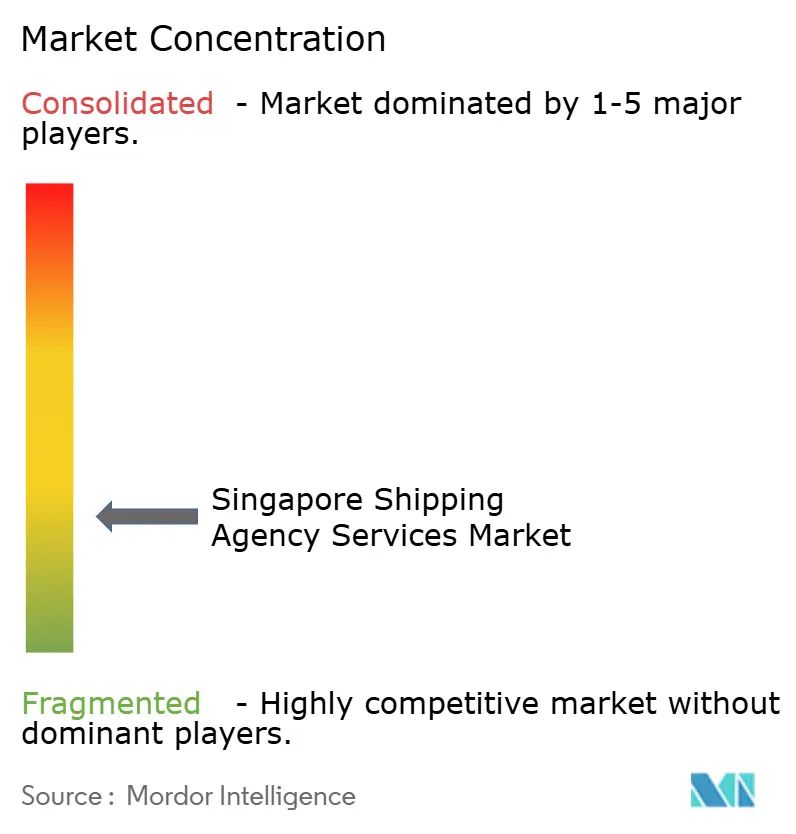
The Singapore shipping agency services market is highly fragmented, with more than 100 licensed operators. Global network agencies and single-desk boutique firms compete in the same port, but they serve different client needs. Local specialists such as Sinoda Shipping Agency, AlfaShip Agencies, and Straits Link Ship Agencies compete through principal relationships, local regulatory knowledge, and operating continuity. International network operators use global volume and coverage across markets to attract liner and tanker principals. Singapore Shipping Corporation Limited reported strong growth in its ship-owning segment during FY2026, while revenue declined and profit fell sharply in its agency and logistics division because high-margin project mandates were absent.
Digital infrastructure is a major area of competition in the Singapore shipping agency services market. OCEANS-X integration, digitalPORT@SG™ connectivity, and TradeTrust participation can make an operator more useful to principals that need quick, traceable document handling. Alternative-fuel coordination and cybersecurity compliance are also important because methanol and LNG bunkering have specific procedures, ammonia standards are progressing in 2026, and MPA’s Cybersecurity for Maritime Operational Technology program was launched in August 2026. Agencies that support these requirements may compete for more complex mandates rather than only price-sensitive calls.
The TradeTrust Readiness Programme helps Digital Trade Platform and carrier pairs demonstrate live electronic bill of lading interoperability. MPA’s move to issue methanol bunkering licenses from January 2026 raises the value of specialized agency coordination. Swire Shipping expanded its Southeast Asian agency network by opening a Kuala Lumpur branch in April 2026 under unified Singapore and Malaysia agency leadership. Opportunities remain in digital disbursement accounting, multi-port hub agency management, and outsourced cybersecurity and compliance support. Boutique agencies can remain active in routine services, while higher-value digital mandates can become more concentrated among capable operators.
Singapore Shipping Agency Services Industry Leaders
Sinoda Shipping Agency Pte Ltd
Nortrans
Capital Shipping Agency (S) Pte Ltd
Singapore Shipping Corporation Limited
Trinity Shipping Agency (S) Pte Ltd
- *Disclaimer: Major Players sorted in no particular order

Recent Industry Developments
- April 2026: Swire Shipping inaugurated a new branch office in Kuala Lumpur, Malaysia, under the expanded oversight of the former Head of Swire Shipping Singapore Agency, now designated Head of Singapore and Malaysia Agencies, reinforcing Singapore's role as the regional control hub for the carrier's Southeast Asian agency network.
- February 2026: IMDA launched the TradeTrust Readiness Programme, offering funding of up to SGD 80,000 (USD 62,286.20) per Digital Trade Platform–carrier pair to achieve live cross-platform eBL interoperability, running until March 2027. Concurrently, four TradeTrust-enabled platforms, AEOTrade, BlockPeer, Credore™, and SGTraDex, received International Group of P&I Clubs approval, granting electronic bills of lading the same insurance status as paper documents for insured maritime trade.
- January 2026: Singapore completed its first commercial methanol bunkering operation on January 20, 2026. Golden Island Pte Ltd supplied 300 metric tons of methanol to MV Brave Pioneer, a Mitsui-owned dual-fuel dry bulk carrier chartered by Cargill, under MPA-issued methanol bunkering licenses effective January 1, 2026, operating under TR129 with mass flow meter verification and e-BDN compliance.
- January 2026: MPA opened applications for additional LNG bunker supply licenses on January 14, 2026, including provisions for sea-based LNG reloading and the supply of liquefied bio-methane and e-methane. It also launched new Standards for Port Limit LNG Bunker Vessels and advanced Singapore's multi-fuel bunkering ecosystem.


Singapore Shipping Agency Services Market Report Scope
By Agency Type
| Port Agency |
| Cargo Agency |
| Charter Agency |
| Others |
By Client Type
| Ship Owners |
| Charterers/Lessee |
| Other Client Types |
By Service Type
| Packaging Services |
| Shipping Services |
| Customs Clearance |
| Logistical Support Services |
| Other Services |
| By Agency Type | Port Agency |
| Cargo Agency | |
| Charter Agency | |
| Others | |
| By Client Type | Ship Owners |
| Charterers/Lessee | |
| Other Client Types | |
| By Service Type | Packaging Services |
| Shipping Services | |
| Customs Clearance | |
| Logistical Support Services | |
| Other Services |


Key Questions Answered in the Report
What is the projected value of Singapore shipping agency services by 2031?
The sector is forecast to reach USD 492.86 million by 2031, growing at a 4.53% CAGR from 2026.
Which agency type has the largest revenue position in Singapore?
Port agency led with 55.97% of 2025 revenue because commercial vessel calls require continuing local support for formalities and coordination.
What is driving demand for customs clearance services in Singapore?
Fully electronic ordinary certificate of origin submissions from August 2026 and regional digital customs workflows support demand for this service.
Why are alternative marine fuels relevant to shipping agents?
Methanol, LNG, biofuel, and future ammonia operations require added certification, metering, and electronic documentation coordination.
Which client group is expanding fastest for shipping agencies?
Charterers/lessees are forecast to grow at a 5.02% CAGR through 2031 as voyage-based charter activity expands.
How is digital trade changing shipping agency operations?
DigitalPORT@SG™, OCEANS-X, and TradeTrust make integrated documentation, port-clearance, and interoperability capabilities more important.
Page last updated on:


 Your data is secure and never sold or shared.


