
Singapore Last-Mile Delivery Market Size and Share
Market Overview
| Study Period | 2020 - 2031 |
|---|---|
| Forecast Data Period | 2026 - 2031 |
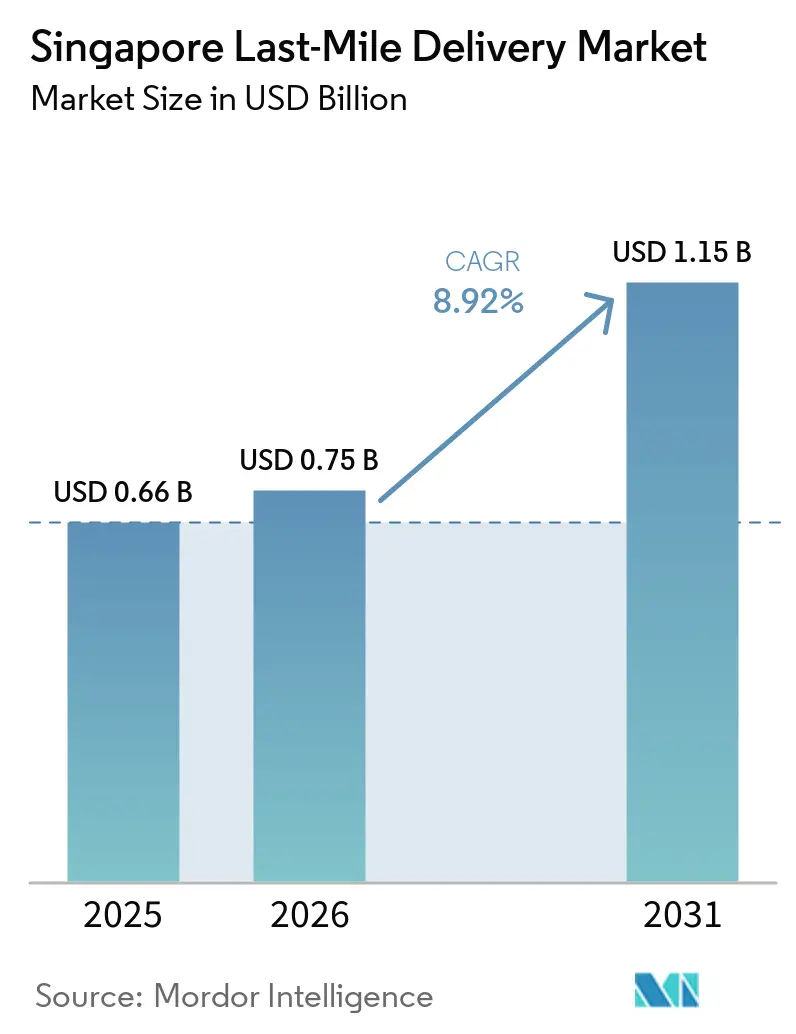
| Base Year Market Size (2025) | USD 0.66 Billion |
| Market Size (2026) | USD 0.75 Billion |
| Market Size (2031) | USD 1.15 Billion |
| Growth Rate (2026 - 2031) | 8.92 % |
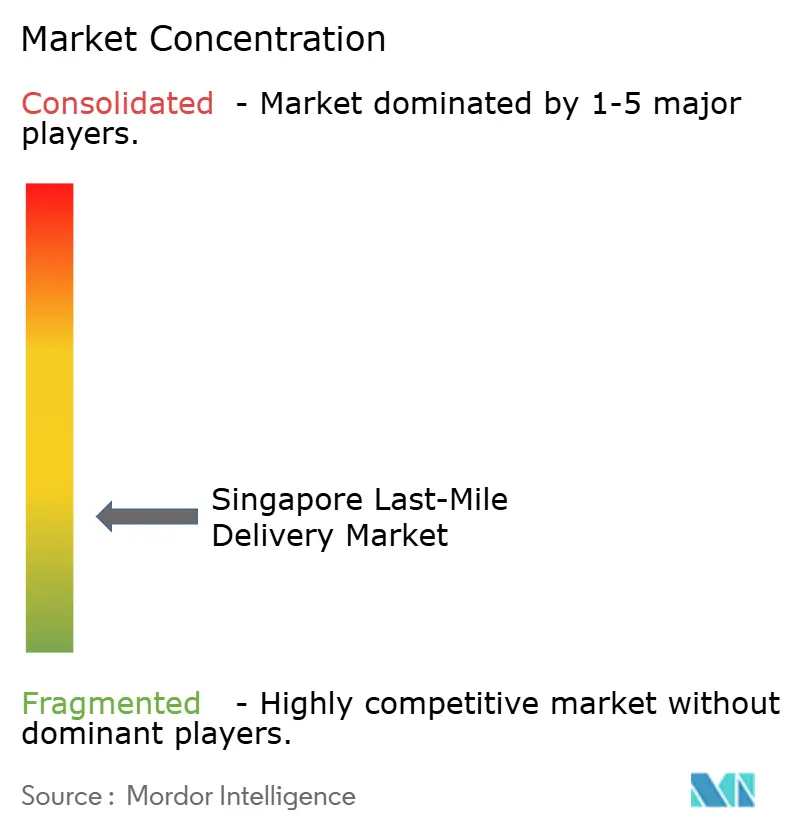
| Market Concentration | Low |
Major Players *Disclaimer: Major Players sorted in no particular order Image © Mordor Intelligence. Reuse requires attribution under CC BY 4.0. | |
Singapore Last-Mile Delivery Market Analysis by Mordor Intelligence
The Singapore Last-Mile Delivery market size is expected to grow from USD 664.24 million in 2025 to USD 747.72 million in 2026 and is forecast to reach USD 1,146.13 million by 2031 at 8.92% CAGR over 2026-2031.
Strong e-commerce adoption, dense urban geography, and policy-led infrastructure investments give Singapore an outsized role in regional fulfillment. Standard delivery maintains volume leadership, but rising same-day expectations, healthcare logistics demand, and cross-border micro-shipments reinforce premium service uptake. The federated locker network, Grade-A urban warehousing, and Tuas–Changi dual-hub configuration underpin high asset utilization, while looming fleet-electrification rules reshape capital planning for operators. Intensifying automation offsets labor scarcity, and platform-owned logistics arms blur B2B, B2C, and C2C boundaries within the Singapore last-mile delivery market.
Key Report Takeaways
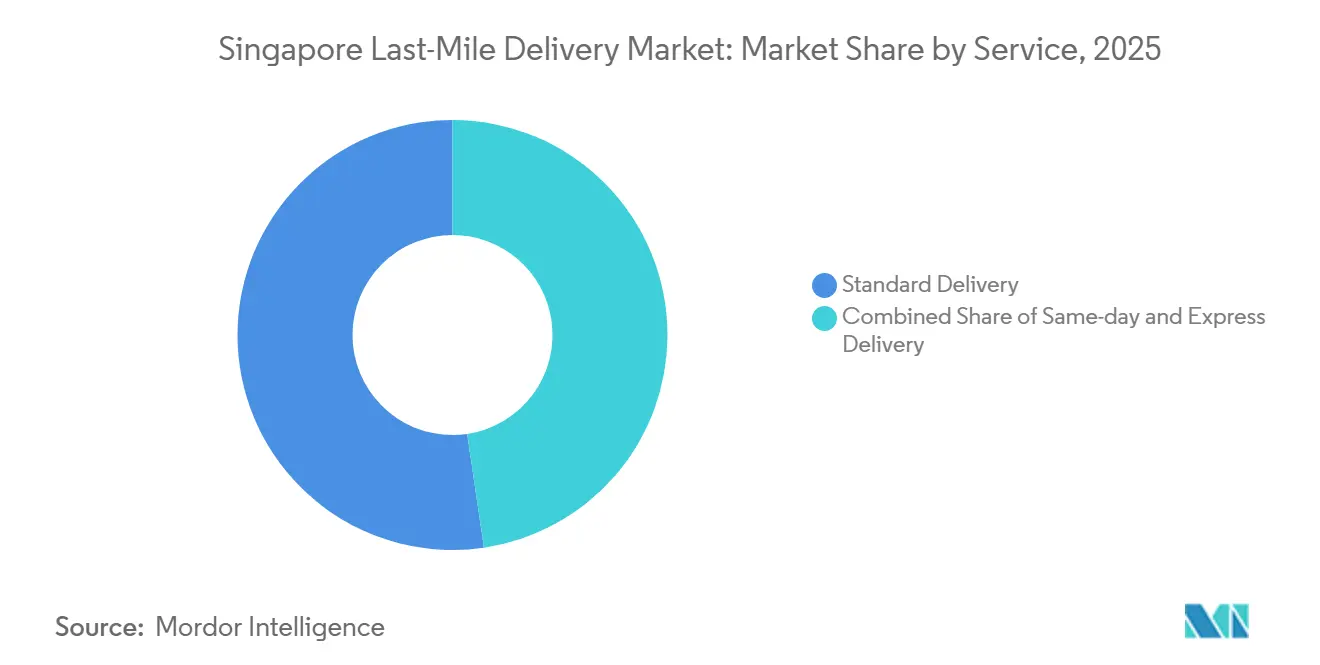
- By service, standard delivery held 52.34% of the Singapore last-mile delivery market share in 2025; express delivery is projected to post an 11.1% CAGR through 2031.
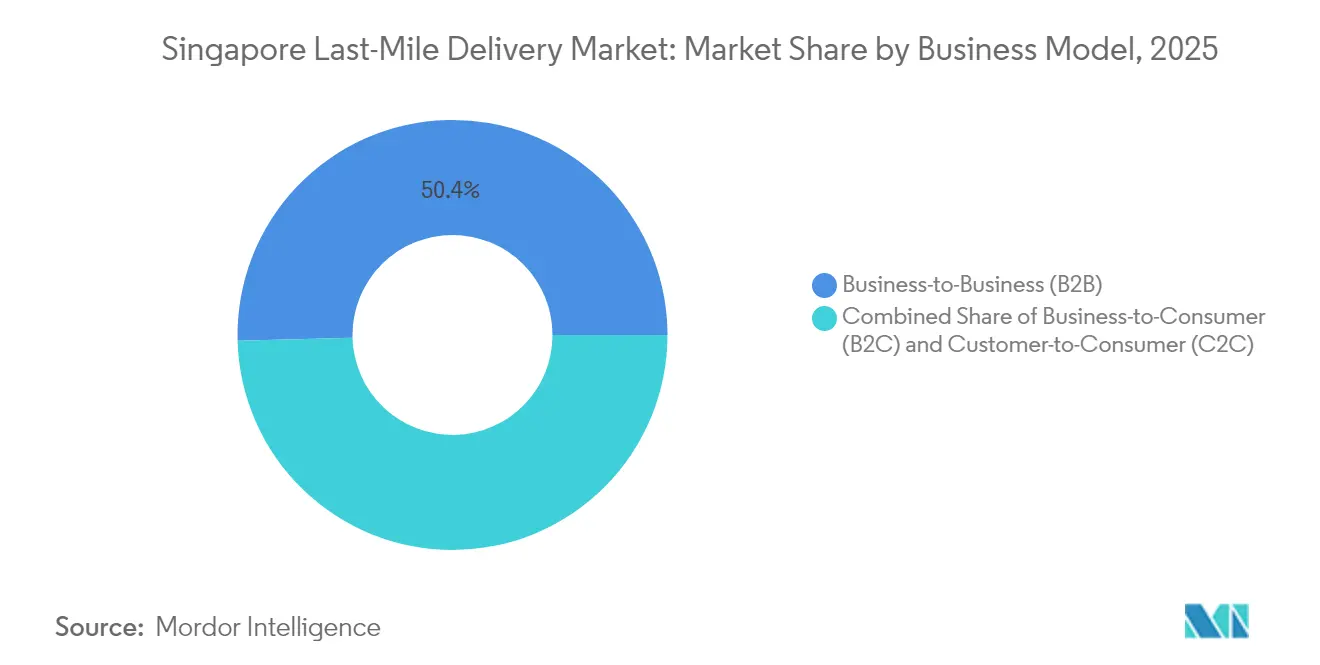
- By business model, B2B commanded a 50.42% share of the Singapore last-mile delivery market size in 2025, while C2C is forecast to advance at a 12.37% CAGR to 2031.
- By end-user, e-commerce retail accounted for 28.65% of the Singapore last-mile delivery market size in 2025; healthcare & medical supplies are rising at a 13.21% CAGR to 2031.
Note: Market size and forecast figures in this report are generated using Mordor Intelligence’s proprietary estimation framework, updated with the latest available data and insights as of 2026.
Singapore Last-Mile Delivery Market Trends and Insights
Drivers Impact Analysis*
| Driver | (≈) % Impact on CAGR Forecast | Geographic Relevance | Impact Timeline |
|---|---|---|---|
| E-commerce penetration surge | +2.8% | Nationwide | Medium term (2-4 years) |
| Rising same-day / express demand | +2.1% | Island-wide | Short term (≤ 2 years) |
| Government-backed nationwide locker network | +1.4% | Nationwide | Long term (≥ 4 years) |
| Cross-border micro-shipments via social commerce | +1.9% | Singapore–Malaysia–Thailand corridor | Medium term (2-4 years) |
| Cold-chain B2B restocking opportunities | +1.2% | Core Singapore, Johor, Batam | Long term (≥ 4 years) |
| Availability of Grade-A urban logistics real estate | +0.8% | Western & Eastern clusters | Medium term (2-4 years) |
| Source: Mordor Intelligence | |||
E-commerce Penetration Surge Drives Structural Market Expansion
Close to 55% of online purchases in Singapore arrive from overseas merchants, straining last-mile capacity during shopping festivals. Social-commerce discovery channels—TikTok, Instagram, Facebook—now funnel 59% of all cross-border purchases, making micro-shipments the new normal. Shopee’s International Platform multiplied seller orders eightfold during pilots, proving that free cross-border shipping incentives permanently elevate parcel flows. Sustained volume growth pushes carriers to invest in multi-modal customs clearance nodes and advanced small-parcel sortation capable of regional reach beyond the city-state.
Rising Same-Day and Express Demand Reshapes Service Expectations
Same-day options have become baseline as 52% of shoppers now expect sub-24-hour fulfillment across more categories. Express services grow at 7.4% CAGR, fueled by premium electronics, B2B restocking, and temperature-sensitive pharma orders. Aging demographics and telemedicine lift healthcare & medical supplies deliveries by 9.6% CAGR. Automated storage and retrieval systems capable of –35 °C to ambient handling protect cold-chain integrity and cut labor exposure. Integrated cold-chain plus express capacity therefore commands premium yields within the Singapore last-mile delivery market.
Government-Backed Nationwide Locker Network Creates Infrastructure Foundation
The Pick Network’s 1,000 parcel lockers sit within a five-minute walk of most HDB households and plug into MRT stations and community clubs, slashing failed deliveries that historically consumed up to 40% of driver time. IMDA’s federated design lets multiple operators share infrastructure, lowering capex while raising network density. Panasonic’s 500 smart lockers anchor phase one, complete with biometric authentication and real-time monitoring[1]Panasonic Connect, “Panasonic Completes 500 Parcel Lockers Island-Wide in Singapore for Pick Network,” ap.connect.panasonic.com. Urban Redevelopment Authority pilots extend the model with consolidated hubs in multi-storey carparks and autonomous robot tests, signaling long-term state commitment to last-mile optimisation.
Cross-Border Micro-Shipments Via Social Commerce Accelerate Regional Integration
TikTok Shop’s 135 million Southeast-Asian users generate impulse buys that rely on Singapore’s fast-clearance customs to hit three-day delivery targets. The city-state’s SGD 400 (USD 294) de minimis threshold keeps most parcels duty-free, cutting border dwell time to under 10 minutes[2]Janio Asia, “Singapore Markets,” janio.asia. Multi-currency corporate cards like YouBiz offer zero FX fees and 1% cashback, easing seller adoption of cross-border campaigns. These platform-centric flows pressure carriers to master specialized customs declarations and real-time duty reconciliation, capabilities that traditional freight forwarders still lack.
Restraints Impact Analysis*
| Restraint | (≈) % Impact on CAGR Forecast | Geographic Relevance | Impact Timeline |
|---|---|---|---|
| Urban curb-space & traffic congestion | -1.6% | CBD, dense residential zones | Short term (≤ 2 years) |
| Tight labour market & rising manpower costs | -2.3% | Nationwide | Short term (≤ 2 years) |
| Phasing-out of shipping subsidies by e-commerce platforms | -1.8% | National / regional | Medium term (2-4 years) |
| High COE & EV-charging costs for fleet electrification | -1.4% | Commercial vehicle operators | Long term (≥ 4 years) |
| Source: Mordor Intelligence | |||
Tight Labour Market and Rising Manpower Costs Accelerate Automation Adoption
Eighty-nine percent of logistics employers report recruitment difficulties as sector revenue outpaces workforce growth. Autonomous mobile robots, AI route optimizers, and digital dispatch engines such as A*STAR SIMTech’s Last-Mile Logistics Management allow carriers to scale parcel volumes without proportional headcount. Automation ROI shortens further when paired with mounting wage pressure and a 1.2% annual labor-supply increase against an 8.7% revenue rise.
Urban Curb-Space and Traffic Congestion Constrain Operational Efficiency
Limited loading bays and heightened enforcement in the CBD squeeze delivery windows. LTA’s new rules reducing personal-mobility-aid speed from 10 km/h to 6 km/h temper rider efficiency but improve pedestrian safety[3]Land Transport Authority, “New Rules on Personal Mobility Aids,” lta.gov.sg. The ERP 2.0 virtual-gantry roadmap may introduce distance-based charging, nudging operators toward night deliveries and locker use to bypass peak congestion.
*Our forecasts treat driver/restraint impacts as directional, not additive. The impact forecasts reflect baseline growth, mix effects, and variable interactions.
Segment Analysis
By Service: Express Delivery Gains Momentum Despite Standard Dominance
Standard delivery retained 52.34% of the Singapore last-mile delivery market share in 2025, reflecting entrenched cost-sensitive habits and optimized 1-to-3-day networks. Express services, however, post an 11.1% CAGR (2026-2031) as merchants weaponize speed for differentiation. Same-day courier apps deliver island-wide in 45 minutes, and GrabExpress leverages super-app driver pools for blended food-and-parcel dispatch. Cold-chain add-ons, secure handling, and white-glove furniture installation broaden express addressable revenue while cushioning margins against commoditized standard rates.
Asset-light micro-fulfilment nodes sited within retail estates compress lead times further. Yet escalating curb-space constraints trigger alternate modes: locker drop-offs, autonomous robots, or scheduled pick-ups. Compliance with GDP pharma standards and HACCP rules raises operational barriers, favoring incumbents with certified quality systems. The Singapore last-mile delivery market size for express services, therefore, rises faster than overall volume growth, signaling ongoing premiumization.



By Business Model: B2B Resilience Meets C2C Innovation
B2B deliveries captured 50.42% of the Singapore last-mile delivery market size in 2025, underpinned by free-trade-zone warehousing and predictable replenishment cycles. Duty-deferred inventory at Changi Air FTZ and Jurong Port lets wholesalers restock ASEAN stores within 48 hours, ensuring low stock-out risk for multinational retailers.
C2C shipments grow at 12.37% CAGR (2026-2031) as peer marketplaces like Carousell integrate on-demand couriers for bulky items. Individual sellers use time-slot booking and digital waybills, turning ad-hoc moves into trackable logistics events. B2C flows, while mature, now blur with C2C as social-commerce micro-brands ship directly from home inventories. This hybridization forces carriers to offer granular APIs and multi-wallet settlement so that one network seamlessly handles invoices, personal parcels, and platform orders within the Singapore last-mile delivery market.
By End-User Industry: Healthcare Acceleration Transforms Traditional Retail Dominance
E-commerce retail controlled 28.65% of the Singapore last-mile delivery market size in 2025, fueled by fashion, beauty, and consumer electronics. Marketplace campaigns and buy-now-pay-later adoption sustain this base.
Healthcare & medical supplies log a 13.21% CAGR (2026-2031), requiring GDP-compliant cold vans, tamper-evident packaging, and minute-level temperature telemetry. Telehealth prescriptions now demand two-hour home delivery, pushing carriers to deploy insulated totes inside express fleets. Furniture and large appliances still hinge on white-glove assembly and flexible scheduling; automation initiatives such as route-sequenced loading reduce dwell time at destination, raising daily drop counts. As vertical specialization deepens, multi-segment operators bundle sector-specific SLAs to maximize fleet utilization across the Singapore last-mile delivery market.
Geography Analysis
Singapore’s compact 728 km² footprint means every address sits within a 50 km radius, underpinning island-wide same-day capability. The western Tuas-Jurong cluster handles 39.01 million TEUs yearly, feeding maritime-origin parcels into micro-fulfilment nodes near HDB estates. Eastern Changi logistics parks manage express air freight, aligning with healthcare and high-tech cargo that demands rapid clearance.
Cross-border corridors via Woodlands Causeway enable daily shuttles to Johor with 3-hour transit times, while ferry links to Batam serve electronics producers sourcing Singapore components. The forthcoming Johor–Singapore Special Economic Zone promises duty-free shuttle runs, expanding the regional relevance of the Singapore last-mile delivery market beyond its borders.
Regulatory Landscape
Singapore last-mile delivery is primarily regulated through the Infocomm Media Development Authority (IMDA), as the appointed Postal Authority administering the Postal Services Act. This includes licensing and codes of practice for postal and parcel services. The Postal Services Act was amended to reflect the evolving postal and e-commerce landscape and to enable IMDA to manage a nationwide public parcel locker network, which aligns regulation with shared infrastructure models such as the federated locker approach used for parcel collection points.
Operational compliance is also shaped by standards and transport rules that affect delivery execution. Singapore Standards Technical Reference TR 105:2022 provides voluntary guidelines for last-mile parcel delivery, covering packaging, labeling, data standardization, and communication gateways between marketplaces and logistics service providers, which supports interoperability across platform-led and carrier-led networks. On-street delivery execution is influenced by Land Transport Authority (LTA) measures for last-mile deliveries, including initiatives tied to delivery waiting bays at private developments and broader urban logistics toolkits that address curbside constraints in dense areas.
Value Chain Analysis
The value chain begins with merchants and marketplaces, including cross-border sellers, that generate parcels. It then moves through upstream consolidation and fulfillment in urban logistics facilities, line-haul and sortation into delivery stations, and finally last-mile distribution via door-to-door, parcel locker, and collection-point networks. Shared infrastructure is a distinctive layer in Singapore, with IMDA-supported federated locker and collection point programs linking locker operators, delivery companies, and retailers to coordinate drop-offs and pick-ups, which reduces failed deliveries and improves route density.
Execution depends on a blend of assets and ecosystem partners: vehicle fleets, including EV trials and charging planning, warehousing and Grade-A urban logistics real estate, and technology vendors for route optimization, tracking, and system-to-system integration aligned with TR 105:2022 guidance. Local and regional bodies such as the Singapore Logistics Association (SLA), Singapore Transport Association (STA), Container Depot and Logistics Association (Singapore) (CDAS), and the Conference of Asia Pacific Express Carriers (CAPEC) support industry coordination and capability building. Large integrators and regional parcel networks, such as DHL Express and J&T Express, contribute scale through automated sorting and line-haul connectivity, while platform-owned logistics arms and on-demand couriers extend reach into B2C and C2C flows.
Competitive Landscape
Singapore’s last-mile delivery industry shows moderate fragmentation: platform-owned carriers, tech-enabled couriers, the national post, and specialized cold-chain players battle for share. Ninja Van scales proprietary routing and region-wide hubs to anchor merchant loyalty. Grab exploits its super-app to blend people, food, and parcel mobility, keeping driver utilization high.
Shopee’s SPX Express now fulfills over half of marketplace orders regionally, locking customers into the ecosystem delivery. Singapore Post pivots from mail to e-commerce logistics, investing in AI load-balancing and 4PL orchestration. Sustainability leadership appears through EV-only start-ups such as EVFY, which offers zero-emission fleets and telematics-based carbon dashboards to enterprise shippers.
Automation is an arms race: carriers pilot robot sorters, computer-vision parcel measurement, and AI dispatch to offset 2.3% wage-inflation drag. Healthcare, cold-chain, and cross-border micro-shipments remain white-space areas where smaller specialists carve defensible niches.
Singapore Last-Mile Delivery Industry Leaders
Ninja Van
Singapore Post
J&T Express
GrabExpress
DHL Express
- *Disclaimer: Major Players sorted in no particular order

Market Opportunities and Future Outlook
Automation and capacity scaling in sortation and delivery orchestration create a clear whitespace for operators serving peak e-commerce and cross-border micro-shipments, particularly where labor scarcity pressures service levels. Company actions in 2026 show how the pathway is being pursued in practice. Singapore Post announced a S$30 million automated sortation hub at its Regional eCommerce Logistics Hub, with small and medium parcel processing capacity rising from 100,000 to 300,000 parcels per day, while regional players such as J&T Express reported expansions in Southeast Asia sorting infrastructure, including more automated sorting lines and a broader sorting-center footprint. Taken together, these moves lift competitive benchmarks for throughput, scanning accuracy, and parcel-handling cycle times, favoring providers that connect facility automation with real-time dispatch and marketplace integration.
Urban execution constraints and sustainability requirements also support opportunities around alternative delivery and consolidation models that cut curbside time, reduce redelivery, and lower fuel exposure. IMDA-enabled federated locker infrastructure and LTA measures to improve last-mile deliveries, including toolkits for delivery waiting bays at private developments developed through a tripartite workgroup since November 2023, support more predictable handover points and scheduled delivery waves. Separately, EV adoption and route optimization are being used as cost and productivity levers amid rising fuel and operating costs, and pilots such as Grab's autonomous delivery robots in Punggol show how dense residential districts can be served using new operating models when integrated with building access and doorstep handover workflows.
Recent Industry Developments
- June 2026: Singapore Post unveiled a S$30 million automated parcel sortation hub at its Regional eCommerce Logistics Hub, increasing small and medium parcel processing capacity from 100,000 to 300,000 parcels per day. The capacity expansion strengthens national e-commerce fulfillment capabilities and enhances throughput for Singapore's last-mile network. Automation-driven efficiency helps maintain service levels amid growing delivery volumes.
- May 2026: Grab commenced piloting autonomous delivery robots in Punggol, Singapore, as part of a multi-company test to address labor shortages in last-mile delivery. The test demonstrates progress toward robot-enabled delivery in dense urban areas and supports sustained capacity. Robot driven operations contribute to long term labor relief strategies for the market.
- May 2026: SPX Express partnered with Carousell to join the Carousell Official Delivery network, offering subsidised delivery fees starting at S$1.80. The collaboration ties delivery pricing to the marketplace ecosystem and expands service reach. The move broadens SPX Express's competitive position in Singapore's last-mile landscape.


Research Methodology Framework and Report Scope
Market Definition and Coverage
This market is sized as the revenue generated from last-mile delivery activities within Singapore, covering the final handoff of parcels and local shipments from a fulfillment point to the end recipient, for consumers and businesses.
Scope exclusions: Excludes cross-border freight forwarding and long-haul linehaul movements that sit upstream of the domestic last-mile handover.
Segmentation Overview
- By Service
- Standard Delivery
- Same-day
- Express Delivery
- By Business Model
- Business-to-Business (B2B)
- Business-to-Consumer (B2C)
- Customer-to-Consumer (C2C)
- By End-user Industry
- E-commerce Retail
- Fashion & Lifestyle
- Beauty, Wellness & Personal Care
- Home & Furniture
- Consumer Electronics & Appliances
- Healthcare & Medical Supplies
- Others
Data Sources, Market Sizing, and Validation
Desk Research
Desk research starts by mapping Singapore demand signals and logistics capacity indicators that can be checked publicly, before any assumptions are pushed into the model. We typically refer to official statistics and regulator publications such as the Singapore Department of Statistics, Enterprise Singapore releases, IMDA e-commerce and digital adoption reads, and LTA transport indicators, which help anchor activity levels and operating conditions.
To translate activity into market value, we also use operator disclosures and public documents such as annual reports, investor presentations, and press releases, followed by association and postal ecosystem materials where available. In a few places, we use paid subscriptions for company financials and a shipment-level import and export view to cross-check revenue direction and trade-linked volume context, even when the final delivery itself is domestic. The desk sources listed are illustrative only, and many other public documents were reviewed for data collection, validation, and clarification.
Primary Interviews and Surveys
Primary work is used to validate what the secondary data cannot show clearly, especially pricing logic, delivery mix shifts, and how volume is distributed across parcel, grocery, and food-type networks. We spoke with executives, functional leaders, and managers across carrier operations, urban logistics teams, and shipper-side logistics owners in Singapore, and then used follow-up checks to close gaps and confirm that assumptions still hold.
Because service levels drive much of the revenue in this market, interview feedback was also used to sanity-check the split between standard, same-day, and express fulfillment, and how this split changes during peak periods and around consumer delivery expectations.
Distribution of primary research fieldwork respondents
| Company type | Respondent position |
|---|---|
| Top tier: 25% | CXOs: 13% |
| Mid tier: 56% | Functional/Unit leaders: 31% |
| Smaller Players: 19% | Managers: 56% |
Market-Sizing & Forecasting
Sizing is built using a top-down reconstruction where e-commerce demand, shipment intensity, and delivery service mix are translated into revenue for Singapore, and then the outputs are checked against what operators and shippers say they see on the ground. Where the data allows it, we corroborate totals using selective bottom-up approximations, such as sampled price-per-drop ranges multiplied by realistic delivery volumes, followed by channel checks across different service levels.
A few inputs that matter most in this market include delivery density in an urban setting, the mix of standard versus same-day and express, average delivery fees and surcharges, failed delivery and re-attempt patterns, and the share of B2C versus B2B drops. These indicators help avoid overcounting by keeping the model tied to the actual last-mile work performed rather than broad logistics spending. If a variable has weak public coverage, we fill the gap with interview-based ranges and apply conservative bounds, which are then re-tested against any available financial disclosures.
Forecasting is done using scenario analysis supported by simple time-series smoothing, because demand is shaped by policy and cost shifts as much as by organic growth. Assumptions on service mix and pricing progression are reviewed with primary respondents so the forecast does not rely on a single aggressive curve.
Data Validation & Update Cycle
Outputs are validated through a set of cross-checks, including variance checks against independent demand indicators and a review of whether the implied price and volume trends look realistic for Singapore. When a segment shows an unusual jump, the drivers are re-opened, and respondents are re-contacted to confirm whether it reflects a true shift, such as service upgrades or peak-driven surcharges.
Before sign-off, the model and its assumptions go through multi-step analyst reviews so calculation logic, unit consistency, and currency timing are aligned. Reports are refreshed annually, and interim updates are made when material events can change volumes or pricing. Prior to delivery, a final pass is completed to align the report with the latest available public information and recent primary feedback.
Mordor Intelligence's Singapore Last Mile Delivery Market Size Measured Against Other Published Estimates
Published market values for Singapore last-mile delivery can look far apart because each publisher draws the market boundary differently, and then applies its own pricing and service-mix assumptions. Differences also show up when one estimate uses an older base year, a different currency conversion point, or a forecast stance that is intentionally conservative or intentionally optimistic.
International express parcels that move mainly as part of cross-border courier chains sit outside Mordor Intelligence scope here, which is one reason our 2025 number can be higher than narrow parcel-only reads, yet lower than figures that fold in broader logistics and linehaul revenue. Another frequent gap driver is how same-day and express premiums are treated, since using a flat average fee can understate peak surcharges and re-attempt costs. Refresh timing matters as well, because a model updated with newer e-commerce and delivery mix signals will not match an older snapshot even if the definitions were similar.
Benchmark comparison
| Source | Market Size | Gaps in Research Methodology |
|---|---|---|
| Mordor Intelligence | USD 12.98 B (2025) | |
| Regional Consultancy A | USD 1.21 B (2022) | Uses a narrower parcel-delivery lens with limited inclusion of on-demand grocery and food-type last-mile flows, and it also anchors pricing on older fee levels without fully reflecting later service premiums. |
| Industry Publisher B | USD 42.98 B (2025) | Appears to bundle adjacent logistics revenues beyond last-mile delivery, which can pull in linehaul and broader freight services, and this inflation is then carried forward through the forecast without a clear service-scope split. |
The spread in the table is mostly explained by what is counted as last mile versus broader logistics, and by whether pricing is kept flat or allowed to shift with service mix and surcharges. By keeping inputs tied to observable delivery activity and then re-checking the implied pricing with primary feedback, the estimate stays traceable to repeatable steps that can be revisited as the market changes.


Key Questions Answered in the Report
How large is the Singapore last-mile delivery market in 2026?
It is valued at USD 747.72 million in 2026 with a 8.92% CAGR outlook to 2031.
Which service segment is expanding fastest?
Express delivery posts the quickest pace at 11.1% CAGR on rising same-day expectations.
Why is healthcare logistics gaining prominence?
Strict temperature control needs and telehealth adoption push healthcare & medical supplies deliveries at 13.21% CAGR.
How do parcel lockers improve efficiency?
The 1,000-unit Pick Network cuts failed deliveries, trimming driver dwell time and curb congestion.
What role do cross-border micro-shipments play?
Social-commerce platforms funnel high-frequency, low-value parcels, boosting small-parcel volumes and customs-clearance demand.
How concentrated is competition?
The top five operators capture roughly 60–65% share, giving the market a moderate concentration score of 6.
Page last updated on:





