
Market Overview
| Study Period | 2020 - 2031 |
|---|---|
| Market Volume (2026) | 3.32 Million tons |
| Market Volume (2031) | 4.26 Million tons |
| Growth Rate (2026 - 2031) | 5.12 % |
| Fastest Growing Market | Asia-Pacific |
| Largest Market | Asia-Pacific |
| Market Concentration | Medium |
Major Players *Disclaimer: Major Players sorted in no particular order Image © Mordor Intelligence. Reuse requires attribution under CC BY 4.0. | |
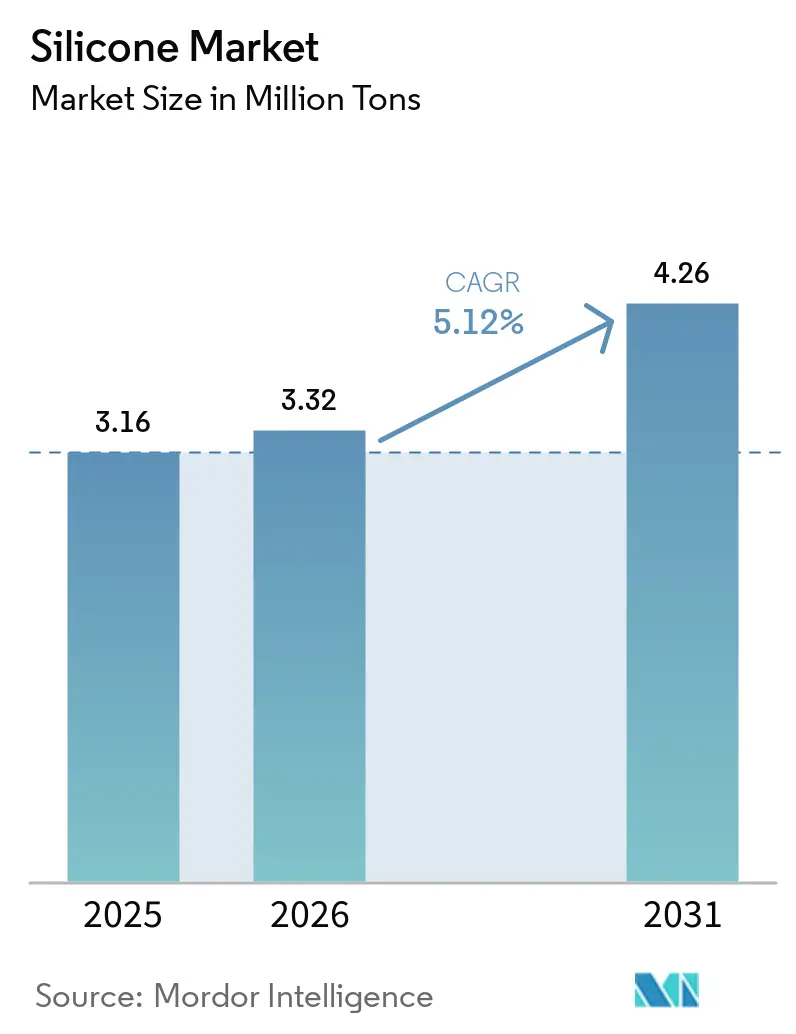
Silicone Market Analysis by Mordor Intelligence
Silicone market size in 2026 is estimated at 3.32 million tons, growing from 2025 value of 3.16 million tons with 2031 projections showing 4.26 million tons, growing at 5.12% CAGR over 2026-2031. This measured expansion reflects the material’s entrenched role across mature end-uses while signaling rapid uptake in next-generation applications that demand higher performance and reliability, especially in electric mobility, renewable power, advanced electronics, and medical technology. Robust infrastructure spending in Asia-Pacific, the shift to battery-electric vehicles, and regulatory pushes for more durable, low-maintenance materials continue to underpin baseline growth. At the same time, specialty grades designed for thermal management, biocompatibility, and environmental compliance are unlocking price premiums that help producers protect margins from silicon-metal volatility. Competitive barriers remain rooted in integrated supply chains, proprietary formulations, and the qualification cycles required in safety-critical applications, all of which support a steady value-creation path for incumbents in the silicone industry.
Key Report Takeaways
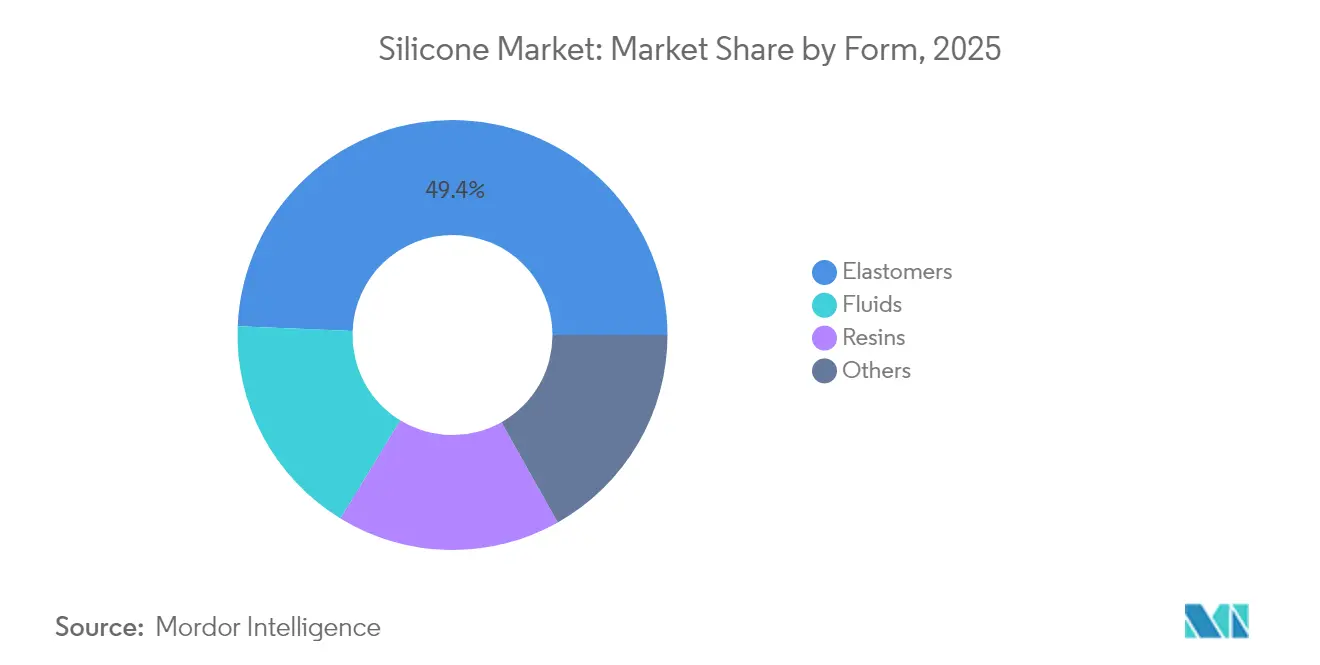
- By form, elastomers captured 49.35% of the silicone market share in 2025, while the segment is projected to expand at a 5.33% CAGR through 2031.
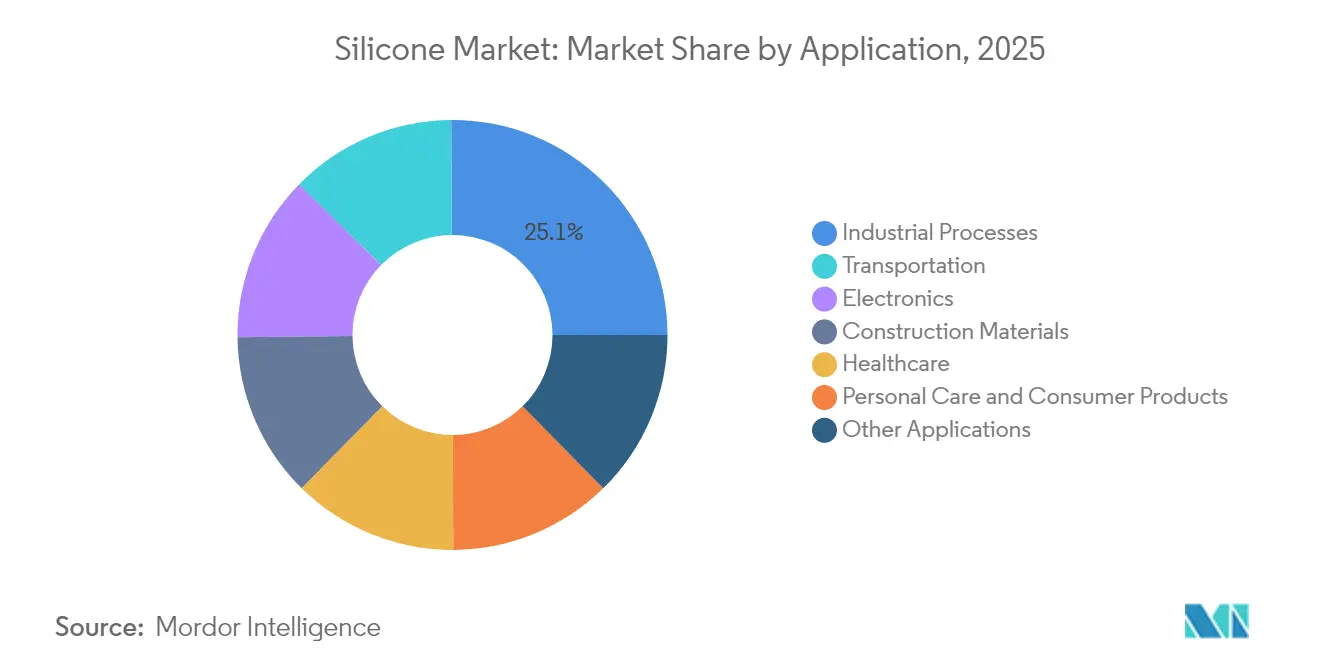
- By application, industrial processes accounted for 25.10% of the silicone market size in 2025 and are forecast to advance at a 5.70% CAGR between 2026-2031.
- By geography, Asia-Pacific held 65.10% of the silicone industry share in 2025; the region is poised to grow at a 6.39% CAGR over the same period.
Note: Market size and forecast figures in this report are generated using Mordor Intelligence’s proprietary estimation framework, updated with the latest available data and insights as of 2026.
Market Trends and Insights
Drivers Impact Analysis of Silicone Market*
| Drivers | (~) % Impact on CAGR Forecast | Geographic Relevance | Impact Timeline |
|---|---|---|---|
| Automotive and e-mobility applications | +1.2% | Global, concentration in China, Europe, North America | Medium term (2-4 years) |
| Healthcare and medical devices usage | +0.9% | Global, led by North America and Europe | Long term (≥ 4 years) |
| Power transmission and distribution grid demand | +0.7% | APAC core, spill-over to MEA and Latin America | Long term (≥ 4 years) |
| 5G base-station thermal materials | +0.6% | Global, early deployment in APAC and North America | Short term (≤ 2 years) |
| LSR in wearable medical sensors | +0.4% | North America and EU, expanding to APAC | Medium term (2-4 years) |
| Source: Mordor Intelligence | |||


Rising Applications in Automotive and E-mobility
Electric-vehicle (EV) adoption is multiplying the use of silicone by widening the performance gap versus traditional elastomers. Battery-pack sealing, thermal gap-pads, and high-voltage cable insulation collectively add close to 15 kg of silicone per Tesla Model Y, roughly triple that of an internal-combustion sedan. European OEMs now favor liquid-silicone rubber (LSR) for under-hood parts that must withstand new glycol-free coolants at 150 °C. Chinese EV makers have begun dual-sourcing high-consistency rubber and addition-cure LSR to buffer silicon-metal price swings, encouraging integrated suppliers to lock in long-term contracts. As stringent zero-emission targets phase in, every major automaker is redesigning gasketing, potting, and interface materials, creating an enduring pull for advanced grades across the silicone industry.
Increasing Usage in Healthcare and Medical Devices
Medical-grade silicones must clear USP Class VI and ISO 10993 testing, a protocol that can extend new-product roadmaps by up to 24 months, thereby shielding incumbent suppliers from short-cycle pricing pressure. Wearable glucose monitors, cardiac leads, and neuromodulation implants all hinge on LSR’s hypoallergenic profile and stable modulus at body temperature. Hospitals value the polymer’s sterilization compatibility with gamma, steam, and e-beam methods, which supports lean re-use strategies in minimally invasive tools. Digitization of care—particularly remote monitoring—has sparked OEM demand for translucent, optically clear silicone films that integrate optical sensors without compromising flex-life. Collectively, these factors cement healthcare as a margin-accretive pillar of the silicone industry.
Demand from Power Transmission and Distribution Grids
Upgrades to extra-high-voltage lines underscore silicone’s hydrophobicity, especially in environments where ceramic insulators suffer flashover. India alone will need roughly 50,000 tons of silicone-rubber insulators through 2030 to hit its grid-reliability targets[1]U.S. Geological Survey, “Mineral Commodity Summaries 2025,” USGS.GOV. Offshore wind farms in Korea and Taiwan further rely on silicone sealants to endure salt spray and ultraviolet exposure, while Latin American utilities specify room-temperature-vulcanizing (RTV) coatings for desert transmission corridors challenged by airborne dust. As climate events amplify outage costs, utilities view the higher upfront spending on silicone components as a justifiable hedge against downtime, reinforcing long-tail demand within the silicone industry.
5G Base-station Thermal Interface Materials
Radio units operating above 24 GHz dissipate more than 200 W/cm², a heat flux that conventional grease fails to manage. Silicone-based thermal pads featuring 3.0 W/mK conductivity meet carrier specifications for gap thicknesses below 200 μm, enabling miniaturized radio-frequency front ends. China exceeded 2.3 million 5G macro sites in 2024, prompting synchronized procurement cycles that stress specialty compound capacity. North American and European operators add complexity by requiring low volatile-siloxane grades to satisfy local emissions rules. Edge-computing nodes now replicate these thermal demands, widening the addressable portion of the silicone market across telecom infrastructure.
Restraints Impact Analysis of Silicone Market*
| Restraints | (~) % Impact on CAGR Forecast | Geographic Relevance | Impact Timeline |
|---|---|---|---|
| Silicon-metal price volatility and bottlenecks | -0.8% | Global, acute in Asia-Pacific | Short term (≤ 2 years) |
| Stringent siloxane-emission regulations | -0.5% | Europe and North America, spreading globally | Medium term (2-4 years) |
| Competition from fluoropolymers and plastics | -0.3% | Global, application-specific | Long term (≥ 4 years) |
| Source: Mordor Intelligence | |||
Volatile Silicon-metal Prices and Supply Bottlenecks
Spot silicon-metal swung between USD 1,800-3,200/ton in 2024 on energy-price gyrations and trade measures, squeezing margin profiles across integrated and merchant producers alike. China supplies nearly 68% of global output, so provincial power rationing immediately reverberates through downstream silicone volumes and pricing. While long-term offtake contracts provide partial insulation, most renew annually, leaving buyers exposed to structural energy-cost inflation. Pilot recycling of semiconductor kerf scrap yields less than 5% of chemical-grade demand, offering only modest relief. Until diversified, low-carbon smelting gains scale, raw-material turbulence will shadow short-term forecasts for the silicone industry.
Stringent Siloxane Emission Regulations
The European Chemicals Agency’s push to restrict D4, D5, and D6 cyclics under REACH obliges producers to re-engineer fluids and personal-care intermediates or face market exit. Reformulation and testing can add more than USD 500,000 per SKU, not counting the 18-month sell-through grace period[2]European Commission DG Environment, “Ship hull anti-fouling—are silicone-based coatings a viable, sustainable alternative to toxic, copper-based coatings in the Baltic Sea?” ENVIRONMENT.EC.EUROPA.EU . Similar draft rules in Canada and selected U.S. states foreshadow a wider compliance footprint. Although the hurdle favors incumbents with strong regulatory teams, it also diverts research and development resources away from growth programs. On the upside, the drive accelerates next-generation linear-chain chemistries, opening differentiated niches within the silicone industry for low-VOC and biodegradable solutions.
*Our forecasts treat driver/restraint impacts as directional, not additive. The impact forecasts reflect baseline growth, mix effects, and variable interactions.
Silicone Market Segment Analysis
By Form:
Elastomers Lead Innovation and Volume GrowthSilicone elastomers controlled 49.35% of the silicone market share in 2025 and are forecast to grow at a 5.33% CAGR through 2031. Within this group, liquid-silicone rubber for EV connectors and medical catheters captures the lion’s share of incremental tonnage, while high-consistency rubber secures repeat orders in industrial gasketing. LSR’s platinum-cure chemistry shortens cycle times, allowing multi-cavity molds that scale efficiently for high-volume parts. Meanwhile, room-temperature-vulcanizing (RTV) grades strength-en sealant franchises in construction rehabilitation, feeding consistent demand regardless of macro-cycles. Collectively, these attributes make elastomers the pivotal innovation hub in the silicone industry.
Fluids rank second in volume, anchored by their role as process aids, lubricants, and personal-care emollients. Although impending siloxane limits challenge commodity cyclics, linear-chain fluids with lower volatility are gaining traction and help offset losses. Resins continue to deliver niche growth as protective encapsulants in power electronics and solar panels, where their thermal stability outperforms epoxy analogs. Specialty formats—gels, foams, and powders—round out the portfolio, supplying advanced textiles, 3-D printing resins, and additive-manufacturing binders. Even as boundaries blur, the cumulative developments sustain a balanced contribution to the silicone market size.


By Application:
Industrial Processes Drive Market EvolutionIndustrial processes accounted for a 25.10% slice of the silicone market size in 2025 and are on track for a 5.70% CAGR by 2031. Chemical and pharmaceutical plants rely on silicone antifoams to secure batch-purity and throughput, an especially salient factor as biologics and high-potency actives proliferate. Food processors adopt FDA-compliant silicone lubricants that resist steam cleaning cycles, boosting equipment uptime and worker safety. These cross-segment synergies reinforce industrial processes as the cornerstone of demand within the silicone industry.
Transportation applications follow closely, energized by EV battery sealing, lightweight glazing, and high-temperature hose assemblies. Construction retains a solid base as stricter building codes specify silicone weather-seals for air-infiltration control. Electronics surge on the back of 5G infrastructure, solid-state lidar, and wearables requiring miniaturized thermal interface layers. Healthcare maintains double-digit unit growth through implantables and disposables that must withstand sterilization. Personal-care volumes plateau in Europe due to cyclic restrictions, but find a lift in Asia via reformulated shampoos and color cosmetics. This diversity of pull factors insulates the silicone industry from single-sector shocks, supporting its durable growth profile.
Geography Analysis
APAC Silicone Market
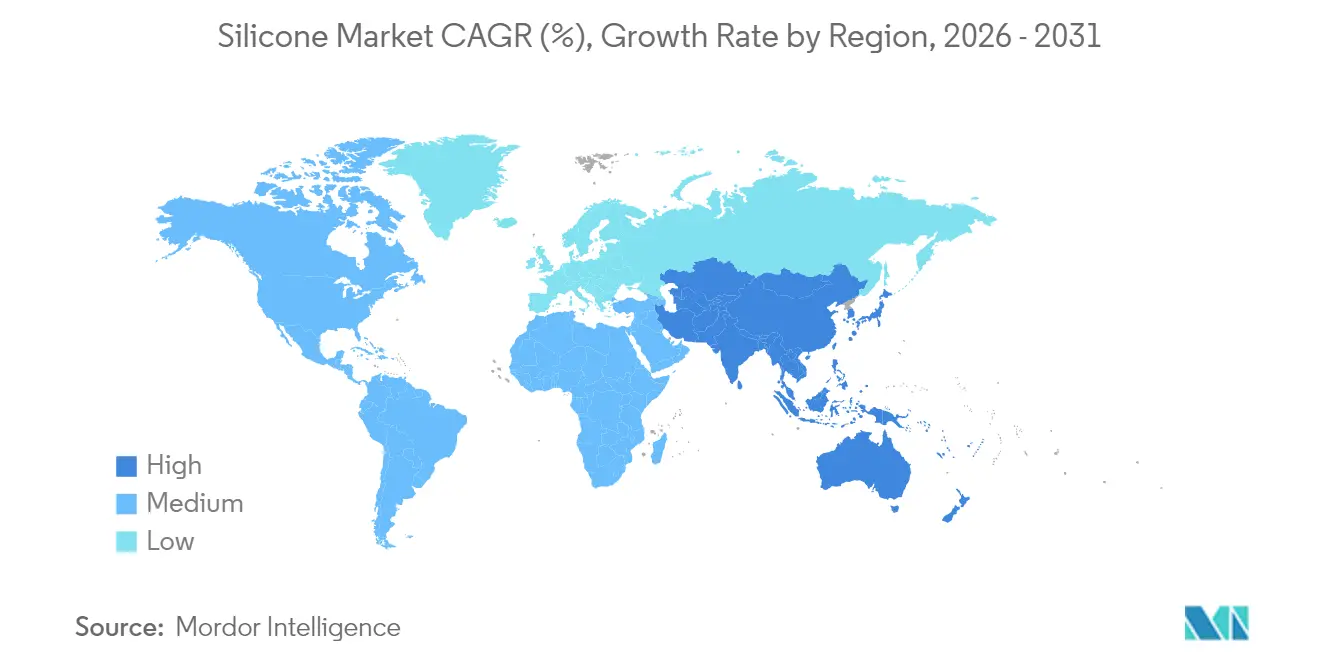
Asia-Pacific wielded 65.10% of the global silicone market share in 2025, propelled by integrated supply chains and prolific downstream manufacturing. China features fully backward-integrated players that couple local silicon-metal furnaces to elastomer finishing plants, enabling cost competitiveness and rapid scale-up.
North America Silicone Market
North America remains a technology vanguard, where aerospace, advanced automotive, and biomedical device makers impose stringent material specifications. The CHIPS Act catalyzes domestic semiconductor production, triggering new orders for ultra-low-ionic contamination silicone encapsulants. Wind-turbine repowering in the Midwest and solar-farm expansions in the Southwest anchor demand for high-durability sealants, while the U.S. Food and Drug Administration’s predictable pathway for LSR components bolsters healthcare volumes. These trends, paired with active research into bio-based siloxane precursors, position the region as an innovation driver in the silicone industry.
Europe Silicone Market
Europe secures its role through specialty applications and regulatory leadership. Producers invest in closed-loop depolymerization units that convert spent elastomer scrap into cyclic monomers, aligning with the bloc’s circular-economy vision. Automotive electrification mandates energize demand for high-temperature, low-bleed thermal pads, while offshore-wind build-outs in the North Sea necessitate robust resins for nacelle encapsulation. Although REACH obligations elevate compliance costs, they also create barriers that temper direct price competition, sustaining value density across the European silicone industry.

Regulatory Landscape
Regulation is increasingly centered on cyclic siloxanes and compliance for downstream products, with Europe a focal point. Under EU REACH, restrictions targeting D4, D5, and D6 tightened further in 2026, and the European Commission adopted Regulation (EU) 2026/1289 on July 14, 2026 to limit the combined D4 and D5 content in silicone sealants to 0.1% w/w, with application from January 1, 2027. This is accelerating moves toward higher-purity, lower-residue formulations, and it raises the documentation and testing burden for sealants and other silicone-containing finished goods sold into the EU.
In North America, U.S. EPA actions can also influence formulation choices in selected end uses. EPA established a tolerance exemption for methyl end-capped polydimethylsiloxane (CAS No 63148-62-9) in pesticide formulations effective March 25, 2026, supporting continued use of specific silicone ingredients in agricultural chemical applications where permitted. In Asia, trade and export-policy changes are shaping the regulatory-operating environment for producers and exporters, including when China canceled the 13% VAT export tax rebate for primary-form polysiloxanes (HS 39100000) effective April 1, 2026, reinforcing a shift away from bulk commodity exports and toward higher-value, processed silicone products.
Value Chain Analysis
The silicone value chain runs from energy-intensive upstream silicon metal and chlorosilane intermediates through polymerization to siloxanes (fluids, elastomers, resins), followed by compounding and formulation into end-use products such as sealants, thermal interface materials, medical-grade LSR components, and industrial process aids. Upstream concentration in Asia, particularly China, continues to influence global availability and pricing, while Western markets tend to emphasize specialty grades and compliance-driven qualification cycles (for example, USP Class VI and ISO 10993 requirements in medical devices). That structure increases the importance of application labs, testing partners, and long-term customer approvals.
Downstream distribution and regional service networks remain a key control point for specialty growth and supply assurance. In May 2026, Univar Solutions expanded its strategic partnership with Dow to distribute silicone additives for plastics and composites across EMEA, improving route-to-market coverage for formulated silicone systems. In July 2026, Caldic India finalized a distribution partnership with Elkay Chemicals to provide specialty silicone technologies across India, aligning with increasing local availability of application support for construction, industrial, and coatings users. Beyond channel expansion, sustainability initiatives are being embedded into supply chains, including moves highlighted by Elkem to reduce the carbon intensity of silicon metal production (for example, replacing fossil carbon with bio-sourced alternatives and evaluating carbon capture), while European circularity efforts push silicone recycling and depolymerization pathways closer to industrial adoption.
Competitive Landscape
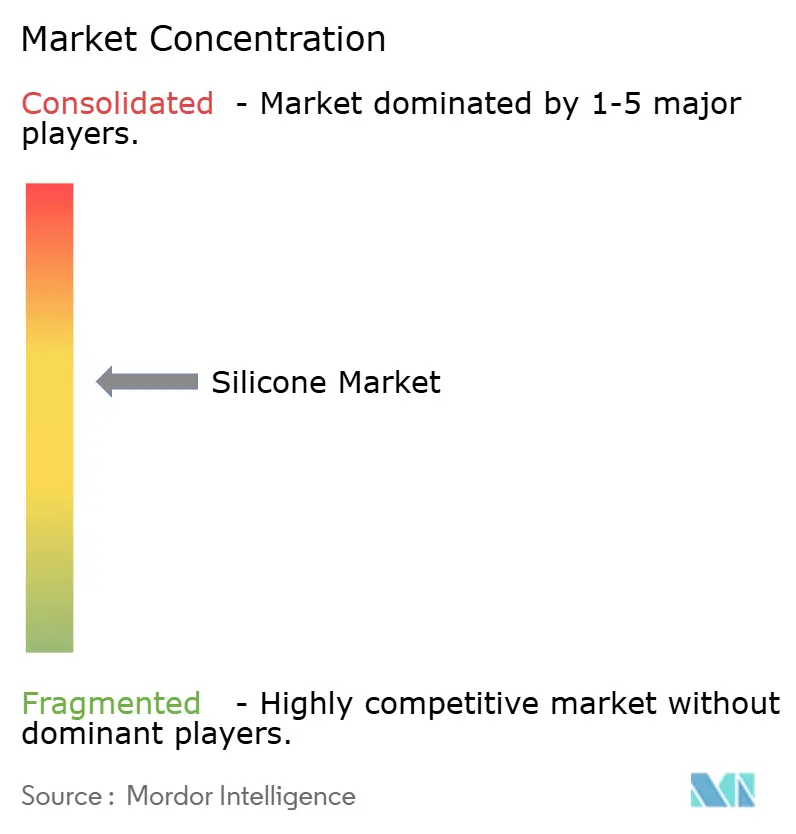
The silicone industry demonstrates moderate fragmentation. Dow and Shin-Etsu maintain parallel research and development footprints, channeling 3-5% of sales into differentiated formulations for EV battery packs, 5G modules, and drug-delivery devices. Vertical integration into silicon-metal smelting buffers these leaders from raw-material spikes, whereas mid-tier formulators often rely on spot purchases, constricting margins during price surges. Patent activity now gravitates toward self-healing elastomers, high-refractive-index optical encapsulants, and chemically recycled siloxane feedstocks, signaling where the next competitive frontiers will emerge. Sustainability credentials are becoming formal bid requirements, especially in Europe, nudging suppliers to certify ISO 14001 systems and disclose life-cycle assessments.
Silicone Industry Leaders
Wacker Chemie AG
Dow
Shin-Etsu Chemical Co. Ltd
Elkem ASA
Momentive
- *Disclaimer: Major Players sorted in no particular order
Silicone Market Companies Covered in this Report
- BRB International (PETRONAS)
- CHT Germany GmbH
- DIC Corporation
- Dongyue Group
- Dow
- DyStar Singapore Pte Ltd
- Elkem ASA
- Evonik Industries AG
- Hoshine Silicon Industry Co., Ltd
- KANEKA Corporation
- KCC SILICONE CORPORATION
- Momentive
- Shin-Etsu Chemical Co. Ltd
- Siltech Corporation
- Wacker Chemie AG
- Wynca Tinyo Silicone Co., Ltd.
- Zhejiang Hengyecheng Organic Silicone Co., Ltd.

Market Opportunities and Future Outlook
Specialty silicones that address thermal management, electrification, and biocompatibility needs are drawing incremental investment and product development focus. Dow announced a USD 100 million investment program (through 2027) in June 2026 to expand specialty silicones manufacturing and innovation capabilities across the United States, China, and Japan, with emphasis on liquid silicone rubber and engineered silicone materials for mobility, electronics, and healthcare. The stated investment direction points to whitespace for higher-value grades, including thermally conductive pads, low-bleed or low-volatility materials for electronics, and platinum-cure LSR systems designed to meet OEM and medical-device qualification requirements.
Localization of supply and application support is also creating opportunities in fast-growing downstream manufacturing hubs. Wacker commissioned a GMP-certified silicone emulsions facility at Panagarh, India in March 2026 to serve personal care demand, and it opened a specialty silicone production site in Karlovy Vary, Czech Republic in 2026 focused on automotive, household appliances, and medical technology. These expansions strengthen in-region supply for regulated, specification-heavy applications. In parallel, regulatory tightening on cyclic siloxanes in Europe is increasing demand for reformulated, lower-residue silicone fluids and sealant chemistries that can document compliance. China policy actions such as the April 1, 2026 cancellation of VAT export rebates for primary-form polysiloxanes also support a structural shift toward value-added silicone finished goods, which gives compounders and converters room to differentiate via formulations and consistent quality systems.
Recent Industry Developments in Silicone Market
- June 2026: Dow announced a USD 100 million investment program through 2027 to expand specialty silicones manufacturing and innovation capabilities across the United States, China, and Japan. The program includes liquid silicone rubber capacity expansions at sites such as Carrollton, Kentucky and Zhangjiagang, China. The program strengthens supply for higher-specification silicone materials used in mobility, electronics, and healthcare applications, where qualification and reliability requirements favor scaled, application-focused capacity.
- June 2025: Wacker introduced POWERSIL 1900 A/B, a two-component high-consistency rubber designed to streamline spiral-extrusion production of composite insulators. The launch targets power transmission and distribution demand, where silicone rubber insulators are specified for hydrophobicity and pollution performance. It supports value-added growth in grid infrastructure applications that require consistent processing and mechanical performance.
- September 2024: REC Silicon signed a multi-year agreement to supply high-purity silane to Sila Nanotechnologies, supporting production of Titan Silicon anode materials through 2031. While not a finished silicone product, the agreement reinforces a critical upstream specialty-gas supply chain used in advanced materials manufacturing. It highlights the pull from electrification-linked value chains that compete for silicon-chemistry feedstocks and processing capacity.


Silicone Market Report Scope and Research Methodology
Market Definition and Coverage
For this report, the silicone market is defined as the demand and supply of silicone materials used across industrial and consumer end uses, measured through production and consumption volumes and then mapped across regions.
Scope exclusions: The model excludes downstream finished goods where silicone is only a minor ingredient (such as complete personal care products or finished electronics), and it counts silicone only at the material level.
Segments Covered in This Report
- By Form
- Fluids
- Elastomers
- Resins
- Others
- By Application
- Transportation
- Construction Materials
- Electronics
- Healthcare
- Industrial Processes
- Personal Care and Consumer Products
- Other Applications
- Geography
- Asia-Pacific
- China
- India
- Japan
- South Korea
- Thailand
- Malaysia
- Indonesia
- Vietnam
- Rest of Asia-Pacific
- North America
- United States
- Canada
- Mexico
- Europe
- Germany
- United Kingdom
- France
- Italy
- Spain
- Russia
- Turkey
- Nordics
- Rest of Europe
- South America
- Brazil
- Argentina
- Colombia
- Rest of South America
- Middle-East and Africa
- Saudi Arabia
- South Africa
- Nigeria
- Egypt
- Qatar
- United Arab Emirates
- Rest of Middle-East and Africa
- Asia-Pacific
Data Sources, Market Sizing, and Validation
Desk Research
Desk research was used to build the base context and to anchor the model to measurable indicators that can be checked year after year. We relied on public and official sources such as UN Comtrade trade statistics, USGS mineral and materials data, U.S. International Trade Commission tariff and import dashboards, and OECD industrial production indicators, which help confirm demand direction by region.
To keep assumptions realistic, we also reviewed sources such as annual reports and investor presentations, sustainability reports that mention capacity additions, association publications, and reputable press coverage on plant expansions and outages. When available, a paid subscription for company financials and a patent database were used to clarify producer footprints and technology intensity. In addition, an import and export shipment-level database was used selectively to sanity-check cross-border silicone flows. The desk sources listed here are illustrative only, and many other public documents were also reviewed for collection, cross-checking, and clarification.
Primary Interviews and Surveys
Primary work focused on validating how demand is behaving across major consuming industries such as construction, transportation, electronics, and healthcare, and on understanding near-term pricing and supply tightness in different regions. We spoke with a mix of raw material suppliers, converters, distributors, and large end users so that assumptions on utilization, product mix, and substitution risk could be cross-verified across the chain. For a global market like silicone, input was balanced across APAC, EMEA, and the Americas to reduce the chance that one region's cycle dominates the final forecast.
Distribution of primary research fieldwork respondents
| Company type | Respondent position | Region |
|---|---|---|
| Top tier: 35% | CXOs: 16% | APAC: 50% |
| Mid tier: 48% | Functional/Unit leaders: 40% | EMEA: 32% |
| Smaller Players: 17% | Managers: 44% | Americas: 18% |
Market-Sizing & Forecasting
Sizing starts with a top-down build where production, trade, and visible end-use output indicators are used to reconstruct the regional demand pool for silicone materials, which is then adjusted for inventory movements and intra-regional redistribution. To keep the totals practical, the result is corroborated with selective bottom-up approximations, including sampled volume-by-application checks and price-per-ton ranges discussed in interviews, which are then used to confirm whether the direction and scale make sense.
Key inputs used in the model include silicone production and capacity additions, import and export volumes by relevant product groupings, construction activity signals, vehicle and electronics output trends, and short-term price movement patterns that affect ordering behavior. Forecasts are built using scenario analysis, where the base case is guided by expert views on capacity utilization, recovery timing in cyclical end markets, and likely normalization in trade flows. When gaps appear in country-level visibility, proxy allocation is done using a combination of trade intensity and end-use output weights, followed by a reasonableness check in primary discussions.
Data Validation & Update Cycle
Outputs are validated through multiple checks so that one data series does not drive the full conclusion. We compare modeled totals against independent signals such as regional trade balances, announced capacity and shutdown timelines, and end-use output direction, and then anomalies are flagged for follow-up before final sign-off.
A second analyst review is completed for key assumptions like utilization, product mix, and near-term pricing sensitivity, and clarifications are re-confirmed with interviewees when the variance is material. Reports are refreshed annually, and interim updates are made when major events occur, such as large capacity additions, extended outages, or sharp shifts in regional trade. Before delivery, a final pass is completed so the published view reflects the most recent verified information.
Mordor Intelligence's Silicone Market Size Compared Against Other Published Estimates
Published market sizes for silicone do not always match because the starting unit of measurement and the item counted can differ, and the forecasting assumptions can widen the gap over time. Differences also show up when one study leans more on revenue modeling and another leans on material volumes and utilization signals.
Finished end products that contain silicone are kept outside Mordor Intelligence's scope, which is one reason value-based estimates can look larger when they include broader downstream revenue pools or apply higher blended price assumptions. Another common gap driver is how average price is moved forward, since some estimates use a single blended ASP curve, while others separate commodity-grade versus specialty mixes and then validate the mix shift through interviews and trade signals.
Benchmark comparison
| Source | Market Size | Gaps in Research Methodology |
|---|---|---|
| Mordor Intelligence | USD 3.32 M (2026) | |
| Industry Publisher A | USD 22.67 B (2024) | Uses a value-based definition that can include wider revenue pools and blended pricing across multiple silicone-related categories, which makes comparisons difficult versus material-level volume tracking. |
| Global Publisher B | USD 22.22 B (2024) | Reports market value in USD with broader inclusions and different price and mix assumptions, and the base year differs, so the number can diverge even if end-use direction is similar. |
The table shows that the biggest spread is driven by what is being counted and how pricing is applied, not only by growth expectations. By keeping the model tied to observable production and trade flows and then pressure-testing key assumptions with interview feedback, the final view stays traceable to simple, repeatable steps.


Key Questions Answered in the Report
How large is the silicone industry in 2026 and how fast is it growing?
The silicone market size stands at 3.32 million tons in 2026 and is projected to post a 5.12% CAGR, reaching 4.26 million tons by 2031.
Which form in silicone industry segment commands the highest share?
Elastomers lead with 49.35% of 2025 volume thanks to broad uptake in EVs, medical devices, and construction sealants.
Why is Asia-Pacific so dominant?
The region houses integrated supply chains, large electronics and automotive bases, and captures 65.10% of 2025 demand while expanding at a 6.39% CAGR.
What is driving silicone demand in electric vehicles?
Battery-pack sealing, thermal gap-pads, and high-voltage insulation collectively triple silicone usage per EV versus traditional cars.
How are regulations affecting silicone formulations?
Proposed REACH limits on cyclic siloxanes force reformulation toward low-volatility linear silicones, raising compliance costs but opening opportunities for greener grades.
Page last updated on:


 Your data is secure and never sold or shared.


