
Signal Conditioning Modules Market Size and Share
Market Overview
| Study Period | 2019 - 2030 |
|---|---|
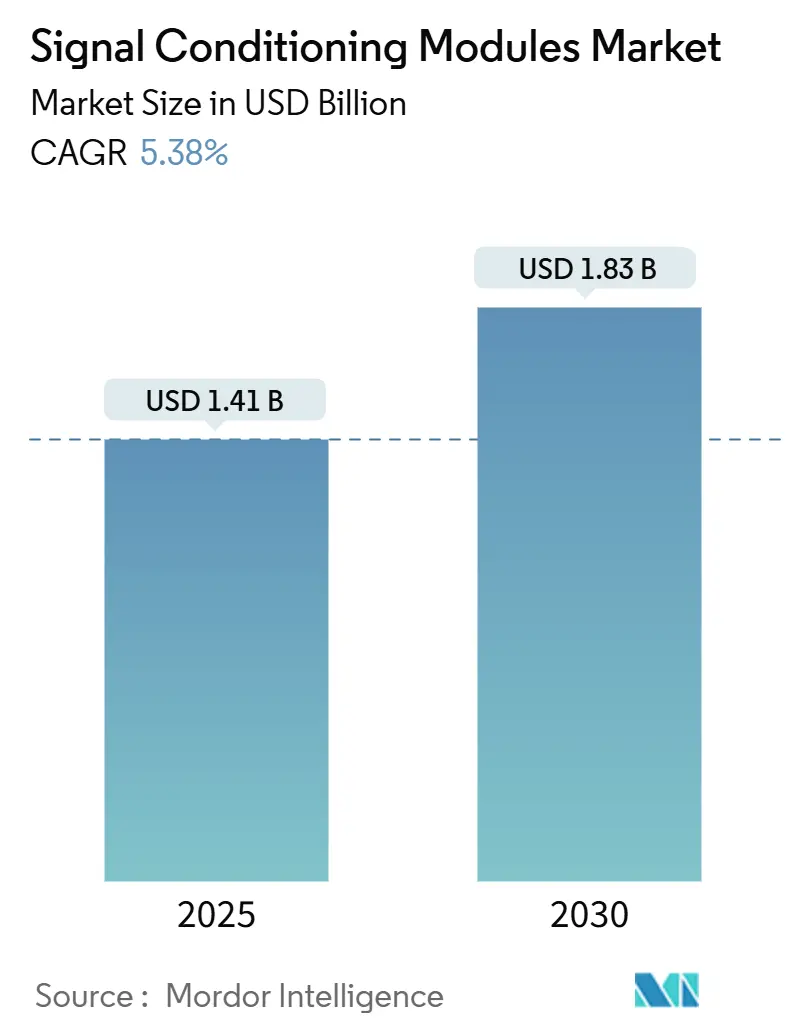
| Market Size (2025) | USD 1.41 Billion |
| Market Size (2030) | USD 1.83 Billion |
| Growth Rate (2025 - 2030) | 5.38 % |
| Fastest Growing Market | South America |
| Largest Market | Asia Pacific |
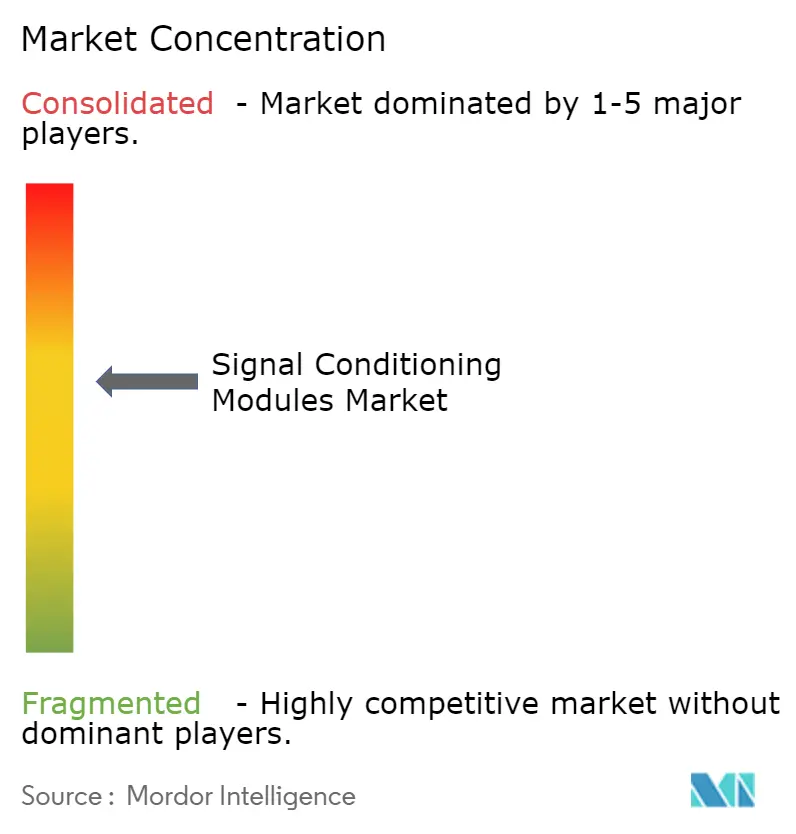
| Market Concentration | Medium |
Major Players *Disclaimer: Major Players sorted in no particular order Image © Mordor Intelligence. Reuse requires attribution under CC BY 4.0. | |
Signal Conditioning Modules Market Analysis by Mordor Intelligence
The signal conditioning modules market size stands at USD 1.41 billion in 2025 and is projected to reach USD 1.83 billion by 2030, advancing at a 5.38% CAGR during the forecast period. Digitization programs across process industries, the roll-out of Industrial IoT platforms, and rising investments in edge-enabled instrumentation sustain this growth momentum. Mandatory upgrades of aging distributed control systems, along with stricter intrinsic-safety rules, favor certified modules over unprotected analog I/O cards. Vendors differentiate through on-board analytics, multi-protocol connectivity, and low-power designs that shrink cabinet footprints. Pricing pressure from integrated PLC analog cards remains a headwind, yet higher accuracy, galvanic isolation, and safety approvals preserve the value proposition for dedicated conditioners. Rapid electric-vehicle test-bench deployment and energy-auditing mandates further widen addressable demand, especially for modules that embed intelligent diagnostics.
Key Report Takeaways
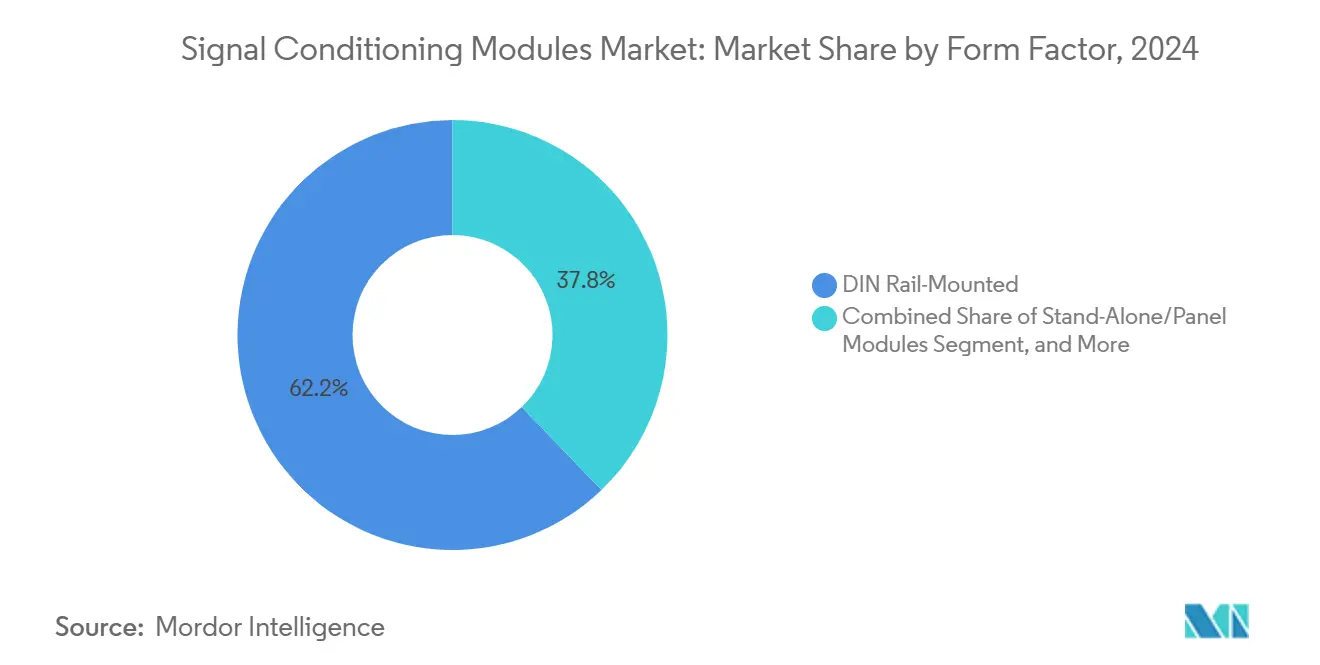
- By form factor, DIN rail-mounted products captured 62.19% of the signal conditioning modules market share in 2024, while the same category is projected to expand at a 7.68% CAGR through 2030.
- By input type, process voltage/current modules led with 37.34% revenue share in 2024; temperature-sensing units are forecast to post the fastest 7.24% CAGR to 2030.
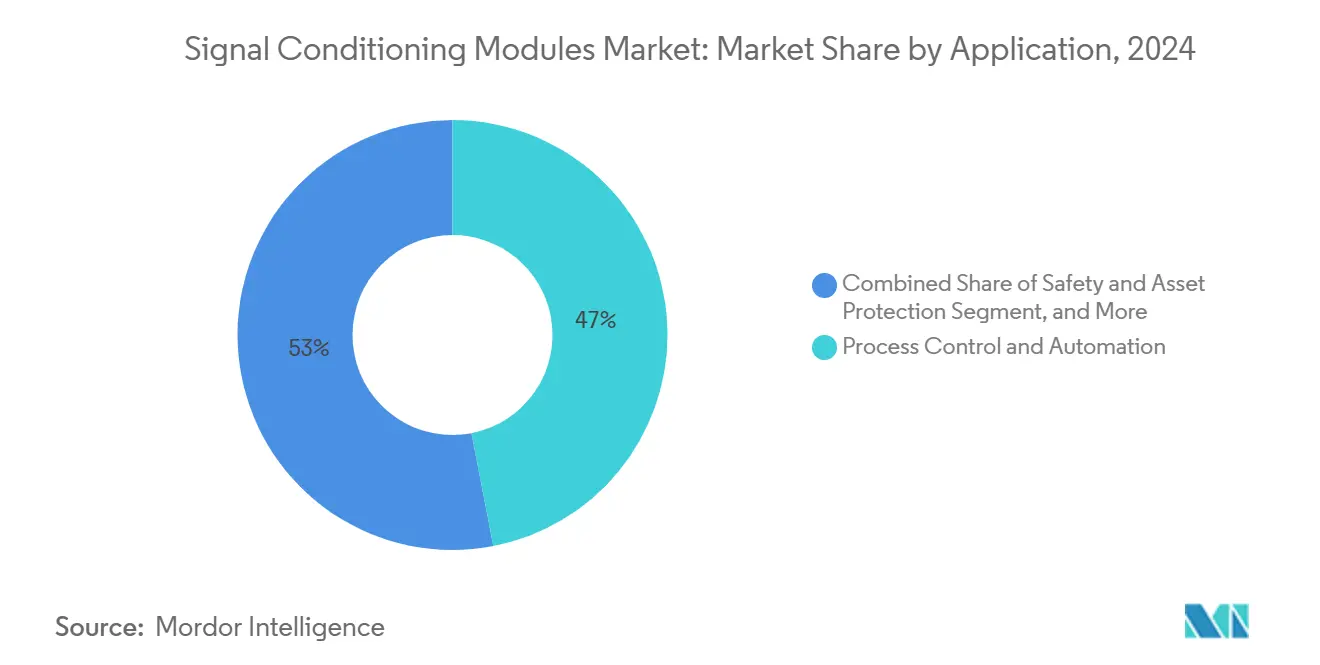
- By application, process control accounted for 46.96% share of the signal conditioning modules market size in 2024, whereas data-acquisition solutions are set to grow at a 7.12% CAGR.
- By end-user industry, oil and gas held 21.42% of 2024 revenue, while automotive testing is rising at a 5.47% CAGR on the back of EV validation needs.
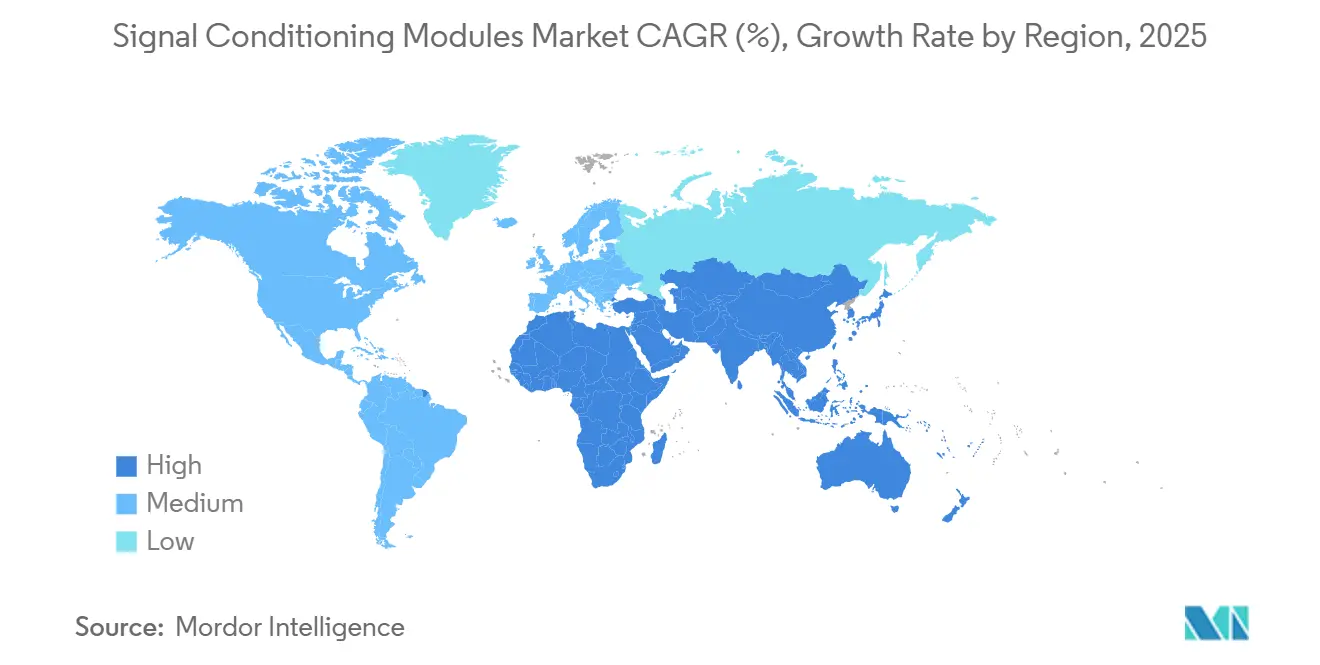
- By geography, Asia-Pacific dominated with 36.58% share in 2024; South America is poised to register the fastest 6.13% CAGR.
Note: Market size and forecast figures in this report are generated using Mordor Intelligence’s proprietary estimation framework, updated with the latest available data and insights as of January 2026.
Market Trends and Insights
Drivers Impact Analysis of Signal Conditioning Modules Market*
| Driver | (~) % Impact on CAGR Forecast | Geographic Relevance | Impact Timeline |
|---|---|---|---|
| Industrial automation and IIoT penetration | +1.8% | Global (Asia-Pacific spearheading) | Medium term (2-4 years) |
| Legacy DCS/PLC upgrade cycle | +1.2% | North America and Europe, spill-over to Asia-Pacific | Long term (≥ 4 years) |
| Stricter intrinsic-safety/isolation regulations | +0.9% | EU and North America, increasing global adoption | Short term (≤ 2 years) |
| Edge-analytics-ready “smart” conditioners | +0.5% | Asia-Pacific and North America early adopters | Long term (≥ 4 years) |
| Mandatory energy-audit and power-quality compliance | +0.7% | EU leading, expanding to North America and Asia-Pacific | Medium term (2-4 years) |
| EV test-bench modularization | +0.6% | China and EU automotive hubs | Medium term (2-4 years) |
| Source: Mordor Intelligence | |||
Industrial automation and IIoT penetration
Factories are moving from isolated loops to connected ecosystems that feed enterprise analytics platforms. Emerson’s purchase of NI unites process-control expertise with high-speed test measurement, signaling tighter convergence between production and data science. Rockwell Automation’s collaboration with NVIDIA on autonomous mobile robotics underscores how signal conditioning interfaces must support low-latency AI workloads at the sensor edge. As plants deploy more intelligent devices, modules that combine conversion, isolation, and embedded processors gain preference over basic analog cards. Early adopters emphasize hot-swap capability and cybersecurity-hardened firmware, elevating technical entry barriers.
Legacy DCS/PLC upgrade cycle
Installed control platforms from the early 2000s are hitting end-of-support, and operators want drop-in modules that talk to both legacy field wiring and modern Ethernet backbones. Honeywell’s virtualized Experion migrations at refineries demonstrate how signal conditioners bridge the gap during phased switchover without downtime.[1]Honeywell, “HPS DCS Modernization,” honeywell.com Schneider Electric’s hybrid-I/O modernization programs likewise favor modules that auto-detect wiring polarity and provide diagnostic LEDs for field technicians. The replacement wave is pronounced in oil, chemical, and power plants, anchoring a multi-year revenue stream for vendors offering long-term spare-parts road maps.
Stricter intrinsic-safety and isolation regulations
Revisions to IEC 60079 and ATEX 2014/34/EU tighten ignition-risk thresholds, driving preference for modules that ship with certified galvanic isolation and SIL-rated fault diagnostics. Eaton’s Crouse-Hinds MTL range markets pre-tested entity parameters that cut project engineering times.[2]Eaton, “Crouse-Hinds Series MTL Intrinsic Safety Solutions brochure,” eaton.comPepperl+Fuchs extends single-channel barriers with global ATEX, IECEx, and FM approvals, letting multinational plants standardize one bill of material worldwide. The complexity of individual device certification shields established brands from low-cost entrants.
Edge-analytics-ready smart conditioners
Analog Devices’ Voyager4 module pairs an accelerometer with an embedded AI core that filters vibration spectra locally, slashing wireless bandwidth needs by 60%. TDK’s ultracompact sensor micro-module applies machine-learning models to spot anomalies before breakdowns, proving that analytics can reside inside a 12 mm package.[3]TDK Corporation, “Ultracompact Sensor Module Redefines Equipment Maintenance,” tdk.com Modules now ship with ARM Cortex-M processors, web servers, and MQTT brokers, enabling field-level autonomy while passing only actionable events to the cloud.
Restraints Impact Analysis of Signal Conditioning Modules Market*
| Restraint | (~) % Impact on CAGR Forecast | Geographic Relevance | Impact Timeline |
|---|---|---|---|
| Price squeeze from low-cost PLC analog I/O cards | -1.1% | Global (Asia-Pacific most intense) | Short term (≤ 2 years) |
| High certification (ATEX/SIL) compliance cost | -0.6% | EU and North America regulatory markets | Medium term (2-4 years) |
| Long asset-replacement cycles in heavy industry | -0.8% | Global, mature markets | Long term (≥ 4 years) |
| Cyber-security risk in networked modules | -0.4% | Global, critical infrastructure focus | Short term (≤ 2 years) |
| Source: Mordor Intelligence | |||
Price squeeze from low-cost PLC analog I/O cards
Mainstream PLC vendors bundle multi-channel analog inputs for under USD 40 per channel, undercutting standalone conditioners in simple 0-10 V or 4-20 mA loops. Chinese suppliers leverage scale to push prices even lower, forcing traditional specialists to emphasize galvanic isolation, hazardous-area approvals, and high-accuracy specs to justify premiums. Recent U.S. tariff hikes on semiconductor imports add uncertainty to cost structures, making dual-sourcing strategies a procurement priority.
High certification compliance cost
Achieving ATEX Zone 1 and SIL 2/3 approvals can consume up to 30% of development budgets, especially when periodic recertification audits are factored in. Smaller firms often outsource test programs, lengthening time-to-market and eroding margins. End users therefore consolidate vendor lists around brands with proven certification track records, reinforcing incumbent positions while limiting newcomer visibility.
*Our forecasts treat driver/restraint impacts as directional, not additive. The impact forecasts reflect baseline growth, mix effects, and variable interactions.
Signal Conditioning Modules Market Segment Analysis
By Form Factor:
Standardized DIN rails cement cabinet efficiencyDIN rail solutions contributed 62.19% of 2024 revenue, underlining end-user preference for quick snap-fit installation and compact cabinet layouts. The signal conditioning modules market size for DIN rail units is forecast to climb alongside a 7.68% CAGR as OEMs embed hot-swappable terminals and NFC setup apps. Centralized rack/backplane designs continue in power generation and large petrochemical complexes where uniform airflow and rear-access maintenance are priorities. Stand-alone panel units cater to retrofit projects on legacy skid packages, while plug-in cards address space-constrained mobile machinery.
Standardized form factors also simplify enclosure thermal calculations and harmonize spare-parts inventories. Phoenix Contact’s push-in terminal blocks cut assembly time by 60% compared with screw-clamp wiring, reinforcing labor-saving ROI. WAGO’s IP67 cabinet-free modules extend DIN rail electronics to the machine side, proving the format’s adaptability to harsh environments.



By Input Type:
Rising temperature precision fuels RTD adoptionProcess voltage/current conditioning retained 37.34% share in 2024, yet temperature modules are advancing at a 7.24% CAGR as pharmaceutical and semiconductor fabs specify ±0.15 °C tolerances. The signal conditioning modules market share for RTD channels is poised to expand as thinner wafer geometries and biologics require tight thermal windows. Frequency and RMS sensing supports power-quality audits, and LVDT/RVDT conditioners target aerospace actuation tests.
Smart-factory mandates drive interest in IO-Link-ready temperature probes that permit hot-plug ID and auto-calibration. Reference designs from Analog Devices show uncompensated RTDs hitting class-A accuracy without field calibration, lowering lifecycle costs. Microchip’s four-wire excitation topologies tackle lead-resistance errors, opening the door for single-point upgrades inside brownfield facilities.
By Application:
Data acquisition rides predictive-maintenance waveProcess control still commanded 46.96% of 2024 revenue, but data-acquisition deployments are growing 7.12% annually as industries pivot from scheduled to condition-based maintenance. The signal conditioning modules market size linked to vibration, torque, and strain monitoring is thus expanding beyond legacy control loops. Energy-monitoring projects dovetail with ISO 50001 audits that oblige continuous recording of kWh flows.
Emerging requirements favor multi-domain DAQ systems that capture electrical, mechanical, and environmental channels in one frame. Dewesoft’s 15 MS/s modules stream synchronous voltage and mechanical strain to in-module FPGAs for instantaneous fault detection. HBK’s QuantumX platform bundles deterministic EtherCAT timing with open REST APIs, allowing IT-OT convergence for analytics dashboards.
By End-User Industry:
Automotive validation accelerates adoptionOil and gas remained the single largest vertical at 21.42% share last year, owing to hazardous-area isolation needs and decades-long asset lifecycles. Automotive labs, however, are projected to advance 5.47% CAGR as EV inverter, battery, and e-axle rigs demand wide-bandwidth measurement combined with high-voltage isolation. The signal conditioning modules industry increasingly tunes channel density and bandwidth to match e-drive switching frequencies.
Tektronix offers EV traction-inverter test benches featuring multi-giga-sample oscilloscopes fronted by differential conditioners to 1000 V. AVL pairs emulated e-motors with temperature and strain conditioners for structural durability assessments of power electronics housings. Water, food, and metals sectors round out demand with rugged IP65 stainless housings and hygienic quick releases.
Geography Analysis
APAC Signal Conditioning Modules Market
Asia-Pacific accounted for 36.58% of global revenue in 2024 and continues to outpace other regions as governments incentivize smart-manufacturing upgrades. Expansion of 5G infrastructure and local semiconductor fabs underwrite additional demand for high-precision conditioners in cleanroom environments. The signal conditioning modules market size in China benefits from stimulus funds targeting brownfield chemical sites, yet margin pressure intensifies because domestic brands undercut imported products.
North America and Europe Signal Conditioning Modules Market
North America remains characterized by high certification uptake and large DCS retrofit pipelines. LNG export terminals along the Gulf Coast specify SIL-3 isolation for burner management loops, sustaining project momentum. Europe leverages ATEX enforcement and net-zero energy directives to mandate power-quality metering and intrinsic-safety interfaces. Both regions show steady replacement demand rather than greenfield surges.
South America and MEA Signal Conditioning Modules Market
South America registers the fastest 6.13% CAGR as Brazilian pulp-and-paper mills and mining operations automate to offset labor shortages. Battery-chemicals projects in Chile and Argentina amplify needs for corrosion-resistant, wide-temperature-range conditioners. The Middle East and Africa cluster focuses on petrochemical debottlenecking, while new gas-to-liquids complexes in the Gulf rely on globally certified modules to streamline multi-vendor integration.

Competitive Landscape
The market exhibits moderate concentration, with the top five suppliers controlling roughly 55% of global revenue. Certification depth, hazardous-area expertise, and proprietary isolation ASICs establish defensible moats. HMS Networks’ acquisition of Red Lion Controls broadens its North American footprint and injects ethernet-gateways into its signal conditioning catalog. Emerson’s NI integration combines software centricity with process-grade enclosures, raising competitive expectations for firmware openness.
Strategic alliances complement M&A moves. SICK and Endress+Hauser formed a joint venture to co-develop gas analyzers, bundling isolation know-how with flow analytics for decarbonization projects. Meanwhile, Pepperl+Fuchs licenses semiconductor IP to niche sensor startups, ensuring backward compatibility while scaling production. Competitive intensity pivots on who can deliver SIL-rated, AI-enabled conditioners without price premiums.
Regional challengers intensify price wars. Several Chinese makers leverage vertically integrated PCB houses to shave costs, though they still seek third-party approvals for EU market entry. Long logistics lead times push end users toward dual sourcing, encouraging global brands to build local assembly plants in Mexico and Malaysia to shorten delivery cycles.
Signal Conditioning Modules Industry Leaders
Dataforth Corporation
Acromag, Inc.
PR electronics A/S
Moore Industries-International, Inc.
Pepperl+Fuchs SE
- *Disclaimer: Major Players sorted in no particular order
Signal Conditioning Modules Market Companies Covered in this Report
- Dataforth Corporation
- Acromag, Inc.
- PR electronics A/S
- Moore Industries-International, Inc.
- Pepperl+Fuchs SE
- Phoenix Contact GmbH & Co. KG
- Weidmüller Interface GmbH & Co. KG
- M-System Co., Ltd.
- Status Instruments Ltd.
- Red Lion Controls, Inc.
- R. Stahl AG
- WAGO Kontakttechnik GmbH & Co. KG
- Turck Inc. (Hans Turck GmbH & Co. KG)
- B+B SmartWorx, Inc.
- G.M. International s.r.l.
- Campbell Scientific, Inc.
- Gantner Instruments GmbH
- Dewesoft d.o.o.
- OMEGA Engineering, Inc.

Recent Industry Developments in Signal Conditioning Modules Market
- January 2025: IFS posted annual recurring revenue above EUR 1 billion after acquiring Copperleaf and EmpowerMX to scale industrial AI portfolios.
- January 2025: Emerson secured a USD 20 million automation contract for a new Cameron LNG liquefaction train, supplying DeltaV safety and control systems.
- October 2024: Advantech completed the acquisition of AURES Technologies to market combined AIoT edge platforms under the ADVANTECH-AURES brand.
- October 2024: Honeywell and Chevron began co-developing AI-assisted alarm-guidance software for refining operations.


Global Signal Conditioning Modules Market Report Scope
| DIN Rail-Mounted Modules |
| Rack/Backplane-Mounted Modules |
| Stand-Alone/Panel Modules |
| Plug-in/Compact Modules |
| Temperature |
| Process |
| Frequency / AC RMS |
| LVDT/RVDT and Displacement |
| Strain and Load Cell |
| Data Acquisition and Test Measurement |
| Process Control and Automation |
| Condition Monitoring and Predictive Maintenance |
| Energy and Power-Quality Monitoring |
| Safety and Asset Protection |
| Oil and Gas |
| Water and Wastewater |
| Chemical and Petrochemical |
| Food and Beverage |
| Metals and Mining |
| Power Generation and Utilities |
| Automotive and Transportation |
| Aerospace and Defense |
| Pharmaceuticals and Life Sciences |
| Semiconductor and Electronics Manufacturing |
| North America | United States | |
| Canada | ||
| Mexico | ||
| Europe | Germany | |
| United Kingdom | ||
| France | ||
| Russia | ||
| Rest of Europe | ||
| Asia-Pacific | China | |
| Japan | ||
| India | ||
| South Korea | ||
| Australia | ||
| Rest of Asia-Pacific | ||
| Middle East and Africa | Middle East | Saudi Arabia |
| United Arab Emirates | ||
| Rest of Middle East | ||
| Africa | South Africa | |
| Egypt | ||
| Rest of Africa | ||
| South America | Brazil | |
| Argentina | ||
| Rest of South America | ||
| By Form Factor | DIN Rail-Mounted Modules | ||
| Rack/Backplane-Mounted Modules | |||
| Stand-Alone/Panel Modules | |||
| Plug-in/Compact Modules | |||
| By Input Type | Temperature | ||
| Process | |||
| Frequency / AC RMS | |||
| LVDT/RVDT and Displacement | |||
| Strain and Load Cell | |||
| By Application | Data Acquisition and Test Measurement | ||
| Process Control and Automation | |||
| Condition Monitoring and Predictive Maintenance | |||
| Energy and Power-Quality Monitoring | |||
| Safety and Asset Protection | |||
| By End-User Industry | Oil and Gas | ||
| Water and Wastewater | |||
| Chemical and Petrochemical | |||
| Food and Beverage | |||
| Metals and Mining | |||
| Power Generation and Utilities | |||
| Automotive and Transportation | |||
| Aerospace and Defense | |||
| Pharmaceuticals and Life Sciences | |||
| Semiconductor and Electronics Manufacturing | |||
| By Geography | North America | United States | |
| Canada | |||
| Mexico | |||
| Europe | Germany | ||
| United Kingdom | |||
| France | |||
| Russia | |||
| Rest of Europe | |||
| Asia-Pacific | China | ||
| Japan | |||
| India | |||
| South Korea | |||
| Australia | |||
| Rest of Asia-Pacific | |||
| Middle East and Africa | Middle East | Saudi Arabia | |
| United Arab Emirates | |||
| Rest of Middle East | |||
| Africa | South Africa | ||
| Egypt | |||
| Rest of Africa | |||
| South America | Brazil | ||
| Argentina | |||
| Rest of South America | |||


Key Questions Answered in the Report
How large is the signal conditioning modules space in 2025 and how fast is it expanding?
Revenue equals USD 1.41 billion in 2025 and is set to rise to USD 1.83 billion by 2030 at a 5.38% CAGR.
Which form factor generates the highest sales?
DIN rail-mounted products lead with a 62.19% revenue share thanks to cabinet-friendly installation and broad certification support.
What segment is growing fastest by application?
Data-acquisition solutions are advancing at 7.12% CAGR as manufacturers deploy predictive-maintenance programs.
Why are temperature-sensing modules gaining traction?
Tight thermal tolerances in pharmaceuticals and semiconductor fabs drive adoption of high-accuracy RTD conditioners.
Which region offers the most untapped upside?
South America is projected to post a 6.13% CAGR through 2030 as modernization initiatives automate pulp, mining, and energy assets.
What is the main competitive differentiator among suppliers?
Depth of intrinsic-safety certification and integration of edge analytics now separate leading brands from low-cost PLC analog I/O alternatives.
Page last updated on:





