
Shingles Vaccine Market Size and Share
Market Overview
| Study Period | 2020 - 2031 |
|---|---|
| Market Size (2026) | USD 5.99 Billion |
| Market Size (2031) | USD 11.29 Billion |
| Growth Rate (2026 - 2031) | 13.53 % |
| Fastest Growing Market | Asia-Pacific |
| Largest Market | North America |
| Market Concentration | High |
Major Players *Disclaimer: Major Players sorted in no particular order Image © Mordor Intelligence. Reuse requires attribution under CC BY 4.0. | |
Shingles Vaccine Market Analysis by Mordor Intelligence
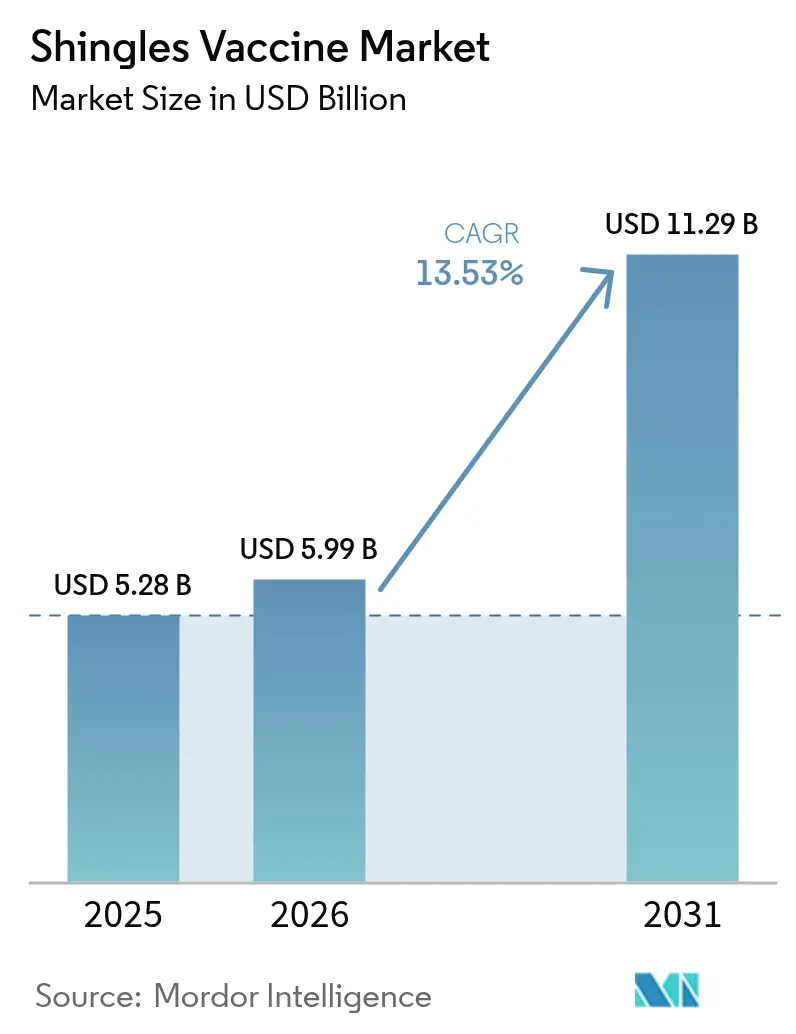
Shingles Vaccine market size in 2026 is estimated at USD 5.99 billion, growing from 2025 value of USD 5.28 billion with 2031 projections showing USD 11.29 billion, growing at 13.53% CAGR over 2026-2031.
The expansion stems from converging forces that include a rapidly growing population of adults aged 50 and above, wider government reimbursement, and steady innovation in recombinant subunit technologies that maintain effectiveness above 90%. Rising life expectancy, particularly in OECD economies, enlarges the clinical pool, while cost-sharing reforms such as the United States Inflation Reduction Act removed out-of-pocket payments for Medicare beneficiaries and triggered a 46% step-up in vaccinations in 2023. National immunization schedule inclusion across 39 countries, from Australia to the United Kingdom, turns discretionary shots into routine adult care, creating predictable procurement volumes for suppliers. Recombinant adjuvant platforms deliver immunogenicity that remains durable for at least seven years, a performance gap that continues to push live-attenuated competitors out of formularies. Meanwhile, mRNA candidates now in Phase 3 trials promise shorter production cycles and may further widen geographic access if stability targets are met.
Key Report Takeaways
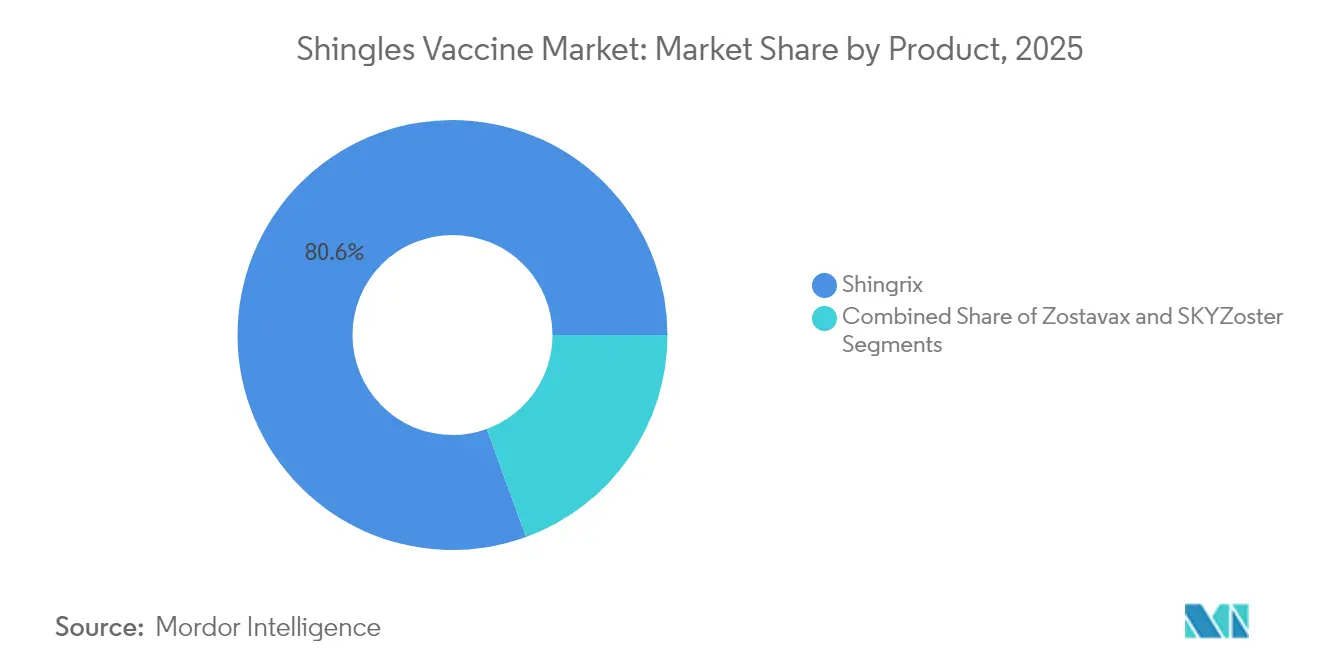
- By product, Shingrix led with 80.56% of the Shingles vaccine market share in 2025; are projected to post the fastest 14.03% CAGR through 2031.
- By vaccine type, recombinant subunit platforms accounted for 83.52% share of the Shingles vaccine market size in 2025 and are projected to grow at a 14.18% CAGR to 2031.
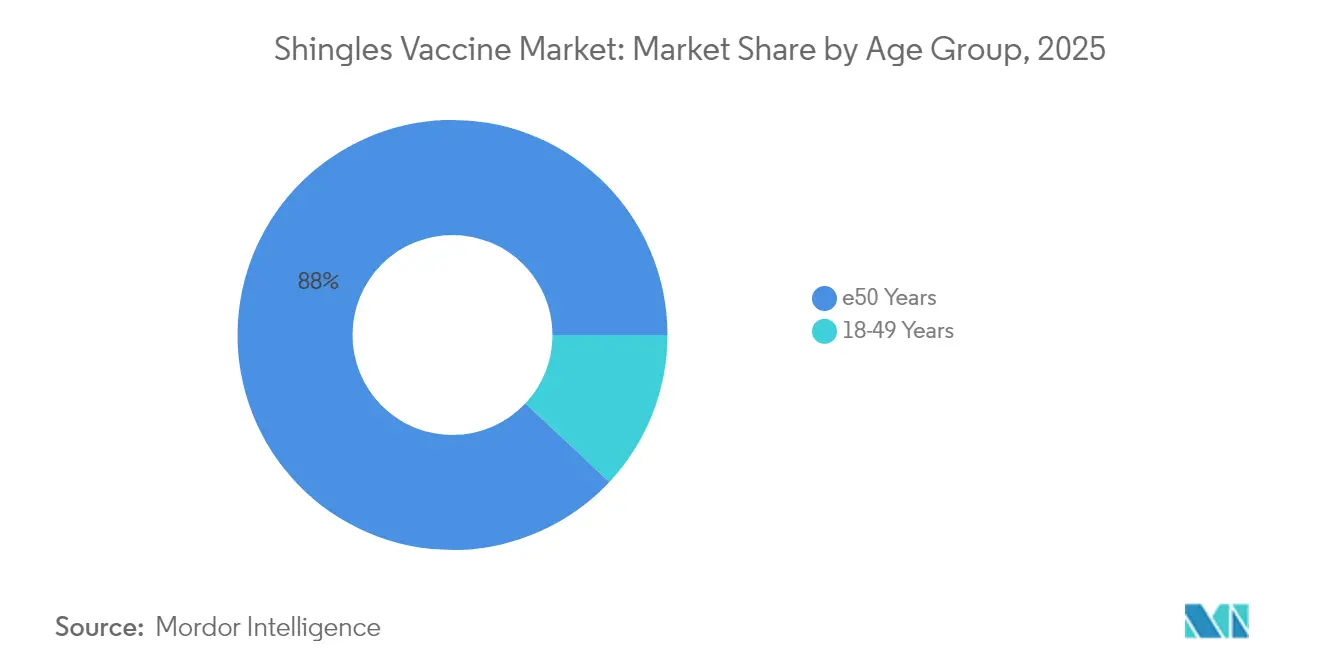
- By age group, adults ≥50 years captured 88.02% revenue share in 2025, while the immunocompromised 18-49 segment is forecast to expand at 15.55% CAGR through 2031.
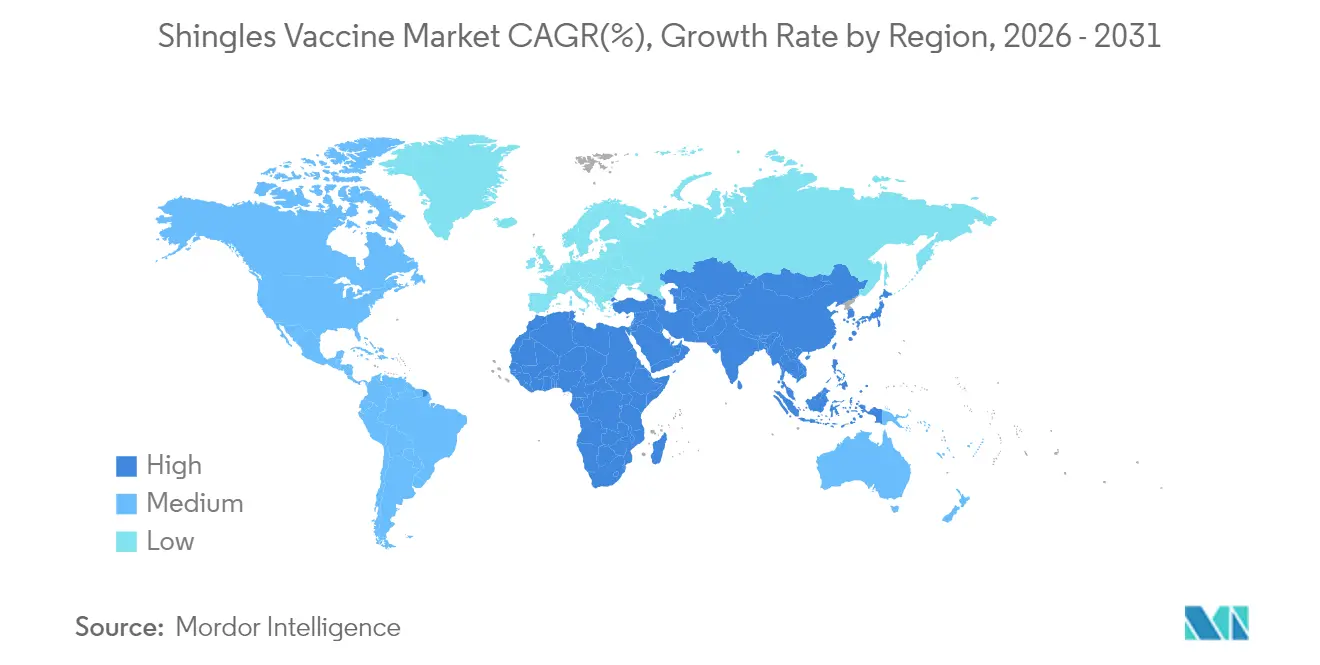
- By geography, North America held 42.86% of the Shingles vaccine market share in 2025; Asia-Pacific is set to register the strongest 18.12% CAGR to 2031.
Note: Market size and forecast figures in this report are generated using Mordor Intelligence’s proprietary estimation framework, updated with the latest available data and insights as of 2026.
Market Trends and Insights
Drivers Impact Analysis of Shingles Vaccine Market*
| Driver | ( ~ ) % Impact on CAGR Forecast | Geographic Relevance | Impact Timeline |
|---|---|---|---|
| Inclusion of shingles vaccines in national immunization schedules | +3.2% | Global, with early adoption in North America & EU | Medium term (2-4 years) |
| Rising incidence in ≥50-year age group & growing elderly population | +4.1% | Global, concentrated in developed markets | Long term (≥ 4 years) |
| Superior cost-effectiveness of vaccination over treatment | +2.8% | North America & EU, expanding to APAC | Medium term (2-4 years) |
| Government reimbursement for recombinant adjuvanted vaccines | +2.3% | North America & EU core markets | Short term (≤ 2 years) |
| Fast-tracked regulatory pathways for mRNA-based shingles vaccines | +1.1% | Global, led by US & EU | Long term (≥ 4 years) |
| Government-led immunization programs targeting older adults | +1.8% | Global, with APAC acceleration | Medium term (2-4 years) |
| Source: Mordor Intelligence | |||
Inclusion of Shingles Vaccines in National Immunization Schedules
Australia added Shingrix to its National Immunisation Program in November 2023, covering adults from 65 years and immunocompromised individuals from 50, a move that immediately lifted demand across pharmacies and primary-care clinics. In the United Kingdom, the 2023 shift from Zostavax to Shingrix extended eligibility to severely immunosuppressed adults aged 50 and immunocompetent adults from 60. Such public-funding decisions lower patient cost hurdles, guarantee multi-year tender volumes, and strengthen bargaining power for bulk procurement. Equally important, the World Health Organization plans to release updated herpes zoster recommendations in March 2025, a step likely to influence immunization roadmaps in emerging markets.[1]Collectively, these actions convert what had been sporadic, self-paid uptake into an institutionalized public-health service, supporting a predictable revenue base for the Shingles vaccine market.
Rising Incidence in ≥50-Year Age Group & Growing Elderly Population
Global life expectancy gains spur a structural rise in the number of adults with waning cell-mediated immunity capable of reactivating latent varicella-zoster virus. The CDC counts around 1 million shingles cases in the United States each year, with 99% of adults >50 already harboring dormant virus.[2]Demand is consequently insulated from macroeconomic cycles and aimed mainly at preventive care budgets. Studies noting potential cardiovascular and dementia risk reductions following vaccination broaden the value proposition and encourage payer support for adult immunization beyond the immediate avoidance of post-herpetic neuralgia.
Superior Cost-Effectiveness of Vaccination Over Treatment
From Canada to Latin America, health-economic modeling places the incremental cost-effectiveness ratio of recombinant shingles vaccination well inside typical willingness-to-pay thresholds. Canadian analyses among high-risk cancer cohorts show CAD 24,328 (USD 18,000) per quality-adjusted life-year gained, reaffirming fiscal prudence for ministries of health. Similar research across five Latin American countries projects prevention of 5 million herpes zoster cases if recombinant vaccines are adopted in national schedules. These data underpin policy approvals and guide insurers toward complete coverage, propelling the Shingles vaccine market size beyond reliance on consumer willingness to pay.
Government Reimbursement for Recombinant Adjuvanted Vaccines
Eliminating patient co-payments demonstrably boosts uptake. After the United States adopted this approach under the Inflation Reduction Act, monthly Medicare vaccinations jumped to 410,564 in 2023 from 281,283 in 2022.[3]By December 2023, virtually every Medicare Part D recipient paid nothing out of pocket. The episode highlights the elasticity of demand and offers a blueprint for other countries weighing similar subsidy models.
Restraints Impact Analysis of Shingles Vaccine Market*
| Restraint | ( ~ ) % Impact on CAGR Forecast | Geographic Relevance | Impact Timeline |
|---|---|---|---|
| Limited public awareness in low- & middle-income countries | −2.1% | APAC emerging markets, Latin America, MEA | Medium term (2-4 years) |
| Supply-chain complexity for cold-chain, multi-dose recombinant products | −1.4% | Global, acute in tropical regions | Short term (≤ 2 years) |
| Adjuvant-related safety concerns driving vaccine hesitancy | −0.8% | Global, social-media-influenced demographics | Medium term (2-4 years) |
| Global bulk-antigen capacity constraints | −1.2% | Worldwide | Long term (≥ 4 years) |
| Source: Mordor Intelligence | |||
Limited Public Awareness in Low- & Middle-Income Countries
In China, only 27.1% of surveyed urban residents expressed willingness to vaccinate, citing scant disease knowledge and the USD 446 price tag as deterrents. Similar gaps exist in Latin America, where under-reporting of herpes zoster incidence complicates policymaking. Without sustained public-health messaging and physician training, market penetration remains thin, slowing progress for the Shingles vaccine market in emerging economies.
Supply-Chain Complexity for Cold-Chain, Multi-Dose Recombinant Products
Recombinant shingles vaccines must remain between 2–8 °C at all times, a constraint that strains healthcare facilities in tropical regions with intermittent electricity. Shingrix presently ships as a two-vial kit requiring reconstitution, increasing handling errors and wastage. Although a pre-filled syringe is under FDA review, the necessity for cold-chain integrity persists. Investments in reliable refrigeration, temperature sensors, and backup generators are essential but costly, limiting reach into rural clinics and thus restraining the broader Shingles vaccine market.
*Our forecasts treat driver/restraint impacts as directional, not additive. The impact forecasts reflect baseline growth, mix effects, and variable interactions.
Shingles Vaccine Market Segment Analysis
By Product:
Recombinant Leader Confronts Emerging mRNA AlternativesThe Shingles vaccine market size for recombinant Shingrix translating into an 80.56% market share in 2025 and validating its clinical advantage over live-attenuated predecessors. Uptake benefits from proven more than 90% efficacy and eligibility across immunocompromised cohorts. Despite this strong foothold, momentum is building around pipeline mRNA assets. Moderna’s mRNA-1468 moved into Phase 3 on the back of robust CD4+ T-cell activity and a tolerability profile that could match or exceed existing benchmarks. Dynavax’s Z-1018 combines its proprietary CpG 1018 adjuvant with recombinant glycoprotein E antigen to elicit comparable immunogenicity, with interim data due in 2025. Should either candidate gain approval, competitive forces could chip away at Shingrix’s large Shingles vaccine market share, though the incumbent’s entrenched reimbursement ties and seven-year real-world performance record form high entry barriers.
Once license holders scale up RNA manufacturing lines originally built for COVID-19, cost per dose could fall, enabling price competition or expanded access in resource-constrained geographies. However, the Shingles vaccine industry still faces the challenge of establishing cold-chain and ancillary-supply capacity for these new formats at parity with current recombinant offerings. For the medium term, therefore, recombinant formulations are expected to retain dominance even as mRNA varieties broaden choice for providers.

By Vaccine Type:
Recombinant Subunit Vaccines Maintain Commanding PositionRecombinant subunit vaccines captured 83.52% of Shingles vaccine market share in 2025 and are projected to sustain a 14.18% CAGR, buoyed by their suitability for immunocompromised recipients and strong immunogenic durability. Live-attenuated alternatives have lost favor after Zostavax discontinuation in several markets. Manufacturing advantages also accrue to recombinant platforms that leverage CHO cell lines and purified antigen processes, reducing the biosafety concerns inherent in live-virus cultures. Adjuvant systems such as AS01B, formulated with monophosphoryl lipid A and QS-21 saponin, stimulate potent CD4+ T-cell and antibody responses, extending protection. Recent breakthroughs in yeast-based QS-21 synthesis could lower raw-material costs, strengthening supply resilience.
Over the forecast horizon, live-attenuated contenders are unlikely to reclaim lost ground unless reformulated to address reduced efficacy in older adults. Instead, future competitive dynamics will likely revolve around whether mRNA or protein-based nanoparticles can match the data set accumulated by current recombinant options while improving dosing convenience. Until that occurs, the recombinant segment will continue to anchor revenue growth for the Shingles vaccine market.
By Age Group:
Core ≥50 Segment Steady, Immunocompromised 18-49 Cohort SurgesAdults aged ≥50 constituted an 88.02% slice of the Shingles vaccine market size in 2025, reflecting guideline recommendations and higher disease incidence. This age group will hold steady as the backbone of demand, supported by consistent public-health messaging on neuropathic pain prevention. In parallel, the immunocompromised 18-49 population stands out with a 15.55% CAGR to 2031, catalyzed by the CDC recommendation that expanded coverage to adults with weakened immunity starting at 19 years. These patients carry a 3-10× greater shingles risk and often face additional complications such as prolonged rash and disseminated infection arthritis.
Health systems are responding by tailoring vaccination campaigns to oncology and rheumatology clinics, enabling same-day immunization during routine visits. Pharmaceutical manufacturers, for their part, have begun sponsoring continuing-education modules to raise physician awareness of eligibility changes. As clarity around reimbursement grows, this younger high-risk segment could provide meaningful volume upside, reinforcing the diversified growth profile of the Shingles vaccine market.
Geography Analysis
North America Shingles Vaccine Market
North America, holding 42.86% of the Shingles vaccine market share in 2025, benefits from comprehensive insurance networks, mature retail-pharmacy vaccination channels, and early clinical adoption of recombinant technology. Medicare’s removal of cost sharing in 2023 caused a near-instant increase in monthly administrations, underscoring the potency of reimbursement levers. Yet absolute growth is moderating as coverage inches toward saturation; GSK’s 2024 U.S. Shingrix sales declined 18% in the fourth quarter as the pool of unvaccinated seniors dwindled and retail chains reset inventory priorities. Future upside therefore relies on broadening indications to younger immunocompromised groups and possibly bundling vaccination with chronic-disease management programs.
APAC Shingles Vaccine Market
Asia-Pacific represents the fastest-expanding opportunity with an 18.12% CAGR through 2031, driven by demographic aging and incremental improvements in adult-vaccination budgets. Australia’s 2023 public funding decision triggered above-trend uptake within the first six months, validating fiscal commitment as a catalyst. In China, where the incidence pool is massive, uptake remains modest due to high list prices and variable awareness; still, the recent extension of the GSK-Zhifei partnership through 2029 coupled with local competition from Changchun BCHT Biotechnology’s domestically produced vaccine is expected to expand access and potentially lower co-pay levels. Japan, South Korea, and Singapore continue to generate supportive real-world data that shape regional policy and encourage reimbursement.
Europe Shingles Vaccine Market
Europe follows a pattern of deliberate but widening adoption. The United Kingdom’s 2023 transition to Shingrix, paired with age-threshold adjustments, set a precedent for neighboring countries evaluating similar moves. Sweden’s nationwide epidemiological study indicating a 36.5% lifetime risk is pushing policymakers toward a cost-benefit review, though final funding decisions remain pending. Continental progress is also influenced by pan-European procurement mechanisms that seek volume discounts, an approach that could compress margins but enlarge total addressable volume. Overall, regional heterogeneity persists, but the trajectory for the Shingles vaccine market remains firmly upward.
Regulatory Landscape
Regulatory oversight is centered on national medicines regulators and immunization advisory bodies, with the FDA and EMA setting the reference for product labeling, pharmacovigilance, and post-approval changes. In the United States, Shingrix has continued to see label and presentation updates, including an FDA update to the package insert in February 2026 addressing Warnings and Precautions related to Guillain-Barre Syndrome, which keeps safety monitoring front of mind for a widely used adult vaccine.
In Europe and the United Kingdom, policy and authorization actions have accelerated the shift away from live-attenuated shingles vaccination toward recombinant products. The European Commission withdrew the marketing authorisation for Zostavax effective 1 June 2025 at the request of the marketing authorisation holder, and the EMA CHMP issued a positive opinion in October 2025 supporting an extension for Shingrix related to a liquid formulation. UKHSA and NHS England also expanded the national shingles vaccination program to include all severely immunosuppressed individuals aged 18 years and over (September 2025), aligning program design with newer eligibility approaches for high-risk adults.
Competitive Landscape
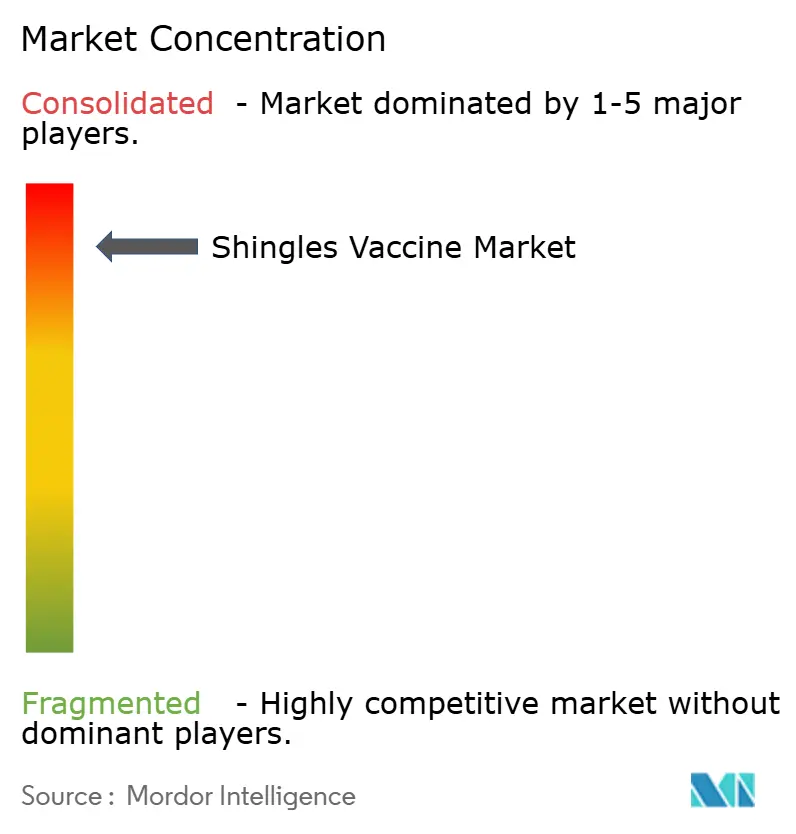
The Shingles vaccine market is highly concentrated, featuring an oligopoly where GSK’s Shingrix controls a significant share, Merck’s residual live-attenuated presence has faded, and future disruption is expected mainly from mRNA entrants. Barriers to entry are steep: multi-year clinical programs, specialized adjuvant supply chains, and stringent cold-chain validation add capital intensity. GSK fortifies its first-mover moat through continuous manufacturing investment, including the USD 800 million Pennsylvania expansion that doubles drug-substance output, and a Belgian site focused on freeze-dried formats designed to simplify field logistics.
Moderna seeks to leverage its experience scaling mRNA vaccines during the COVID-19 response, positioning mRNA-1468 for accelerated regulatory review and potential first-to-market status among the new wave of candidates. Dynavax’s Z-1018 bets on its CpG 1018 adjuvant, already used in Hepatitis B vaccination, to provide a differentiated safety profile that could appeal to younger or immunocompromised segments. Supply-chain advances, such as yeast-based QS-21 synthesis, could lower adjuvant costs and reduce GSK’s procurement advantage, yet full industrial-scale readiness is unlikely before 2028.
Regional manufacturers are also mobilizing. Changchun BCHT Biotechnology became the first domestic company to win Chinese approval for a shingles vaccine in June 2024, potentially securing provincial tenders where local preference rules apply. Similar in-country initiatives are surfacing in India and Brazil, though these remain at pre-clinical stages. Collectively, the next five years will see incremental erosion of incumbent dominance but not enough to overturn the leadership position, sustaining a premium-pricing environment for the Shingles vaccine market.
Shingles Vaccine Industry Leaders
-
Merck & Co., Inc.
-
SK bioscience
-
GSK plc
-
Curevo Inc
-
GeneOne Life Science
- *Disclaimer: Major Players sorted in no particular order
Shingles Vaccine Market Companies Covered in this Report
- GlaxoSmithKline
- Merck
- SK bioscience
- Changchun BCHT Biotech
- GeneOne Life Science
- Vaccitech
- CanSinoBIO
- Pfizer
- Curevo Inc.
- Jiangsu Recbio Technology
- Moderna
- BioNTech
- Novavax
- Valneva
- Bavarian Nordic
- Johnson & Johnson
- Daiichi Sankyo
- Bharat Biotech
- Sinovac
- Vaxart
Market Opportunities and Future Outlook
Operational simplification and expanded eligibility create clear whitespace in adult immunization delivery, especially where two-dose completion and clinic workflow introduce friction. Regulatory approvals for Shingrix in prefilled syringe presentations (US FDA approval in July 2025 and European Commission approval in January 2026) support faster administration and fewer preparation steps versus reconstitution-based formats, which can improve throughput in retail pharmacy and primary-care settings where most adult vaccinations are delivered.
Geographic scale-up and next-generation product development are progressing in parallel, shaping competitive and access pathways. GSKs amended commercialization approach with Chongqing Zhifei Biological Products highlights how long-term distribution partnerships can broaden access in large, high-population markets like China. On the innovation front, pipeline activity centers on maintaining high efficacy while addressing reactogenicity and durability constraints that affect initiation and series completion, with published research exploring stability-oriented approaches such as lyophilized mRNA formulations and alternative delivery and antigen-display technologies. These directions point to where differentiation can emerge beyond the incumbent recombinant benchmark.
Recent Industry Developments in Shingles Vaccine Market
- May 2026: Curevo entered into a definitive agreement to be acquired by Eli Lilly and Company for up to USD 1.5 billion (including USD 1 billion upfront) to advance its next-generation shingles vaccine candidate, Amezosvatein (CRV-101). The transaction reflects the strategic value investors are attaching to differentiated herpes zoster profiles that target improved tolerability and stronger positioning against established recombinant vaccines.
- July 2025: The US FDA approved GSKs Shingrix in a prefilled syringe presentation for the prevention of herpes zoster. Moving to a ready-to-administer format reduces preparation steps for providers and can lower administration errors and wastage, supporting higher throughput in adult vaccination channels.
- December 2024: GSK and Chongqing Zhifei Biological Products extended their shingles vaccine partnership in China through 2029, adjusting commitments to reflect evolving market conditions. The extended arrangement underscores the importance of in-country commercialization partners for distribution reach and tender participation in one of the largest adult-immunization opportunity pools.
Shingles Vaccine Market Report Scope and Research Methodology
Market Definition and Coverage
This market covers revenues earned from prophylactic vaccines used to prevent shingles (herpes zoster) in eligible adults, counted at the point of sale through public immunization channels and private pharmacy retail across the countries tracked in the study.
Scope exclusions: Antiviral treatment drugs, pain management medicines, vaccination administration fees, delivery devices, and pipeline R&D spending are excluded from the market value.
Segments Covered in This Report
- By Product
- Shingrix
- Zostavax
- SKYZoster
- By Vaccine Type
- Recombinant Subunit
- Live-attenuated
- By Age Group
- ≥50 Years
- 18-49 Years
- By Geography
- North America
- United States
- Canada
- Mexico
- Europe
- Germany
- United Kingdom
- France
- Italy
- Spain
- Rest of Europe
- Asia-Pacific
- China
- Japan
- India
- Australia
- South Korea
- Rest of Asia-Pacific
- Middle East & Africa
- GCC
- South Africa
- Rest of Middle East & Africa
- South America
- Brazil
- Argentina
- Rest of South America
- North America
Data Sources, Market Sizing, and Validation
Desk Research
We start by collecting demand and policy signals that explain who is eligible for shingles vaccination and how uptake is changing. For this, public sources such as CDC immunization guidance and coverage information, WHO position documents, OECD health statistics, and national immunization technical advisory group publications are reviewed, followed by peer reviewed clinical and epidemiology literature for age and risk based incidence patterns.
To connect these signals to revenues, we also reference government procurement notices, official health ministry budget documents, and reputable press coverage of supply and access changes. Company filings and investor presentations help cross check reported vaccine sales directionally, and a paid subscription for company financials and news is used selectively to fill gaps in geography level revenue splits and timing. The desk sources listed here are illustrative, and many other public documents were also used for data collection, validation, and clarifying assumptions.
Primary Interviews and Surveys
Our primary work focuses on confirming how volumes move by age cohort, channel, and country, and then translating that into realistic pricing and mix assumptions. We speak with stakeholders such as immunization program advisors, pharmacists and vaccination service managers, and commercial leaders involved in vaccine distribution. The fieldwork is balanced across APAC, EMEA, and the Americas so regional rollout pace and reimbursement differences are properly reflected.
Distribution of primary research fieldwork respondents
| Company type | Respondent position | Region |
|---|---|---|
| Top tier: 33% | CXOs: 15% | APAC: 50% |
| Mid tier: 49% | Functional/Unit leaders: 38% | EMEA: 31% |
| Smaller Players: 18% | Managers: 47% | Americas: 19% |
Market-Sizing & Forecasting
We build the market from a demand pool view, where eligible adult population and vaccination uptake rates by country are used to reconstruct annual doses, which are then converted into revenues using price and channel mix assumptions. Where country level uptake data is incomplete, the gap is handled by triangulating from program eligibility rules, reimbursement status, and proxy adoption curves from comparable adult vaccination rollouts.
To keep the totals grounded, selective bottom-up checks are run using sampled price points from public procurement outcomes and pharmacy retail benchmarks, followed by a reasonableness check against reported vaccine sales directionally from company disclosures. Inputs that typically matter most include the size of the age 50+ cohort, immunocompromised adult eligibility in younger groups, two dose regimen compliance, public program coverage timing, and the share moving through retail pharmacies versus public channels.
For forecasting, we primarily use scenario analysis because policy shifts, reimbursement expansion, and supply constraints can change adoption faster than historic patterns suggest. The forward path for uptake and pricing is then stress tested with expert feedback, so the forecast reflects practical rollout speed in each region rather than a straight line extension of the past.
Data Validation & Update Cycle
We validate outputs through a set of checks before sign off, including cross comparing implied doses per eligible person, country level adoption rates, and price progression against independent public signals and what interviewees describe as feasible. If an outlier appears, assumptions are revisited and the relevant country model is reworked until the variance can be explained by a real driver such as a program launch, a reimbursement change, or supply disruption.
Reviews are done in multiple steps, starting with internal consistency checks and then moving to peer review of the main inputs and sensitivities. The report is refreshed annually, with interim updates when major events occur. In those cases, analysts re contact sources as needed to confirm what changed. Before delivery, a final pass is completed so clients receive the most current view available at that time.
Mordor Intelligence's Shingles Vaccines Market Size Measured Against Other Published Estimates
Published numbers for shingles vaccines can vary even when the topic name looks identical, because sources do not always count the same revenue items or use the same demand build logic. Differences also show up when one estimate leans on reported sales only, while another rebuilds demand from eligible population and vaccination uptake and then applies pricing and channel mix.
Vaccination administration fees and clinic service charges are a common add on in some published figures, but those sit outside Mordor Intelligence's scope for the shingles vaccines market, which helps explain why some totals read higher even in the same year. Other gaps come from how the two dose regimen is modeled (completed series versus doses shipped), how fast uptake is assumed to climb after reimbursement changes, and whether exchange rates are taken at an annual average or a spot timing.
Benchmark comparison
| Source | Market Size | Gaps in Research Methodology |
|---|---|---|
| Mordor Intelligence | USD 5.99 B (2026) | |
| Industry Publisher A | USD 4.86 B (2024) | Uses an earlier base year and often applies a broad uptake curve without clearly separating completed two dose courses from single dose activity, which can shift the revenue timing versus a doses based demand build. |
| Financial News Brief B | USD 4.85 B (2024) | May reflect a press reported headline value that can blend pharmacy and public channel revenues with adjacent vaccination services and uses a longer horizon growth rate without showing country level eligibility and reimbursement assumptions. |
The spread across these figures is largely explained by what is included in the revenue line and how dose completion and uptake timing are treated. By keeping the model tied to eligible adults, expected doses, and observable pricing by channel, the estimate stays traceable to clear inputs that can be re checked and updated when program conditions change.
Key Questions Answered in the Report
What is the projected value of the Shingles vaccine market by 2031?
The market is expected to reach USD 11.29 billion by 2031 on a 13.53% CAGR trajectory.
Which region shows the fastest growth for shingles vaccination?
Asia-Pacific is set to expand at 18.12% CAGR, reflecting demographic aging and recent public-funding decisions.
Why is Shingrix dominant in the Shingles vaccine market?
Its recombinant subunit design delivers >90% efficacy and allows use in immunocompromised adults, securing 80.56% market share in 2025.
How did U.S. policy changes influence vaccine uptake?
Eliminating Medicare Part D cost sharing led to a 46% rise in monthly vaccinations during 2023.
Are new technologies challenging current shingles vaccines?
Yes. mRNA candidates from Moderna and Dynavax are in clinical trials and could diversify the product mix after 2027.
What limits adoption in low-income countries?
Low public awareness, high out-of-pocket prices, and limited cold-chain infrastructure constrain uptake despite rising disease incidence.