
Sandwich Panels Market Size and Share
Market Overview
| Study Period | 2021 - 2031 |
|---|---|
| Market Size (2026) | USD 16.52 Billion |
| Market Size (2031) | USD 21.21 Billion |
| Growth Rate (2026 - 2031) | 5.12 % |
| Fastest Growing Market | Asia Pacific |
| Largest Market | Asia Pacific |
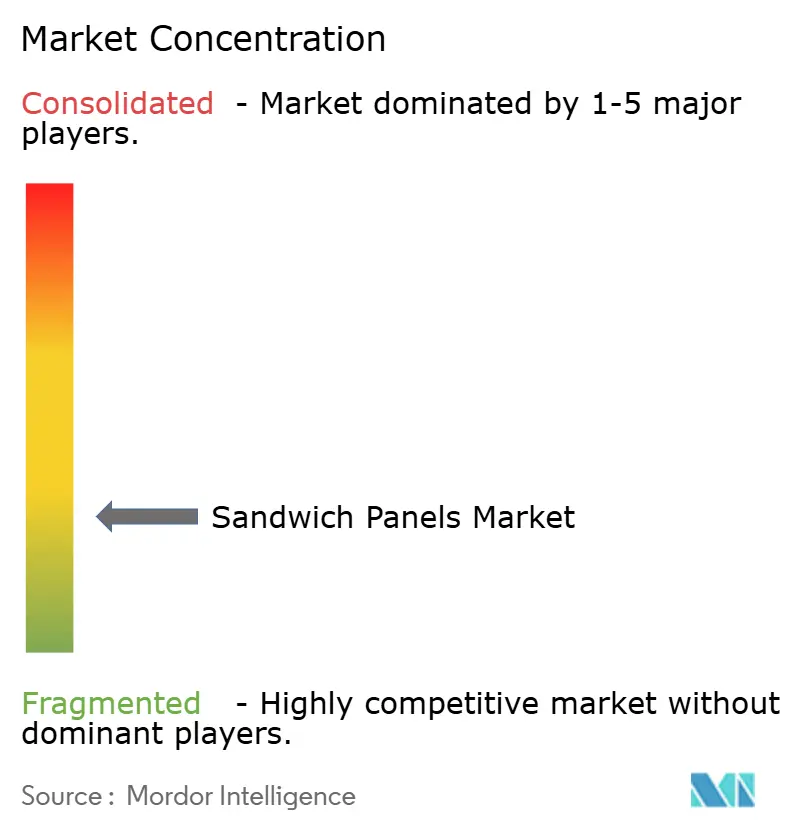
| Market Concentration | Low |
Major Players
*Disclaimer: Major Players sorted in no particular order Image © Mordor Intelligence. Reuse requires attribution under CC BY 4.0. |
|
Sandwich Panels Market Analysis by Mordor Intelligence
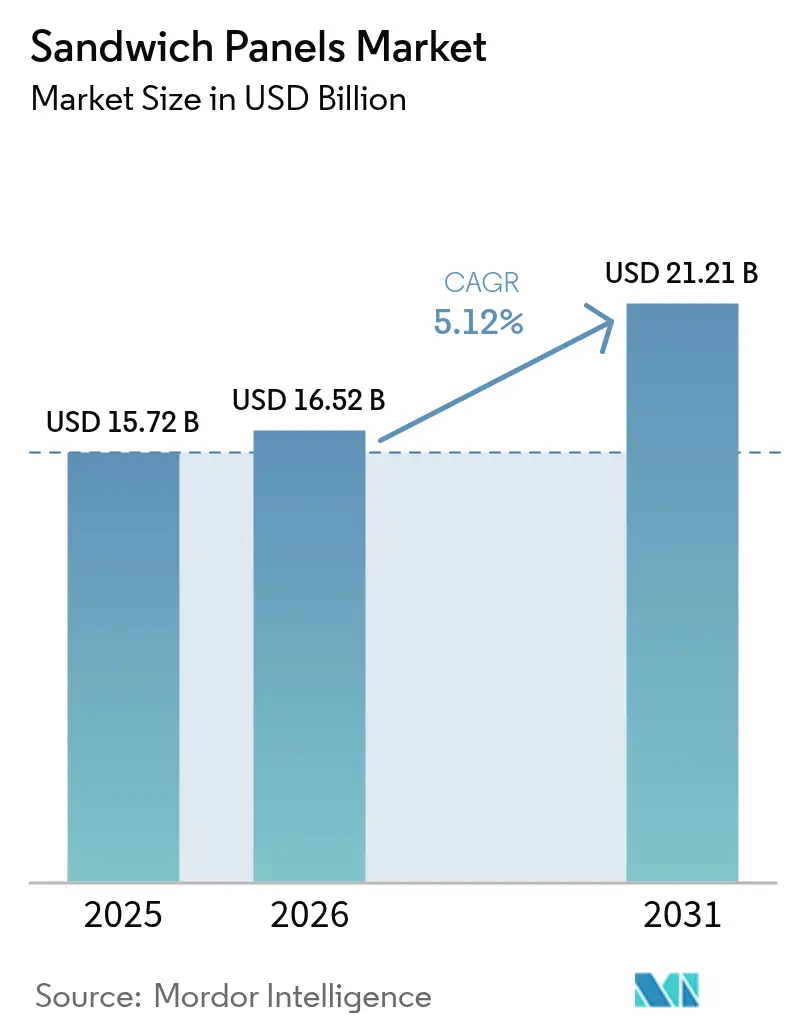
The Sandwich Panels Market size is projected to be USD 15.72 billion in 2025, USD 16.52 billion in 2026, and reach USD 21.21 billion by 2031, growing at a CAGR of 5.12% from 2026 to 2031. The growth reflects a shift in procurement priorities as owners seek fast occupancy and long-term energy savings, which favors prefabricated envelopes that combine structure, insulation, and finish in one lift. Polyurethane cores continue to dominate because their price-performance ratio is attractive for large industrial buildings, yet fire-safety mandates are steering high-occupancy projects toward mineral wool. Aluminum skins remain the leading facing material, while continuous fiber-reinforced thermoplastics (CFRT) are gaining share thanks to lower embodied carbon and end-of-life recyclability. Continuous production lines strengthen cost leadership by cutting scrap and maintaining tight thickness tolerances that appeal to curtain-wall contractors. Rapid cold-chain expansion and hyperscale data-center construction are the most visible demand spikes, each requiring envelope R-values that few alternatives can match at comparable installed cost.
Key Report Takeaways
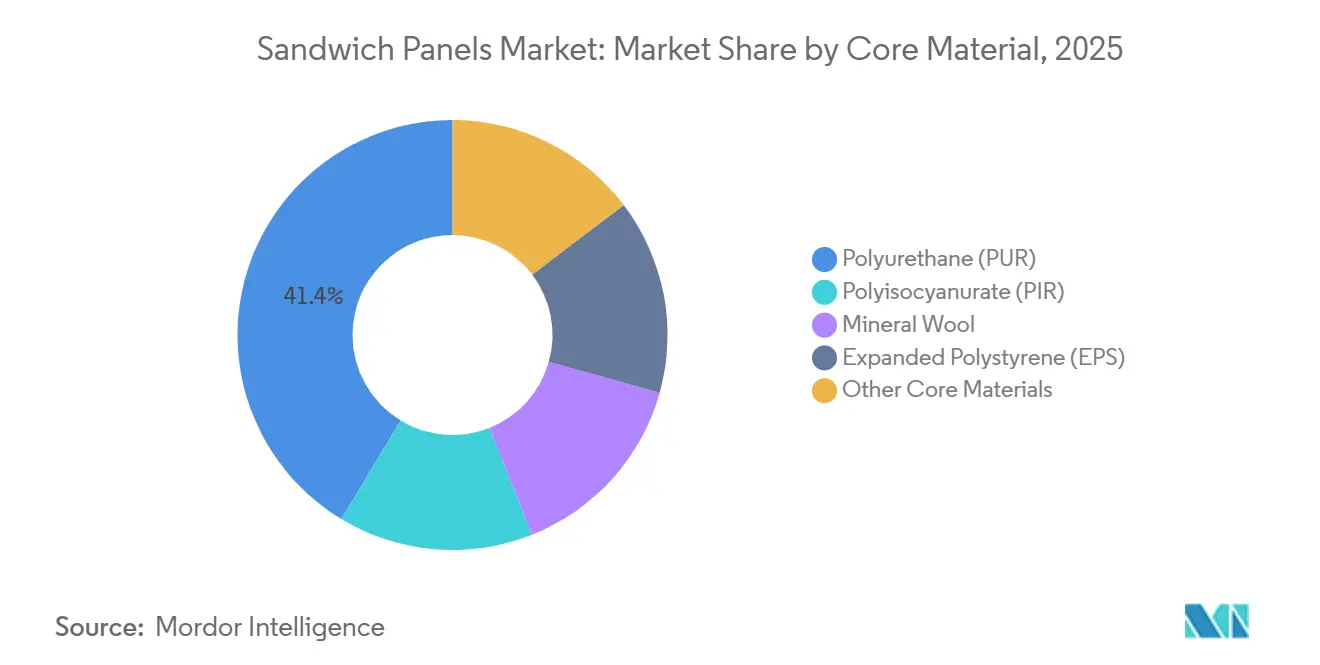
- By core material, polyurethane (PUR) led with 41.36% revenue share in 2025, and also posted the fastest CAGR at 5.38% through 2031.
- By skin material, aluminum maintained 45.31% of the sandwich panels market share in 2025, whereas continuous fiber reinforced thermoplastics (CFRT) recorded the highest projected CAGR at 5.27% to 2031.
- By technology, continuous manufacturing accounted for 75.12% of the sandwich panels market size in 2025 and is advancing at a 5.15% CAGR to 2031.
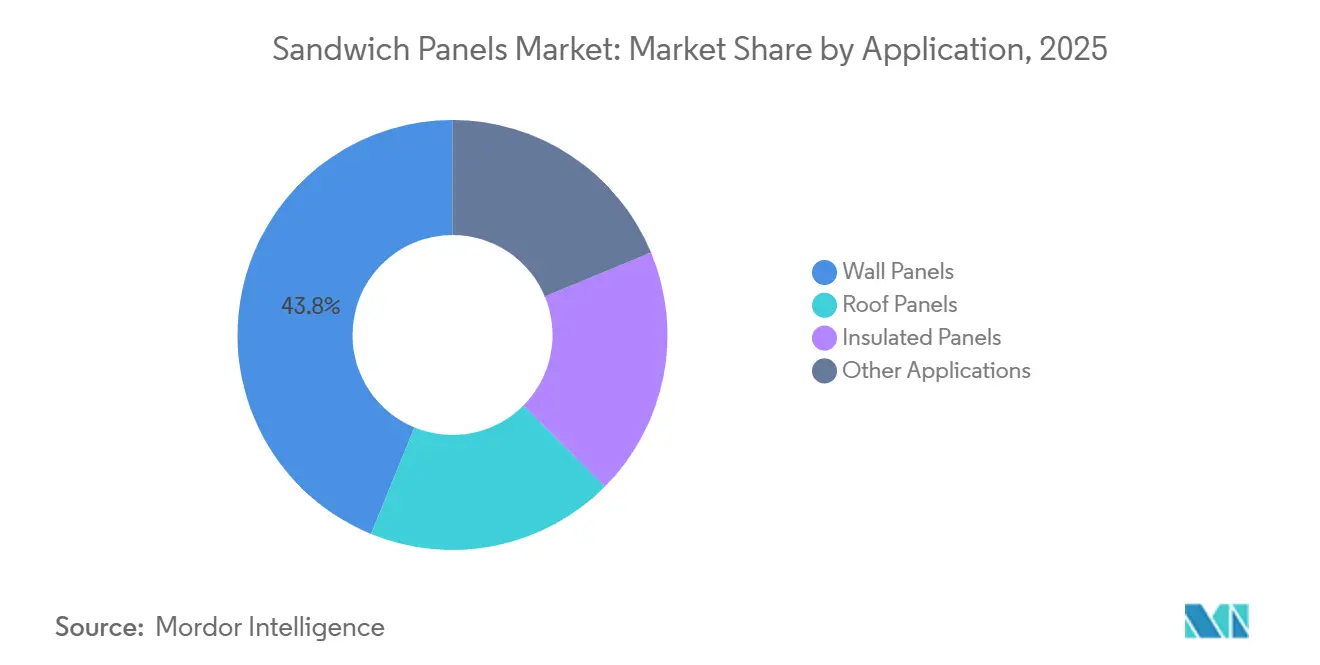
- By application, wall panels represented a 43.82% share in 2025, while insulated panels are projected to expand at a 5.69% CAGR to 2031.
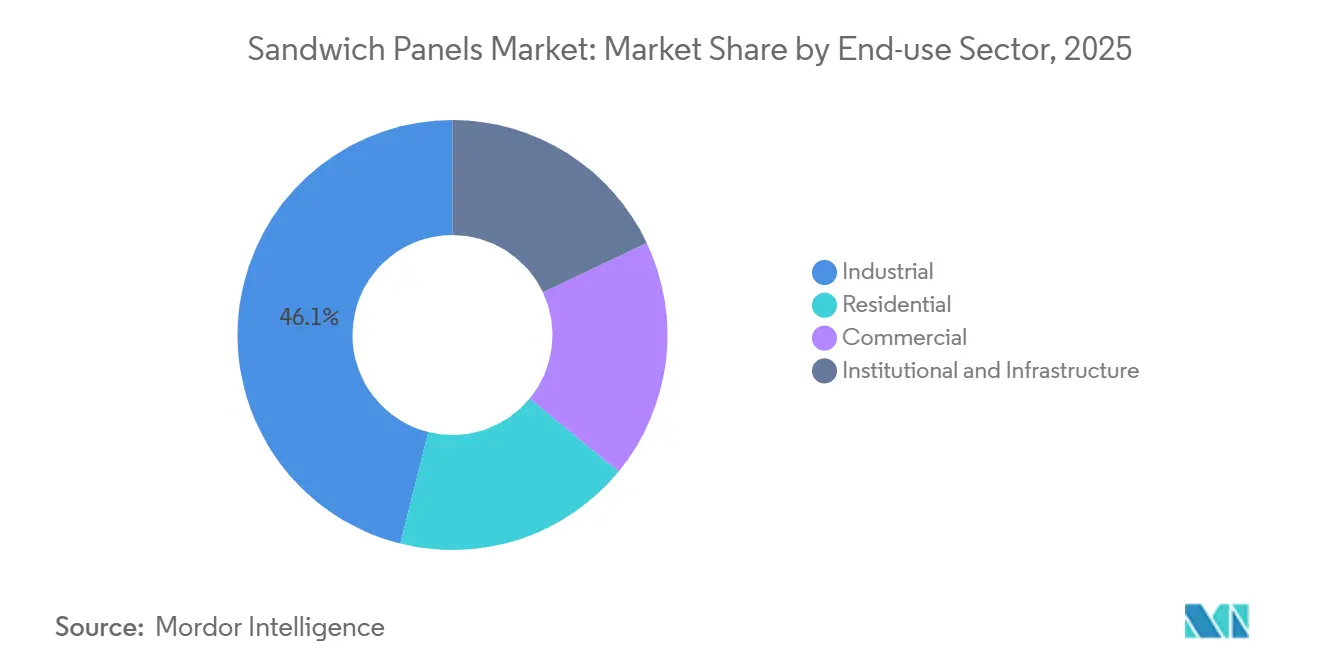
- By end-use sector, industrial buildings held 46.10% of the sandwich panels market size in 2025, and this category is growing at a 5.33% CAGR through 2031.
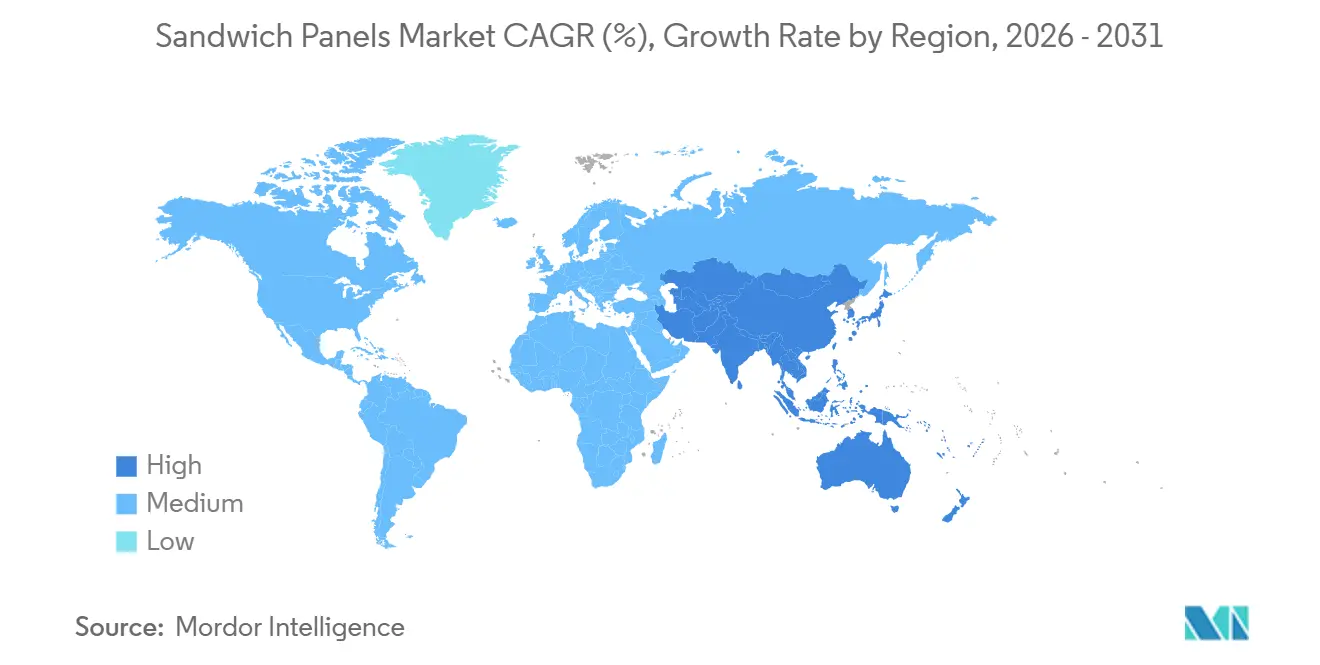
- By geography, Asia-Pacific held 49.90% of the market in the year 2025, and is growing at a CAGR of 5.81%.
Note: Market size and forecast figures in this report are generated using Mordor Intelligence’s proprietary estimation framework, updated with the latest available data and insights as of 2026.
Market Trends and Insights
Drivers Impact Analysis of Sandwich Panels Market*
| Drivers | (~) % Impact on CAGR Forecast | Geographic Relevance | Impact Timeline |
|---|---|---|---|
| Increasing demand for PVDF-based aluminum composite panels | +0.8% | Global, with concentration in Asia-Pacific high-rise markets and Middle East façade projects | Medium term (2-4 years) |
| Rapid growth of prefabricated and modular construction | +1.2% | Asia-Pacific core, North America industrial, Europe residential retrofit | Medium term (2-4 years) |
| Energy-efficiency regulations for building envelopes | +1.0% | Europe (EU Energy Performance of Buildings Directive), North America (IECC updates), emerging in Asia-Pacific | Long term (≥4 years) |
| Data-center boom requiring high-performance envelopes | +0.9% | North America hyperscale hubs, Europe (Ireland, Netherlands), Asia-Pacific (Singapore, India) | Short term (≤2 years) |
| Green-hydrogen gigafactories driving demand for climate-controlled production halls | +0.7% | Europe (Germany, Spain, Nordic), early adoption in Middle East and Asia-Pacific | Long term (≥4 years) |
| Source: Mordor Intelligence | |||
Increasing Demand for PVDF-Based Aluminum Composite Panels
Designers benefit from PVDF coatings, which promise long-term color retention and enable a reduction in cladding weight, subsequently lessening seismic loads in towering structures. In Jakarta and Manila, developers achieved a reduction in structural steel by opting for PVDF-clad sandwich panels over precast concrete, all while meeting wind-load standards. Meanwhile, in the Gulf, a high solar-reflectance index for PVDF translates to cooling bill savings during peak heat. Marine locations value the resin's resistance to salt spray, boosting façade lifespans and enhancing net present value for property owners. Due to resin shortages causing a price surge for PVDF, architects now reserve its use for sunlit façades, opting for more affordable finishes on shaded sides, a strategy that maintains thermal advantages at a reduced initial expense.
Rapid Growth of Prefabricated and Modular Construction
Volumetric units, when factory-assembled, can reduce schedules and offer cost savings compared to traditional stick-built methods. Additionally, the use of modular components reduces site waste, a move that resonates well with ESG scorecards[1]Talent Traction, "2025, Outlook: The Rise of Modular Construction," talenttraction.org. Prefabrication is expected to grow significantly by 2026, driven primarily by labor shortages that have heightened the value of factory work. Sandwich panels, achieving tight tolerances, eliminate the need for on-site shimming and ensure air leakage remains below Passive House limits. Thanks to incentive schemes in India, modular factories are increasingly opting for R-30 cores tailored for cleanroom spaces. In China, developers are incentivized with floor-area bonuses to push beyond 50% prefabrication, leading to a surge in demand for sandwich panels, especially in tier-2 cities. With cycle times reduced, owners of data centers and cold storage facilities can sidestep revenue losses from scheduling delays, even when sandwich panels come at a premium over basic cladding.
Energy-Efficiency Regulations for Building Envelopes
By 2028, the EU mandates zero-emission standards for public assets and extends this requirement to all new structures by 2030, driving up the demand for ultra-low-U-value panels[2]European Parliament, Directive (EU) 2024/1275, eur-lex.europa.eu. By 2028, the EU's updated Energy Performance Directive mandates that new non-residential buildings achieve U-values below 0.18 W/m²·K. Notably, 150 mm PIR sandwich panels can meet this requirement without the need for additional layers. In the U.S., jurisdictions implementing the 2024 IECC have increased minimum insulation standards, nudging developers towards opting for thicker panels and hybrid PIR-vacuum solutions. Meanwhile, South Korea has set a carbon-intensity limit for 2025, incentivizing the use of panels with recycled cores. In California, updates to Title 24 now require parametric thermal modeling for larger envelopes. Here, sandwich panels offer an edge in compliance, as their factory-controlled density remains consistent within a ±3% range. Producers operating on a continuous line stand to gain the most, given that their uniform density accelerates the process of third-party certification.
Data-Center Boom Requiring High-Performance Envelopes
In 2026, hyperscale facilities are operational. These facilities maintain server temperatures between 18 °C and 27 °C, even in climates ranging from −20 °C to 45 °C. Utilizing mineral-wool cores, these facilities achieve a 2-hour fire rating without the need for intumescent coatings, resulting in savings on insurance premiums. In 2025, Northern Virginia and Dublin contributed new floor area, with a significant portion opting for 200 mm panels to comply with ASHRAE 90.4 and secure utility rebates. Operators are increasingly opting for vapor-permeable interior skins, which, while adding an extra cost, mitigate mold risks during rapid load ramps. In India, driven by new subsidies, data-center projects have specified panels, aiming for a Power Usage Effectiveness (PUE) below 1.3.
Restraints Impact Analysis of Sandwich Panels Market*
| Restraints | (~) % Impact on CAGR Forecast | Geographic Relevance | Impact Timeline |
|---|---|---|---|
| Oriented-strand-board VOC emissions | -0.4% | North America (CARB Phase 2 states), Europe (EU VOC limits), emerging in Asia-Pacific | Short term (≤2 years) |
| Moisture ingress and long-term degradation in PUR/PIR cores | -0.6% | Global, with acute impact in high-humidity coastal zones and tropical climates | Medium term (2-4 years) |
| Volatility in MDI, steel and aluminum prices squeezing panel margins | -0.9% | Global, with highest exposure in non-integrated fabricators across all regions | Short term (≤2 years) |
| Source: Mordor Intelligence | |||
Oriented-Strand-Board VOC Emissions
In 2025, OSB bonded with urea-formaldehyde neared CARB Phase 2's formaldehyde limit. This led to a shift towards phenolic or zero-VOC adhesives, increasing panel costs. The EU has set a stricter indoor formaldehyde cap. This effectively sidelines conventional OSB in the EU unless manufacturers undertake a reformulation and recertification process, which can extend up to 18 months. In North America, producers tackled the emissions challenge by substituting urea resins with MDI binders. However, this switch resulted in a hike in raw material costs, putting pressure on gross margins. South Korea, implementing real-time VOC monitoring and imposing hefty fines, has hastened the transition to low-emission cores. Meanwhile, Southeast Asian fabricators, primarily export-oriented, encounter fresh hurdles as multinational developers enforce CARB standards on a global scale.
Moisture Ingress and Long-Term Degradation in PUR/PIR Cores
Moisture seeping through seam imperfections can diminish R-value over time. In humid coastal areas, this degradation can escalate to a loss in compressive strength. Buyers seeking a long service life often shy away from PUR/PIR. This hesitation stems from the fact that most warranties, capping at a limited period, notably exclude moisture-related failures. Remediation expenses can sometimes surpass the initial panel budgets. In response to these concerns, European insurers have raised premiums for PUR/PIR buildings situated in flood-prone zones, subtly steering projects towards mineral wool. While hybrid cores, which feature PIR sandwiched between mineral wool layers, come at an added cost, they offer a significant advantage: extending warranties. This extension alleviates concerns for both lenders and insurers.
*Our forecasts treat driver/restraint impacts as directional, not additive. The impact forecasts reflect baseline growth, mix effects, and variable interactions.
Sandwich Panels Market Segment Analysis
By Core Material:
Polyurethane Continues to Lead While Mineral Wool GainsPolyurethane delivered 41.36% of 2025 revenue and is forecast to expand at 5.38%, illustrating how the sandwich panels market balances performance with first cost. PUR’s lower mass helps brownfield warehouses avoid expensive foundation upgrades, and its thermal efficiency keeps panel thickness to 100 mm or less in moderate climates, saving interior space. Polyisocyanurate enjoys a better R-value per inch and resists rooftop temperatures, making it popular in the Middle-East, where roof surfaces reach high temperatures. Code changes after high-profile façade fires push schools and hospitals toward mineral wool even when budgets are tight.
Mineral-wool cores are expanding due to their A1 fire rating and acoustic attenuation. The sandwich panels market size for mineral wool in data centers and production halls is rising as insurers tighten rules around combustible cores. EPS remains critical for farm buildings because the price premium of PUR cannot be recovered in low-margin agriculture. Niche materials such as phenolic foam and vacuum-insulated panels suggest slow but steady penetration where extremely low smoke or extraordinary R-values are mandatory.



By Skin Material:
Aluminum Dominates, CFRT AcceleratesIn 2025, aluminum commanded a 45.31% market share, lauded for its corrosion resistance, workability, and lightweight nature. Steel, favored for cost-sensitive applications like sheds and barns, also held a notable share. While CFRT accounted for a modest portion of the 2025 revenue, it boasted a 5.27% CAGR, the market's fastest growth rate. This surge is attributed to lifecycle assessments highlighting CFRT's lower embodied carbon compared to aluminum. Even with a higher price tag than coated steel, clients pursuing net-zero certifications are increasingly opting for CFRT.
Fiberglass skins play a crucial role in the food and pharmaceutical sectors, where their non-porous surface simplifies sanitation. Meanwhile, exotic metals like copper and zinc cater to luxury façades and environments with extreme chemical exposure due to their heightened corrosion resistance. With the updated EU CSRD mandating Scope 3 disclosures starting in 2025, developers are turning to CFRT to potentially slash reported emissions. This strategic move is anticipated to dent aluminum's market share in the coming years.
By Technology:
Continuous Lines Sustain Cost AdvantageContinuous lines produced 75.12% of global volume in 2025 and will grow at 5.15%. These lines, equipped with double-belt laminators, achieve speeds of 8-12 meters per minute while maintaining a density variation of less than ±3%. This precision is a challenging feat for batch presses. Given that a complete line comes with a high price tag, the cost creates significant barriers to entry. As a result, capacity is concentrated among leading global players, bolstering economies of scale in the sandwich panels market.
Discontinuous presses play a crucial role in crafting curved stadium roofs and terminal façades, where customized geometries are paramount. Their success is attributed to flexible tool changes, allowing small fabricators to switch between PUR, EPS, and mineral wool in just half a day. Meanwhile, emerging hybrid lines are making waves by merging continuous foaming with batch profiling. This innovation enables them to handle bespoke orders without sacrificing throughput, and they have already secured a notable share of the new capacity announced in 2025.
By Application:
Wall Panels Hold Lead, Insulated Panels Grow FastIn 2025, wall panels accounted for 43.82% of total revenue, serving as both the structural backbone and enclosure for expansive warehouses. While they offer essential bracing and can reduce onsite frame erection time, their growth rate is beginning to plateau in more established markets. Roof panels, on the other hand, secured a notable market share, experiencing steady growth. This uptick is largely attributed to snow-belt owners opting for upgraded cores, achieving improved thermal ratings, and realizing reductions in heating fuel costs.
Insulated panels, encompassing both walls and roofs with enhanced thermal breaks, are witnessing a 5.69% CAGR. The demand for sandwich panels in insulated boxes is on the rise, driven by stringent pharmaceutical GDP standards. These standards mandate cold storage facilities to maintain temperatures between 2 °C and 8 °C, all while minimizing energy loss. Lastly, partition walls and doors contribute the remaining share to the revenue pie, growing steadily. This growth is fueled by modular builders' appreciation for factory-cut service penetrations, which expedite the MEP fit-out process.
By End-Use Sector:
Industrial Leads and AcceleratesIndustrial users held 46.10% of the 2025 demand and are expanding at 5.33%. The construction of gigafactories for batteries, green hydrogen, and semiconductors is driving a surge in demand for high bay cleanrooms, where ISO Class 6 particulate control is a must. Sandwich panels, featuring stainless skins and mineral-wool cores, not only meet essential fire and hygiene standards but can also be installed faster than traditional masonry.
Commercial buildings contributed notably to the revenue, growing consistently. This growth is largely attributed to landlords retrofitting offices to attract tenants willing to pay a premium for LEED Gold certifications. The residential sector is witnessing steady growth. Notably, modular schemes in Scandinavia and Japan are utilizing panels to reduce costs while adhering to stringent airtightness regulations. Meanwhile, the institutional and infrastructure sectors are expanding steadily. This growth is fueled by the establishment of vaccine-storage hubs post-pandemic, which are required to meet the WHO PQS cold-chain standards.
Geography Analysis
APAC Sandwich Panels Market
Asia-Pacific delivered 49.90% of global revenue in 2025 and will climb at a 5.81% CAGR. This growth is largely driven by China's goal to prefabricate a portion of its new constructions by 2030 and India's push for electronics factories. In 2025, a notable percentage of the new industrial floor area in Chinese provinces utilized sandwich panels, indicating swift policy adoption. India constructed a substantial amount of Grade A warehouses in 2025, with a significant portion featuring insulated boxes that align with Global Cold Chain Alliance standards. Japan and South Korea made up a considerable share of the region's revenue, while aging workforces in these nations are pushing for more labor-saving solutions. Southeast Asia experienced growth as manufacturers shifted operations from China, though ASEAN's import tariffs on steel and aluminum have extended lead times.
North America Sandwich Panels Market
North America accounted for a notable share of global sales in 2025, with steady growth. U.S. e-commerce warehouses expanded significantly, and a considerable percentage of high bay facilities over a certain size opted for panels in their construction. In Canada, a stricter code in 2025 has hastened the adoption of these panels in prairie cold rooms. Mexico's growth can be attributed to USMCA regulations promoting nearshoring, with new automotive plants opting for LEED-eligible designs.
Europe Sandwich Panels Market
Europe, contributing a significant share to global sales, is on a steady rise. Volatility in natural gas prices has led factories to retrofit with thicker panels, achieving a notable reduction in heating loads. Germany and Poland, bolstered by battery cell plants currently under construction, cater to a considerable portion of Europe's demand. The Nordic states, witnessing growth, are seeing a surge in hydrogen projects that necessitate airtightness due to extreme cold.
MEA and South America Sandwich Panels Market
South America, with a notable share of global revenue, is growing steadily. Brazil established numerous cold storage facilities for protein exports, with a significant portion utilizing 180 mm PIR cores. Meanwhile, Argentina's mining surge is prompting rapid constructions that prioritize quick-install envelopes. The Middle-East and Africa, holding a notable share, are experiencing significant growth, spearheaded by Saudi NEOM and the UAE's industrial zones, both aiming for LEED Gold standards in arid conditions.
Mordor Intelligence provides coverage of the sandwich panels market across other key regional markets. Detailed country-level analysis extends to Morocco incorporating local coverage and market participation, as required.

Regulatory Landscape
Regulatory requirements are tightening around both fire performance and product conformity for sandwich panels used in building envelopes. In Europe, Regulation (EU) 2024/3110 (Construction Products Regulation, adopted 27 November 2024) strengthens harmonized rules for marketing construction products and increases emphasis on environmental sustainability information and labeling, which raises the need for verified documentation from panel producers and their upstream material suppliers. Germanys DIBt continues to require national technical approvals (abZ) or European Technical Assessments (ETA) for sandwich panels not fully covered by harmonized standards such as EN 14509, adding an additional compliance gate for new or differentiated panel constructions.
Fire-safety provisions also influence core selection, particularly in higher-risk building types and tall buildings. In the United Kingdom, Approved Document B sets stringent reaction-to-fire expectations for insulation and filler materials in taller buildings, including A2 class thresholds for certain height categories, steering specified systems toward non-combustible solutions such as mineral wool in relevant applications. In North America, performance-based acceptance commonly relies on ICC-ES evaluation pathways, and the ICC-ES AC04-24 acceptance criteria for sandwich panels (editorially revised in August 2024) provides an updated reference framework that manufacturers and project teams use to support code compliance and approvals.
Value Chain Analysis
The sandwich panel value chain begins with core raw materials and facings: polyols, MDI (isocyanates), blowing agents (pentane and newer HFO options), catalysts and flame retardants for PUR/PIR systems, and mineral wool for non-combustible cores, paired with coil-coated steel (including PPGI) or aluminum, plus specialty skins such as fiberglass and CFRT. Upstream availability and price volatility in MDI and metals directly influence panel pricing and producer margins, while regulatory shifts on emissions and fire behavior drive formulation changes, including lower-emission binders and higher fire-performance core systems. Equipment and process suppliers are also central contributors to throughput and yield, especially for continuous lines using double-belt lamination where tight thickness and density tolerances are key selling points.
Manufacturing converts coils and core chemistries into finished panels via continuous or discontinuous lines, followed by profiling, cutting, joint machining, packaging, and distribution to contractors, modular builders, and OEM cold-room fabricators. Operational bottlenecks frequently arise from press cycle times and bonding steps, where adhesive cure rates can vary with ambient temperature and constrain capacity without additional lines. Process innovation such as multi-component adhesive systems targets this constraint. Downstream, demand is pulled through design-and-build contractors and specialized installers (façade, cold storage, and industrial roofing), alongside increasing requirements for third-party certification, EPD documentation, and consistent factory quality control, which favors producers with automated inspection, stable raw-material supply arrangements, and the ability to support project approvals across multiple jurisdictions.
Competitive Landscape
The global sandwich panels market is fragmented. Regional fabricators, adept at custom profiling, are capitalizing on short lead times. Some are crafting niche cores, such as soy-based PUR that reduces embodied carbon. These eco-conscious offerings attract architects, who are willing to pay a premium for the sustainability branding. In 2025, patent filings spotlighted hybrid mineral-wool-plus-PIR cores. These innovations achieve the A2 fire class while maintaining high R-values, effectively addressing the age-old dilemma of combustibility versus performance. With Industry 4.0 enhancements, including inline density sensors and predictive maintenance, defect rates have significantly decreased. This achievement is something smaller shops can only replicate through labor-intensive inspections. There's a burgeoning opportunity in re-cladding. As aging sheds seek lightweight overlays to comply with new energy codes, they can do so without the need for structural reinforcement. Broad Sustainable Building, a vertically integrated modular builder, is moving backward into panel production. This strategy not only helps them capture the envelope margin but also ensures dimensional compatibility, further propelling consolidation in the sandwich panels market.
Sandwich Panels Industry Leaders
-
Kingspan Group
-
Metecno Group
-
ArcelorMittal
-
Tata Steel
-
Assan Panel A.S.
- *Disclaimer: Major Players sorted in no particular order
Sandwich Panels Market Companies Covered in this Report
- Alubel
- ArcelorMittal
- Areco
- Assan Panel A.S.
- Building Component Solutions LLC
- Cornerstone Building Brands, Inc.
- DANA Group of Companies
- EPACK Prefab
- Isopan
- Jiangsu Jingxue Energy Saving Technology Co., Ltd.
- Kingspan Group
- Lattonedil
- Marcegaglia Steel S.p.A.
- Metecno Group
- NAV SYSTEM
- Rautaruukki Corporation
- Romakowski GmbH and Co. KG
- Sintex
- Structural Panels
- Tata Steel
- Teknopanel
- Tonmat Group

Market Opportunities and Future Outlook
White-space is opening where building owners need faster occupancy, higher envelope performance, and clearer sustainability documentation, aligning with the market shift toward factory-controlled systems. Capacity additions and automation investments in 2025-2026 reflect this pull, with EPACK Prefab bringing an 800,000 m2 per year sandwich panel plant online at Mambattu in Andhra Pradesh, and Mount Roofing & Structures inaugurating a second fully automated continuous sandwich panel line in Tumkur. Together, these projects point to rising local supply for cold-chain and industrial envelopes that favor insulated panels. In Europe, TeraSteel (TeraPlast Group) inaugurated a new thermal insulation panels plant in Lehliu-Gara, Romania, backed by an investment reported at over EUR 20 million, which supports shorter lead times and regional sourcing for projects prioritizing energy performance.
Product and material development is also creating incremental demand pockets tied to fire performance and multifunctional envelopes. Byucksans launch of a lightweight mineral wool roof-oriented product (50K mineral wool) with certification for improved fire resistance in small building applications shows how non-combustible cores are being engineered to compete on weight and installability, not only compliance. In parallel, adjacent envelope solutions that combine layers into single-install panels, such as Owens Cornings EZSheath structural insulated sheathing (structural sheathing plus XPS insulation plus a water-resistive barrier), reinforce the direction toward fewer on-site steps and fewer interfaces. Sandwich panel producers can respond through integrated accessory systems, improved joint detailing for moisture control, and documented environmental and fire performance for high-occupancy and high-value assets such as data centers and cold storage.
Recent Industry Developments in Sandwich Panels Market
- May 2026: Kingspan Roofing + Waterproofing, Inc. closed New Markets Tax Credit financing to build an advanced manufacturing facility in Stillwater, Oklahoma, focused on energy-efficient roof systems for commercial buildings. The project expands domestic capacity for high-performance building-envelope solutions and leverages public incentive structures that can accelerate plant modernization and throughput scaling.
- October 2025: ArcelorMittal inaugurated the Helioroof production line in Contrisson, France, for an insulated steel sandwich panel roof system that integrates solar cells into the panel. The move blends on-site power generation with insulated envelope performance, supporting developers looking to reduce installation complexity while addressing building energy targets.
- October 2024: ArcelorMittal and Kingspan | Invespanel released a high-recycled-content sandwich panel range using XCarb steel with at least 75% scrap input and 100% renewable electricity, positioned around a 60% carbon-emission reduction claim. This strengthened the availability of lower-embodied-carbon panel options for projects that require EPD-backed material choices and Scope 3 reporting support.


Sandwich Panels Market Report Scope and Research Methodology
Market Definition and Coverage
For this study, the sandwich panels market covers factory-made insulated panels that combine two outer facings with an insulating core. These panels are used as building envelope or partition elements in construction and industrial facilities.
Scope exclusions: On-site built-up insulation systems, standalone insulation boards without facing skins, and structural framing materials are excluded from this market sizing.
Segments Covered in This Report
-
By Core Material
- Polyurethane (PUR)
- Polyisocyanurate (PIR)
- Mineral Wool
- Expanded Polystyrene (EPS)
- Other Core Materials
-
By Skin Material
- Continuous Fiber Reinforced Thermoplastics (CFRT)
- Fiberglass Reinforced Panel (FRP)
- Aluminum
- Steel
- Other Skin Materials
-
By Technology
- Continuous
- Discontinuous
-
By Application
- Wall Panels
- Roof Panels
- Insulated Panels
- Other Applications
-
By End-use Sector
- Residential
- Commercial
- Industrial
- Institutional and Infrastructure
-
By Geography
-
Asia-Pacific
- China
- India
- Japan
- South Korea
- Rest of Asia-Pacific
-
North America
- United States
- Canada
- Mexico
-
Europe
- Germany
- United Kingdom
- Italy
- France
- Spain
- Poland
- NORDIC Countries
- Hungary
- Rest of Europe
-
South America
- Brazil
- Argentina
- Rest of South America
-
Middle-East and Africa
- Saudi Arabia
- South Africa
- Rest of Middle-East and Africa
-
Asia-Pacific
Data Sources, Market Sizing, and Validation
Desk Research
Desk work started by mapping how demand forms across building envelope applications and temperature-controlled facilities, then matching that to published construction activity and insulation guidance. Public sources were used, including national construction statistics releases, customs trade data for insulated panels and related inputs, building energy code updates from government bodies, and fire-safety guidance notes referenced by regulators. To avoid double counting, import and export signals were used only as directional checks, not as a direct proxy for consumption.
On the supply side, we reviewed company annual reports, investor presentations, and public product catalogs to understand typical core mixes, facing materials, and the main panel applications (walls, roofs, and insulated enclosures). Patent databases were used to spot shifts in core chemistry and panel skins that can change pricing over time. We also used a paid subscription for company financials and a separate paid subscription for shipment-level trade screening, mainly to validate large capacity additions and cross-border flows. The desk source list is not exhaustive, and additional public documents were used for data collection, validation, and clarification.
Primary Interviews and Surveys
Primary work focused on manufacturers, distributors, installers, and large project buyers so we could confirm where panels are actually specified, and how pricing moves by core type and facing. Because this is a global market, inputs were checked across APAC, EMEA, and the Americas. Where the desk dataset was incomplete, gaps were closed through follow-up questions on utilization, project cycles, and regulation-led substitutions.
Distribution of primary research fieldwork respondents
| Company type | Respondent position | Region |
|---|---|---|
| Top tier: 26% | CXOs: 16% | APAC: 44% |
| Mid tier: 53% | Functional/Unit leaders: 37% | EMEA: 29% |
| Smaller Players: 21% | Managers: 47% | Americas: 27% |
Market-Sizing & Forecasting
Market sizing was first constructed using a top-down approach where construction activity, cold-chain buildouts, and industrial facility additions are converted into an addressable panel demand pool, then filtered by typical panel usage intensity. The model uses practical inputs such as new floor area additions, cold storage capacity additions, renovation share, insulation and fire-safety code tightening, and average panel thickness and core mix shifts. These factors then influence value through price per square meter assumptions.
To keep totals realistic, we corroborated outputs with selective bottom-up approximations. This included sampled supplier revenue splits, channel checks on regional pricing, and volume sanity checks using typical project panel take-off rates. Where data is thin, especially in smaller countries, proxy indicators like construction permits and industrial output trends were used, then adjusted using interview feedback so results stay consistent with how suppliers see demand moving.
For forecasting, scenario analysis was used because demand is sensitive to construction cycles and regulation timing. The forward path was built by stress-testing key drivers, including non-residential construction momentum, cold-chain investment pace, energy retrofit incentives, and raw material cost pass-through behavior. The final trajectory was then aligned to the expert consensus gathered during the research period.
Data Validation & Update Cycle
Before final sign-off, outputs are checked against independent signals such as the direction of regional construction spending, reported capacity expansions, and trade flow movements that should track panel availability. If a country-level result looks out of line, we re-check assumptions like core mix, thickness, and pricing ladders. Sources are re-contacted when variance cannot be explained through desk evidence.
A second analyst review is used to confirm formulas, units, and currency handling, followed by a final consistency pass across regions and end-use logic. Reports are refreshed annually, and interim updates are made when material events occur, such as major code changes, large plant additions, or sharp feedstock swings. Right before delivery, a fresh review is run so clients receive an updated view.
Mordor Intelligence's Sandwich Panels Market Size Compared With Other Published Estimates
Published market sizes for sandwich panels can look far apart even when the topic name is the same, since the boundary around products, revenue point, and the year used for currency and pricing can change the total quickly. Differences also come from whether the estimate is tied to construction activity and insulation adoption, or if it leans more on manufacturer revenues without fully separating imports, exports, and downstream resales.
By tracking installed-area demand signals and then refreshing currency timing assumptions, Mordor Intelligence keeps the sizing tied to end-use consumption rather than factory-gate revenue capture. This is why the spread shows up versus estimates that mix revenue points or apply more aggressive price growth.
Benchmark comparison
| Source | Market Size | Gaps in Research Methodology |
|---|---|---|
| Mordor Intelligence | USD 15.72 B (2025) | |
| Global Consultancy A | USD 11.57 B (2025) | Often narrower product and application coverage, with less explicit adjustment for panel thickness, core mix, and how retrofit demand converts into panel value, which can keep the 2025 total lower. |
| Trade Journal B | USD 18.30 B (2025) | Uses a factory-gate revenue lens that can count manufacturer-level sales and related services, and it may not fully align revenues to installed-demand checks by geography, which can lift the near-term value. |
The comparison mainly comes down to what is being counted and where in the value chain the counting happens, followed by how price and currency are timed for the stated year. With clear demand-side variables, selective supplier cross-checks, and simple variance tests, we can keep the final number traceable and repeatable, even when external publications start from a different scope.


Key Questions Answered in the Report
What CAGR is forecast for the sandwich panels market between 2026 and 2031?
The market is projected to grow at a 5.12% CAGR during the 2026-2031 period, growing from USD 16.52 billion to USD 21.21 billion.
Which region shows the fastest growth through 2031?
Asia-Pacific leads with a 5.81% CAGR, driven by prefabrication mandates and industrial expansion.
Why are mineral-wool cores gaining share?
They carry an A1 fire rating that meets stricter codes for high-occupancy buildings.
How do continuous lines outperform discontinuous lines?
Continuous production achieves higher speeds, lower scrap, and tighter thickness tolerances, cutting unit cost.
What application segment is growing fastest?
Insulated panels for cold-storage and data-center envelopes are advancing at a 5.69% CAGR.
Page last updated on:


 Your data is secure and never sold or shared.


