
Salts And Flavored Salts Market Size and Share
Market Overview
| Study Period | 2021 - 2031 |
|---|---|
| Market Size (2026) | USD 9.56 Billion |
| Market Size (2031) | USD 11.19 Billion |
| Growth Rate (2026 - 2031) | 3.21 % |
| Fastest Growing Market | Middle East and Africa |
| Largest Market | Asia Pacific |
| Market Concentration | Medium |
Major Players *Disclaimer: Major Players sorted in no particular order Image © Mordor Intelligence. Reuse requires attribution under CC BY 4.0. | |
Salts And Flavored Salts Market Analysis by Mordor Intelligence
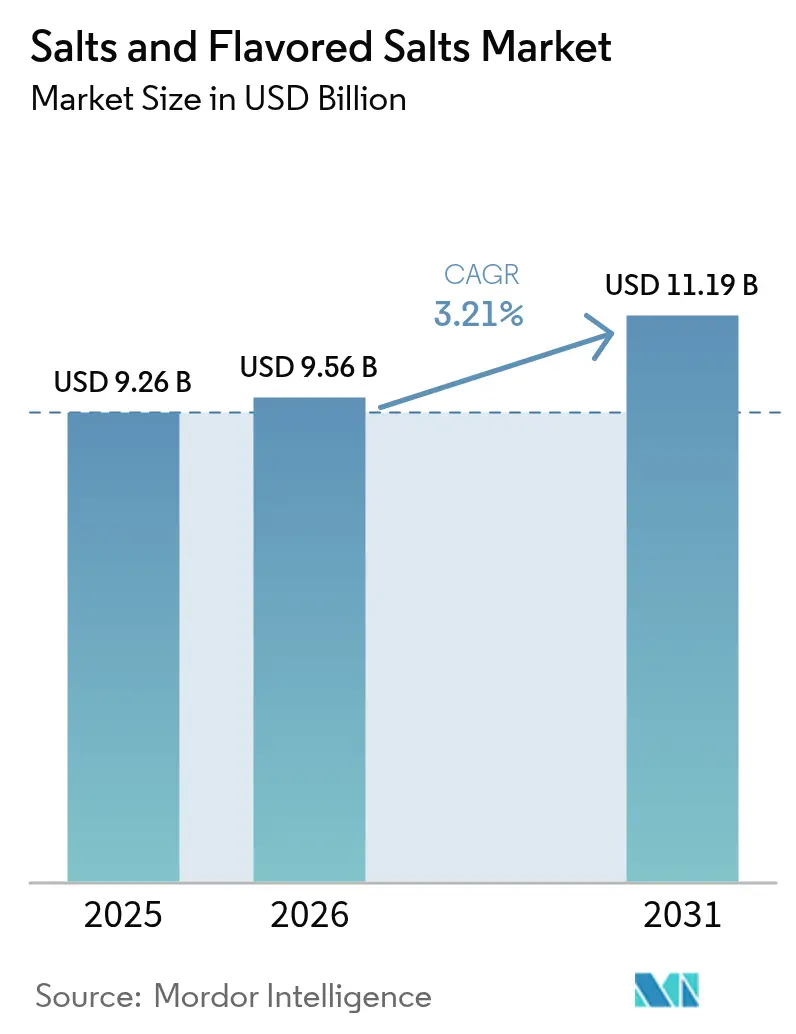
The Salts and Flavored Salts Market size was valued at USD 9.26 billion in 2025 and estimated to grow from USD 9.56 billion in 2026 to reach USD 11.19 billion by 2031, at a CAGR of 3.21% during the forecast period (2026-2031). Market expansion is primarily supported by increasing consumer preference for premium salt products, continuous innovation in developing unique flavored salt combinations, and necessary product reformulations to meet evolving regulatory standards. However, traditional salt segments maintain steady but modest growth patterns. The Asia-Pacific region continues to dominate the market, driven by substantial per-capita sodium consumption, robust food processing industry operations, and a rapidly expanding middle-class consumer base. North American and European markets exhibit strong growth in specialty salt segments, influenced by increasing health consciousness, demand for clean-label products, and growing interest in gourmet cooking. The market dynamics are shaped by weather-dependent production fluctuations and strategic industry consolidation through mergers and acquisitions, while technological advancements in flavor enhancement capabilities continue to unveil new market opportunities.
Key Report Takeaways
- By product type, table salt held 84.65% of the Salts and Flavored Salts Market share in 2025, whereas seasoned variants are forecast to expand at a 4.69% CAGR to 2031.
- By source, rock salt captured 45.12% of the Salts and Flavored Salts Market size in 2025, while naturally harvested alternatives are expected to advance at a 4.49% CAGR through 2031.
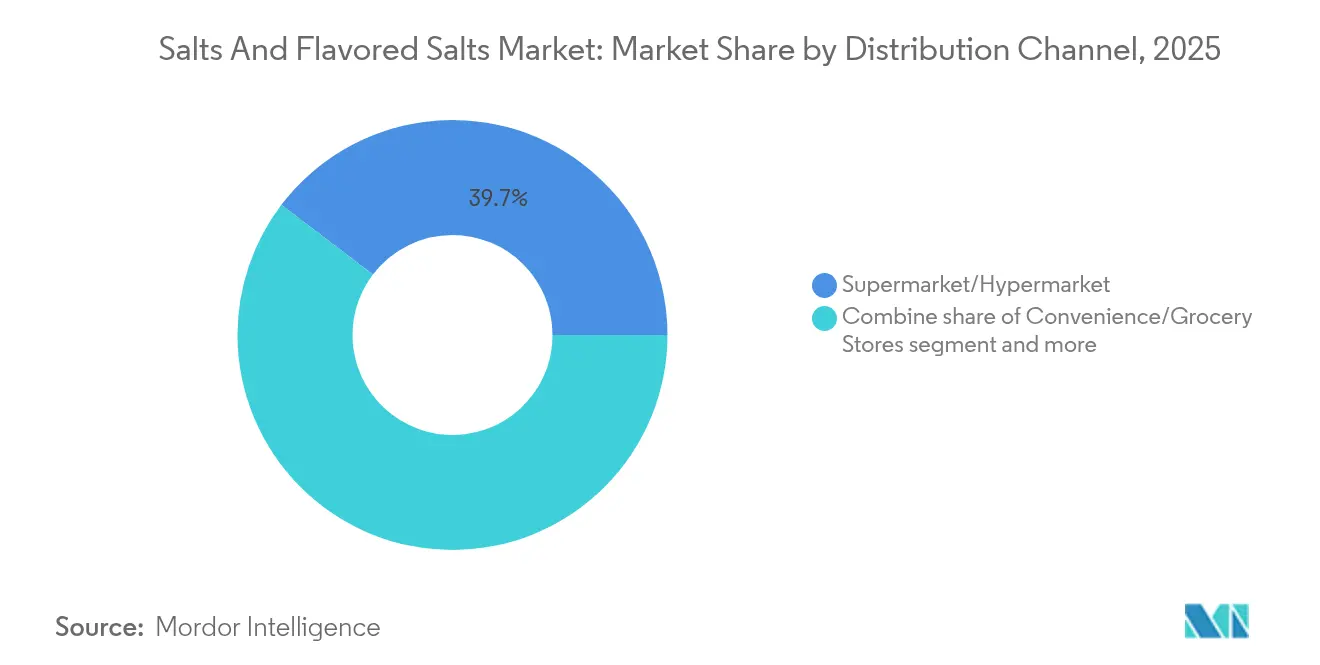
- By distribution channel, supermarket/hypermarket outlets controlled 39.65% of revenue in 2025; online stores are projected to deliver the highest 5.29% CAGR between 2026-2031.
- By geography, Asia-Pacific accounted for 55.72% of global sales in 2025, while the Middle East and Africa region is set to post the fastest 4.38% CAGR to 2031.
Note: Market size and forecast figures in this report are generated using Mordor Intelligence’s proprietary estimation framework, updated with the latest available data and insights as of 2026.
Market Trends and Insights
Drivers Impact Analysis of Salts And Flavored Salts Market*
| Driver | (~) % Impact on CAGR Forecast | Geographic Relevance | Impact Timeline |
|---|---|---|---|
| Demand for natural, organic, and clean-label ingredients | +1.2% | Global, with premium focus in North America and Europe | Medium term (2-4 years) |
| Popularity of gourmet and specialty foods | +0.8% | North America, Europe, urban Asia-Pacific | Short term (≤ 2 years) |
| Increase in global culinary cultural exchange and awareness | +0.7% | Global, accelerated in metropolitan areas | Long term (≥ 4 years) |
| Preference for artisanal, minimally processed products | +0.6% | North America, Europe, affluent Asia-Pacific markets | Medium term (2-4 years) |
| Innovation in low-sodium salt blends and fortified products | +0.5% | Global, regulatory-driven in developed markets | Long term (≥ 4 years) |
| Increase in global culinary cultural exchange and awareness | +0.4% | Emerging markets, food service sector | Medium term (2-4 years) |
| Source: Mordor Intelligence | |||
Demand for Natural, Organic, and Clean-Label Ingredients
Consumer demand for food transparency is influencing product formulations across food categories, as consumers show willingness to pay higher prices for clean-label products. Salt producers have responded by implementing traceable sourcing protocols and minimal processing methods, particularly for naturally harvested sea salts and rock salts with verified origins. McCormick's 2025 introduction of finishing salts with natural flavor infusions, free from artificial additives, reflects the industry's alignment with clean-label requirements. The FDA's updated voluntary sodium reduction guidelines present dual requirements for clean ingredients and functional reformulation. The combination of health awareness and premium positioning allows salt producers to maintain higher profit margins while meeting consumer demands for ingredient authenticity and minimal processing. The organic products market shows significant expansion, with organic purchases present in over 95% of households last year and an addition of 2 million new buyers. Consumer preference for organic products continues to exceed that of conventional products, primarily driven by younger consumers' value-based purchasing decisions. Market growth stems from increased online and direct-to-consumer sales, alongside retailers expanding their organic product offerings. Despite a slowdown in organic product innovation, with companies adopting more strategic approaches, organic products remain central to the natural products industry in 2025 [1].
Popularity of Gourmet and Specialty Foods
Specialty food retailers demonstrated substantial growth in their annual performance, effectively securing their competitive position against traditional grocery retail channels. The fusion of sweet and salty flavors has become increasingly prominent in consumer preferences, with market projections indicating significant expansion in menu offerings through 2027. This evolution has positioned flavored salts as fundamental ingredients, driving innovative culinary applications throughout the food service industry. Premium salt varieties consistently generate substantial price premiums compared to conventional table salt, reflecting strong consumer acceptance and willingness to invest in distinguished flavor experiences and premium-quality ingredients. The market dynamics showcase a clear shift in consumer behavior, where value perception extends beyond basic functionality to encompass enhanced taste experiences and culinary sophistication. This trend has encouraged specialty food retailers to expand their premium salt offerings, capitalizing on the growing consumer appetite for gourmet ingredients and unique flavor profiles.
Increase in Global Culinary Cultural Exchange and Awareness
Southeast Asian flavors continue to establish a strong presence in Western markets, with consumers increasingly embracing Thai, Vietnamese, and Indonesian seasonings characterized by umami-rich salt blends. The influence of social media platforms has transformed how these flavors spread, as viral food content generates immediate market response for innovative seasoning combinations. Traditional Asian fermentation practices are reshaping Western salt manufacturing processes, with companies investing in the development of fermented salt products that deliver enhanced umami profiles. The expansion of global trade networks facilitates broader access to diverse salt varieties, from the mineral-rich Himalayan pink salt to the delicate French fleur de sel, enabling consumers to appreciate the distinct characteristics of regional salt products. The continuous sharing of international culinary experiences through digital platforms sustains market demand for authentic flavor experiences, which premium and specialty salt products effectively deliver to discerning consumers.
Preference for Artisanal, Minimally Processed Products
Artisanal salt producers use traditional harvesting methods and small-batch production processes to differentiate themselves from industrial producers. Their use of solar evaporation and hand-harvesting techniques helps maintain premium market positioning. At the Great Salt Lake, declining water levels create operational challenges for traditional harvesting while increasing the value of naturally produced salts. Consumer preference for minimally processed products has increased demand for salts with distinct textures, mineral profiles, and verified geographic origins. By focusing on sustainable harvesting and environmental preservation, artisanal producers attract environmentally conscious consumers willing to pay premium prices. These producers have developed effective direct-to-consumer sales channels, maintaining profitable margins while building brand relationships through product education. The growing preference for minimally processed foods reflects consumer interest in healthier, natural options and concerns about artificial ingredients. Although processed foods are often considered unhealthy, consumers recognize that some minimal processing can be acceptable. The need for convenience and time savings continues to influence purchasing decisions, making minimally processed ready-to-eat foods important in modern diets. This combination of health consciousness and convenience requirements influences grocery shopping patterns across all income levels [2].
Restraints Impact Analysis of Salts And Flavored Salts Market*
| Restraint | (~) % Impact on CAGR Forecast | Geographic Relevance | Impact Timeline |
|---|---|---|---|
| Regulatory challenges in flavor formulation and labeling | -0.9% | Global, particularly Europe and North America | Short term (≤ 2 years) |
| Safety concerns about artificial additives in certain flavored salts | -0.7% | Global, heightened in developed markets | Medium term (2-4 years) |
| Limited awareness in developing markets for premium salts | -0.6% | Asia-Pacific emerging markets, Africa, Latin America | Long term (≥ 4 years) |
| Environmental impact of salt harvesting practices | -0.5% | Global, regulatory focus in Europe and North America | Long term (≥ 4 years) |
| Source: Mordor Intelligence | |||
Regulatory Challenges in Flavor Formulation and Labeling
The FDA's 2024 voluntary sodium reduction targets present significant operational challenges for flavored salt manufacturers, who must now navigate the intricate process of product reformulation while ensuring their products maintain consumer-preferred taste profiles and necessary shelf stability. In North America, manufacturers face a complex regulatory environment, with Mexico's NOM-051 labeling requirements and Canada's nutritional labeling standards creating distinct compliance obligations in each market. The European Union's comprehensive Farm to Fork strategy introduces additional layers of requirements focused on sustainability and labeling, which directly impact how companies source their salt and maintain processing documentation. These diverse regulatory frameworks across international markets necessitate companies to develop and maintain separate product formulations and implement multiple labeling systems, resulting in increased operational complexity and resource allocation. The situation becomes particularly challenging in the flavored salt category, where manufacturers must ensure their natural flavor declarations align with varying international requirements for ingredient transparency and safety documentation, while meeting local market expectations.
Safety Concerns About Artificial Additives in Certain Flavored Salts
The growing consumer demand for clean-label products is driving reformulation across food categories, particularly in flavored salt varieties that traditionally used synthetic flavor enhancers and preservatives. Research linking artificial colorants and flavor compounds to potential health risks has increased regulatory oversight and consumer concerns, compelling manufacturers to adopt natural alternatives. These natural ingredients often have higher costs and reduced shelf stability. This transition particularly affects mass-market flavored salt products, where artificial additives previously enabled consistent flavor profiles and extended shelf life at competitive prices. The shift to natural ingredients requires substantial research and development investment and typically increases production costs, potentially affecting profit margins or retail prices. Sourcing natural flavor compounds that maintain food safety standards and deliver uniform sensory qualities across production runs has also increased supply chain complexity.
*Our forecasts treat driver/restraint impacts as directional, not additive. The impact forecasts reflect baseline growth, mix effects, and variable interactions.
Salts And Flavored Salts Market Segment Analysis
By Product Type:
Seasoned Variants Drive Premium GrowthTable salt holds an 84.65% market share in 2025, maintaining its essential position across global markets. Its dominance stems from widespread use in food processing operations, diverse industrial applications, and consistent household consumption patterns. The seasoned salt/flavored salt segment demonstrates robust growth potential, advancing at a 4.69% CAGR through 2031, as consumers increasingly seek convenient options and innovative flavor experiences.
McCormick's strategic 2025 product line expansion encompasses 5 new finishing salts, including Balsamic & Herb, Smoky Garlic & Rosemary, and Watermelon Lime, responding to evolving consumer preferences. In the flavored segments, truffle salt and smoked salt variants continue to command premium prices, while garlic salt maintains steady demand across both retail and food service sectors. The market observes notable growth in jalapeño salt and lime-lemon varieties, which align with the emerging "swicy" trend. This flavor profile is projected to experience significant menu growth over the next 4 years, indicating strong potential for increased adoption in restaurant applications.


By Source:
Natural Harvesting Gains Premium PositioningRock salt maintains its market leadership with a 45.12% share in 2025, building on decades of established mining infrastructure and providing consistent supply reliability for both industrial applications and consumer markets. Natural harvested salt demonstrates remarkable market performance, achieving the highest growth rate at 4.49% CAGR through 2031, as consumers increasingly value products with traceable origins and traditional production methods.
Environmental challenges significantly impact the market dynamics, with the Great Salt Lake's declining water levels creating operational constraints for solar evaporation facilities while simultaneously enhancing the market value of naturally produced varieties. The industry faces additional pressures from heightened environmental scrutiny of mineral salt extraction, particularly concerning ecosystem preservation and water resource management. Recent market disruptions, exemplified by severe winter conditions, compelled American Rock Salt to increase production capacity by 25% through continuous operations, highlighting the infrastructure limitations that affect market stability and pricing mechanisms.
By Distribution Channel:
E-Commerce Accelerates Specialty AccessSupermarkets and hypermarkets hold a dominant 39.65% market share in salt distribution in 2025. These retail formats maintain their market leadership through established consumer shopping habits and their ability to offer a wide range of salt products, from basic to premium varieties. The online retail segment is growing at 5.29% CAGR through 2031, driven by the growth of specialty food e-commerce platforms and direct-to-consumer models that increase profit margins for artisanal producers. The U.S. Census Bureau's Quarterly Retail E-Commerce Sales report for Q2 2025 shows e-commerce sales reached 16.3% of total retail sales, a 5.3% increase year-over-year. The online food retail segment expanded due to increased consumer preference for convenience and safety, particularly after the pandemic .
Convenience stores and grocery outlets continue to serve as essential points of access for consumers seeking daily salt purchases while maintaining competitive pricing structures for standard table salt varieties. The market's distribution network is further complemented by specialized channels, including food service providers, industrial suppliers, and specialty gourmet retailers, each serving distinct market segments with specific product requirements and volume demands. Digital platforms have emerged as powerful tools for consumer education and product storytelling, offering advantages that traditional retail environments cannot match. This digital advantage becomes particularly significant in the premium salt category, where factors such as product origin, processing methodologies, and distinct flavor profiles significantly influence consumer purchasing decisions.
Geography Analysis
APAC Salts and Flavored Salts Market
In 2025, Asia-Pacific is projected to hold a 55.72% share of the global salt market. This dominance is attributed to the region's large population and cultural preference for sodium-rich cuisines. Consumption patterns highlight significant intake levels, with South Korea at 12.3g per day, Singapore at 11.5g, and Thailand at 10.8g. The market is deeply rooted in traditional fermentation practices and umami-focused culinary traditions, driving demand for specialty salt varieties. Additionally, the growing middle-class populations in India, Indonesia, and Southeast Asia present opportunities for premium products. However, there is a clear urban-rural divide, as specialty salt products primarily cater to urban areas with higher purchasing power.
MEA Salts and Flavored Salts Market
The Middle East and Africa region is expected to achieve a robust compound annual growth rate (CAGR) of 4.38% through 2031. This growth is fueled by expanding food processing capabilities, urbanization, and increased cultural exchange through tourism. Key markets such as the UAE, Saudi Arabia, and South Africa are witnessing shifts in consumer preferences and rising prosperity, which support demand for premium salt products. Traditional preservation methods and spice-rich culinary practices in the region align well with flavored salt varieties. Growth is further supported by strategic infrastructure development and improved distribution networks, facilitating the availability of both local and imported salt products.
North America and Europe Salts and Flavored Salts Market
North America and Europe continue to hold significant positions in the global salt market, despite operating in mature consumption landscapes. These regions are experiencing shifts driven by regulatory measures, such as the FDA's sodium reduction guidelines and the EU's sustainability standards. These regulations encourage innovation in low-sodium alternatives and clean-label products. The premium segment remains strong, with consumers willing to pay 300-500% more for artisanal and specialty salts that offer unique flavor profiles and transparent sourcing practices.

Regulatory Landscape
Regulation affecting salts and flavored salts is increasingly shaped by public-health sodium reduction initiatives, international identity and quality standards, and country-specific labeling and trade measures. In May 2026, the World Health Organization (WHO) released a revamped SHAKE technical package (second edition) that emphasizes reformulation targets and labeling approaches to reduce salt intake, raising the bar for manufacturers selling into markets adopting sodium-reduction programs.
For traded and industrially supplied food-grade salt, Codex Alimentarius updated the Standard for Food-Grade Salt (CXS 150-1985) in 2025, including changes to non-retail container labeling and analytical and sampling references, which affects how specifications and documentation are set up for global supply. In the United States, the FDA set January 1, 2028 as the uniform compliance date for final food labeling regulations published from January 1, 2025 through December 31, 2026, which anchors label-change planning for blends and flavored salts. Trade rules also diverge by market, for example, the Philippines implemented a 9% ad valorem tariff on imported salt under the Philippine Salt Industry Development Act (Republic Act No. 11985, enacted March 11, 2024), while Canada’s 2026 Customs Tariff schedule maintains HS classifications that support routine cross-border planning for many trade partners.
Value Chain Analysis
The value chain runs from upstream salt production (rock mining, vacuum or evaporated salt production, and solar sea-salt harvesting) through purification and grading to food-grade specifications, blending and flavoring (herbs, spices, smoke and umami notes), and packaging for retail and foodservice formats. Large integrated producers and refiners (for example, Morton Salt, Cargill, and K+S AG) supply base salt into both consumer and industrial channels, while seasoning specialists and branded consumer companies (for example, McCormick) add value through flavor development, blend consistency, and marketing-led premiumization.
Midstream operations increasingly include capability for low-sodium solutions (potassium-based blends or engineered crystal structures) and traceability documentation for origin and processing, particularly for naturally harvested varieties. Capacity and sourcing resilience are influenced by project-scale investments and site expansions, including Michigan Potash & Salt Co.’s March 2025 announcement of a 1 million ton food-grade salt business and Morton Salt’s June 2025 plan to lift North American output by about 500,000 tons (evaporated) and 360,000 tons (solar) annually. Downstream, supermarkets and hypermarkets remain central for volume, while online and direct-to-consumer channels support long-tail assortment and storytelling for artisanal and premium salts. Cross-border distribution requires compliance with food facility registration and import programs (for example, U.S. FDA facility registration and FSVP for importers) as well as market-specific flavored-salt standards (for example, China’s QB/T 2020-2024 for flavored edible salt, effective May 1, 2025).
Competitive Landscape
The salt market demonstrates moderate concentration, characterized by a diverse competitive landscape where established multinational companies operate alongside regional specialists and artisanal producers. These companies compete across various price segments and applications, each targeting specific market niches and consumer preferences. The industry structure reflects a balance between large-scale industrial production and specialized local manufacturing capabilities.
Industry consolidation has become increasingly prominent, as evidenced by Stone Canyon Industries' significant USD 3.2 billion acquisition of K+S Americas' salt business, which included Morton Salt operations. This trend continues with Compass Minerals attracting attention from potential buyers such as Koch, Rio Tinto, Cargill, and private equity firms, despite facing challenges with its USD 868.8 million debt burden and operational issues. The market's technological landscape varies considerably, with larger companies investing in advanced processing innovations like Cargill's Potassium Pro Ultra Fine technology for sodium reduction, while smaller artisanal producers maintain their focus on traditional production methods and direct consumer engagement.
The industry presents several growth opportunities, particularly in developing fermentation-enhanced salt varieties, implementing AI-assisted flavor development, and creating sustainable packaging solutions that address environmental concerns while ensuring product quality and stability. Innovation continues to shape the market, as demonstrated by companies like Kirin Holdings, which introduced the Electric Salt Spoon at CES 2025. This technology utilizes electrical current to enhance perceived saltiness without increasing sodium content, potentially revolutionizing how consumers interact with salt products.
Salts And Flavored Salts Industry Leaders
-
Morton Salt Inc.
-
McCormick & Company Inc.
-
K+S AG
-
SaltWorks Inc.
-
Tata Consumer Products
- *Disclaimer: Major Players sorted in no particular order

Salts And Flavored Salts Market Companies Covered in this Report
- Morton Salt Inc.
- McCormick & Company Inc.
- K+S AG
- SaltWorks Inc.
- Tata Consumer Products
- Cargill Inc.
- Compass Minerals
- Murray River Gourmet Salt
- Infosa
- Maldon Crystal Salt Co.
- San Francisco Salt Co.
- Cornish Sea Salt Co.
- Himalayan Salt Company
- Akzo Nobel N.V.
- United Salt Corporation
- Fleur de Sel de Camargue (Salins du Midi)
- Jacobsen Salt Co.
- Selina Naturally
- Pink Himalayan Salt Co.
- Pacific Sea Salt LLC
Market Opportunities and Future Outlook
Sodium-reduction reformulation and premium flavor differentiation create room for value-added salt formats that preserve taste while easing pressure from sodium declarations in packaged foods. In 2026, market activity shows companies leaning on physical and formulation-led approaches rather than simple substitution. Cornish Sea Salt launched TekSalt in June 2026 for food manufacturers and foodservice, positioning a mineral-rich sea salt designed to increase flavor intensity while enabling sodium reduction, and Landa Labs has been commercializing an optical-technology process (LOT) that converts sodium chloride into ultra-thin flakes that dissolve rapidly to enhance perceived saltiness.
Opportunities also show up in B2B collaboration with snack, bakery, and prepared-food manufacturers that need consistent sensory outcomes during salt reduction, supported by applied research such as spray-dried NaCl-starch microparticles demonstrated in 2026 technical studies for extruded snacks. On the standards and market-access side, the 2025 Codex update to the Standard for Food-Grade Salt (CXS 150-1985) reinforces a harmonized reference point for quality and labeling expectations in global trade, supporting exporters and private-label suppliers that can align specifications and documentation across regions. For flavored salts, headroom is tied to clean-label flavor systems (herb, spice, smoke, fermentation, and umami cues) that fit within mainstream ingredient decks, along with digital channels that expand assortment access and support premium storytelling for origin and processing method.
Recent Industry Developments in Salts And Flavored Salts Market
- June 2026: K+S Aktiengesellschaft signed an agreement to acquire Qemetica’s two evaporated salt production sites in Stassfurt, Germany, and Janikowo, Poland, for EUR 350 million plus a performance bonus. The deal strengthens K+S’s salt division footprint in Europe and expands access to evaporated salt capacity used across food and industrial applications.
- May 2026: Tata Chemicals’ board approved an investment of INR 100 crore to debottleneck salt capacity at its Mithapur plant by 82,500 TPA. The project supports higher throughput and can improve supply reliability for customers that use salt as a food ingredient and processing input.
- June 2025: Morton Salt announced a major expansion of its North American Consumer segment, planning to increase annual evaporated salt production capacity by about 500,000 tons and solar salt production by about 360,000 tons. The added capacity improves responsiveness to demand spikes and helps stabilize availability for both retail and downstream food and industrial users.
Salts And Flavored Salts Market Report Scope and Research Methodology
Market Definition and Coverage
For this study, the salts and flavored salts market covers edible salt products sold for cooking, seasoning, and table use, including plain salt and value-added seasoned or flavored salt blends across retail and foodservice channels.
Scope exclusions: Industrial-grade salt used mainly for chemicals, de-icing, and water treatment is excluded from this sizing.
Segments Covered in This Report
- By Product Type
- Table Salt
- Seasoned Salt/Flavored Salt
- Truffle Salt
- Garlic Salt
- Lime and Lemon Salt
- Smoked Salt
- Jalapeño Salt
- Others
- By Source
- Mineral
- Rock
- Naturally Harvested
- By Distribution Channel
- Supermarket/Hypermarket
- Convenience/Grocery Stores
- Online Stores
- Other Distribution Channels
- By Geography
- North America
- United States
- Canada
- Mexico
- Rest of North America
- Europe
- Germany
- United Kingdom
- Italy
- France
- Spain
- Netherlands
- Poland
- Belgium
- Sweden
- Rest of Europe
- Asia-Pacific
- China
- India
- Japan
- Australia
- Indonesia
- South Korea
- Thailand
- Singapore
- Rest of Asia-Pacific
- South America
- Brazil
- Argentina
- Colombia
- Chile
- Peru
- Rest of South America
- Middle East and Africa
- South Africa
- Saudi Arabia
- United Arab Emirates
- Nigeria
- Egypt
- Morocco
- Turkey
- Rest of Middle East and Africa
- North America
Data Sources, Market Sizing, and Validation
Desk Research
Desk research was used to map the product scope, build the demand drivers, and set realistic ranges for prices and consumption. We relied on public sources such as national food consumption statistics, customs and trade datasets, agricultural and mineral production statistics, and food labeling and nutrition guidance from regulators (such as the USDA and FDA in the United States where relevant), followed by trade association releases and peer-reviewed food science journals for formulation and flavoring trends.
In parallel, we reviewed company annual reports, investor presentations, and reputable press coverage to understand route-to-market and product mix shifts between plain and flavored options. In places where public data was not granular enough, paid subscriptions that compile company financials, news, patent filings, and shipment level trade records were used to cross-check the direction and magnitude of assumptions. The desk research sources listed here are illustrative only, and additional references were also used for data collection, validation, and clarification.
Primary Interviews and Surveys
Primary work was done through expert interviews and structured surveys with salt producers and blenders, ingredient and seasoning distributors, retail buyers, and foodservice focused stakeholders. The inputs were then compared back to the desk model to confirm assumptions around product mix and usage rates.
Since this is a global market, we also covered views across APAC, EMEA, and the Americas to validate differences in household usage, packaged food demand, and flavored salt adoption across cuisines.
Distribution of primary research fieldwork respondents
| Company type | Respondent position | Region |
|---|---|---|
| Top tier: 34% | CXOs: 16% | APAC: 47% |
| Mid tier: 48% | Functional/Unit leaders: 39% | EMEA: 32% |
| Smaller Players: 18% | Managers: 45% | Americas: 21% |
Market-Sizing & Forecasting
Sizing was built using a top-down approach where household and foodservice demand pools were reconstructed from food consumption patterns and packaged food activity, and then translated into salt and flavored salt volumes using usage rates validated in interviews. After the main total was formed, selective bottom-up approximations were used to keep the number realistic, such as rolling up a sample of supplier revenues by edible salt and seasoning lines, and checking implied volumes against typical price bands by product type.
A few market-specific inputs were tracked closely because they move the total the most. These included per capita salt usage trends, the share of flavored or seasoned salt within culinary salt purchases, retail and e-commerce channel mix, foodservice recovery indicators, and average price differences between standard table salt and premium blends (such as smoked or garlic variants). Where country data was missing, we used proxy indicators like packaged food penetration and cuisine-driven seasoning intensity, then applied conservative ranges that were stress-tested with primary respondents.
For forecasting, scenario analysis was applied around key variables that are easier to explain and update, including flavored salt adoption, price progression for value-added blends, and shifts in consumption at home versus away-from-home. Those scenarios were then anchored back to macro food demand signals and refined using expert consensus on how fast premiumization and clean-label preferences are likely to move in each region.
Data Validation & Update Cycle
Validation was handled through several checks so that one data point did not overdrive the outcome. We compared modeled totals against independent signals like trade flows for edible salt categories, public production indicators where applicable, and the implied spend per household for culinary salts, and then reviewed and corrected outliers before sign-off.
A second analyst review is completed to test assumptions, conversion steps, and year-to-year movements, and follow-up calls are triggered when a variance cannot be explained by a known driver. The report is refreshed annually, and interim updates are made when material events occur, such as major pricing shocks or regulation changes impacting labeling and formulation. Before delivery, a final pass is done so clients receive the latest updated view.
Mordor Intelligence's Salts and Flavored Salts Market Size Compared With Other Published Estimates
Published market numbers for salts and flavored salts often do not match because the scope can shift in small ways that add up, and because different models treat pricing and channels differently. In our checks, the biggest differences usually came from whether industrial salt is mixed into the total, how flavored blends are counted versus broader seasonings, and how the base year is chosen.
Some estimates widen the basket to include non-edible salt demand or adjacent seasoning mixes, and that tends to push the number up even if the growth rate looks similar. In Mordor Intelligence, the market is counted only for edible table salt and seasoned or flavored salt products sold for cooking and table use, and industrial salt uses are not added into the total even when trade data makes that tempting.
Benchmark comparison
| Source | Market Size | Gaps in Research Methodology |
|---|---|---|
| Mordor Intelligence | USD 9.56 B (2026) | |
| Industry Publisher A | USD 8.96 B (2024) | Uses an earlier base year and often relies on broader, blended category splits, which can undercount the premium uplift from flavored variants when price progression is not refreshed by channel. |
| Industry Publisher B | USD 10.20 B (2024) | Reports a larger 2024 value that appears to assume a wider spend pool and faster adoption, and may fold in adjacent salt demand beyond culinary use, which raises totals without a clear edible-only filter. |
The comparison shows that most of the spread comes from scope and timing choices, not from a totally different demand story. By keeping the product definition tied to edible use cases and by updating the mix and price assumptions through primary checks, the final number stays traceable to clear drivers and can be repeated when new data arrives.
Key Questions Answered in the Report
What is the current value of the Salts and Flavored Salts Market?
The market was worth USD 9.56 billion in 2026 and is forecast to exceed USD 11.19 billion by 2031.
Which region generates the largest demand?
Asia-Pacific contributes 55.72% of global revenue, reflecting high sodium usage and large food-processing volumes.
Which product segment is growing fastest?
Seasoned and flavored salts are projected to expand at a 4.69% CAGR through 2031, outpacing plain table salt.
How are online channels influencing sales?
Online stores are forecast to post a 5.29% CAGR, enabling long-tail assortment and direct-to-consumer sales for artisanal brands.
What technological innovations are shaping the industry?
Advances include potassium-based low-sodium formulations and electro-sensory devices like Kirin’s Electric Salt Spoon that enhance taste perception without extra sodium.