
Tractor Market Size and Share
Tractor Market Analysis by Mordor Intelligence
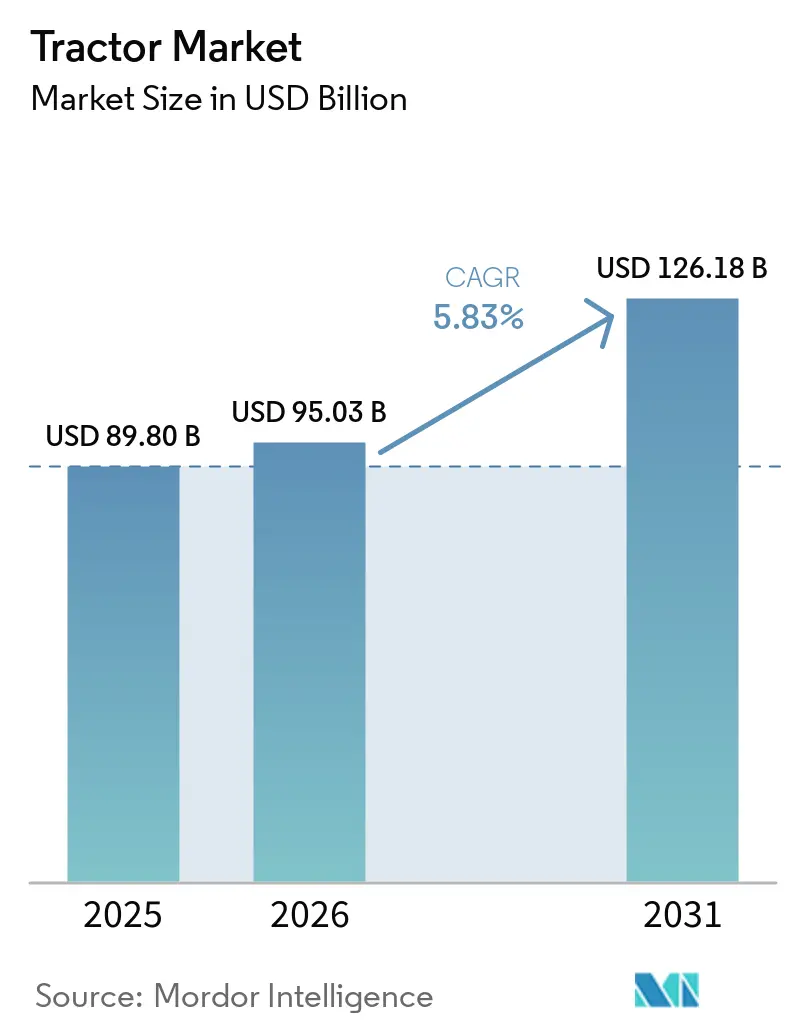
The tractor market size was valued at USD 95.03 billion in 2026 and estimated to grow from USD 100.6 billion in 2027 to reach USD 131.3 billion by 2032, at a CAGR of 5.47% during the forecast period (2027-2032).
Mechanization demand in India combines fleet renewal with first ownership, while labor scarcity raises the value of agricultural fieldwork per operator. Financing can help convert those needs into tractor purchases, although equipment costs and weather-sensitive demand constrain the pace. Manufacturers are broadening higher-power tractor offers, linking product development with the fieldwork that scarce labor must cover. Higher-power offers gain a clearer purchase case when they address labor-constrained fieldwork and the buyer can use an eligible tractor-financing program.
Key Report Takeaways
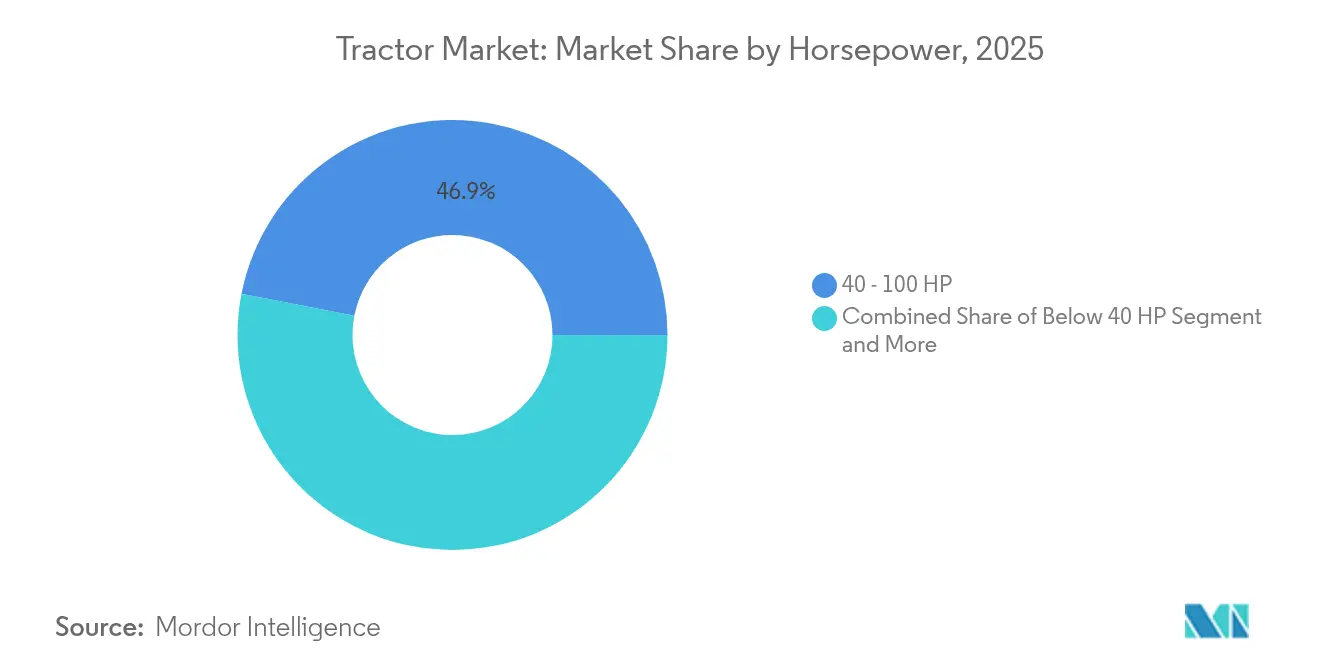
- By horsepower, 40-100 HP tractors led with a 46.65% tractor market share in 2026, and tractors above 100 HP are forecast to grow fastest at a 6.6% CAGR during 2027-2032.
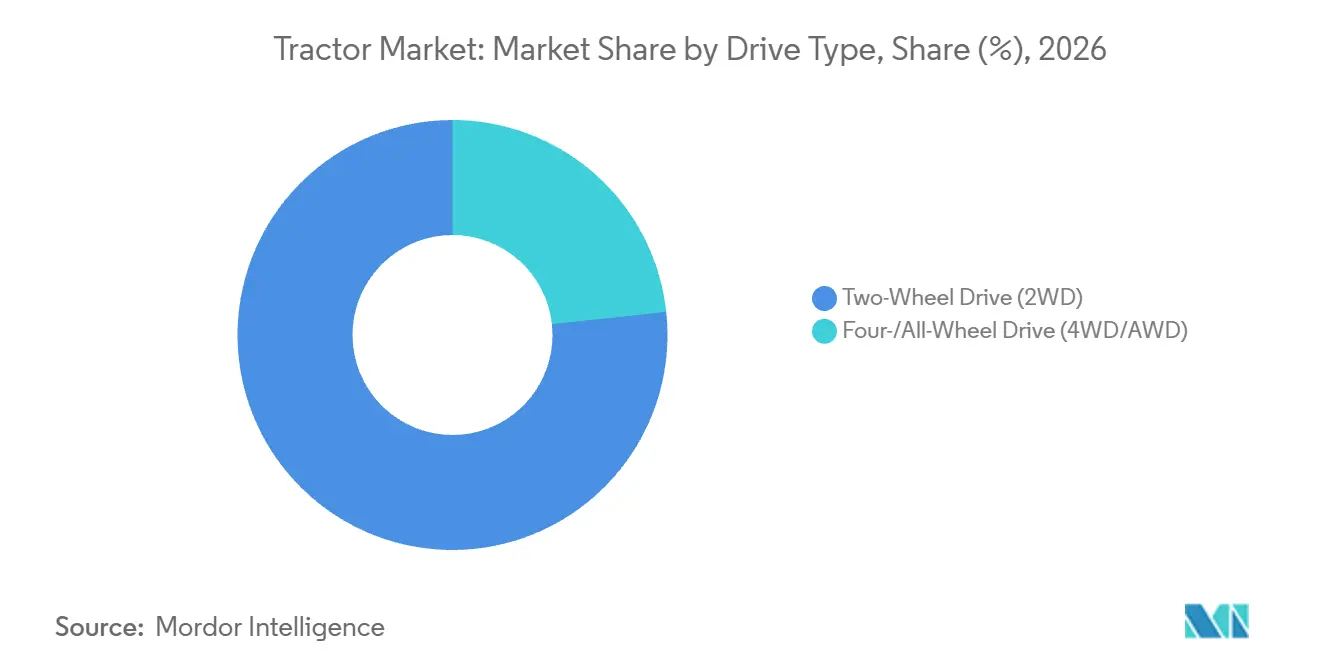
- Within drive types, 2WD held a 76.72% share of the tractor market size in 2026, while 4WD/AWD is the fastest-growing segment with a forecast CAGR of 7.2% during 2027-2032.
- Among propulsion types, battery-electric tractors are forecast to grow fastest at an 8.8% CAGR during 2027-2032, while diesel led with 90.01% of global tractor revenue in 2026.
- Agriculture led the application mix with 88.77% of global tractor revenue in 2026, and construction is forecast to grow fastest at a 7% CAGR during 2027-2032.
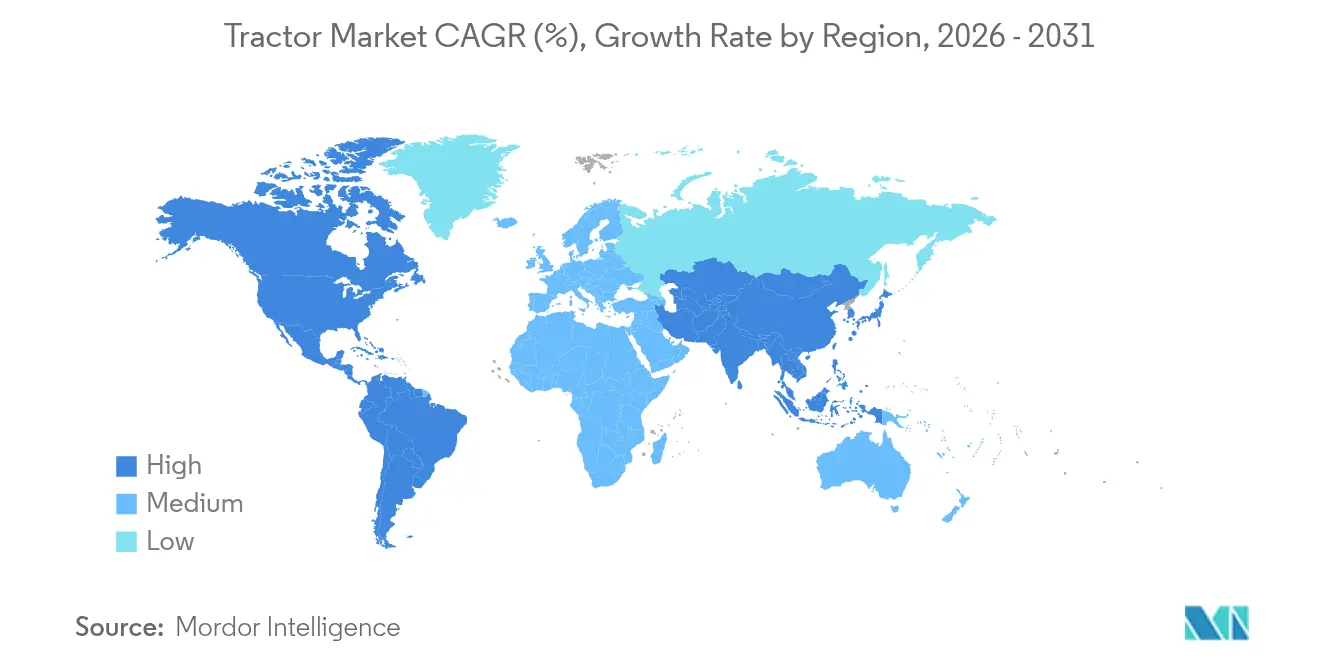
- Geographically, Asia-Pacific led with 55.66% of global tractor revenue in 2026, and South America is forecast to grow fastest at a 6.55% CAGR during 2027-2032.
Note: Market numbers in this report are based on Mordor Intelligence's proprietary estimation framework, which combines nine months of actuals with Q4 projections for base year 2026.
Market Trends and Insights
Drivers Impact Analysis of Tractor Market*
| Driver | (~) % Impact on CAGR Forecast | Geographic Relevance | Impact Timeline |
|---|---|---|---|
| Rising Mechanization Demand in Emerging Economies | +2.1% | Agricultural regions of India | Medium term (2-4 years) |
| Government Subsidies and Low-Interest Ag-Credit Lines | +1.7% | Agricultural regions throughout Brazil | Short term (≤ 2 years) |
| Escalating Farm-Labor Shortages in OECD and BRICS | +1.5% | Farming regions across India | Long term (≥ 4 years) |
| Rapid Adoption of Precision-Ag and Telematics Platforms | +1.4% | Agricultural regions across Europe | Medium term (2-4 years) |
| Commercialization of Battery-Electric Tractors and Trials of Fuel-Cell Tractors | +0.5% | United Kingdom, Ireland and Germany | Long term (≥ 4 years) |
| Growth of Data-Driven Tractor-Rental Platforms | +0.4% | Countries across the African continent | Medium term (2-4 years) |
| Source: Mordor Intelligence | |||
Rising Mechanization Demand in Emerging Economies
India's tractor industry recorded 1.16 million tractor sales in FY2026, up 23.5% from FY2025.[1] In its March 2026 analysis of 5 manufacturers covering over 90% of industry volume, CRISIL Ratings attributed its estimated FY2026 increase primarily to GST rationalization. It said improved affordability supported first-time and replacement purchases, which it estimated at 35-40% and about 60-65% of domestic sales, respectively. CRISIL said tractors were increasingly seen as multi-utility assets for land preparation, haulage, irrigation, and transport. Versatility can strengthen the case for a tractor across both buyer populations by connecting the machine with multiple farm and transport tasks. The sales mix shows India's demand resting mostly on replacement of existing machines, with first-time buyers supplying a smaller but substantial 35-40%.
Government Subsidies and Low-Interest Ag-Credit Lines
Government-backed credit supports tractor demand by giving eligible agricultural buyers a defined route to equipment financing. Brazil's 2026/27 Moderfrota program finances tractor and implement purchases by rural producers and agricultural production cooperatives. Effective fixed annual rates are capped at 11.5% for Pronamp farmers and 12.5% for other eligible borrowers. Eligibility limits annual gross income or operating revenue, including the economic group, to BRL 45 million (USD 8.81 million). These parameters make financing terms predictable for qualifying buyers, strengthening the proposition for a purchase within the program's agricultural scope. For tractor suppliers, identifying eligible borrowers and their applicable rate becomes part of converting financing availability into equipment orders.
Escalating Farm-Labor Shortages in OECD and BRICS
India's agricultural labor shortage strengthens the case for tractors that let an available operator complete more fieldwork. The Institute for Social and Economic Change's January-March 2026 agriculture report identified shortages as workers opted for industrial jobs and perceived agriculture as less financially rewarding. That employment alternative makes recruiting additional farm labor an uncertain basis for expanding the work a farm can undertake. Mechanization offers a different response by concentrating field capacity around the operators a farm can secure. The OECD's October 2025 assessment likewise identified recruitment and retention difficulties in member-country agriculture, so labor constraints that favor tractors are not confined to India.
Rapid Adoption of Precision-Ag and Telematics Platforms
Daily use of connected farm tools makes tractor integration commercially relevant to operators whose work already depends on digital systems. In May 2026, 66.4% of surveyed European farm end-users reported daily use of connectivity-dependent tools, including machinery telematics, guidance systems, and farm-management platforms. Such recurring use gives connected tractors a potential role within established working routines, supporting demand for equipment that can participate in them. Manufacturers can address that requirement through integrated tractor and digital-service offerings whose value rests on usable field connectivity. With more than 83% of the same end-users rating field connectivity as highly or very highly important, a tractor's value to these operators depends on keeping its telematics and guidance functions usable in the field.
Restraints Impact Analysis of Tractor Market*
| Restraint | (~) % Impact on CAGR Forecast | Geographic Relevance | Impact Timeline |
|---|---|---|---|
| High Upfront Cost and Commodity-Price Volatility | -1.1% | Agricultural production regions of Canada | Short term (≤ 2 years) |
| Seasonal Income Dependence on Monsoon/Weather Cycles | -0.6% | India's monsoon-exposed agricultural regions | Short term (≤ 2 years) |
| Electronics-Grade Chip Supply Bottlenecks | -0.2% | Asia-Pacific, Europe and North America | Medium term (2-4 years) |
| Localization and Content-Origin Rules in Trade Pacts | -0.2% | United States, Canada and Mexico | Long term (≥ 4 years) |
| Source: Mordor Intelligence | |||
High Upfront Cost and Commodity-Price Volatility
High equipment prices become a stronger barrier when the crops financing a tractor purchase generate weaker returns. In its December 2025 outlook, Farm Credit Canada (FCC) projected Canadian new 100+ HP tractor unit sales to fall 5.6% in 2026 versus 2025. The lender linked tighter farm profitability to low commodity prices, high equipment prices, and geopolitical and trade uncertainty. This combination raises the burden on the future earnings expected to justify replacing a tractor. FCC's June 2026 assessment also linked declining crop prices, rising operating costs, and high equipment prices with reduced Canadian farm-equipment sales over several years. Capital recovery must therefore compete with operating expenses for the earnings available to finance a replacement machine.
Seasonal Income Dependence on Monsoon/Weather Cycles
Monsoon stress and a high comparison base can mute retail tractor growth even while wholesale shipments increase. Indian retail tractor volumes grew 0.8% year over year in August 2026, compared with wholesale growth of 6.5%.[2] ICRA attributed the muted retail increase primarily to monsoon-related stress and a high base effect. For suppliers serving India, shipment growth offers less assurance of completed sales while monsoon stress and a high retail comparison base limit retail growth. With both pressures affecting the retail comparison, committing additional supply can leave its commercial return dependent on a later sales window.
*Our forecasts treat driver/restraint impacts as directional, not additive. The impact forecasts reflect baseline growth, mix effects, and variable interactions.
Tractor Market Segment Analysis
By Horsepower:
Midrange Volume Supports A Separate High-Power Growth OpportunityTractors in the 40-100 HP range accounted for a 46.65% share of the tractor market size in 2026. In India, the narrower 41-50 HP band represented nearly two-thirds of tractor unit sales in FY2026. CRISIL Ratings' March 2026 retrospective linked shifts toward 41-50 HP models to October 2022 TREM-IV norms, which covered only tractors above 50 HP and allowed manufacturers a 6-month transition. Compliance costs raised prices above 50 HP while prices below 50 HP stayed largely unchanged. Because TREM-IV added compliance cost only above 50 HP, the 41-50 HP band's Indian sales position depended partly on the resulting price gap.
Tractors above 100 HP are the fastest-growing segment, with a forecast CAGR of 6.6% during 2027-2032. In Portugal, registrations for the narrower above-120-HP class rose 8% to 591 units in 2025, from 549 in 2024. The class also rose to 12% of Portugal's national tractor registrations in 2025 from 9% in 2024. The class gained registration share despite only 8% unit growth, implying that registrations at 120 HP or below fell and higher-power buyers gained ground in a shrinking Portuguese market.

By Drive Type:
Established Two-Wheel Volume Meets A Changing Four-Wheel Price PropositionTwo-wheel drive (2WD) represented a 76.72% tractor market share in 2026, making it the largest segment. Preliminary member-company data from the Association of Equipment Manufacturers (AEM) recorded 133,877 US retail sales of 2WD farm tractors during January-September 2026. The total was 12.5% below January-September 2025, while the 86,030 tractors below 40 HP, down 14.2% year over year, made up most of it. US 2WD volume therefore moves mainly with sub-40 HP demand.
Four-/all-wheel drive (4WD/AWD) is the fastest-growing segment, with a forecast CAGR of 7.2% during 2027-2032. India cut tractor GST from 12% to 5% effective September 22, 2025, except for road tractors for semi-trailers above 1,800 cc, which were taxed at 18%. Carraro India reported that the GST reduction brought post-GST 4WD tractor prices close to pre-GST 2WD prices, accelerating the domestic shift toward 4WD. The component supplier also reported continuing growth in domestic 4WD axle demand in the quarter ended June 30, 2026. For manufacturers, India's opportunity extends from selling the configuration to securing the axle capacity needed to deliver it as adoption broadens.
By Propulsion Type:
Diesel Fleet Continuity Coexists With Targeted ElectrificationDiesel was the largest segment, accounting for 90.01% of global tractor revenue in 2026. On January 1, 2025, diesel powered 95.8% of the 302,853 tractors registered in the Netherlands, according to Statistics Netherlands.[3] The agency reported slightly more than 2,000 electric tractors, or 0.7% of the registered fleet, on the same date. That fleet mix gives diesel replacement offers an established customer base, while electric suppliers face a conversion opportunity much larger than the registered electric population.
Battery-electric tractors are the fastest-growing segment, with a forecast CAGR of 8.8% during 2027-2032. AGCO Corporation reported that its Fendt e100 Vario battery-electric series was available in 21 European countries in 2026. The company also described Oslo's purchase of a small fleet for winter road maintenance in line with local environmental goals. That municipal purchase connects electrification with a defined public-service task and a buyer objective beyond crop production.
By Application:
Crop Production Anchors Demand As Construction Adds Another Growth RouteAgriculture was the largest segment, holding 88.77% of global tractor revenue in 2026. Deere & Company's global Production & Precision Agriculture equipment and technology segment generated USD 17.31 billion in net sales in fiscal 2025. That business serves production-scale growers of crops including grains, cotton, and sugarcane. Deere identified labor shortages, volatile input costs, and tighter job timeframes among those customers' challenges.
Construction is the fastest-growing segment, with a forecast CAGR of 7% during 2027-2032. In its April 2025 outlook for FY2026, which ended March 31, 2026, CRISIL Ratings put agriculture at 70-75% of India's tractor volumes, with construction and related activities making up the balance. The outlook linked its projected road-construction pickup to Union Budget allocations for that fiscal year. That ties the construction and related activities behind the balance of Indian tractor sales to public infrastructure budgets, a demand route distinct from agriculture's 70-75%.
Geography Analysis
Asia-Pacific Tractor Market
Asia-Pacific held a 55.66% tractor market share in 2026, making it the largest geography. Swaraj Tractors, part of the Mahindra Group, reached cumulative production of 2.5 million tractors with its August 29, 2025 rollout in Mohali, Punjab, India. In August 2026, Escorts Kubota Ltd., Kubota Corporation's Indian subsidiary, began site preparation for a planned Uttar Pradesh plant intended to expand capacity for tractors and other products for India. Swaraj's cumulative output and Escorts Kubota's planned capacity place an established manufacturing base and further supply investment close to Indian tractor buyers.
South America Tractor Market
South America is the fastest-growing geography, with a forecast CAGR of 6.55% during 2027-2032. Brazil's agricultural-machinery retail sales fell 3.6% to 49,800 units in 2025, and ANFAVEA's April 2026 assessment forecast a further 6.2% decline for 2026. That assessment also reported growth in low-power tractor sales associated with family farming and programs such as PRONAF Mais Alimentos. It described the program's interest rates as around 5%. The contrast makes family-farm financing the concrete entry point for Brazil's low-power tractor business within an adverse broader machinery outlook.
In North America, FCC's December 2025 outlook for 2026 identified Canadian livestock producers as potential tractor-upgrade buyers if cattle prices and revenues remained strong, making cattle returns a condition for replacement offers. In Europe, CLIMMAR, an agricultural-machinery dealers' and repairers' association, reported declining registrations across 13 member countries in 2025, led by France, Germany, and Italy with 33,251, 20,497, and 17,552 registrations, respectively. The leading national totals favor focused dealer coverage in France, Germany, and Italy, with the sample counting all tractor powers in Austria and Italy and at least 50 HP elsewhere. In Middle-East and Africa, Nigeria's Belarus Project, implemented with AfTrade DMCC and Belarusian support, delivered 2,000 tractors and 9,000 implements under federal mechanization policy in 2025. The Nigerian delivery links completed equipment supply to a federal mechanization program implemented with AfTrade DMCC.
Mordor Intelligence provides coverage of the tractor market across other key regional markets. Detailed country-level analysis extends to Brazil incorporating local coverage and market participation, as required.
Regulatory Framework and Outlook
The comparison covers selected jurisdictions' engine and vehicle-approval requirements for manufacturers selling diesel agricultural tractors. The United States links Tier 4 engine requirements with engine-family certification and compliance over the engine's useful life. China adds factory-fitted positioning and data-transmission duties for covered machinery with diesel engines rated at least 37 kW. For manufacturers, technical conformity therefore extends from the engine itself to factory integration and reporting.
Regulatory Table of Tractor Market
| Decision factor | United States | Brazil | Germany | China | Turkey |
|---|---|---|---|---|---|
| Primary authority | Environmental Protection Agency | IBAMA, the environmental licensing authority | Kraftfahrt-Bundesamt | Ministry of Ecology and Environment | Ministry of Industry and Technology |
| Key instruments or direction | Tier 4 under 40 CFR Part 1039; July 2026 SCR inducement proposal | CONAMA Resolution 433/2011, MAR-I; October 2026 MAR-II draft proposes a January 1, 2030 start for 130-560 kW engines | Stage V under Regulation (EU) 2016/1628 and agricultural-tractor approval | HJ 1014-2020; June 2026 China V draft with implementation recommended around 2028 | AB/167/2013 and AB/2018/985 with incorporated Stage V requirements |
| Commercial effect | Engine-family certification and useful-life emissions compliance | MAR-I compliance for covered new domestic and imported diesel machinery from 19 kW | Covered-engine approval and in-service emissions monitoring | Positioning and terminals fitted before factory release, with required data transmission, for machinery with diesel engines of at least 37 kW | Type approval conditional on covered vehicle and engine emissions conformity |
| Current policy attractiveness | Medium | Medium | Medium | Low | Medium |
| Future direction of policy attractiveness | Easing | Hardening | No change | Hardening | No change |
| Source: Mordor Intelligence | |||||
The United States' Medium rating reflects certification and useful-life duties, while its July 2026 SCR proposal would substitute notifications for derates while retaining emissions standards, supporting an Easing direction. Germany's Medium and No change ratings reflect approval and Stage V duties, while the October 2026 hydrogen-fuel proposal would leave diesel pollutant limits intact. Brazil's Medium rating reflects MAR-I and China's Low rating reflects factory monitoring, with Hardening based on proposed tighter particulate limits for 130-560 kW and emissions limits for 56-560 kW, respectively. Turkey's Medium and No change ratings reflect tractor-specific emissions approval requirements operative from January 1, 2023, with engine-category conditions keeping compliance centered on established vehicle and engine conformity.
Value Chain Stages
The tractor value chain compares where suppliers earn revenue and how each operational stage can protect delivery continuity. Carraro supplies transmission systems for tractors and other off-highway equipment, while AGCO Power produces diesel engines in Finland. Deere's 2025 Form 10-K reported historical supply-chain disruptions involving shortages of materials, components, and whole goods across its equipment business. The company identified multisourcing selected parts and materials as an implemented mitigation measure.
Value Chain Analysis Table of Tractor Market
| Primary activity | Key participants | Value capture | Bottleneck | Resilience response |
|---|---|---|---|---|
| Component production | Transmission suppliers such as Carraro; engine producers such as AGCO Power | Component sales | Exposure to material and component shortages | Multisource selected parts and materials |
| Tractor manufacturing | Tractor manufacturers such as AGCO Corporation through Valtra and Argo Tractors S.p.A. | Complete-machine sales | Synchronizing component deliveries with assembly | Sequence assembly around confirmed component availability |
| Distribution and retail | Sales-branch and importer networks such as Argo Tractors S.p.A.; dealers such as Danieli S.r.l. in northeastern Italy | Tractor resales | Connecting international supply with local buyer access | Pair importer coverage with authorized local dealerships |
| Replacement-parts supply | Replacement-parts providers such as AGCO Corporation | Replacement-parts sales | Supporting discontinued model generations | Preserve part identification and replenishment for older models |
| Source: Mordor Intelligence | ||||
After-sales revenue gives suppliers a commercial interest in equipment beyond factory release, with AGCO selling replacement parts for products no longer in production. That service span makes retained product knowledge and parts identification important resilience assets when model ranges change. Maintaining those capabilities links future model development with the commercial value of supporting older machines.
Competitive Landscape
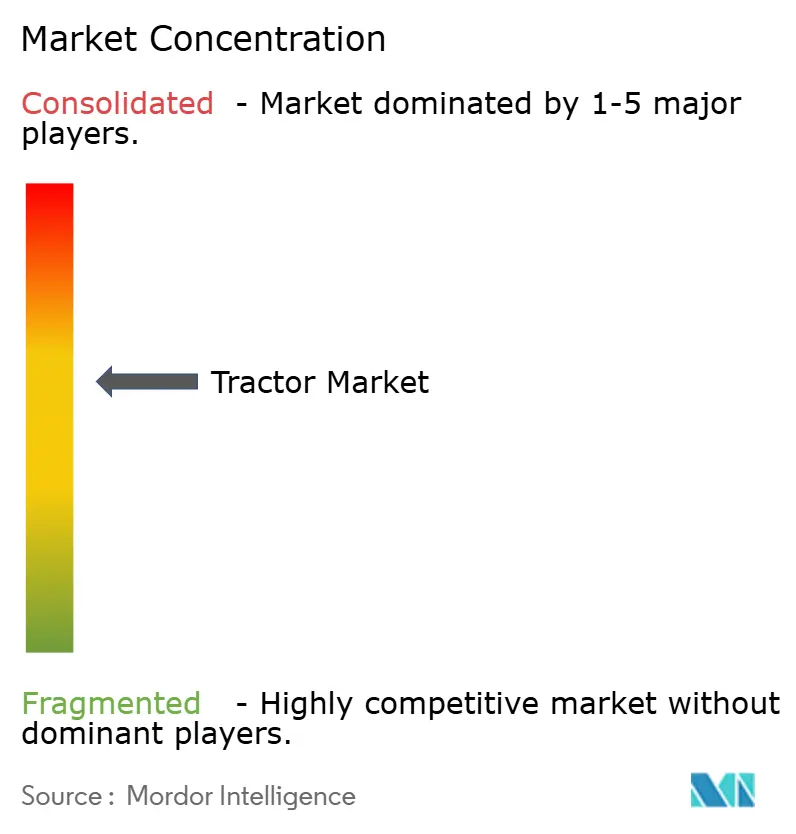
The industry is moderately concentrated around Mahindra & Mahindra Ltd., Deere & Company, and other established tractor groups. CNH Industrial N.V., whose Agriculture segment develops, manufactures, distributes, and supports equipment and precision-agriculture solutions through brands including Case IH and New Holland, competes alongside Kubota Corporation and AGCO Corporation (Massey Ferguson, Valtra, Fendt). Deere's production-equipment portfolio includes 4WD, track, and row-crop tractors alongside other agricultural machinery. Mahindra reported 505,930 domestic Indian tractor sales in FY2026, including Gromax Agri Equipment Limited sales, up 24.3% from FY2025. Mahindra's domestic volume growth slightly outpaced the Indian industry total in the same annual report, lifting its share of India's tractor units.
AGCO's North American agricultural-equipment net sales rose 19.8% year over year on a constant-currency basis in Q2 2026, with high-horsepower tractors among the largest sales increases. Deere's global Production & Precision Agriculture equipment and technology segment reported USD 4 billion in Q3 2026 net sales, down 6% year over year. Deere also launched 6 new 8R and 8RX tractor models with higher-horsepower options in February 2026. AGCO's high-horsepower sales gains and Deere's added higher-horsepower options point to a shared focus on higher-power machines despite Deere's broader segment decline.
Kubota announced an April 2027 Japan launch plan for unmanned and manned Agri Robo Tractor MR Series models in August 2026. The planned unmanned models' remote-monitoring function would let users leave the worksite while the tractors perform agricultural tasks autonomously. Kubota says the MR Series complies with the Ministry of Agriculture, Forestry and Fisheries' Guideline for Ensuring Safety of Automated Agricultural Machinery, which covers remotely monitored autonomous tractor operation in fields. In July 2026, Yanmar South America began building a factory in Indaiatuba, Brazil, planned to raise annual tractor output from 5,000 to 7,000 units on one shift. Kubota's plan ties operator-time savings to Japan's safety guideline, while Yanmar's planned factory would add 2,000 units of annual single-shift tractor output in Brazil, distinguishing autonomy-led competition from investment in local production.
Tractor Industry Leaders
-
Mahindra & Mahindra Ltd.
-
Deere & Company
-
CNH Industrial N.V. (Case IH, New Holland)
-
Kubota Corporation
-
AGCO Corporation (Massey Ferguson, Valtra, Fendt)
- *Disclaimer: Major Players sorted in no particular order
Tractor Market Companies Covered in this Report
- Deere & Company
- CNH Industrial N.V. (Case IH, New Holland)
- AGCO Corporation (Massey Ferguson, Valtra, Fendt)
- Mahindra & Mahindra Ltd.
- Kubota Corporation
- CLAAS KGaA mbH
- Escorts Kubota Ltd.
- TAFE Ltd.
- Sonalika (International Tractors Ltd.)
- SDF Group (Same Deutz-Fahr)
- Yanmar Agribusiness Co., Ltd.
- Argo Tractors S.p.A.
- LS Mtron Ltd.
- Daedong (Kioti)
- TYM Corporation
- Weichai Lovol Intelligent Agricultural Technology CO., LTD
- YTO Group Corp.
- XCMG Construction Machinery Co., Ltd.
- Zetor Tractors a.s.
- J C Bamford Excavators Ltd
Key Opportunities for Market Participants
These opportunities compare tractor-purchase routes where financing structures address different buyer cash-flow needs. Brazil's 2026/27 Moderfrota financing window runs through June 30, 2027. Different maximum financing shares for eligible Pronamp farmers and other producers create separate offers with different buyer-funded balances. In August 2026, Co-operative Bank of Kenya and Kubota distributor Car & General (Trading) Limited agreed on a new-tractor financing route for eligible farmers, cooperatives, and agribusinesses.
Market Opportunities Table of Tractor Market
| Opportunity | Why now | Buyer / lead segment | Recommended play | Main barrier | Likely beneficiaries |
|---|---|---|---|---|---|
| Pronamp tractor renewal in Brazil | 2026/27 credit can cover up to 100% of eligible goods' value per agricultural year | Eligible Pronamp farmers | Match qualifying John Deere tractors with a credit application | Prior approval and revocable credit limits | Deere & Company and Banco John Deere |
| Producer and cooperative fleet modernization in Brazil | 2026/27 credit can cover up to 85% of eligible goods' value per agricultural year | Other eligible rural producers and agricultural production cooperatives | Structure a qualifying tractor offer with funding identified for the balance | Economic-group revenue ceiling and the unfinanced balance | Program-eligible tractor suppliers such as John Deere |
| Seasonally repaid tractor purchases in Kenya | August 2026 route offers eligible customers up to 100% financing under select structures, up to 72 months and seasonal options | Eligible Kenyan farmers, cooperatives and agribusinesses | Match new Kubota tractors and repayments to agricultural cash flows | Debt-service capacity across agricultural seasons | Kubota Corporation, Car & General (Trading) Limited and Co-operative Bank of Kenya |
| Source: Mordor Intelligence | |||||
These opportunities split the credit problem into the buyer-funded balance and the timing of repayments. Brazil's 2 financing ceilings affect the former, while Kenya's seasonal structures address the latter. Lender-distributor coordination consequently becomes part of the tractor offer itself, giving suppliers a way to serve different agricultural buyers through different purchase structures.
Recent Industry Developments in Tractor Market
- Aug 2026: Co-operative Bank of Kenya and Kubota distributor Car & General (Trading) Limited agreed on a new-tractor financing partnership for eligible Kenyan farmers, cooperatives, and agribusinesses.
- Aug 2026: Escorts Kubota Ltd., Kubota Corporation's Indian subsidiary, began site preparation for a planned Uttar Pradesh plant intended to expand capacity for tractors and other products for India.
- Jul 2026: Yanmar South America began building a factory in Indaiatuba, Brazil, planned to raise annual tractor output from 5,000 to 7,000 units on one shift.
Tractor Market Report Scope and Research Methodology
Market Definition and Coverage
The global tractor market measures annual spending on new complete tractors sold worldwide for work across its accepted applications. The value covers complete equipment across all horsepower, drive and propulsion configurations and application classes.
Scope exclusions: Used tractor resale transactions, attachments and implements sold separately, replacement parts sold separately, and ongoing service, finance, and insurance revenues are excluded.
Segments Covered in This Report
- By Horsepower
- Below 40 HP
- 40 - 100 HP
- Above 100 HP
- By Drive Type
- Two-Wheel Drive (2WD)
- Four-/All-Wheel Drive (4WD/AWD)
- By Propulsion Type
- Diesel
- Battery-Electric
- Hybrid (Diesel-Electric)
- By Application
- Agriculture
- Construction
- Forestry
- Municipal & Grounds Maintenance
- Haulage & Logistics
- By Geography
- North America
- United States
- Canada
- Rest of North America
- South America
- Brazil
- Argentina
- Rest of South America
- Europe
- Germany
- United Kingdom
- France
- Italy
- Spain
- Russia
- Rest of Europe
- Asia-Pacific
- China
- India
- Japan
- South Korea
- Australia
- Rest of Asia-Pacific
- Middle-East and Africa
- United Arab Emirates
- Saudi Arabia
- Turkey
- Egypt
- South Africa
- Rest of Middle-East and Africa
- North America
Data Sources, Market Sizing, and Validation
Desk Research
Public secondary research uses sources such as the Food and Agriculture Organization's agricultural machinery statistics, which track machinery in use, production and trade, and the Association of Equipment Manufacturers' monthly retail tractor reports to assess sales direction and power-class mix. CEMA registration releases help interpret European new-equipment demand, while USDA Economic Research Service farm-income forecasts provide context for farm purchasing capacity and replacement timing.
Company annual reports, investor materials and regulatory filings can clarify product mix, geographic exposure, reported equipment revenue and operating conditions, with reputable press used to cross-check dated developments and market signals. These sources are illustrative rather than exhaustive, and further sources inform collection, validation and clarification.
Primary Interviews and Surveys
Interviews and structured surveys with tractor manufacturers, dealers and distributors, agricultural equipment specialists, and fleet or farm buyers can test secondary evidence on new-equipment pricing, channel inventory, replacement timing and application mix. Analyst follow-up can clarify inconsistent definitions or missing regional and segment evidence, then triangulate responses against company disclosures, registration and sales indicators, and farm economic data.
Distribution of primary research fieldwork respondents
| Company type | Respondent position | Region |
|---|---|---|
| Top tier: 35% | CXOs: 20% | APAC: 40% |
| Mid tier: 45% | Functional/Unit leaders: 35% | EMEA: 30% |
| Smaller Players: 20% | Managers: 45% | Americas: 30% |
Market-Sizing & Forecasting
A top-down model estimates global annual manufacturer sales of new complete tractors in USD, then checks the result through selective supplier and dealer roll-ups and sampled selling price times unit volume. The main indicators include agricultural and other application sales trends, tractor registrations and retail units, horsepower and drive mix, farm income and credit conditions, and changes in equipment prices. These indicate demand, product mix, buying capacity and value per unit. Evidence from company disclosures, national statistics and association data supports regional and product shares, with unit trends and observed price and mix changes informing the value outlook. Forecasts can use multivariate regression where demand drivers have consistent series, time-series smoothing for stable sales histories, and scenario analysis for weather, financing or commodity shocks. Primary experts can test whether the variable-level forecast assumptions fit purchasing and channel conditions. Gaps are handled by comparing definitions and periods, then using the closest supported regional or segment indicator and recording a range for sensitivity checks rather than filling missing observations with unsupported precision.
Data Validation & Update Cycle
Analysts triangulate the model against independent company, association and public statistical signals, then investigate material differences in units, value, period or product coverage. Anomaly checks flag abrupt share shifts, implausible price or volume movements and inconsistent regional totals. Analysts trace each issue to its source and resolve or document it before sign-off through successive source, model and editorial reviews. Re-contact is triggered when a source definition is unclear, an important input conflicts with another signal, or a material market event changes an assumption. The model is refreshed annually, updated between cycles for material events, and given a fresh pre-delivery review.
Mordor Intelligence's Tractors Market Estimate Compared With Other Published Estimates
Published estimates can differ in the transactions and products they count and the inputs used to model demand. The value covers complete equipment across all horsepower, drive and propulsion configurations and application classes.
Key Gap Drivers include the study's defined coverage and market-specific modeling choices. The main indicators include agricultural and other application sales trends, tractor registrations and retail units, horsepower and drive mix, farm income and credit conditions, and changes in equipment prices.
Benchmark comparison
| Source | Market Size | Gaps in Research Methodology |
|---|---|---|
| Mordor Intelligence | USD 100.6 B (2027) | |
| Global Consultancy A | USD 89.8 B (2026) | At its 2026 base, this estimate is 10.7% below this report's 2027 value of USD 100.6 B, 1 year later. Its published 2026 value is one year earlier, and its forecast grows from that base, which can contribute to a lower value against a 2027 measure. |
| Global Consultancy B | USD 67.5 B (2025) | At its 2025 base, this estimate is 32.9% below this report's 2027 value of USD 100.6 B, 2 years later. Its stated agricultural tractor boundary is narrower than the accepted measure, which also counts tractors used in non-agricultural applications. |
Mordor Intelligence's analysts triangulate the model against independent company, association and public statistical signals, then investigate material differences in units, value, period or product coverage.
Key Questions Answered in the Report
What is the tractor market size and growth outlook?
The market is estimated at USD 100.6 billion in 2027 and forecast to reach USD 131.3 billion by 2032, at a 5.47% CAGR during 2027-2032.
What is supporting tractor demand?
Mechanization, farm-labor shortages, and financing support purchases. Brazil's 2026/27 Moderfrota program finances eligible agricultural tractor and implement purchases.
Which tractor horsepower class has the largest revenue share?
Tractors in the 40-100 HP range led with 46.65% of global tractor revenue in 2026.
Which companies are prominent tractor suppliers?
Prominent suppliers include Mahindra & Mahindra Ltd., Deere & Company, CNH Industrial N.V., Kubota Corporation, and AGCO Corporation.
What challenges affect new tractor purchases?
High equipment prices and weak farm profitability constrain replacement. In its December 2025 outlook, Farm Credit Canada projected Canadian new 100+ HP tractor unit sales to fall 5.6% in 2026 versus 2025.
Which regions lead tractor revenue and forecast growth?
Asia-Pacific held 55.66% of global tractor revenue in 2026, while South America is forecast to grow fastest at a 6.55% CAGR during 2027-2032.