
Market Overview
| Study Period | 2021 - 2031 |
|---|---|
| Forecast Data Period | 2026 - 2031 |
| Base Year Market Size (2025) | USD 36.01 Billion |
| Market Size (2026) | USD 40.22 Billion |
| Market Size (2031) | USD 62.86 Billion |
| Growth Rate (2026 - 2031) | 9.34 % |
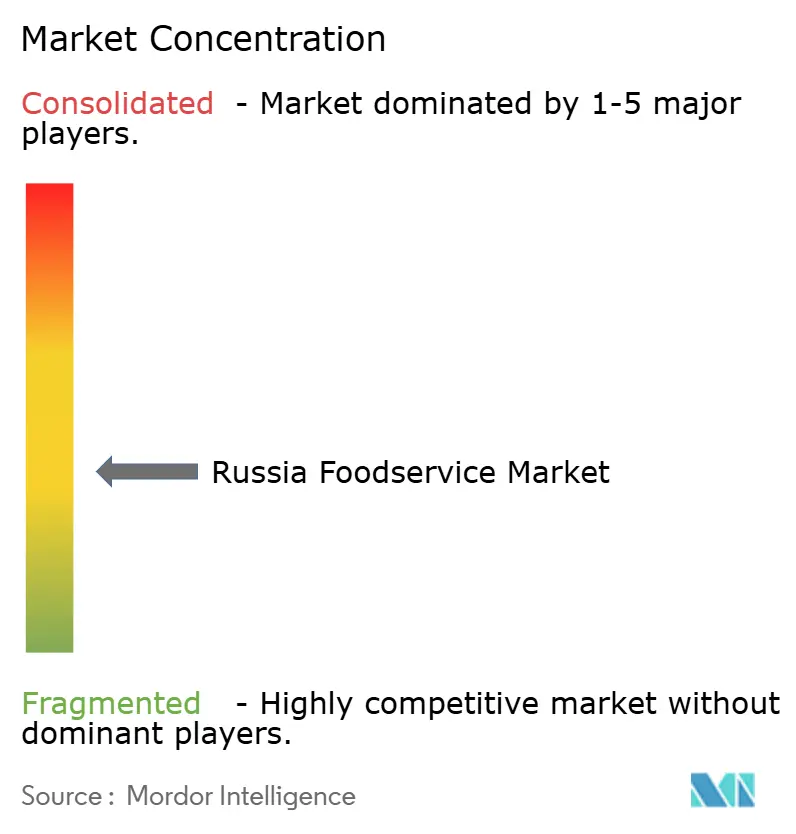
| Market Concentration | Medium |
Major Players *Disclaimer: Major Players sorted in no particular order Image © Mordor Intelligence. Reuse requires attribution under CC BY 4.0. | |
Russia Foodservice Market Analysis by Mordor Intelligence
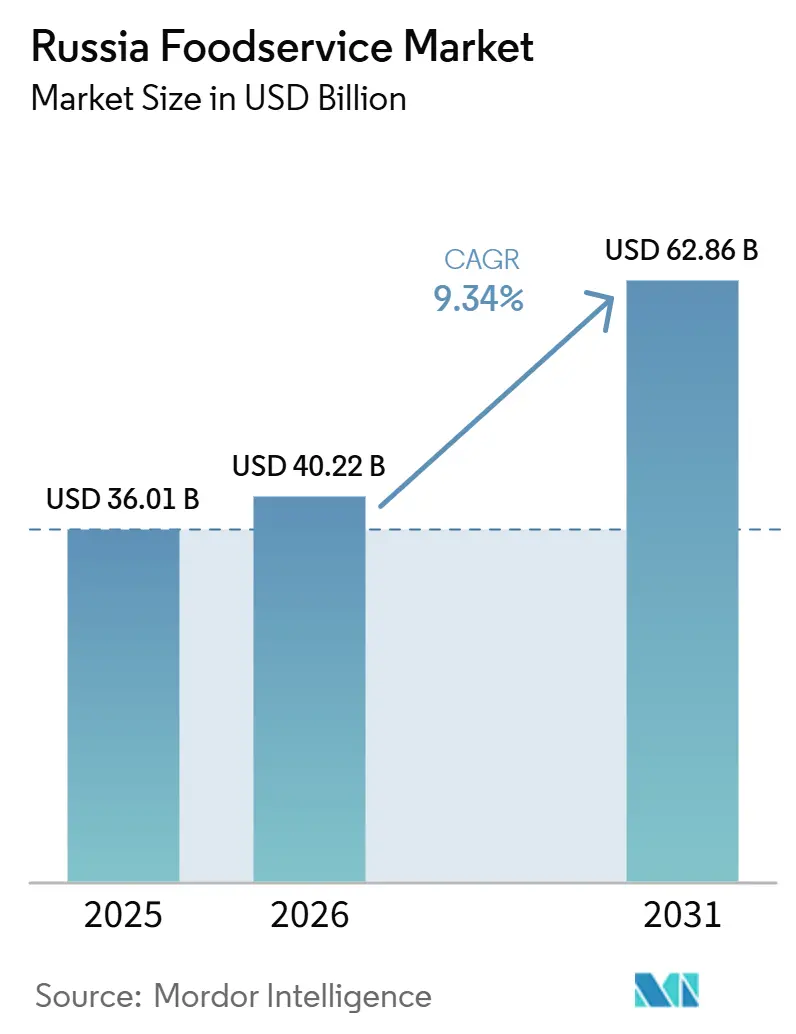
The Russia foodservice market size was valued at USD 36.01 billion in 2025 and estimated to grow from USD 40.22 billion in 2026 to reach USD 62.86 billion by 2031, at a CAGR of 9.34% during the forecast period (2026-2031). The Russian foodservice market is entering a new operating phase, with domestic chains, digital ordering, and delivery-led formats setting the pace for expansion. Growth is no longer tied only to a broad recovery in eating out, because spending is being redirected toward lower-ticket formats, standardized menus, and channels that can handle higher order volumes with tighter labor use. The Russian foodservice market also remains geographically uneven, with Moscow still accounting for a large share of spending and the top 10 regions contributing more than half of national restaurant expenditure, leaving meaningful room for organized expansion outside the largest cities. Delivery infrastructure is now shaping format choices, since Yandex reported 46% year-on-year growth in foodtech and e-commerce revenue in Q2 2025 to RUB 102.8 billion, showing how digital ordering is pulling demand across the Russian foodservice market[1]. Competitive behavior is becoming more disciplined as operators focus on regional rollout, kiosk adoption, standardized procurement, and formats that protect unit economics under inflation and compliance pressure.
Key Report Takeaways
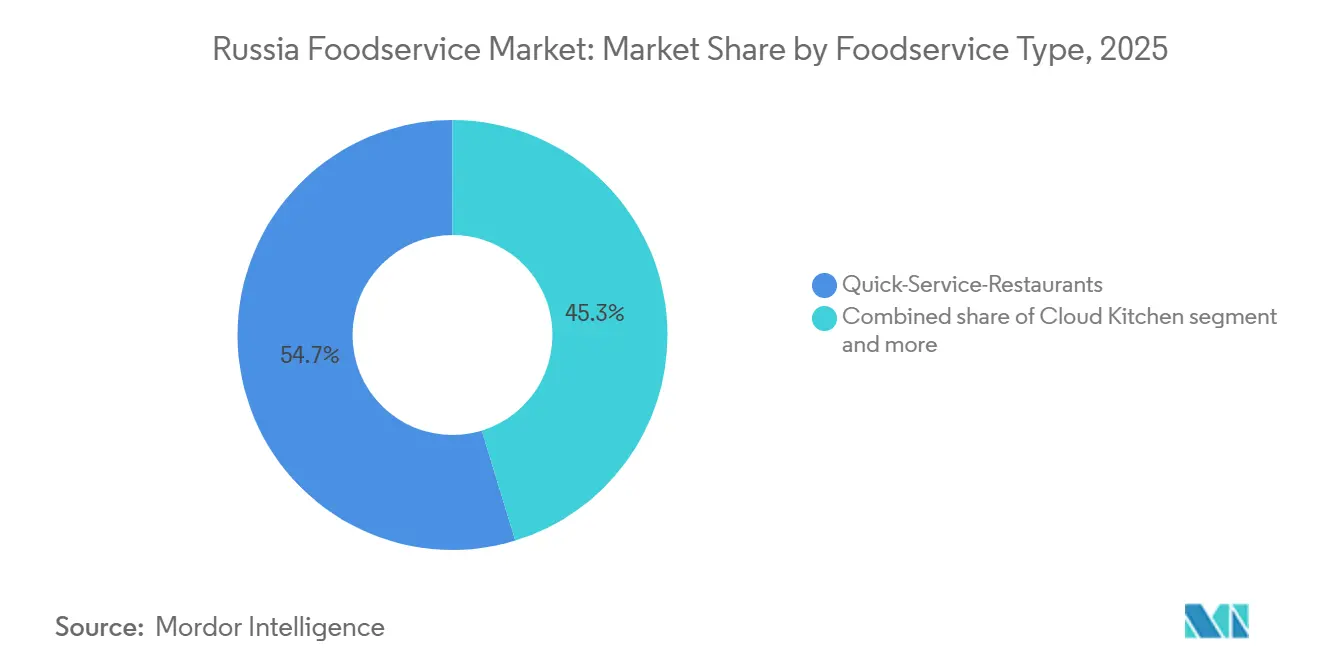
- By foodservice type, Quick Service Restaurants held 54.72% of revenue in 2025, while cloud kitchens are forecast to expand at an 11.28% CAGR through 2031.
- By outlet, independent outlets held 64.68% of the Russia foodservice market share in 2025, while chained outlets are projected to grow at a 10.62% CAGR through 2031.
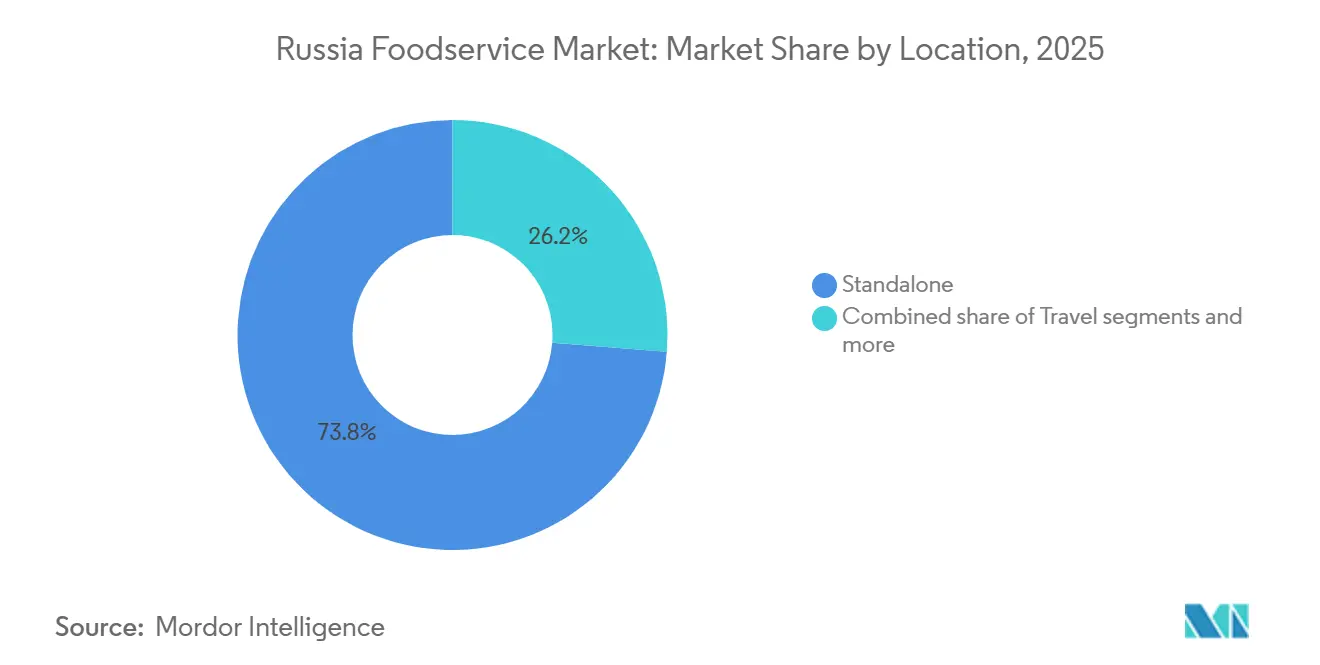
- By location, standalone sites accounted for 73.76% of the Russia foodservice market size in 2025, while travel locations are expected to advance at a 10.35% CAGR through 2031.
- By service model, dine-in represented 53.76% of revenue in 2025, while delivery is set to grow at a 10.84% CAGR through 2031.
Note: Market size and forecast figures in this report are generated using Mordor Intelligence’s proprietary estimation framework, updated with the latest available data and insights as of 2026.
Russia Foodservice Market Trends and Insights
Drivers Impact Analysis*
| Driver | (~) % Impact on CAGR Forecast | Geographic Relevance | Impact Timeline |
|---|---|---|---|
| Expansion of domestic QSR and fast-casual chains | +2.6% | National, strongest in Moscow, St. Petersburg, Krasnodar, Yekaterinburg, Novosibirsk, and Kazan | Medium term (2-4 years) |
| Growing penetration of online food delivery and aggregator platforms | +2.1% | National, led by Moscow and St. Petersburg, with widening reach into secondary cities | Medium term (2-4 years) |
| Growing demand for value-oriented dining options | +1.4% | National, strongest in lower-income regions and inflation-exposed households | Short term (≤ 2 years) |
| Technology adoption across foodservice operations | +1.2% | Moscow, St. Petersburg, and major franchise networks in regional cities | Medium term (2-4 years) |
| Growing influence of western food culture | +0.7% | Strongest in Moscow, St. Petersburg, and university cities | Long term (≥ 4 years) |
| Recovery in domestic tourism and mobility | +0.6% | Southern Russia, Tatarstan, Leningrad Oblast, and Kaliningrad | Short term (≤ 2 years) |
| Source: Mordor Intelligence | |||
Expansion of Domestic QSR and Fast-Casual Chains
The departure of global brands created a competitive void that domestic operators have filled with remarkable speed and scale. Rostic's, operating under the revived Soviet-era fried chicken brand after Yum! Brands exited, manages more than 1,300 restaurants across Russia as of early 2026, making it the country's largest fast-food chain by outlet count. Vkusno & Tochka, the successor to McDonald's operations, is actively expanding into underserved geographies: it plans up to 15 new outlets in the North Caucasus over five years and opened its first Chechen Republic location in autumn 2026, entering its 67th regional geography. The deeper insight here is that these chains inherit not just physical assets but deeply embedded consumer behaviors, meaning capital costs for brand building are substantially lower than those faced by typical greenfield QSR entrants. Teremok, operating 349 Russian-cuisine restaurants by end-2025, recorded a 17.3% revenue increase to RUB 25.04 billion (~USD 279 million) in 2025 and plans to triple the number of restaurants equipped with self-service kiosks by 2026, integrating digital infrastructure directly into its expansion model. White Rabbit Family, the premium restaurant group, announced franchise packages for brands including Gorynich and Tehnikum with plans to open up to 30 restaurants across Russia and CIS by 2026.
Growing Penetration of Online Food Delivery and Aggregator Platforms
Yandex's foodtech and e-commerce revenue, encompassing Yandex Eats, Yandex Lavka, and Delivery, grew 46% year-on-year in Q2 2025 to RUB 102.8 billion, the highest growth rate across all Yandex business lines, signaling that delivery is driving demand across the entire foodservice sector. Yandex Eats holds an estimated 40-50% market share in platform-aggregated delivery, with the next-largest players collectively holding 25-35%. The proliferation of dark kitchens, estimated at 2,500-3,500 operating sites by 2026, concentrated in Moscow (40-45% of total), St. Petersburg, and major regional capitals, provides the physical infrastructure for delivery-first brands to scale without the real estate overhead of traditional storefronts, reducing capital intensity by 40-60% versus conventional restaurant openings. The counter-intuitive insight is that delivery growth is cannibalizing mid-market dine-in concepts far more aggressively than it is enabling new entrants: the same aggregator infrastructure that fuels delivery demand is compressing the addressable market for full-service restaurant operators by making casual dining a convenience trade-off rather than a destination.
Technology Adoption Across Foodservice Operations
Russia's domestic technology ecosystem is producing foodservice-specific automation tools at a pace that would not be possible if global technology vendors were still dominant. Inno Clouds, a Skolkovo resident, developed Russia's first AI-enabled cashier for foodservice establishments, projecting deployment across 350+ cafes, restaurants, and food courts by end-2026; the system accelerates service by 35% and increases average revenue per outlet by 15-30%. Self-service kiosk adoption is accelerating independently of AI: at Kroshka Kartoshka, wall-mounted kiosks account for 15-40% of revenues at equipped outlets, with an average check uplift of +8.8%[2]. St. Petersburg bakeries began aggressively rolling out self-service kiosks in July 2026, with the Khlebnik chain embedding the technology in all new outlets. The strategic significance of this trend extends beyond operational efficiency: operators that deploy proprietary digital ordering infrastructure can detach from aggregator fee structures, improving unit economics materially over a 2-3 year horizon.
Growing Demand for Value-Oriented Dining Options
Inflation-driven consumer downtrading reshaped demand, with food prices rising, butter up 33%, potatoes doubling, and services inflation hitting 12.67%, compressing household budgets. Consumer spending on cafés, restaurants, and delivery decelerated from 23% year-over-year growth to 6.2% in December 2025, signaling that price sensitivity now governs purchase decisions, according to Sberbank Consumer Trends 2024. Operators responded by expanding value tiers: Vkusno & Tochka's menu pricing undercuts premium QSR formats by 15-20%, while regional chains like Kroshka Kartoshka (baked-potato specialist) and Teremok (Russian pancakes) emphasize portion size and local ingredients to maintain affordability. The World Bank projects Russian GDP growth to slow from 3.2% in 2024 to 1.1% in 2026, with private consumption growth decelerating in parallel, reinforcing the structural shift toward budget-conscious formats. Franchise economics also favors value chains: lower initial investment and faster payback periods attract entrepreneurs in regions where household incomes lag behind those of Moscow and St. Petersburg. This trend explains why quick-service restaurants, which offer lower check averages than full-service establishments, captured 54.72% market share in 2025 and will sustain above-market growth. Importantly, value orientation does not imply quality degradation, operators compete on speed, convenience, and perceived freshness rather than premium ingredients, a positioning that resonates with middle-income consumers navigating persistent inflation.
Restraints Impact Analysis*
| Restraint | (~) % Impact on CAGR Forecast | Geographic Relevance | Impact Timeline |
|---|---|---|---|
| Geopolitical instability and sanctions | -1.4% | National, with acute supply-chain disruption in Moscow and St. Petersburg due to import dependencies | Long term (≥ 4 years) |
| High inflation and economic pressures | -1.8% | National, disproportionately affecting regions with below-average household income | Short term (≤ 2 years) |
| Limited access to international brands and technologies | -0.7% | National, with greater impact on chained operators reliant on imported equipment and software | Medium term (2-4 years) |
| Strict food safety regulations | -0.5% | National, with heightened enforcement in Moscow, St. Petersburg, and major urban centers | Medium term (2-4 years) |
| Source: Mordor Intelligence | |||
Geopolitical Instability and Sanctions
The structural impact of Western sanctions on Russia's foodservice market extends well beyond brand exits. The Association of European Businesses (AEB) 2025 annual survey found that 87% of European companies operating in Russia were negatively affected by US, EU, and other countries' sanctions and countermeasures, up from 80% in 2024[3]. This contraction in international business activity has reduced the pool of premium ingredients, proprietary equipment, and operational technology available to Russian foodservice operators, compelling a pivot to domestic substitutes that often carry higher unit costs or lower performance standards. Restaurant traffic and revenue hit 25-year lows in early 2026, according to the Federation of Restaurateurs and Hoteliers, as consumers pulled back on discretionary spending even as official data showed rising nominal incomes. The non-obvious dimension here is regulatory: legislation being advanced in 2025 would formalize restrictions on Western companies' re-entry, and Russian domestic operators are lobbying the Kremlin to maintain this lockout, creating a political economy that simultaneously protects domestic incumbents and suppresses the competitive pressure that typically drives service quality and menu innovation. Over the forecast period, sanctions create a ceiling on the total addressable market by limiting the variety of dining concepts that can operate, which constrains the premiumisation trajectory that typically drives CAGR in comparable emerging markets.
Limited Access to International Brands and Technologies
Sanctions and brand exits curtailed access to proprietary technologies, menu innovations, and operational best practices that international franchisors historically provided. Operators lost access to global supply-chain platforms, such as McDonald's centralized procurement system, that negotiated volume discounts and ensured consistent quality across thousands of outlets. Software licensing restrictions affect point-of-sale systems, kitchen display systems, and customer relationship platforms, forcing operators to migrate to domestic alternatives that may lack feature parity or integration capabilities. Equipment imports face delays: commercial-grade ovens, fryers, and refrigeration units from European manufacturers are subject to an embargo, and Chinese substitutes often require retrofitting or have shorter lifespans, increasing the total cost of ownership. The absence of international brand equity also constrains pricing power: Vkusno & Tochka, despite operational continuity with former McDonald's locations, cannot command the same premium as the McDonald's brand, limiting revenue per transaction. Franchise development suffers as well: domestic chains seeking to expand internationally face payment-system barriers and lack the global recognition needed to attract foreign franchisees. The -0.7% CAGR drag from limited access to international brands and technologies will persist through the medium term (2-4 years) as domestic suppliers and software developers gradually fill gaps, but the innovation deficit, particularly in menu R&D and customer-experience design, will take longer to close.
*Our forecasts treat driver/restraint impacts as directional, not additive. The impact forecasts reflect baseline growth, mix effects, and variable interactions.
Segment Analysis
By Foodservice Type: QSR Scale Advantage Widens as Cloud Kitchens Gain Ground
Quick-service restaurants captured 54.72% market share in 2025, reflecting consumer preference for speed, value, and convenience amid inflation-driven budget constraints. Vkusno & Tochka (900+ outlets, RUB 187.4 billion revenue in 2024), Burger King Russia (1,000+ restaurants), and Domino's (200+ stores) anchor the QSR segment, leveraging standardized menus and centralized procurement to maintain affordability. Full-service restaurants face margin pressure from labor costs, unemployment at 2.5% drove wage inflation, and longer table turns that limit throughput, constraining growth relative to QSR formats. Within full-service, Asian cuisine gained traction among urban millennials, while European and Middle Eastern formats serve niche demand in affluent neighborhoods. Cafés and bars, including specialty coffee shops like Shokoladnitsa and Stars Coffee, benefit from high-margin beverage sales and repeat-visit frequency, though coffee imports of 286,000 tonnes in 2024 indicate that at-home consumption is also rising, potentially capping out-of-home growth.
Cloud kitchens, though a small segment in absolute terms, will grow at 11.28% CAGR through 2031, the fastest rate across all foodservice types, as operators eliminate rent and labor costs associated with dine-in facilities. The model aligns with aggregator-platform economics: delivery-only concepts optimize kitchen layouts for order throughput, reducing preparation time and improving delivery-speed metrics that platforms reward with higher search rankings. Retailers are also entering the segment, X5 Retail Group's acquisition of Nice Ice positions the company to produce 40,000 meals daily. Bakeries, ice cream parlors, and juice/smoothie bars occupy niche positions within QSR, appealing to snack-occasion demand rather than meal replacement. The foodservice-type mix will continue tilting toward QSR and cloud kitchens as inflation sustains demand for value-oriented formats and delivery penetration deepens, leaving full-service restaurants to compete on experiential differentiation or premium positioning that justifies higher check averages.

By Outlet: Independent Fragmentation Persists, Chains Accelerate via Franchising
Independent outlets held 64.68% market share in 2025, reflecting Russia's fragmented foodservice landscape, where family-owned cafés, neighborhood restaurants, and single-location QSRs dominate outside Moscow and St. Petersburg. However, chained outlets will expand at 10.62% CAGR through 2031, outpacing the overall market's 9.34% growth, as institutional capital and franchise models favor scalable concepts. Chained operators benefit from technology adoption; iiko and R-Keeper POS systems serve over 66,000 and 65,000 establishments, respectively, which reduces labor costs and improves throughput, advantages that independents struggle to replicate. Vkusno & Tochka's expansion to over 900 outlets by late 2024, targeting 1,000 by 2026, exemplifies the velocity at which domestic chains can scale when backed by experienced management and localized supply chains.
Independent operators face margin compression from inflation: food costs up 11.68% year-over-year and services inflation 12.67%, which they cannot offset through volume discounts or centralized procurement, according to Trading Economics Russia Inflation. Compliance burdens also weigh heavily on independents: Rospotrebnadzor's TR CU 021/2011 food safety regulations mandate HACCP implementation and periodic inspections, adding RUB 500,000-2,000,000 (USD 5,500-22,000) annually per outlet, costs that chained operators spread across hundreds of locations. Regional expansion by chained operators, food-hall projects opened 20 new locations in 2023, with 15 in regional cities, and launched 33 additional projects in 2024, brings professional management and capital investment to markets where independents previously faced no competition. The structural shift toward chained outlets will accelerate as aggregator platforms prioritize partnerships with multi-location operators that can guarantee consistent quality and delivery speed, leaving independents to compete on hyperlocal differentiation or niche cuisines.
By Location: Standalone Density Reflects Urban Footprint Realities
Standalone locations account for 73.76% of 2025 market revenue, reflecting the dominance of street-level and purpose-built restaurant real estate in Russia's major urban centers. This concentration is a function of Russia's Soviet-era urban planning legacy, which created dense residential and commercial corridors suited to standalone QSR and café placements rather than mixed-use retail centers. The Travel location format, while small in absolute terms, is forecast to grow at the fastest rate of 10.35% CAGR through 2031, driven by Russia's domestic tourism recovery: 68.9 million domestic trips were recorded in the first nine months of 2025, up 5% year-on-year, with Krasnodar Territory (7.45 million trips) and St. Petersburg (5.4 million trips) ranking as the second and third most-visited destinations, according to the Xinhua, November 2025.
Leisure locations, covering foodservice within parks, entertainment venues, and cultural sites, are gaining strategic importance as domestic tourism trends intersect with premiumization in urban recreation. Vkusno & Tochka's flagship opening on the renovated Pushkinskaya Naberezhnaya in Gorky Park, Moscow (March 2026), exemplifies this trend: placing QSR formats in high-traffic leisure destinations provides both footfall certainty and brand visibility in contexts associated with positive consumer experiences. Retail locations, foodservice within shopping centres, are facing structural headwinds as shopping centre traffic declines; Teremok reported that 25% of its shopping centre outlets saw turnover declines in 2025 due to reduced foot traffic, even as delivery revenue grew 19.5%. Lodging-linked foodservice remains the most premium and price-inelastic format, benefiting from the recovery in both domestic business travel and resort hospitality demand in southern Russia.
By Service Model: Delivery Economics Reshape Operational Architecture
Dine-in service commanded 53.76% market share in 2025, reflecting consumer preference for experiential dining and social occasions, yet delivery channels will grow at 10.84% CAGR through 2031, driven by aggregator-platform expansion and dark-store proliferation. Yandex Eda reached 112 cities with 14,000+ restaurant partners and 4.6 million active users in Q4 2024, generating RUB 84.8 billion (USD 935 million) in revenue, up 64% year-over-year, while the broader online food delivery market hit USD 8.7 billion in 2024. Dark stores: Samokat deployed 2,300, Yandex Lavka 550, Vkusville 218 by the end of 2024. 15-minute delivery promises enable cost compression in the last mile and allow aggregators to offer competitive commission rates, making delivery economically viable for smaller restaurants. Takeaway and drive-thru formats occupy the middle ground, appealing to time-pressed consumers seeking convenience without delivery fees, though these channels lack the infrastructure investment and platform effects driving delivery growth.
X5 Retail Group's acquisition of the Nice Ice production facility in April 2024, a 4,200-square-meter facility producing 7,000 meals daily, scalable to 70,000, illustrates how retailers are entering the ready-to-eat segment with vertically integrated supply chains that compete directly with traditional foodservice. Dine-in recovery faces headwinds from inflation-driven downtrading: consumer spending on cafés and restaurants decelerated from 23% growth to 6.2% year-over-year in December 2025, signaling that price-sensitive households are cutting discretionary dining, according to the Sberbank Consumer Trends 2024. Tourism recovery, 78.3 million domestic trips in 2024, up 7.8%, generating RUB 3.5 trillion (USD 41 billion) in spending, partially offsets this trend, as tourists dine out 2-3 times daily versus 0.5-1 time for residents, concentrating demand in Moscow (25.3 million visitors, up 8.5%) and other high-traffic destinations, according to the Rostourism Tourism Statistics 2024.
Geography Analysis
Russia's foodservice market exhibits pronounced geographic concentration, with Moscow and St. Petersburg accounting for an outsized share of revenue due to higher household incomes, tourist traffic, and density of chained operators. Moscow attracted 25.3 million visitors in 2024, up 8.5% year-over-year, generating demand for quick-service and casual-dining formats near tourist attractions, transportation hubs, and hotels, according to the Moscow Department of Tourism. The capital's foodservice infrastructure is the most mature in the country, with aggregator platforms like Yandex Eda achieving near-universal coverage and dark stores enabling 15-minute delivery across most districts. St. Petersburg mirrors this dynamic on a smaller scale, benefiting from cultural tourism and a concentration of international-brand successors such as Stars Coffee and Vkusno & Tochka. Regional cities, including Yekaterinburg, Novosibirsk, Kazan, and Rostov-on-Don, are experiencing accelerated growth as chain operators expand beyond the two largest metros: food-hall projects opened 15 new locations in regional cities during 2023 and 33 additional projects launched in 2024, bringing professional management and capital investment to previously underserved markets.
Tier-2 and Tier-3 cities represent the frontier for market expansion, driven by aggregator-platform penetration, Samokat entered Kurgan, Yoshkar-Ola, Pskov, and Petrozavodsk in 2024, and franchise-model adoption that lowers entry barriers for local entrepreneurs. However, these markets face structural headwinds: household incomes lag Moscow and St. Petersburg, inflation disproportionately affects below-average earners, and supply-chain costs are higher due to longer distribution distances. The franchise market growth in restaurant and delivery franchising signals that regional expansion is accelerating, yet operators must adapt menus and pricing to local purchasing power. Domestic tourism recovery, 78.3 million trips in 2024, up 7.8%, generating RUB 3.5 trillion (USD 41 billion) in spending, benefits regional destinations such as Black Sea resorts, Golden Ring cities, and Siberian nature tourism hubs, where seasonal demand spikes drive foodservice revenue, according to the Rostourism Tourism Statistics 2024.
Geographic disparities in technology adoption also shape growth trajectories: Moscow and St. Petersburg lead in cashless-payment penetration and POS-system deployment (iiko and R-Keeper serve 66,000+ and 65,000+ establishments respectively), whereas regional cities exhibit lower adoption rates, constraining operational efficiency. Regional operators, by contrast, rely more heavily on manual processes and face longer payback periods for technology investments. The geographic growth pattern will remain Moscow-centric in absolute terms, but regional cities will contribute an increasing share of incremental growth as chained operators and aggregator platforms extend reach, franchise models proliferate, and domestic tourism sustains demand in secondary markets.
Competitive Landscape
The Russia foodservice market exhibits moderate fragmentation, indicating that the top five players, Restaurant Brands International (Burger King Russia), Rosinter Restaurants, Vkusno & Tochka, Stars Coffee, and Yum! Brands' legacy operations hold a meaningful but not dominant share. Competition intensified following Western brand exits, as domestic chains and entrepreneurs moved aggressively to capture vacated market share: Vkusno & Tochka absorbed over 900 former McDonald's locations and generated RUB 187.4 billion (USD 2.07 billion) in revenue in 2024, while Stars Coffee acquired 82 former Starbucks outlets and expanded beyond Moscow and St. Petersburg. Franchise models emerged as the dominant growth strategy, with restaurant and delivery franchising surging within a broader franchise market, enabling rapid geographic expansion without the capital intensity of company-owned outlets.
Technology adoption differentiates leaders from laggards: operators deploying POS systems like iiko (66,000+ establishments) and R-Keeper (65,000+ worldwide) achieve 15-20% labor-cost savings through automated order-taking and inventory management, compressing payback periods to under 18 months and freeing capital for new-unit development. White-space opportunities cluster in Tier-2 and Tier-3 cities where aggregator platforms recently extended coverage, Samokat entered Kurgan, Yoshkar-Ola, Pskov, and Petrozavodsk in 2024, and franchise penetration remains low relative to Moscow and St. Petersburg. Cloud kitchens represent another frontier, with the segment projected to grow at 10.76% CAGR through 2031, yet few operators have scaled delivery-only concepts beyond pilot markets.
Retailers are also encroaching on traditional foodservice: X5 Retail Group's acquisition of the Nice Ice production facility in April 2024 positions the company to produce 40,000 meals daily (upgradeable to 70,000) and capture 9% of the combined retail and HoReCa ready-to-eat market by 2026, leveraging vertically integrated supply chains and real-time demand forecasting. Emerging disruptors include regional chains like Teremok (Russian pancakes) and Kroshka Kartoshka (baked potatoes) that emphasize local ingredients and cultural authenticity, differentiating from Western formats and appealing to consumers seeking value without sacrificing perceived quality. The competitive landscape will continue consolidating around operators that master franchise economics, deploy technology to reduce labor dependency, and secure favorable terms with aggregator platforms, while independents face margin erosion and market-share loss absent differentiation or hyperlocal positioning.
Russia Foodservice Industry Leaders
-
Restaurant Brands International Inc.
-
Rosinter Restaurants Holding PJSC
-
Vkusno & Tochka JSC
-
Stars Coffee LLC
-
Yum! Brands Inc.
- *Disclaimer: Major Players sorted in no particular order
Recent Industry Developments
- June 2026: Vkusno and Tochka opened their 5th Irkutsk restaurant, with a 6th planned for the Novo-Lenino district; the company has invested over RUB 1 billion in Irkutsk Oblast, committing to 8 total locations over 5 years and creating approximately 600 jobs.
- August 2025: "Kroshka Kartoshka," a fast-food restaurant, has opened in the new terminal at Gelendzhik Airport. Situated in the departure lounge on the first floor, the eatery spans nearly 70 sq.m. Passengers can indulge in a variety of offerings, from Russian and international potato dishes to soups, sandwiches, salads, desserts, and beverages.
- July 2025: Khleburger has launched its inaugural outlet for a new fast-food chain in Vladivostok, marking its entry into the region's competitive quick-service restaurant market.
- April 2024: X5 Retail Group acquired the Nice Ice production facility in Vsevolozhsky District, Leningrad Region, a 4,200-square-meter smart kitchen producing 7,000 ready-to-eat meals daily with installed capacity upgradeable to 70,000. The facility produces salads, breakfasts, hot meals, starters, sandwiches, and desserts for Pyaterochka and Perekrestok chains, positioning X5 to grow its share in the combined retail and HoReCa ready-to-eat market.
Russia Foodservice Market Report Scope
The Russia foodservice market comprises establishments that prepare and serve food and beverages for immediate consumption through dine-in, takeaway, and delivery formats. The market is segmented by foodservice type, outlet, location, and service type. By foodservice type, the market includes cafés and bars, cloud kitchens, full-service restaurants, and quick-service restaurants. Cafés and bars are further segmented into bars and pubs, cafés, juice/smoothie/dessert bars, and specialist coffee and tea shops. Full-service restaurants are categorized by cuisine into Asian, European, Latin American, Middle Eastern, North American, and other FSR cuisines. Quick-service restaurants are segmented into bakeries, burgers, ice cream, meat-based cuisines, pizza, and other QSR cuisines. Based on the outlet, the market is divided into chained outlets and independent outlets. By location, the market covers leisure, lodging, retail, standalone, and travel locations. Based on service type, the market is segmented into dine-in, takeaway, and delivery. The report analyzes the market size and forecasts for the Russia foodservice market across these segments. For each segment, the market sizing and forecast have been done based on value (USD million).
By Foodservice Type
| Cafés and Bars | By Cuisine | Bars and Pubs |
| Cafés | ||
| Juice/Smoothie/Desserts Bars | ||
| Specialist Coffee and Tea Shops | ||
| Cloud Kitchen | ||
| Full Service Restaurants | By Cuisine | Asian |
| European | ||
| Latin American | ||
| Middle Eastern | ||
| North American | ||
| Other FSR Cuisines | ||
| Quick Service Restaurants | By Cuisine | Bakeries |
| Burger | ||
| Ice Cream | ||
| Meat-based Cuisines | ||
| Pizza | ||
| Other QSR Cuisines |
By Outlet
| Chained Outlets |
| Independent Outlets |
By Locations
| Leisure |
| Lodging |
| Retail |
| Standalone |
| Travel |
By Service Type
| Dine-in |
| Takeaway |
| Delivery |
| By Foodservice Type | Cafés and Bars | By Cuisine | Bars and Pubs |
| Cafés | |||
| Juice/Smoothie/Desserts Bars | |||
| Specialist Coffee and Tea Shops | |||
| Cloud Kitchen | |||
| Full Service Restaurants | By Cuisine | Asian | |
| European | |||
| Latin American | |||
| Middle Eastern | |||
| North American | |||
| Other FSR Cuisines | |||
| Quick Service Restaurants | By Cuisine | Bakeries | |
| Burger | |||
| Ice Cream | |||
| Meat-based Cuisines | |||
| Pizza | |||
| Other QSR Cuisines | |||
| By Outlet | Chained Outlets | ||
| Independent Outlets | |||
| By Locations | Leisure | ||
| Lodging | |||
| Retail | |||
| Standalone | |||
| Travel | |||
| By Service Type | Dine-in | ||
| Takeaway | |||
| Delivery | |||
Key Questions Answered in the Report
What is the expected value of the Russia foodservice market by 2031?
The Russia foodservice market is forecast to reach USD 62.86 billion by 2031, rising from USD 40.22 billion in 2026.
What is driving growth in Russia foodservice through 2031?
Growth is being supported by domestic QSR expansion, delivery platform penetration, technology adoption, and stronger value-oriented demand.
Which foodservice format leads revenue in Russia?
Quick Service Restaurants led the Russia foodservice market with 54.72% of revenue in 2025.
Which service model is growing the fastest in Russia foodservice?
Delivery is the fastest-growing service model, with a projected 10.84% CAGR through 2031.
Why are chained outlets gaining ground in Russia?
Chains are scaling faster because they can use centralized procurement, franchise rollout, digital ordering systems, and stronger compliance processes.