
Market Overview
| Study Period | 2020 - 2031 |
|---|---|
| Forecast Data Period | 2026 - 2031 |
| Base Year Market Size (2025) | USD 5.24 Billion |
| Market Size (2026) | USD 5.72 Billion |
| Market Size (2031) | USD 8.88 Billion |
| Growth Rate (2026 - 2031) | 9.18 % |
| Market Concentration | Medium |
Major Players *Disclaimer: Major Players sorted in no particular order Image © Mordor Intelligence. Reuse requires attribution under CC BY 4.0. | |
South America Data Center Construction Market Analysis by Mordor Intelligence
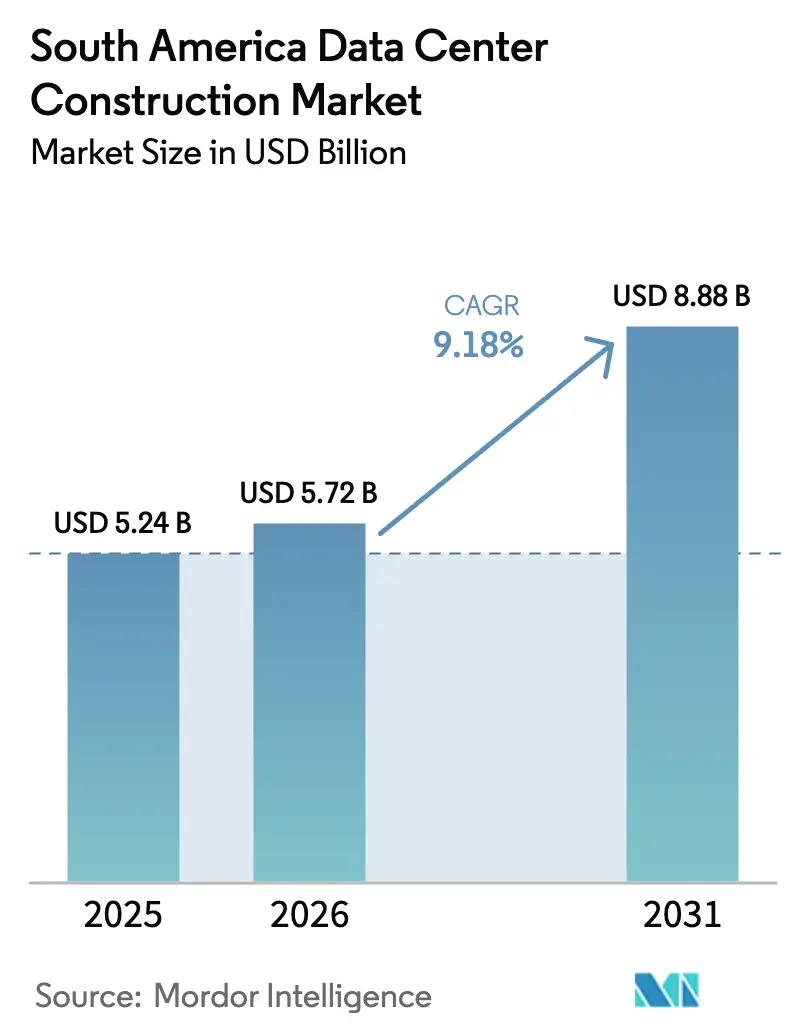
South America data center construction market size in 2026 is estimated at USD 5.72 billion, growing from 2025 value of USD 5.24 billion with 2031 projections showing USD 8.88 billion, growing at 9.18% CAGR over 2026-2031. Capacity additions are propelled by cloud-first enterprise strategies, rising AI workloads that demand specialized infrastructure, and strategic tax incentives across Brazil and Chile. Hyperscale and colocation capital expenditure are expected to increase significantly, translating into rapid greenfield builds and expansions in São Paulo, Santiago, and Fortaleza. Tier 3 sites dominate current deployments, yet Tier 4 facilities are growing the fastest as financial services, gaming, and public-sector workloads migrate to mission-critical environments. Intensifying competition among AWS, Microsoft, Google, Scala Data Centers, and regional specialists is amplifying demand for power backup, high-density cooling, and renewable energy procurement. Construction firms are responding with modular designs, prefabricated components, and integrated sustainability features to meet compressed build timelines and evolving regulatory frameworks.
Key Report Takeaways
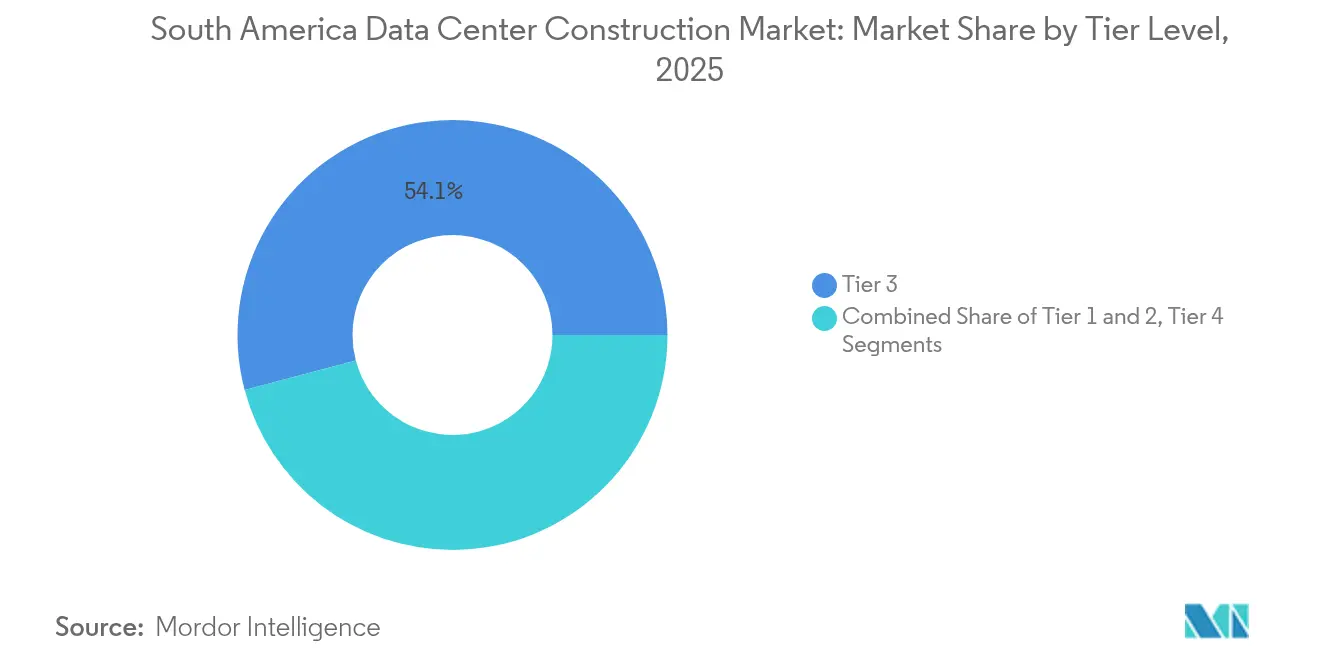
- By tier type, Tier 3 facilities held 54.12% of the South America data center construction market share in 2025, while Tier 4 is projected to expand at an 11.24% CAGR through 2031.
- By data center type, colocation services accounted for 55.63% share of the South America data center construction market size in 2025; self-built hyperscalers record the highest 11.76% CAGR to 2031.
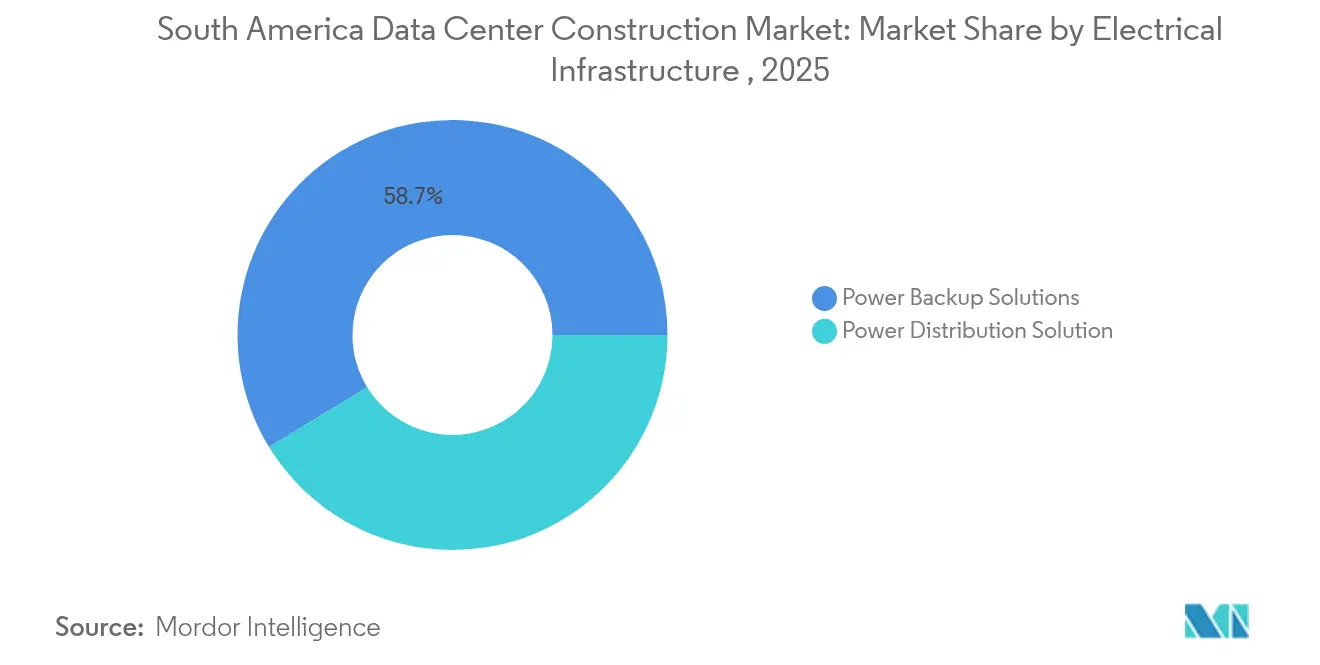
- By electrical infrastructure, power backup solutions led with a 58.73% share in 2025, and power distribution is set to grow at an 11.42% CAGR through 2031.
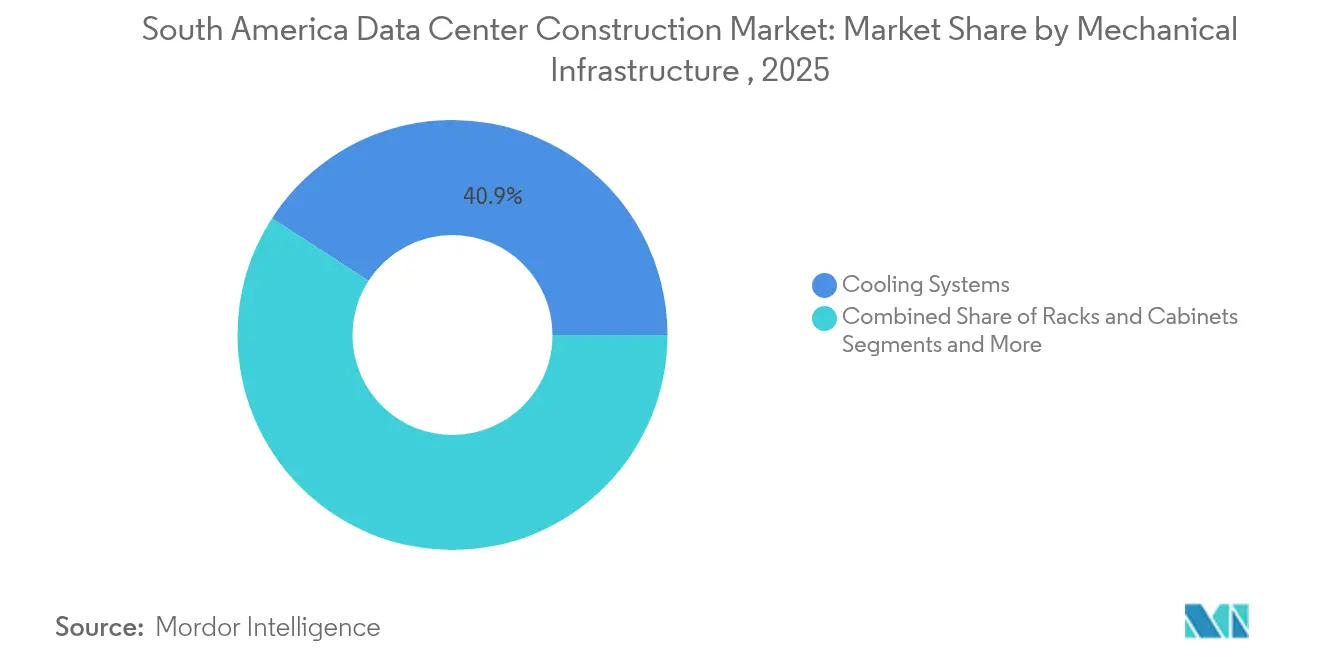
- By mechanical infrastructure, cooling systems captured 40.86% revenue share in 2025, whereas servers and storage show the fastest 9.94% CAGR to 2031.
Note: Market size and forecast figures in this report are generated using Mordor Intelligence’s proprietary estimation framework, updated with the latest available data and insights as of 2026.
600+
data center reports by Mordor Intelligence
covering AI facilities, power, servers and more - global, regional or country-level, right down to individual data center components
Market Trends and Insights
Drivers Impact Analysis of South America Data Center Construction Market*
| Driver | (~)% Impact on CAGR Forecast | Geographic Relevance | Impact Timeline |
|---|---|---|---|
| Cloud-first enterprise digitalization wave | +2.1% | Brazil, Chile, Colombia core markets | Medium term (2-4 years) |
| Hyperscale and colocation capex build-out acceleration | +1.8% | São Paulo, Santiago, Rio de Janeiro primary hubs | Short term (≤ 2 years) |
| AI / GPU-dense workloads driving high-density designs | +1.4% | Global, with Brazil and Chile leading adoption | Long term (≥ 4 years) |
| Government "neutral host" tax incentives in Brazil and Chile | +0.9% | Brazil and Chile national policies | Medium term (2-4 years) |
| Green financing access for Tier III+ energy-efficient builds | +0.7% | Regional, strongest in Chile and Brazil | Long term (≥ 4 years) |
| Sub-1 ms latency demand from fintech and gaming hubs | +0.5% | São Paulo, Santiago, Buenos Aires financial centers | Short term (≤ 2 years) |
| Source: Mordor Intelligence | |||
Cloud-first Enterprise Digitalization Wave
Enterprise adoption of hybrid cloud is reshaping construction priorities as organizations exit legacy on-premises environments. Secondary cities such as Fortaleza have emerged as strategic hubs because sixteen submarine cables deliver global connectivity that rivals major metros. Colombia illustrates the trend, with internet penetration surpassing two-thirds of the population and e-commerce surging, which increases demand for carrier-neutral facilities.[1] Brazil-based Patria committed USD 1 billion to a new platform targeting these enterprise workloads, signalling the scale of opportunity. Data sovereignty rules across the region further accelerate colocation uptake as enterprises seek compliant environments. Providers able to deliver hybrid cloud gateways and robust compliance frameworks are gaining share in the South America data center construction market.
Hyperscale and Colocation Capex Build-out Acceleration
Cloud majors have announced more than USD 8 billion in new sites through 2030, compressing traditional build schedules to as little as 18 months. AWS’s USD 4 billion Chile region and USD 1.8 billion Brazil expansion, along with V.tal’s USD 1 billion Fortaleza campus, are catalyzing regional supply chains. Scala Data Centers’ USD 50 billion AI City proposal targeting 4.7 GW exemplifies superscale ambition. Modular designs and prefabricated power rooms are now mainstream to meet hyperscale timelines. Smaller operators are consolidating or partnering with construction specialists to remain competitive in the South America data center construction market.
AI / GPU-dense Workloads Driving High-density Designs
AI training clusters are lifting rack densities to 40-140 kW, far above the 5-10 kW legacy norm, forcing adoption of direct liquid and immersion cooling. Scala’s AI City is engineered for these workloads with purpose-built cooling and reinforced floors. Contractors with high-density expertise are in demand, while conventional builders face steep learning curves. Samsung C&T has introduced underwater cooling solutions tailored for this market. Vertiv identifies AI enablement and energy efficiency as top transformation themes shaping Latin American data centers. [2]
Government “Neutral Host” Tax Incentives in Brazil and Chile
Brazil grants tax exemptions on qualifying data center investments, targeting facilities that meet energy efficiency and local content rules to cement the country’s role as the region’s digital hub. Chile’s National Data Centers Plan launched in December 2024 sets a USD 2.5 billion investment target backed by streamlined construction guides and environmental criteria.[3] Argentina’s new RIGI framework encourages projects above USD 200 million, with Cirion planning a 20 MW Buenos Aires site. These incentives lower development costs and favor Tier III and Tier IV builds that incorporate renewable energy.
Restraints Impact Analysis of South America Data Center Construction Market*
| Restraint | (~) % Impact on CAGR Forecast | Geographic Relevance | Impact Timeline |
|---|---|---|---|
| Escalating power and real-estate costs | -1.2% | São Paulo, Santiago, Rio de Janeiro | Short term (≤ 2 years) |
| Long lead-time for utility grid interconnects | -0.9% | Brazil, Argentina | Medium term (2-4 years) |
| Skilled labor shortages for complex MEP installations | -0.7% | Brazil, Chile, Colombia | Long term (≥ 4 years) |
| Water-stress regulations limiting evaporative cooling | -0.5% | Chile, northeastern Brazil | Medium term (2-4 years) |
| Source: Mordor Intelligence | |||
Escalating Power and Real-estate Costs
Land suitable for hyperscale campuses in São Paulo now commands premium valuations, pushing developers toward secondary zones such as Campinas that offer larger parcels and improved power headroom. Brazil sources 85% of its electricity from renewables, yet drought cycles reduce hydropower output and raise electricity prices, affecting facility operating costs. Public concern about grid stress has grown as citizens fear data centers may jeopardize the residential supply. Developers respond with on-site solar, battery storage, and power purchase agreements that shape construction blueprints in the South America data center construction market.
Long Lead-time for Utility Grid Interconnects
Securing new grid connections can stretch construction timelines by up to seven years, particularly for 100 MW-plus campuses. Developers mitigate risk by funding transmission upgrades and building private substations; Scala’s 560 MW substation in São Paulo underscores this capital commitment. Sites with existing high-voltage infrastructure gain a competitive advantage during site selection across the South America data center construction market.
*Our forecasts treat driver/restraint impacts as directional, not additive. The impact forecasts reflect baseline growth, mix effects, and variable interactions.
South America Data Center Construction Market Segment Analysis
By Tier Type:
Mission-Critical Drives Premium GrowthTier 3 sites captured 54.12% of overall revenue in 2025, reflecting enterprise preference for resilient yet cost-balanced designs. Within this category, banks and digital-first retailers account for the majority of spend on redundant power trains and multi-path fibre. The South America data center construction market size for Tier 3 facilities is projected to expand steadily as cloud regions seek adjacent interconnection space. Tier 4 capacity, while smaller today, shows an 11.24% CAGR through 2031 as AI model training, government public-cloud mandates, and fintech platforms demand 99.995% uptime. The South America data center construction market share associated with Tier 4 builds is therefore positioned to rise, intensifying competition for contractors able to deliver concurrent maintainability and fault tolerance.
Higher tiers require dual utility feeds, active-active power architectures, and stringent certification audits that lengthen commissioning cycles. Contractors specialising in complex mechanical, electrical, and plumbing systems thus command price premiums. HostDime’s ISO 27701 achievement in Brazil illustrates how compliance certifications intersect with tiering decisions

By Data Center Type:
Hyperscaler Reshape Market DynamicsColocation retained 55.63% of 2025 revenue as enterprises sought scalable alternatives to on-premises servers while maintaining network diversity and regulatory compliance. Carrier-neutral sites in major metros recorded near-full occupancy, pushing new builds toward suburbs and secondary cities. Simultaneously, self-built hyperscale sites register a 11.76% CAGR to 2031, elevating the South America data center construction market size for proprietary campuses. AWS, Microsoft, and Google expand footprints to support cloud regions and edge nodes tuned for sub-1 ms latency critical to gaming and fintech transactions.
Hyperscalers deploy repeatable design templates that compress schedule risk and simplify vendor qualification, leading to bulk procurement of switchgear, generators, and prefabricated modules. This standardisation cascades through local supply chains, incentivising parts manufacturers to align with global specifications. Colocation operators respond with ecosystem-rich campuses offering cross-connect fabrics and cloud on-ramps to differentiate in the South America data center construction market.
By Electrical Infrastructure:
Power Systems Drive ComplexityPower backup accounts for 58.73% share because grid volatility necessitates robust uninterruptible architectures. Diesel rotary UPS, lithium-ion battery systems, and static UPS topologies dominate specifications, with renewable integration gaining ground via microgrids and on-site solar arrays. Power distribution sees an 11.42% CAGR as AI racks require innovative busway layouts, intelligent PDUs, and granular power monitoring. South America data center construction market size related to switchgear, transformers, and converged monitoring platforms is therefore increasing in tandem with computational intensity.
Elevated power densities push designers to separate critical and non-critical loads within the data hall, demanding precise coordination between electrical engineers and IT architects. Banrisul’s deployment of Cisco MDS technology highlights the intersection of modern power distribution and a high-performance storage environment. Skilled electricians familiar with medium-voltage interlocks and arc-flash safety standards are in short supply, adding schedule risk to major projects.
By Mechanical Infrastructure:
Cooling Innovation Leads TransformationCooling systems held 40.86% of mechanical revenue in 2025 as hot-aisle containment, chillers, and CRAH units remained foundational. Immersion and direct liquid solutions move from pilot to production as rack densities rise, which propels the fastest 9.94% CAGR in servers and storage hardware that require tailored enclosures. Mechanical scopes increasingly integrate water-free cooling to comply with Chilean and northeastern Brazilian drought regulations. Samsung C&T’s underwater heat-exchange technology offers alternative pathways to reduce potable water use.
New builds accommodate heavier AI servers by reinforcing raised-floor loading and widening rack spacing for maintenance. Thermal energy storage, heat reuse into district systems, and machine-learning-driven airflow optimisation are emerging differentiators within the South America data center construction market. Alignment between mechanical and electrical teams becomes critical as cooling set points influence power budgets and redundancy levels.
Geography Analysis
Brazil Data Center Construction Market
Brazil dominates the South America data center construction market with more than 60 active facilities and 46 projects in the pipeline. São Paulo alone houses around 80% of the national capacity, yet land scarcity and grid congestion encourage developers to migrate toward Campinas and Porto Alegre. Microsoft’s USD 2.7 billion commitment and AWS’s USD 1.8 billion expansion underscore Brazil’s central role. The country’s 85% renewable electricity mix offers sustainability benefits, though droughts reduce hydropower output and raise approval hurdles, shaping design choices around on-site generation and energy storage.
Chile Data Center Construction Market
Chile is the region’s second major hotspot, backed by the National Data Centers Plan targeting USD 2.5 billion in investment. Amazon’s USD 4 billion Santiago region slated for 2026 leverages abundant solar and wind resources while prioritising water-efficient cooling. Yet water stress prompted Google to pause a USD 200 million Santiago expansion amid environmental scrutiny. Developers now incorporate closed-loop and air-cooled chillers to satisfy strict permitting standards. Santiago’s proximity to subsea cables and its fintech community sustains demand for low-latency hubs.
Regulatory Landscape
South America data center construction is increasingly shaped by investment incentives and tightening scrutiny on environmental and energy use. In Brazil, the federal government advanced a special tax regime for data centers (REDATA) with conditions tied to clean or renewable energy use and local content participation, aligning project design with power sourcing and procurement requirements. Brazil has also debated a broader National Data Center Policy in Congress, including mechanisms to prioritize access to electricity in areas with generation surpluses, which affects site selection and grid-connection strategy for 100 MW-plus campuses.
Permitting and sustainability compliance are also becoming more prescriptive, particularly for large builds. Brazil’s CONAMA has moved toward requiring more robust socio-environmental and climatic impact assessments for data centers rather than simplified, self-declared licensing pathways, increasing documentation, timeline, and design diligence for water, heat rejection, and resilience measures. In Argentina, the proposed Super RIGI framework targets large-scale foreign investment while emphasizing domestic supplier development (including minimum allocation to local suppliers), reinforcing localization expectations across construction materials, MEP contracting, and operations supply chains.
Competitive Landscape
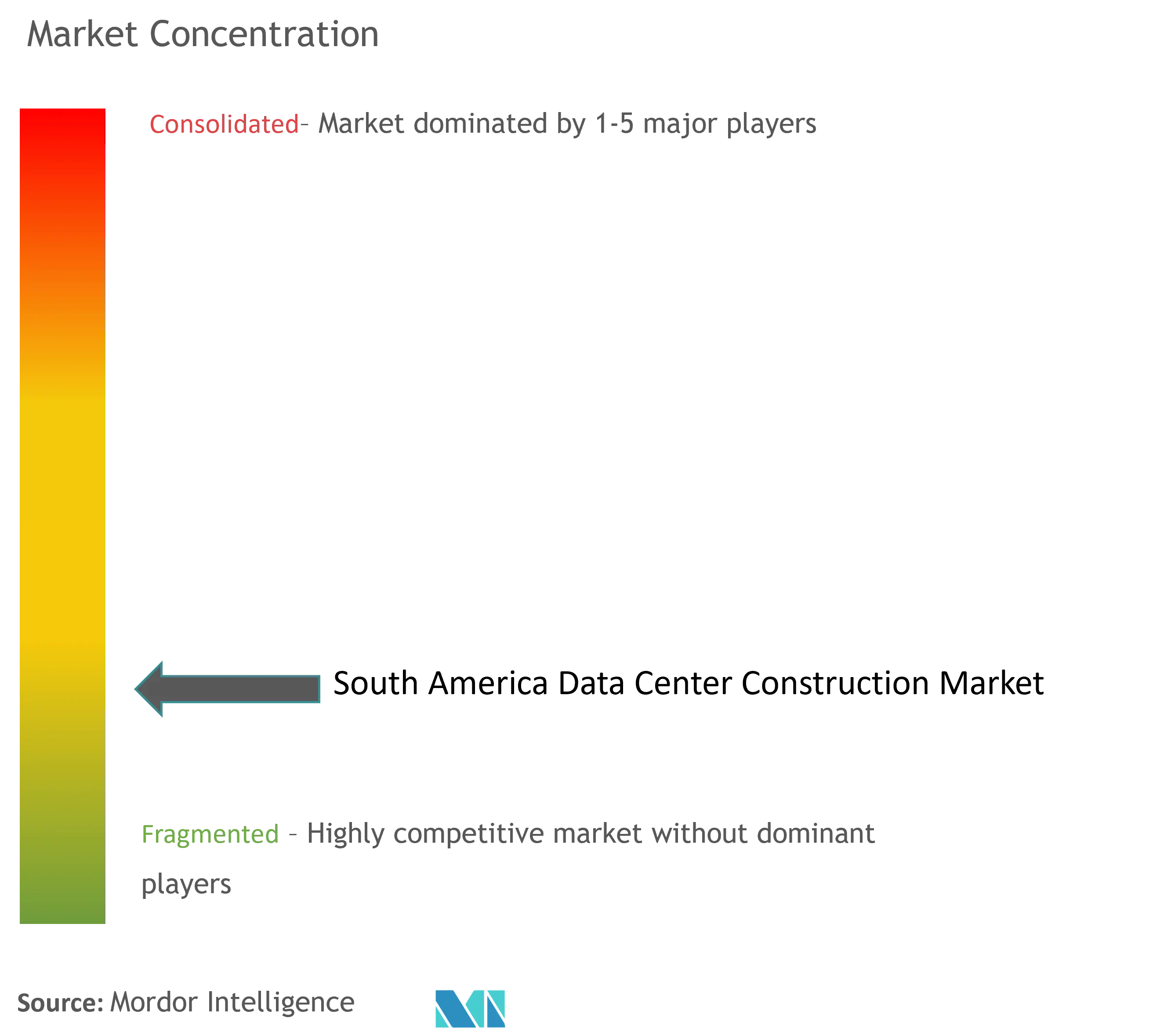
The competitive profile remains moderately fragmented but is trending toward consolidation as hyperscale cloud providers accelerate direct builds. AWS, Microsoft, and Google collectively account for the bulk of announced capacity, leveraging global procurement leverage to secure generator sets, switchgear, and liquid cooling systems at scale. Scala Data Centers, Ascenty, Equinix, and V.tal expand through greenfield campuses and acquisitions, focusing on interconnection ecosystems and renewable energy procurement. Patria’s USD 1 billion platform signals growing interest from infrastructure investors seeking stable, long-term returns in the South America data center construction market.
Strategic differentiation centres on sustainability, latency, and ecosystem depth. Scala’s partnership with Serena Energia secures wind power, reducing exposure to grid emission factors. Equinix expands Rio de Janeiro footprint, adding metro interconnect capacity for content and gaming clients. Construction firms such as Turner Construction, DPR Construction, and ACECO TI pivot to integrated design-build models, offering prefabricated modules to cut lead times. Smaller regional players increasingly specialise by targeting edge facilities in underserved cities, deploying modular 5 MW blocks that align with local demand profiles and utility constraints.
South America Data Center Construction Industry Leaders
-
AECOM
-
Turner Construction Company
-
Jacobs Solutions Inc.
-
DPR Construction
-
Fluor Corporation
- *Disclaimer: Major Players sorted in no particular order
South America Data Center Construction Market Companies Covered in this Report
- AECOM
- Turner Construction Company
- Jacobs Solutions Inc.
- DPR Construction
- Fluor Corporation
- Constructora Andrade Gutierrez
- Sonda Ingeniería e Implementación
- Mercury Engineering
- Hensel Phelps
- Gilbane Building Company
- McCarthy Building Companies
- Balfour Beatty US
- Rider Levett Bucknall
- Fonseca Mercadante Constructor
- GSI Ingenieria & Construcción
- Quark Datacenter Solutions
- ACECO TI
- Whiting-Turner Contracting Company
- Synergy Engenharia
- Constructora Sudamericana
Read Analysis of South America Data Center Construction Companies
Market Opportunities and Future Outlook
Policy-backed cost reduction and grid-access priority are creating clear whitespace for energy-aligned campuses in Brazil. The ReData/REDATA framework and related legislative initiatives provide federal tax exemptions on categories such as machinery and construction materials for qualifying projects, improving project economics for high-capex electrical and mechanical scopes (switchgear, backup power, and cooling). At the same time, Brazil’s push to prioritize data center projects for access to transmission networks in areas with power surpluses supports new site clusters beyond saturated metros, particularly where developers can pair private substations, transmission upgrades, and fast-track modular builds.
Named, funded projects and programs are also reinforcing demand for specialized construction capabilities in secondary hubs and port-adjacent connectivity zones. Ada Infrastructure moved from plan to execution with the GRU10 campus in Franco da Rocha and a broader multi-campus investment program, while Omnia Data Centers began work on a large TikTok-linked facility at the Pecem Port Complex in Fortaleza, highlighting the pull of cable-linked locations outside Sao Paulo. In Chile, the National Data Centers Plan launched in December 2024 with a USD 2.5 billion investment target and clearer construction and environmental criteria, supporting opportunities for water-efficient cooling retrofits and new-build designs that can clear stricter permitting pathways.
Recent Industry Developments in South America Data Center Construction Market
- July 2026: Racional Engenharia started construction for the first phase of Ada Infrastructure's GRU10 campus in Franco da Rocha, involving a data center building and a substation. The work points to faster execution capacity for large multi-megawatt campuses and supports the local modular-construction ecosystem serving Brazil's hyperscale demand.
- June 2026: Ada Infrastructure announced a R$2.7 billion investment plan for Brazil data center projects, including a 300MW campus in Franco da Rocha and a 50MW campus in Rio de Janeiro metropolitan area. This expands Brazil's footprint through a multi-campus approach and aligns with hyperscale growth and regional interconnection needs.
- March 2026: Omnia Data Centers began construction on a data center project for TikTok at the Pecém Port Complex in Fortaleza, Brazil, with an initial R$11 billion budget for physical infrastructure. The project establishes Fortaleza Pecém as a strategic hyperscale hub with large-scale local data center build activity.
South America Data Center Construction Market Report Scope and Research Methodology
Market Definition and Coverage
For this study, the market is defined as spending tied to building and expanding data centers across South America, covering new builds and upgrades that enable capacity, reliability, and energy and cooling performance at the facility.
Scope exclusions: We exclude day-to-day data center operations costs and purely IT service revenues that do not relate to construction or facility build activity.
Segments Covered in This Report
- By Tier Type
- Tier 1 and 2
- Tier 3
- Tier 4
- By Data Center Type
- Colocation
- Self-build Hyperscalers (CSPs)
- Enterprise and Edge
- By Infrastructure
- By Electrical Infrastructure
- Power Distribution Solution
- Power Backup Solutions
- By Mechanical Infrastructure
- Cooling Systems
- Racks and Cabinets
- Servers and Storage
- Other Mechanical Infrastructure
- General Construction
- Service - Design and Consulting, Integration, Support and Maintenance
- By Electrical Infrastructure
- Tier 1 and 2
Data Sources, Market Sizing, and Validation
Desk Research
Desk work was used to set the context for where data centers are being built and what usually drives construction spend in South America. We reviewed public planning and infrastructure signals such as energy availability, grid expansion, and renewable supply, because power and cooling needs strongly shape construction budgets.
To anchor assumptions, we referenced non-paywalled sources such as national energy agencies and electricity system operators, central bank inflation and exchange rate series, national statistics offices, customs and trade data portals, and telecom regulator updates on connectivity programs. We also used company filings, investor presentations, reputable press, and selective paid subscriptions focused on company financials and intelligence, patent databases, and shipment-level import and export records for cross-checking equipment flow and timing. The sources listed here are illustrative only, and many other public and paid references were also used for data collection, validation, and clarification.
Primary Interviews and Surveys
We use interviews and surveys with data center developers, construction specialists, equipment distributors, consultants, and facility operators across South America. Responses help test project timing, construction cost assumptions, power availability, cooling choices, and demand from cloud and AI workloads. The findings also fill country-level gaps and support final triangulation with desk evidence.
Distribution of primary research fieldwork respondents
| Company type | Respondent position |
|---|---|
| Top tier: 30% | CXOs: 15% |
| Mid tier: 45% | Functional/Unit leaders: 35% |
| Smaller Players: 25% | Managers: 50% |
Market-Sizing & Forecasting
Sizing starts from a top-down build that reconstructs construction demand by linking planned and active data center capacity additions to typical build-cost intensity, and then mapping that spend to facility and infrastructure work. Because costs can move quickly in this market, the model is set up to refresh key cost drivers before totals are finalized.
Inputs that most affect the totals include announced and under-construction capacity by country, typical cost per MW ranges by facility class, power and cooling system choices, the split between greenfield and expansion projects, and local cost inflation with USD conversion timing. Where project details are incomplete, we use structured gaps based on comparable builds in the same country and tier level, and then re-check these gaps during interviews.
Forecasts are produced using scenario analysis supported by year-by-year views on capacity pipelines, power availability constraints, and expected construction cost movements. The output is corroborated with selective bottom-up approximations, such as sampled project budgets, sampled cost per MW checks, and supplier and contractor channel feedback, which are used to adjust the top-down totals when mismatches appear.
Data Validation & Update Cycle
Multiple checks are applied before numbers are finalized, including reconciling totals against independent signals like capacity pipeline trends, major project timelines, and country-level cost movements. When a variance looks unusual, the underlying assumptions are reviewed, and follow-up conversations are triggered with relevant respondents to confirm what changed and whether it is temporary.
An internal review is completed in steps so that definitions, inputs, and calculations are verified separately before sign-off. The report is refreshed annually, and interim updates are made when material events occur, such as large project announcements, cancellations, policy shifts, or sharp currency moves. Before delivery, a fresh pass is done to ensure clients receive the latest updated view.
Mordor Intelligence's South America Data Center Construction Market Size Compared Against Other Published Estimates
Published market sizes for data center construction in South America often do not match because each publisher draws the line differently on what construction value includes, and because currency timing and cost inflation can be handled in different ways. Differences also come from how pipeline visibility is treated, since some models lean heavily on announced projects while others require stronger evidence that budgets will actually convert into spend.
The main gap comes from whether mechanical and electrical infrastructure spend is counted inside construction totals, where Mordor Intelligence counts these work packages only when they are directly tied to facility build-outs and expansions, rather than bundling broader IT hardware value. Another recurring driver is the cost-per-MW approach, since some estimates apply one regional average even though Sao Paulo and Santiago can show different labor, power, and cooling cost behaviors. Refresh cadence matters too, because a fast-changing pipeline can shift the current-year value if large campuses move forward or pause.
Benchmark comparison
| Source | Market Size | Gaps in Research Methodology |
|---|---|---|
| Mordor Intelligence | USD 5.24 B (2025) | |
| Trade Journal A | USD 5.51 B (2022) | Uses an investment total that is closer to overall data center market spending and may mix construction with operator capex categories, and it is not aligned to the 2025 base year or updated currency timing. |
| Global Consultancy B | USD 10.26 B (2022) | Covers a wider region (South and Central America) and uses an earlier base year, which can lift the total when more countries and older cost assumptions are included together. |
Across the three figures, the spread is mainly explained by region coverage, what is counted inside construction value, and which year is used as the starting point. By keeping the scope tied to South America and by linking spend to capacity additions and cost drivers that can be rechecked, the model stays traceable to clear variables and repeatable steps.
Key Questions Answered in the Report
What is the current value of the South America data center construction market?
The market stands at USD 5.72 billion in 2026 and is projected to rise to USD 8.88 billion by 2031.
Why are Tier 4 facilities growing faster than other tiers?
Financial services, government workloads, and AI training clusters demand 99.995% uptime, driving an 11.24% CAGR for Tier 4 builds through 2031.
How are power constraints influencing project locations?
High land and electricity costs in São Paulo and Santiago push developers toward secondary sites like Campinas and Fortaleza where grid headroom and land availability are greater.
What cooling technologies are gaining traction in the region?
Direct liquid and immersion cooling, as well as emerging underwater heat-exchange systems, are being adopted to support rack densities of up to 140 kW.
More reports on data centers
- Artificial Intelligence (AI) Data Center Market Global AI facilities demand, split by facility type, component and tier.
- Data Center Power Market Power systems across all regions, split by component, tier and facility size.
- Data Center Server Market Servers across the global market, covering tier, facility size and facility type.
- South America Hyperscale Data Center Market Hyperscale sites in South America, split by facility type, component and tier.
- South America Data Center Power Market South America power systems, split by power infrastructure, end user and power capacity range.
- South America Data Center Networking Market Networking demand across South America, covering component, end-user and data-center type.
- South America Data Center SSD Market SSDs demand across South America, covering form factor, interface and nand technology.
- South America Data Center Server Market South America servers, split by facility size and tier.
- South Korea Data Center Rack Market South Korea racks, split by rack size, rack height and rack type.
- South America Artificial Intelligence (AI) Data Center Market AI facilities in South America, split by facility type, component and tier.