
Market Overview
| Study Period | 2020 - 2031 |
|---|---|
| Forecast Data Period | 2026 - 2031 |
| Base Year Market Size (2025) | USD 119.26 Billion |
| Market Size (2026) | USD 123.66 Billion |
| Market Size (2031) | USD 148.17 Billion |
| Growth Rate (2026 - 2031) | 3.69 % |
| Market Concentration | Medium |
Major Players *Disclaimer: Major Players sorted in no particular order Image © Mordor Intelligence. Reuse requires attribution under CC BY 4.0. | |
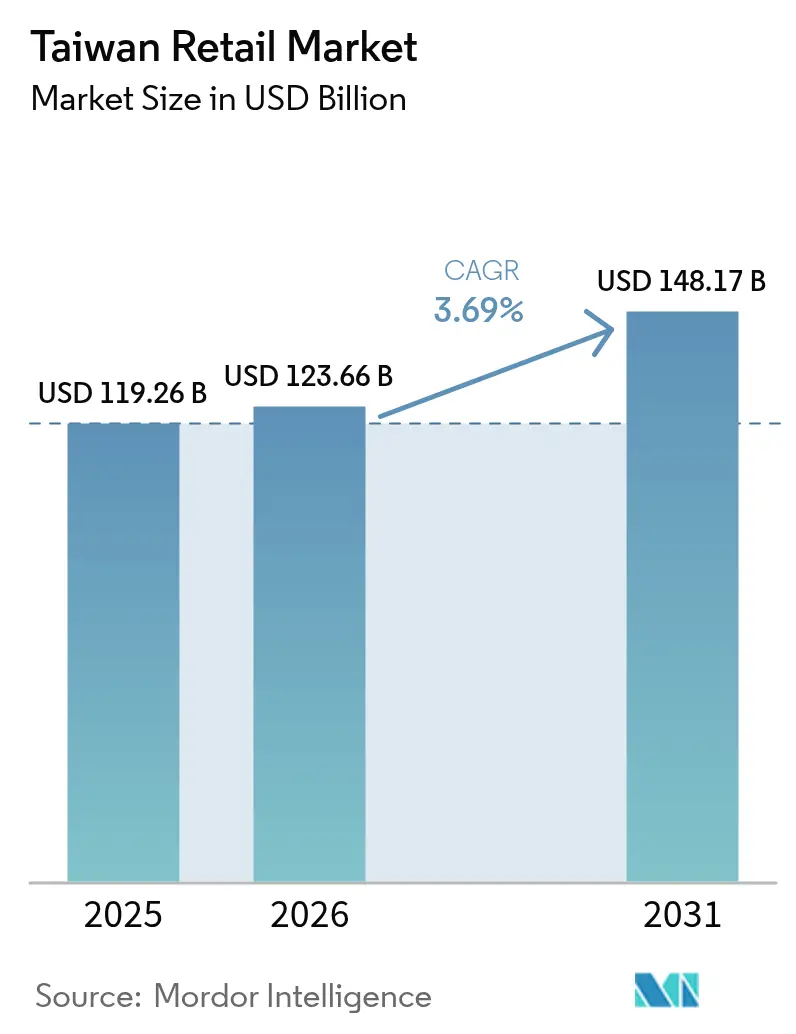
Taiwan Retail Market Analysis by Mordor Intelligence
Taiwan retail market size in 2026 is estimated at USD 123.66 billion, growing from 2025 value of USD 119.26 billion with 2031 projections showing USD 148.17 billion, growing at 3.69% CAGR over 2026-2031. Robust purchasing power, high urban density, and rapid digitalization sustain steady value growth even as volume expansion plateaus. Mergers such as PX Mart’s TWD 11.5 billion (USD 358.8 million) takeover of RT-Mart demonstrate how consolidation fortifies bargaining strength with suppliers and streamlines last-mile logistics. Dense convenience-store networks—6.98 outlets per 10,000 residents—act as ready-made fulfillment hubs, creating a formidable omnichannel ecosystem that online-only players struggle to match [1]. Demographic aging simultaneously restrains labor supply yet expands demand for health-oriented products and services, prompting retailers to invest in AI-driven process automation and elder-friendly merchandising. Meanwhile, regulatory vigilance—exemplified by the Fair Trade Commission’s block of Uber’s USD 950 million Foodpanda acquisition—signals that future market share gains will hinge more on service innovation than on headline-grabbing acquisitions.
Key Report Takeaways
- By product category, food, beverage & tobacco led with 42.10% of the Taiwan retail market share in 2025; electronic & household appliances are forecast to expand at an 8.05% CAGR through 2031.
- By retail channel, modern trade held 31.05% of the Taiwan retail market size in 2025, while e-commerce & others are projected to record the highest CAGR at 11.85% through 2031.
- By format, convenience stores accounted for a 29.00% share of the Taiwan retail market size in 2025, and specialty stores are advancing at an 8.70% CAGR through 2031.
Note: Market size and forecast figures in this report are generated using Mordor Intelligence’s proprietary estimation framework, updated with the latest available data and insights as of 2026.
Taiwan Retail Market Trends and Insights
Drivers Impact Analysis*
| Driver | (~) % Impact on CAGR Forecast | Geographic Relevance | Impact Timeline |
|---|---|---|---|
| Convenience-store density & O2O ecosystems | +1.2% | National, concentrated in urban areas | Medium term (2-4 years) |
| Mobile-first e-commerce & digital payments boom | +0.9% | National, higher penetration in metropolitan areas | Short term (≤ 2 years) |
| Ageing population spurs health-oriented retail demand | +0.7% | National, early gains in Taipei, Taichung, Kaohsiung | Long term (≥ 4 years) |
| Retail consolidation rewrites supplier terms | +0.5% | National | Medium term (2-4 years) |
| Cross-border live-stream commerce inflows | +0.4% | National, youth demographic | Short term (≤ 2 years) |
| Smart-retail subsidies & 5G roll-out | +0.3% | National, pilot programs in major cities | Long term (≥ 4 years) |
| Source: Mordor Intelligence | |||
Convenience-store Density & O2O Ecosystems
Taiwan’s convenience-store leaders, such as 7-Eleven and FamilyMart, have evolved into digital hubs that handle financial services, parcel collection, and prepared foods while feeding real-time transaction data into AI inventory engines. President Chain Store’s 7-Eleven network operated 6,859 outlets in 2024, averaging TWD 30.1 million (USD 940,000) sales per store and offering same-day delivery to nearly every urban household. Fujitsu-backed pilots employ blockchain payments and computer-vision shelf monitoring to minimize shrinkage and automate replenishment [2]. These capabilities reinforce the Taiwan retail market’s omnichannel strength by fusing offline convenience with online reach.
Mobile-First E-Commerce & Digital Payments Boom
Digital wallets and contactless cards processed TWD 8.3 trillion (USD 258.96 billion) in 2024 transactions, a 14.2% jump as smartphone penetration neared 90% and livestream shopping became mainstream [3]. The Financial Supervisory Commission's target of TWD 10 trillion (USD 312 billion) by 2026 reflects systematic digitization across retail touchpoints. Mobile-first platforms leverage Taiwan's 90% smartphone penetration to create seamless shopping experiences, with livestream commerce emerging as a critical conversion channel where 73% of online shoppers engage with video content. Shopee dominates with 62% livestream preference share, followed by Facebook at 36%, indicating social commerce integration drives incremental sales rather than channel substitution. This mobile-centric approach enables micro-targeting capabilities that traditional retail formats cannot match, particularly for impulse purchases during peak evening hours between 8-10 PM.
Ageing Population Spurs Health-Oriented Retail Demand
Taiwan's demographic transition accelerates demand for functional foods and health-oriented retail categories, with the elderly care market reaching TWD 3.6 trillion (USD 112.32 billion) in 2025. The 2025 Silver-Friendly Food Awards attracted 135 companies submitting 350 products, demonstrating industry-wide pivot toward age-appropriate nutrition solutions. Major food manufacturers are launching specialized product lines targeting seniors with chewing difficulties, emphasizing high-protein content and easy-to-consume formats. This demographic shift creates sustainable competitive advantages for retailers who establish early distribution relationships with specialized suppliers, as switching costs increase once elderly consumers develop brand loyalty. The Ministry of Agriculture's requirement for 10% Taiwanese agricultural ingredients in silver-friendly products also supports domestic supply chain development.
Retail Consolidation Rewrites Supplier Terms
PX Mart's acquisition of RT-Mart fundamentally alters supplier negotiation dynamics through centralized procurement power, affecting 20% of Taiwan's FMCG market [4]. The consolidated entity implements consignment systems where suppliers bear inventory risk while paying post-deduction fees based on sales performance, shifting traditional wholesale margins toward retailers. This structural change forces suppliers to develop direct-to-consumer capabilities or accept reduced profitability, accelerating vertical integration trends across food and beverage categories. Smaller suppliers face particular pressure as they lack negotiating leverage against consolidated retail buyers, potentially driving industry consolidation at the manufacturer level. The Fair Trade Commission's monitoring of these practices suggests regulatory intervention may limit the most aggressive terms, but fundamental power rebalancing favors large-format retailers.
Restraints Impact Analysis*
| Restraint | ( ) % Impact on CAGR Forecast | Geographic Relevance | Impact Timeline |
|---|---|---|---|
| Store-saturation cannibalization risk | -0.8% | National, acute in metropolitan areas | Medium term (2-4 years) |
| Labour shortages & rising wage floor | -0.6% | National, service-sector concentration | Short term (≤ 2 years) |
| Supply chain disruptions due to cross-strait tensions | -0.7% | National, especially import-dependent sectors | Short to Medium term (1–3 years) |
| Aging population reducing consumer base | -0.5% | National, more pronounced in rural areas | Medium to Long term (3–5 years) |
| Source: Mordor Intelligence | |||
Store-Saturation Cannibalization Risk
Taiwan's retail density approaches physical limits with convenience store count exceeding 13,706 outlets, creating one store per 1,703 people. This saturation triggers cannibalization effects where new store openings primarily redistribute existing demand rather than generating incremental sales growth. 7-Eleven's expansion beyond 7,000 stores in 2025 demonstrates continued network growth despite diminishing returns on individual locations. Market leaders respond by shifting focus from store count to same-store sales optimization through technology deployment, including smart vending machines and unmanned store formats that reduce labor costs while maintaining market presence. The challenge intensifies in urban cores where rental costs continue rising while foot traffic patterns shift toward suburban shopping centers and online channels.
Labour Shortages & Rising Wage Floor
Taiwan's retail sector confronts acute labor shortages, with 73% of employers reporting recruitment difficulties, particularly for customer-facing roles requiring language skills and cultural sensitivity. The semiconductor industry's expansion compounds this challenge by attracting workers with higher wages, creating upward pressure on retail compensation packages. Service sector wages have remained frozen for over 60% of workers across three years, reducing job satisfaction and increasing turnover rates. Retailers respond through automation investments, with FamilyMart implementing AI-powered inventory systems and 7-Eleven deploying unmanned store technologies to reduce labor dependency. However, customer service quality concerns limit full automation adoption, particularly for complex transactions and elderly customer segments who prefer human interaction.
*Our forecasts treat driver/restraint impacts as directional, not additive. The impact forecasts reflect baseline growth, mix effects, and variable interactions.
Segment Analysis
By Product Type: Health Focus Re-Shapes Spending
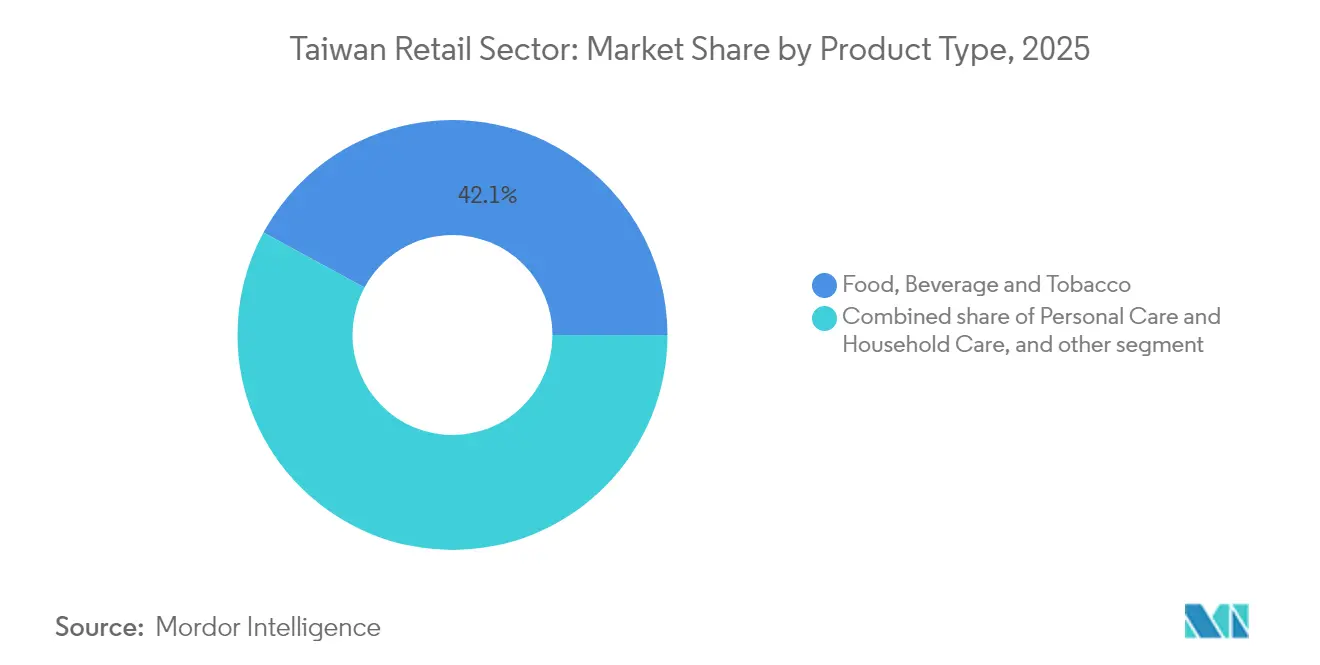
Food, beverage & tobacco remained the largest category, capturing 42.10% of Taiwan retail market share in 2025 as consumers favored ready-to-eat meals and premium coffee offerings. Electronic & Household Appliances are forecast to post an 8.05% CAGR through 2031, the swiftest pace among product lines. The rise of AI-enabled air purifiers and smart cooking gadgets underpins this trajectory, lifting the Taiwan retail market size for the segment well above historical averages. Personal Care & Household products benefit from the aging demographic, driving growth in adult diapers, low-allergen detergents, and vitamin supplements. Meanwhile, Apparel, Footwear & Accessories confront margin pressure from cross-border fast fashion yet still log mid-single-digit growth by leaning on domestic designers and sustainable fibers. Furniture, Toys & Hobby products gain from urban renovation trends as city dwellers maximize small-space living. Industrial & Automotive categories remain stable, their outlook tied to electric-vehicle accessory demand rather than gasoline-engine maintenance.
Over the next five years, retailers will cluster premium health SKUs adjacent to daily staples to entice impulse purchases and maximize basket value. Product localization accelerates as authorities push a 10% domestic ingredient mandate for silver-friendly foods, aiding local farmers and shortening supply chains. Omnichannel merchandising delivers click-and-collect flexibility, letting shoppers test home-electronics bundles in-store before finalizing digital payments. Private labels broaden into high-protein snacks and eco-detergents, keeping price-sensitive consumers loyal amid cost inflation. This category diversification fortifies resilience in the Taiwan retail market against isolated demand shocks such as tariff hikes or tourism slowdowns.

By Retail Channel: Seamless Journeys Trump Channel Silos
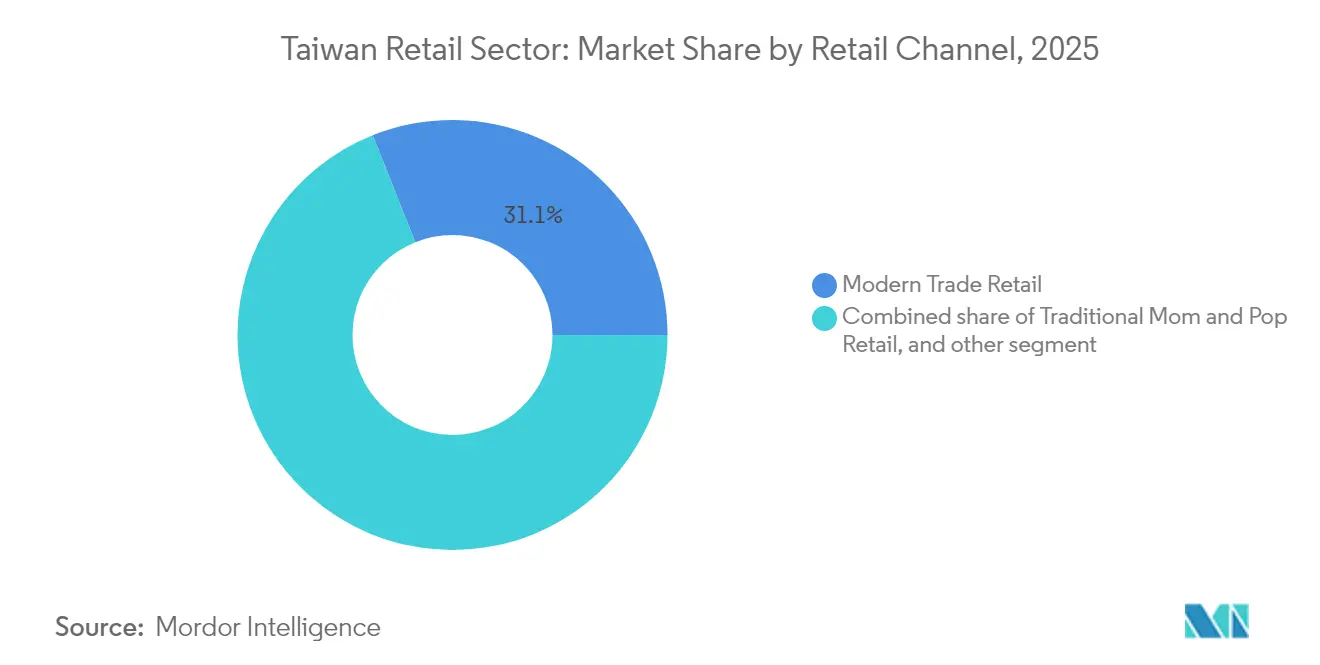
Modern trade accounted for 31.05% of the Taiwan retail market size in 2025, owing to its broad assortments and aggressive loyalty programs. Yet E-Commerce & Others will expand at 11.85% CAGR as frictionless returns, same-day grocery delivery, and livestream promotions woo urban millennials. Domestic giant Momo logged record revenue of TWD 112.56 billion (USD 3.51 billion) in 2024, leveraging proprietary logistics to guard NPS scores and fend off foreign sites. Traditional Mom-and-Pop shops decline in share but persist in rural districts where personal rapport beats speed. Cross-channel hybrid models emerge: PX Mart restricts payments to its own PX Pay, capturing transaction data and slashing interchange costs.
Omnichannel shoppers exhibit 30% higher annual spend, prompting retailers to integrate inventory views and reward points across apps, kiosks, and physical aisles. Cross-border marketplaces inject product novelty and price tension, but domestic players counter with tighter after-sales service and local warranty coverage. As 5G becomes commonplace, augmented-reality product demos and shoppable video further blur lines between browsing and buying. Competitive intensity, therefore, depends less on owning a specific channel and more on orchestrating shopper journeys across the Taiwan retail market.
By Format: Convenience Reigns, Specialty Accelerates
Convenience stores held a 29.00% slice of the Taiwan retail market in 2025, with their 24/7 hours, ready meals, and bill-payment kiosks woven into daily life. Specialty Stores are projected to grow fastest at 8.70% CAGR, fueled by beauty boutiques, pet-care shops, and nutrition clinics that deliver category expertise. Supermarkets maintain stable momentum by curating local produce and meal-kit subscriptions. Hypermarkets battle e-grocery incumbents by rolling out curbside pick-up bays and dynamic pricing screens. Department Stores downsize apparel floors while expanding experiential zones—book cafés, art exhibitions—that extend dwell time.
AI-driven shelf analytics allow convenience chains to cut out-of-stock instances by 20%, lifting same-store sales even in saturated districts. Specialty retailers deploy membership apps offering health diagnostics or personalized cosmetics mixing, deepening loyalty. Unmanned mini-stores and smart lockers appear in office lobbies, tapping micro-commerce demand during commute gaps. Collectively, these shifts reinforce the Taiwan retail market’s pivot toward data-guided microformats over raw square-meter expansion.
Regulatory Landscape
Taiwan retail operates under a competition and consumer-protection framework, with the Fair Trade Commission (FTC) enforcing the Fair Trade Act for practices such as resale price maintenance, discriminatory treatment, and abuse of market power across distribution formats (hypermarkets, convenience stores, and department stores). The market also falls under the Ministry of Economic Affairs Administration of Commerce (AOC), which oversees retail-market management and related guidance for commercial operations.
In 2026, compliance requirements tightened in selected consumer-goods categories and transaction processes. The Taiwan Food and Drug Administration (TFDA, MOHW) implemented the final phase of the Cosmetics Product Information File (PIF) requirement and aligned it with mandatory GMP compliance for domestic cosmetic factories, raising documentation and supplier-traceability demands for cosmetic retailers and importers. In parallel, the Ministry of Finance moved to amend tax-free shop management rules to remove customer signature requirements on sales slips, supporting more paperless, electronic transaction records that benefit retailers operating in travel retail and higher-ticket categories.
Value Chain Analysis
Taiwan retail value chains span brand owners and importers, domestic manufacturers (particularly in food and personal care), wholesalers and distributors, modern-trade operators (hypermarkets, supermarkets, convenience chains), and e-commerce platforms with in-house or outsourced fulfillment. The convenience-store network acts as both a sales channel and last-mile infrastructure through parcel pickup, bill payment, and increasingly O2O services, while large modern-trade groups shape procurement terms and assortment access for FMCG suppliers.
Logistics and cold-chain capability have become a core differentiator as retailers shift from store-count expansion toward fulfillment speed and inventory visibility across channels. Uni-President activated the Tainan Shin-Shi Logistics Park in December 2025 with multi-temperature zones to support chilled and frozen distribution. Third-party logistics capacity expansion, such as ALP (Ally Logistics Property) adding the OMEGA 2 facility in June 2025 (serving clients including PX Mart and PChome), reflects a more flexible, shared warehousing model. The June 2026 rebranding of Carrefour Taiwan stores under Uni-President further underscores the role of integrated sourcing, distribution, and store operations in controlling costs and service levels, from upstream procurement to last-mile delivery.
Competitive Landscape
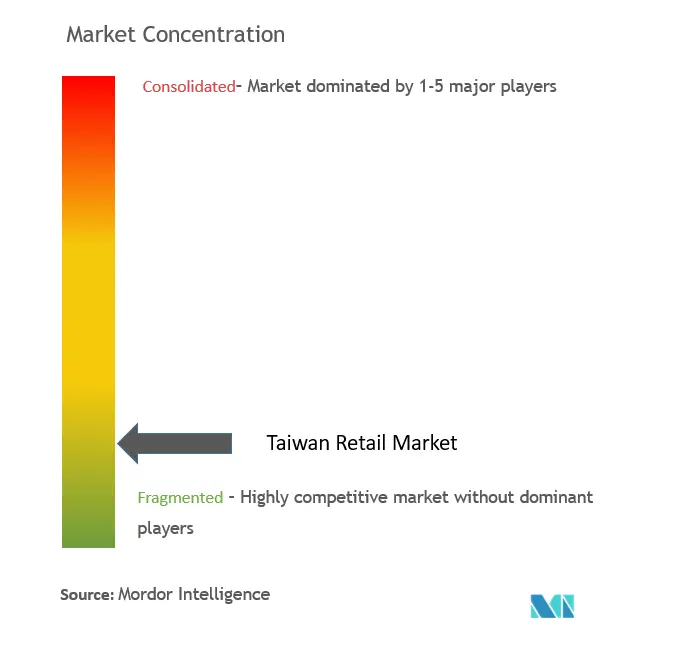
The Taiwan retail market is led by a few dominant players, with the top five chains holding a significant share. PX Mart’s expansion through mergers has prompted President Chain Store to enhance its private label offerings and collaborate with Costco’s warehouse club format to maintain pricing competitiveness. Carrefour Taiwan is focusing on refining its gourmet food lines to stand out from deep-discount competitors. Increasingly, technology is replacing price as the key competitive edge. Coretronic’s autonomous robots, for instance, help major retailers cut warehouse picking time significantly.
Retail innovation is rapidly evolving, with 7-Eleven rolling out computer-vision kiosks across Taiwan, reducing checkout times to just 15 seconds and allowing staff to focus on more customer-focused tasks. Cross-border e-commerce platforms rely on algorithmic dynamic pricing, but domestic retailers are responding with integrated loyalty ecosystems. These systems offer added value through transit card top-ups, micro-insurance policies, and utility bill payments. This deepens customer engagement while building data-driven advantages. Meanwhile, regulatory bodies such as the Fair Trade Commission continue to play a strong role in shaping market dynamics.
Proactive regulation has made large-scale mergers more difficult, curbing moves that could lead to monopolistic control. As a result, Taiwan’s retail market remains competitive despite consolidation pressures. Looking ahead, new growth areas are emerging. These include elder-care focused retail, sustainable fashion aligned with circular economy principles, and low-carbon supply chains. These sectors remain relatively untapped by both established players and foreign competitors, offering fresh opportunities for innovation and investment.
Taiwan Retail Industry Leaders
-
PX Mart (incl. RT-Mart)
-
President Chain Store (7-Eleven, Carrefour stake)
-
Costco Taiwan
-
FamilyMart Taiwan
-
Momo.com
- *Disclaimer: Major Players sorted in no particular order
Market Opportunities and Future Outlook
Omnichannel retail infrastructure remains a clear opening for both incumbents and new entrants, as Taiwan combines very high convenience-store density with fast-growing mobile-first shopping behavior and heavy reliance on digital payments. Operational programs already underway support this shift, including the Ministry of Economic Affairs launching the 2025 Cloud Solution Subsidy Program for retail and services under its data-sharing innovation project, and the Executive Yuan approving the Ten AI Initiatives Promotion Plan (2025-2028), which includes provisions to help SMEs adopt AI for retail operations. These initiatives create room for vendors and retailers to standardize product data, improve demand forecasting, and automate replenishment, particularly for categories with short shelf life and multi-temperature delivery needs.
Format and portfolio reshaping also present a near-term opportunity, supported by visible corporate actions and traffic reallocation. Uni-President has been restructuring its retail footprint, including the 2026 rebranding of former Carrefour Taiwan stores, and board approval in April 2026 to invest in LOPIA Taiwan to expand supermarket operations and related supply capabilities. New-to-Taiwan brands are also building offline presence to complement digital demand, such as Musinsa establishing a Taiwan subsidiary in July 2026 to localize operations and grow its store network. This increases competition for specialty formats and creates partnership opportunities in mall leasing, last-mile delivery, and localized merchandising.
Recent Industry Developments
- July 2026: Musinsa established a Taiwan subsidiary to localize operations and support a multi-store offline rollout. The move signals continued interest from cross-border specialty retailers in combining online demand capture with physical stores and local fulfillment partnerships in Taiwan.
- June 2026: Uni-President Enterprises announced that former Carrefour Taiwan outlets would be rebranded, with hypermarkets renamed Prosperity Plaza and supermarkets renamed Uni-Prosperity after the Carrefour brand licensing arrangement ended. This accelerates the shift toward domestic-led banners and enables tighter integration of procurement, private label strategy, and logistics across the store base.
- August 2025: PX Mart completed rebranding of RT-Mart sites under the MEGA PXMART banner and integrated operations onto a unified supply-chain platform. The consolidation strengthens negotiating leverage with suppliers and supports faster omnichannel fulfillment by standardizing systems, assortments, and distribution processes.
Research Methodology Framework and Report Scope
Market Definition and Coverage
For this market, we size the value of retail sales in Taiwan across common store-based and non-store channels, where consumer goods are sold to end customers at retail prices, including the related margins captured by retailers.
Scope exclusions: We exclude wholesale-only transactions, business-to-business sales, and pure logistics or payment service revenues that do not represent retail selling value.
Segmentation Overview
- By Product Type
- Food, Beverage, and Tobacco Products
- Personal Care and Household Care
- Apparel, Footwear, and Accessories
- Furniture, Toys, and Hobby
- Industrial and Automotive
- Electronic and Household Appliances
- Other Products
- By Retail Channel
- Traditional Mom and Pop Retail
- Modern Trade Retail
- E-Commerce and Others
- By Format
- Hypermarkets
- Supermarkets
- Convenience Stores
- Department Stores
- Specialty Stores
- Others (Drugstore, Cash and Carry, Wholesaler)
Data Sources, Market Sizing, and Validation
Desk Research
Desk research was used to set the base structure of the model and to anchor the big demand signals that retail follows in Taiwan. We reviewed public statistics and releases such as Taiwan government economic and trade statistics, customs and trade data, central bank and inflation releases, and household income and consumption surveys, which help frame retail spending direction.
We also used sources such as trade and retail association publications, peer reviewed journals on consumer behavior and channel shifts, listed-company annual reports and investor presentations, and reputable news coverage to capture format expansion, store network changes, and e-commerce momentum. Where needed, paid subscriptions we already use for company financials, news and financials, and patent databases were applied to cross-check retailer scale and major investment cycles. The desk sources named here are illustrative rather than exhaustive, and we relied on additional public materials for data collection, validation, and clarification.
Primary Interviews and Surveys
Interviews and surveys with retailers, format managers, distributors, and operations leaders in Taiwan help test turnover, channel mix, online share, pricing, promotions, and store productivity. Respondents also clarify gaps in delayed or grouped public data. We compare these views with desk data, re-contact respondents after material variance, and triangulate assumptions before final analysis.
Distribution of primary research fieldwork respondents
| Company type | Respondent position |
|---|---|
| Top tier: 25% | CXOs: 15% |
| Mid tier: 55% | Functional/Unit leaders: 30% |
| Smaller Players: 20% | Managers: 55% |
Market-Sizing & Forecasting
The sizing starts from a top-down build where retail value is reconstructed using Taiwan-wide consumption and retail activity signals, and then split across channel and product group using observed mix patterns. After that, selective bottom-up approximations were used as a check, where we rolled up sampled retailer revenues, store counts by format, and channel-level sales per outlet to see if totals stayed realistic.
Key inputs that shaped the model include household consumption growth, inflation and category price movement, store network additions and closures, e-commerce penetration within retail, promotion intensity, and category mix shifts between food and non-food. When a variable was not consistently available for a smaller format, gap handling was done through proxy indicators such as peer format productivity and validated share bands from interviews.
For forecasting, we relied on scenario analysis supported by simple multivariate relationships between retail value, consumer spending direction, and price trends, and then we adjusted the path using what experts expect for channel mix and store expansion over the forecast period. Assumptions were kept transparent so the model can be replicated and stress-tested with updated macro and channel indicators.
Data Validation & Update Cycle
Outputs were checked against independent signals like retail-related macro trends, channel growth narratives, and known format shifts, and then reviewed for year-to-year jumps that look inconsistent with consumer demand conditions. When an outlier appeared, the drivers were traced back to the exact input, and the assumptions were re-tested with additional calls before the number was finalized.
A multi-step internal review was followed, where definitions, currency handling, and growth paths were checked before sign-off. The report is refreshed annually, and interim updates are triggered when major events materially change retail demand or channel structure. Right before delivery, a final pass is completed so clients receive the most current view supported by the latest available indicators.
Mordor Intelligence's Taiwan Retail Market Size Versus Other Published Estimates
It is normal to see different published market sizes for Taiwan retail, even when everyone is talking about the same country. The gaps usually come from how each publisher defines retail boundaries, which year is treated as the anchor, and whether values are measured at transaction level or as retailer revenue.
The biggest differences in this market often come from whether visitor spending is blended into retail totals, how online retail is counted (marketplace gross value versus retail sales value), and how inflation is carried through the forecast years. Currency conversion timing and refresh cadence also matter because retail values can shift meaningfully after annual statistics revisions.
Benchmark comparison
| Source | Market Size | Gaps in Research Methodology |
|---|---|---|
| Mordor Intelligence | USD 119.26 B (2025) | |
| Regional Consultancy A | USD 130.00 B (2024) | Uses a different anchor year and often blends wider consumer transaction coverage, which can pull in spending that is not captured as retail sales value in a consistent way. |
| Industry Publisher B | USD 112.40 B (2026) | Starts from a narrower base and applies a different growth path by treating channel mix and price movement more conservatively, which compresses the sized value in the early forecast years. |
The spread mainly reflects counting choices, especially around whether online commerce is treated as gross merchandise value and whether visitor-linked shopping is included. Retail sales value is counted only when it maps to the defined channels and product baskets, followed by store productivity and macro cross-checks, which is how the model stays consistent for Taiwan across years in Mordor Intelligence.
Key Questions Answered in the Report
How large is the Taiwan retail market in 2026 and what growth is expected by 2031?
The Taiwan retail market size reached USD 123.66 billion in 2026 and is projected to expand to USD 148.17 billion by 2031 at a 3.69% CAGR.
Which product category contributes the most revenue?
Food, Beverage & Tobacco represents 42.10% of sales, making it the largest contributor.
Which sales channel is growing fastest?
E-Commerce & Others is forecast to rise at a 11.85% CAGR through 2031 as livestream shopping and cross-border platforms gain traction.
What is driving specialty-store expansion?
Rising demand for curated beauty, pet-care, and health products is fueling an 8.70% CAGR in Specialty Stores.
How does consolidation affect suppliers?
Large chains like PX Mart employ consignment and data-driven fee structures that shift inventory risk and squeeze supplier margins.
What regulatory measures shape competition?
The Fair Trade Commission enforces stringent merger thresholds, illustrated by its 2024 block of Uber’s Foodpanda acquisition, to preserve market competition.