
Recreational Boating Market Size and Share
Recreational Boating Market Analysis by Mordor Intelligence
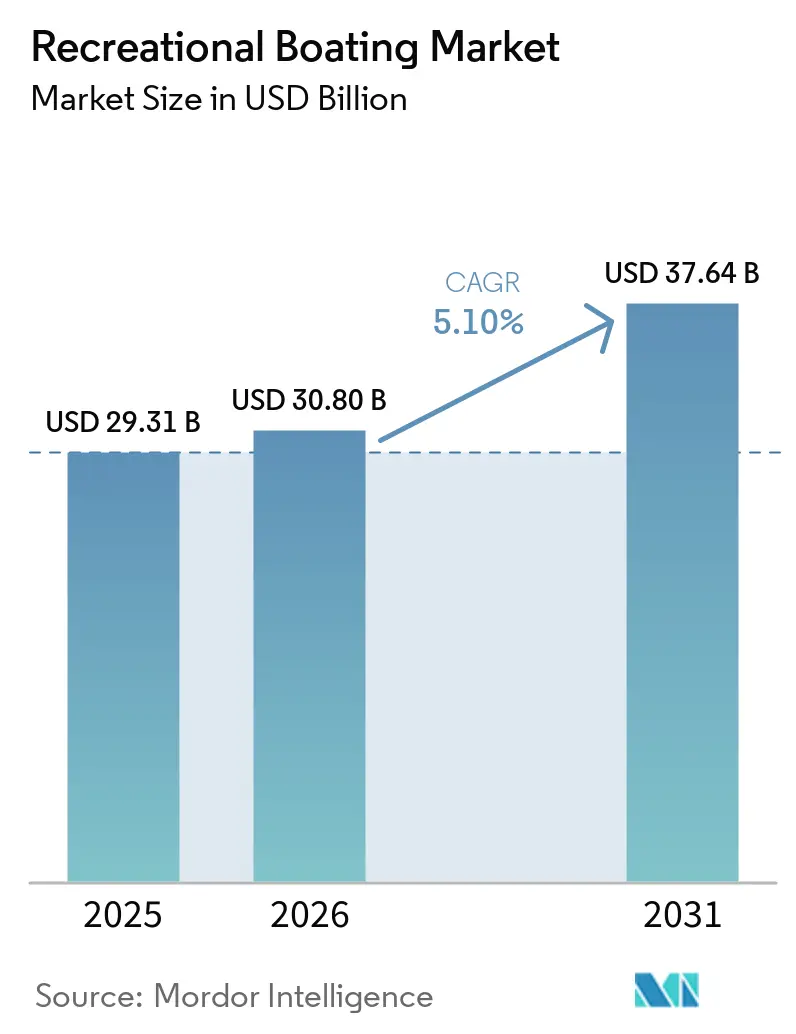
The recreational boating market size is projected to expand from USD 30.8 billion in 2026 and USD 32.37 billion in 2027 to USD 40.92 billion by 2032, registering a CAGR of 4.8% between 2027 and 2032.
Boat-club operators in the United States can pool occasional users into fleet purchases, widening the route from first outings to new-boat orders. International marina access in China gives owners and operators more destinations, strengthening the practical case for cruising vessels. Iranian attacks following US and Israeli operations against Iran disrupted Strait of Hormuz shipping from March 2026, adding petroleum logistics risk. Dealer reach and fleet sales can capture these use occasions, while higher resin costs increase pressure on manufacturers to preserve earnings from each completed fiberglass boat.
Key Report Takeaways
- By boat type, outboard powerboats held a 43.03% recreational boating market share in 2026, while personal watercraft (PWC) are forecast to grow fastest at a CAGR of 7.1% between 2027 and 2032.
- Fiberglass/GRP led hull materials with a 63.91% share of the recreational boating market size in 2026, whereas composites (carbon, Kevlar) are forecast to grow fastest at a CAGR of 10.1% between 2027 and 2032.
- Among boat lengths, craft less than 20 ft led with 56.77% of sales value in 2026, and boats greater than 50 ft are forecast to grow fastest at a CAGR of 8% between 2027 and 2032.
- By power source, boats with internal-combustion engines led with 91.06% of sales value in 2026, while electric/hybrid boats are forecast to grow fastest at a CAGR of 11% between 2027 and 2032.
- Watersports led activity demand with 39.09% of sales value in 2026, and the cruising and coastal tourism segment is forecast to grow fastest at a CAGR of 8.4% between 2027 and 2032.
- In distribution, dealer/showroom (OEM) sales represented 87.27% of recreational boat sales value in 2026, while the online direct-to-consumer channel is forecast to grow fastest at a CAGR of 12.6% between 2027 and 2032.
- Geographically, North America led with 47.91% of recreational boat sales value in 2026, whereas Asia-Pacific is forecast to grow fastest at a CAGR of 8.8% between 2027 and 2032.
Note: Market numbers in this report are based on Mordor Intelligence's proprietary estimation framework, which combines nine months of actuals with Q4 projections for base year 2026.
Market Trends and Insights
Drivers Impact Analysis of Recreational Boating Market*
| Driver | (~) % Impact on CAGR Forecast | Geographic Relevance | Impact Timeline |
|---|---|---|---|
| Growing Participation in Watersports Fueled by Millennial & Gen-Z Demographics in North America | +1.5% | United States lakes, rivers, and coasts | Short term (≤ 2 years) |
| Rise of Boat-Club & Fractional Ownership Models Potentially Increasing First-Time Buyer Conversions in the United States & Canada | +1.4% | United States and Canada | Short term (≤ 2 years) |
| Government Marina Expansion Programs in China's Hainan & Guangdong Provinces | +1.2% | Hainan and Guangdong provinces | Medium term (2-4 years) |
| High-Net-Worth Individual Wealth Expansion Accelerating Yacht Purchases in Europe & the Middle East | +1.3% | Europe and the Middle East | Medium term (2-4 years) |
| Eco-Tourism Push Driving Demand for Small Electric Cruisers in Nordic & Alpine Lakes | +0.8% | Nordic countries and Alpine lake districts | Long term (≥ 4 years) |
| Digital Dealer Platforms Shortening Sales Cycles for 20-50 ft Boats in Australia & New Zealand | +0.6% | Australia and New Zealand | Medium term (2-4 years) |
| Source: Mordor Intelligence | |||
Growing Participation in Watersports Fueled by Millennial & Gen-Z Demographics in North America
More than 34 million Americans participated in paddlesports in 2025, adding 446,000 participants year over year, although growth eased from the pandemic surge. Outdoor Industry Association identified people ages 25 to 34 as the anchor of the US participant base across paddlesports disciplines. It also described participation as increasingly casual, making the occasion of use commercially significant alongside the number of participants. NMMA reported in January 2026 that US boating participation was supported by an estimated 11 million registered boats in use and growing demand for boat clubs, peer-to-peer rentals, and charter options. For paddlesports providers, the casual-use pattern favors low-commitment entry points that let the core 25-to-34 age group participate occasionally.
Rise of Boat-Club & Fractional Ownership Models Potentially Increasing First-Time Buyer Conversions in the United States & Canada
Shared access can turn recreational participation into fleet demand before an individual commits to boat ownership. In June 2026, Brunswick Corporation's Freedom Boat Club announced the opening of its 450th global location, a franchise-owned club at Liberty Landing Marina in Jersey City, New Jersey.[1] In 2025, 18 Freedom Boat Club locations recorded at least 10,000 member trips each, 2 more than a year earlier, including Grand Strand and Hilton Head. Those high-use locations concentrate recurring outings within club operations, giving manufacturers a potential customer able to aggregate vessel demand. A boatbuilder can pursue fleet orders from club operators without requiring each additional user to become an owner.
Government Marina Expansion Programs in China's Hainan & Guangdong Provinces
Opening a marina to international traffic can increase the usefulness of its berths without adding new physical capacity. Sanya Port's Qing Shuiwan area opened to international vessels on July 3, 2026, with 299 yacht berths serving international yacht traffic and mooring.[2] This gives yacht owners and recreational operators an additional international destination around which to organize vessel use. For boat suppliers serving Hainan, the demand mechanism is improved operating access that makes a vessel more useful across destinations. On June 2, 2026, Guangzhou Kaitai Transportation Investment and Hainan Yaode Waterfront Industry agreed to plan and build public yacht marinas and supporting facilities in Guangzhou's Huangpu District. The demand effect of that agreement depends on project delivery, while Qing Shuiwan's opening established international operating access.
High-Net-Worth Individual Wealth Expansion Accelerating Yacht Purchases in Europe & the Middle East
Capgemini's World Wealth Report 2026 found Europe's high-net-worth individual population grew 6.5% in 2025 after declining in 2024. That population comprised people with at least USD 1 million in investable assets, excluding primary residences, collectibles, consumables, and consumer durables. Such an expanded pool widens the potential audience for yachtbuilders seeking customers able to fund a vessel. Ferretti Group's yacht order intake attributed to Europe rose 3% in 2025 compared with 2024, using dealer exclusivity areas or customer nationalities to classify geography. Gulf Craft's Majesty brand handed over a 60-ft Majesty 60 flybridge family yacht to an Emirati owner at its UAE shipyard the week before June 4, 2026. The 2025 European readings pair an expanding affluent population after the prior year's decline with higher yacht orders at Ferretti, giving suppliers distinct signals of potential customers and committed demand.
Restraints Impact Analysis of Recreational Boating Market*
| Restraint | (~) % Impact on CAGR Forecast | Geographic Relevance | Impact Timeline |
|---|---|---|---|
| Inflation-Linked Surge in Fiberglass & Resin Prices Compressing OEM Margins | -0.9% | North American and European boatbuilding regions | Short term (≤ 2 years) |
| Lengthy Coastal Permit Lead-Times for New Marina Slips in Mediterranean Hot-Spots | -0.6% | Mediterranean coastal boating destinations | Long term (≥ 4 years) |
| Insurance Premium Hardening for Vessels Above 50 ft in Hurricane-Prone Caribbean Waters | -0.3% | Caribbean islands and adjacent waters | Short term (≤ 2 years) |
| IC-Engine Emission Restrictions on Alpine & Scandinavian Lakes Limiting Legacy Fleet Usage | -0.2% | Alpine and Scandinavian lake districts | Medium term (2-4 years) |
| Source: Mordor Intelligence | |||
Inflation-Linked Surge in Fiberglass & Resin Prices Compressing OEM Margins
US and Israeli military operations against Iran began in February 2026, followed by Iranian forces declaring the Strait of Hormuz closed from March 4 and disrupting oil shipping between Iran and Oman. On March 20, 2026, Interplastic announced price increases of up to USD 0.23 per pound on polyester and vinyl ester resins, gel coats, bonding compounds, and colorants. Interplastic cited higher raw-material and operating costs amid Middle East instability and set April 4, 2026, as the effective shipment date. For fiberglass boatbuilders, higher resin and related-material costs can reduce the contribution earned on each vessel when selling prices do not rise in step. The cost increase can consequently narrow the range of fiberglass models that a builder can profitably offer at established selling prices.
Lengthy Coastal Permit Lead-Times for New Marina Slips in Mediterranean Hot-Spots
Coastal marina projects can miss their construction schedules when permissions govern the water depth needed to serve boats. In November 2025, work on Gandia's new recreational marina had not begun as planned because Nueva Marina Gandia awaited dredging authorization, according to port and city officials. The planned September start depended on permission to deepen the port basin sufficiently for vessels. Marina works were underway in July 2026. The missed start delayed the works needed for new berth availability, leaving boat owners dependent on authorization before that mooring capacity could be developed.
*Our forecasts treat driver/restraint impacts as directional, not additive. The impact forecasts reflect baseline growth, mix effects, and variable interactions.
Recreational Boating Market Segment Analysis
By Boat Type:
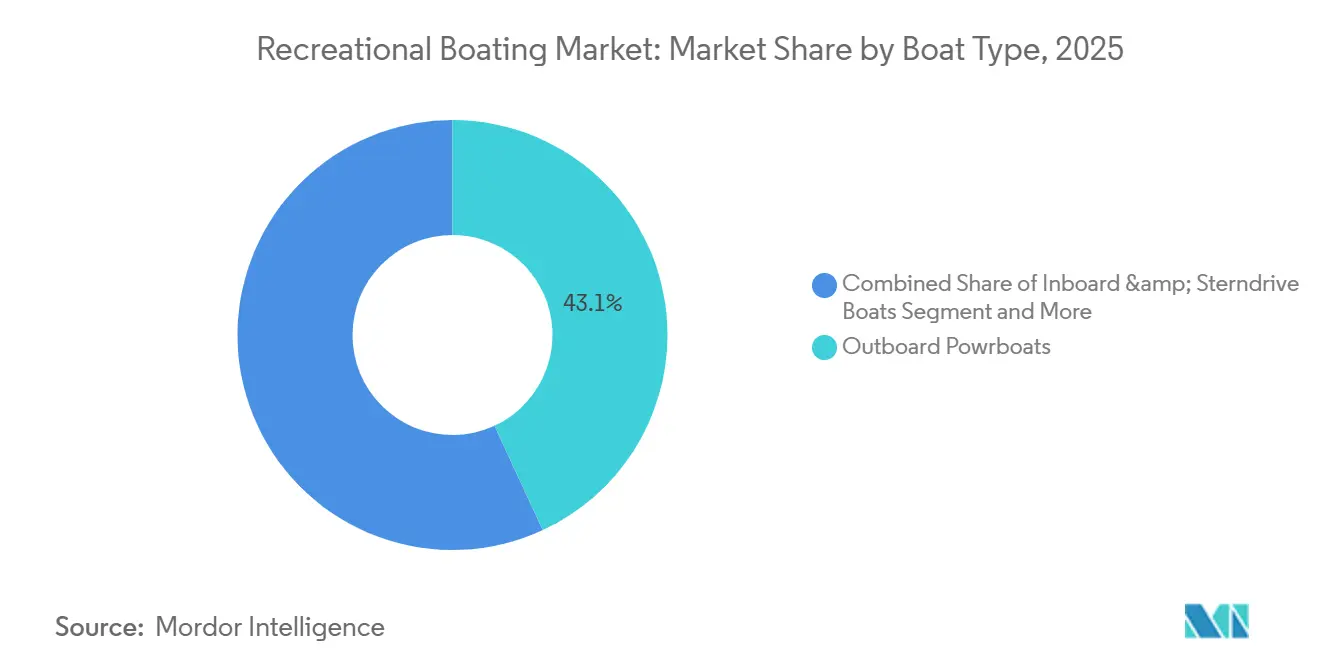
Scale and Shared Recreation Shape DemandOutboard powerboats accounted for a 43.03% share of the recreational boating market size in 2026. Through March 2026, US outboard boats led new-boat sales by engine type with 24,596 units sold, down 6.6% from the same period in 2025. Leadership by share coincides with softer early-2026 outboard unit sales, so the segment's position does not by itself indicate rising volume. A large category can absorb substantial production capacity, but a falling sales run rate increases the commercial risk of adding capacity ahead of orders.
Personal watercraft (PWC) are forecast to be the fastest-growing segment, registering a CAGR of 7.1% between 2027 and 2032. US sales totaled 63,643 units in 2025, with 3-passenger models accounting for 89% of PWC unit sales. The category's average retail price was just over USD 16,000 in 2025. NMMA identified consumer preference for premium 3-passenger models as driving the US category in 2025, concentrating competition in the premium 3-seat tier.



By Hull Material:
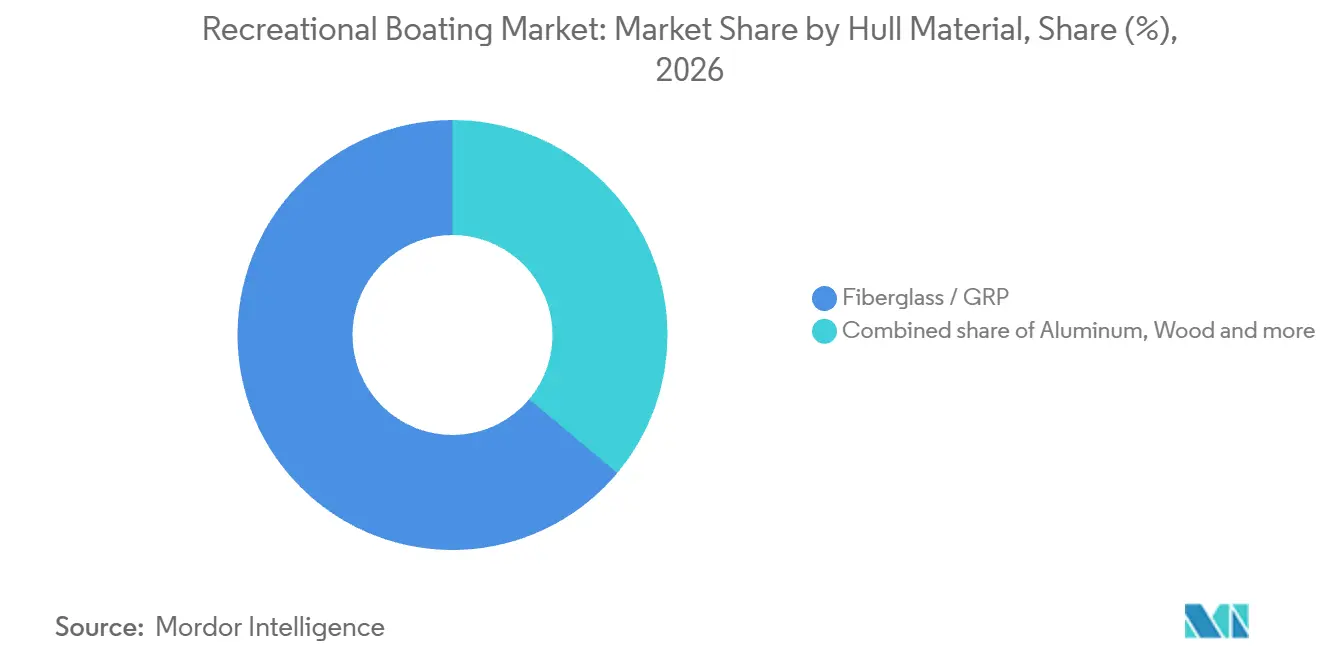
Incumbent Scale Meets Specialized ConstructionFiberglass/GRP represented a 63.91% recreational boating market share in 2026. Brunswick reported USD 237.5 million in net sales from its Recreational Fiberglass Boats product line for the 6 months ended July 4, 2026.[3] In September 2025, Brunswick announced plans to close its Reynosa, Mexico, plant, primarily for small, value fiberglass boats, and shift production to Tennessee and Florida. The company cited industry-wide value-fiberglass volume changes and sought lower fixed costs, with transition completion then anticipated by summer 2026. Brunswick's plan shows how shifts in value-boat volume can change where fiberglass production is economical.
Composites (carbon, Kevlar) are forecast to be the fastest-growing segment, with a CAGR of 10.1% between 2027 and 2032. In April 2025, Cure Marine had 5 Cure 55 catamarans in construction and orders from Australia, Europe, and the United States, using carbon fiber extensively. McConaghy subsequently took over production of the Cure range. Aluminum has a different demand base, with NMMA identifying aluminum fishing boats among US entry-level, volume-leading categories in 2025. The Cure orders connect extensive carbon-fiber construction with commercial catamaran demand, giving composite suppliers an order-backed production application.

By Length:
Compact Volume and Larger Yacht Orders DivergeBoats less than 20 ft were the largest segment, accounting for 56.77% of boat-sales value in 2026. In Spain, boats up to 6 meters recorded 3,492 registrations in 2025, or 70% of the country's recreational-boat registrations, with the class 1% below 2024. That high local registration concentration illustrates how compact vessels can sustain a substantial transaction base through a relatively steady year. Spain's registration mix makes compact models the main exposure to a broad recovery or further weakness in local boat transactions.
Boats greater than 50 ft are forecast to be the fastest-growing segment, with a CAGR of 8% between 2027 and 2032. In fiscal 2025, over 50% of Ferretti Group's new orders in its composite segment were for yachts longer than 80 ft. The group identified yachts above 80 ft among its most profitable segments, giving the order mix a strategic dimension beyond vessel length. This supports allocating yachtbuilding capacity toward larger models where the producer identifies stronger profitability and where its order mix provides evidence of buyer commitment.
By Power Source:
Combustion Scale and Electric Retail IntegrationInternal-combustion engine boats were the largest segment, with a 91.06% share of boat-sales value in 2026. NMMA reported 267,000 US outboard engines sold in 2025, down 3.9% year over year, while US outboard-engine market value reached USD 3.5 billion. Average US outboard-engine retail prices rose 3.2% in 2025, with NMMA also reporting continued strength in higher-horsepower segments. Because a complete boat's sale value includes its factory-fitted engine, higher-horsepower pricing strength can lift value per boat even when unit sales soften.
Electric/hybrid boats are forecast to be the fastest-growing segment, registering a CAGR of 11% between 2027 and 2032. Vision Marine reported USD 1.12 million in electric boat sales under contract from September 1, 2025, through late February 2026, up 446% from the comparable prior-year period. In March 2026, Vision Marine operated as a marine technology company with a vertically integrated, multi-brand boat retail platform. Vision Marine can use its multi-brand retail platform to present electric boats to shoppers, linking propulsion adoption to its retail reach.
By Activity / Application:
Specialized Boats and Tourism EconomicsWatersports was the largest segment, accounting for 39.09% of recreational boat-sales value in 2026. MasterCraft Boat Holdings reported 1,639 unit sales in its Performance and Wake segment in fiscal 2026, up 5.9% from 1,548 in fiscal 2025. The higher unit count gives MasterCraft a demand-based reason to sustain its specialized Performance and Wake production.
Cruising and coastal tourism is forecast to be the fastest-growing segment, with a CAGR of 8.4% between 2027 and 2032. In Italy, 57% of Confindustria Nautica's charter and rental company sample reported turnover growth in 2025, while 29% reported year-over-year declines limited to 10%. Angling/fishing has a distinct hired-boat use, with White Sturgeon fishing accounting for 37% of British Columbia freshwater guided or charter boat-trip spending in the 2025-26 fishing year. Tourism operators and fishing guides can therefore generate vessel demand from different recreational experiences. Italy's mixed 2025 charter results make the growing operators a more selective source of fleet demand than a uniformly expanding tourism base would provide.
By Distribution Channel:
Dealer Reach and Digital TransactionsThe dealer/showroom (OEM) channel was the largest segment, with an 87.27% share of recreational boat-sales value in 2026. Malibu Boats Inc. sold its boats through more than 345 dealer locations across 68 countries as of June 30, 2026. The company described its dealers as part of the consumer experience and its marketing efforts, connecting physical distribution to brand execution across countries.
The online direct-to-consumer channel is forecast to be the fastest-growing segment, registering a CAGR of 12.6% between 2027 and 2032. In fiscal 2025, Vision Marine reported selling electric recreational powerboats to retail customers and rental fleet operators directly through its website or via marinas, distributors, and showrooms. In research published in March 2026, NMMA and Ipsos reported that 27% of US buyers who purchased boats in the past 2 years bought online. Recent-buyer use of online purchasing gives manufacturers with a website sales route an opportunity to serve buyers already willing to transact digitally.
Geography Analysis
North America Recreational Boating Market
North America accounted for a 47.91% share of the recreational boating market size in 2026. US new-boat retail sales fell 8.8% to 215,237 units in 2025 from 236,070 in 2024. By July 21, 2026, Cruisers Yachts' authorized Mexican dealer Powerboats had sold and delivered a new 50 GLS Outboard to an owner in Cancún. North America's lead thus rests on a US new-boat base that contracted in 2025, while the Cancún delivery shows Cruisers Yachts reaching one Mexican owner through its newly appointed dealer.
Asia-Pacific Recreational Boating Market
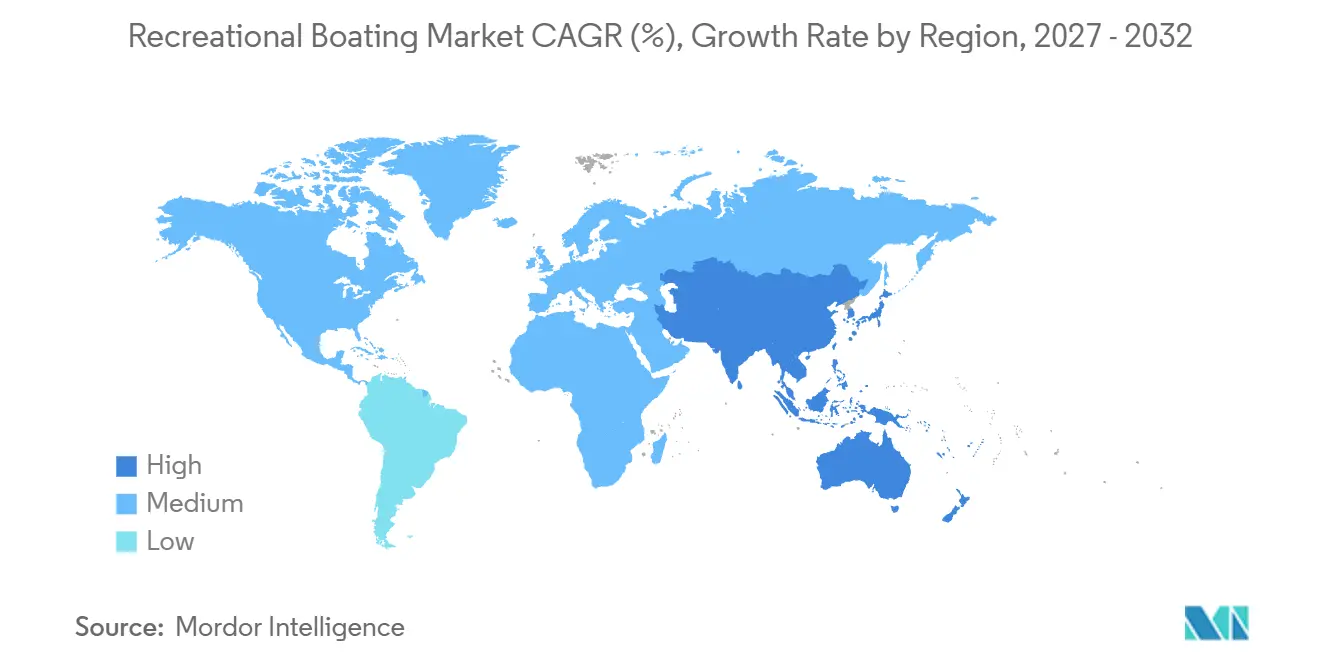
Asia-Pacific is forecast to be the fastest-growing geography, with a CAGR of 8.8% between 2027 and 2032. China had 9,850 registered yachts at the end of 2025, with yachts newly registered in the preceding 3 years representing 54.7% of that total. Australian personal watercraft registrations grew 20% over the 5 years to July 2026. New Zealand retail outboard sales were approximately 6,000-6,500 units in 2025, a separate propulsion-channel signal. The Chinese and Australian registration readings point to fleets being built up, linking the regional growth outlook to yacht and personal watercraft adoption.
South America combines Brazil's Santa Catarina boatbuilding cluster with Chilean retail activity, where Oceanic delivered a Beneteau Antares 8 in October 2026 for use in the Chiloé archipelago's channels. In Europe, Windy reported shipments from Sweden to Norway of a 34 Alizé and a 29 Huracán in May 2026, with owners preparing to take delivery. Within the Middle East and Africa, Cape Town builder Robertson and Caine rolled out its 3,000th boat, a Leopard 40 Powercat for US owners, in 2025. Dubai marinas also received 97 foreign-flagged yachts in the first half of 2025, compared with 39 in the same period of 2024. The Swedish shipments bound for Norway and Cape Town's boat for US owners show how builders serve buyers outside their production country.
Mordor Intelligence provides coverage of the recreational boating market across other key regional markets, including Europe, each with their regulatory frameworks and demand patterns.
Regulatory Framework and Outlook
The comparison covers selected jurisdictions from the perspective of suppliers selling complete recreational motorboats to private owners. It contrasts manufacturer documentation at product entry with the survey, registration, and inspection procedures that affect owners' ability to use a boat. The United Arab Emirates comparison focuses on Dubai's vessel inspection and renewal framework.
Regulatory Table of Recreational Boating Market
| Decision factor | United States | Germany | China | Argentina | United Arab Emirates |
|---|---|---|---|---|---|
| Primary authority | U.S. Coast Guard, Recreational Boating Product Assurance Branch | Federal-state market-surveillance authorities | China Maritime Safety Administration and local maritime authorities | Prefectura Naval Argentina | Dubai Maritime Authority, for Dubai |
| Key instruments or direction | 33 CFR Part 181 certification for boats subject to Part 183 standards | 10. ProdSV implementing Directive 2013/53/EU | Yacht Safety Management Regulations for owner-used, mechanically propelled leisure yachts | Ordenanza 1-26 under Disposición 1053/2026, effective August 27, 2026 | Dubai Resolution No. (2) of 2024 on technical inspection |
| Commercial effect | Manufacturer label before factory release for sale or before import; marked export-only craft exempt | German declaration of conformity and German manual use/safety information at market entry | Survey certificate before use and nationality certificate for navigation or berthing in Chinese jurisdictional waters | Owners of craft with gross tonnage 2 in the Second Group, Third Group, or Special Yacht Registry must request re-registration by August 27, 2028 | Dubai permits owner photo/video self-inspection for recreational and sports craft up to 12 meters |
| Current policy attractiveness | Medium | Medium | Medium | Medium | High |
| Future direction of policy attractiveness | No change | No change | No change | Hardening | Easing |
| Source: Mordor Intelligence | |||||
US labeling and Germany's German-language conformity documents create compliance work, while the U.S. Coast Guard's 2025 withdrawal of a proposed engine cut-off switch rule and the European Commission's 2026 evaluation of Directive 2013/53/EU, described in its maritime strategy as ongoing and focused on novel watercraft and propulsion, support continuity of core entry duties. China's May 2026 draft retained survey and nationality certification while distinguishing self-use and rental yachts, supporting continuity in these owner-use prerequisites. Argentina's transition adds an administrative step for a defined existing fleet before the August 2028 deadline, underpinning the hardening assessment. Dubai's May 2025 remote renewal-inspection service for pleasure vessels up to 12 meters, pleasure water-sports craft, and visiting foreign vessels supports procedural flexibility while preserving technical inspection.
Value Chain Stages
The value chain comparison follows propulsion and marine systems into boat assembly and onward to parts support during use. In 2025, Brunswick Boat Group procured substantially all its engines from the group's Propulsion segment and incorporated significant parts and systems content from its Engine Parts & Accessories and Navico Group businesses. This integrated example concentrates control of component supply and finished-boat production inside one group, while preserving distinct opportunities to earn supplier revenue at each operational stage.
Value Chain Analysis Table of Recreational Boating Market
| Primary activity | Key participants | Value capture | Bottleneck | Resilience response |
|---|---|---|---|---|
| Propulsion manufacturing | Marine propulsion manufacturers such as Brunswick Corporation's Propulsion segment | Sales of engines, controls, rigging, and propellers | Availability of critical engine components | Qualify alternative component sources before production |
| Marine systems supply | Marine electronics and systems suppliers such as Navico Group, a Brunswick business | Sales of electronics, power components, and switching systems | Coordinating several systems within one vessel | Verify system interfaces before final assembly |
| Boat assembly and distribution | Recreational boat manufacturers such as Brunswick Boat Group | Finished-boat sales through dealers and distributors | Delayed material or component supply | Alternative sourcing and critical-supply buffers |
| Aftermarket parts distribution | Parts producers and distributors such as Brunswick Corporation's Engine Parts & Accessories segment | Replacement-parts and consumables sales | Reaching dispersed vessels during service | Use established dealer and distributor channels |
| Source: Mordor Intelligence | ||||
Brunswick reported intermittent supply disruptions, shortages, and higher costs for certain materials in 2025, and said it was identifying alternative suppliers, working to secure critical inventories, and monitoring supplier capabilities. Securing critical inputs before assembly can protect finished-boat output, while wide parts distribution addresses the separate challenge of serving vessels after delivery. A systems offer combining electronics, electrification, and digital switching can move commercial emphasis toward coordinating components within the finished vessel.
Competitive Landscape
Market Concentration
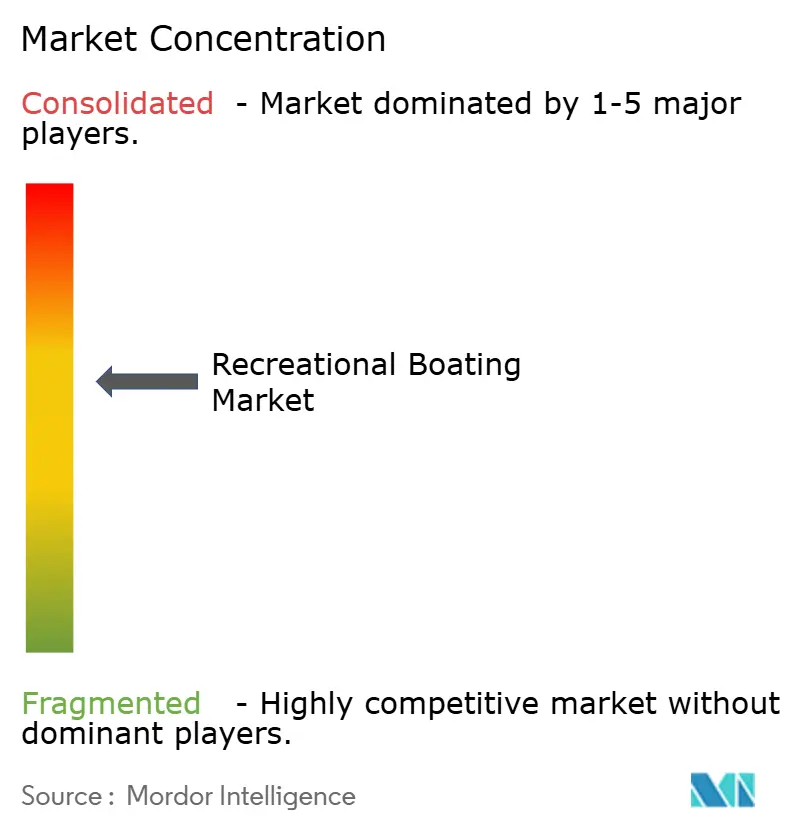
Competition combines diversified marine groups and specialist boatbuilders, with Brunswick Corporation, Groupe Beneteau, Azimut-Benetti Group, Ferretti Group, and Malibu Boats Inc. among the established manufacturers. Groupe Beneteau's 23 new models launched in 2025 accounted for nearly 30% of its first-half 2026 sales. Brunswick's Boat segment recorded USD 1.53 billion in net sales in 2025, down 1.8% from 2024. Azimut-Benetti Group's infrastructure plan announced in 2025 included upgrading its Avigliana site to build yachts up to 28 meters. Ferretti Group's Composite yachts order intake rose 7.6% in 2025, placing positive yacht-order momentum alongside softer net sales at Brunswick's Boat segment.
Malibu Boats Inc. announced on May 27, 2025, that it was continuing its GM Marine collaboration for vertical integration of Monsoon engines at its Loudon, Tennessee, factory. That arrangement links propulsion integration to vessel production at the same factory. Because the collaboration is exclusive, the Monsoon engine line is tied to Malibu's own Loudon production site.
Portfolio integration offers another route to a stronger competitive position when an acquired boat business begins contributing to consolidated sales. Malibu Boats Inc.'s consolidated net sales increased 13.3% to USD 914.6 million in fiscal 2026, including its newly acquired Saxdor segment. Malibu described the Saxdor integration as covering its first 4 months with the business, so the fiscal 2026 increase combined that partial-year addition with its existing boats. The acquisition, completed March 2, 2026, added a Finnish maker of premium adventure dayboats to Malibu's portfolio.
Recreational Boating Industry Leaders
-
Brunswick Corporation
-
Groupe Beneteau
-
Azimut-Benetti Group
-
Ferretti Group
-
Malibu Boats Inc.
- *Disclaimer: Major Players sorted in no particular order
Recreational Boating Market Companies Covered in this Report
- Brunswick Corporation
- Groupe Beneteau
- Azimut-Benetti Group
- Ferretti Group
- Malibu Boats Inc.
- Sunseeker International Ltd.
- Princess Yachts Ltd.
- MasterCraft Boat Holdings Inc.
- Polaris Inc.
- Marine Products Group, LLC
- Bavaria Yachtbau GmbH
- Tracker Marine (White River Marine Group)
- Hobie Cat Company
- Sportsman Boats Manufacturing Inc.
- Catalina Yachts
- HanseYachts AG
- X-Yachts A/S
- Alubat
- Yamaha Motor Co., Ltd. (PWC Division)
- Walker Bay Boats
Key Opportunities for Market Participants
The opportunities comparison examines how new marina capacity and cross-border access can translate into demand for complete recreational boats. In September 2026, Guangzhou Nansha District approved an investment filing for 195 planned additional berths for 30- to 60-ft yachts. On October 16, 2026, Guangdong launched southbound yacht travel to Hong Kong with a maiden voyage. These changes favor vessel offerings linked to specific berth profiles and usable itineraries, with boat orders depending on owner adoption and project delivery.
Market Opportunities Table of Recreational Boating Market
| Opportunity | Why now | Buyer / lead segment | Recommended play | Main barrier | Likely beneficiaries |
|---|---|---|---|---|---|
| Compact cruisers for Nansha owners | Planned berths include 30- and 40-ft sizes | Private owners of 30-40 ft cruisers | Match cruiser offerings and delivery timing to berth availability | Timing of planned berth completion | Jeanneau, with its Sun Odyssey 350 cruising sailboat |
| Yachts for northbound coastal cruising | More than 20 Hong Kong and Macao yachts entered designated terminals in Guangzhou, Shenzhen, Zhuhai, and Zhongshan in June 2026 | Hong Kong and Macao yacht owners using Guangzhou | Position 50-60 ft yachts with local berthing and maintenance support | Huangpu berthing and maintenance shortfalls identified in June 2026 | Azimut Yachts, with its Fly 58 |
| Yachts for mainland-to-Hong Kong cruising | Greater route utility from southbound access | Guangdong private yacht owners | Offer complete yachts around repeat cross-border cruising use | Eligible existing yachts may already meet the owner's route needs | Azimut Yachts |
| Source: Mordor Intelligence | |||||
The central opening is to sell vessels that add practical cruising utility as berth capacity and cross-border routes develop. An owner able to use an existing yacht may gain travel flexibility without needing an additional craft, so a new-boat offer needs a distinct reason for replacement or a first purchase. Berthing and maintenance gaps identified in Huangpu in June 2026 can also make dependable local operating support a meaningful part of the whole-boat offer.
Recent Industry Developments in Recreational Boating Market
- Oct 2026: Guangdong launched southbound yacht travel to Hong Kong with a maiden voyage on October 16, extending cross-border recreational-yacht access.
- Aug 2026: Boater's World Manufacturing Group announced plans to invest more than USD 6 million in upgrades to the NauticStar facility in Beaufort County, North Carolina, to increase production.
- Jul 2026: Sanya Port's Qing Shuiwan area opened to international vessels on July 3, with 299 yacht berths for international yacht traffic and mooring.
Recreational Boating Market Report Scope and Research Methodology
Market Definition and Coverage
The recreational boating market measures annual value from sales of recreational boats worldwide. It covers craft bought for personal, shared, tourism, or charter use across boat types, hull materials, lengths, propulsion systems, and sales channels.
Scope exclusions: Commercial-purpose vessels, standalone propulsion engines and propulsion units, separately sold boat parts, accessories, repair and maintenance, and marina, boat-club, charter, tourism and diving services are excluded.
Segments Covered in This Report
- By Boat Type
- Inboard & Sterndrive Boats
- Outboard Powerboats
- Personal Watercraft (PWC)
- Sailboats
- Yachts (30-120 ft)
- Inflatable & RIB Boats
- By Hull Material
- Fiberglass / GRP
- Aluminum
- Wood
- Steel
- Composites (Carbon, Kevlar)
- By Length
- Less than 20 ft
- 20-50 ft
- Greater than 50 ft
- By Power Source
- Internal-Combustion Engine
- Electric / Hybrid
- Sail-Propelled
- By Activity / Application
- Watersports
- Angling / Fishing
- Cruising & Coastal Tourism
- Dive & Charter Operations
- By Distribution Channel
- Dealer / Showroom (OEM)
- Online Direct-to-Consumer
- By Geography
- North America
- United States
- Canada
- Caribbeans
- Rest of North America
- South America
- Brazil
- Argentina
- Rest of South America
- Asia-Pacific
- China
- Japan
- India
- Australia
- South Korea
- Southeast Asia
- Rest of Asia Pacific
- Europe
- Germany
- United Kingdom
- France
- Italy
- Spain
- Netherlands
- Rest of Europe
- Middle East and Africa
- Saudi Arabia
- United Arab Emirates
- Qatar
- Turkey
- Rest of Middle East and Africa
- North America
Data Sources, Market Sizing, and Validation
Desk Research
Public sources such as the National Marine Manufacturers Association's retail and category reports, the International Council of Marine Industry Associations' description of its global and national statistics, U.S. Census Bureau trade data, and U.S. Coast Guard registration statistics can establish retail activity, category mix, trade flows, and the registered fleet. These series provide distinct checks on boat demand and geography, while their units and coverage must be matched to complete-boat sales value before they inform the market estimate.
Company annual filings, investor materials, product announcements, and reputable trade and financial press can supplement those public indicators with boat revenue, unit shipments, model mix, dealer reach, and production developments. Sources named here are illustrative and not exhaustive, and further sources inform collection, validation and clarification.
Primary Interviews and Surveys
Interviews and structured surveys would target boat manufacturers, dealers, marine distributors, boat-club and charter fleet buyers, and component or propulsion specialists, with respondents selected across company sizes and relevant functions. Their input would test secondary findings on realized boat prices, retail and fleet ordering, channel mix, geographic demand, and material or propulsion substitution. Analysts would use follow-up questions to address material gaps, compare responses with independent sales and registration signals, and revise assumptions only where the evidence supports a change.
Distribution of primary research fieldwork respondents
| Company type | Respondent position | Region |
|---|---|---|
| Top tier: 25% | CXOs: 20% | APAC: 38% |
| Mid tier: 55% | Functional/Unit leaders: 35% | EMEA: 32% |
| Smaller Players: 20% | Managers: 45% | Americas: 30% |
Market-Sizing & Forecasting
The model starts with a top-down estimate of annual global sales value for complete recreational boats, valued at the buyer's end-user transaction price, and allocates that value across the report's boat types, hull materials, lengths, power sources, activities, channels, and regions. A multivariate regression can relate historical sales value to 4 practical indicators, where retail boat units show realized demand, average selling prices by boat class translate units into value, registrations and trade flows check the scale and direction of national markets, and household purchasing conditions and marina or fleet investment inform demand timing. Segment and regional shares are built from the best available unit, revenue, registration, trade, and company mix evidence, with each split reconciled to the complete global total.
Forecasts extend the indicators through their expected relationships, with scenario analysis used where rates, consumer demand, access, or fleet ordering create a material range of outcomes. Selective bottom-up checks multiply sampled retail or fleet volumes by supported average prices and compare those results with manufacturer revenue and dealer evidence, while unmatched coverage, missing price or unit observations, and differences in fiscal periods are recorded and bridged using comparable sources rather than treated as market sales. Primary respondents can check the direction and practical drivers of each variable-level forecast, while analysts test their input against the independent series and document any assumption that remains unsupported.
Data Validation & Update Cycle
Analysts triangulate the complete-boat sales estimate against independent retail, registration, trade, manufacturer, and channel signals, checking that each observation matches the market boundary, geography, and period. They investigate outliers, reconcile unit and value movements, and review segment totals and source changes through analyst preparation, independent review, and senior sign-off, and a re-contact is triggered when a material price, volume, mix, or coverage discrepancy cannot be resolved from published evidence. The model is refreshed annually, updated between annual cycles after material market events or source revisions, and given a fresh pre-delivery review of definitions, calculations, and cited evidence.
Mordor Intelligence's Recreational Boating Market Size Versus Other Published Estimates
Published estimates can differ in the transactions and products they count and the inputs used to model demand. The recreational boating market measures annual value from sales of recreational boats worldwide.
Key Gap Drivers include the study's defined coverage and market-specific modeling choices. Forecasts extend the indicators through their expected relationships, with scenario analysis used where rates, consumer demand, access, or fleet ordering create a material range of outcomes.
Benchmark comparison
| Source | Market Size | Gaps in Research Methodology |
|---|---|---|
| Mordor Intelligence | USD 32.37 B (2027) | |
| Global Consultancy A | USD 25.5 B (2025) | At its 2025 base, this estimate is 21.2% below this report's 2027 value of USD 32.37 B, 2 years later. Its estimate is for 2025, two years before this report's 2027 measurement, and the page projects growth over the following period. |
| Global Consultancy B | USD 34.94 B (2025) | At its 2025 base, this estimate is 7.9% above this report's 2027 value of USD 32.37 B, 2 years later. Its stated definition includes vessels used for commercial purposes, beyond the recreational-only boundary applied here. |
Mordor Intelligence's analysts triangulate the complete-boat sales estimate against independent retail, registration, trade, manufacturer, and channel signals, checking that each observation matches the market boundary, geography, and period.
Key Questions Answered in the Report
What is the recreational boating market size and growth outlook?
The size is projected to rise from USD 32.37 billion in 2027 to USD 40.92 billion by 2032, at a CAGR of 4.8% between 2027 and 2032.
What supports demand for recreational boats?
Shared access can support fleet demand. In 2025, 18 Freedom Boat Club locations recorded at least 10,000 member trips each, 2 more than in 2024, including Grand Strand and Hilton Head.
Which boat type leads recreational boat sales?
Outboard powerboats held the largest share at 43.03% of recreational boat sales value in 2026.
Which companies are major recreational boat manufacturers?
Major manufacturers include Brunswick Corporation, Groupe Beneteau, Azimut-Benetti Group, Ferretti Group, and Malibu Boats Inc.
What is a major cost challenge for fiberglass boatbuilders?
In March 2026, Interplastic announced increases of up to USD 0.23 per pound on polyester and vinyl ester resins and related products, effective for shipments from April 4, 2026. That can pressure margins at unchanged boat selling prices.
Which regions lead recreational boating?
North America held 47.91% of recreational boat sales value in 2026. Asia-Pacific is forecast to grow fastest at a CAGR of 8.8% between 2027 and 2032.