
Luxury Yacht Market Size and Share
Market Overview
| Study Period | 2020 - 2031 |
|---|---|
| Market Size (2026) | USD 10.76 Billion |
| Market Size (2031) | USD 14.61 Billion |
| Growth Rate (2026 - 2031) | 6.31 % |
| Fastest Growing Market | Asia Pacific |
| Largest Market | Europe |
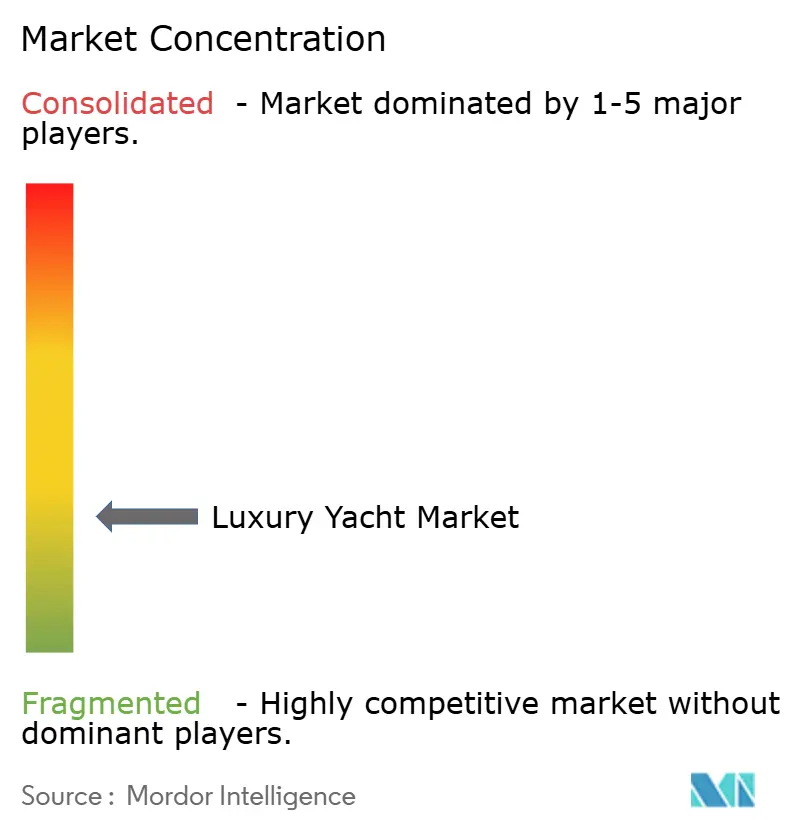
| Market Concentration | Low |
Major Players *Disclaimer: Major Players sorted in no particular order Image © Mordor Intelligence. Reuse requires attribution under CC BY 4.0. | |
Luxury Yacht Market Analysis by Mordor Intelligence
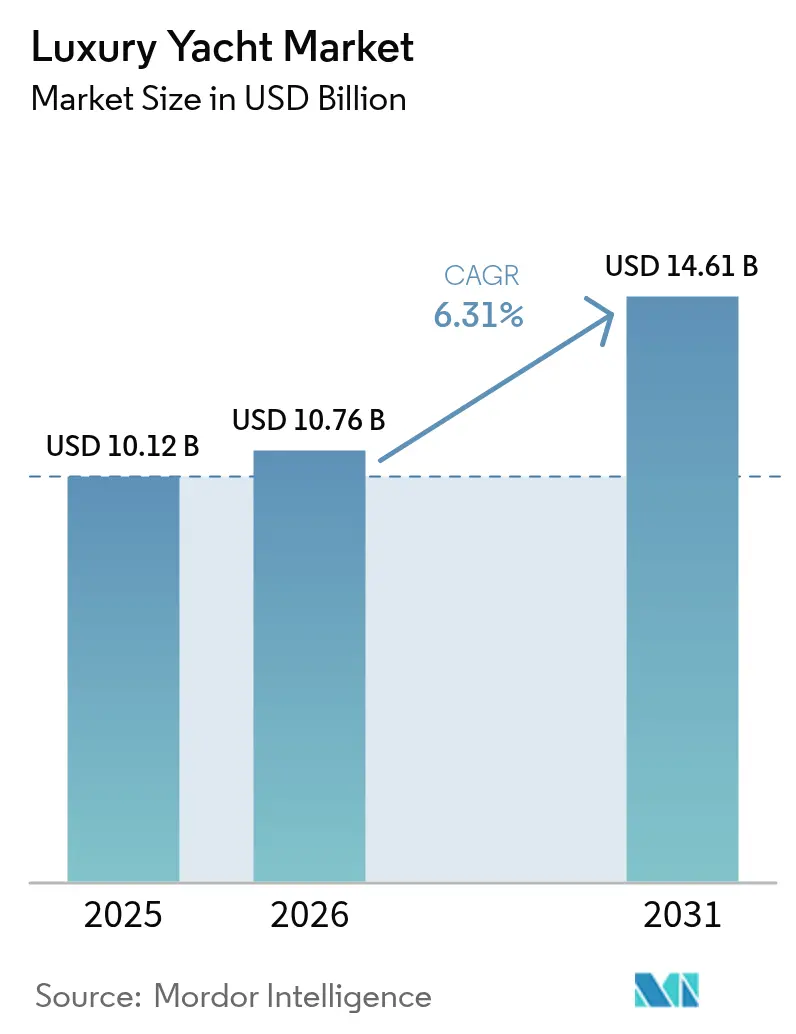
Luxury yacht market size in 2026 is estimated at USD 10.76 billion, growing from 2025 value of USD 10.12 billion with 2031 projections showing USD 14.61 billion, growing at 6.31% CAGR over 2026-2031. Current momentum stems from the rise in ultra-high-net-worth individuals (UHNWIs), rapid propulsion innovation, and a cultural shift toward experiential assets. Hybrid and electric systems gain traction as builders seek compliance with future IMO greenhouse-gas rules, while expedition-style yachts broaden cruising grounds beyond the Mediterranean. Consolidation among builders and marina operators intensifies, with private-equity funds targeting infrastructure that secures berth availability. Meanwhile, tariffs on European, Chinese, and Taiwanese vessels create a near-term pricing advantage for U.S. yards and could prompt regional reshoring in the luxury yacht market.
Key Report Takeaways
- By type, motor yachts held 66.68% of the luxury yacht market share in 2025, whereas hybrid-electric yachts are projected to post a 10.09% CAGR through 2031.
- By size, vessels measuring 20 to 40 m accounted for 43.62% of the luxury yacht market size in 2025, while yachts above 80 m are forecast to expand at 11.74% CAGR to 2031.
- By hull material, fiberglass/composite commanded a 55.68% share of the luxury yacht market in 2025; carbon-fiber hulls are set to grow at a 12.98% CAGR through 2031.
- By propulsion system, diesel retained an 82.62% share of the luxury yacht market in 2025, yet diesel-electric/hybrid systems will accelerate at a 9.12% CAGR through 2031.
- By end user, private individuals held a 60.74% share of the luxury yacht market in 2025, whereas fractional-ownership clubs are on track for an 11.08% CAGR to 2031.
- By geography, Europe led with a 42.62% share in 2025, while Asia-Pacific is expected to record the fastest 11.24% CAGR through 2031.
Note: Market size and forecast figures in this report are generated using Mordor Intelligence’s proprietary estimation framework, updated with the latest available data and insights as of 2026.
Market Trends and Insights
Drivers Impact Analysis of Luxury Yacht Market*
| Driver | (~) % Impact on CAGR Forecast | Geographic Relevance | Impact Timeline |
|---|---|---|---|
| Surge in Yacht-Tourism Boom | +1.2% | Global, with concentration in Mediterranean, Caribbean, Asia-Pacific | Medium term (2-4 years) |
| Rising UHNWIs in Emerging Markets | +1.8% | Asia-Pacific core, spill-over to Middle East and South America | Long term (≥ 4 years) |
| Growing Demand for Expedition/Explorer Yachts | +0.9% | Global, with early gains in Northern Europe, North America | Medium term (2-4 years) |
| Shift Toward Hybrid and Electric Propulsion | +0.7% | Europe and North America, expanding to Asia-Pacific | Long term (≥ 4 years) |
| Private-Island and Remote-Marina Build-Out | +0.6% | Caribbean, Pacific Islands, Mediterranean | Medium term (2-4 years) |
| Rise of Fractional-Ownership Platforms | +0.8% | North America and Europe, expanding globally | Short term (≤ 2 years) |
| Source: Mordor Intelligence | |||
Surge in Yacht-Tourism Boom
Yacht tourism will demonstrate healthy growth, accounting for 26% of the marine economy by 2030. Yacht tourists spend approximately USD 287 daily, nearly double conventional tourists, significantly impacting local economies. The sector benefits from post-pandemic travel preferences favoring private, controlled environments, with overcrowded destinations. Charter companies increasingly invest in larger, more luxurious vessels to capture this premium spending, with yacht sailing programs emerging as the most valued attribute among tourists. Safety training and accessible locations within one hour of transport represent optimal combinations that tourists prefer, driving infrastructure development in emerging cruising destinations.
Rising UHNWIs in Emerging Markets
The ultra-wealthy population is projected to grow considerably by 2028, reaching over 587,000 individuals with a net worth exceeding USD 30 million. Emerging markets drive disproportionate growth, with Vietnam forecasting 95% centi-millionaire growth, India 80%, and Mauritius 75%. These new wealth centers prioritize experiential luxury over traditional assets, with yachts representing passion investments that combine status, privacy, and lifestyle benefits. The shift toward sustainable investments among 20% of UHNW investors creates demand for hybrid and electric propulsion systems. Younger generations increasingly drive wealth mobility and investment decisions, favoring technologically advanced vessels with environmental credentials.
Growing Demand for Expedition/Explorer Yachts
Expedition yachts address evolving owner preferences for remote cruising and adventure experiences beyond traditional Mediterranean and Caribbean circuits. 58 new explorer yachts launched in 2025, including notable vessels like REV Ocean (194.9m) equipped for scientific research and Shackleton (107m) featuring ice-classed hulls for polar cruising[1]. These vessels incorporate hybrid propulsion systems and self-sufficiency features for extended autonomous cruising. The segment benefits owners seeking unique experiences in sensitive marine environments, driving demand for environmentally compatible designs. Damen Yachting's Xplorer 60 represents the first in their luxury expedition range, capable of autonomous cruising and designed for high-latitude regions.
Shift Toward Hybrid and Electric Propulsion
Environmental regulations accelerate the adoption of alternative propulsion systems, with the IMO approving new greenhouse gas requirements taking effect from 2028[2]. EU Emissions Trading System expansion and FuelEU Maritime regulations impact vessels over 5,000 gross tons calling at EU ports, requiring emissions reporting and compliance with greenhouse gas intensity limits. Hybrid systems offer operational flexibility, reduced noise and vibration, and improved fuel efficiency during cruising. Rolls-Royce launched integrated hybrid ship propulsion systems suitable for yachts, with power ranges from 1,000 to 4,000 kilowatts. The world's largest sailing yacht, Sailing Yacht A, demonstrates hybrid system application in luxury vessels, showcasing technology maturation.
Restraints Impact Analysis of Luxury Yacht Market*
| Restraint | (~) % Impact on CAGR Forecast | Geographic Relevance | Impact Timeline |
|---|---|---|---|
| High Ownership and Maintenance Costs | -1.4% | Global, particularly acute in North America and Europe | Short term (≤ 2 years) |
| Supply-Chain Bottlenecks for Specialized Components | -0.8% | Global, with concentration in European and North American shipyards | Medium term (2-4 years) |
| Stringent Environmental Emission Regulations | -0.6% | Europe and North America, expanding globally | Long term (≥ 4 years) |
| Shortage of Skilled Crew Inflating Operating Costs | -0.9% | Global, particularly acute in Mediterranean and Caribbean | Medium term (2-4 years) |
| Source: Mordor Intelligence | |||
High Ownership and Maintenance Costs
Rising operational expenses strain yacht ownership economics, with Princess Yachts reporting a GBP 61 million loss in 2022 on revenues of GBP 315 million amid challenging market conditions. The company announced 250 workforce reductions due to rising operational costs and challenging global market conditions. Marina costs escalate as premium facilities command higher rates, with Safe Harbor Marinas' USD 5.65 billion valuation reflecting 21 times the estimated 2024 Funds from Operations. Interest rate increases compound financing costs for yacht purchases, while insurance premiums rise due to increased claims and replacement values. These factors drive owners toward fractional ownership models and charter arrangements to distribute costs across multiple users.
Supply-Chain Bottlenecks for Specialized Components
Post-COVID supply chain disruptions persist in yacht manufacturing, with specialized components experiencing extended lead times and cost inflation. The recreational boating market stabilizes after a 40% pandemic surge, creating inventory challenges and production bottlenecks. European shipyards report that 95% currently use or plan to use composite materials, primarily fiberglass and polyester resin, but face procurement challenges for advanced materials. Trade tensions exacerbate supply issues, with President Trump's universal 10% tariff on yacht imports and higher rates for specific countries creating pricing pressures. Chinese-built yachts face 54% tariffs, while EU brands encounter 20% duties, potentially reshaping global supply chains and forcing buyers toward domestic alternatives.
*Our forecasts treat driver/restraint impacts as directional, not additive. The impact forecasts reflect baseline growth, mix effects, and variable interactions.
Luxury Yacht Market Segment Analysis
By Type:
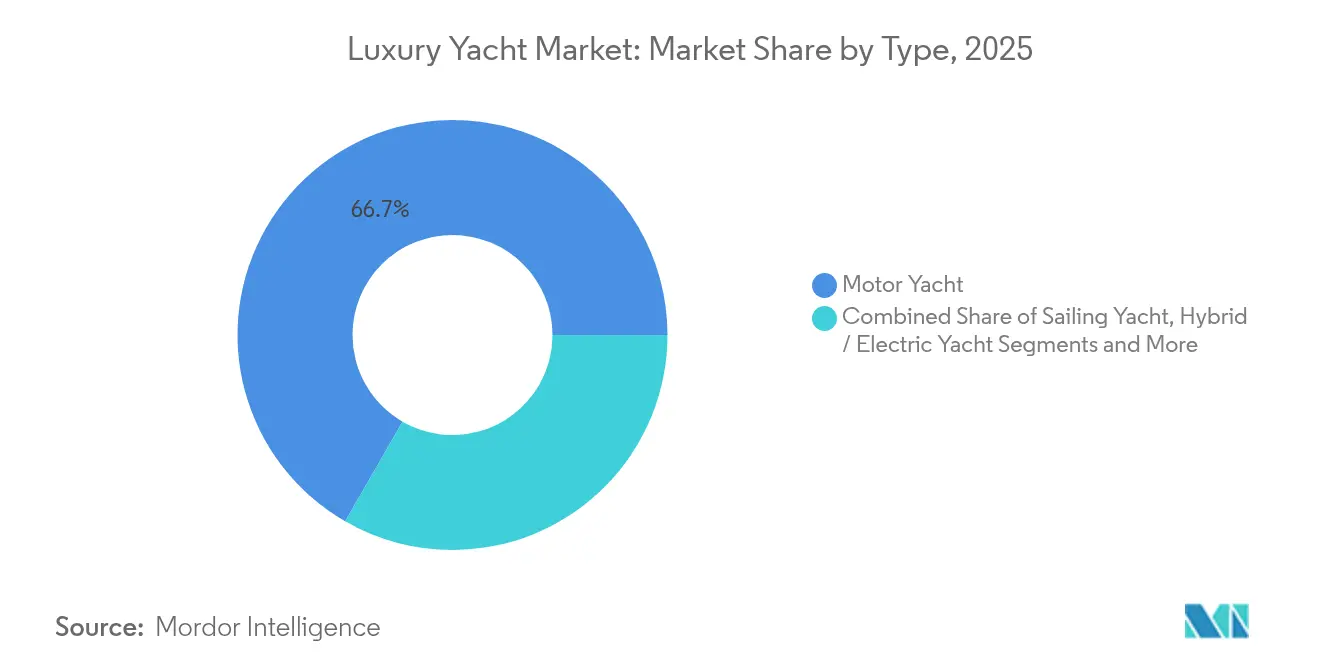
Motor Yachts Dominate Despite Electric SurgeIn 2025, motor yachts dominated the luxury yacht market, securing a commanding 66.68% share, reflecting established consumer preferences for spacious layouts, extended range capabilities, and proven reliability across diverse cruising conditions. Hybrid/electric yachts emerge as the fastest-growing segment at 10.09% CAGR through 2031, driven by environmental regulations and technological advancements. Sailing yachts maintain steady demand among purist owners seeking traditional experiences, while catamaran yachts gain traction for charter operations due to stability and space efficiency. Explorer yachts represent a specialized but rapidly expanding niche, with 58 new vessels launching in 2025 targeting adventure-oriented owners.
The electrification trend accelerates as manufacturers integrate hybrid systems offering reduced noise, improved fuel efficiency, and modular powertrains allowing easy upgrades. Ferretti Group unveiled the Riva El-Iseo, their first full-electric model in the E-Luxury segment, combining traditional design with modern electric technology. Solar energy integration and AI-powered energy management systems optimize power consumption, enhancing the luxury experience while addressing environmental concerns. Motor yacht manufacturers increasingly offer hybrid variants across their model ranges to capture environmentally conscious buyers without sacrificing performance expectations.

By Size:
Superyachts Drive Premium GrowthThe 20 to 40-meter segment emerged as the frontrunner, holding 43.62% of the market share in 2025, striking a balance between space, operational complexity, and marina accessibility, making it the prime choice for private ownership. Vessels above 80 meters achieve the highest growth rate at 11.74% CAGR through 2031, reflecting ultra-wealthy buyers' preference for floating estates with comprehensive amenities. The up to 20-meter segment serves entry-level luxury buyers and charter operations, while 40 to 60-meter yachts cater to established owners seeking enhanced capabilities. The 60-to-80-meter range targets experienced owners transitioning to larger vessels with expanded crew and guest accommodations.
Superyacht construction increasingly incorporates advanced materials and technologies, with carbon composites moving beyond racing applications into luxury vessels for weight reduction and performance optimization. The Scheherazade exemplifies this trend, incorporating carbon composites in masts, rigging, and deck structures. Larger vessels benefit from economies of scale in hybrid propulsion integration, with Rolls-Royce's systems ranging from 1,000 to 4,000 kilowatts suitable for various yacht sizes. The size escalation reflects owners' desire for self-sufficiency during extended cruising, driving demand for vessels with enhanced range, storage, and onboard facilities.
By Hull Material:
Carbon Fiber Gains MomentumIn terms of hull materials, fiberglass and composites led the way, accounting for 55.68% of the market share in 2025, offering proven durability, cost-effectiveness, and established manufacturing processes across global shipyards. Carbon fiber is the fastest-growing segment at 12.98% CAGR through 2031, driven by weight reduction benefits and performance optimization demands. Aluminum maintains relevance for larger vessels requiring structural strength, while steel serves specialized applications, including ice-classed expedition yachts. Other materials encompass innovative solutions, including biocomposites and recycled materials, addressing sustainability concerns.
European shipyards report that nearly 95% currently use or plan to use composite materials, with manufacturing processes evolving toward vacuum infusion and automated techniques. Chomarat's C-PLY noncrimp fabrics demonstrate carbon fiber applications in Arcona Yachts' models 435 and 465, enhancing structural integrity while reducing weight. Technology enables high-speed racing and low-speed cruising capabilities without customization, with the Arcona 435 winning the European Yacht of the Year award in 2019. Carbon fiber construction allows achieving high strength with fewer layers, making it increasingly cost-effective for luxury yacht manufacturing while supporting environmental goals through weight reduction and fuel efficiency improvements.
By Propulsion System:
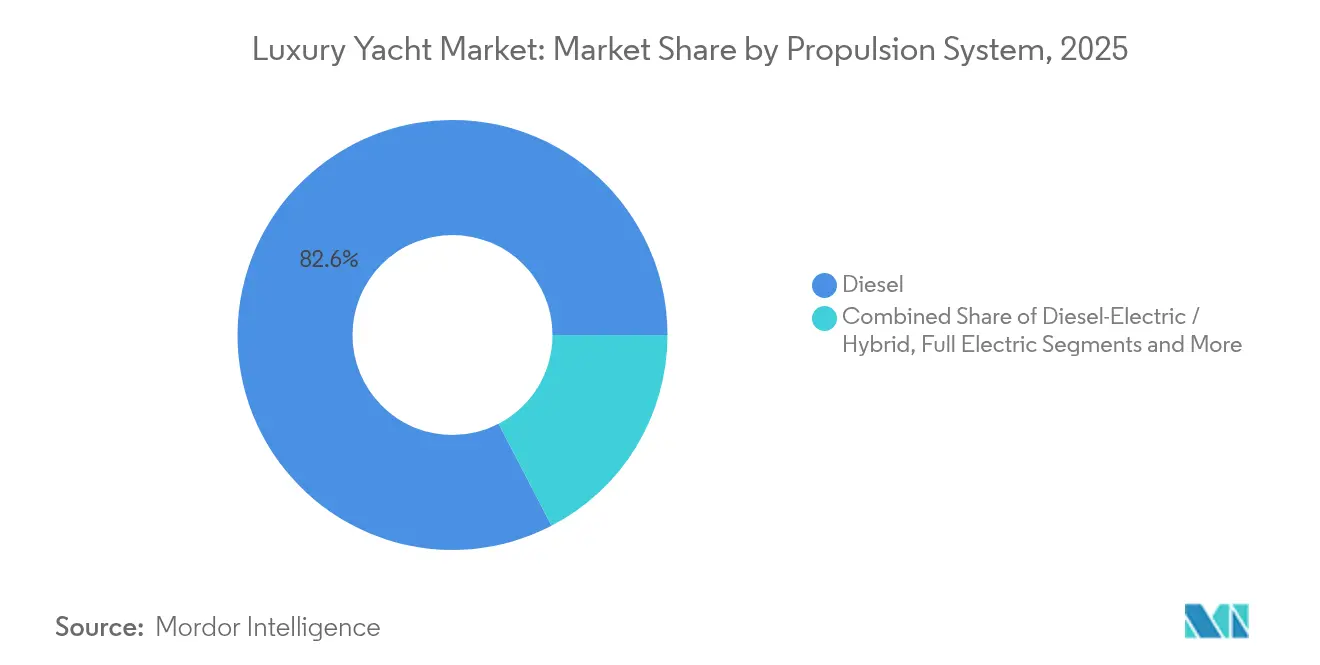
Diesel Dominance Faces Electric ChallengeDiesel propulsion maintains 82.62% of the Luxury Yacht Market's market share in 2025, reflecting established infrastructure, proven reliability, and extensive service networks supporting global cruising operations. Diesel-Electric/Hybrid systems accelerate at 9.12% CAGR through 2031, driven by environmental regulations and technological maturation. Full electric propulsion targets specific applications, including harbor operations and short-range cruising, while hydrogen fuel cells represent emerging technology for zero-emission operations. Diesel-electric hybrid configurations offer transitional solutions combining range capabilities with environmental benefits.
The IMO's new greenhouse gas requirements, taking effect from 2028, accelerate alternative propulsion adoption. EU regulations, including the Emissions Trading System expansion and FuelEU Maritime requirements, impact vessels over 5,000 gross tons, necessitating emissions reporting and compliance with greenhouse gas intensity limits. Hybrid systems provide operational flexibility, enabling silent running for wildlife observation, reduced vibration for guest comfort, and improved fuel efficiency during displacement cruising. Technology integration supports luxury positioning while addressing regulatory compliance, creating competitive advantages for early adopters in environmentally sensitive markets.
By End-User:
Fractional Ownership Disrupts Traditional ModelsPrivate individuals were the primary stakeholders, representing 60.74% of the luxury yacht market in 2025, maintaining dominance through direct ownership of luxury yachts for personal use and family enjoyment. Fractional-ownership clubs emerge as the fastest-growing segment at 11.08% CAGR through 2031, addressing high ownership costs and utilization challenges. Charter companies serve growing yacht tourism demand, while corporate and events usage provide steady revenue streams. Government and naval VIP applications represent specialized requirements for official transportation and representation.
The fractional ownership model addresses cost barriers preventing yacht ownership, with platforms enabling shared access to luxury vessels without full ownership responsibilities. This trend aligns with UHNW investors' shift toward sustainable investments and experiential luxury over traditional asset accumulation. Charter companies increasingly invest in larger, more luxurious vessels to capture premium spending, with yacht tourists paying approximately USD 287 per day compared to USD 150 for conventional tourists. The model evolution reflects changing generational preferences, with younger wealthy individuals favoring access over ownership and prioritizing experiences over possessions.
Geography Analysis
Europe Luxury Yacht Market
Europe commanded 42.62% of the luxury yacht market in 2025 on the strength of enduring shipbuilding clusters in Italy, the Netherlands, and Germany. Italian yards delivered half of all 24 m-plus vessels globally, with Azimut-Benetti aiming for EUR 1.5 billion turnover by 2025 despite soft luxury-goods sentiment. EU climate legislation spurs R&D in hybrid propulsion, allowing builders to market compliance as a competitive edge to carbon-conscious buyers. However, 20% U.S. import tariffs on EU yachts may divert some American orders to domestic brands, potentially trimming Europe’s share over the forecast horizon.
APAC Luxury Yacht Market
Asia-Pacific is the fastest-growing region at an 11.24% CAGR. The 2025 Hong Kong Superyacht Summit drew 250 executives who outlined marina expansions in Hainan, Cebu, and Langkawi. Chinese registrations increase as the easing of coastal cruising permits streamlines itineraries. India’s coastline modernization plan earmarks eleven new marinas, positioning Goa as a charter springboard for the Maldives. Nevertheless, bureaucratic clearance protocols and limited deep-water berths still inhibit full exploitation of regional demand in the luxury yacht market.
North America Luxury Yacht Market
North America remains a mature yet expanding arena. The U.S. marina sector booked USD 6.7 billion in 2023 revenue with occupancy above 90% in many hubs. Blackstone’s record purchase of Safe Harbor Marinas grants the fund 138 properties and underscores the strategic value of berth infrastructure. Universal 10% import tariffs, escalating to 20-54% by source country, buttress domestic builders such as Westport and Christensen. Skill shortages, however, increase crew wages by double-digit percentages, nudging some owners toward less labor-intensive displacement yachts, a trend reverberating across the luxury yacht market.
Mordor Intelligence provides coverage of the luxury yacht market across other key regional markets, including Europe and Asia, each with their regulatory frameworks and demand patterns. Detailed country-level analysis extends to United States incorporating local coverage and market participation, as required.

Regulatory Landscape
The regulatory framework for luxury yachts is tightening around emissions and safety, with several updates in 2025-2026 shaping newbuild specifications and operating permissions. The RMI Yacht Code 2026 entered into force on 1 January 2026, aligning large-yacht compliance more closely with revised IMO instruments. Transport Malta brought its Commercial Yacht Code 2025 (CYC 2025) into effect on 1 July 2025, with CYC 2020-certified yachts moving to CYC 2025 at the first renewal survey after 31 December 2025.
On the environmental and route-access side, the IMO continued advancing its Net-Zero Framework after MEPC 83 (April 2025), and MARPOL Annex VI amendments establishing new requirements for the Norwegian Sea Emission Control Area entered into force on 1 March 2026. For expedition and explorer segments, amendments to the IMO Polar Code and SOLAS Chapter XIV entered into force on 1 January 2026, introducing requirements for pleasure yachts of 300 gross tonnage and above in polar waters, which raises the compliance bar for vessels marketed for high-latitude cruising.
Value Chain Analysis
The luxury yacht value chain follows a project-service model, with lead shipyards acting as prime contractors and program managers that coordinate naval architecture, composite and metal fabrication, propulsion and bridge systems, interiors, and commissioning through specialized subcontractors. Long-lead items, including custom glass, propulsion packages, and high-spec electrical systems, influence build schedules, and 2024-2025 bottlenecks pointed to exposure to skilled-labor constraints in core European hubs as well as procurement pressure for advanced materials such as aluminum and carbon fiber.
Recent moves also show deeper tier collaboration and selective production localization to manage lead times and capability gaps. Rolls-Royce Power Systems expanded its partnership with Overmarine (Mangusta) under a 2026-2029 framework agreement covering supply of 64 mtu Series 2000 engines and integration of NautIQ Bridge systems, reflecting a push toward more integrated bridge-to-propulsion packages. Manufacturing diversification progressed as well, with Tureddi Group signing a strategic agreement with Suprema Marine to produce 60-110 ft GRP yachts in Bahrain, combining Italian design with regional composite manufacturing capacity.
Competitive Landscape
The luxury yacht market exhibits moderate concentration with established European builders maintaining leadership through brand heritage, technological innovation, and manufacturing scale. Industry consolidation accelerates through strategic acquisitions, exemplified by Sanlorenzo's EUR 48.5 million purchase of 60% of Nautor Swan, positioning the combined entity as a leader in sustainable yachting technologies. Blackstone Infrastructure's USD 5.65 billion acquisition of Safe Harbor Marinas demonstrates private equity interest in marine infrastructure, potentially reshaping competitive dynamics through operational improvements and network expansion.
Competition intensifies technological differentiation, with manufacturers investing heavily in hybrid propulsion, advanced materials, and digital integration to capture environmentally conscious buyers. White-space opportunities emerge in fractional ownership platforms, expedition yacht segments, and emerging market penetration where traditional builders lack presence. The Red Ensign Group's revised Yacht Code, effective July 2024, establishes enhanced safety and design standards while supporting innovation, creating competitive advantages for compliant manufacturers.
Technology adoption patterns favor builders integrating AI-powered energy management, modular propulsion systems, and sustainable materials to differentiate offerings. Smaller contenders leverage specialized expertise in expedition yachts and electric propulsion to challenge incumbents, while established players expand through acquisitions to capture emerging segments and geographic markets.
Luxury Yacht Industry Leaders
-
Fincantieri Yachts
-
Feadship
-
Lürssen Werft
-
Azimut-Benetti Group
-
Sanlorenzo
- *Disclaimer: Major Players sorted in no particular order
Luxury Yacht Market Companies Covered in this Report
- Azimut-Benetti Group
- Lürssen Werft
- Feadship
- Ferretti Group
- Sanlorenzo
- Heesen Yachts
- Oceanco
- Fincantieri Yachts
- Nobiskrug
- Sunseeker International
- Royal Huisman
- Damen Yachting
- Palumbo Superyachts
- Gulf Craft
- Princess Yachts
- Sunreef Yachts
- Westport Yachts
- Trinity Yachts
- Baglietto
- Baltic Yachts
Market Opportunities and Future Outlook
Shipyard capacity additions and campus consolidation are creating whitespace in the 45-80 m segment, particularly in build slots that can incorporate alternative-fuel readiness and hybridization without extending delivery timelines. In Europe, Azimut Benetti Group announced a EUR 100 million self-financed 2026-2028 investment program across Tuscan sites (Viareggio, Massa, Livorno) to expand capacity, upgrade infrastructure, and add renewable energy facilities. Tankoa Yachts integrated its Civitavecchia hull construction site with its historic Genoa shipyard, stating this setup enables annual delivery capacity of 3 to 4 yachts between 45 and 80 meters. In Turkey, RMK Marine began construction of a dedicated 70,000 sqm luxury yacht campus in Yalova, signaling additional throughput for large projects beyond traditional Western European clusters.
Refit, maintenance, and lifecycle upgrades are a second opportunity track, supported by association-level quantification of the broader superyacht economy and the service tail around the installed fleet. A May 2026 study by SYBAss and The Superyacht Life Foundation estimated EUR 54 billion of total economic output in 2022 for the global superyacht industry, including EUR 5.6 billion attributed to refit and maintenance, which reinforces the commercial weight of aftersales capabilities (technical upgrades, energy-management retrofits, interior refits) alongside newbuild activity. Facility expansion programs also point to continued capacity build-out, including Sunreef Yachts commencing a EUR 30 million industrial expansion across Gdansk (Poland) and Ras Al Khaimah (UAE), with completion targeted by summer 2026.
Recent Industry Developments in Luxury Yacht Market
- July 2026: Fincantieri announced a contract to build a third ultra-luxury hospitality vessel for Marc-Henry Cruise Holdings LTD, with delivery scheduled for 2031 at its Ancona shipyard. The order extends a long-horizon newbuild pipeline and reinforces the overlap between large-yacht capabilities and ultra-luxury hospitality-led vessel programs.
- June 2026: Lurssen announced the delivery of the 102.4-metre yacht NIXIE (formerly Project JASSJ), adding to its 2026 delivery cadence. The handover highlights continued throughput at the very-large-yacht end of the market, supporting demand for specialized systems integration and high-end subcontractor capacity.
- April 2025: The IMO approved its Net-Zero Framework at MEPC 83, targeting a global fuel standard and GHG emissions pricing for large ships as part of a wider decarbonization package. Even where thresholds and implementation mechanics differ by yacht size and profile, the decision has accelerated builder and supplier focus on hybridization, alternative-fuel readiness, and emissions reporting practices that align with IMO instruments.
Luxury Yacht Market Report Scope and Research Methodology
Market Definition and Coverage
For this methodology, the luxury yacht market is the value of new luxury yachts sold and delivered globally, covering motor and sailing designs across common length bands and use cases, and counted at manufacturer-level pricing in USD.
Scope exclusions: Used yacht resale transactions, refit and repair services, marina berthing fees, crew management services, and insurance and finance revenues are excluded from the market value.
Segments Covered in This Report
- By Type
- Motor Yacht
- Sailing Yacht
- Hybrid / Electric Yacht
- Catamaran Yacht
- Explorer / Others
- By Size
- Up to 20 m
- 20 to 40 m
- 40 to 60 m
- 60 to 80 m
- Above 80 m
- By Hull Material
- Fiberglass / Composite
- Aluminum
- Steel
- Carbon Fiber
- Others
- By Propulsion System
- Diesel
- Diesel-Electric / Hybrid
- Full Electric
- Hydrogen Fuel Cell (Emerging)
- By End-User
- Private Individuals
- Charter Companies
- Corporate and Events
- Fractional-Ownership Clubs
- Government and Naval (VIP)
- By Geography
- North America
- United States
- Canada
- Rest of North America
- South America
- Brazil
- Argentina
- Chile
- Rest of South America
- Europe
- Italy
- Germany
- United Kingdom
- France
- Netherlands
- Spain
- Rest of Europe
- Asia-Pacific
- China
- Japan
- South Korea
- Australia
- India
- Rest of Asia-Pacific
- Middle East and Africa
- Saudi Arabia
- United Arab Emirates
- Egypt
- South Africa
- Rest of Middle East and Africa
- North America
Data Sources, Market Sizing, and Validation
Desk Research
Desk research was used to build the base structure of the market model and to anchor assumptions that can be checked independently. We relied on public and official sources such as UN Comtrade for trade flows, OECD and World Bank indicators for macro context, the International Monetary Fund for currency and inflation series, and customs and maritime authority publications for country-level boating and port activity signals.
On the industry side, we reviewed company annual reports and investor decks, major shipyard announcements, national yachting and marine associations, and reputed marine media for order pipeline and delivery commentary. Select paid subscriptions were used for company financials and news screening, and also for patent tracking related to propulsion and hull materials. This helped us sanity check innovation cycles and pricing changes alongside the delivery and order inputs. The desk sources listed here are illustrative, and many other public documents and datasets were also referred to for data collection, validation, and clarification.
Primary Interviews and Surveys
Primary work focused on filling data gaps that desk research cannot answer cleanly, especially around average selling prices by length band, build lead times, and the share of yachts going into private ownership versus charter fleets. We spoke with a mix of shipyard and supplier executives, dealers and brokers, charter operators, and marina-facing stakeholders across major demand hubs in the Americas, EMEA, and APAC, so the assumptions could be cross-checked and adjusted against how transactions are actually structured.
Distribution of primary research fieldwork respondents
| Company type | Respondent position | Region |
|---|---|---|
| Top tier: 34% | CXOs: 12% | APAC: 44% |
| Mid tier: 52% | Functional/Unit leaders: 28% | EMEA: 34% |
| Smaller Players: 14% | Managers: 60% | Americas: 22% |
Market-Sizing & Forecasting
Sizing was built using a top-down and bottom-up logic. The main total was reconstructed from yacht delivery volumes by length class and typical ASP bands, then mapped to regions and end use. To keep the model tied to real market motion, inputs were guided by indicators such as new build order backlogs and cancellation signals, delivery lead times and capacity utilization at key yards, mix shifts toward larger lengths, propulsion preferences (diesel, hybrid, and other options), and currency timing for euro- and dollar-denominated contracts.
Selective bottom-up checks were then used to corroborate totals, including supplier and component demand proxies, sampled build cost to selling price ranges discussed in interviews, and channel checks with charter operators on fleet additions. Where smaller geographies or niche hull material splits lacked consistent public datapoints, we used ratio-based allocations constrained by interview-validated ranges, then rebalanced to match the global total.
Forecasts were developed using scenario analysis supported by a simple multivariate regression overlay. Variables like high net worth wealth trends, tourism and charter demand signals, financing conditions, and yard capacity expansion plans were used to shape the growth path. Assumptions were kept transparent so a user can trace how each variable moves the final numbers.
Data Validation & Update Cycle
Validation was done through multiple checks so the totals do not rely on any single dataset. We compared model outputs against independent signals like reported delivery counts, trade flow directionality for major yacht building countries, and observed pricing movement for comparable length categories, followed by a variance review at region and application level.
Anomalies were flagged when year-over-year changes did not match known order book conditions or when implied ASPs moved outside interview-confirmed ranges. In those cases, the underlying drivers were revisited. A second analyst review is completed before sign-off, and experts are re-contacted when new policies, major yard expansions, or demand shocks occur. Reports are refreshed annually, with interim updates for material events, and a final pre-delivery pass is completed so clients receive the latest updated view.
Mordor Intelligence's Luxury Yacht Market Size Versus Other Published Estimates
It is common to see different published market sizes for luxury yachts, even when the same years are referenced, because scope and counting approach can change across studies. The biggest drivers are usually whether the estimate is limited to new-build yacht sales, how charter-related activity is treated, and how prices are converted across currencies and contract timings.
The main gap comes from whether refit, maintenance, and used yacht brokerage value is blended into the total, where Mordor Intelligence counts only new yacht sales value tied to deliveries by length class and then cross-checks the implied ASP progression with interview ranges before forecasts are extended.
Benchmark comparison
| Source | Market Size | Gaps in Research Methodology |
|---|---|---|
| Mordor Intelligence | USD 10.76 B (2026) | |
| Industry Publisher A | USD 11.48 B (2025) | Uses a different base year and can mix demand timing by using order intake or broader yachting activity, which can pull value forward versus a deliveries-based build. |
| Trade Media B | USD 10.12 B (2025) | Often reflects a narrower definition focused on large yacht transactions and may apply simpler ASP assumptions without checking length-class mix shifts and currency timing by contract. |
The spread in the table is mainly explained by what gets counted as market value and how timing is handled, especially around deliveries versus orders and whether adjacent services are added. Our approach stays traceable because volumes, ASPs, and mix are built up in steps that can be checked against public signals and then stress-tested through expert feedback before the final totals are published.
Key Questions Answered in the Report
What is the current size of the luxury yacht market?
The luxury yacht market stands at USD 10.76 billion in 2026 and is forecast to reach USD 14.61 billion by 2031.
Which yacht type is most popular?
Motor yachts dominate with 66.68% market share in 2025, but hybrid-electric motor yachts are the fastest-growing sub-segment.
Which region will grow the fastest through 2031?
Asia-Pacific is expected to expand at an 11.24% CAGR, driven by rising UHNWIs and new marina infrastructure.
How are environmental regulations influencing yacht design?
IMO and EU greenhouse-gas rules, effective from 2028, will propel the adoption of hybrid and electric propulsion and stimulate R&D in lightweight materials.
Which region has the biggest share in Luxury Yacht Market?
Europe hold the largest market share of 42.62% in the Luxury Yacht market in 2025