
Rear Spoiler Market Size and Share
Market Overview
| Study Period | 2019 - 2031 |
|---|---|
| Market Size (2026) | USD 3.87 Billion |
| Market Size (2031) | USD 5.36 Billion |
| Growth Rate (2026 - 2031) | 6.76 % |
| Fastest Growing Market | Asia-Pacific |
| Largest Market | Asia-Pacific |
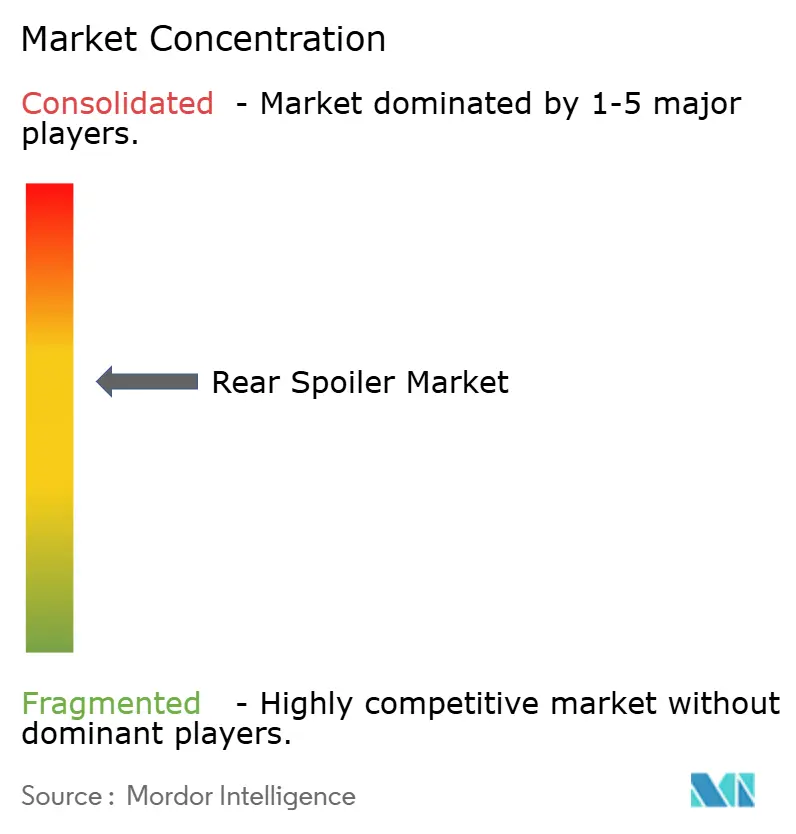
| Market Concentration | Medium |
Major Players *Disclaimer: Major Players sorted in no particular order Image © Mordor Intelligence. Reuse requires attribution under CC BY 4.0. | |
Rear Spoiler Market Analysis by Mordor Intelligence
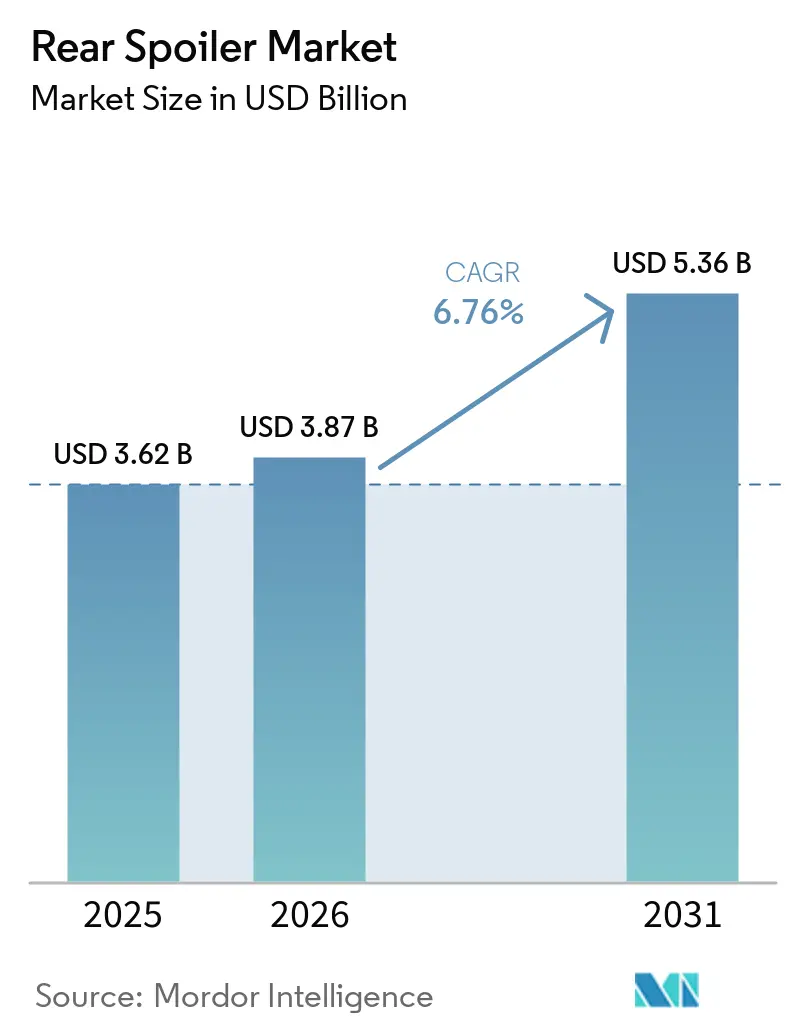
The rear spoiler market was valued at USD 3.62 billion in 2025 and is projected to grow from USD 3.87 billion in 2026 to USD 5.36 billion by 2031, at a CAGR of 6.76% during the forecast period (2026–2031). Heightened regulatory scrutiny of vehicle aerodynamics, the rapid electrification of global fleets, and the growing popularity of sporty design cues across mainstream models are steering demand higher. Automakers are treating spoilers as functional range-extending devices instead of cosmetic add-ons. Tier-1 suppliers are blending lightweight composites with mechatronic actuation to create active systems that integrate seamlessly with advanced driver-assistance features. Parallel cost pressure on resins and carbon fiber is prompting dual-material strategies that balance affordability and premium differentiation. Altogether, these forces keep the rear spoiler market on a healthy growth trajectory despite raw-material volatility and emerging microplastic regulations.
Key Report Takeaways
- By material type, ABS (Acrylonitrile Butadiene Styrene) captured 44.13% of the rear spoiler market share in 2025, while carbon fiber is forecast to expand at a 10.66% CAGR to 2031.
- By system type, passive units led with 63.26% of the rear spoiler market share in 2025; active spoilers are advancing at a 12.45% CAGR through 2031.
- By vehicle type, hatchbacks accounted for 39.13% of the rear spoiler market in 2025, whereas SUVs posted the fastest CAGR of 11.78% over 2026-2031.
- By propulsion, internal combustion engine vehicles held 72.05% of the rear spoiler market share in 2025, while battery-electric vehicles are projected to grow at a 13.92% CAGR through 2031.
- By distribution channel, OEM installations dominated, with 69.12% of the rear spoiler market share in 2025, while aftermarket revenues are climbing at a 9.41% CAGR through 2031.
- By geography, Asia-Pacific accounted for 47.32% of the rear spoiler market share in 2025 and is projected to grow at a 9.95% CAGR through 2031.
Note: Market size and forecast figures in this report are generated using Mordor Intelligence’s proprietary estimation framework, updated with the latest available data and insights as of January 2026.
Global Rear Spoiler Market Trends and Insights
Drivers Impact Analysis*
| Driver | (~) % Impact on CAGR Forecast | Geographic Relevance | Impact Timeline |
|---|---|---|---|
| EV Sales to Maximize Range | +2.0% | China, the EU, and North America | Medium term (2-4 years) |
| CO₂ and Fuel-Efficiency Rules | +1.8% | EU, India, China, Global | Medium term (2-4 years) |
| SUV and Hatchback Production | +1.5% | Asia-Pacific core, spill-over to North America and Europe | Long term (≥ 4 years) |
| ADAS and Thermal-management | +1.2% | North America, EU, Japan premium segments | Long term (≥ 4 years) |
| Sporty Aesthetics and Personalization | +0.9% | North America, Europe, Japan, emerging India, and Brazil | Short term (≤ 2 years) |
| Additive-manufactured and Spoiler Customization | +0.4% | North America, Europe, niche segments | Short term (≤ 2 years) |
| Source: Mordor Intelligence | |||
Rising EV Sales to Maximize Range Via Drag-reduction
Battery-electric adoption is skyrocketing, and rear spoilers are an easy lever for gaining a few extra kilometers of range. Studies on popular BEVs document drag reductions above 10% once the rear wake is properly managed, translating into measurable efficiency improvements. Because adding battery capacity is expensive, the aerodynamic return on investment keeps the rear spoiler market top of mind for EV program planners across China, Europe, and the United States.
Stricter CO₂ and Fuel-Efficiency Rules Are Driving Aerodynamic Lightweighting
Tighter global efficiency targets are elevating spoilers from stylistic accessories to mission-critical aero devices. India’s draft CAFE Stage 3 norms for 2027-28 force OEMs to claw back every fractional drag advantage, and validated CFD work shows that optimized rear surfaces can significantly trim coefficients [1]“CFD Study on Spoiler Drag Reduction,” International Institute for Energy Technology and Applications, iieta.org. Active designs that rotate from 0° cruise to 45° braking angles unlock dual-mode benefits without full-time penalty, pushing the rear spoiler market deeper into mechatronics and lightweight composites. Suppliers able to meet durability, actuation, and emissions requirements simultaneously secure higher content value per vehicle.
Global SUV and Hatchback Production Growth
Worldwide, new light-vehicle sales reached 16.2 million units in 2025; SUVs and hatchbacks together account for the lion’s share, and each typically carries at least one factory-fitted spoiler. In North America, light trucks dominated sales in 2025. Meanwhile, in India, a festive surge in 2025 boosted the demand for hatchbacks. As sales volumes rise, OEMs are standardizing spoilers to meet regulatory targets and achieve styling differentiation. This trend is driving consistent growth in the rear spoiler market.
Active Aero-integration with ADAS and Thermal-management
Modern spoilers do more than push air downward. Systems patented by major automakers vary the angle of attack to correct understeer, complement brake cooling, or even harvest exhaust heat via integrated thermoelectric generators [2]“Thermoelectric Generator-Integrated Spoiler,” SAE International, sae.org. As sensor integration increases, rear spoilers are evolving into multifunctional modules that manage drag, downforce, and heat flow in real time, driving demand for smart composite designs. This shift reflects a broader industry move toward components that actively respond to driving conditions rather than serving a single static purpose.
Restraints Impact Analysis*
| Restraint | (~) % Impact on CAGR Forecast | Geographic Relevance | Impact Timeline |
|---|---|---|---|
| Cost of Carbon-fiber and Composites | −1.0% | North America, EU premium segments | Medium term (2-4 years) |
| Supply-chain Volatility | −0.8% | Global, acute in import-dependent regions | Medium term (2-4 years) |
| Radar-sensor Interference | −0.6% | North America, the EU, and Japan | Short term (≤ 2 years) |
| Microplastic-Shedding Regulations | −0.5% | EU initially, possible global spread | Long term (≥ 4 years) |
| Source: Mordor Intelligence | |||
High Cost of Carbon-fiber and Advanced Composites
In January 2026, Toray announced price increases for aerospace-grade fibers, highlighting persistent inflationary pressures. This trend has limited the adoption of carbon components in mainstream trims. Although large-tow alternatives and recycled content provide some cost relief, carbon fiber remains significantly more expensive than ABS. Consequently, carbon fiber penetration remains low by volume, constraining growth opportunities in the rear spoiler market unless more affordable fiber alternatives emerge.
Supply-chain Volatility for Specialty Resins and Polymers
In 2025-2026, producers faced fluctuating ABS and nylon prices as they worked to recover margins. North American ABS prices varied, while import alternatives, though less expensive, carried tariff risks. These price fluctuations created budgeting challenges, particularly for spoiler programs with strict cost targets. Procurement teams found it increasingly difficult to lock in stable contracts, and cost overruns became more common as raw material quotes shifted between the planning and production phases, squeezing already-thin margins across the supply chain.
*Our forecasts treat driver/restraint impacts as directional, not additive. The impact forecasts reflect baseline growth, mix effects, and variable interactions.
Segment Analysis
By Material Type: ABS Dominance Yields To Carbon-Fiber Acceleration
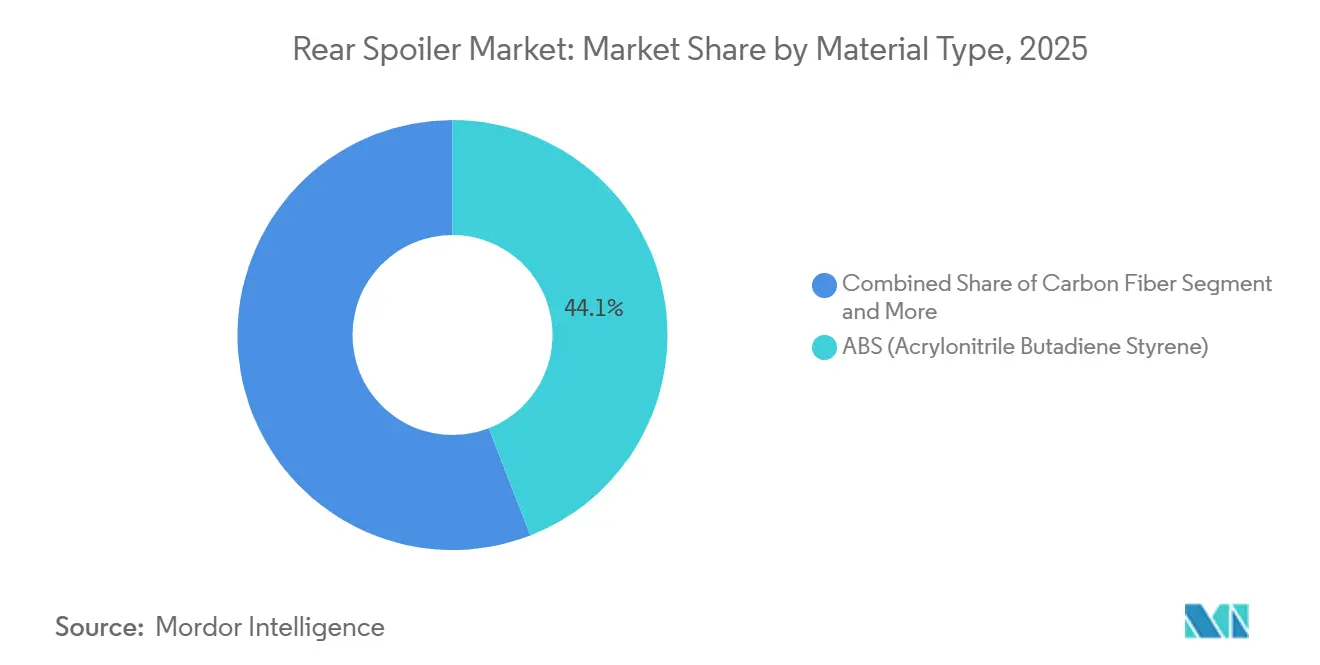
ABS accounted for 44.13% of the rear spoiler market in 2025, supported by its low cost and established injection-molding infrastructure. Carbon fiber is growing at a 10.66% CAGR, driven by demand for weight reduction in electric vehicles, although recent price increases are compressing margins. ABS remains the default choice for mass-market vehicles due to its ease of processing and compatibility with high-volume production lines, making it difficult to displace despite growing interest in alternative materials.
Cost-sensitive vehicle trims use in-mold-coated ABS, a process that eliminates secondary painting and reduces plant emissions by approximately 60%. Premium EVs, by contrast, use high-grade T700 or T800 fibers for structural spoilers, while forged-carbon cosmetic components address personalization demand without significantly increasing costs. These distinct material strategies position both ABS and carbon fiber as relevant materials in the rear spoiler market. As automakers balance performance targets with cost pressures, material selection continues to reflect broader priorities across vehicle segments.



By System Type: Passive Spoilers Retain Volume, Active Systems Capture Value
Passive solutions held a 63.26% of the rear spoiler market in 2025, reflecting the importance of cost efficiency and simplicity in high-volume hatchback production. Manufacturers continue to favor passive designs because they require no electronic control systems, reduce assembly complexity, and significantly lower per-unit costs. This makes them particularly attractive for entry-level and mid-range hatchbacks where price sensitivity is high. Active units are projected to grow at 12.45% annually, integrating electric or SMA actuators that tilt, tuck, or translate in response to speed and yaw data.
Suppliers are promoting thermoelectric generator add-ons and venting channels that harvest exhaust heat or cool batteries, positioning the spoiler as a multifunctional module. These additions allow OEMs to extract greater value from a single component, improving thermal management without adding separate systems. Warranty exposure remains a concern; however, the efficiency benefits continue to secure OEM investment and expand the rear spoiler market's value pool, making it a commercially attractive segment for both established suppliers and new entrants.
By Vehicle Type: SUV Growth Outpaces Hatchback Volume Leadership
Hatchbacks accounted for 39.13% of the rear spoiler market in 2025, while SUVs are growing at a CAGR of 11.78% as crossovers gain popularity in global markets. Roof-mounted units reduce aerodynamic drag behind taller vehicle bodies, while aftermarket wings cater to performance styling preferences. As consumer preferences shift toward larger vehicles, manufacturers are increasingly integrating spoilers as standard features rather than optional add-ons, reflecting the growing importance of both aerodynamic efficiency and visual appeal across vehicle segments.
The shift of production back to the United States following significant tariffs presents local suppliers with an opportunity to secure new SUV spoiler contracts. Sporty coupes and MPVs, though smaller in volume, are driving experimentation with carbon materials and active aerodynamics, innovations that are gradually being adopted in mainstream trims within the rear spoiler market. This cross-segment technology transfer is shortening development cycles, allowing manufacturers to bring performance-derived aerodynamic features to a broader range of vehicles at competitive price points.
By Propulsion: BEV Aerodynamic Optimization Drives Fastest Growth
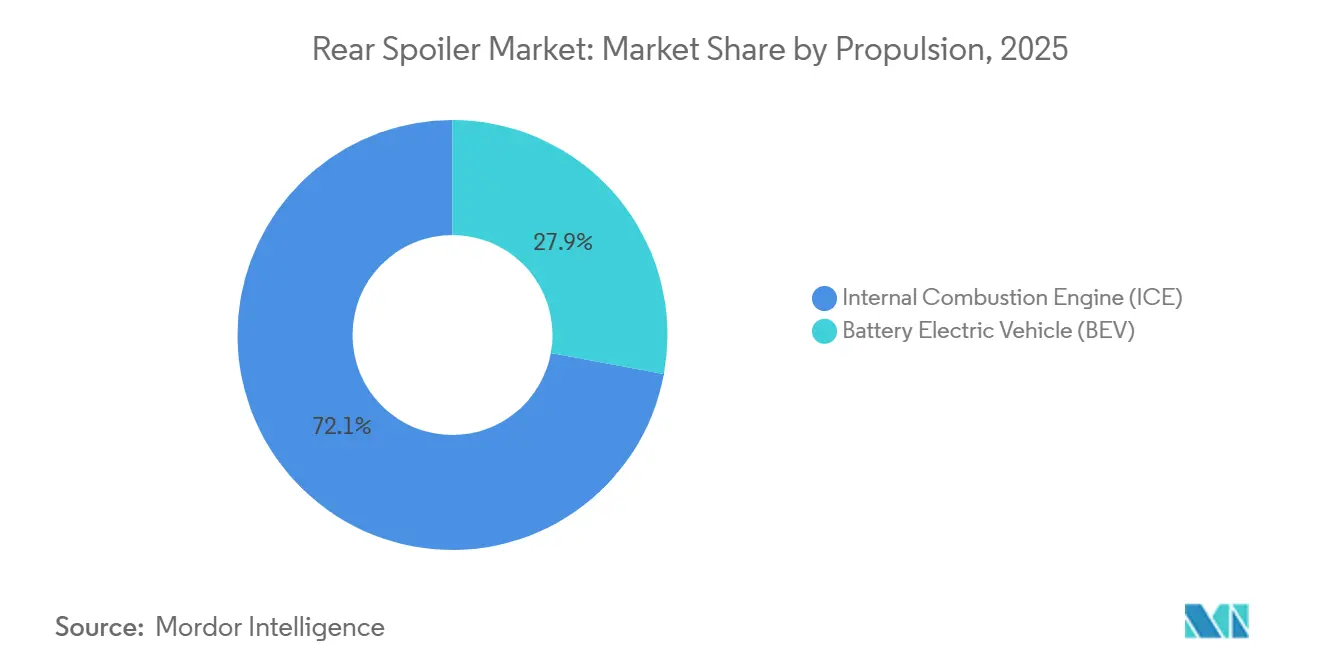
Internal combustion platforms still account for 72.05% of the rear spoiler market in 2025, while BEVs are growing at a 13.92% CAGR, underscoring the importance of energy efficiency. A drag reduction on a popular crossover BEV resulted in improved energy efficiency, demonstrating the spoiler's contribution to vehicle range. As automakers push for longer range without increasing battery size, aerodynamic components like spoilers are becoming a practical tool in vehicle development, particularly for mass-market BEV models where every efficiency gain directly affects consumer appeal.
Chinese OEMs are integrating spoilers into early design stages to achieve sub-0.25 drag coefficients, which is driving growth in the rear spoiler market in Asia. Supplier opportunities are increasingly focused on combination modules, spoilers, diffusers, and lighting, delivered as ready-to-install kits that reduce BEV time-to-market. This approach allows manufacturers to streamline assembly, reduce costs, and meet tightening aerodynamic targets. As competition among Chinese automakers intensifies, the pressure to deliver aerodynamically optimized vehicles at competitive price points is pushing the adoption of integrated spoilers further into mainstream production.
By Distribution Channel: OEM Dominance Coexists With Aftermarket Vitality
OEM fitment accounted for 69.12% of the rear spoiler market in 2025, as automakers increasingly bundle aero kits with trim upgrades. Toyota's GR Line and Subaru's STI packages reflect manufacturers' efforts to retain accessory revenue in-house. As consumer demand for sportier aesthetics grows, automakers are integrating spoilers and diffusers directly into factory trim levels, reducing the need for post-purchase modifications and ensuring design consistency, fitment accuracy, and warranty coverage across their vehicle lineups.
The aftermarket segment is growing at a CAGR of 9.41%, with suppliers offering forged carbon wings priced between USD 849 and USD 2,999, as well as ABS lip kits for budget-conscious consumers. ADAS calibration compatibility and radar-transparent materials are emerging as key differentiators, supporting demand across price tiers in the rear spoiler market. Enthusiasts seeking personalization beyond factory options continue to drive aftermarket sales, prompting suppliers to expand material choices and ensure compatibility with modern driver-assistance systems.
Geography Analysis
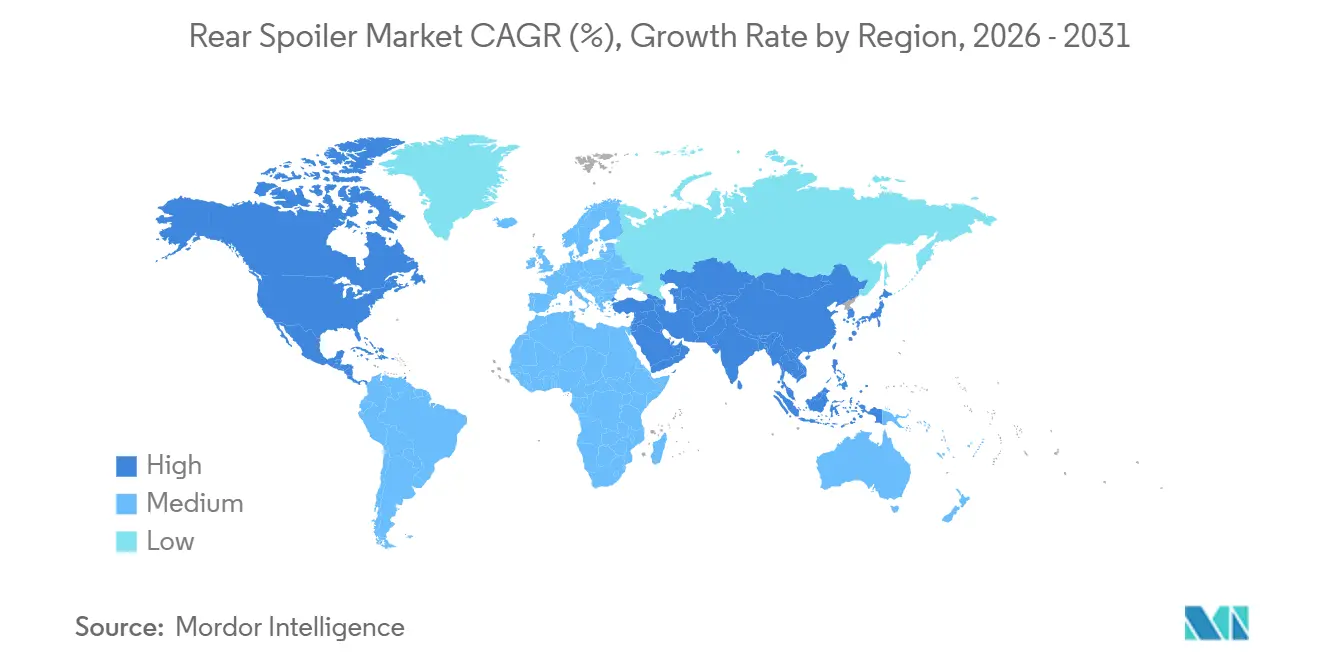
Asia-Pacific accounted for 47.32% of the rear spoiler market in 2025 and is projected to grow at a 9.95% CAGR through 2031. Rising disposable incomes across Southeast Asia are encouraging consumers to invest in vehicle customization, and government-backed EV adoption programs in China and India are steadily increasing the volume of vehicles requiring aerodynamic components, making the region a key growth driver for rear spoiler manufacturers.
In 2025, Europe produced vehicles while setting the regulatory tone. With REACH microplastic rules and upcoming pellet-loss mandates, suppliers are pivoting towards recycled composites [3]“REACH Entry 78 Regulation Text,” European Commission, europa.eu. This shift presents early adopters with a competitive advantage in the rear spoiler market. Premium German manufacturers are launching platforms for active, carbon-intensive aerodynamics that are gradually being adopted downstream. Stricter emissions targets are also pushing automakers to explore lightweight spoiler materials that contribute to overall vehicle efficiency, reinforcing Europe's role as a regulatory and technological reference point for the global market.
North America recorded a stabilization in vehicle output in 2025. However, the dominance of SUVs and light trucks has kept spoiler orders strong. Local demand is supported by tariff-driven reshoring and a growing accessories market. United States suppliers with expertise in ADAS-compatible materials are gaining a competitive advantage in the domestic market. Consumer preference for performance-oriented aesthetics, combined with a well-established aftermarket network, continues to sustain steady demand for rear spoilers across both OEM and replacement channels in the region.

Competitive Landscape
The rear spoiler market is witnessing a series of strategic developments. Magna International's exterior segment demonstrated strong performance in 2025. Following its 2026 sale of lighting and roof systems, Magna is sharpening its focus on integrated aero modules. This shift reflects a broader industry trend in which Tier 1 suppliers are streamlining their portfolios to focus on high-value, technology-driven components that align with evolving OEM requirements and vehicle aerodynamic performance standards.
In 2026, OPMOBILITY's Exterior & Lighting unit recorded robust growth. Its expanded YFPO joint venture is well-positioned to benefit from China's growing BEV market by producing bumpers, spoilers, and signature lighting. Samvardhana Motherson's acquisition of Dr. Schneider has increased its high-grade polymer capacity and added smart-illumination expertise, enabling the packaging of spoilers with embedded LEDs. These moves collectively signal a shift toward multifunctional exterior components that combine structural and lighting functions within a single assembly.
Private specialists are establishing distinct niches within the market. ADRO's growth underscores the scalability of design-focused aftermarket players in the rear-spoiler segment. Mutares is consolidating lighting, roof, and exterior assets to build a broad portfolio that offers OEMs complete aero solutions. As vehicle platforms diversify across electric and hybrid architectures, these specialists are increasingly well-placed to serve OEMs seeking flexible, cost-effective exterior solutions without long-term supply commitments.
Rear Spoiler Industry Leaders
Samvardhana Motherson Automotive Systems Group B.V.
Flex-N-Gate Group
MONTAPLAST GmbH
TOYODA GOSEI Co., Ltd.
OPMOBILITY SE
- *Disclaimer: Major Players sorted in no particular order

Recent Industry Developments
- April 2026: Hyundai Motor introduced the IONIQ 3, a fully electric compact hatchback featuring a new “Aero Hatch” body style designed to optimize aerodynamic efficiency and interior space. The vehicle features a low front end that transitions into a roofline extending over the front and rear occupants before sloping downward to meet the rear spoiler.
- March 2026: Toyota Motor Corporation launched the new RAV4 (PHEV) in Japan. The RAV4 (PHEV) is built on an energy-efficient hybrid platform using a plug-in hybrid system. The vehicle features a front lip spoiler and wing-type rear spoiler.


Global Rear Spoiler Market Report Scope
The Rear Spoiler market is segmented by material type, system type, vehicle type, propulsion, distribution channel, and geography. By Material Type, the market is segmented into ABS (Acrylonitrile Butadiene Styrene), Carbon Fiber, Fiberglass, Sheet Metal, and Others. By System Type, the market is segmented into Active Spoiler and Passive Spoiler. By Vehicle Type, the market is segmented into Hatchbacks, Sport Utility Vehicles (SUVs), Multipurpose Vehicles (MPVs), and Sports Cars. By Propulsion, the market is segmented into Internal Combustion Engine (ICE) and Battery Electric Vehicle (BEV). By Distribution Channel, the market is segmented into Original Equipment Manufacturer (OEM) and Aftermarket. By Geography, the market is segmented into North America (United States, Canada, and Rest of North America), South America (Brazil, Argentina, and Rest of South America), Europe (United Kingdom, Germany, Spain, Italy, France, Russia, and Rest of Europe), Asia-Pacific (India, China, Japan, South Korea, and Rest of Asia-Pacific), and Middle East and Africa (United Arab Emirates, Saudi Arabia, Turkey, Egypt, South Africa, and Rest of Middle East and Africa). The Market Forecasts are Provided in Terms of Value (USD).
| ABS (Acrylonitrile Butadiene Styrene) |
| Carbon Fiber |
| Fiberglass |
| Sheet Metal |
| Others |
| Active Spoiler |
| Passive Spoiler |
| Hatchback |
| Sport Utility Vehicle (SUVs) |
| Multipurpose Vehicle (MPV) |
| Sports Cars |
| Internal Combustion Engine (ICE) |
| Battery Electric Vehicle (BEV) |
| Original Equipment Manufacturer (OEM) |
| Aftermarket |
| North America | United States |
| Canada | |
| Rest of North America | |
| South America | Brazil |
| Argentina | |
| Rest of South America | |
| Europe | United Kingdom |
| Germany | |
| Spain | |
| Italy | |
| France | |
| Russia | |
| Rest of Europe | |
| Asia-Pacific | India |
| China | |
| Japan | |
| South Korea | |
| Rest of Asia-Pacific | |
| Middle East and Africa | United Arab Emirates |
| Saudi Arabia | |
| Turkey | |
| Egypt | |
| South Africa | |
| Rest of Middle East and Africa |
| By Material Type | ABS (Acrylonitrile Butadiene Styrene) | |
| Carbon Fiber | ||
| Fiberglass | ||
| Sheet Metal | ||
| Others | ||
| By System Type | Active Spoiler | |
| Passive Spoiler | ||
| By Vehicle Type | Hatchback | |
| Sport Utility Vehicle (SUVs) | ||
| Multipurpose Vehicle (MPV) | ||
| Sports Cars | ||
| By Propulsion | Internal Combustion Engine (ICE) | |
| Battery Electric Vehicle (BEV) | ||
| By Distribution Channel | Original Equipment Manufacturer (OEM) | |
| Aftermarket | ||
| By Geography | North America | United States |
| Canada | ||
| Rest of North America | ||
| South America | Brazil | |
| Argentina | ||
| Rest of South America | ||
| Europe | United Kingdom | |
| Germany | ||
| Spain | ||
| Italy | ||
| France | ||
| Russia | ||
| Rest of Europe | ||
| Asia-Pacific | India | |
| China | ||
| Japan | ||
| South Korea | ||
| Rest of Asia-Pacific | ||
| Middle East and Africa | United Arab Emirates | |
| Saudi Arabia | ||
| Turkey | ||
| Egypt | ||
| South Africa | ||
| Rest of Middle East and Africa | ||


Key Questions Answered in the Report
How large will the rear spoiler market be by 2031?
The rear spoiler market size is projected to reach USD 5.36 billion by 2031, expanding at a 6.76% CAGR over 2026-2031.
Which material segment is growing the fastest?
Carbon fiber spoilers are expected to post a 10.66% CAGR to 2031 as premium and BEV platforms prioritize weight savings.
Which region leads demand growth?
Asia-Pacific commands nearly half of global revenue and is tracking a 9.95% CAGR through 2031, driven by Chinese and Indian production boosts.
What is the outlook for spoilers on battery-electric vehicles?
BEV applications grow at a 13.92% CAGR as OEMs leverage spoilers to squeeze extra range without adding costly battery capacity.
Page last updated on:


 Your data is secure and never sold or shared.


