
Railway Pantograph Market Size and Share
Market Overview
| Study Period | 2020 - 2032 |
|---|---|
| Market Size (2027) | USD 0.95 Billion |
| Market Size (2032) | USD 1.15 Billion |
| Growth Rate (2027 - 2032) | 4.12 % |
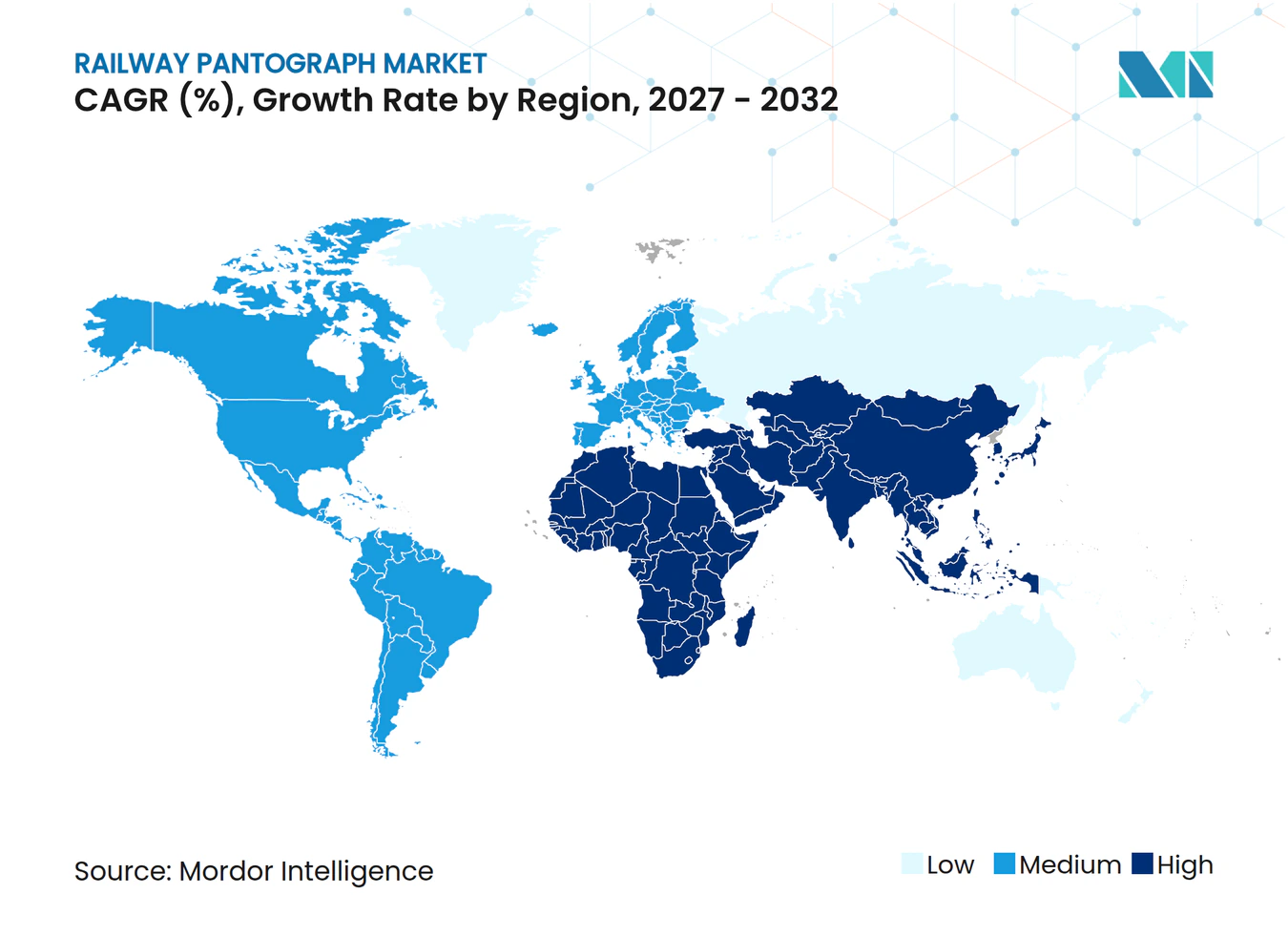
| Fastest Growing Market | Middle East and Africa |
| Largest Market | Asia-Pacific |
| Market Concentration | Medium |
Major Players *Disclaimer: Major Players sorted in no particular order Image © Mordor Intelligence. Reuse requires attribution under CC BY 4.0. | |
Railway Pantograph Market Analysis by Mordor Intelligence
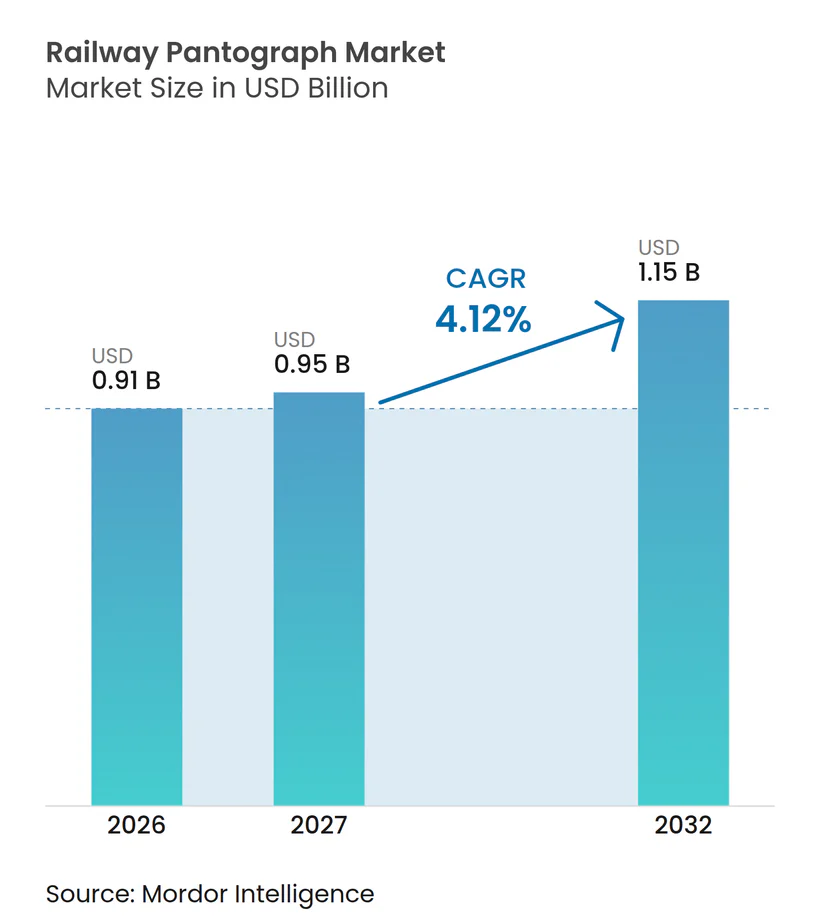
The Railway pantograph market size was valued at USD 0.91 billion in 2026 and is estimated at USD 0.94 billion in 2027, and is projected to reach USD 1.15 billion by 2032, growing at a CAGR of 4.12% from 2027 to 2032. Electrification programs are increasing the installed base of electric rolling stock and creating a long replacement cycle for pantographs and contact strips. India’s broad-gauge network reached 99.2% electrification in December 2025, which provides a large operating base for new equipment and aftermarket work. New train orders in Europe and India are supporting demand for original equipment, while condition monitoring is expanding the value of maintenance services. The railway pantograph market also faces slower adoption, as operators must qualify equipment for different national overhead-line systems. Suppliers with validated multi-system designs, local manufacturing, and monitoring capabilities are better placed to address these requirements.
Key Report Takeaways
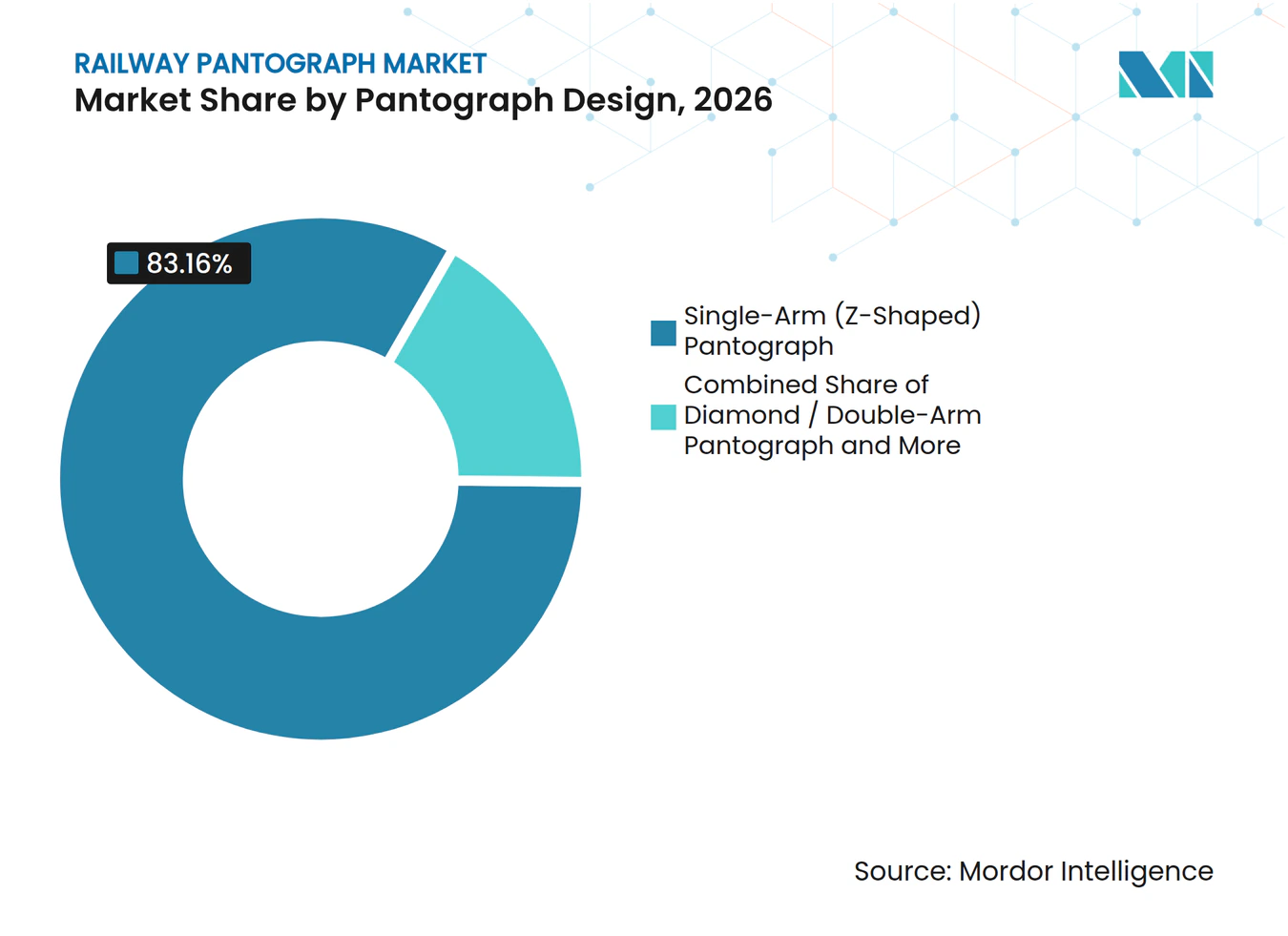
- By pantograph design, single-arm systems held an 83.16% share in 2026, while the same segment is projected to grow at a 4.27% CAGR through 2032.
- By train type, mainline trains held a 28.36% share in 2026, while high-speed trains are projected to grow at a 5.18% CAGR through 2032.
- By operating voltage, AC 25 kV 50/60 Hz held a 32.16% share in 2026, while multi-system pantographs are projected to grow at a 5.27% CAGR through 2032.
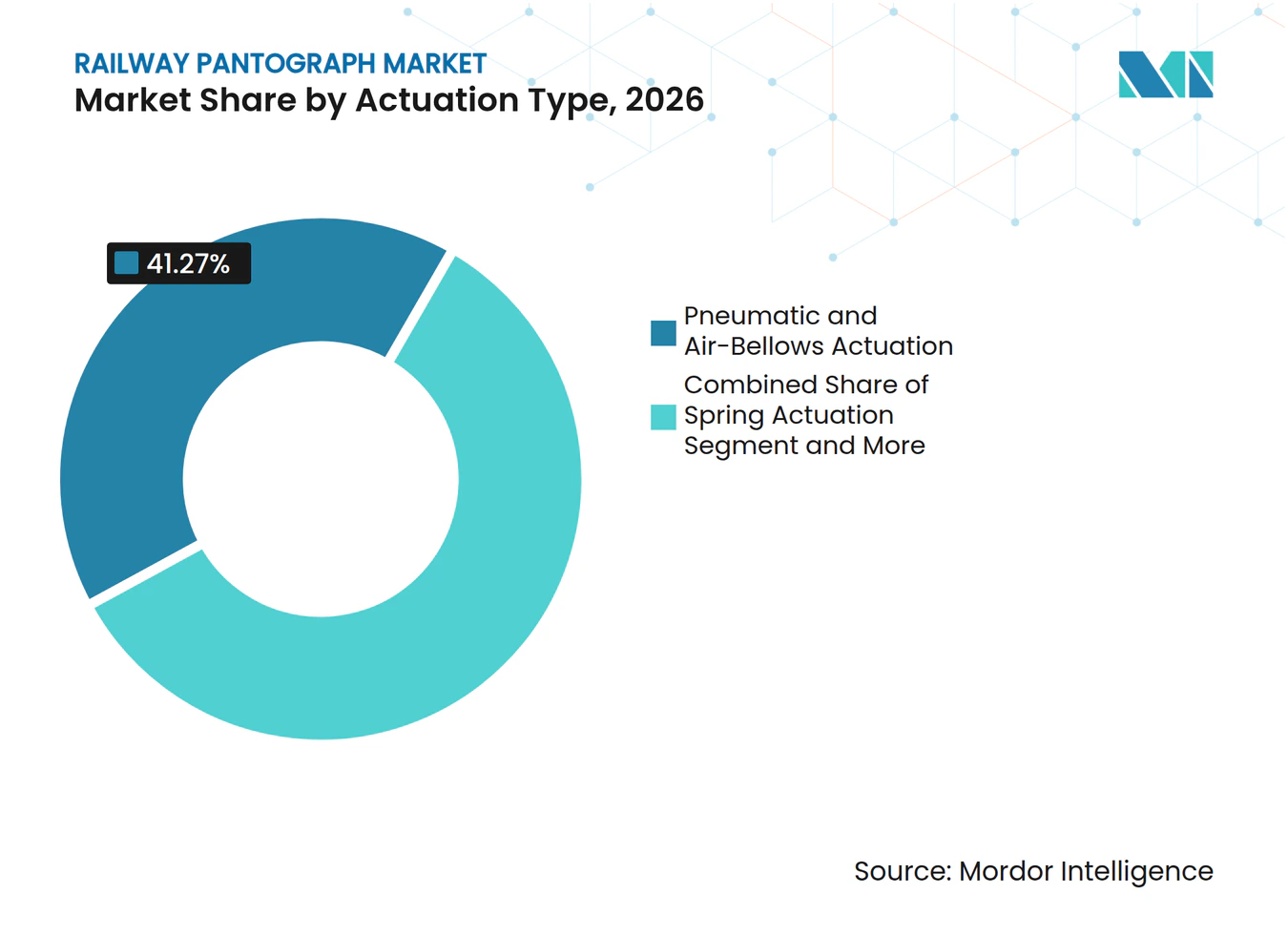
- By actuation type, pneumatic and air-bellows systems held a 41.27% share in 2026, while active-control systems are projected to grow at an 8.63% CAGR through 2032.
- By sales channel, OEM fitment held a 54.18% share in 2026, while retrofit and modernization are projected to grow at a 4.18% CAGR through 2032.
- By component, pantograph heads and contact strips held a 38.16% share in 2026, while actuators, control units, and sensors are projected to grow at a 4.61% CAGR through 2032.
- By geography, Asia-Pacific held a 47.18% share in 2026, while the Middle East and Africa are projected to grow at a 4.82% CAGR through 2032.
Note: Market numbers in this report are based on Mordor Intelligence's proprietary estimation framework, which combines nine months of actuals with Q4 projections for base year 2026.
Market Trends and Insights
Drivers Impact Analysis of Railway Pantograph Market*
| Driver | (~) % Impact on CAGR Forecast | Geographic Relevance | Impact Timeline |
|---|---|---|---|
| National Rail Electrification and Diesel Replacement Programs | +1.1% | Global, with peak intensity in South Asia, Sub-Saharan Africa, and Eastern Europe | Medium term (2-4 years) |
| High-Speed and Urban Rail Fleet Expansion | +0.8% | Asia-Pacific, with spillover to Europe and the Middle East and Africa | Medium term (2-4 years) |
| Railway Fleet Modernization and Pantograph Replacement Cycles | +0.6% | Europe, North America, and mature Asia-Pacific networks | Long term (≥ 4 years) |
| Multi-System Interoperability Requirements Across Voltage Regimes | +0.5% | Europe, Central Asia, and Southeast Asia | Medium term (2-4 years) |
| Rising Adoption of Condition Monitoring and Predictive Maintenance | +0.4% | Europe, North America, and Japan | Short term (≤ 2 years) |
| Demand for Active-Control Pantographs on High-Frequency and Harsh-Climate Routes | +0.4% | Asia-Pacific high-speed rail, Northern Europe, and Gulf states | Long term (≥ 4 years) |
| Source: Mordor Intelligence | |||
National Rail Electrification and Diesel Replacement Programs
The railway pantograph market benefits from electrification programs that replace diesel traction with electric multiple units and electric locomotives. Each newly electrified route generates demand during fleet delivery and requires ongoing inspection, replacement, and overhaul services [1]. Indian Railways has significantly expanded its electrification network and achieved near-complete broad-gauge electrification. Tanzania’s standard-gauge railway program uses AC electrification, while the Tanzania-Burundi extension further expands the equipment base in East Africa, where electrified mainline operations have historically been limited. In the United Kingdom, the Transpennine Route Upgrade continues to support demand through ongoing electrification activities. These projects require equipment that meets established railway standards, favoring suppliers that have completed the necessary qualification processes.
High-Speed and Urban Rail Fleet Expansion
High-speed and urban rail procurements are raising demand for pantographs that perform reliably at higher operating speeds and under intensive service schedules. FlixTrain ordered 65 Talgo 230-platform trains with Siemens Vectron locomotives in May 2025, supporting demand for equipment designed for multiple national systems. Wabtec secured contracts for more than 680 pantographs across six Indian metro, commuter, and intercity programs in March 2026. Those programs include Chennai Metro Phase II, Mumbai Metro Lines 4, 5, and 6, the MEMU program, and Vande Bharat Sleeper [2]. Smaller private rail operators often run mixed fleets and rely more heavily on external maintenance providers. This can increase demand for carbon strip replacements and maintenance parts. Metro growth in the Middle East is also increasing demand for imported current-collection equipment.
Interoperability, Fleet Modernization, and Replacement Cycles
The railway pantograph market benefits from cross-border rail operations, which require rolling stock to operate across different voltage systems and overhead-line geometries. Multi-voltage freight locomotives operating on the Brenner Corridor use multiple pantographs to comply with national requirements along the route. The corridor study recommends a long-term transition to a standardized pantograph head, which could reduce the number of pantograph variants over time.
An international standard defines requirements for validating simulations of pantograph and overhead contact line interaction. The standard supports a more consistent technical validation process; however, operators must continue to use equipment compatible with existing national requirements. Mature fleets also generate recurring replacement demand as contact strips, frames, and air systems age. Suppliers offering qualified components and retrofit kits can sustain revenue beyond the initial train delivery.
Condition Monitoring and Active Control Adoption
Condition monitoring is gaining importance as operators seek to identify faults in pantographs and overhead lines before they disrupt rail services. Camlin Rail’s PanVue system uses trackside stereoscopic cameras to assess pantograph condition without taking trains out of service. Rail operators and infrastructure managers across Europe, North America, and Asia have contracted the system.
Active control offers another approach to addressing wear and unstable contact at high speeds. Research indicates that an active control approach can substantially reduce contact force variation in simulations. These systems are increasing the importance of actuators, sensors, and control units in the railway pantograph industry.
Restraints Impact Analysis of Railway Pantograph Market*
| Restraint | (~) % Impact on CAGR Forecast | Geographic Relevance | Impact Timeline |
|---|---|---|---|
| High Upfront Cost and Long Qualification Cycles | -0.5% | Global, most acute in emerging markets and smaller operators | Long term (≥ 4 years) |
| Pantograph and Catenary Compatibility Constraints | -0.4% | Europe and cross-border Asia-Pacific routes | Medium term (2-4 years) |
| Carbon-Strip Wear Variability and Certified-Material Supply Risk | -0.3% | Europe and North America | Short term (≤ 2 years) |
| Limited Local Test Infrastructure for Dynamic Current-Collection Validation | -0.2% | South America, the Middle East and Africa, South Asia, and Southeast Asia | Long term (≥ 4 years) |
| Source: Mordor Intelligence | |||
High Upfront Cost, Qualification Cycles, and Test Capacity
The railway pantograph market faces a high barrier to entry because systems require extensive testing before they can operate on national rail networks. The supplied draft notes that certification can take 18 to 36 months and cost several million euros for a platform variant. Smaller operators can find it difficult to spread this cost across enough trainsets. Emerging markets may also have limited local facilities for dynamic current-collection validation. This increases reliance on established OEM specifications or overseas testing resources. Longer approval cycles can slow the introduction of lighter composite-frame designs even where these could improve energy use and maintenance. Lifecycle-cost assessments can help operators consider reduced mass, lower wear, and longer component intervals rather than the unit price alone.
Pantograph and Catenary Compatibility Constraints
Pantograph and catenary compatibility remains a constraint because national rail networks use different head geometries and operating conditions. Technical standards establish compatibility criteria between pantographs and overhead contact lines, subject to country-specific restrictions. Variations in contact-wire heights and lateral-deviation limits increase testing requirements. Operators on cross-border routes may require multiple pantograph configurations, increasing locomotive mass and capital costs. Carbon-strip wear also varies by duty cycle, voltage, and contact-wire condition, which complicates maintenance planning. In addition, the availability of certified materials and the need for local testing capabilities can delay market entry into new regions.
*Our forecasts treat driver/restraint impacts as directional, not additive. The impact forecasts reflect baseline growth, mix effects, and variable interactions.
Railway Pantograph Market Segment Analysis
By Pantograph Design:
Single-Arm Systems Lead New-Build DemandSingle-arm systems held 83.16% of the railway pantograph market share in 2026 and are forecast to grow at a 4.27% CAGR through 2032. Their lead reflects the move away from diamond-frame designs in new high-speed, mainline, metro, and light-rail procurements. A single-arm architecture reduces aerodynamic drag and can lower noise at speed. Its lower mass can also improve contact-force stability on faster routes. These operating features are important where higher speed makes pantograph-catenary interaction more demanding. Japan’s Shinkansen fleet uses single-arm designs on modern trainsets, which reinforces their position as the normal choice for high-speed service. The railway pantograph market continues to use this format as the reference design for new rolling stock.
Diamond and double-arm designs remain relevant where heavy freight service requires higher collector force and mechanical robustness. This is particularly relevant on new electrified freight corridors in Sub-Saharan Africa and South America. New units from electrification programs provide one source of growth for single-arm systems. Active-control upgrades on installed single-arm frames provide another source of demand. The supplied draft notes that Siemens and Nikon SLM Solutions demonstrated a 70% reduction in weight and lifecycle cost for certain pantograph components using selective laser melting. That development supports continued interest in lighter designs. Design choice still depends on route speed, climate, available maintenance support, and the characteristics of the overhead line.



By Train Type:
Mainline Fleets Anchor Revenue While High-Speed Service Grows FastestMainline trains held a 28.36% share in 2026, while high-speed trains are forecast to grow at a 5.18% CAGR through 2032. Mainline fleets are the largest revenue base because they operate across a broad installed base and require recurring strip replacement and pantograph overhaul. India, Europe, and the United Kingdom are expanding or renewing mainline services. These programs support both new fitment and long-term maintenance work. High-speed operations require aerodynamic single-arm systems and tighter contact-force control. This produces demand for higher-specification equipment. FlixTrain’s 2025 order and India’s Vande Bharat program illustrate the importance of new intercity fleet activity.
Alstom’s Avelia Horizon platform illustrates the complexity of high-speed cross-border rail services. The platform can operate across several countries via the Channel Tunnel and must be compatible with multiple overhead line configurations. Metro and light rail fleets generate steady replacement demand, as frequent stops and changes in current accelerate carbon strip wear. The Los Angeles Metro awarded Wabtec a contract to overhaul pantographs for its rail vehicles. Freight represents a smaller segment but may expand as heavy-haul routes transition from diesel to electric traction. Tram and light rail demand remains distributed across numerous urban networks. Each train type requires a distinct balance of collector force, weight, durability, and maintenance accessibility.
By Operating Voltage:
AC 25 kV Leads While Multi-System Units ExpandAC 25 kV 50/60 Hz held a 32.16% share in 2026, while multi-system equipment is forecast to grow at a 5.27% CAGR through 2032. AC 25 kV is the target supply system for new high-speed infrastructure under the EU Energy TSI. It also serves India’s electrified broad-gauge network and China’s high-speed rail system. The scale of these networks makes it the leading design reference for pantograph suppliers. Equipment for this voltage requires stable operation at high speed and under changing weather conditions. The railway pantograph market benefits from the common use of this system on new intercity rail lines. It also supports a broad installed base for replacement components.
Multi-system systems grow faster because cross-border train operators need to work across several voltage regimes without changing equipment. Talgo’s Avril platform for Renfe was designed for 1.5 kV DC, 3 kV DC, and 25 kV, 50 Hz AC service. This flexibility allows a trainset to operate on more routes and can reduce repositioning requirements. DC 600-750 V and DC 1.5-3 kV remain important in metro, tram, and legacy mainline applications. These lower-voltage systems use specialized strip materials because of their higher current density. AC 15 kV, 16.7 Hz remains established in Germany, Austria, and Switzerland. Its share is stable but faces a gradual decline as new high-speed infrastructure adopts AC 25 kV.
By Actuation Type:
Pneumatic Systems Remain the Base While Active Control Gains GroundPneumatic and air-bellows systems held 41.27% of the railway pantograph market share in 2026, while active-control systems are forecast to grow at an 8.63% CAGR through 2032. Pneumatic equipment remains common because it has a long operating history, established supply chains, and lower unit costs. Its installed base is particularly large on mainline and freight locomotives. New procurement specifications are gradually moving beyond pneumatic-only operation. Active-control systems use sensors and actuators to adjust contact force in response to operating conditions. This is important at speeds above 300 km/h, where passive systems can struggle to control fluctuations. The railway pantograph industry is therefore placing greater value on electronic controls and validated system behavior.
A 2025 literature review identifies servo-pneumatic actuators, linear electromagnetic actuators, and hardware-in-the-loop testing as major active-control platforms. Active catenary control is also under development as a possible complement to pantograph-side control. Electro-pneumatic designs occupy a middle position between basic pneumatic equipment and closed-loop active control. Spring systems remain relevant for trams and light rail where lower capital cost is important. Wabtec is developing an all-electric pantograph concept that would remove compressed-air infrastructure from the rolling stock. This could change the mix of actuation technologies if it is validated for widespread service. The pace of adoption will depend on route speed, maintenance capability, and certification outcomes.

By Sales Channel:
OEM Fitment Holds the Lead and Retrofit Work BuildsOEM fitment held 54.18% share in 2026, while retrofit and modernization are forecast to grow at a 4.18% CAGR through 2032. OEM installations lead because pantographs are integrated with roof layout, pneumatic circuits, and vehicle controls during train design. This approach also gives rolling-stock manufacturers a single point of responsibility for system performance. New electric multiple units, high-speed trainsets, and locomotives support this channel across Asia and Europe. Demand is increasing in parts of the Middle East and Africa as electrified networks expand. The railway pantograph market is therefore closely linked to new vehicle procurement cycles. Initial OEM selection can also shape later demand for compatible parts and service.
Retrofit demand is growing as older fleets remain in service longer in Europe and North America. Full fleet replacement is often costly, so operators upgrade existing vehicles with improved safety, monitoring, and maintenance features. India’s July 2025 tender activity for automatic-dropping-device retrofits on legacy high-reach pantographs illustrates this pattern. Modular upgrades can make retrofitting easier when parts can be fitted without large changes to the vehicle. Bosch Engineering’s catenary assist system was designed for both new installation and retrofit applications BOSCH-PRESSE.DE. Monitoring data can also change replacement timing by identifying rapid strip wear before a scheduled overhaul. This supports service demand alongside traditional hardware sales.
By Component:
Contact Heads Lead Revenue While Sensors Add ValuePantograph heads and contact strips held 38.16% share in 2026, while actuators, control units, and sensors are forecast to grow at a 4.61% CAGR through 2032. Contact heads lead component revenue because they wear during normal operation and require repeat replacement. This demand continues even when new train procurement slows. Strip selection depends on speed, voltage, weather, and overhead-line material. Mersen offers copper-impregnated carbon grades for rail current collection. Morgan Advanced Materials provides traction current-collector materials designed for rail applications. These products show the move toward material choices tailored to route conditions.
Actuators, sensors, and control units grow faster as active control and condition monitoring become more common. These parts increase the electronic content of a pantograph and support preventive maintenance. Arms and frames are also evolving from aluminum forgings toward lighter composite materials. The supplied draft reports that SCHUNK’s Lock & Load coupling can reduce replacement component count and maintenance time. Base and insulator assemblies generate lower margins but still affect fleet availability because they influence removal intervals. Component suppliers compete through durability, compatibility, and ease of service. The railway pantograph market increasingly rewards components that reduce unplanned work and improve the reliability of current collection.
Geography Analysis
Asia-Pacific held a 47.18% share in 2026. China’s 45,000-plus km high-speed rail network, India’s 99.2% broad-gauge electrification, and Japan’s rolling-stock renewal support the region’s scale. China is expanding its high-speed network to 50,000 km by 2035, according to the supplied draft. India is also becoming more important for local supply, as Wabtec’s Indian orders cover more than 680 pantographs across metro, commuter, and intercity programs. Deliveries are scheduled to begin from the company’s Hosur, Tamil Nadu facility in late 2026. Japan maintains demanding requirements for reliable high-speed operation, which supports premium product specifications. Together, these factors make Asia-Pacific the largest regional base for new equipment and replacement parts.
Europe is a leading regional market, driven by fleet procurement, technical standards, and cross-border rail operations. Alstom received additional orders from Eurostar for Avelia Horizon trains, with further options available. Alstom also secured an order for additional RER NG trainsets. These projects, along with demand for certified equipment, support the railway pantograph market in Europe. Germany’s railway infrastructure sector continues to support market demand. Standards such as EN and the Energy TSI create a compliance-focused environment that favors experienced suppliers. North America remains a smaller market; however, Caltrain and Amtrak continue to support demand for pantograph monitoring and maintenance systems.
The Middle East and Africa are forecast to grow at a 4.82% CAGR through 2032, the fastest regional rate in the railway pantograph market. Riyadh Metro, Dubai Metro’s Blue Line, Etihad Rail, and Tanzania’s standard-gauge railway are key sources of new demand. The Tanzania-Burundi extension was signed in January 2025, and construction continued across several lots. These projects can increase both original-equipment orders and later contact-strip replacement activity. South America has a smaller current base because its rail electrification is fragmented and freight remains largely diesel-powered. Brazil and Argentina are the main countries in the region. Urban rail investment in São Paulo, Santiago, and Buenos Aires provides incremental demand. Local-content requirements in the Middle East, Africa, and South America may create opportunities for regional assembly and service capacity.
Competitive Landscape
Market Concentration
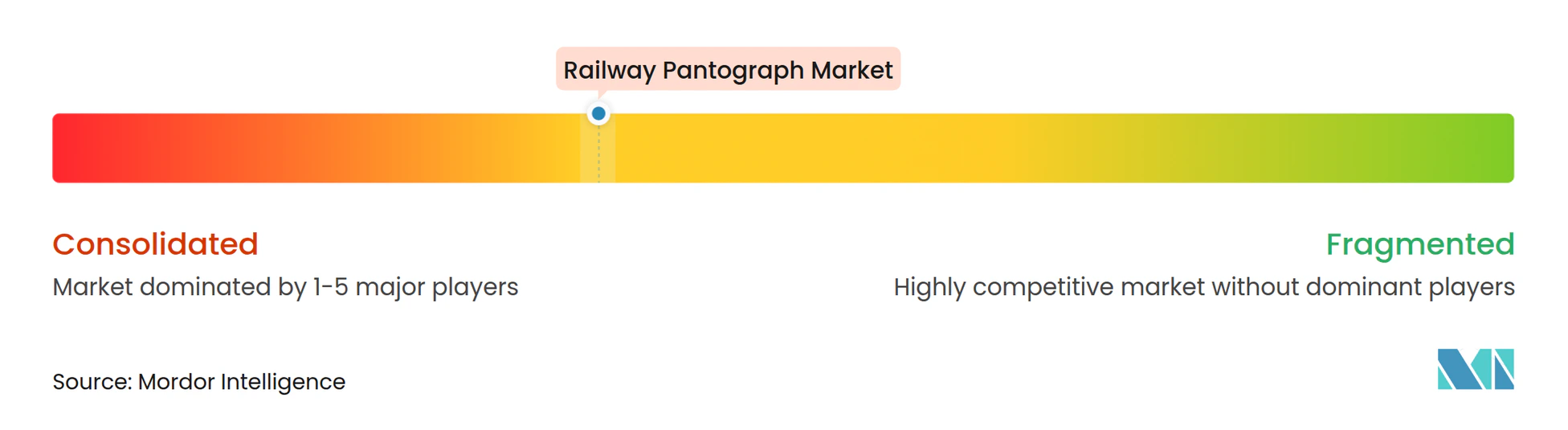
The railway pantograph market is moderately consolidated, with rolling stock OEMs, pantograph specialists, and contact-material suppliers serving distinct parts of the value chain. Alstom, Siemens, CRRC, and Hitachi influence product specifications through their train programs. Wabtec, Sécheron, and Kiepe Electric supply pantograph and current-collector systems to multiple customers. SCHUNK, Mersen, Morgan Advanced Materials, SGL Carbon, and similar companies compete based on carbon-strip and contact-material performance. This market structure gives major OEMs significant influence over original equipment fitment, while specialists compete through product compatibility and service quality. CRRC’s vertical integration provides manufacturing and coordination advantages in domestic Chinese programs. Suppliers outside China often focus on certified cross-border products, monitoring solutions, and material expertise.
Strategic developments demonstrate how companies are responding to increasingly stringent technical requirements. Wabtec secured pantograph orders across Indian programs and will manufacture them in Hosur, Tamil Nadu. Alstom’s Eurostar order covers multi-voltage Avelia Horizon trainsets and includes a capacity investment across French sites. Camlin Rail partnered with Caltrain and Stadler US to deploy PanVue on Caltrain’s electric multiple-unit fleet. These initiatives combine local production, multi-system train delivery, and digital maintenance capabilities. They also indicate that equipment suppliers must support fleets throughout their operational life. Consequently, the railway pantograph industry is becoming increasingly dependent on post-installation technical support.
Competitive opportunities remain in multi-system equipment, shared monitoring platforms, and local manufacturing for recently electrified networks. Cross-border freight corridors require pantographs that comply with multiple technical standards, although qualification requirements remain stringent. Digital monitoring providers can create value by helping operators identify wear, arcing, and contact-force issues at an early stage. Applicable IEC standards strengthen the role of validated simulation in the approval of new platforms. Suppliers with established simulation tools and type approvals hold an advantage over new entrants. Material suppliers can also differentiate themselves through strip grades designed for high-current applications, severe weather conditions, or intensive urban operations. Each supplier’s competitive position depends on its product certifications, installed base, service network, and ability to meet local procurement requirements. The market concentration assessment is appropriate, as the supplied draft identifies several strong global OEMs, specialists, and material suppliers but does not provide a combined market-share figure for the leading players.
Railway Pantograph Industry Leaders
-
Wabtec Corporation
-
Alstom SA
-
CRRC Corporation Limited
-
SCHUNK GmbH & Co. KG
-
G&Z Enterprises Ltd
- *Disclaimer: Major Players sorted in no particular order
Railway Pantograph Market Companies Covered in this Report
- Alstom SA
- Siemens AG
- Wabtec Corporation
- SCHUNK GmbH & Co. KG
- CRRC Corporation Limited
- Hitachi, Ltd.
- Mersen
- Morgan Advanced Materials plc
- Toyo Denki Seizo K.K.
- Sécheron
- Knorr-Bremse AG
- Mitsubishi Electric Corporation
- Kawasaki Heavy Industries, Ltd.
- G&Z Enterprises Ltd
- Shanghai Tianhai Shoudian Electric Co., Ltd.
- Hunan Kemeida Electric Co., Ltd.
- Yongji Electric Co., Ltd.
- SGL Carbon SE
- Kiepe Electric GmbH
- Toyo Tanso Co., Ltd.
Recent Industry Developments in Railway Pantograph Market
- September 2026: Alstom, a global leader in smart and sustainable mobility, and Northrail, a rolling stock leasing company, announced the signing of a framework agreement at the InnoTrans trade fair in Berlin. The agreement covers the supply of up to 100 Traxx Shunter locomotives. The order reflects Northrail’s confidence in Alstom and supports the production of a new generation of shunting locomotives. It also marks the culmination of several years of Alstom’s research, innovation, and development efforts focused on customer needs.
- March 2026: Wabtec Corporation announced that it secured multiple contracts to supply more than 680 pantographs for six major commuter rail and metro projects across India. The advanced pantograph systems will enhance fleet availability by enabling more reliable, efficient, and sustainable rail operations. Under these contracts, Wabtec will supply pantograph systems for Chennai Metro Phase II; Mumbai Metro Lines 4, 5, and 6; and Indian Railways’ MEMU (Mainline Electric Multiple Unit) and Vande Bharat Sleeper programs. Wabtec will manufacture the systems at its state-of-the-art Transit facility in Hosur, Tamil Nadu.
Global Railway Pantograph Market Report Scope
The Railway Pantograph Market is Segmented by Pantograph Design (Single-Arm (Z-Shaped) Pantograph, Double-Arm (Diamond/Scissor) Pantograph), Train Type (High-Speed Train, Mainline Train, Freight Train, Metro/Suburban Train, Tram/Light Rail), Operating Voltage (DC 750V, DC 1.5 kV, DC 3 kV, AC 15 kV 16.7 Hz, AC 25 kV 50/60 Hz, Multi-System), Actuation Type (Pneumatic and Air-Bellows Actuation, Electro-Pneumatic Actuation, Active-Control Actuation), Sales Channel (OEM Fitment on New Rolling Stock, Aftermarket Replacement and Maintenance, Retrofit and Modernization), Component (Pantograph Head and Contact Strips, Lower and Upper Arms/Linkages, Base Frame and Mounting, Actuators, Control Units, and Sensors), and Geography (North America, Europe, Asia-Pacific, South America, Middle East and Africa). The Market Forecasts are Provided in Terms of Value (USD) and Volume (Units).
Segmentation Overview
| Single-Arm (Z-Shaped) Pantograph |
| Diamond / Double-Arm Pantograph |
| Other Pantograph Designs |
| High-Speed Train |
| Mainline Train |
| Freight Train |
| Metro Train |
| Light Rail Train |
| Tram |
| Other Train Types |
| DC 600-750 V |
| DC 1.5-3 kV |
| AC 15 kV 16.7 Hz |
| AC 25 kV 50/60 Hz |
| Multi-System |
| Spring Actuation |
| Pneumatic and Air-Bellows Actuation |
| Electro-Pneumatic Actuation |
| Active-Control Actuation |
| Other Actuation Types |
| OEM |
| Aftermarket Replacement |
| Pantograph Head and Contact Strips |
| Arms, Frames, and Linkages |
| Base, Insulators, and Mounting Systems |
| Actuators, Control Units, and Sensors |
| Other Pantograph Components |
| North America | United States |
| Canada | |
| Rest of North America | |
| South America | Brazil |
| Argentina | |
| Rest of South America | |
| Europe | Germany |
| United Kingdom | |
| France | |
| Italy | |
| Spain | |
| Rest of Europe | |
| Asia-Pacific | China |
| India | |
| Japan | |
| South Korea | |
| Rest of Asia-Pacific | |
| Middle East and Africa | Saudi Arabia |
| United Arab Emirates | |
| South Africa | |
| Rest of Middle East and Africa |
| By Pantograph Design | Single-Arm (Z-Shaped) Pantograph | |
| Diamond / Double-Arm Pantograph | ||
| Other Pantograph Designs | ||
| By Train Type | High-Speed Train | |
| Mainline Train | ||
| Freight Train | ||
| Metro Train | ||
| Light Rail Train | ||
| Tram | ||
| Other Train Types | ||
| By Operating Voltage | DC 600-750 V | |
| DC 1.5-3 kV | ||
| AC 15 kV 16.7 Hz | ||
| AC 25 kV 50/60 Hz | ||
| Multi-System | ||
| By Actuation Type | Spring Actuation | |
| Pneumatic and Air-Bellows Actuation | ||
| Electro-Pneumatic Actuation | ||
| Active-Control Actuation | ||
| Other Actuation Types | ||
| By Sales Channel | OEM | |
| Aftermarket Replacement | ||
| By Component | Pantograph Head and Contact Strips | |
| Arms, Frames, and Linkages | ||
| Base, Insulators, and Mounting Systems | ||
| Actuators, Control Units, and Sensors | ||
| Other Pantograph Components | ||
| By Geography | North America | United States |
| Canada | ||
| Rest of North America | ||
| South America | Brazil | |
| Argentina | ||
| Rest of South America | ||
| Europe | Germany | |
| United Kingdom | ||
| France | ||
| Italy | ||
| Spain | ||
| Rest of Europe | ||
| Asia-Pacific | China | |
| India | ||
| Japan | ||
| South Korea | ||
| Rest of Asia-Pacific | ||
| Middle East and Africa | Saudi Arabia | |
| United Arab Emirates | ||
| South Africa | ||
| Rest of Middle East and Africa | ||
Key Questions Answered in the Report
What is the projected value of the railway pantograph sector by 2032?
It is projected to reach USD 1.15 billion by 2032, from USD 0.91 billion in 2026, at a 4.1% CAGR from 2027 to 2032.
Why are active-control pantographs growing quickly?
Active-control systems are projected to grow at an 8.63% CAGR as high-speed rail needs better contact-force control and lower wear.
What affects pantograph replacement demand?
Contact-strip wear, fleet age, urban duty cycles, and condition-monitoring results all influence replacement and overhaul demand.
What is the main barrier for new pantograph suppliers?
Long qualification cycles, technical compatibility rules, certified material requirements, and limited testing infrastructure can delay entry.
Which region has the largest demand for railway pantographs?
Asia-Pacific held 47.18% share in 2026, supported by Chinese high-speed rail, Indian electrification, and Japanese fleet renewal.