
Market Overview
| Study Period | 2021 - 2031 |
|---|---|
| Forecast Data Period | 2026 - 2031 |
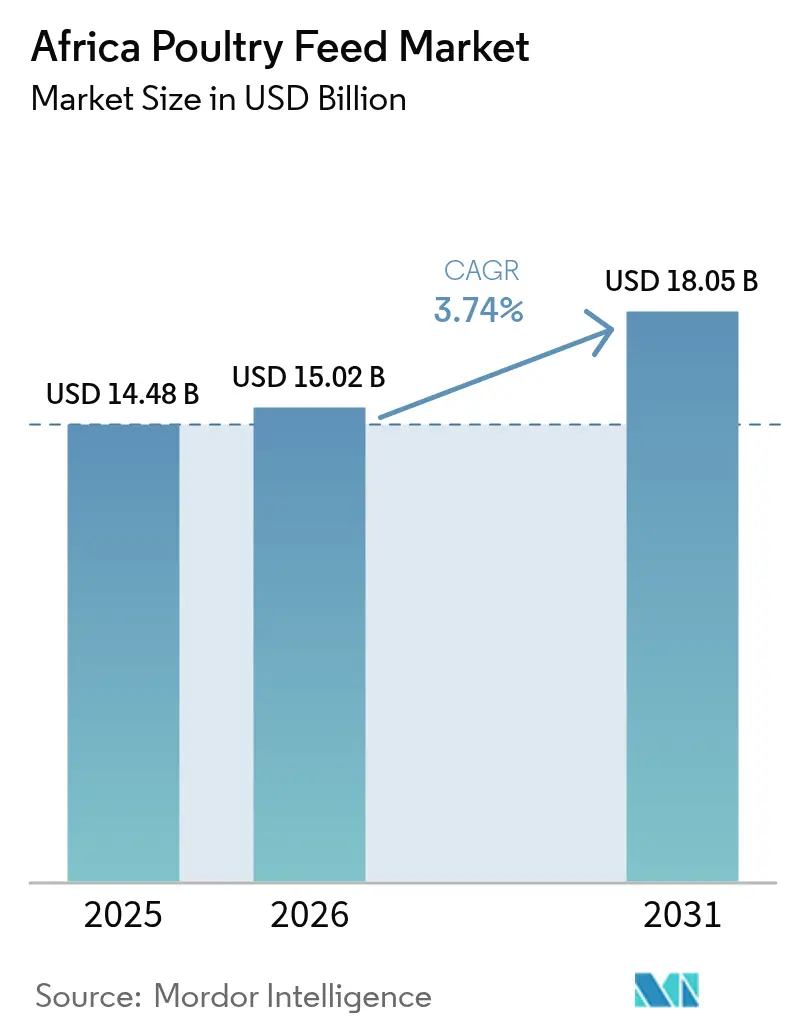
| Base Year Market Size (2025) | USD 14.48 Billion |
| Market Size (2026) | USD 15.02 Billion |
| Market Size (2031) | USD 18.05 Billion |
| Growth Rate (2026 - 2031) | 3.74 % |
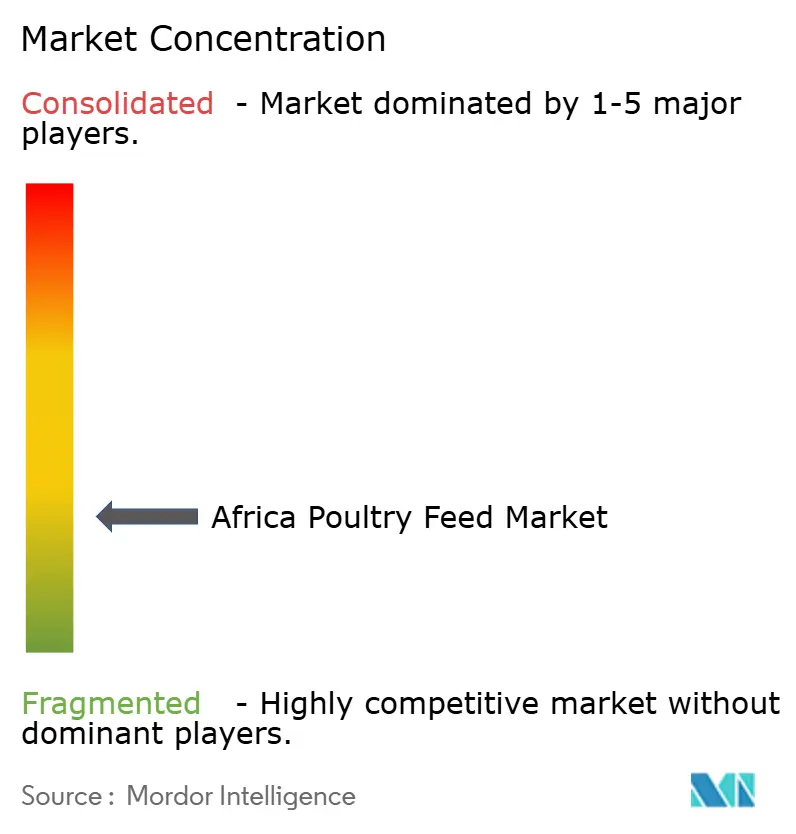
| Market Concentration | Low |
Major Players *Disclaimer: Major Players sorted in no particular order Image © Mordor Intelligence. Reuse requires attribution under CC BY 4.0. | |
Africa Poultry Feed Market Analysis by Mordor Intelligence
The Africa poultry feed market size was valued at USD 14.48 billion in 2025 and estimated to grow from USD 15.02 billion in 2026 to reach USD 18.05 billion by 2031, at a CAGR of 3.74% during the forecast period (2026-2031). Sustained urban growth, rising disposable incomes and protein intake, and regional policy coordination under the African Continental Free Trade Area (AFCFTA) underpin this outlook. Integrated producers are scaling feed operations to capture economies of scale, while quick-service restaurants (QSRs) demand traceable, high-quality broiler supply chains that, in turn, increase demand for nutritionally consistent feed. Government input subsidies and technology investments in precision nutrition further accelerate efficiencies, even as manufacturers continue to mitigate grain cost volatility through ingredient diversification and logistics optimization. Finally, cross-border feed corridors enabled by AFCFTA lower landed costs for soybean meal and maize, sharpening competitiveness of regional mills.
Key Report Takeaways
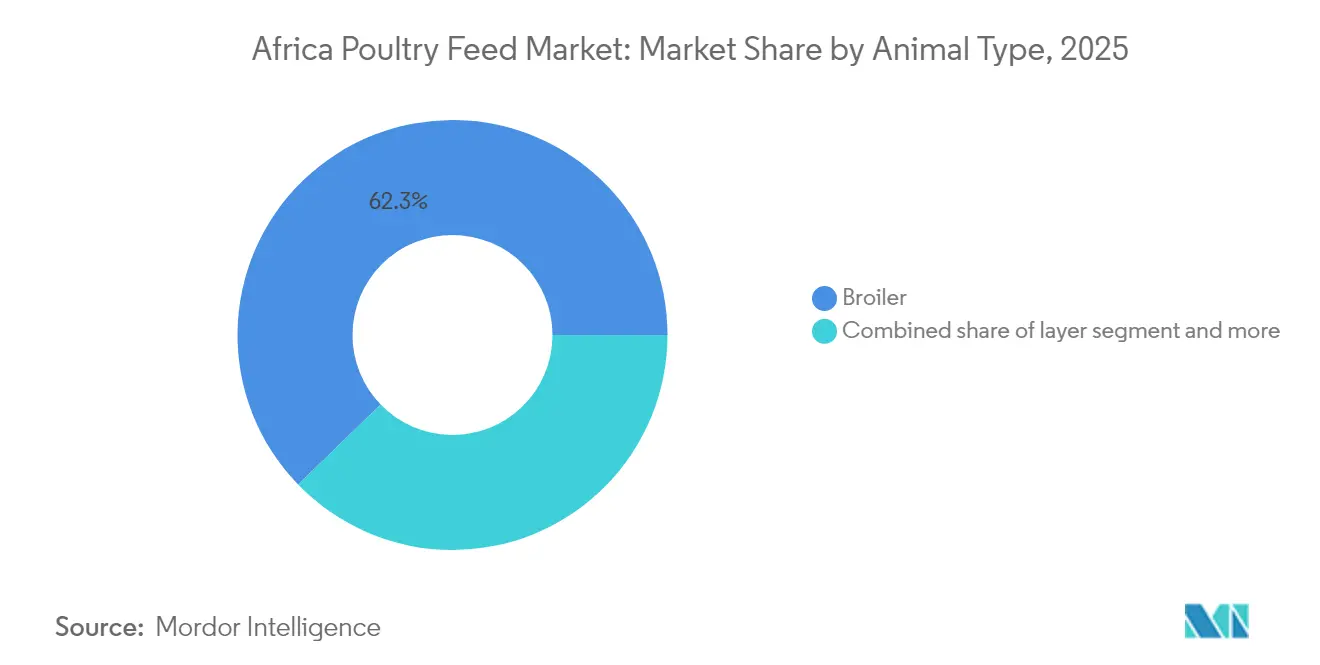
- By animal type, broiler feed held 62.25% of the Africa poultry feed market share in 2025, whereas turkey feed is forecast to post the fastest 7.30% CAGR through 2031.
- By ingredient type, cereals accounted for 54.05% of the Africa poultry feed market size in 2025, while molasses is projected to expand at an 18.35% CAGR to 2031.
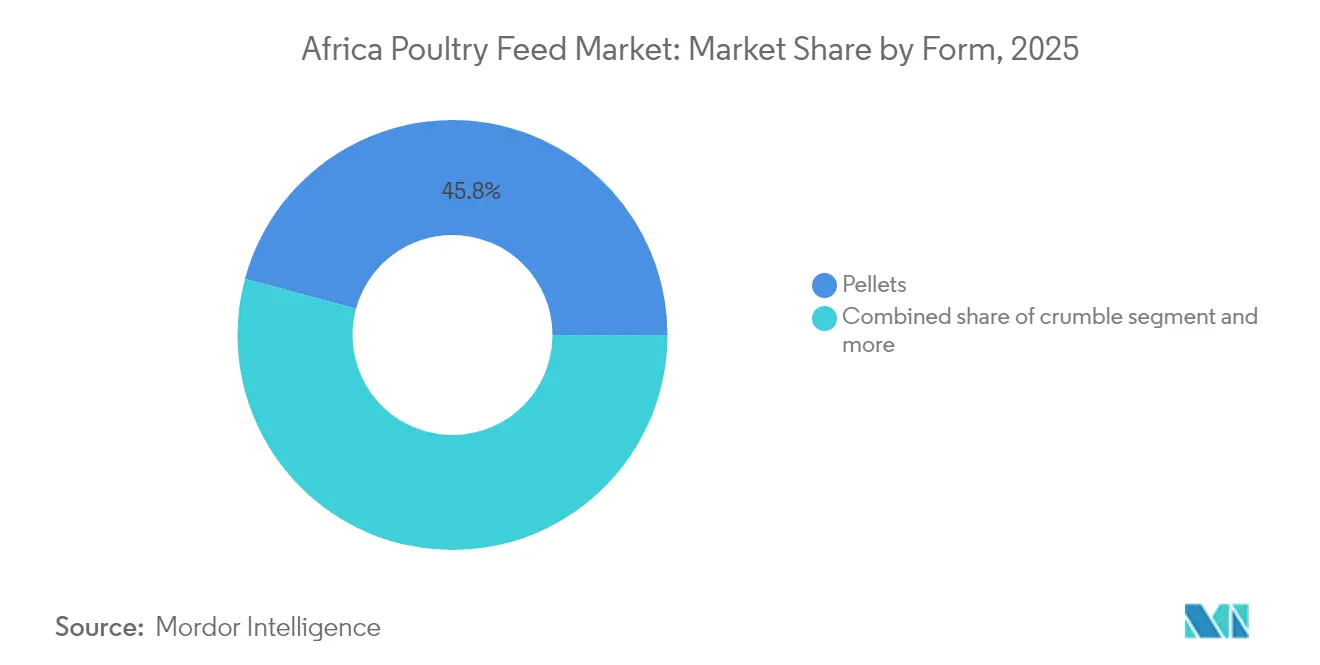
- By form, pellets led with 45.78% revenue share in 2025. The crumble feed shows a 7.15% CAGR through 2031.
- By geography, Nigeria captured 28.22% of the market in 2025. Ethiopia is anticipated to expand at a market-leading 7.64% CAGR to 2031.
Note: Market size and forecast figures in this report are generated using Mordor Intelligence’s proprietary estimation framework, updated with the latest available data and insights as of 2026.
Africa Poultry Feed Market Trends and Insights
Drivers Impact Analysis*
| Driver | (~)% Impact on CAGR Forecast | Geographic Relevance | Impact Timeline |
|---|---|---|---|
| Strong demand from quick-service restaurant chicken chains | +0.8% | Nigeria, South Africa, Kenya, and Morocco | Medium term (2-4 years) |
| Growth of integrated poultry producers | +0.6% | South Africa, Algeria, Morocco, and Ethiopia | Long term (≥ 4 years) |
| Government subsidies for maize and soybean cultivation | +0.5% | Nigeria, Ghana, Senegal, Malawi, and Zambia | Short term (≤ 2 years) |
| Rising adoption of nutritionally balanced commercial feed | +0.7% | Global, with early gains in South Africa, Nigeria, and Kenya | Medium term (2-4 years) |
| Surge in insect-meal pilot projects for feed protein | +0.4% | Kenya, Rwanda, South Africa, Namibia, and Zimbabwe | Long term (≥ 4 years) |
| African Continental Free Trade Area (AFCFTA)-driven cross-border feed logistics efficiencies | +0.3% | Regional corridors: East Africa, SADC, and ECOWAS | Medium term (2-4 years) |
| Source: Mordor Intelligence | |||
Strong Demand from Quick-Service Restaurant Chicken Chains
Pan-African QSR expansion, led by KFC’s more than 1,000 outlets, requires standardized broiler supply programs that lock in feed quality and volume commitments. Contract farming models incentivize mills to formulate feeds that consistently meet weight and feed-conversion targets within six-week grow-outs. QSR procurement policies increasingly specify antibiotic-free protocols, accelerating uptake of phytogenic additives that carry premium margins. The resulting predictable demand stream enables capital investment in automated pelleting lines and regional distribution hubs. Together, these factors anchor a virtuous cycle of higher throughput, lower per-unit costs, and improved profitability across the Africa poultry feed market.
Growth of Integrated Poultry Producers
Companies such as Zalar Holding and Country Bird Holdings deepen vertical integration to shield against raw-material price swings, which account for 60-70% of cost of goods sold. In-house feed mills allow synchronized formulation changes that match flock age and performance targets, supporting phase-feeding programs that reduce waste. Integrated models shorten working-capital cycles, enhance quality control, and support rapid adoption of alternative proteins like insect meal. Over time, this alignment is projected to compress cost structures across major North and Southern African producers, bolstering competitiveness.
Government Subsidies for Maize and Soybean Cultivation
Input subsidy schemes help narrow the yield gap between African growers and global exporters, improving local raw-material availability. Lagos State’s 25% feed subsidy, launched in January 2025, directly lowered mill gate prices for poultry and aquaculture farmers[1]Source: MSME Africa Online, “Lagos Launches 25% Feed Subsidy,” msmeafricaonline.com. Senegal is committed to buying 5,000 metric tons of local maize at USD 0.37/kg, surpassing the USD 0.33/kg import price to spur domestic production. Such interventions partially insulate feed producers from foreign-exchange shocks and improve raw-material security, even though long-term fiscal sustainability remains a question.
Rising Adoption of Nutritionally Balanced Commercial Feed
Commercial feed adoption enables consistent nutrient delivery that optimizes growth performance and reduces production variability, particularly critical for broiler operations targeting specific market weights[2]Source: International Livestock Research Institute, “Local Production of Quality Affordable Poultry Feed,” ilri.org. Local technology packages that blend regionally sourced maize, soybean meal, and vitamin premixes trim delivered costs up to 60% versus imported formulations. Better flock uniformity and shorter grow-out cycles raise enterprise incomes, supporting reinvestment in improved housing and water systems. Feed mills respond by launching starter, grower, and finisher lines matched to local breed genetics, cementing loyalty and market share.
Restraints Impact Analysis*
| Restraint | (~)% Impact on CAGR Forecast | Geographic Relevance | Impact Timeline |
|---|---|---|---|
| High volatility in grain import prices | -0.9% | Nigeria, Ghana, Egypt, and Morocco | Short term (≤ 2 years) |
| Disease outbreaks driving temporary demand slumps | -0.6% | South Africa, Nigeria, and Egypt | Short term (≤ 2 years) |
| Electricity shortages affecting feed-mill uptime | -0.4% | South Africa, Nigeria, Ghana, and Zimbabwe | Medium term (2-4 years) |
| Limited cold-chain for vitamin premix storage | -0.3% | Rural sub-Saharan markets | Long term (≥ 4 years) |
| Source: Mordor Intelligence | |||
High Volatility in Grain Import Prices
Commodity price fluctuations create significant margin pressure for feed manufacturers, particularly in markets with limited domestic grain production capacity. In 2024, maize prices in Ghana jumped 80% in eight months, forcing mills to idle 30% of capacity and prompting calls for import-license waivers. Egypt’s sector likewise teetered under soaring corn and soybean costs that eroded producer margins. Currency devaluation compounds these challenges, as most African countries import significant portions of their feed ingredients in hard currencies while selling finished products in local markets.
Disease Outbreaks Driving Temporary Demand Slumps
Highly pathogenic avian influenza (HPAI) culled 10 million birds in South Africa, resulting in a loss of USD 515 million in value and a sudden reduction in feed demand in 2023. The Food and Agriculture Organization (FAO) 's surveillance programs in Côte d'Ivoire demonstrate the ongoing regional coordination efforts required to manage transboundary animal disease risks [3]Source: Food and Agriculture Organization, “FAO in Côte d'Ivoire,” fao.org. Producers redirect cash toward biosecurity rather than feed upgrades, causing sporadic order cancellations and inventory write-downs at mills. Regional governments are stepping up surveillance, yet recurring outbreaks sustain an environment of unpredictable demand.
*Our forecasts treat driver/restraint impacts as directional, not additive. The impact forecasts reflect baseline growth, mix effects, and variable interactions.
Segment Analysis
By Animal Type: Broiler Feed Dominates Commercial Production
Broiler formulations accounted for 62.25% of Africa poultry feed market share in 2025, reflecting the segment’s short grow-out cycles and standardized demand profiles. The Africa poultry feed market size for turkey diets is projected to grow at a 7.30% CAGR to 2031, propelled by premium positioning and higher per-bird consumption. Broiler feed leverages economies of scale in pelleting and bulk distribution, resulting in lower unit costs compared to layer diets. Integrators align nutrient density with fast live-weight targets, reinforcing demand for energy-dense maize-soy rations.
Turkey feed, although smaller in volume, commands higher price points due to extended 28- to 32-week fattening schedules and specialized amino acid profiles. Feed manufacturers utilize differentiated additives, such as probiotic blends, to manage gut health over extended grow-out periods. While layer feed remains steady among egg enterprises, niche markets for guinea fowl and ducks spur tailored micro-batch production, preserving margins for agile, regionally focused mills.



By Ingredient Type: Cereals Lead Despite Molasses Growth
Cereals made up 54.05% of total inclusion rates in 2025, relying largely on maize for metabolizable energy and wheat byproducts where available. The Africa poultry feed market tied to molasses inputs is forecast to expand at a 18.35% CAGR through 2031, as mills adopt the byproduct to enhance pellet durability and reduce dust. High metabolizable sugar content allows partial substitution for costly grains, delivering savings without compromising energy density.
Oilseed meals, chiefly soybean meal, remain primary protein contributors despite price volatility. Fishmeal faces sustainability and cost constraints, pushing formulators toward alternative proteins such as insect meal. Supplements, vitamins, minerals, and enzymes occupy a smaller tonnage share yet drive product differentiation and premium pricing. Over the forecast period, ingredient portfolios are likely to diversify further to buffer against import shocks and climate variability.
By Form: Pellets Preferred for Handling Efficiency
Pellets held a 45.78% share of finished-feed output in 2025, favored for superior feed-conversion ratios and ease of mechanized handling. The Africa poultry feed market linked to crumble formulations is projected to grow at a 7.15% CAGR, driven by starter and grower diets where smaller particle sizes boost digestibility. Pelleted diets enable automated on-farm feeding, cutting labor requirements and minimizing spillage.
Crumble feed, produced by breaking pellets, targets early-age birds with limited gizzard capacity. Despite additional processing costs, higher early-stage weight gain justifies premium pricing. Mash retains market share among cost-sensitive backyard producers, and liquid feed solutions occupy niche applications such as medicated water-soluble nutrients.
Geography Analysis
Nigeria captured 28.22% of the market in 2025, while Ethiopia is anticipated to expand at a market-leading 7.64% CAGR to 2031. South Africa anchors the Africa poultry feed market with the continent’s most advanced manufacturing base and consolidated supply chains. Major integrators like Astral Foods invest in precision dosing and energy-efficient pellet coolers, even as intermittent power shortages oblige diesel generator outlays. Domestic grain sourcing and established rail networks reduce landed raw-material costs compared with many peers.
Nigeria represents the largest incremental demand center, powered by demographic momentum, urban income growth, and robust QSR expansion. Yet currency depreciation and port congestion inflate costs for imported soybean meal and vitamin premixes, challenging mill margins. The government’s 25% feed subsidy offers partial respite but faces budgetary limits. Morocco serves as a logistical gateway for North and West African grain flows. It's free-trade agreement with the United States secures favorable corn import tariffs, benefiting domestic mills and enabling re-exports along ECOWAS corridors. Algeria leverages its Mediterranean proximity to access global grain markets, while its poultry expansion is reinforced by state-backed financing for feed mill upgrades.
Regulatory Landscape
Regulation is tightening around feed quality, labeling, and import controls, with a mix of national acts and regional standards shaping compliance. In East Africa, Uganda enacted the Animal Feeds Act 2024 (May 2024), and the Uganda National Bureau of Standards adopted EAS 90:2024, Compounded poultry feed specification (September 2025). The standard covers compounded poultry feed requirements, sampling, and test methods for chicken and turkey categories used in East African Community markets. This regional standardization reduces technical barriers for manufacturers supplying multiple EAC member states.
In Southern and West Africa, compliance is shaped by established frameworks and ongoing updates. South Africa continues to regulate farm feeds under Act 36 of 1947, and amended regulations were gazetted for public comment on 16 January 2026. This is the first substantive update to the framework since 2010 and creates a near-term compliance window for registration and labeling alignment. In Nigeria, the National Agency for Food and Drug Administration and Control (NAFDAC) maintains permitting requirements for importers of feed supplements, concentrates, additives, premixes, and fish meal under the NAFDAC Act CAP N1 (LFN) 2004, reinforcing the need for complete technical dossiers and traceability for imported premixes and additives.
Competitive Landscape
The Africa poultry feed market is low, with multinational corporations, regionals, and agile local mills vying for share. Multinationals such as Cargill and Nutreco leverage global R&D pipelines to localize precision nutrition products, while regionals like RCL Foods Limited (Remgro Limited) and Astral Foods Limited differentiate themselves through vertically integrated value chains. In March 2024, consolidation includes Olam Agri’s USD 18.4 million acquisition of Senegalese feed maker Avisen, which expands West African throughput capacity.
Companies are gaining competitive advantages through the adoption of technology. DSM-Firmenich established feed premix facilities in Egypt to reduce delivery times for customized feed blends. Nutreco expanded its feed enzyme and probiotic offerings through the acquisition of Animal Nutrition and Health in South Africa's feed market in 2024. In the emerging insect-protein segment, AgriProtein's Gauteng facility increased Black Soldier Fly production to commercial scale, indicating a transformation in protein-sourcing methods.
Local feed mills leverage their proximity to smallholder clusters as a key differentiator, offering microcredit and extension services to secure demand. Digital formulation platforms powered by cloud-based least-cost algorithms are emerging, lowering formulation errors and boosting margin capture. Nonetheless, fragmented distribution networks, limited cold-chain infrastructure, and uneven regulatory enforcement maintain significant entry barriers for new participants.
Africa Poultry Feed Industry Leaders
Cargill Inc.
Nutreco N.V. (Trouw Nutrition)
Alltech Inc.
Kemin Industries Inc.
Novus International, Inc. (Mitsui & Co., Ltd. and Nippon Soda Co., Ltd.)
- *Disclaimer: Major Players sorted in no particular order

Market Opportunities and Future Outlook
Capacity additions and backward integration are creating a clearer opportunity for suppliers that can stabilize ingredient availability while delivering consistent nutrition to integrated poultry systems and QSR-linked broiler programs. In February 2026, De Heus opened an animal feed facility in Athi River, Kenya (about USD 23 million investment) with 240,000 metric tonnes of annual capacity. This points to continued investment in scaled, automated milling positioned for regional corridors. Similar scale-up activity is visible in Nigeria through value-chain investments such as Olam Agri commencing operations at an integrated soybean crushing and feed mill facility in Ilorin, Kwara State (April 2026). The move targets local protein meal availability, which directly affects least-cost formulation for broiler-dominant demand.
Opportunities also emerge in compliance-led formalization and nutrient-specialty expansion. Adoption of EAS 90:2024 in East Africa, along with active regulatory updates in South Africa and import-permit controls by NAFDAC in Nigeria, is raising expectations for standardized formulations, documentation, and quality assurance. Manufacturers with lab capacity, mycotoxin management, and robust premix handling are positioned to benefit from this shift. At the formulation level, ingredient diversification supports premium product lines, including antibiotic-free and performance-focused feeds used in contract farming models tied to large QSR networks (for example, KFCs pan-African footprint cited in the report). The broader direction also includes molasses for pellet durability and insect meal pilots referenced in the report scope.
Recent Industry Developments
- July 2026: Silverlands announced an expansion of its integrated poultry operations in Tanzania, including feed manufacturing alongside hatchery and veterinary services. The move improves local feed availability for commercial poultry systems and supports tighter control over feed quality and flock performance across a broader operating footprint.
- December 2025: BUA Group signed an agreement with Viteral (Turkey) to construct a 40-tonnes-per-hour feed mill in Kano, Nigeria. The project adds new industrial-scale milling capacity in one of Africa's largest poultry markets, increasing competitive pressure on established feed suppliers and improving proximity to northern demand centers.
- April 2024: Nutreco opened a new poultry and animal feed production facility in Ibadan, Oyo State, Nigeria, through Skretting and Trouw Nutrition, with 125,000 metric tons of annual capacity. This commissioning expanded modern production capacity and reinforced multinational participation in Nigeria's commercial feed segment through localized manufacturing.


Research Methodology Framework and Report Scope
Market Definition and Coverage
This market is defined as the value of commercially sold poultry feed across Africa, covering complete feed and related formulated products used for poultry production in the region.
Scope exclusions: We exclude homemade or on-farm mixed feed that is not sold commercially.
Segmentation Overview
- By Animal Type
- Broiler
- Layer
- Turkey
- Other Animal Types
- By Ingredient Type
- Cereals
- Oilseed Meal
- Molasses
- Fish Oil and Fish Meal
- Supplements
- Other Ingredient Types
- By Form
- Pellets
- Crumble
- Mash
- Other Forms
- By Geography
- South Africa
- Algeria
- Nigeria
- Ethiopia
- Morocco
- Rest of Africa
Data Sources, Market Sizing, and Validation
Desk Research
Desk research was used to set the factual base for the model and to keep assumptions realistic across different African poultry systems. We reviewed public agriculture and feed-related statistics and notes such as FAOSTAT data series, national agriculture and livestock departments, and central bank or national statistics offices for inflation and exchange-rate context, plus customs or trade portals for maize and oilseed meal import and export signals.
To keep the market direction consistent with what is happening in poultry feed and poultry production, we also referenced trade association releases, peer-reviewed journals on poultry nutrition and feed conversion, and widely available company filings and investor presentations for capacity, product mix, and country focus. For cross-checking company scale and financial context, we used a paid subscription focused on company financials and news, and we also used a paid patent database when a formulation or additive trend needed confirmation. The sources listed here are illustrative and not exhaustive, and many additional public references were used for data collection, validation, and clarification.
Primary Interviews and Surveys
Our analysts use expert interviews and surveys with feed mill leaders, poultry integrators, distributors, ingredient buyers, and farm managers in African markets. These discussions help test feed prices, utilization, channel shares, capacity changes, and local data gaps. Analysts then recheck unusual answers against secondary indicators, using the findings to refine assumptions and triangulate the country roll-up rather than relying on one source.
Distribution of primary research fieldwork respondents
| Company type | Respondent position |
|---|---|
| Top tier: 27% | CXOs: 20% |
| Mid tier: 48% | Functional/Unit leaders: 30% |
| Smaller Players: 25% | Managers: 50% |
Market-Sizing & Forecasting
The core sizing starts with a top-down demand pool build that links poultry population and production intensity to feed use, then converts that demand into value using locally relevant pricing logic. In practice, we used country-level poultry output signals and commercial feed adoption to reconstruct the commercial feed consumption base before rolling totals up to Africa.
To keep the model grounded, we checked several market fingerprints that move poultry feed demand in Africa, such as broiler versus layer mix, feed conversion trends by production system, the split between mash and pellets, maize and soybean meal price movements, and the penetration of formulated feed versus informal rations. Where the data was thin, we handled gaps by using proxy ranges from similar markets and then narrowed them through interview feedback before locking the final numbers.
Results were corroborated with selective bottom-up approximations, mainly by sampling supplier volumes and matching them with typical ASP bands by feed type, followed by channel checks in large consuming countries. For forecasting, we used scenario analysis so growth can reflect expected poultry consumption, macro constraints on feed ingredient costs, and realistic shifts in commercial feed adoption as farms scale up, then refined scenario weights using expert consensus from primary calls.
Data Validation & Update Cycle
Model outputs were validated through multiple checks so the totals do not drift away from real-world signals. We compared implied feed demand against independent indicators such as poultry production direction, major feed ingredient import intensity, and country-level price trends, then reworked any unusual jumps until the assumptions were explainable.
Before sign-off, the work is reviewed in steps across analysts so inputs, unit conversions, and currency handling are consistent. If a variance is large versus what interviews or public indicators suggest, we re-contact experts to confirm whether it is a true market shift or a modeling issue. Reports are refreshed annually, with interim updates when material events occur, and a final pre-delivery check is completed to ensure the latest data and context are reflected.
Mordor Intelligence's African Poultry Feed Market Estimate Compared With Other Published Estimates
Published market sizes for Africa poultry feed can look far apart because each study draws the boundary in its own way and uses different demand signals to convert volume into value. Differences also build up when one estimate leans more on price assumptions, while another leans more on production or trade indicators.
By tracking commercial-feed penetration, feed conversion assumptions, and ingredient-linked price bands, Mordor Intelligence keeps the estimate tied to feed that is actually sold in the market, which avoids mixing in homemade rations or overstating value through aggressive price escalation.
Benchmark comparison
| Source | Market Size | Gaps in Research Methodology |
|---|---|---|
| Mordor Intelligence | USD 14.48 B (2025) | |
| Industry Research Publisher A | USD 8.50 B (2024) | This estimate appears to use an earlier base year and may apply a narrower value boundary or different inclusion rules around commercial versus informal feed, which can pull down the measured market size. |
| Regional Analytics Publisher B | USD 12.50 B (2025) | The scope signals suggest a broader product mix that can blend additives and premix-heavy categories differently, and the sizing can shift based on how feed type splits and pricing are applied across countries. |
The table shows that year choice, what is counted as commercial feed, and how pricing is built from ingredients and feed forms are the main reasons the totals do not match. When the scope is clearly limited to commercial sales and the key drivers are checked against poultry output and ingredient cost reality, the resulting market value stays easier to replicate and explain.


Key Questions Answered in the Report
How large is the Africa poultry feed market in 2026?
It stands at USD 15.02 billion and is projected to reach USD 18.05 billion by 2031.
What is the projected CAGR for poultry feed demand across Africa to 2031?
The compound annual growth rate is forecast at 3.74%.
Which animal type consumes the most feed across Africa?
Broiler feed dominates with 62.25% share of total volumes in 2025.
Which ingredient category is growing fastest in African feed formulations?
Molasses is expanding fastest at an 18.35% CAGR through 2031.
Page last updated on:


 Your data is secure and never sold or shared.


