
Professional Microphones Market Size and Share
Market Overview
| Study Period | 2020 - 2031 |
|---|---|
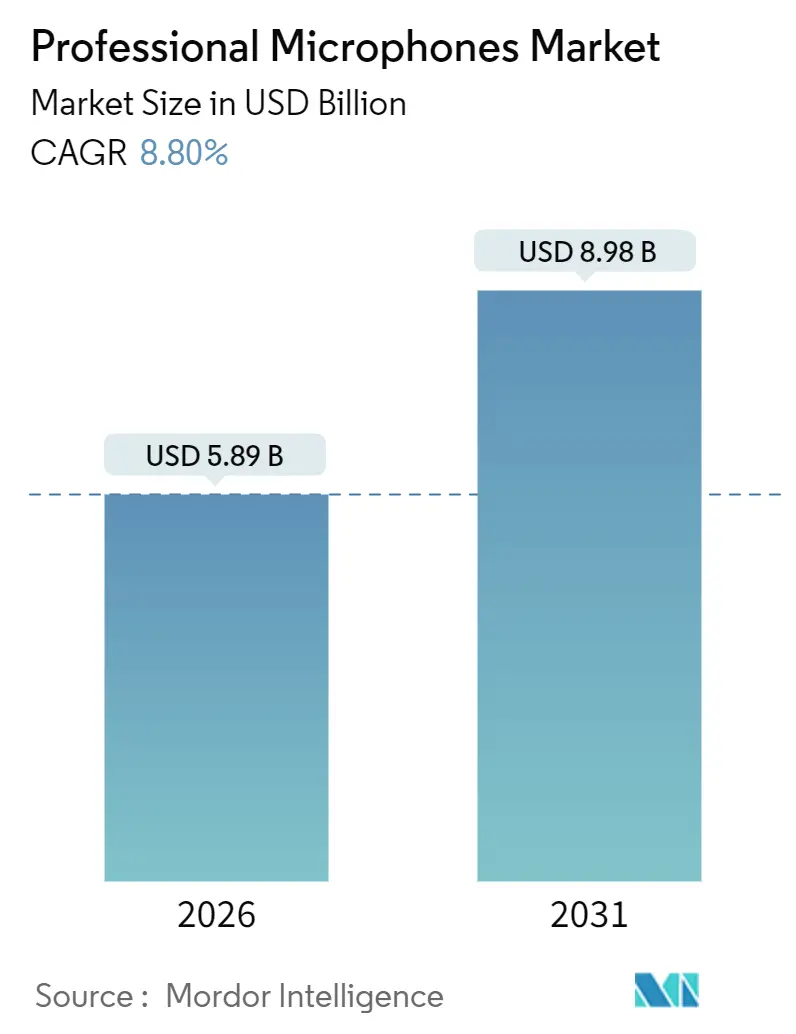
| Market Size (2026) | USD 5.89 Billion |
| Market Size (2031) | USD 8.98 Billion |
| Growth Rate (2026 - 2031) | 8.80 % |
| Fastest Growing Market | Asia Pacific |
| Largest Market | North America |
| Market Concentration | Medium |
Major Players *Disclaimer: Major Players sorted in no particular order Image © Mordor Intelligence. Reuse requires attribution under CC BY 4.0. | |
Professional Microphones Market Analysis by Mordor Intelligence
The professional microphones market size stood at USD 5.89 billion in 2026 and is projected to reach USD 8.98 billion by 2031, advancing at an 8.80% CAGR. Expansion is anchored in permanent venue upgrades, spectrum-driven replacement cycles, and creator-economy monetization, all of which convert audio capture into recurring revenue. Wireless platforms, especially Bluetooth Low Energy Audio, outpace wired systems as live-sound engineers migrate to frequency-agile arrays. Capsule innovation is shifting toward MEMS-based small diaphragms that incorporate AI noise suppression, while live-event operators standardize multi-channel packs that extend product lifecycles through firmware updates rather than hardware replacements. Regulatory actions, from the Federal Communications Commission’s 600 MHz reallocation to the European Union’s Critical Raw Materials Act, simultaneously accelerate system refreshes and drive eco-design commitments.
Key Report Takeaways
- By product, cardioid commanded 35.83% of the 2025 revenue of the Professional Microphones Market, and super-cardioid microphones are projected to experience 9.44% growth.
- By technology, wireless commanded 61.84% of the 2025 revenue of the Professional Microphones Market and is forecast to grow at a 10.11% CAGR through 2031.
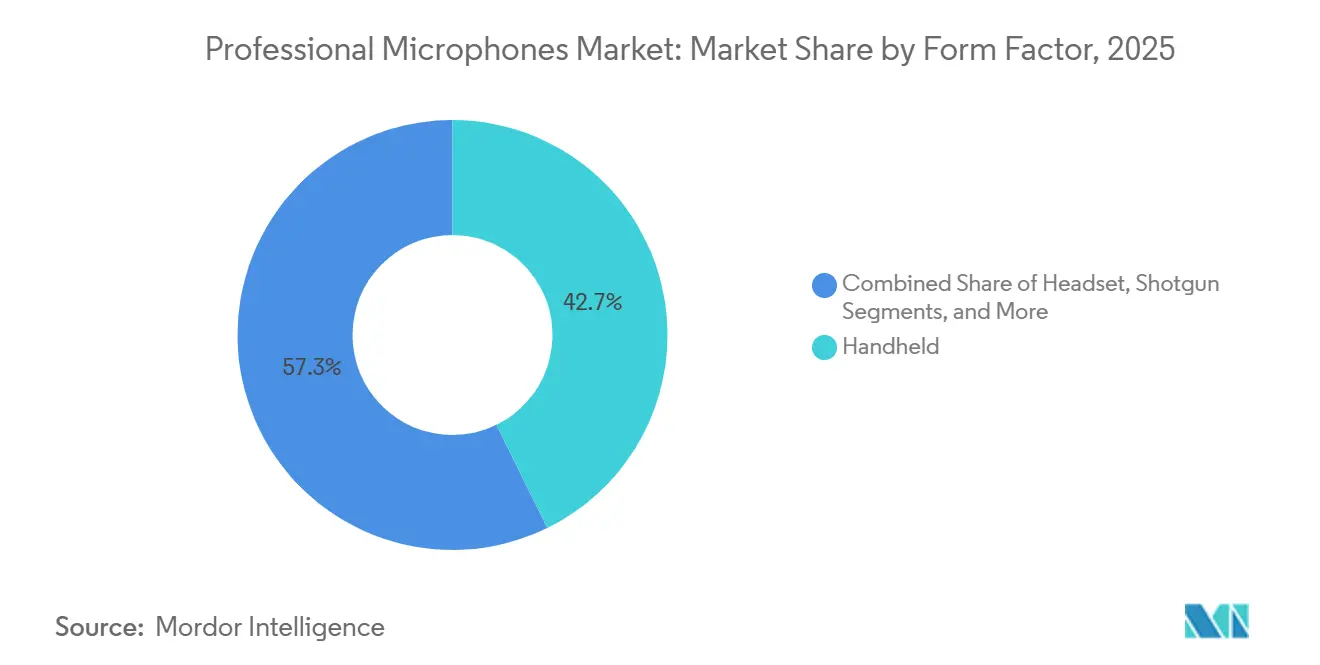
- By form factor, handheld designs led with 42.74% share in 2025 of the Professional Microphones Market, yet lavalier units are on track for a 9.56% CAGR to 2031.
- By diaphragm size, large diaphragms captured 45.94% of the 2025 sales of the Professional Microphones Market, while small-diaphragm capsules are projected to expand at 9.66% during the forecast period.
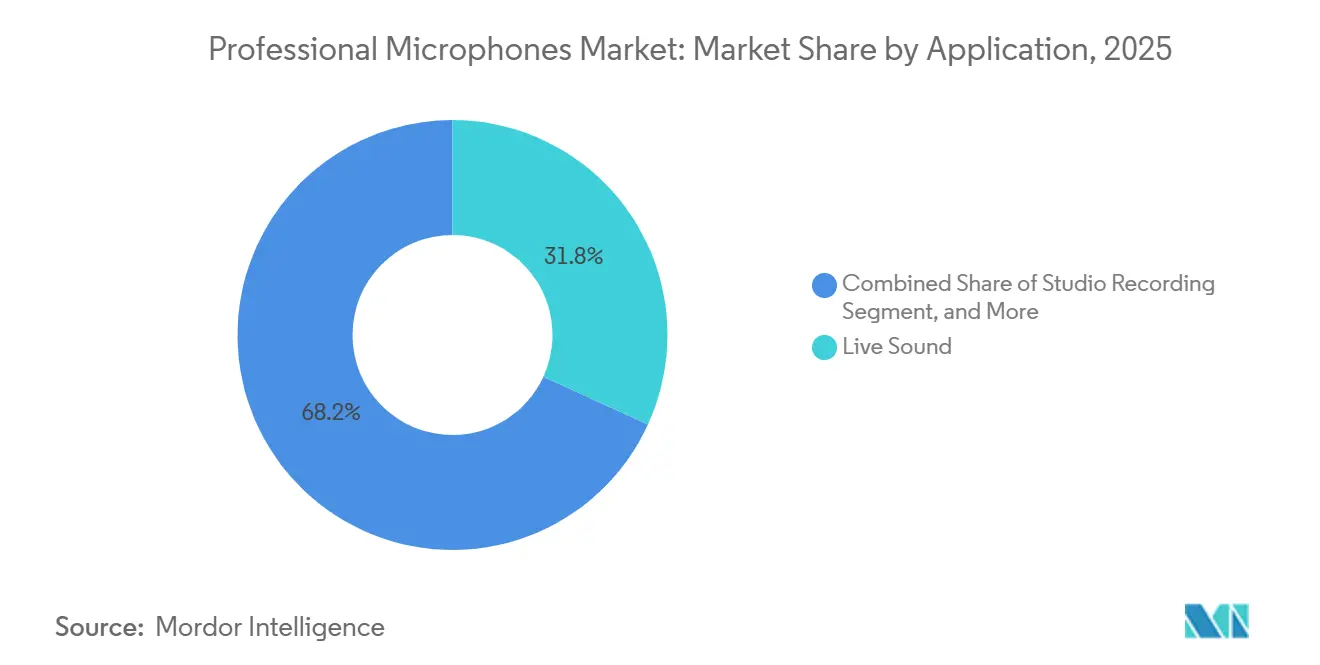
- By application, live sound accounted for 31.84% of the revenue in the Professional Microphones Market in 2025, whereas podcasting and home studios are expected to advance at a 9.48% CAGR from 2026 to 2031.
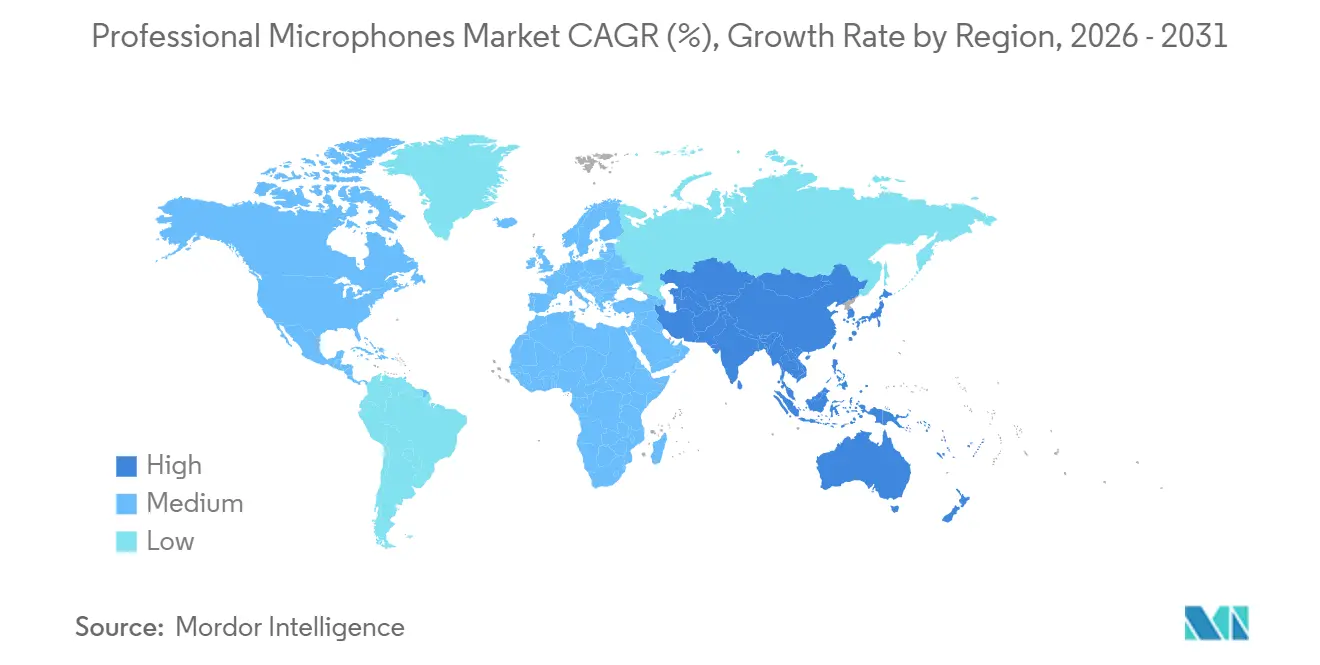
- By geography, Asia-Pacific is set to register the fastest pace at 9.76% through 2031 in the Professional Microphones Market, narrowing the gap with North America’s 38.74% 2025 share.
Note: Market size and forecast figures in this report are generated using Mordor Intelligence’s proprietary estimation framework, updated with the latest available data and insights as of January 2026.
Market Trends and Insights
Drivers Impact Analysis of Professional Microphones Market*
| Driver | (~) % Impact on CAGR Forecast | Geographic Relevance | Impact Timeline |
|---|---|---|---|
| Surging entertainment industries and rising demand for immersive event experiences | +2.1% | North America, Europe, Asia-Pacific touring circuits | Medium term (2-4 years) |
| Rapid adoption of cloud-based collaborative workflows | +1.4% | North America and Europe, expanding to Asia-Pacific hubs | Short term (≤ 2 years) |
| Rise in wireless microphone technology | +1.8% | Global, concentrated in North America and Asia-Pacific | Medium term (2-4 years) |
| Growth of podcasting and home studios | +1.3% | North America, Europe, Latin America, Southeast Asia | Short term (≤ 2 years) |
| AI-enhanced noise suppression chipsets enabling ultra-clear voice capture | +1.0% | Global corporate conferencing centers | Long term (≥ 4 years) |
| Corporate hybrid-event compliance requirements driving redundant audio capture solutions | +0.9% | North America and Europe multinational offices | Medium term (2-4 years) |
| Source: Mordor Intelligence | |||
Surging Entertainment Industries and Rising Demand for Immersive Event Experiences
Live-event operators are shifting from rental inventories to permanently installed multi-microphone arrays, locking in predictable maintenance contracts and smoothing revenue cycles for manufacturers. Live Nation expanded its venue count by 13% during 2024 and allocated three-quarters of its USD 700 million capital plan to distributed-audio systems that require 20-30 wireless channels per stage. Festival riders increasingly specify super-cardioid capsules that reject wind and crowd noise above 90 dB SPL, underpinning a 9.44% CAGR for that polar pattern. Attendance at the 2024 National Association of Broadcasters convention reached 55,000, with foot traffic centered on Dante-networked microphone demos that replace analog copper with IP endpoints. Moving to digital transport extends product life from three to five years out to seven to ten as firmware updates supersede hardware swaps, enhancing lifecycle value and reducing total cost of ownership for venue operators.
Rapid Adoption of Cloud-Based Collaborative Workflows
Remote recording sessions accounted for roughly one-quarter of North American and European studio bookings in 2025, encouraging engineers to adopt microphones with onboard A/D conversion and native USB-C outputs. Rode’s NT1 5th Generation, launched at USD 249, delivers 32-bit float capture and dual XLR/USB connectivity, removing the need for external interfaces. Major digital audio workstations have introduced cloud collaboration modules that synchronize overdubs in real-time, favoring microphones with embedded DSP latency compensation. Sennheiser invested EUR 49 million (USD 54.4 million) in 2024 R&D to develop networked capsules that authenticate through blockchain, securing file provenance in distributed workflows. The shift reduces geographic friction, allowing labels to engage talent in lower-cost regions without fidelity trade-offs.
Rise in Wireless Microphone Technology
Bluetooth Low Energy Audio, standardized in 2024, compresses data using the LC3 codec at 345 kilobits per second and achieves latency below 20 milliseconds while consuming 50% less power than legacy SBC, enabling coin-cell transmitters that run for 8-10 hours.[1] The Federal Communications Commission’s 600 MHz reallocation reduced available UHF spectrum from 108 MHz to 70 MHz, accelerating adoption of frequency-agile systems that auto-coordinate open channels.[2] Shure’s cloud-based spectrum service scans local congestion and cuts setup time for touring crews from 15 minutes to under two. Manufacturers are now exploring Wi-Fi 6E’s 1,200 MHz of contiguous bandwidth, which supports sub-5 millisecond latency via OFDMA scheduling, offering a path around UHF scarcity.
Growth of Podcasting and Home Studios
United States podcast advertising topped USD 2 billion in 2024, prompting creators to migrate from USB condensers to XLR chains for outboard compression. Logitech’s Blue Sona active dynamic microphone, priced at USD 379.99, features a clean 60 dB gain stage to eliminate the need for external preamps. Yamaha’s Narikiri Microphone utilizes TransVox AI to transform voices in real-time, reducing episode production to under two hours and enhancing upload cadence for algorithms.[3] Rode’s 32-bit float Wireless PRO transmitter eliminates gain staging in two-person interviews, reducing post-edit time by up to 40%. These innovations reduce technical barriers and expand the addressable base of paid creators.
Restraints Impact Analysis of Professional Microphones Market*
| Restraint | (~) % Impact on CAGR Forecast | Geographic Relevance | Impact Timeline |
|---|---|---|---|
| Design and complexity challenges for high-efficiency microphones | -0.8% | Global, pronounced in Asia-Pacific and Latin America | Medium term (2-4 years) |
| Common problems associated with wireless microphones | -0.6% | North America and Europe touring and broadcast sectors | Short term (≤ 2 years) |
| Spectrum reallocation for 5G forcing costly equipment re-tuning | -0.7% | North America, Europe, Asia-Pacific | Short term (≤ 2 years) |
| Sustainability regulations on rare-earth metals used in microphone capsules | -0.5% | Europe first, then North America and Asia-Pacific | Long term (≥ 4 years) |
| Source: Mordor Intelligence | |||
Design and Complexity Challenges for High-Efficiency Microphones
Miniaturizing capsules below 0.5 inch raises self-noise by 10-15 dB over large-diaphragm condensers, limiting use in critical studio settings that demand −130 dBu floors. DPA’s 6060 CORE lavalier achieves 134 dB SPL through a pre-polarized capsule and discrete FET buffer but retails at USD 580, reserving adoption for broadcast and theater. Thermal constraints in wireless packs add complexity, as lithium-polymer cells degrade above 45 °C, a threshold common at outdoor festivals. Rode mitigates heat by throttling transmitter power when internal temperature reaches 42 °C, trading range for battery longevity.
Spectrum Reallocation for 5G Forcing Costly Equipment Re-Tuning
The FCC auction shifted 84 MHz of UHF spectrum to mobile broadband, raising intermodulation risk in multi-channel deployments and pushing operators to invest USD 50,000-150,000 per rig in new frequency-agile gear. Shure’s digital Axient platform supports 47 coordinated channels but adds up to USD 40,000 in network hardware, lengthening payback periods, particularly for mid-size rental houses. European regulators plan a 2027 UHF handoff that could trigger a parallel replacement wave, further straining broadcaster budgets.
*Our forecasts treat driver/restraint impacts as directional, not additive. The impact forecasts reflect baseline growth, mix effects, and variable interactions.
Professional Microphones Market Segment Analysis
By Product Type:
Super-Cardioid Designs Tighten Stage ControlSuper-cardioid models are expected to grow at a 9.44% clip through 2031, surpassing the professional microphones market average as engineers seek sharper rear rejection in arenas where drum kits and side-fills exceed 110 dB SPL. Cardioid capsules accounted for 35.83% of 2025, valued for their versatility; however, their 120-degree acceptance angle admits room tone and reduces gain-before-feedback in untreated venues. Omni-directional and figure-8 patterns remain niche, servicing orchestral ambience and mid-side recording but trailing overall growth.
The demand for super-cardioid pickup coincides with the rise of in-ear monitoring, which removes floor wedges and allows for tighter pattern control without compromising feedback. Shure’s dual-diaphragm Nexadyne toggles between cardioid and super-cardioid modes, cutting rental inventories by up to 20%. Audio-Technica’s AE6100 hypercardioid delivers 20 dB of rear rejection at 180 degrees, allowing monitor engineers to place speakers within two meters of the capsule without howling.


By Technology:
Wireless Platforms Outpace Wired AlternativesWireless systems generated 61.84% of 2025 revenue and will climb at 10.11% to 2031, outpacing wired growth by nearly 200 basis points. RF-based units dominate touring and broadcast because they deliver sub-3 millisecond latency and 100-meter range, but Bluetooth LE Audio is carving a share in lavaliers as LC3 efficiency narrows fidelity gaps. Wired condensers retain studio relevance where zero-latency foldback and RF immunity remain critical.
Digital modulation replaces analog FM, enabling encryption vital for government and corporate use cases. Wi-Fi microphones operating on 5 GHz and 6 GHz bands integrate seamlessly with existing network infrastructure, eliminating the need for dedicated cabling. MEMS capsules fabricated on silicon drive sub-3 millimeter footprints and pair with edge-AI inference processors, a convergence accelerated by Syntiant’s USD 150 million purchase of Knowles’ consumer MEMS unit. Electret condensers continue serving cost-sensitive entry tiers given their low bill of materials.
By Form Factor:
Lavalier Momentum Builds in Creator WorkflowsHandhelds led with 42.74% of 2025 receipts, yet lavalier and lapel units are projected to scale at 9.56% as influencers, hybrid presenters, and streaming hosts demand hands-free capture. Rode’s 12-gram Wireless PRO features 32-bit float recording, eliminating the need for gain staging and reducing edit time. Shotgun mics maintain a strong presence in film and ENG for their long-throw rejection, while boundary microphones remain rooted in conference and theater settings.
Headset designs bridge lavalier convenience and consistent mouth distance but remain vulnerable to wind outdoors. DPA’s 8-gram 6060 CORE offers 134 dB SPL and near-invisible concealment, expanding use in costume-heavy shoots. Convergence is emerging as true-wireless earbuds gain outward-facing MEMS capsules to double as recording nodes, blurring lines between communication and content creation.
By Diaphragm Size:
Small Capsules Accelerate via MEMS IntegrationLarge diaphragms above 1 inch claimed 45.94% of 2025 turnover for their low self-noise and rich low-frequency extension favored in studio voiceover. Small-diaphragm capsules measuring under 0.5 inches are designed to expand by 9.66%, as MEMS wafers provide 75 dB signal-to-noise ratios and beamforming capabilities. Medium diaphragms strike a balance between transient speed and noise, resonating with the capture of acoustic instruments.
Wafer-scale production cuts unit cost to under USD 50 compared with USD 200-plus for hand-assembled large capsules, supporting mass adoption in conferencing endpoints. Neumann’s Dante-based MCM array utilizes 10-millimeter electret capsules to deliver a self-noise of -40 dBV, allowing for seamless integration into IT networks without the need for an outboard device. Large diaphragms will continue to rule premium studios where -130 dBu noise floors remain non-negotiable; yet, their share will erode as small-format, AI-enabled designs mature.
By Application:
Podcasting and Home Studios Monetize Creator DemandLive sound retained 31.84% of 2025 revenue but faces single-digit expansion, while podcasting and home studios are forecast to grow at 9.48% as platforms reward high-fidelity uploads. Rode’s NT1 5th Generation lets podcasters archive raw 32-bit float files straight to cloud storage. Broadcasting stays stable, migrating analog consoles to IP infrastructure that calls for Dante-ready capsules. Public-speaking use aligns with overall professional microphones market growth as hybrid meetings lock in redundant capture.
Yamaha’s Narikiri Microphone shortens content turnaround to under two hours, enabling creators to push more episodes and capture sponsor dollars. Spotify’s catalog surpassed 5 million podcasts in 2024, marking a double-digit annual growth rate among creators that directly drives microphone demand. Studio recording margins are compressing as remote overdubs reduce full-facility bookings, but replacement cycles persist because legacy analog mics lack networked connectivity.
Geography Analysis
North America Professional Microphones Market
North America generated 38.74% of 2025 turnover, fueled by dense touring circuits, network-broadcast installs, and corporate meeting rooms that record in redundant multi-track formats. Live Nation’s USD 700 million venue upgrade plan prioritizes distributed-audio arrays, cementing replacement demand across 150-plus properties. The FCC’s 600 MHz handoff forced operators to invest USD 50,000-150,000 per rig in frequency-agile systems, pulling forward capital cycles. Canadian and Mexican markets combined remain under 5% of continental revenue but rely on cross-border touring that necessitates bilingual interfaces and multi-region coordination.
APAC Professional Microphones Market
Asia-Pacific is on track for a 9.76% CAGR through 2031 as China, India, and Southeast Asia commission new concert venues and streaming studios. Yamaha booked JPY 121.1 billion (USD 847 million) in audio revenue for fiscal 2024 with operating profit of JPY 6.4 billion (USD 44.8 million), underscoring pricing power in premium conferencing bundles. China approved 47 new arenas in 2024, each ordering 20-30 wireless channels, while India upgrades post-production suites for regional cinema. Mature markets such as Japan, South Korea, and Australia contribute over 40% of regional sales via replacement rather than greenfield builds.
EMEA and South America Professional Microphones Market
Europe represented roughly 26% of global sales in 2025, dominated by the United Kingdom, Germany, and France. The EU Critical Raw Materials Act mandates 15% recycled rare-earth magnets by 2030, nudging designers toward neodymium-free motors. Sennheiser recorded EUR 492.3 million (USD 546.5 million) revenue in 2024 and maintained EUR 49 million (USD 54.4 million) R&D spend targeting network-secured capsules. Middle East demand is led by Saudi and UAE mega-projects, while Africa remains nascent, centered on South African and Nigerian government tenders. South America grows modestly as Brazilian and Argentine creators adopt sub-USD 150 lavaliers for regional podcasting.
Regulatory Landscape
Wireless professional microphones in the United States operate under FCC equipment authorization requirements, including 47 CFR Part 2 Subpart J and the technical constraints of 47 CFR 15.236. These rules shape power limits, spectrum usage, and the choice between Certification and Supplier's Declaration of Conformity depending on device category.
Value Chain Analysis
The professional microphone value chain starts with capsule materials, magnets and diaphragms, RF chipsets, batteries, DSP/MCUs and mechanical housings, moving through precision transducer assembly, electronics integration, firmware development, certification testing, and final packaging for channel-based sales. Supply-chain stress remains visible in the pro-audio ecosystem, with a Professional Audio Manufacturers Alliance (PAMA) member survey indicating semiconductor shortfalls and supply disruptions as a major to high impact factor for 72% of manufacturers as of late 2024, reinforcing the importance of qualified alternates, test capacity, and multi-sourcing for critical electronics.
Competitive Landscape
The top five vendors, Shure, Sennheiser, Audio-Technica, Sony, and Harman, collectively control most of the professional microphones market, leaving space for specialists such as DPA, Lewitt, and Rode to carve high-margin niches. Samsung’s Harman arm acquired Masimo’s audio assets for USD 350 million in May 2025, uniting AKG and JBL Professional R&D to pursue integrated conferencing bundles. Syntiant’s USD 150 million buyout of Knowles’ consumer MEMS line marries analog front-ends with neural decision processors, enabling always-on voice triggers at 140 µW and extending true-wireless earbud life from five to eight hours.
Patent data reveal 1,027 Shure filings covering frequency agility and automatic gain control, while Neumann emphasizes modular capsules with Dante networking. White-space opportunities include sub-10 millisecond wireless for gaming and neodymium-free designs that satisfy EU recycling mandates. Rode’s direct-to-consumer strategy undercuts incumbents by 20-30% yet sustains gross margins above 50%, leveraging community marketing to lock in creator loyalty. As analog gives way to digital RF, incumbents benefit from amortized R&D over large installed bases, though open standards such as AES67 allow challengers to compete on interoperability rather than proprietary ecosystems.
Professional Microphones Industry Leaders
-
Electro-Voice (Bosch Group)
-
Behringer (Music Tribe Global Brands Ltd.)
-
Shure Incorporated
-
Audio-Technica Corporation
-
Sennheiser Electronic GmbH and Co. KG
- *Disclaimer: Major Players sorted in no particular order

Professional Microphones Market Companies Covered in this Report
- Shure Incorporated
- Sennheiser Electronic GmbH and Co. KG
- Audio-Technica Corporation
- Sony Corporation
- AKG by Harman (Samsung Electronics)
- Electro-Voice (Bosch Group)
- Rode Microphones
- DPA Microphones A/S
- Shenzen Fifine Technology Co.
- Blue Microphones (Logitech)
- Behringer (Music Tribe Global Brands)
- Neumann GmbH
- Zoom Corporation
- Tascam (TEAC Corporation)
- Heil Sound
- Lewitt GmbH
- Aston Microphones Ltd
- MXL (Marshall Electronics)
- Beyerdynamic GmbH and Co. KG
- Antlion Audio
Market Opportunities and Future Outlook
Product whitespace is widening where microphone hardware, software control, and collaboration ecosystems converge, especially in ceiling arrays and network-managed systems used for hybrid work, education, and multi-room deployments. June 2026 launches such as Sennheiser TeamConnect Ceiling M Plus, managed through DeviceHub, illustrate demand for centrally administered, AI-assisted capture that reduces room tuning effort and supports standardized rollouts across campuses and enterprises, and Shure’s AI-enabled MXA925 alongside expanded MXA901 capabilities illustrate a parallel shift toward IT-managed AV workflows in large installations.
Recent Industry Developments in Professional Microphones Market
- July 2026: Shure appointed Hub Media as an authorized distributor for multiple African markets, expanding access to its professional audio portfolio and improving local service coverage for installers and live-sound users.
- June 2026: Sennheiser launched the TeamConnect Ceiling M Plus (TCC M Plus) at InfoComm 2026, enabling enterprise and education deployments with centralized administration via DeviceHub.
- May 2025: Samsung's Harman division completed the USD 350 million acquisition of Masimo's audio business, consolidating AKG and JBL Professional under a shared R&D umbrella and strengthening conferencing and professional-audio portfolio integration.
Professional Microphones Market Report Scope and Research Methodology
Market Definition and Coverage
This market covers microphones built and purchased for professional audio capture, where performance, reliability, and repeatable sound quality matter in real use, not just basic voice pickup. The values reflect equipment sales used across pro settings and are sized in USD.
Scope exclusions: We exclude consumer-only microphones bundled with phones or laptops, plus general audio accessories and unrelated studio gear that do not function as microphones.
Segments Covered in This Report
- By Product Type
- Cardioid
- Super-Cardioid
- Omni
- Figure-8
- By Technology
- Wired
- Wireless
- RF
- Bluetooth
- Wi-Fi
- Micro-Electro-Mechanical System (MEMS)
- Electret Condenser Microphone
- By Form Factor
- Handheld
- Lavalier / Lapel
- Headset
- Shotgun
- Boundary / Surface
- Desktop / USB
- By Diaphragm Size
- Large (above 1 Inch)
- Medium (0.5 – 0.99 Inch)
- Small (below 0.5 Inch)
- By Application
- Broadcasting
- Studio Recording
- Live Sound
- Public Speaking
- Other Applications
- By Geography
- North America
- United States
- Canada
- Mexico
- South America
- Brazil
- Argentina
- Rest of South America
- Europe
- United Kingdom
- Germany
- France
- Italy
- Spain
- Rest of Europe
- Asia-Pacific
- China
- Japan
- India
- South Korea
- Australia and New Zealand
- Rest of Asia Pacific
- Middle East and Africa
- Middle East
- Saudi Arabia
- United Arab Emirates
- Turkey
- Rest of Middle East
- Africa
- South Africa
- Nigeria
- Rest of Africa
- Middle East
- North America
Data Sources, Market Sizing, and Validation
Desk Research
Desk research was used to set the demand context and keep assumptions tied to observable signals. We reviewed public trade and production indicators, such as U.S. International Trade Commission data, UN Comtrade trade flows, and national statistics portals that publish electronics output or import trends. Regulatory and standards context was checked through sources such as FCC filings and spectrum guidance for wireless audio, plus IEC and AES publications that clarify test norms used in pro audio.
We also used manufacturer annual reports, investor presentations, and product documentation to understand launches, pricing tiers, and replacement cycles for wired and wireless systems. Patent databases helped confirm where technical change is active (for example, wireless protocols, capsule design, and noise handling), and a paid subscription for company financials and news was used to speed up cross-checks when public disclosures were limited. The desk sources listed above are not exhaustive, and additional public references were used to collect data, validate trends, and clarify open questions.
Primary Interviews and Surveys
Primary work focused on making the sizing assumptions usable in the real market, especially where published data is thin on mix and pricing. We spoke with a spread of stakeholders, including product managers, channel partners, rental and live sound buyers, broadcast and studio users, and service teams who see failure rates and refresh timing. For a global view, coverage was balanced across major demand regions so regional price bands, wireless adoption, and application mix could be validated and then used to tune the model.
Distribution of primary research fieldwork respondents
| Company type | Respondent position | Region |
|---|---|---|
| Top tier: 25% | CXOs: 15% | APAC: 42% |
| Mid tier: 57% | Functional/Unit leaders: 37% | EMEA: 36% |
| Smaller Players: 18% | Managers: 48% | Americas: 22% |
Market-Sizing & Forecasting
The sizing starts with a top-down build where the global demand pool is reconstructed using application-led adoption and replacement logic, and then distributed by region and use case. For example, broadcasting, studio recording, live sound, and public speaking demand are treated separately because their purchase cycles and average selling prices behave differently. Once that structure is in place, selective bottom-up approximations are used to sanity-check totals, such as sampled price bands by form factor (handheld, lavalier, headset, shotgun, boundary, and desktop/USB) multiplied by realistic shipment ranges discussed in interviews.
Key inputs used in the model include the wired versus wireless mix, channel and tender activity signals for venues and institutions, typical replacement timing for rental fleets, diaphragm size and pickup pattern mix that influences pricing, and region-level currency and import cost effects that shift realized ASPs. Where direct volume visibility is weak, gaps are handled by using proxy indicators (such as venue activity and content production intensity) and then tightening the range through channel checks. Forecasts were produced using scenario analysis, where a base case is anchored to expert expectations on wireless migration pace, pricing normalization, and event activity, and then stressed with conservative and aggressive adoption paths.
Data Validation & Update Cycle
Validation is done in layers so one data stream does not drive the final number by itself. We compare modeled results against independent signals, such as trade movement patterns, visible product pricing bands, and region mix implied by distributor commentary, and then investigate outliers before sign-off. When a variance looks material, follow-up calls are triggered to recheck definitions, price timing, or whether a wireless system was counted as a single unit or as a bundled set.
The report is refreshed annually, and interim updates are made when major events occur, such as large regulatory changes for wireless bands or sharp currency moves that affect ASPs. Before delivery, a final analyst pass is completed so the numbers reflect the latest available public information and newly validated assumptions.
Mordor Intelligence's Professional Microphones Market Sizing Compared With Other Published Estimates
It is normal to see different market values for professional microphones because the scope line is not always drawn the same way, and the pricing logic also varies by publisher. Differences also come from the year chosen as the base, the way wireless systems are treated (bodypack, transmitter, receiver, and capsule), and how strictly professional-only use is enforced.
By tracking form-factor mix, checking wired versus wireless share by application, and refreshing currency timing, Mordor Intelligence places the market total around equipment that is actually purchased for pro use, which can widen the gap versus estimates that rely more heavily on shipment proxies or include adjacent consumer creator products.
Benchmark comparison
| Source | Market Size | Gaps in Research Methodology |
|---|---|---|
| Mordor Intelligence | USD 5.89 B (2026) | |
| Industry Research Outlet A | USD 2.60 B (2024) | This estimate is anchored to an earlier base year and is presented as a revenue point with a strong emphasis on wireless transition, which can understate later-year expansion and may apply a tighter product boundary on what counts as professional microphone revenue. |
| Market Analytics Publisher B | USD 2.75 B (2024) | This figure uses 2024 as the base and appears to include a broad set of microphone types and use cases, but year alignment and how bundled wireless systems are priced can shift totals materially when compared across a 2026 base and a different application mix. |
The spread in the table mainly comes from base-year choice and what is counted inside a complete professional microphone purchase, especially for wireless setups and newer desktop/USB formats. When the scope boundary, mix assumptions, and price timing are stated clearly, decision-makers can map the number to their own demand pool and update it using the same repeatable steps.
Key Questions Answered in the Report
How large is the professional microphones market in 2026?
The professional microphones market size reached USD 5.89 billion in 2026 and is projected to advance at an 8.80% CAGR to 2031.
Which technology segment is expanding fastest?
Wireless solutions lead growth, forecast to rise at a 10.11% CAGR as Bluetooth LE Audio and frequency-agile UHF systems displace wired alternatives.
What is driving demand for super-cardioid microphones?
Live-sound engineers favor tighter rear rejection to control feedback in high-SPL venues, positioning super-cardioid designs for a 9.44% CAGR through 2031.
Why is Asia-Pacific the fastest growing region?
Venue construction in China, India, and Southeast Asia combined with regional-language streaming studios is propelling Asia-Pacific toward a 9.76% CAGR.
How are sustainability rules affecting capsule design?
The EU Critical Raw Materials Act requires 15% recycled rare-earth magnet content by 2030, prompting manufacturers to explore neodymium-free motor alternatives.