
Microphone Market Size and Share
Market Overview
| Study Period | 2020 - 2031 |
|---|---|
| Market Size (2026) | USD 2.96 Billion |
| Market Size (2031) | USD 3.85 Billion |
| Growth Rate (2026 - 2031) | 5.40 % |
| Fastest Growing Market | Africa |
| Largest Market | Asia Pacific |
| Market Concentration | Medium |
Major Players *Disclaimer: Major Players sorted in no particular order Image © Mordor Intelligence. Reuse requires attribution under CC BY 4.0. | |
Microphone Market Analysis by Mordor Intelligence
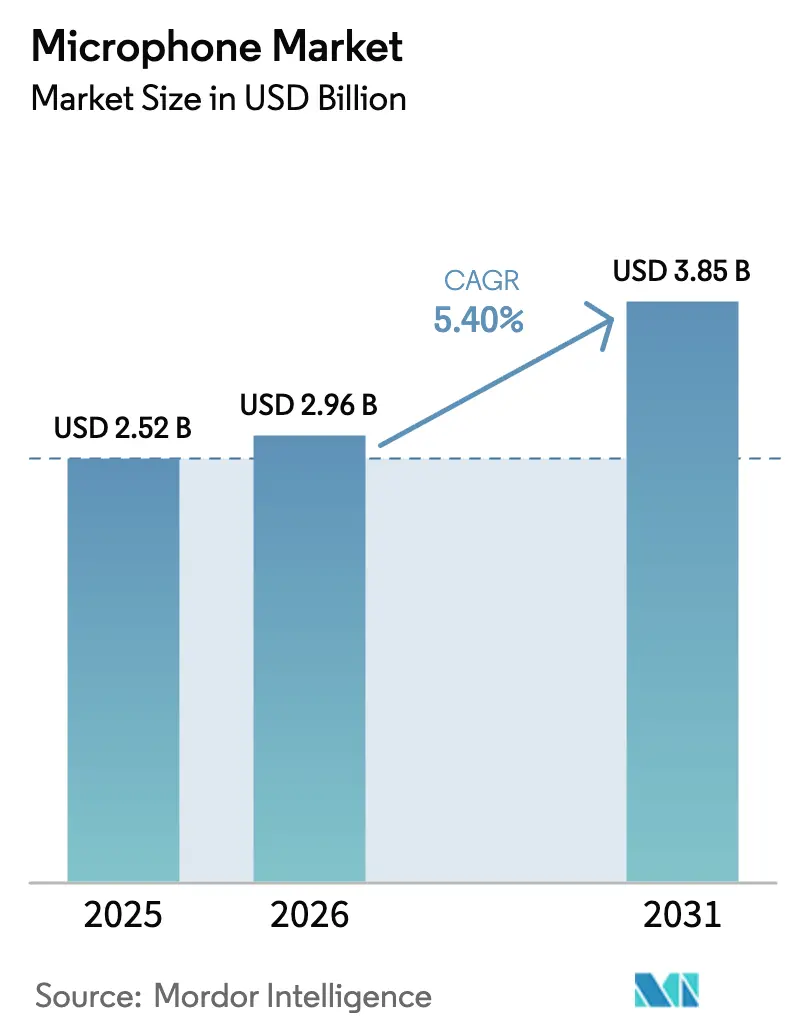
The Microphone market size is projected to expand from USD 2.52 billion in 2025 and USD 2.96 billion in 2026 to USD 3.85 billion by 2031, registering a 5.4% CAGR between 2026 and 2031. Shipments are shifting rapidly from legacy electret condenser capsules toward compact digital MEMS arrays as edge-AI voice processing, automotive electrification and enterprise hybrid-work infrastructure converge. Wireless configurations already dominate because regulators continue to re-farm sub-1 GHz spectrum, while the proliferation of true wireless earbuds hastens the migration to Bluetooth Low Energy and other 2.4 GHz protocols. Asia-Pacific suppliers leverage vertical integration and government incentives to hold cost advantages in MEMS fabrication, whereas Europe and North America emphasize compliance and premium audio performance. Consolidation continues as component makers bundle microphones with DSP, neural processors and amplifiers to capture more value per socket.
Key Report Takeaways
- By technology, MEMS microphones captured 56.81% of the Microphone market share in 2025 and are forecast to grow at a 5.88% CAGR through 2031.
- By product type, array and beam-forming modules are advancing at a 6.02% CAGR, the fastest in the segment hierarchy.
- By communication type, wireless systems accounted for 59.74% of the Microphone market size in 2025 and are projected to expand at 5.61% CAGR over 2026-2031.
- By end-user vertical, healthcare and medical devices are poised to rise at a 6.73% CAGR, outpacing all other industries.
- By geography, the Middle East region in the microphone market is forecast to post a 6.11% CAGR through 2031, the highest regional growth rate.
Note: Market size and forecast figures in this report are generated using Mordor Intelligence’s proprietary estimation framework, updated with the latest available data and insights as of January 2026.
Market Trends and Insights
Drivers Impact Analysis of Microphone Market*
| Driver | (~) % Impact on CAGR Forecast | Geographic Relevance | Impact Timeline |
|---|---|---|---|
| Proliferation of MEMS microphones in true-wireless earbuds across Asia | +1.2% | Asia-Pacific core, spillover to North America and Europe | Medium term (2-4 years) |
| Automotive OEM shift to in-cabin voice UX for EV platforms (Europe and North America) | +0.9% | Europe and North America, early adoption in China | Long term (≥4 years) |
| Rapid adoption of AI-enabled beam-forming arrays in enterprise UC equipment | +0.8% | Global, concentrated in North America and Europe | Short term (≤2 years) |
| Content-creator economy fueling premium handheld and USB mics (North America) | +0.5% | North America, Western Europe | Short term (≤2 years) |
| Government mandates for wireless spectrum re-farming driving digital migration | +0.6% | Global, regulatory pressure highest in North America and Europe | Medium term (2-4 years) |
| Surge in health-wearables deploying acoustic biosensing microphones | +1.0% | Global, led by North America and Asia-Pacific | Long term (≥4 years) |
| Source: Mordor Intelligence | |||
Proliferation of MEMS Microphones in True-Wireless Earbuds Across Asia
True wireless earbuds remained the primary driver of shipments in the Microphone market in 2025, as Asia-Pacific brands outproduced competitors elsewhere. Digital MEMS capsules, small enough to fit 3 mm × 4 mm slots, now support multi-mic active noise cancellation and far-field voice pickup while drawing minimal power. Syntiant’s 2024 acquisition of Knowles’ consumer MEMS unit aligns neural processors with sensors, reducing latency for always-on voice wake functions.[1]Knowles Corporation, “Knowles Completes Sale of Consumer MEMS Microphone Business,” KNOWLES.COM Chinese suppliers AAC Technologies and Goertek expanded 200 mm wafer capacity to serve domestic smartphone OEMs, further amplifying supply advantages. The shift to digital interfaces such as I²S simplifies PCB routing and reduces EMI, which matters more as Bluetooth 5.3 and LE Audio introduce tighter RF coexistence requirements.
Surge in Health-Wearables Deploying Acoustic Biosensing Microphones
Healthcare wearables are emerging as a major demand node because MEMS microphones enable continuous, non-invasive capture of cardio-respiratory signals with clinical-grade fidelity. A 2025 Scientific Reports study reported 93.21% accuracy in classifying lung sounds using MEMS sensors, validating the viability of remote auscultation. Device makers now pair sensors with on-device neural models that spot cough events and respiratory distress in real time, supporting telemedicine workflows. Growth is strongest in North America, where reimbursement codes for remote patient monitoring already exist, and in Asia-Pacific, where aging populations drive preventive-care spending. Suppliers that integrate acoustic sensors with low-power edge-AI increasingly win design slots because hospitals demand HIPAA-compliant, always-on endpoints that never upload raw voice data to the cloud.
Automotive OEM Shift to In-Cabin Voice UX for EV Platforms
Electric-vehicle cabins are quieter than those of internal-combustion models, enabling far-field voice assistants to operate reliably. BMW’s Alexa+ system, launched in 2026, employs distributed MEMS arrays along the headliner and pillars, delivering sub-300 ms wake-word response for navigation and climate commands. Mercedes-Benz has already deployed multi-zone voice control in more than 3 million vehicles. European and North American safety regulators endorse voice-over-touchscreens to reduce driver distraction, compelling OEMs to specify digital MEMS capsules with integrated DSPs for beamforming and echo cancellation. Tier-one suppliers bundle microphones with cameras and radar to create multimodal driver-monitoring suites, positioning themselves for Euro NCAP’s forthcoming interior-sensing requirements.
Rapid Adoption of AI-Enabled Beam-Forming Arrays in Enterprise UC Equipment
Hybrid-work policies sustain demand for ceiling arrays that remove table clutter and intelligently track speakers. Cisco’s Ceiling Microphone Pro features a 64-element array that forms eight adaptive beams, covering classrooms and boardrooms without fixed pickup zones.[2]Cisco Systems, “Cisco Ceiling Microphone Pro,” CISCO.COM Yamaha’s ADECIA firmware update in 2025 added AI De-Noiser acceleration and raised capacity to 64 wireless tabletop units per processor, addressing enterprise-scale needs. Integrators prefer these solutions because IEEE 802.1X authentication and SNMP monitoring slot easily into corporate IT routines. The result is shorter installation cycles and reduced reliance on standalone DSP hardware, an advantage in markets facing skilled-labor shortages.
Restraints Impact Analysis of Microphone Market*
| Restraint | (~) % Impact on CAGR Forecast | Geographic Relevance | Impact Timeline |
|---|---|---|---|
| RF congestion and interference risk in sub-1 GHz bands for wireless mics | -0.7% | North America and Europe, regulatory pressure on analog systems | Medium term (2-4 years) |
| BOM-cost inflation from silicon substrate shortages (MEMS fabs) | -0.6% | Global, acute in Asia-Pacific MEMS supply chain | Short term (≤2 years) |
| Counterfeit after-market capsules diluting brand value in Asia-Pacific | -0.4% | Asia-Pacific, concentrated in China and Southeast Asia | Long term (≥4 years) |
| Stringent EU WEEE/RoHS recycling targets raising compliance costs | -0.5% | Europe, spillover to exporters targeting EU markets | Long term (≥4 years) |
| Source: Mordor Intelligence | |||
RF Congestion and Interference Risk in Sub-1 GHz Bands for Wireless Mics
As the FCC auctions 600 MHz blocks to mobile carriers, analog wireless microphones lose clear spectrum, forcing users into the crowded 2.4 GHz ISM band. Digital systems offer encryption and eliminate companding artifacts but face packet-loss spikes when Wi-Fi, Bluetooth and Zigbee traffic peaks.[3]AKG Acoustics Engineering Team, “Comparing Digital and Analog Wireless Mic Systems,” AKG.COM The added complexity of channel scanning and firmware updates slows adoption among budget-constrained schools and theaters, holding back revenue growth in specific professional-audio niches within the Microphone market.
BOM-Cost Inflation from Silicon Substrate Shortages (MEMS Fabs)
Tight 150 mm and 200 mm wafer supply raised MEMS microphone input costs by double-digit percentages between 2024 and 2025. Knowles reported a 9.9% year-over-year revenue dip in Q3 2024, citing substrate shortages and customer inventory corrections. Some OEMs switched to China-based foundries backed by state subsidies, but geopolitical export-control risks add long-term uncertainty. Fabless designers without captive capacity endure the highest margin squeeze, slowing new-product cycles and tempering near-term Microphone market expansion.
*Our forecasts treat driver/restraint impacts as directional, not additive. The impact forecasts reflect baseline growth, mix effects, and variable interactions.
Microphone Market Segment Analysis
By Technology:
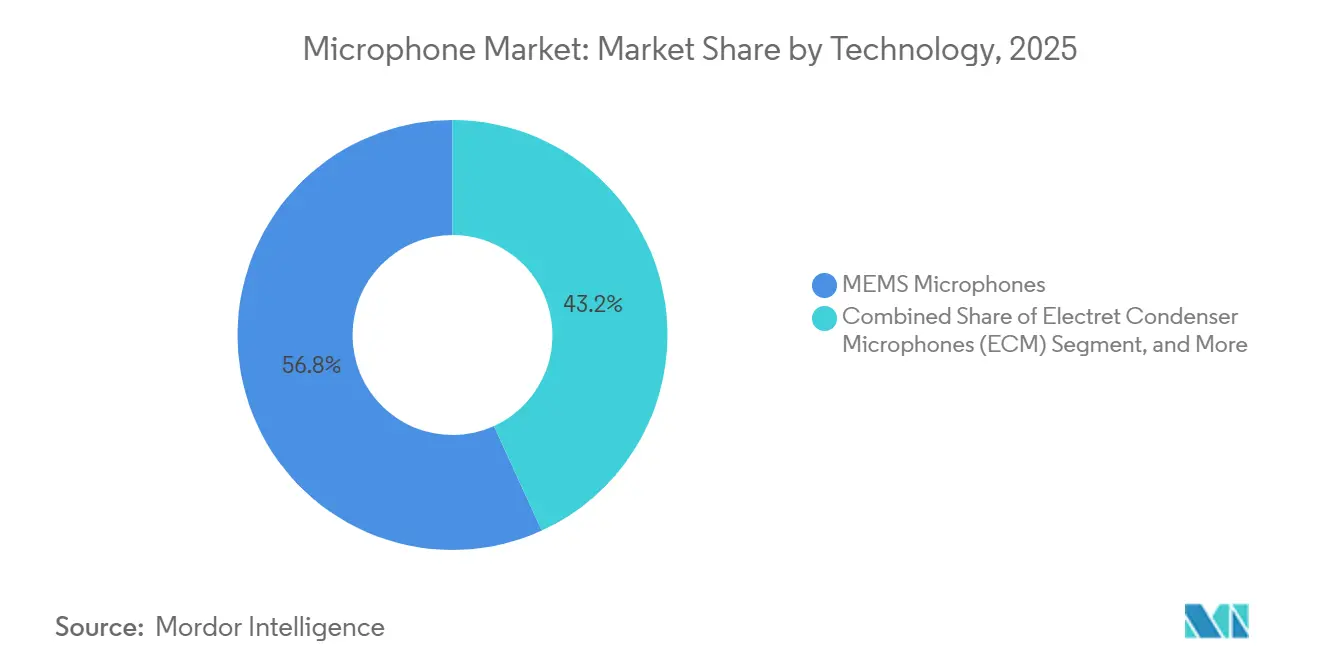
Digital MEMS Dominate Consumer Electronics IntegrationMEMS microphones held a 56.81% Microphone market share in 2025, and the segment is on track for a 5.88% CAGR through 2031. Digital variants displace analog MEMS because on-package A-to-D conversion eliminates EMI issues and reduces PCB complexity. Cirrus Logic began sampling an ultra-low-power voice-wake codec for AI-ready laptops in late 2025, signaling a fresh wave of demand for digital MEMS front ends. Electret condensers remain cost-effective for cost-sensitive applications, while dynamic capsules remain relevant for high-SPL applications like live sound. Ribbon microphones retain a boutique footprint in studio recording, valued for their figure-8 polar patterns. The Microphone market size attributable to MEMS is therefore expanding faster than the overall category as consumer electronics OEMs demand higher integration and lower power profiles.
Analog MEMS remain attractive for cabin-noise cancellation in automobiles and basic industrial monitoring, where simple analog chains suffice. Yet the ecosystem momentum behind I²S and SoundWire bus architectures ensures that digital MEMS will continue climbing the mix. Suppliers able to embed DSP or neural accelerators inside the microphone package differentiate on latency and power, critical for always-listening devices. Consequently, design wins now hinge on total module functionality rather than raw acoustic specifications, accelerating platform lock-in across smartphones, laptops and wearables.



By Product Type:
Array Modules Lead Enterprise Conferencing ShiftArray and beam-forming modules recorded the fastest growth rate at 6.02% CAGR as enterprises swapped boundary microphones for ceiling arrays that streamline meeting spaces. Head-worn systems held 32.47% of shipments in 2025 because fitness instructors and broadcasters value mobility; however, their unit growth trails that of arrays. Freestanding USB mics such as Logitech’s Blue Sona cater to the creator economy that prizes plug-and-play gain boosts.
Dynamic handheld microphones remain staples for live vocals, supported by condenser variants on instruments and in studio situations. Gooseneck models still anchor podiums but face encroachment from wireless tabletop units that remove cable management headaches. The microphone market size for array modules is set to widen as AI software bundles automate beamforming, echo cancellation, and noise suppression, reducing commissioning time for IT departments and integrators.
By Communication Type:
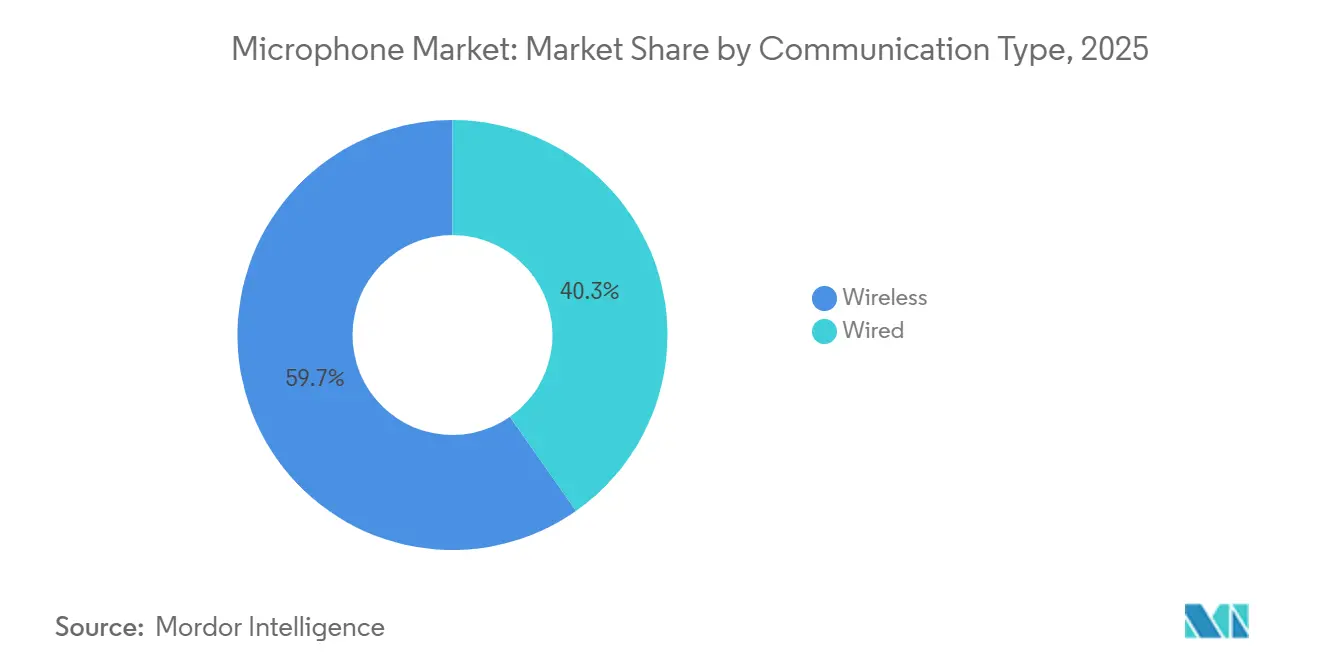
Wireless Gains Share Despite Spectrum ChallengesWireless solutions represented 59.74% of the Microphone market size in 2025 and should climb at 5.61% CAGR through 2031. Bluetooth LE Audio, proprietary 2.4 GHz links, and digital UHF platforms replace analog UHF systems displaced by spectrum auctions. Fitness studios, classrooms, and corporate presenters prioritize mobility over the higher latency and battery maintenance burdens, driving uptake.
Wired XLR connections persist in studios and broadcast control rooms where deterministic latency and long-distance balanced lines remain essential. Manufacturers mitigate 2.4 GHz congestion by layering frequency hopping and adaptive modulation, though these features raise bill-of-materials costs. As a result, wireless growth is strongest in segments that can tolerate potential packet loss, while mission-critical users occasionally revert to cables, preserving a stable wired revenue core of the microphone market.
By End-User Vertical:
Healthcare Emerges as Fastest-Growing SegmentConsumer electronics accounted for 41.82% of revenue in 2025, driven by smartphones and wearables that integrate multiple MEMS capsules per device. Healthcare applications-ranging from digital stethoscopes to respiratory patches-lead growth with a 6.73% CAGR as providers embrace tele-consultation workflows. Broadcasting and media outlets still invest in premium handheld and studio condensers to maintain signal quality for podcasts and live streams.
Corporate and institutional buyers adopt ceiling arrays and large-scale wireless systems to modernize hybrid-meeting suites. Live performance venues gradually refresh RF rigs as budgets recover post-pandemic. Automotive OEMs are moving to multi-mic arrays for voice assistants and interior noise control, a trend that is reinforcing MEMS penetration. Industrial and environmental monitoring remains a niche but is accelerating as rugged MEMS sensors gain IP-rated housings suitable for harsh environments. Together these shifts diversify the revenue base of the microphone market and insulate it from single-vertical volatility.
Geography Analysis
APAC Microphone Market
Asia-Pacific held 45.77% of global revenue in 2025, underpinned by China’s scale in MEMS wafer processing and module assembly. Local champions AAC Technologies and Goertek secure preferential supply for domestic smartphone giants, reinforcing regional dominance. Japan and South Korea focus on packaging innovation and high-SNR performance, while India and Southeast Asia attract new green-field plants that hedge geopolitical exposure.
North America and Europe Microphone Market
North America ranked second, buoyed by enterprise spending on hybrid-work upgrades and a vibrant creator economy purchasing premium USB and XLR devices. Content platforms such as YouTube and Twitch incentivize high-quality audio capture, creating a steady pull for mid-range condenser microphones. Europe emphasizes WEEE and RoHS compliance, concentrating share among established brands that can shoulder recycling costs. EU rules also encourage modular designs that simplify end-of-life disassembly, subtly altering product roadmaps for global vendors.
MEA and South America Microphone Market
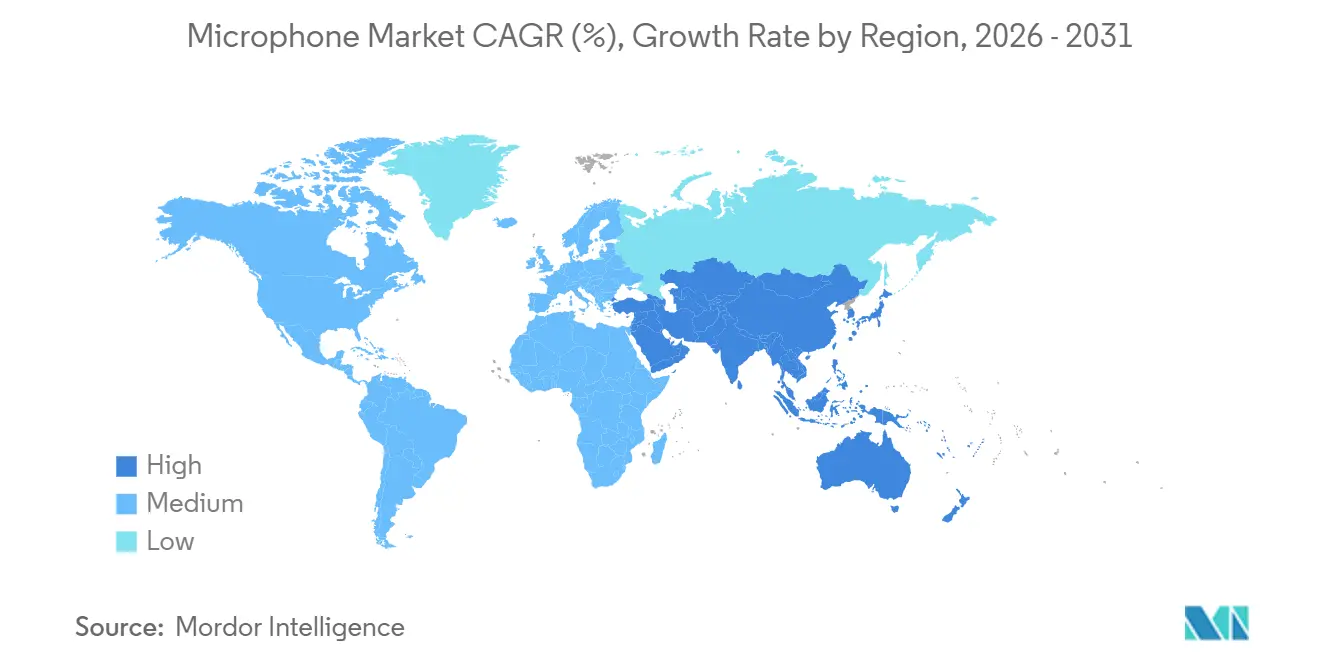
The Middle East and Africa region, though small in absolute dollars, is forecast to post the fastest expansion at 6.11% CAGR, driven by Saudi Arabia and the United Arab Emirates deploying telemedicine and distance-learning infrastructure. South America’s growth is moderate as macroeconomic headwinds curb capital outlays in broadcast and live-event markets. Overall, regional variations in regulatory policy, supply-chain incentives and digital-transformation budgets shape localized opportunity pockets within the microphone market.

Regulatory Landscape
Wireless microphone compliance is shaped by spectrum access rules and equipment-authorization requirements. In the United States, the Federal Communications Commission (FCC) governs operation under 47 CFR Part 15 (unlicensed) and Part 74 (licensed low power auxiliary). FCC equipment authorization is required for most transmit-capable systems, and in February 2024 the FCC adopted rules enabling Wireless Multichannel Audio Systems (WMAS) to operate with wider bandwidths (up to 20 MHz), improving spectral efficiency for dense professional deployments.
In Europe, market access depends on CE marking and conformity assessment under the Radio Equipment Directive (RED) 2014/53/EU for wireless products, alongside the EMC Directive 2014/30/EU and LVD 2014/35/EU for applicable mains-powered devices. This is supported by harmonised standards such as ETSI EN 300 422 and ETSI EN 301 489. Environmental and product-safety compliance can also affect microphone OEMs shipping into the EU, including RoHS substance restrictions and the EU General Product Safety Regulation (EU) 2023/988 obligations, such as designating an EU representative for in-scope products placed on the market.
Value Chain Analysis
The value chain starts with raw materials and semiconductor inputs (silicon wafers, ASICs/DSPs, package substrates, magnets/diaphragms for dynamic capsules). It then moves through MEMS fabrication, acoustic transducer manufacturing, assembly and packaging (often system-in-package for digital MEMS), calibration and acoustic testing, and finally integration into finished microphones or modules (arrays, wireless handheld/headworn devices, and USB offerings). Downstream, distribution flows through consumer-electronics OEM channels (smartphones, TWS, laptops), pro-audio integrators and dealers, automotive tier-one suppliers, and healthcare-device manufacturers. For wireless systems, aftersales support is increasingly tied to firmware and RF configuration.
Recent supply-chain changes also point to consolidation and localization. Knowles completed the sale of its Consumer MEMS Microphones business to Syntiant in December 2024, reflecting a shift toward bundling sensing with edge-AI silicon and tightening control over key front-end IP. On the manufacturing side, Infineon Technologies and Kaynes Semicon signed an MoU in September 2025 to establish India’s first MEMS microphone and advanced semiconductor packaging facility in Gujarat, aligning with broader diversification away from China-centric capacity for risk and logistics management. Bottlenecks still cluster around specialized MEMS wafer capacity, high-throughput acoustic testing and calibration, and availability of complementary analog and mixed-signal components, which can extend lead times during demand spikes.
Competitive Landscape
The Microphone market is moderately fragmented. Traditional audio houses-Shure, Sennheiser, and Audio-Technica-defend premium dynamic and condenser segments, leaning on decades-old brand trust and global channel reach. MEMS-focused semiconductor vendors such as Infineon, STMicroelectronics, TDK-InvenSense, and Knowles compete on noise floor, package size, and power metrics.
Syntiant’s USD 150 million purchase of Knowles’ consumer MEMS line in 2024 encapsulates a trend toward vertically integrating sensors with neural inference silicon, enabling turnkey always-on voice designs that conserve battery life. Harman’s USD 350 million acquisition of Masimo’s audio assets in 2025 signals that automotive and professional-audio integrators want complete microphone-to-speaker stacks that include DSP software. DPA Microphones’ majority stake in Austrian Audio shows boutique studio brands consolidating to defend engineering depth and European manufacturing heritage.
Chinese incumbents AAC Technologies and Goertek leverage captive fabs and state incentives to offer cost-optimized MEMS modules, pressuring Western suppliers on high-volume consumer deals. Meanwhile, Cisco, Yamaha and Crestron differentiate enterprise arrays through software ecosystems and security integration, emphasizing manageability over raw acoustic specs. Suppliers that can deliver full-stack solutions-sensor, processor, algorithm and cloud hooks-capture higher average selling prices and tighten customer lock-in, positioning themselves favorably as the Microphone market transitions to AI-centric architectures.
Microphone Industry Leaders
Knowles Corporation
AAC Technologies Holdings
Sony Corporation
Shure Incorporated
Goertek Inc.
- *Disclaimer: Major Players sorted in no particular order

Microphone Market Companies Covered in this Report
- Shure Incorporated
- Sennheiser Electronic GmbH and Co. KG
- Audio-Technica Corporation
- AKG Acoustics
- Georg Neumann GmbH
- Sony Corporation
- Harman International (Inc. AKG, JBL)
- Logitech International (Blue Microphones)
- RODE Microphones
- Knowles Corporation
- AAC Technologies Holdings Inc.
- Goertek Inc.
- TDK Corporation
- Infineon Technologies AG
- Robert Bosch GmbH
- STMicroelectronics N.V.
- Cirrus Logic Inc.
- Omron Corporation
- Hosiden Corporation
- Valeo SA
- Qorvo Inc.
- Yamaha Corporation

Market Opportunities and Future Outlook
A clear opportunity is the move from discrete capsules toward intelligent microphone modules that combine sensing, array processing, and AI-enabled noise management in small footprints. This shift shows up in enterprise and institutional deployments, where ceiling arrays and software-managed audio endpoints reduce dependence on external DSP hardware and simplify provisioning. It also appears in consumer prosumer devices, where wireless systems add onboard processing to stabilize voice capture in noisy environments. Product activity in 2026 supports this direction: Shure introduced the MXA925 ceiling array microphone with AI-enabled IntelliMix DSP (June 2026), and Insta360 launched Mic Pro with a three-microphone array and AI-powered noise cancellation (May 2026), reinforcing demand for higher-value array and processing-capable designs.
Technology whitespace is also forming around next-generation MEMS architectures that aim to improve noise floor and overload limits while preserving manufacturability for high volume. Industry coverage of optical MEMS microphones points to improved SNR and higher acoustic overload points versus traditional capacitive MEMS, and vendors are signaling investment in MEMS-based pro-audio capture: RODE introduced its Sonaura studio-grade MEMS microphone technology in collaboration with Infineon Technologies (April 2026). In parallel, healthcare and medical devices continue to open integration pathways for MEMS microphones beyond voice, as acoustic biosensing and remote auscultation workflows pull demand for low-power, high-SNR sensors and robust calibration in regulated device environments.
Recent Industry Developments in Microphone Market
- June 2026: Shure introduced the MXA925 ceiling array microphone with AI-enabled IntelliMix DSP for enterprise and institutional collaboration spaces. The launch reinforces a shift toward software-defined beamforming and endpoint-side processing that reduces the need for separate DSP boxes and simplifies IT-managed deployments.
- November 2025: AAC Technologies collaborated with Alibaba to integrate a custom five-microphone array and bone conduction system into the Quark AI Glasses S1. The design highlights tighter co-development between microphone suppliers and wearable OEM ecosystems, increasing demand for compact arrays optimized for always-on assistants and near-field pickup.
- December 2024: Knowles completed the sale of its Consumer MEMS Microphone business to Syntiant for USD 150 million. The transaction accelerates consolidation around sensor-plus-edge-AI stacks and signals a strategic pivot toward higher-value microphone applications that pair acoustic front ends with on-device inference.


Microphone Market Report Scope and Research Methodology
Market Definition and Coverage
For this methodology, the microphone market covers revenues from stand-alone wired and wireless microphones sold as finished devices or finished components that convert sound into an electrical output for use in consumer, professional, automotive, and industrial settings.
Scope exclusions: We exclude integrated acoustic dies embedded inside chipsets, pure software voice processing tools, and refurbished units.
Segments Covered in This Report
- By Technology
- MEMS Microphones
- Analog MEMS
- Digital MEMS
- Electret Condenser Microphones (ECM)
- Dynamic Microphones
- Ribbon Microphones
- MEMS Microphones
- By Product Type
- Handheld
- Head-worn
- Gooseneck
- Freestanding / USB
- Array and Beam-forming Modules
- By Communication Type
- Wired
- Wireless
- By End-user Vertical
- Broadcasting and Media
- Consumer Electronics
- Corporate and Institutional
- Live Performances and Events
- Automotive
- Healthcare and Medical Devices
- Industrial and Environmental
- By Geography
- North America
- United States
- Canada
- Mexico
- Europe
- Germany
- United Kingdom
- France
- Italy
- Spain
- Rest of Europe
- Asia-Pacific
- China
- Japan
- South Korea
- India
- South East Asia
- Australia
- Rest of Asia-Pacific
- South America
- Brazil
- Argentina
- Rest of South America
- Middle East
- United Arab Emirates
- Saudi Arabia
- Rest of Middle East
- Africa
- South Africa
- Nigeria
- Rest of Africa
- North America
Data Sources, Market Sizing, and Validation
Desk Research
Desk work starts with building a clean view of where microphones are used and how demand moves across devices and industries. We relied on public sources such as USITC trade statistics, UN Comtrade, World Bank macro indicators, and OECD industry datasets to sanity check shipment direction, price pressure, and geographic exposure.
To keep the model grounded, we also reviewed company filings and investor presentations, product catalogs, and reputable press coverage around launches and capacity changes. In a few places, a paid subscription database was used only to standardize company financials, patent activity, and import export shipment patterns, which then helped us avoid double counting across similar product formats. The sources listed here are illustrative, and other public references were also used for data collection, validation, and clarification.
Primary Interviews and Surveys
Primary interviews and surveys were used to pressure test the demand pool and pricing assumptions across consumer devices, pro audio, automotive, and industrial uses. We spoke with participants across manufacturing, distribution, and procurement roles so that ASP ranges, wireless adoption, and replacement cycles could be checked, then refined across major regions.
Distribution of primary research fieldwork respondents
| Company type | Respondent position | Region |
|---|---|---|
| Top tier: 36% | CXOs: 12% | APAC: 42% |
| Mid tier: 42% | Functional/Unit leaders: 32% | EMEA: 34% |
| Smaller Players: 22% | Managers: 56% | Americas: 24% |
Market-Sizing & Forecasting
Sizing was built using a top-down approach where device production, trade flows, and end market adoption were used to reconstruct microphone demand, followed by pricing checks to translate volumes into value. Before totals were finalized, selective bottom-up approximations were applied using sampled ASP by format and channel checks, which helped adjust for mix shifts between wired and wireless products.
Key inputs used in the model include estimated unit demand from consumer electronics and pro audio equipment cycles, wireless penetration and spectrum related migration pace, average selling price progression by product format, automotive content per vehicle trends (voice features and cabin monitoring), and regional manufacturing and import patterns. When coverage gaps showed up in smaller channels or niche formats, assumptions were filled using proxy device volumes and interview based ranges, and then revisited during internal review. Forecasting was done with scenario analysis so that adoption speed, pricing pressure, and macro demand swings could be flexed, and the final path was aligned to what interviewees considered the most realistic outlook.
Data Validation & Update Cycle
Validation is handled through a few repeatable checks that look for inconsistencies across value, volume, and regional splits. We compare modeled outputs against independent signals such as trade totals, macro demand direction, and observed product mix shifts, and any sharp variances are reviewed before sign off.
If a driver moves materially, such as a change in wireless adoption, large pricing resets, or a supply disruption, we re contact sources and rerun the impacted parts of the model. Reports refresh annually, with interim updates when events are significant, and a final pre delivery review is completed so clients receive the latest view available at the time.
Mordor Intelligence's Microphone Market Sizing Compared With Other Published Estimates
Published market sizes for microphones can differ by a lot, even when the topic name looks the same, because the counted products and the pricing logic are not always aligned. Differences also come from whether the estimate is anchored on a device demand pool versus supplier revenue, and how often assumptions are refreshed.
The biggest gap drivers we saw were scope choices (stand-alone microphones versus mic elements inside chipsets), how wireless products are valued when bundles include extra electronics, and the year used for currency conversion and inflation handling. Some estimates also lean on a single growth path without checking it against trade movement or end market unit trends, which can widen the spread during periods of mix change.
Benchmark comparison
| Source | Market Size | Gaps in Research Methodology |
|---|---|---|
| Mordor Intelligence | USD 2.96 B (2026) | |
| Industry Research Publisher A | USD 2.82 B (2026) | Typically treats parts of the supply chain more narrowly, with limited adjustment for mix shifts between wired and wireless formats, which can keep the value estimate lower in years when wireless share rises. |
| Industry Research Publisher B | USD 2.80 B (2025) | Uses a different base year and often applies a broad product definition that may not clearly separate finished microphones from adjacent audio capture components, creating timing and scope differences versus the 2026 view. |
The table shows that timing and product inclusion choices explain most of the spread, more than any single growth assumption. By separating stand-alone microphones from integrated mic dies and checking pricing ranges with interviews before locking the year value, the estimate stays traceable to a repeatable demand pool, a modeling choice used by Mordor Intelligence.


Key Questions Answered in the Report
How large will the Microphone market be by 2031?
Forecasts indicate it will reach USD 3.85 billion by 2031 at a 5.4% CAGR from 2026 to 2031.
Which technology leads current revenue?
MEMS microphones held 56.81% of Microphone market share in 2025 and remain the growth engine through 2031.
Why are array microphones growing so quickly?
Enterprise hybrid-work investments favor ceiling arrays that track multiple speakers and integrate AI beamforming, driving a 6.02% CAGR for this product type.
What vertical shows the fastest demand rise?
Healthcare and medical devices post a 6.73% CAGR because acoustic biosensing enables remote respiratory and cardiac monitoring.
Which region is expanding the quickest?
The Middle East and Africa Microphone market is projected to grow at 6.11% CAGR thanks to telemedicine and digital-government programs.
How are suppliers responding to spectrum re-allocation?
Vendors migrate from analog UHF to encrypted 2.4 GHz digital links and add frequency-hopping algorithms to mitigate congestion issues.
Page last updated on:


 Your data is secure and never sold or shared.


