
Poland Pet Nutraceuticals Market Size and Share
Market Overview
| Study Period | 2021 - 2031 |
|---|---|
| Forecast Data Period | 2026 - 2031 |
| Base Year Market Size (2025) | USD 71.81 Million |
| Market Size (2026) | USD 79.43 Million |
| Market Size (2031) | USD 120.81 Million |
| Growth Rate (2026 - 2031) | 8.75 % |
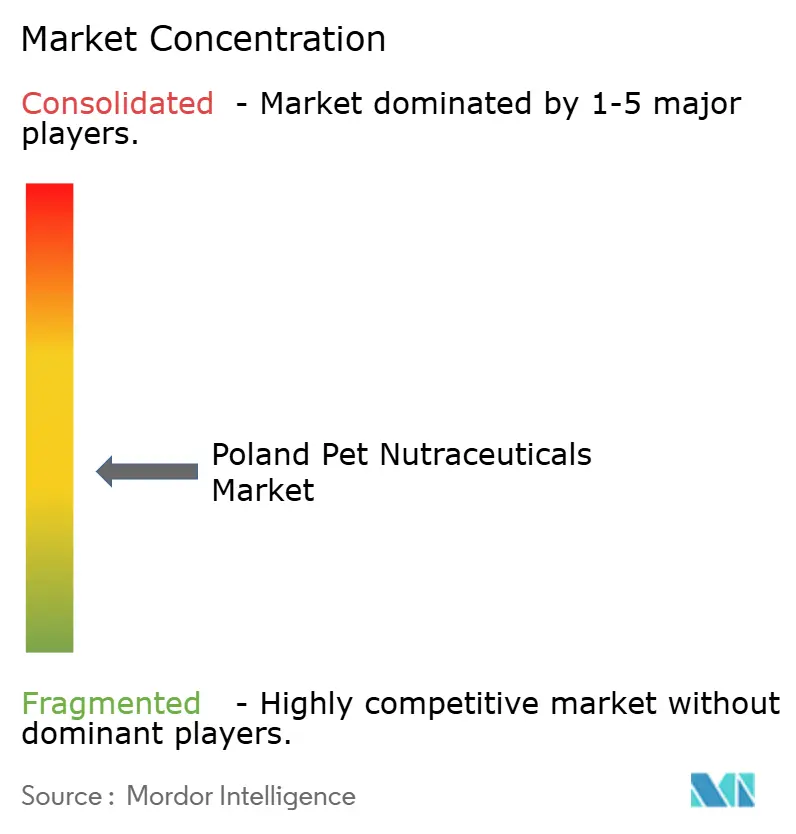
| Market Concentration | Medium |
Major Players *Disclaimer: Major Players sorted in no particular order Image © Mordor Intelligence. Reuse requires attribution under CC BY 4.0. | |
Poland Pet Nutraceuticals Market Analysis by Mordor Intelligence
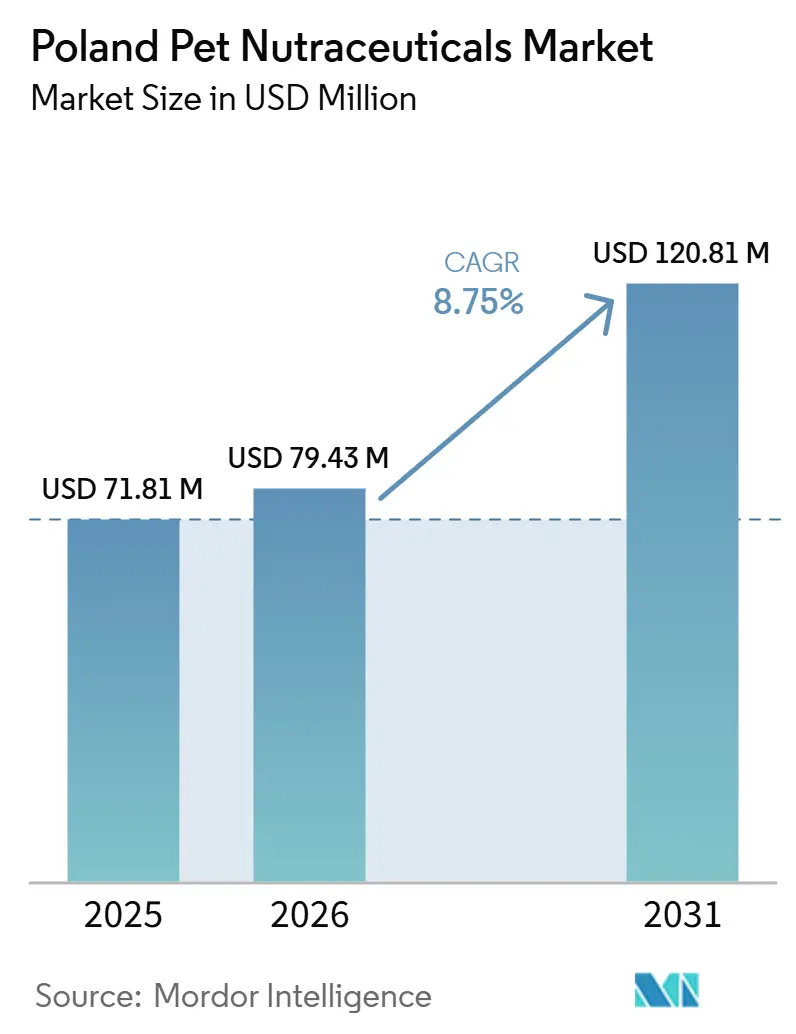
The Poland pet nutraceuticals market size is projected to expand from USD 71.81 million in 2025 and USD 79.43 million in 2026 to USD 120.81 million by 2031, registering a CAGR of 8.75% between 2026 and 2031. Poland’s high dog ownership base, with 8.4 million dogs in 2025, according to the European Pet Food Industry Federation (FEDIAF), supported steady demand for joint, digestive, and recovery supplements, especially in categories that already have strong veterinary acceptance. The market is also gaining support from urban buyers who are applying human wellness habits to pet care, which is lifting interest in clean labels, ingredient transparency, and condition-specific formulations. Distribution is broadening as digital access and veterinary channels make specialized products easier to find, compare, and reorder nationwide. Competitive activity remains active, with global and local brands using acquisitions, digital tools, and clinic-led positioning to build presence in the Poland pet nutraceuticals market. The main pressure points still come from price sensitivity outside major cities and the regulatory burden attached to feed materials and functional claims.
Key Report Takeaways
- By sub product, proteins and peptides held 23.5% of Poland pet nutraceuticals market size in 2025, while milk bioactives recorded the fastest projected expansion at a 6.9% CAGR between 2026 and 2031.
- By pets, dogs held 52.2% of Poland pet nutraceuticals market share in 2025, whereas cats recorded the highest projected CAGR of 8.6% between 2026 and 2031.
- By distribution channel, supermarkets and hypermarkets accounted for 35.9% of Poland pet nutraceuticals market share in 2025, while the online channel advanced at the highest forecast CAGR of 9.3% between 2026 and 2031.
Note: Market size and forecast figures in this report are generated using Mordor Intelligence’s proprietary estimation framework, updated with the latest available data and insights as of January 2026.
Poland Pet Nutraceuticals Market Trends and Insights
Drivers Impact Analysis*
| Driver | (~) % Impact on CAGR Forecast | Geographic Relevance | Impact Timeline |
|---|---|---|---|
| Rising Pet Health Premiumization in Poland | +2.00% | Poland core urban markets, including Warsaw, Krakow, Wrocław, and Poznań | Short term (≤ 2 years) |
| Expanding Veterinary Recommendation of Preventive Supplements | +1.50% | National, with early gains in cities with high veterinary clinic density | Medium term (2-4 years) |
| Faster Online Access to Specialized Pet Nutraceuticals | +1.40% | National, especially urban and peri urban electronic commerce clusters | Short term (≤ 2 years) |
| Human-Grade Ingredient Positioning and Clean Label Demand | +1.00% | Premium urban segments, with gradual spillover into secondary cities | Medium term (2-4 years) |
| Veterinary Microbiome Testing and Personalized Nutrition | +0.80% | National, with early gains in specialist clinics in major cities | Long term (≥ 4 years) |
| Cold-Chain-Light Formulations for Emerging Eastern European Distribution | +0.60% | National, with stronger effect in sub regional and rural distribution networks | Medium term (2-4 years) |
| Source: Mordor Intelligence | |||
Rising Pet Health Premiumization in Poland
The Poland pet nutraceuticals market is benefiting from a clear shift in owner behavior, where supplements are moving closer to routine care rather than occasional problem-solving. In 2025, Poland had the fifth-largest dog population in Europe, with approximately 8.4 million dogs, according to the European Pet Food Industry Federation. This represented a significant installed base for repeat purchases of pet nutraceutical products focused on mobility, digestion, immune support, and overall wellness. This matters because premiumization works best when owners are already emotionally invested and willing to spend more per animal on preventive care. The same pattern is visible in veterinary supplement lines that highlight ingredient quality and targeted use rather than simple mass appeal. In practice, that supports stronger pricing in proteins and peptides, joint care products, and senior formulations that need more specialized ingredients. It also shortens the adoption cycle for new formats because buyers who already accept premium nutrition are more open to adjacent preventive products. The Poland pet nutraceuticals market, therefore, gains from a demand base that is not only large but also increasingly willing to trade up when value is framed around pet health outcomes. That combination helps explain why premium categories are holding value even while the broader retail environment remains price aware.
Expanding Veterinary Recommendation of Preventive Supplements
Veterinary recommendation remains one of the strongest trust drivers in the Poland pet nutraceuticals market because owners often rely on clinicians when choosing products linked to joint support, digestive balance, and recovery care. The veterinary endorsement is becoming more important as nutraceuticals are used alongside diagnostic-driven treatment plans in Poland. This strengthens repeat buying because products introduced in clinics usually enter the home with a clearer use case and a stronger compliance message. Animal Nutraceuticals sp. z o.o. has built vet-exclusive lines around this model, which shows how the channel can support premium positioning and narrower clinical targeting. The wider regulatory framework also reinforces the role of veterinarians because claim interpretation and compliant product positioning matter more in a controlled channel than in mass retail[1]Source: European Union, “Regulation (EC) No 1831/2003 on Additives for Use in Animal Nutrition,” Official Journal of the European Union, eur-lex.europa.eu. Products that come through clinics can therefore command better trust and better repurchase rates than items bought on impulse. The Poland pet nutraceuticals market is likely to keep benefiting from this pattern as veterinary education and clinical familiarity deepen across urban centers. Over time, that should help preventive supplementation look more normal and less discretionary for Poland pet owners.
Faster Online Access to Specialized Pet Nutraceuticals
The Poland pet nutraceuticals market is also moving forward because digital channels reduce access barriers that used to limit specialized products to a few stores or clinics. Online platforms can carry narrower formulations that physical shelves often cannot support, especially in probiotic blends, milk bioactives, and premium peptide products. This expands choice for owners outside the largest cities and gives niche brands a practical route to national visibility. Digital engagement is becoming even more relevant as Mars, Incorporated has invested in artificial intelligence-based pet health tools that connect observations to nutrition and supplement suggestions in 2025[2]Mars, Incorporated. “Mars Puts Pet Health in Pet Parents’ Hands with New Artificial Intelligence-Powered Tools,” May 6, 2025, mars.com. That kind of ecosystem supports education, comparison, and repeat ordering in one place. It also helps bridge the gap between veterinary recommendations and actual purchases because owners can search and reorder after a clinic visit without depending on local stock. The Poland pet nutraceuticals market stands to benefit from this convenience because it fits categories that often need ongoing use rather than a one-time trial. As a result, online growth supports both reach and retention, which makes it more than a simple channel shift.
Human Grade Ingredient Positioning and Clean Label Demand
Clean label demand is becoming a meaningful force in the Poland pet nutraceuticals market because urban owners are reading pet supplement labels with the same scrutiny they apply to their own wellness products. This benefits products built around recognizable ingredients, simpler formulas, and clearer sourcing language. Animal Nutraceuticals sp. z o.o. has leaned into this preference through pharmaceutical-grade positioning in its veterinary lines, showing how ingredient quality can serve both clinicians and consumers. That approach matters because clean label value is not only about the removal of additives, it is also about confidence in purity and intended effect. In a market where education is still developing, transparency can shorten the path from curiosity to first purchase. The Poland pet nutraceuticals market, therefore, gains when brands can explain function and quality in plain terms without overreaching on claims. This driver is especially relevant for premium dog and cat products, where owners are already more willing to compare composition before purchase.
Restraints Impact Analysis*
| Restraint | (~) % Impact on CAGR Forecast | Geographic Relevance | Impact Timeline |
|---|---|---|---|
| Low Consumer Price Tolerance Outside Core Urban Centers | -1.20% | Rural areas and secondary Polish cities outside the top 5 urban centers | Short term (≤ 2 years) |
| Regulatory Complexity Across Functional Claims and Feed Additives | -0.90% | National, with uniform European Union level application | Medium term (2-4 years) |
| Limited Local Manufacturing of High-Purity Actives | -0.70% | National, with import dependent supply chain exposure | Medium term (2-4 years) |
| Product Trust Gaps Versus Conventional Pet Food | -0.50% | Rural markets and cost sensitive urban segments | Short term (≤ 2 years) |
| Source: Mordor Intelligence | |||
Regulatory Complexity Across Functional Claims and Feed Additives
Regulation is a material restraint in the Poland pet nutraceuticals market because products must fit within strict rules on feed additives, feed materials, and labeling language. European Union Regulation (EC) No 1831/2003 governs additives used in animal nutrition, while European Union Regulation (EC) No 767/2009 sets the framework for placing feed on the market and using compliant product information[3]Source: European Union, “Regulation (EC) No 767/2009 on the Placing on the Market and Use of Feed,” Official Journal of the European Union, eur-lex.europa.eu. These rules do help market quality, but they also raise the burden of proof for companies that want to commercialize newer actives or more explicit functional claims. Smaller firms usually feel that burden more sharply because they have fewer internal resources for regulatory work. Product development can therefore take longer, cost more, and require more careful wording even when the commercial idea is sound. This slows innovation speed and favors companies with stronger regulatory teams and international experience. The Poland pet nutraceuticals market still benefits from high-quality standards, but the compliance process can reduce launch flexibility. In practical terms, that means some niche concepts will reach the market later than demand conditions might otherwise allow.
Limited Local Manufacturing of High Purity Actives
The Poland pet nutraceuticals market also faces supply-side pressure because many higher-purity active ingredients are not widely available through local production. Categories such as premium proteins, peptides, and specialized bioactives depend on consistent sourcing quality if they are to maintain veterinary credibility and repeat use. When domestic availability is limited, brands become more exposed to imported input costs, lead times, and supplier concentration. That exposure is especially relevant for products that market purity, traceability, or pharmaceutical grade handling as part of their value proposition[4]Source: Animal Nutraceuticals sp. z o.o., “Naturalne Suplementy Dla Psa I Kota,” Animal Nutraceuticals, animal-nutraceuticals.pl. It can also narrow the pricing room available to local brands that want to compete with larger multinationals. VAFO Group’s move to deepen its physical presence in Poland underlines how valuable local capacity and local distribution control can become in this environment. The Poland pet nutraceuticals market, therefore, remains vulnerable to upstream constraints even when consumer demand is healthy. Until ingredient sourcing and domestic production depth improve, this restraint will keep margins and launch speed under pressure.
*Our forecasts treat driver/restraint impacts as directional, not additive. The impact forecasts reflect baseline growth, mix effects, and variable interactions.
Segment Analysis
By Sub Product: Proteins and Peptides Lead on Value, Milk Bioactives Gain Momentum
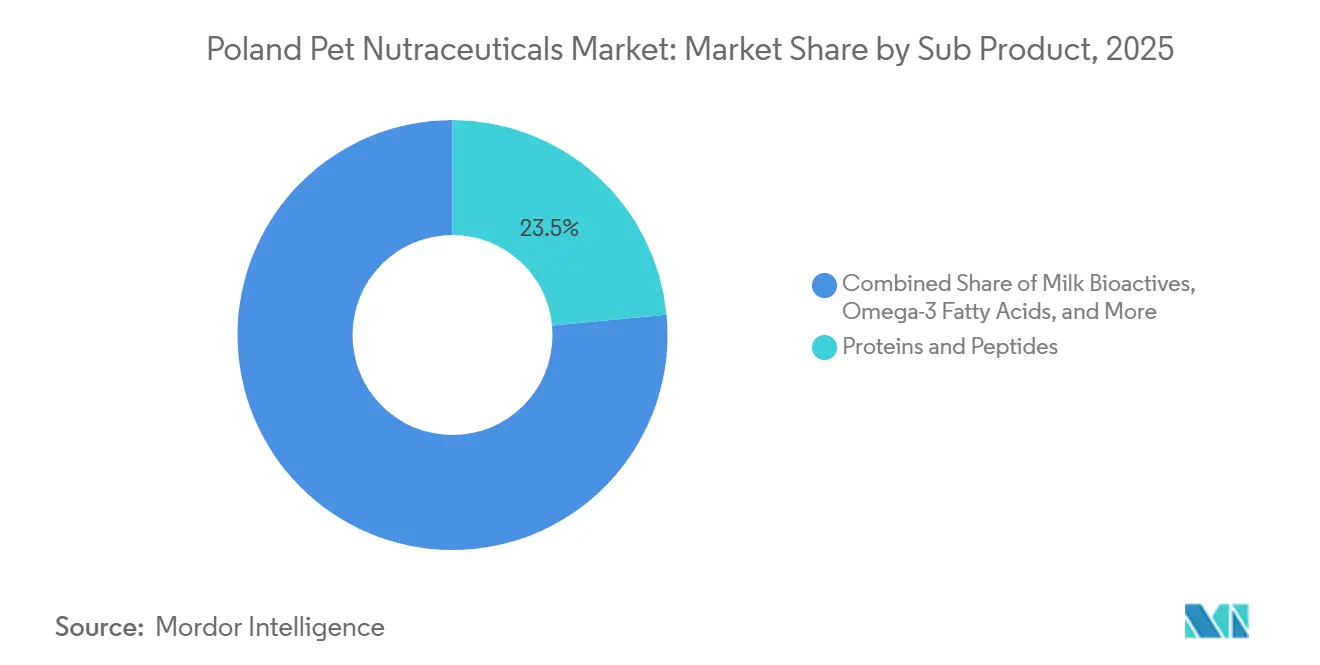
Proteins and peptides accounted for 23.5% of revenue in 2025, giving the category the largest share of the Poland pet nutraceuticals market size among sub-products. Their lead came from strong use in senior care, post-procedure recovery, and clinical mobility support, where owners and veterinarians are more willing to pay for specialized formulations. Vitamins and minerals and probiotics remained important volume drivers, while omega-3 fatty acids, milk bioactives, and other nutraceuticals added depth to the category mix. This keeps demand spread across both routine and condition-specific use cases.
Milk bioactives are anticipated to record the fastest expansion, with a 6.9% CAGR through 2031 in the Poland pet nutraceuticals market. That growth reflects stronger owner familiarity with immunoglobulins and bioactive proteins, along with demand for ingredients that sound closer to human wellness logic. Omega-3 fatty acids should remain commercially important because dermatology and cardiovascular support are already established uses in companion animals. Probiotics, vitamins, and minerals are also likely to maintain steady traction as accessible entry points into supplementation. Other nutraceuticals can widen the premium mix as more targeted concepts enter veterinary and specialty channels.



By Pets: Dogs Anchor Demand, Cats Offer the Best Expansion Path
Dogs held 52.2% of revenue in 2025, which means they captured the largest share of the Poland pet nutraceuticals market by pet type. This position reflects Poland’s large dog ownership base and the heavier use of mobility, digestive, and recovery products in dogs than in other companion animals. Cats remained the next important opportunity because their health needs support, renal, urinary, skin, and digestive supplementation. Other pets, including birds, rodents, and reptiles, formed a smaller and more specialized demand pocket that stayed tied to clinics and niche retail.
Cats are anticipated to grow at a fastest CAGR of 8.6% between 2026 and 2031. Their upside comes from underpenetration, younger urban ownership patterns, and room for more specialized formats that solve palatability and dose delivery issues. Dogs should remain the revenue anchor because repeat use and larger product baskets are already well established in canine care. Other pets are likely to stay niche, but they can support stable incremental demand through specialist veterinary channels. This keeps the Poland pet nutraceuticals industry broad enough to support targeted product development without changing its canine-led structure.
By Distribution Channel: Supermarkets and Hypermarkets Hold Scale, Online Leads Growth
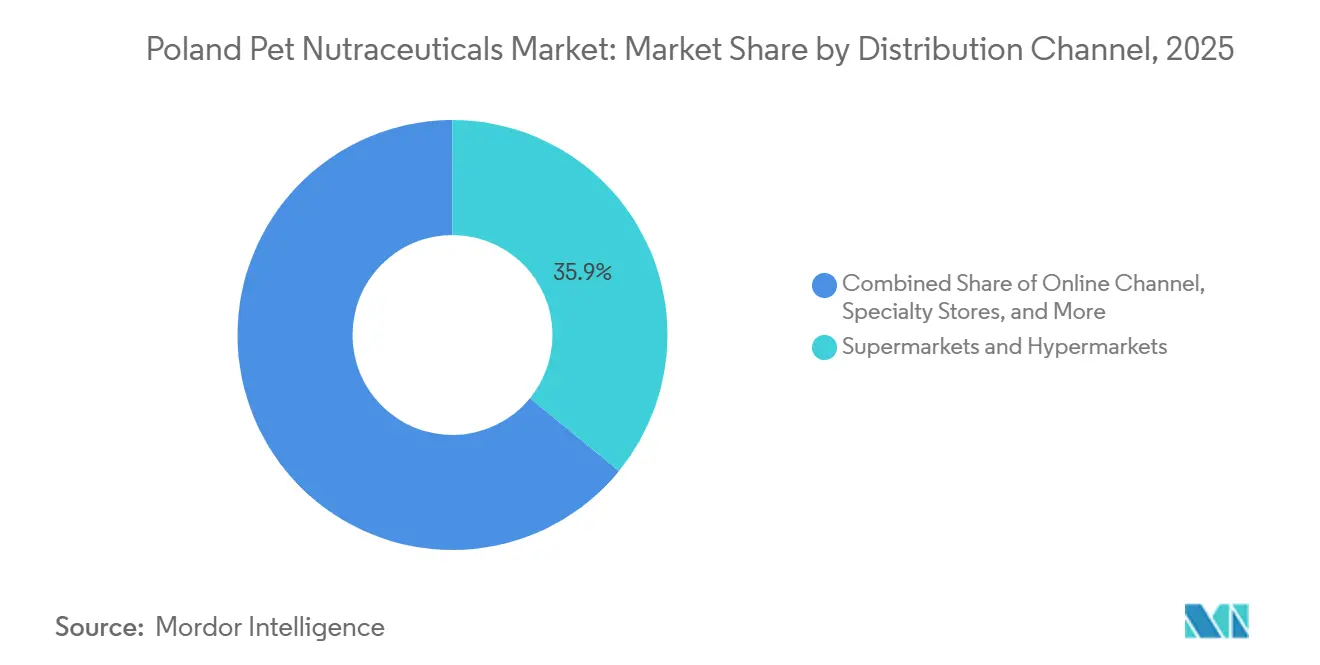
Supermarkets and hypermarkets represented 35.9% of revenue in 2025, which made them the largest route to market in the Poland pet nutraceuticals market by distribution channel. Their scale came from national retail reach and frequent everyday shopping behavior, which helps basic supplement categories move in larger volumes. Specialty stores continued to matter because they provide more explanation and a better setting for premium formulas. The online channel also became more visible in the mix, while convenience stores and other distribution channels added smaller but still relevant access points for routine and clinic-linked purchases.
The online channel is anticipated to advance at the fastest pace, with a 9.3% CAGR between 2026 and 2031 in the Poland pet nutraceuticals market. Its role is expanding because digital shelves can carry narrower assortments, support repeat ordering, and connect product discovery with pet health content. Supermarkets and hypermarkets should remain central for broad visibility, but they are less suited to premium clinical positioning. Specialty stores are likely to retain a useful middle ground by combining product access with guided selling. Other distribution routes, especially veterinary-linked sales, should keep growing where trust and recommendation matter most.
Geography Analysis
In Poland, the demand is still concentrated in the main urban clusters rather than evenly spread across the territory. Warsaw, Kraków, Wrocław, Poznań, and the Tri City area remain the strongest locations for premium supplement purchases because veterinary density, disposable income, and awareness are all higher there. These cities also create better conditions for products that depend on education and repeat use, such as peptides, probiotics, and joint support formulas.
The Poland pet nutraceuticals market is supported by the country's significant dog ownership, with a dog population of 8.4 million in 2025, according to the European Pet Food Industry Federation. This provides a broader base for canine-focused formulations compared to many neighboring markets. Urban demand is also more receptive to clean label positioning and condition-specific health claims, especially when products are introduced through veterinarians or premium retail channels. Outside the largest cities, the market remains more price sensitive and more dependent on simple value communication. That slows conversion for higher-priced supplements, even when awareness of pet health is improving. Digital access is helping reduce this gap because owners can search, compare, and reorder products without depending fully on local shelf availability.
Regulatory conditions apply across the country in the same legal framework, which means regional differences in performance come more from demand readiness than from formal rule differences. Distribution depth is becoming more important because broad national access can turn urban brand success into wider market penetration. VAFO Group’s acquisition of AZAN sp. z o.o. in July 2025 supports that point by showing that physical market access in Poland remains strategically valuable for premium pet health portfolios. As a result, the Poland pet nutraceuticals market is developing as a national opportunity with a clear two speed pattern, where urban leadership shapes adoption and the rest of the country defines the next growth reserve.
Competitive Landscape
The Poland pet nutraceuticals market remained moderately fragmented in 2025, with multinational suppliers, veterinary-focused specialists, and local Polish brands all sharing space across retail and clinic channels. Mars, Incorporated, Nestlé S.A., Vetoquinol, Alltech, Inc., and Virbac were the leading players in the market, but none of them dominated the full market on a standalone basis. This left room for companies that compete through clinical credibility, category specialization, or stronger local service. It also kept the market open to brand switching, where recommendation and trust are more important than mass advertising alone.
Competitive positioning in the Poland pet nutraceuticals market generally followed 3 tracks. The first group consisted of large-animal health companies such as Vetoquinol and Virbac, which relied on veterinary distribution and clinically positioned formulations. The second group included broad pet care companies such as Mars, Incorporated, and Nestlé S.A., which could extend existing brand trust into supplements and related wellness products. The third group included local and regional specialists such as Animal Nutraceuticals sp. z o.o., Dolfos Pets Sp. z o.o., and Vet Planet, which competed through proximity to clinics, local language support, and focused veterinary relationships. This structure keeps the Poland pet nutraceuticals market active because no single route to market or brand model is strong enough to exclude the others.
Several recent moves show how companies are trying to strengthen position in the Poland pet nutraceuticals market. In July 2025, VAFO Group completed the acquisition of AZAN sp. z o.o., which expanded its access to Polish retail, veterinary, and modern trade customers. In February 2025, Elanco Animal Health launched Pet Protect, a veterinarian formulated supplement line for dogs and cats, which underlined the value of clinic aligned wellness portfolio. Together, these actions show that scale, distribution control, and evidence backed positioning remain central to competition.
Poland Pet Nutraceuticals Industry Leaders
Mars, Incorporated
Vetoquinol
Virbac
Alltech, Inc.
Nestlé S.A.
- *Disclaimer: Major Players sorted in no particular order

Recent Industry Developments
- July 2025: VAFO Group completed the acquisition of AZAN sp. z o.o., a leading distributor of pet products in Poland, catering to approximately 7,000 customers across retail, veterinary, and modern trade channels. This acquisition enhances VAFO Group's direct presence in the Polish market, aligning with its Central European growth strategy.
- May 2025: Mars Incorporated launched AI-driven pet health tools across Europe, including the PEDIGREE Toothscan in Poland. This initiative is increasing demand for Mars' supplements by connecting real-time dental and health insights with personalized nutrition recommendations. It simplifies the process for Polish pet owners to identify and purchase targeted supplements, thereby driving growth in Mars' supplement sales in the region.
- February 2025: Elanco Animal Health launched Pet Protect, a veterinarian-formulated supplement line for dogs and cats covering joint health, multivitamins, digestive health, situational calming, and skin health. The line earned the National Animal Supplement Council quality seal and is distributed through veterinary clinics and major retail channels.


Poland Pet Nutraceuticals Market Report Scope
Pet nutraceuticals are bioactive products derived from nutritional, natural, or functional ingredients that are administered to companion animals to support health, wellness, and disease management beyond basic nutritional requirements. The Poland pet nutraceuticals market is segmented by sub product (milk bioactives, omega-3 fatty acids, probiotics, proteins and peptides, vitamins and minerals, and other nutraceuticals), by pets (dogs, cats, and other pets), by distribution channel (online channel, specialty stores, supermarkets and hypermarkets, convenience stores, and other distribution channels). The market forecasts are provided in terms of value (USD) and volume (metric tons).
| Milk Bioactives |
| Omega-3 Fatty Acids |
| Probiotics |
| Proteins and Peptides |
| Vitamins and Minerals |
| Other Nutraceuticals |
| Dogs |
| Cats |
| Other Pets |
| Online Channel |
| Specialty Stores |
| Supermarkets and Hypermarkets |
| Convenience Stores |
| Other Distribution Channels |
| By Sub Product | Milk Bioactives |
| Omega-3 Fatty Acids | |
| Probiotics | |
| Proteins and Peptides | |
| Vitamins and Minerals | |
| Other Nutraceuticals | |
| By Pets | Dogs |
| Cats | |
| Other Pets | |
| By Distribution Channel | Online Channel |
| Specialty Stores | |
| Supermarkets and Hypermarkets | |
| Convenience Stores | |
| Other Distribution Channels |


Key Questions Answered in the Report
What is the 2026 size of the Poland pet nutraceuticals sector?
The Poland pet nutraceuticals market stands at USD 79.43 million in 2026.
Which pet type contributes the most revenue in Poland?
Dogs lead demand with 52.2% of revenue in 2025, supported by high dog ownership and stronger use of joint, digestive, and recovery supplements.
Which sub product leads sales in Poland?
Proteins and peptides held the largest share at 23.5% in 2025 because they are closely tied to premium clinical uses such as mobility support and recovery care.
Which channel is growing the fastest for pet nutraceuticals in Poland?
The online channel is estimated to grow at the fastest CAGR of 9.3% between 2026 and 2031 because it improves access to specialized formulations and supports repeat ordering.
Page last updated on:





