
Poland Pet Food Market Size and Share
Market Overview
| Study Period | 2018 - 2031 |
|---|---|
| Forecast Data Period | 2026 - 2031 |
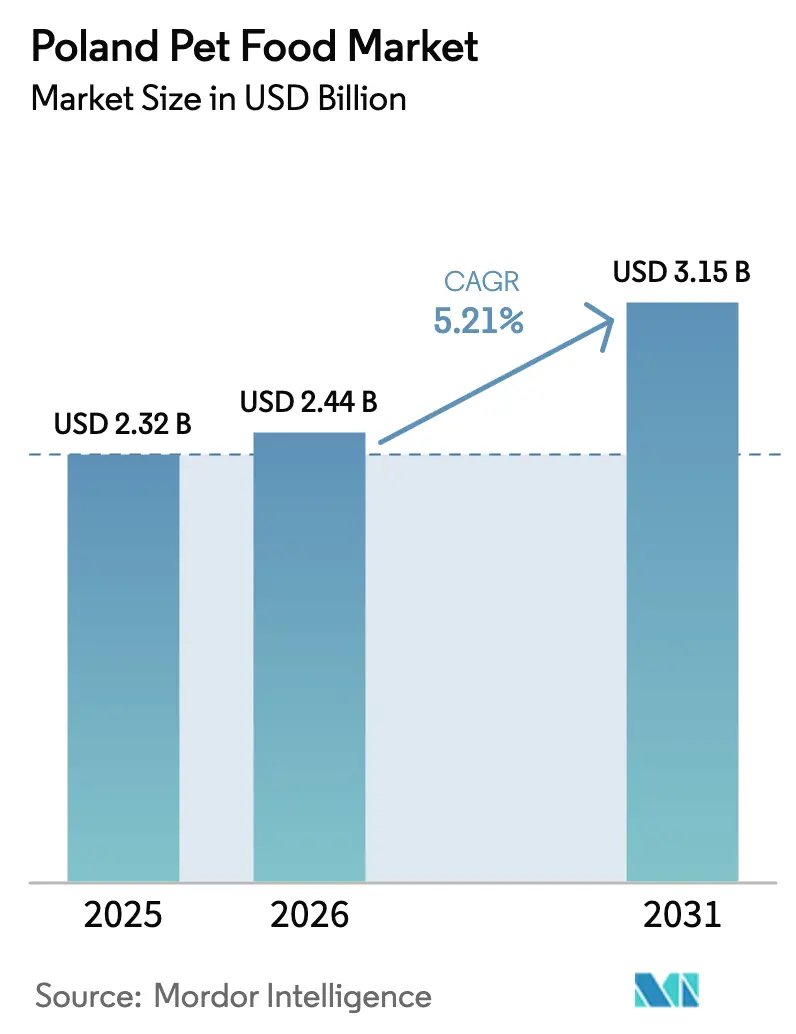
| Base Year Market Size (2025) | USD 2.32 Billion |
| Market Size (2026) | USD 2.44 Billion |
| Market Size (2031) | USD 3.15 Billion |
| Growth Rate (2026 - 2031) | 5.21 % |
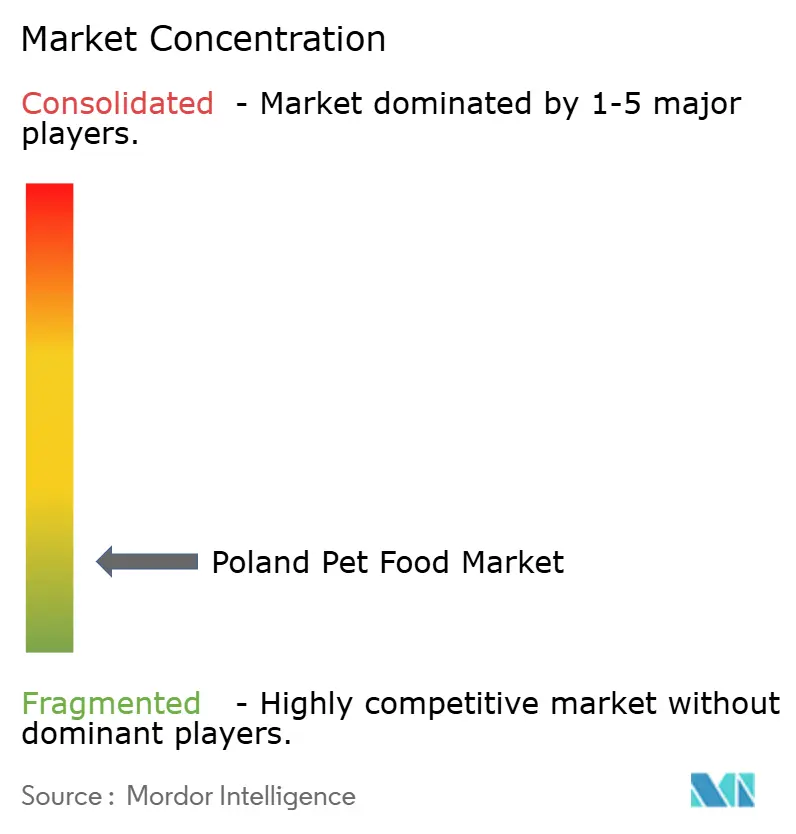
| Market Concentration | Low |
Major Players *Disclaimer: Major Players sorted in no particular order Image © Mordor Intelligence. Reuse requires attribution under CC BY 4.0. | |
Poland Pet Food Market Analysis by Mordor Intelligence
The Poland pet food market size was valued at USD 2.32 billion in 2025 and estimated to grow from USD 2.44 billion in 2026 to reach USD 3.15 billion by 2031, at a CAGR of 5.21% during the forecast period (2026-2031). Rising urban single-person households, sustained export capacity, and increased veterinary influence are boosting per-person spending, even as demographic headwinds persist. Premium lines built on human-grade ingredients and functional claims are expanding shelf space, while direct-to-consumer subscriptions accelerate repeat purchases and data-driven product innovation. Inflation-linked trade-down has intensified price segmentation, prompting retailers and brands to justify premiums through sustainability, traceable sourcing, and recyclable packaging.
Key Report Takeaways
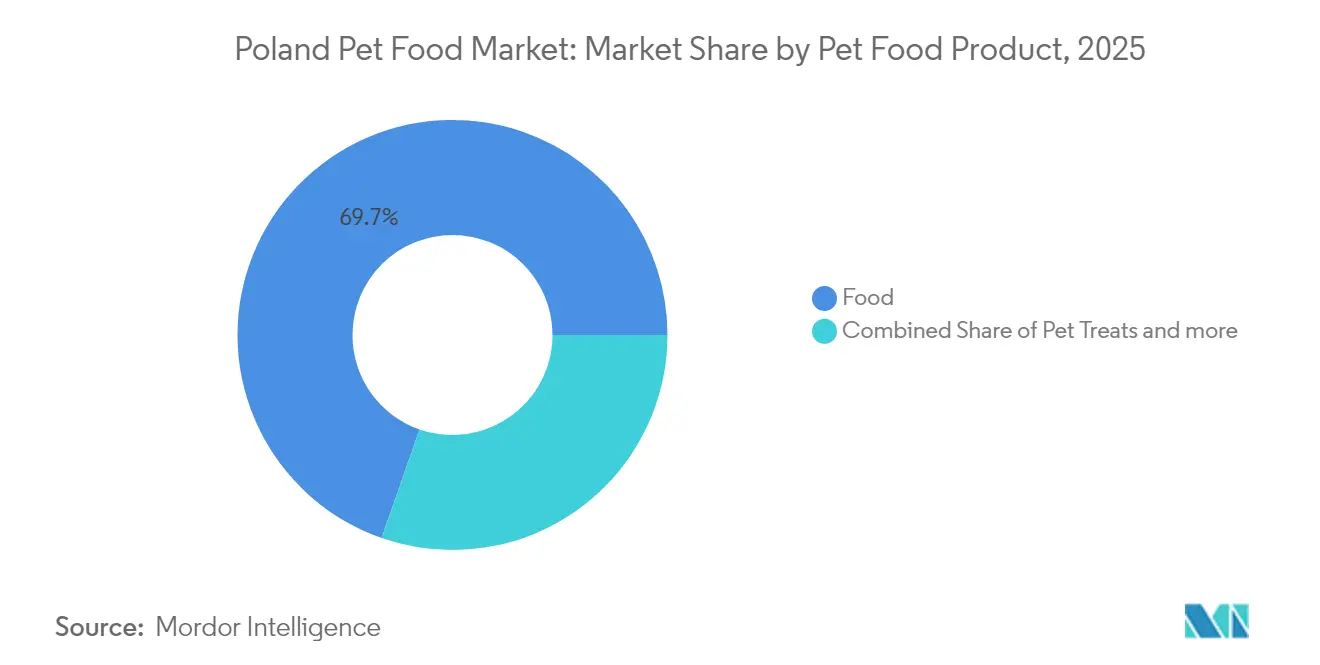
- By pet food product, food products led with 69.65% of Poland's pet food market share in 2025, whereas pet treats are projected to grow at a 6.01% CAGR through 2031.
- By pets, dogs captured 55.75% of the Poland pet food market share in 2025, and the segment is forecast to post a 5.62% CAGR through 2031.
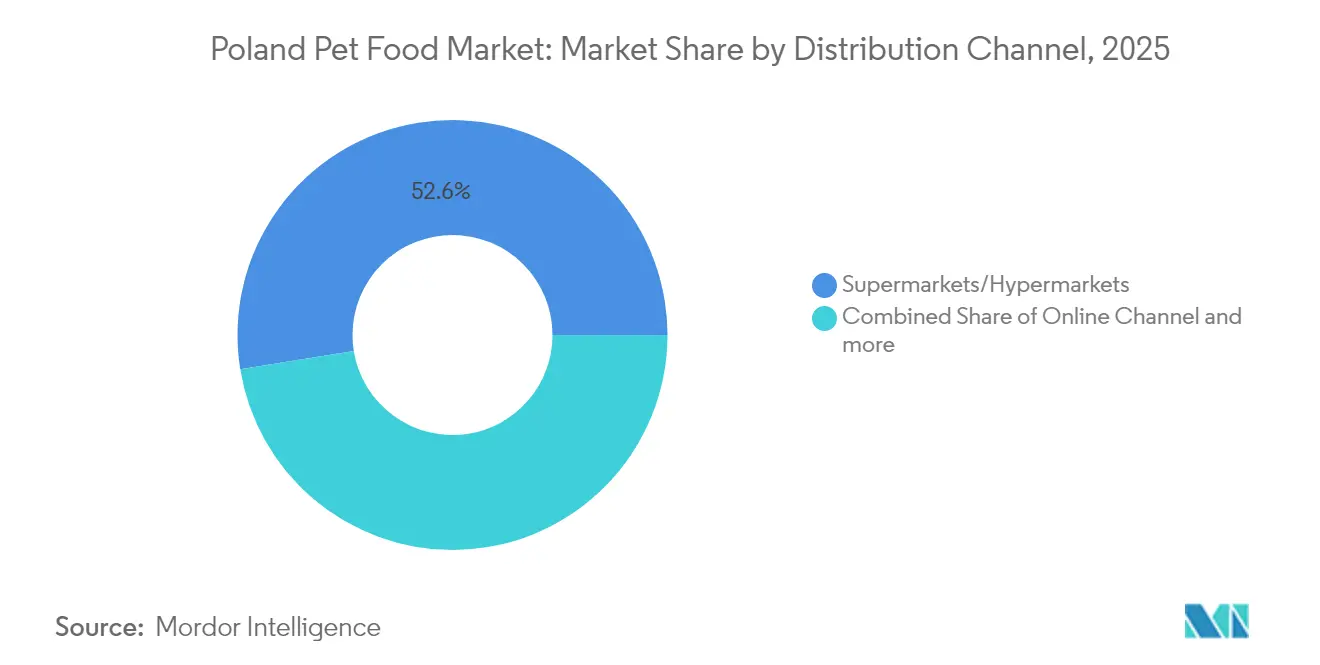
- By distribution channel, supermarkets and hypermarkets accounted for 52.55% of the Poland pet food market size in 2025, while the online channel is set to expand at a 6.66% CAGR to 2031.
Note: Market size and forecast figures in this report are generated using Mordor Intelligence’s proprietary estimation framework, updated with the latest available data and insights as of 2026.
Poland Pet Food Market Trends and Insights
Drivers Impact Analysis*
| Driver | (~) % Impact on CAGR Forecast | Geographic Relevance | Impact Timeline |
|---|---|---|---|
| Premiumization and Human-grade Formulations | +1.8% | Poland's urban centers, spillover to rural areas | Medium term (2-4 years) |
| Rising Veterinary Recommendations of Functional Diets | +1.2% | National, concentrated in major cities with veterinary clinics | Short term (≤ 2 years) |
| Urban Single-household Growth Fueling Small-Pack Demand | +0.9% | Warsaw, Krakow, Gdansk metropolitan areas | Long term (≥ 4 years) |
| Expansion of Modern Retail Chains | +0.7% | National, accelerated in secondary cities | Medium term (2-4 years) |
| Growth of Direct-to-Consumer Subscription Models | +0.5% | Urban Poland, early adoption in affluent districts | Short term (≤ 2 years) |
| Surging Demand for Insect-based Sustainable Proteins | +0.3% | Europe Union-wide, Poland as production hub | Long term (≥ 4 years) |
| Source: Mordor Intelligence | |||


Premiumization and Human-grade Formulations
Consumer willingness to pay premium prices for human-grade pet food formulations represents the primary growth catalyst, driven by pet humanization trends that position animals as family members deserving equivalent nutritional standards. Poland pet owners increasingly scrutinize ingredient lists, favoring products with recognizable, whole-food components over traditional by-product meals. This shift has enabled domestic producers like 3coty to build successful export businesses based on 100% poultry-sourced, monoprotein formulations targeting allergic and diabetic cats, with their Pruszków facility expanding to meet Nordic and Western European demand.
Rising Veterinary Recommendations of Functional Diets
The influence of the veterinary channel has intensified as practitioners increasingly recommend therapeutic and functional diets for preventive health management, moving beyond the treatment of diagnosed conditions. VET EXPERT, produced by Poland company VET PLANET Ltd., has achieved market leadership in veterinary recommendations according to Kantar Research, demonstrating how domestic brands can compete effectively against multinational therapeutic diet specialists. This trend benefits from Poland's expanding veterinary infrastructure and growing pet owner awareness of nutrition's role in preventing costly health issues. The functional diet segment encompasses digestive health, joint support, and hypoallergenic formulations that command premium pricing while building veterinary practitioner loyalty.
Urban Single-household Growth Fueling Small-Pack Demand
Poland's urbanization pattern, characterized by 38% single-person households that typically favor smaller pets and convenient packaging formats, drives demand for portion-controlled, premium-positioned products. This demographic shift aligns with broader European trends toward smaller living spaces and delayed family formation, creating sustained demand for 1-2 kg package sizes that maintain product freshness while fitting urban storage constraints. The trend particularly benefits treat and supplement categories, where single-serve packaging enables trial of premium products without large upfront commitments.
Expansion of Modern Retail Chains
The proliferation of modern retail formats has democratized access to premium pet food brands while enabling private-label development that challenges established players. Discounter chains now control 37% of Poland's grocery market value, with Biedronka generating PLN 85 billion in revenue and operating approximately 3,600 stores, creating unprecedented distribution reach for pet food brands. This retail expansion has particularly benefited ALDI Poland, whose pet food sales have grown approximately 20% annually since 2019, demonstrating how private-label strategies can capture market share from branded competitors [1]Source: DHL eCommerce, “2024 Online Shopper Trends — Country Report: Poland,” dhl.com . The modern retail channel also facilitates consumer education through improved merchandising, nutritional information displays, and staff training programs that support premiumization trends.
Restraints Impact Analysis*
| Restraint | (~) % Impact on CAGR Forecast | Geographic Relevance | Impact Timeline |
|---|---|---|---|
| Stagnant Birth Rate Limiting Long-term Pet Population | -0.8% | National, acute in rural areas | Long term (≥ 4 years) |
| Inflation-driven Trade-down to Economy Brands | -1.1% | National, concentrated in lower-income regions | Short term (≤ 2 years) |
| Regulatory Uncertainty on Novel Proteins | -0.4% | Europe Union-wide, affecting Poland producers | Medium term (2-4 years) |
| Competition from Homemade Diet Trends | -0.6% | Urban areas with high social-media penetration | Medium term (2-4 years) |
| Source: Mordor Intelligence | |||
Stagnant Birth Rate Limiting Long-term Pet Population
Poland's fertility rate of 1.28, among the lowest in Europe, constrains household formation and reduces the traditional pathway to pet adoption through young families. This demographic challenge is compounds with an aging population that may reduce pet ownership due to mobility limitations and fixed incomes, creating long-term headwinds for volume growth. The trend particularly affects rural areas, where traditional family structures have historically driven pet ownership for both working and companionship purposes. This constraint has paradoxically accelerated premiumization, as existing pet owners concentrate their spending on fewer animals, treating them as child substitutes deserving of premium nutrition and healthcare.
Inflation-driven Trade-down to Economy Brands
The 43% increase in pet food prices experienced in March 2023 compared to 2022 triggered significant changes in consumer behavior, with many households switching to economy brands or reducing their purchase frequency to manage budgets. Despite Poland's projected GDP growth of 3.4% in 2025 and 3.0% in 2026, the recovery of household disposable income remains uneven, particularly affecting lower-income segments that represent a significant volume potential. This pressure has intensified private-label competition, forcing premium brands to justify their price points through enhanced value propositions, including subscription discounts and loyalty programs that maintain customer relationships during economic stress.
*Our forecasts treat driver/restraint impacts as directional, not additive. The impact forecasts reflect baseline growth, mix effects, and variable interactions.
Segment Analysis
By Pet Food Product: Treats Drive Innovation Beyond Traditional Nutrition
Food products maintain a commanding market leadership position with a 69.65% share in 2025, reflecting their essential nature and high purchase frequency across all consumer segments. Within this category, Dry Pet Food dominates through kibble formats that offer convenience, shelf stability, and cost efficiency, while Wet Pet Food captures premium positioning through palatability and perceived freshness benefits. The segment has also witnessed significant innovation in terms of product formulations, with manufacturers introducing grain-free options, limited-ingredient diets, and customized foods specific to pet health needs. Major players in the market are continually expanding their product portfolios to meet the diverse nutritional needs of various pets, with a particular focus on premium and natural ingredients.
Pet Treats emerge as the fastest-growing segment, with a 6.01% CAGR through 2031, driven by humanization trends that position treats as bonding tools and training aids rather than mere indulgences. The segment's growth is particularly strong in premium and functional treats, which offer additional health benefits beyond basic nutrition. Manufacturers are innovating with new flavors, textures, and functional ingredients, particularly in dental treats and freeze-dried varieties. The trend toward natural and organic ingredients in treats, combined with the rising demand for grain-free and limited-ingredient options, is further propelling the segment's growth.


By Pets: Dogs Dominate Despite Premiumization Trends
Dogs command 55.75% market share in 2025, supported by Poland's exceptional 22.9% per capita dog ownership rate, the highest in Europe, with 8.44 million dogs nationwide. This dominance reflects cultural preferences for larger pets and outdoor lifestyles, although urbanization trends favor smaller dog breeds that align with the constraints of apartment living. The dog segment benefits from diverse product innovations tailored to various life stages, activity levels, and breed-specific formulations, which enable premium positioning and foster customer loyalty.
Growth projections of 5.62% CAGR through 2031 for the dog segment reflect both population expansion and increased per-pet spending as owners embrace premium nutrition concepts. The segment's growth is driven by increasing premiumization trends, with pet owners showing a strong preference for high-quality commercial pet food products over home-cooked alternatives. The segment is experiencing the fastest growth trajectory, supported by the rising adoption of specialized diets, including grain-free options and veterinary formulations. The increasing focus on pet health and wellness, coupled with the growing availability of premium and specialized dog food products through various distribution channels, continues to strengthen this segment's market position.
By Distribution Channel: E-commerce Disrupts Traditional Retail Dominance
Supermarkets and Hypermarkets are likely to maintain a 52.55% market share in 2025, leveraging their extensive physical footprints and consumer shopping habits that integrate pet food purchases with grocery trips. This channel benefits from the expansion of modern retail chains, with major players such as Biedronka, Lidl, and Carrefour collectively operating thousands of stores that provide convenient access across both urban and rural markets. The traditional retail advantage lies in immediate product availability, competitive pricing through volume purchasing, and the ability to showcase new products through end-cap displays and promotional activities.
Online Channel emerge as the fastest-growing distribution segment at 6.66% CAGR through 2031, driven by increasing digital literacy among Poland consumers and their growing preference for convenient shopping options. Popular platforms like Zooart, Zooplus, Fera, and Zoo24 are enhancing their digital presence by offering extensive product selections, competitive pricing, and convenient delivery options. The segment's growth is further supported by the rising trend of premium and specialized pet food products being purchased online, where detailed product information and customer reviews help inform purchase decisions.
Geography Analysis
Poland represents a unique European pet food market, characterized by a high export capacity and significant domestic growth potential, positioning the country as both a major production hub and an underpenetrated consumer market. The domestic market benefits from strong fundamentals, including 8.44 million dogs and 7.25 million cats, which represent 49% and 41% household penetration rates in 2023. This penetration gap suggests a substantial organic growth opportunity as consumer education progresses and urbanization accelerates the shift away from homemade feeding practices.
Poland's export performance demonstrates its manufacturing competitiveness, with EUR 2.0 billion (USD 2.14 billion) in pet food exports in 2024, representing 14% growth compared to 2023 and establishing the country as the world's fifth-largest pet food exporter. Major export destinations include Germany, the UK, France, and the Netherlands, while emerging markets in Nordic countries and Asia provide growth opportunities for specialized producers.
Regional development patterns within Poland favor urban centers like Warsaw, Krakow, and Gdansk, where higher disposable incomes and smaller household sizes drive premiumization trends and e-commerce adoption. These metropolitan areas serve as testing grounds for new product launches and direct-to-consumer models, with successful concepts subsequently expanding to secondary cities and rural markets.
Competitive Landscape
The Poland pet food market exhibits a fragmented competitive landscape with a mix of global conglomerates and specialized local players. Global companies Mars, Incorporated, Colgate-Palmolive Company (Hill's Pet Nutrition, Inc.), Schell & Kampeter, Inc. (Diamond Pet Foods), VAFO Group a.s., and FARMINA PET FOODS are leverages their extensive research capabilities, established brand portfolios, and sophisticated distribution networks to maintain market leadership. These multinational corporations benefit from economies of scale and integrated supply chains, allowing them to offer competitive pricing while maintaining product quality. Local players, meanwhile, compete by focusing on niche segments and leveraging their understanding of regional preferences and distribution channels.
The market shows moderate consolidation trends, with larger companies actively pursuing acquisitions to expand their product portfolios and market reach. While global players dominate the premium segments, local manufacturers maintain strong positions in mid-range and economy segments. The competitive dynamics are further shaped by the increasing presence of private label products from retail chains, creating additional pressure on established brands to differentiate their offerings. The market structure encourages continuous innovation and specialization, with companies investing in research and development to create unique value propositions.
Strategic differentiation occurs through vertical integration, sustainability initiatives, and direct-to-consumer capabilities that bypass traditional retail gatekeepers. Mars exemplifies this approach through regenerative agriculture partnerships covering 3,359 hectares in Western Poland to secure wheat supplies for major brands, while simultaneously advancing recyclable packaging technology that reduces environmental impact by 46% versus traditional multi-material pouches [3]Source: Mars Incorporated, “Petcare,” mars.com .
Poland Pet Food Industry Leaders
Mars, Incorporated
Colgate-Palmolive Company (Hill's Pet Nutrition, Inc.)
Schell & Kampeter, Inc. (Diamond Pet Foods)
VAFO Group a.s.
FARMINA PET FOODS
- *Disclaimer: Major Players sorted in no particular order

Recent Industry Developments
- July 2023: Hill's Pet Nutrition introduced its new MSC (Marine Stewardship Council) certified pollock and insect protein products for pets with sensitive stomachs and skin lines. They contain vitamins, omega-3 fatty acids, and antioxidants.
- May 2023: Vafo Praha, s.r.o. launched its new range of Brit RAW Freeze-dried treats and toppers for dogs. These products are made up of high-quality proteins and minimally processed ingredients for potential health benefits.
- May 2023: Vafo Praha, s.r.o. launched its new line of functional snacks for dogs called Brit Dental Stick. The products are available in four different varieties with seven sticks in a package.


Poland Pet Food Market Report Scope
Food, Pet Nutraceuticals/Supplements, Pet Treats, Pet Veterinary Diets are covered as segments by Pet Food Product. Cats, Dogs are covered as segments by Pets. Convenience Stores, Online Channel, Specialty Stores, Supermarkets/Hypermarkets are covered as segments by Distribution Channel.| Food | By Sub Product | Dry Pet Food | By Sub Dry Pet Food | Kibbles |
| Other Dry Pet Food | ||||
| Wet Pet Food | ||||
| Pet Nutraceuticals/Supplements | By Sub Product | Milk Bioactives | ||
| Omega-3 Fatty Acids | ||||
| Probiotics | ||||
| Proteins and Peptides | ||||
| Vitamins and Minerals | ||||
| Other Nutraceuticals | ||||
| Pet Treats | By Sub Product | Crunchy Treats | ||
| Dental Treats | ||||
| Freeze-dried and Jerky Treats | ||||
| Soft & Chewy Treats | ||||
| Other Treats | ||||
| Pet Veterinary Diets | By Sub Product | Diabetes | ||
| Digestive Sensitivity | ||||
| Oral Care Diets | ||||
| Renal | ||||
| Urinary tract disease | ||||
| Obesity Diets | ||||
| Derma Diets | ||||
| Other Veterinary Diets |
| Cats |
| Dogs |
| Other Pets |
| Convenience Stores |
| Online Channel |
| Specialty Stores |
| Supermarkets/Hypermarkets |
| Other Channels |
| Pet Food Product | Food | By Sub Product | Dry Pet Food | By Sub Dry Pet Food | Kibbles |
| Other Dry Pet Food | |||||
| Wet Pet Food | |||||
| Pet Nutraceuticals/Supplements | By Sub Product | Milk Bioactives | |||
| Omega-3 Fatty Acids | |||||
| Probiotics | |||||
| Proteins and Peptides | |||||
| Vitamins and Minerals | |||||
| Other Nutraceuticals | |||||
| Pet Treats | By Sub Product | Crunchy Treats | |||
| Dental Treats | |||||
| Freeze-dried and Jerky Treats | |||||
| Soft & Chewy Treats | |||||
| Other Treats | |||||
| Pet Veterinary Diets | By Sub Product | Diabetes | |||
| Digestive Sensitivity | |||||
| Oral Care Diets | |||||
| Renal | |||||
| Urinary tract disease | |||||
| Obesity Diets | |||||
| Derma Diets | |||||
| Other Veterinary Diets | |||||
| Pets | Cats | ||||
| Dogs | |||||
| Other Pets | |||||
| Distribution Channel | Convenience Stores | ||||
| Online Channel | |||||
| Specialty Stores | |||||
| Supermarkets/Hypermarkets | |||||
| Other Channels | |||||


Market Definition
- FUNCTIONS - Pet foods are usually intended to provide complete and balanced nutrition to the pet but are primarily used as functional products. The scope includes the food and supplements consumed by pets including veterinary diets. Supplements/nutraceuticals that are directly supplied to pets are considered within the scope.
- RESELLERS - Companies engaged in reselling of pet food without value addition have been excluded from the market scope, in order to avoid double counting.
- END CONSUMERS - Pet owners are considered to be the end-consumers in the market studied.
- DISTRIBUTION CHANNELS - Supermarkets/hypermarkets, specialty stores, convenience stores, online channels and other channels are considered within the scope. The stores which are exclusively providing pet related basic and custom products are considered within the scope of specialty stores.
| Keyword | Definition |
|---|---|
| Pet Food | The scope of pet food includes the food that is eatable by pets including food, treats, veterinary diets, and nutraceuticals/supplements. |
| Food | Food is animal feed intended for consumption by pets. It is formulated to provide essential nutrients and meet the dietary needs of various types of pets, including dogs, cats, and other animals. These are generally segmented into dry and wet pet foods. |
| Dry Pet Food | Dry pet foods may be extruded/baked (kibbles) or flaked. They have a lower moisture content, typically around 12-20%. |
| Wet Pet Food | Wet pet food, also known as canned pet food or moist pet food, generally has a higher moisture content compared to dry pet food, often ranging from 70-80%. |
| Kibbles | Kibbles are dry, processed pet food in small, bite-sized pieces or pellets. They are specifically formulated to provide balanced nutrition for various domestic animals, such as dogs, cats, and other animals. |
| Treats | Pet Treats are special food items or rewards given to pets, to show affection, and encourage good behavior. They are especially used during training. Pet treats are made from various combinations of meat or meat-derived materials with other ingredients. |
| Dental Treats | Pet dental treats are specialized treats that are formulated to promote good oral hygiene in pets. |
| Crunchy Treats | It is a type of pet treat that has a firm and crispy texture which can be a good source of nutrition for pets. |
| Soft and chewy treats | Soft and Chewy pet treats are a type of pet food product that is formulated to be easy to chewy and digest. They are usually made from soft and pliable ingredients, such as meat, poultry, or vegetables, that have been blended and formed into bite-sized pieces or strips. |
| Freeze-dried & Jerky Treats | Freeze-dried and jerky treats are snacks given to pets, that are prepared through a special preservation process, without damaging the nutritional content, resulting in long-lasting, nutrient-rich treats. |
| Urinary Tract Disease Diets | These are commercial diets that are specifically formulated to promote urinary health and reduce the risk of urinary tract infections and other urinary problems. |
| Renal Diets | These are specialized pet foods formulated to support the health of pets with kidney disease or renal insufficiency. |
| Digestive Sensitivity Diets | Digestive-sensitive diets are specially formulated to meet the nutritional needs of pets with digestive issues such as food intolerances, allergies, and sensitivities. These diets are designed to be easily digestible and to reduce the symptoms of digestive problems in pets. |
| Oral Care Diets | Oral care diets for pets are specially formulated diets produced to promote oral health and hygiene in pets. |
| Grain-Free Pet Food | Pet food that does not contain common grains like wheat, corn, or soy. Grain-free diets are often preferred by pet owners seeking alternative options or if their pets have specific dietary sensitivities. |
| Premium Pet Food | High-quality pet food formulated with superior ingredients often offers additional nutritional benefits compared to standard pet food. |
| Natural Pet Food | Pet food made from natural ingredients, with minimal processing and without artificial preservatives. |
| Organic Pet Food | Pet food is produced using organic ingredients, free from synthetic pesticides, hormones, and genetically modified organisms (GMOs). |
| Extrusion | A manufacturing process used to produce dry pet food, where ingredients are cooked, mixed, and shaped under high pressure and temperature. |
| Other Pets | Other pets include birds, fish, rabbits, hamsters, ferrets, and reptiles. |
| Palatability | The taste, texture, and aroma of pet food influence its appeal and acceptance by pets. |
| Complete and Balanced Pet Food | Pet food that provides all essential nutrients in appropriate proportions to meet the nutritional needs of pets without additional supplementation. |
| Preservatives | These are the substances that are added to pet food to extend its shelf life and prevent spoilage. |
| Nutraceuticals | Food products that offer health benefits beyond basic nutrition, often contain bioactive compounds with potential therapeutic effects. |
| Probiotics | Live beneficial bacteria that promote a healthy balance of gut flora, supporting digestive health and immune function in pets. |
| Antioxidants | Compounds that help neutralize harmful free radicals in the body, promoting cellular health and supporting the immune system in pets. |
| Shelf-Life | The duration of which pet food remains safe and nutritionally viable for consumption after its production date. |
| Prescription diet | Specialized pet food formulated to address specific medical conditions under veterinary supervision. |
| Allergen | A substance that can cause allergic reactions in some pets, leading to food allergies or sensitivities. |
| Canned food | Wet pet food that is packed in cans and contains higher moisture content than dry food. |
| Limited ingredient diet (LID) | Pet food formulated with a reduced number of ingredients to minimize potential allergens. |
| Guaranteed Analysis | The minimum or maximum levels of certain nutrients present in pet food. |
| Weight management | Pet food designed to help pets maintain a healthy weight or support weight loss efforts. |
| Other Nutraceuticals | It includes prebiotics, antioxidants, digestive fiber, enzymes, essential oils and herbs. |
| Other Veterinary Diets | It includes weight management diets, skin and coat health, cardiac care, and joint care. |
| Other Treats | It includes rawhides, mineral blocks, lickables, and catnips. |
| Other Dry Foods | It includes cereal flakes, mixers, meal toppers, freeze-dried foods, and air-dried foods. |
| Other Animals | It includes birds, fish, reptiles, and small animals (rabbits, ferrets, hamsters). |
| Other Distribution Channels | It includes veterinary clinics, local unregulated stores, and feed and farm stores. |
| Proteins and Peptides | Proteins are large molecules composed of basic units called amino acids which help in the growth and development of pets. Peptides are the short string of 2 to 50 amino acids. |
| Omega-3 fatty acids | Omega-3 fatty acids are essential polyunsaturated fats that play a crucial role in the overall health and well-being of Pets |
| Vitamins | Vitamins are the essential organic compounds that are essential for vital physiological functioning. |
| Minerals | Minerals are naturally occurring inorganic substances that are essential for various physiological functions in pets. |
| CKD | Chronic Kidney Disease |
| DHA | Docosahexaenoic Acid |
| EPA | Eicosapentaenoic Acid |
| ALA | Alpha-linolenic Acid |
| BHA | Butylated Hydroxyanisol |
| BHT | Butylated Hydroxytoluene |
| FLUTD | Feline Lower Urinary Tract Disease |


Research Methodology
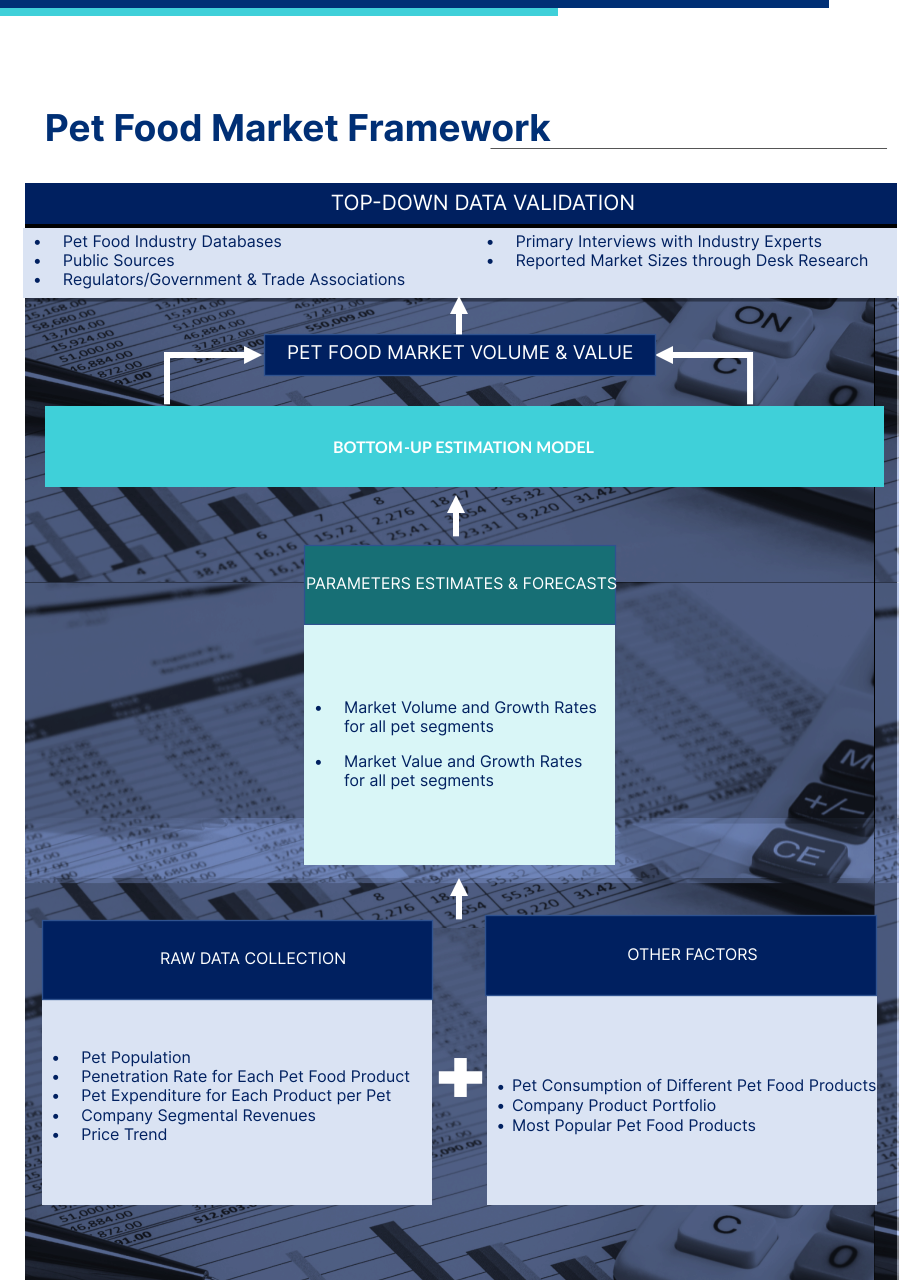
Mordor Intelligence follows a four-step methodology in all our reports.
- Step-1: IDENTIFY KEY VARIABLES: In order to build a robust forecasting methodology, the variables and factors identified in Step-1 are tested against available historical market numbers. Through an iterative process, the variables required for market forecast are set and the model is built on the basis of these variables.
- Step-2: Build a Market Model: Market-size estimations for the forecast years are in nominal terms. Inflation is not a part of the pricing, and the average selling price (ASP) is kept constant throughout the forecast period.
- Step-3: Validate and Finalize: In this important step, all market numbers, variables and analyst calls are validated through an extensive network of primary research experts from the market studied. The respondents are selected across levels and functions to generate a holistic picture of the market studied.
- Step-4: Research Outputs: Syndicated Reports, Custom Consulting Assignments, Databases & Subscription Platforms





 Your data is secure and never sold or shared.


