
Netherlands Pet Nutraceuticals Market Size and Share
Market Overview
| Study Period | 2021 - 2031 |
|---|---|
| Forecast Data Period | 2026 - 2031 |
| Base Year Market Size (2025) | USD 39 Million |
| Market Size (2026) | USD 43.30 Million |
| Market Size (2031) | USD 72.90 Million |
| Growth Rate (2026 - 2031) | 11.00 % |
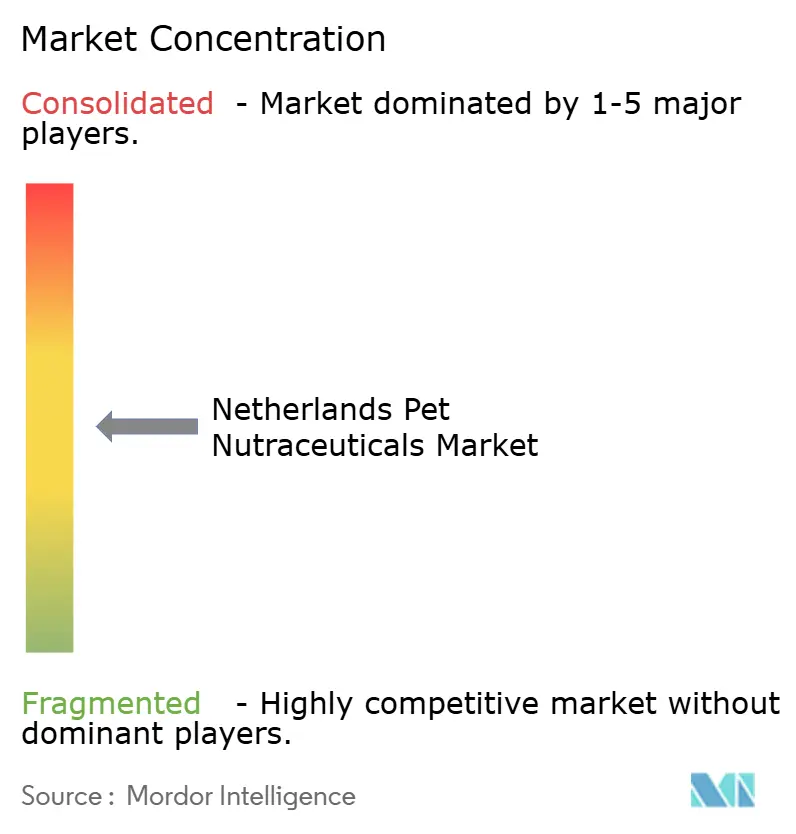
| Market Concentration | Medium |
Major Players *Disclaimer: Major Players sorted in no particular order Image © Mordor Intelligence. Reuse requires attribution under CC BY 4.0. | |
Netherlands Pet Nutraceuticals Market Analysis by Mordor Intelligence
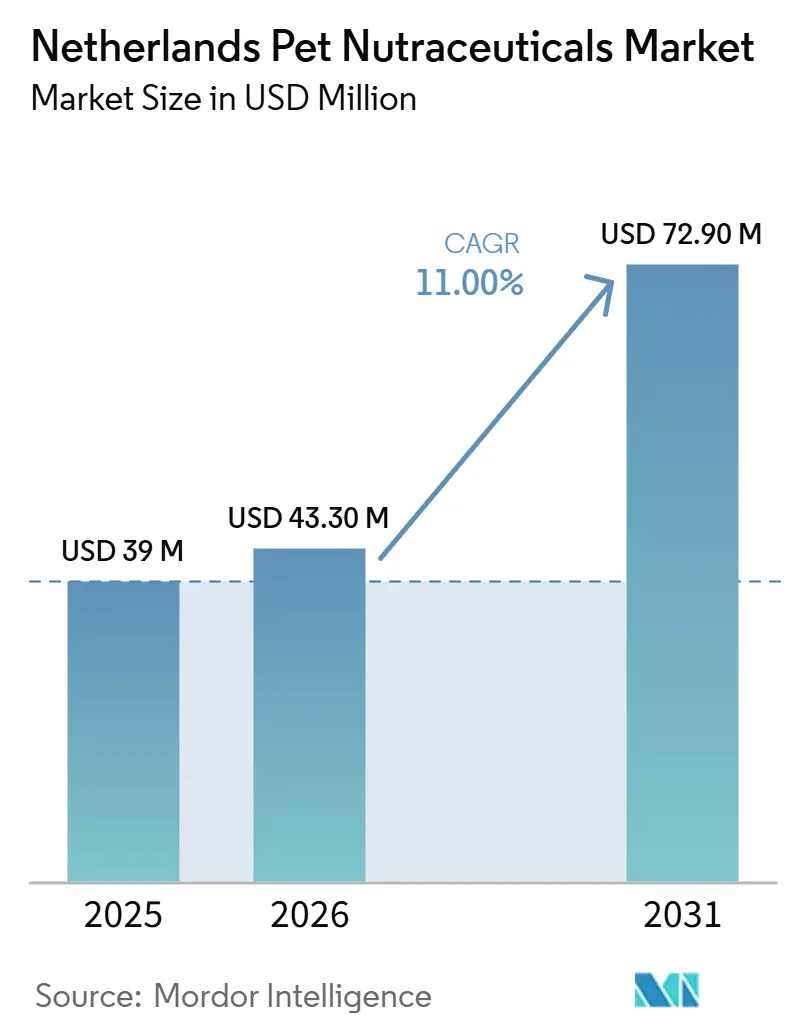
The Netherlands pet nutraceuticals market is projected to grow from USD 39.0 million in 2025 to USD 43.3 million in 2026 and further estimated to reach USD 72.9 million by 2031, with a CAGR of 11.0% between 2026 and 2031. This growth is supported by steady pet ownership, strong spending on pet care, and an increasing focus on preventive health routines for companion animals. In 2025, pet ownership remained prevalent in Dutch households, maintaining a broad market base for supplements targeting dogs and cats[1]Source: FIDIN, “Nederlandse Markt Voor Diergeneesmiddelen,” FIDIN, fidin.nl. Additionally, the market benefits from a well-established online shopping environment, which facilitates repeat purchases of products used daily or weekly. Veterinary guidance is playing an increasingly important role in product selection, encouraging repeat purchases and increasing acceptance of higher-value formulations. However, regulatory requirements pose a challenge to growth, as health claims for functional ingredients require careful wording and evidence, which slows product launches and enforces disciplined commercial strategies.
Key Report Takeaways
- By sub product, vitamins and minerals accounted for 34% share of the Netherlands pet nutraceuticals market size in 2025, while probiotics are projected to expand at a 13.5% CAGR through 2031.
- By pets, dogs held 52% of the Netherlands pet nutraceuticals market share in 2025, while cats recorded the highest projected CAGR at 11.8% through 2031.
- By distribution channel, supermarkets/hypermarkets led with 36% revenue share in 2025, while the online channel is forecast to grow at a 14.2% CAGR through 2031.
Note: Market size and forecast figures in this report are generated using Mordor Intelligence’s proprietary estimation framework, updated with the latest available data and insights as of January 2026.
Netherlands Pet Nutraceuticals Market Trends and Insights
Drivers Impact Analysis*
| Driver | (~) % Impact on CAGR Forecast | Geographic Relevance | Impact Timeline |
|---|---|---|---|
| Pet Humanization and Premiumization in Companion Animal Care | +2.8% | Netherlands | Short term (≤ 2 years) |
| Veterinary-Led Preventive Nutrition Adoption | +2.0% | Netherlands | Medium term (2-4 years) |
| High Online Replenishment and Subscription Readiness | +1.7% | Netherlands, and Nordics | Short term (≤ 2 years) |
| Sustainability-Led Ingredient and Packaging Preference | +1.2% | Northern Europe, including the Netherlands | Long term (≥ 4 years) |
| Microbiome and Precision Nutrition Adoption in Clinics | +1.4% | Netherlands | Medium term (2-4 years) |
| Aging Pet Population and Geriatric Mobility Support Demand | +1.3% | Netherlands | Medium term (2-4 years) |
| Source: Mordor Intelligence | |||
Pet Humanization and Premiumization in Companion Animal Care
The Netherlands pet nutraceuticals market is experiencing growth due to a shift in how Dutch households approach pet care, integrating it into routine family care rather than treating it as discretionary spending. Pet ownership remains high, with dogs and cats forming the primary base of companion animals, ensuring consistent demand for wellness-oriented products. This change has led to supplements being purchased earlier in the care cycle, often as a preventive measure before conditions escalate to the point of requiring treatment. This trend supports market expansion, as pet owners increasingly invest in daily-use products that are perceived as safe, easy to use, and well-explained. Products that emphasize ingredient transparency, traceability, and veterinary endorsement foster greater trust among buyers who prioritize thoughtful spending on pet wellness. This preference drives demand for premium formulations, such as soft chews, liquid formats, and targeted solutions, while ensuring accessibility beyond clinical environments.
Veterinary-Led Preventive Nutrition Adoption
The Netherlands pet nutraceuticals market is benefiting from veterinarians' growing influence in guiding preventive feeding and supplement practices. Veterinary recommendations play a significant role, as pet owners often seek professional guidance when choosing between products with similar wellness claims. When supplements are incorporated into a veterinarian-recommended routine, repeat purchases tend to be more consistent compared to standard retail channels. This trend also supports brands that focus on clinical positioning, professional education, and condition-specific product development, rather than relying solely on shelf appeal. Additionally, Dutch veterinary oversight has become more prominent in how products are discussed and recommended, helping to distinguish functional supplements from regular treats. This has created a demand pattern in the Netherlands pet nutraceuticals market that emphasizes consistency, trust, and clinical relevance.
High Online Replenishment and Subscription Readiness
The Netherlands' pet nutraceuticals market is poised for digital growth, driven by the country's established e-commerce practices and efficient delivery infrastructure. Online channels are particularly effective for supplements, as these products are often purchased on a recurring basis, aligning well with repeat-order models. The Netherlands is among Europe’s more advanced e-commerce markets, providing pet care brands with a strong foundation for autoship and subscription-based offerings. Recurring orders are commercially significant as they help reduce buyer churn and provide greater visibility into long-term demand[2]Source: Netherlands Enterprise Agency, “E-Commerce in the Netherlands,” Netherlands Enterprise Agency, rvo.nl. Dutch e-commerce platforms offer an extensive range of pet care products, and subscription models help lower customer acquisition costs compared to single-purchase transactions. This positions the online channel not just as a convenience but as a sustainable demand driver for the Netherlands pet nutraceuticals market.
Sustainability-Led Ingredient and Packaging Preference
The market is increasingly influenced by consumer demand for cleaner sourcing and more sustainable packaging options. Dutch consumers operate in a retail environment where environmental claims are more prominent and more closely monitored than in many other markets. Additionally, EU policies continue to pressure supply chains to enhance traceability, optimize material use, and ensure compliance with ingredient sourcing requirements. For supplement brands, this trend increases the attractiveness of alternative omega-3 sources, recyclable packaging, and supplier networks that are easier to audit. These factors provide well-prepared manufacturers with a competitive edge in premium retail, as sustainability now plays a significant role in brand selection alongside efficacy and price. Over time, this preference is anticipated to benefit companies that successfully combine functional nutrition with disciplined sourcing practices in the Netherlands pet nutraceuticals market.
Restraints Impact Analysis*
| Restraint | (~) % Impact on CAGR Forecast | Geographic Relevance | Impact Timeline |
|---|---|---|---|
| Premium Price Sensitivity Outside Core Urban Buyers | -2.2% | Netherlands, especially peri-urban and rural areas | Short term (≤ 2 years) |
| Product Claim and Compliance Friction for Functional Ingredients | -1.8% | Netherlands | Medium term (2-4 years) |
| Limited Awareness of Pet Nutraceutical Benefits Among Mass Buyers | -1.4% | Netherlands mass retail base | Medium term (2-4 years) |
| Ingredient Cost Volatility for Marine Oils and Bioactives | -1.0% | Global supply chains with spillover into the Netherlands | Long term (≥ 4 years) |
| Source: Mordor Intelligence | |||
Premium Price Sensitivity Outside Core Urban Buyers
The Netherlands pet nutraceuticals market continues to face pricing challenges outside its primary urban demand centers. Consumers in cities such as Amsterdam, Rotterdam, Utrecht, and The Hague are generally more inclined to spend on premium pet wellness products compared to households in less densely populated areas. This results in a disparity in category adoption, with advanced products gaining traction first in affluent urban regions before gradually reaching a wider audience. The challenge is not a rejection of pet wellness by non-urban consumers but rather a lower willingness to pay higher prices for specialized products that require additional explanation. This dynamic slows mass-market growth and emphasizes the importance of pack size, format, and value communication for brands aiming to expand their reach. Until entry-level pricing becomes more accessible or consumer understanding of the category improves, this limitation will continue to create uneven demand across different regions in the Netherlands pet nutraceuticals market.
Product Claim and Compliance Friction for Functional Ingredients
The market operates under stringent regulations regarding the description of health benefits on packaging and in marketing materials. EU rules governing feed additives, along with the European Food Safety Authority (EFSA) substantiation process, require companies to provide robust scientific evidence before making functional claims. Additionally, FIDIN (Federation/Association of Manufacturers and Importers of Veterinary Medicines in the Netherlands) has noted that stronger supervision by the Netherlands Food and Consumer Product Safety Authority (NVWA) will take effect from 2025, increasing compliance requirements for companies offering supplements and related veterinary products in the Dutch market. While these regulations do not hinder product innovation, they can delay product rollouts, restrict marketing language, and often benefit larger firms with greater legal and regulatory resources. Smaller brands can still compete but may require additional time and resources to justify product positioning. This regulatory environment ensures discipline within the Netherlands pet nutraceuticals market but also slows the integration of new scientific advancements into mainstream consumer communication.
*Our forecasts treat driver/restraint impacts as directional, not additive. The impact forecasts reflect baseline growth, mix effects, and variable interactions.
Segment Analysis
By Sub Product: Vitamins as the Foundation, Probiotics Driving Growth
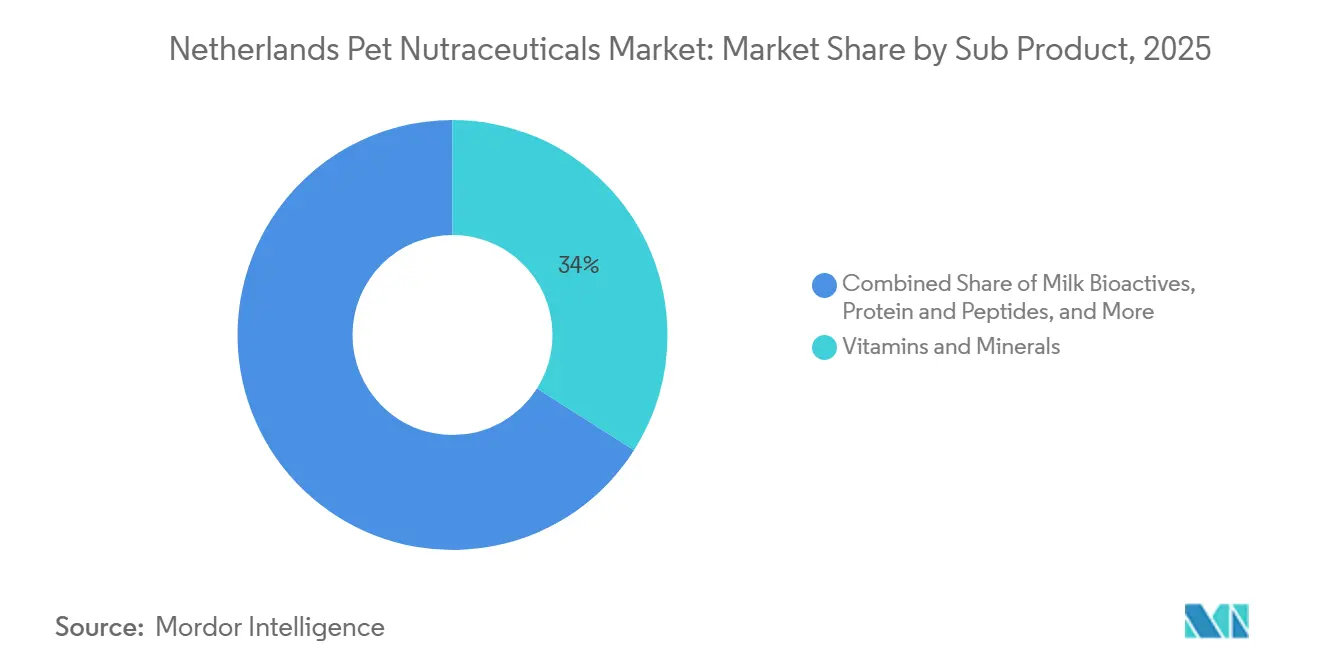
Vitamins and minerals accounted for 34% of the Netherlands pet nutraceuticals market share in 2025, positioning this segment as a key entry point for first-time buyers. Probiotics are projected to grow at a CAGR of 13.5% through 2031, making it the fastest-growing subcategory in the Netherlands pet nutraceuticals market. This growth is driven by the growing focus on gut health, which is easier for pet owners to understand and incorporate into daily routines than other advanced supplement themes. The European Food Safety Authority (EFSA) register supports several probiotic strains for companion animals, providing brands with a stronger scientific and regulatory foundation for product development.
Proteins and peptides, along with omega-3 fatty acids, hold significant market share due to their alignment with well-understood needs such as joint support, recovery, and skin and coat health. Milk bioactives represent a smaller segment but offer a clear innovation angle, as Dutch-origin company NGD Care has developed products featuring liposomal delivery and veterinarian-designed protocols. Additionally, other pet nutraceuticals, including plant-based and behavior-support options, are gradually gaining traction as the market shifts from general wellness solutions to more targeted condition-specific support.



By Pets: Dogs lead volume, cats drive format innovation
Dogs accounted for 52% of the Netherlands pet nutraceuticals market in 2025, reflecting higher supplement spending per animal and a wider shelf range than is currently available for cats or other pets. The dog segment still benefits from the strongest product depth in joint support, multivitamins, digestive care, and skin-support formats. Royal Canin launched supplements and probiotics in 2025, which further increased visibility in the premium dog and cat wellness space through veterinary and specialty channels. This keeps dogs ahead on present value, even as growth is spreading more widely across species.
Cats are forecast to grow at a 11.8% CAGR through 2031, making them the fastest-growing pet segment in the Netherlands pet nutraceuticals market size outlook. Virbac’s January 2026 launch of URSOLYX Soft Chews for Cats is important because it brought a feline-specific muscle health format to market and signaled stronger clinical attention to the category. That matters because cats have long been underrepresented in specialized supplement ranges, leaving more room for new formats to scale. Other pets remains the smallest segment, but brands such as Vetius continue to build natural supplement lines across exotic birds and other species, which supports niche expansion outside the main cat and dog base.
By Distribution Channel: Retail Dominates Currently, Digital Transformation Shapes the Future
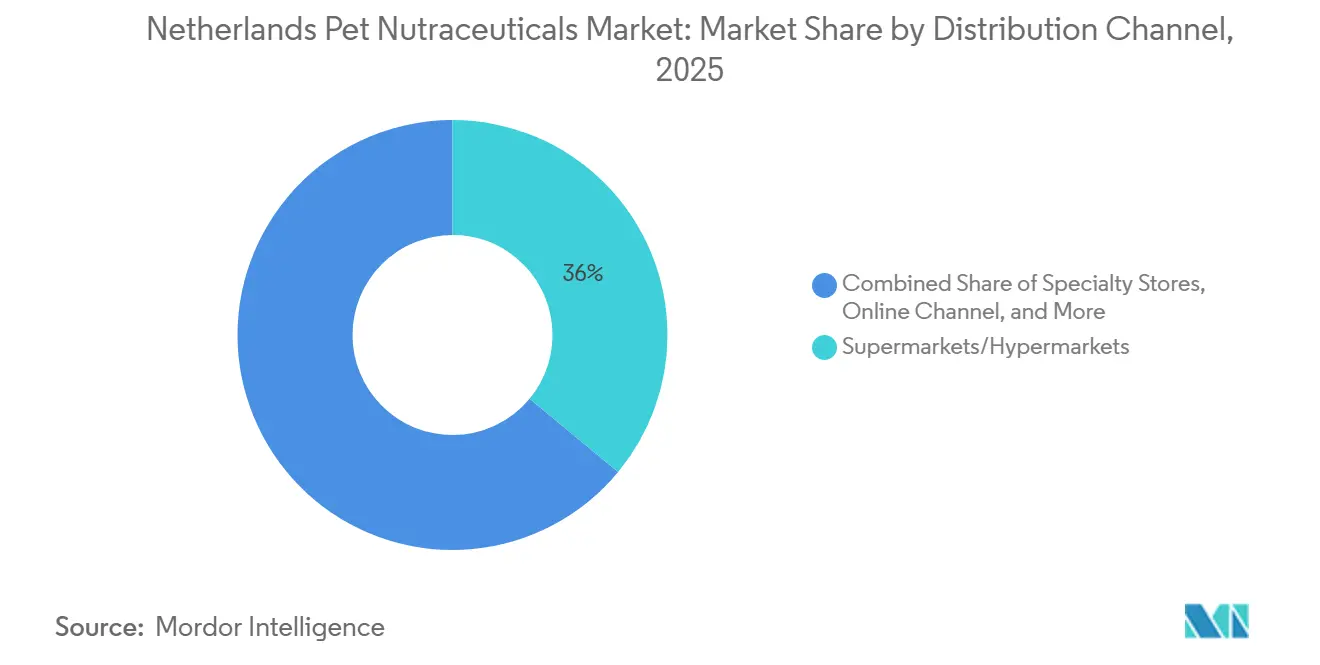
Supermarkets/Hypermarkets accounted for 36% of the market in 2025, keeping large-format retail in the lead because they offer visibility, convenience, and consistent traffic for everyday pet care purchases. Specialty stores remain important because they offer deeper assortments and are better suited to higher-value, condition-specific products. Convenience stores and other channels continue to play a smaller top-up role rather than acting as the main route for planned supplement replenishment. The online channel is projected to grow at a 14.2% CAGR through 2031, indicating the strongest channel momentum in the Netherlands pet nutraceuticals market.
This shift is supported by the country’s strong e-commerce habits and the natural fit between supplements and recurring delivery models. The subscription and autoship structures lower acquisition costs and support repeat buying in Dutch pet care e-commerce. A more important change is that veterinary clinics are starting to operate as hybrid recommendation and digital sales nodes, blending professional trust with online convenience. Nutriliq’s Benelux private-label platform adds another layer to this shift by helping smaller brands launch soft chews, gummies, liquids, powders, and pastes without building domestic manufacturing at scale.
Geography Analysis
The Netherlands pet nutraceuticals market is projected to grow at a CAGR of 11.0% through 2031, positioning it as a key player within the mature Western European pet care landscape. The country's extensive pet ownership base provides a stable foundation for demand, while its advanced digital infrastructure enables faster repeat purchases than traditional offline retail models. Additionally, Rotterdam's role as a logistics hub supports the efficient flow of imported ingredients and finished products into the Dutch and broader Benelux pet care supply chain. This combination of strong pet ownership, logistical advantages, and digital readiness gives the Netherlands pet nutraceuticals market a unique position within Europe.
Within the Netherlands, the Randstad corridor remains the primary hub for premium supplement demand. This region, encompassing cities such as Amsterdam, Rotterdam, Utrecht, and The Hague, benefits from higher-income households, dense veterinary networks, and better access to specialty retail outlets. These factors make it an ideal launch zone for new product formats, particularly those requiring consumer education. Outside the Randstad, demand persists but relies more on supermarkets and online channels due to lower specialty retailer density. This disparity highlights why urban clusters tend to adopt premium innovations earlier than rural and peri-urban areas. Future growth in the Netherlands pet nutraceuticals market will partly depend on how effectively brands adjust pricing strategies and communication to cater to less concentrated markets.
The Dutch market benefits from the broader Benelux supply chain, reducing reliance on domestic production alone. Compliance with EU sustainability regulations requires suppliers to enhance traceability and sourcing practices over time. Consequently, the Netherlands pet nutraceuticals market operates at the intersection of strong local demand, port-driven accessibility, and cross-border production support within the Benelux region.
Competitive Landscape
In 2025, the Netherlands pet nutraceuticals market was moderately concentrated, with the top five companies being Mars, Incorporated, Nestlé S.A. (Purina), Vetoquinol S.A., Virbac, and Nutramax Laboratories Inc. This market structure provided large firms with a clear advantage in scale, while still allowing opportunities for local and specialist brands. The primary strengths of global players included brand trust, established veterinary relationships, and the ability to scale science-backed products across multiple distribution channels.
Nestlé S.A. (Purina) reinforced its market position in April 2026 with the launch of the AdvantEDGE line[3]Source: Nestle Purina PetCare, “Purina Pro Plan Launches AdvantEDGE Line with Triple-Action Digestive and Senior Formulas for Dogs and Cats,” Purina News Center, newscenter.purina.com. This product range introduced a triple-action blend of prebiotics, probiotics, and postbiotics, targeting adult and senior dog and cat nutrition. Similarly, Virbac expanded its market presence through both product innovation and portfolio diversification. Notable developments included the January 2026 launch of URSOLYX Soft Chews for Cats and the December 2025 acquisition of Felanorm for GBP 100 million (USD 128 million). Additionally, Symrise made a strategic investment in Bond Pet Foods in April 2026, focusing on precision fermentation, which could influence the future ingredient mix in premium pet nutrition. These initiatives highlight how major companies are not only defending their market positions but also driving advancements in digestive health, feline nutrition, and sustainable product formats.
While global players dominate certain segments, specialist Dutch and Benelux companies are carving out defensible niches in areas that have not been fully standardized by larger brands. NGD Care, for instance, focuses on liposomal formulations and veterinarian-designed protocols, positioning itself in high-trust, personalized use cases. Synopet has concentrated on liquid joint-support products for dogs and cats, offering a format that is convenient for pet owners to administer consistently. Nutriliq adds another layer of competition by enabling smaller brands to enter the market through private-label manufacturing, facilitating the launch of premium formats and lowering entry barriers for new propositions. The combination of global scale and specialist agility is anticipated to maintain a competitive yet consolidated landscape in the Netherlands pet nutraceuticals market. This balance ensures innovation and diversity while preventing excessive market fragmentation.
Netherlands Pet Nutraceuticals Industry Leaders
Nestlé S.A. (Purina)
Vetoquinol S.A
Virbac
Nutramax Laboratories Inc.
Mars, Incorporated
- *Disclaimer: Major Players sorted in no particular order

Recent Industry Developments
- April 2026: Purina Pro Plan launched the AdvantEDGE probiotic-powered nutrition line for adult and senior dogs and cats, featuring a triple-action prebiotics, probiotics, and postbiotics blend for digestive and immune health, positioning Nestle Purina PetCare directly against specialist probiotic brands in Dutch veterinary and e-commerce channels.
- April 2026: Symrise made a strategic equity investment in Bond Pet Foods, a US-based biotechnology company producing animal-identical proteins via precision fermentation, to co-develop biotech-enabled sustainable ingredients for the pet food portfolio, reinforcing its long-term competitiveness in the Netherlands and European ingredient supply chains.
- May 2025: Nestle S.A. (Purina) ’s Pro Plan Veterinary Supplements introduced a Skin Care supplement for dogs with sensitive skin, formulated with a multi-active blend, expanding the professional veterinary supplement range available through Dutch veterinary and online channels.


Netherlands Pet Nutraceuticals Market Report Scope
Pet nutraceuticals are non-drug substances produced from food or natural extracts. Administered orally, they bridge the gap between nutrition and medicine, offering health benefits such as disease prevention and support for normal body functions. The Netherlands pet nutraceuticals market report is segmented by sub-product (milk bioactives, omega-3 fatty acids, probiotics, proteins and peptides, vitamins and minerals, and other nutraceuticals), by pets (cats, dogs, and other pets), and by distribution channel (convenience stores, online channel, specialty stores, supermarkets and hypermarkets, and other channels). The market forecasts are provided in terms of value (USD) and volume (metric tons).
| Milk Bioactives |
| Omega-3 Fatty Acids |
| Probiotics |
| Proteins and Peptides |
| Vitamins and Minerals |
| Other Pet Nutraceuticals |
| Cats |
| Dogs |
| Other Pets |
| Convenience Stores |
| Online Channel |
| Specialty Stores |
| Supermarkets/Hypermarkets |
| Other Channels |
| By Sub Product | Milk Bioactives |
| Omega-3 Fatty Acids | |
| Probiotics | |
| Proteins and Peptides | |
| Vitamins and Minerals | |
| Other Pet Nutraceuticals | |
| By Pets | Cats |
| Dogs | |
| Other Pets | |
| By Distribution Channel | Convenience Stores |
| Online Channel | |
| Specialty Stores | |
| Supermarkets/Hypermarkets | |
| Other Channels |


Key Questions Answered in the Report
What is the projected value of the Netherlands pet nutraceuticals space by 2031?
It is forecast to reach USD 72.9 million by 2031, rising from USD 43.3 million in 2026 at an 11.0% CAGR.
Which sub product category currently leads sales in the Netherlands?
Vitamins and Minerals led with 34% share in 2025 because the category is familiar to buyers and easier to explain than newer functional formats.
Which pet category is expanding the fastest through 2031?
Cats are projected to grow the fastest at an 11.8% CAGR, helped by rising feline-specific innovation such as Virbac’s 2026 URSOLYX Soft Chews for Cats.
Why is online distribution becoming more important for pet supplements in the Netherlands?
Online channels fit recurring supplement use, support subscription orders, and benefit from the country’s strong e-commerce environment and delivery networks.
What is the main regulatory issue affecting product launches?
European Union and Dutch Authorities oversight limit how companies can present health claims, which slows rollouts and favors firms with stronger compliance resources.
Page last updated on:





